"What a thousand acres of Silphiums looked like when they tickled the bellies of the buffalo is a question never again to be answered, and perhaps not even asked." -Aldo Leopold


As much as I love the change of seasons generally, nothing can beat the excitement and enjoyment of the arrival of spring. I simply can’t get out of doors enough during April and May. This past weekend Miguel and I had a great time in hunting newly arrived birds and newly emerged plants at a few of our favorite spots not too far from home. Here are a few photos from our day out.
First, a beautiful male Prairie Warbler from Weldon Springs Conservation Area.


A Worm-eating Warbler also found at Bush Wildlife C.A.


After a brick-fired pizza for lunch, we crossed the river to another favorite nearby location – Engelmann Woods Conservation Area. Here we were hoping to find the Wister’s coralroot orchid for Miguel to scratch off his list. During a good year, hundreds of flowering stems of this species can be found here. This year we found 15-20 stems just by looking along a mile or so along the trail.
Finally, we were able to find three stems of the parasitic Orobanche uniflora (one-flowered broomrape) mere inches off of the trail.
Hoping you find the time to get out and enjoy this wonderful spring!
-OZB
During this past weekend the WGNSS Nature Photography group met up with our friend Dr. Rick Essner from SIUE to see and photograph one of our favorite subjects, the Illinois chorus frog (Pseudacris illinoensis) . I first wrote about these wonderful little guys a couple of years ago when Rick helped a few of us see them for the first time.
This year’s visit was perfectly timed for my primary photography goal, which was to photograph this species during amplexus. Our first stop was at a sand-prairie habitat where the frogs use small plastic basins that are set into the ground in order to keep the standing water these frogs need to deposit eggs and the resulting tadpoles need for their development. In addition to these artificial basins, the land mangers at this and a nearby sand prairie tract have recently installed larger ponds with liners to retain water long enough to see the frogs through their development cycle without the need to worry about egg-predating fish. These ponds were only installed this winter, however, and cover-providing vegetation and structures in the water are not yet established. We only found a couple of frogs at these locations but hopefully these new ponds will support a strong breeding population in years to come.


Getting photographs was not the primary reason Rick and his students were out on this fantastic evening. The biologists at SIUE are using mark-recapture techniques to study population demography and spatial activity, as well as the frog’s feeding behavior, locomotor behavior, and diet. It was fascinating to watch the students insert the smallest available PIT (Passive Integrated Transponders) tags in order to identify individual frogs in order to monitor their growth, movement and other characteristics over time.


After finding a few frogs in the sand prairie, we followed Rick and his students to other potential locations that might contain breeding frogs. We found what we were looking for in a location that was somewhat unfortunate but definitely contained what the frogs were looking for. At a drainage ditch between a small blacktop road and an agricultural field we found a group that I estimated to be between 25 and 50 Illinois chorus frogs along with quite a few American toads (Anaxyrus americanus). Here we easily photographed pairs in amplexus and struggled to photograph calling male Illinois chorus frogs.


In order to photograph the frogs with inflated vocal sacs during their vocalizations, we first needed to find the solo males that were vocalizing. This was the first challenge. The unpaired males seemed to have a high preference for vocalizing under the cover of the short vegetation along the banks of the ditch. This made finding them quite a difficulty. Additionally, as anyone who might have the experience of attempting to find vocalizing frogs will know, they exhibit what could be called a ventriloquist effect. As the observer hones into the location where the frog must be calling from, it is simply impossible to find. This effect is hypothesized to be an adaptation to predation avoidance. A stationary frog, vocalizing at incredible decibels, could be seen as ringing the dinner bell for predators with the ability to use auditory cues to track their prey. This may help with predator avoidance, but then how does the female find her chosen mate with the sweetest voice?
Finding the vocalizing males was just half the battle. In order to photograph these guys at night, we must shine a light in order to focus on them. More times than not, as soon as I trained my focusing light on to one of them, they would quit calling. It would then take quite a while for them to get started again after sitting still with the lights out. It took me quite a few attempts to get the few successful images I was fortunate to get.


When male frogs are in a perfect situation such as this, they are eager for ANY opportunity. If it moves and in any way matches their search pattern – namely, any other frog, they are known to grab and hold on, whether that be a conspecific female or male, or sometimes something even more, shall we say, less evolutionarily appropriate…
That’s all I have to share from this wonderful evening. I’m happy to see that researchers at SIUE are studying this threatened species and that the land managers are making strong attempts at improving breeding habitats for this wonderful species.
Thanks for the visit!
While hunting caterpillars in mid-September. I found this sawfly larvae in the middle of the Kaintuck Hollow Fen in Phelps County. This might be in the Nematus genus as this group feeds a lot on willows. It wasn’t until I looked closely at the photo much later that I noticed it was being parasitized by a small wasp. I would have loved to have gotten a closer photo of the wasp.
I believe this is the last I have to share from this year’s caterpillar season. Overall, I think this was a successful season and I had a lot of fun finding some cool species. I still have tons to learn and species to find. I’m hoping to continue this next year and hopefully get going on early season hunting. This is quite difficult because the spring and early summer are great for things like birds and plants as well. I need more Saturdays!
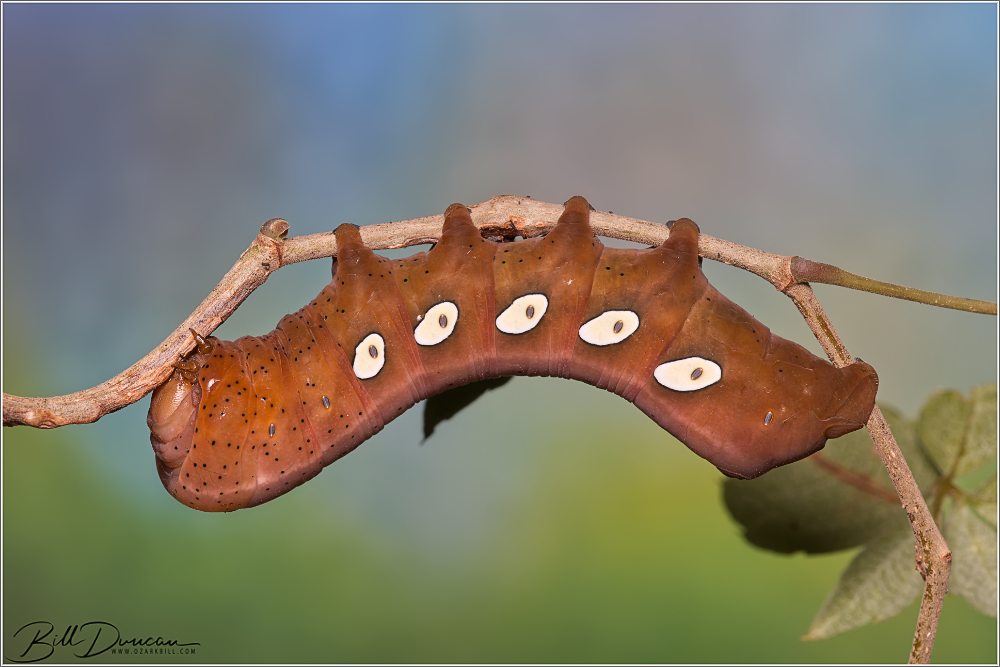
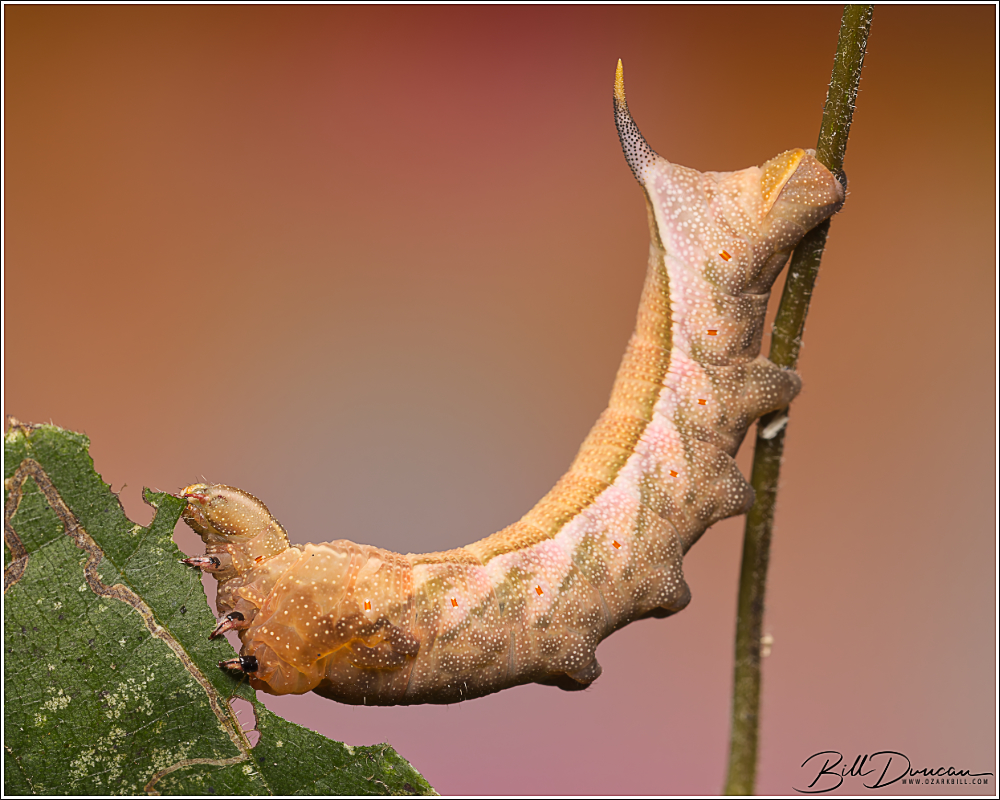
I’ll finish up with this fantastic late season walnut sphinx caterpillar (Amorpha juglandis) that I found at Onondaga Cave State Park in late September. I finally noticed that this genus name, Amorpha, is shared with one of my favorite groups of plants, the false indigos, like Amorpha fruticosa. I looked this up and Amorpha comes from Greek for “shapeless” or “deformed.” This genus of plants received this name due to their having only one petal on their flowers, unlike the rest of the Fabaceae.
Amorpha juglandis has been in a few other genera and now is placed in it’s own monotypic genus. I have not been able to find out which particular characteristic provides the “deformed” nature for the Amorpha epithet. If you know this, I’d be grateful to learn this.
Red-crossed Button Slug
Tortricidia pallida fam. Limacodidae
Host plant: red oak member (Quercus sp.)
Dates found: 14, Sep, 2024
Locations Found: Kaintuck Hollow, Phelps County, MO
Notes: Although we supposedly have two other button slug species in Missouri, this is the only one I’ve been able to identify. Very common.
With books, apps and internet sources, I think I did a fair job of identifying most of the caterpillars that came my way this year. There are still a few that I have not been able to identify, however. I placed the following on iNaturalist and Bugguide months ago, but so far no experts have given their opinions. If you have any ideas that could help, I’d appreciate to hear them.
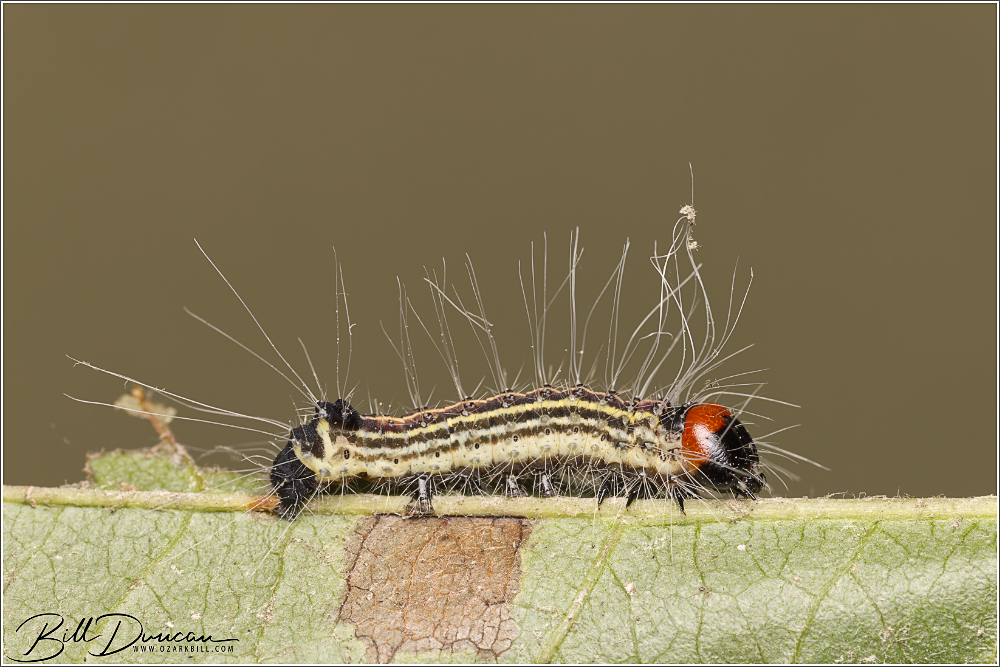
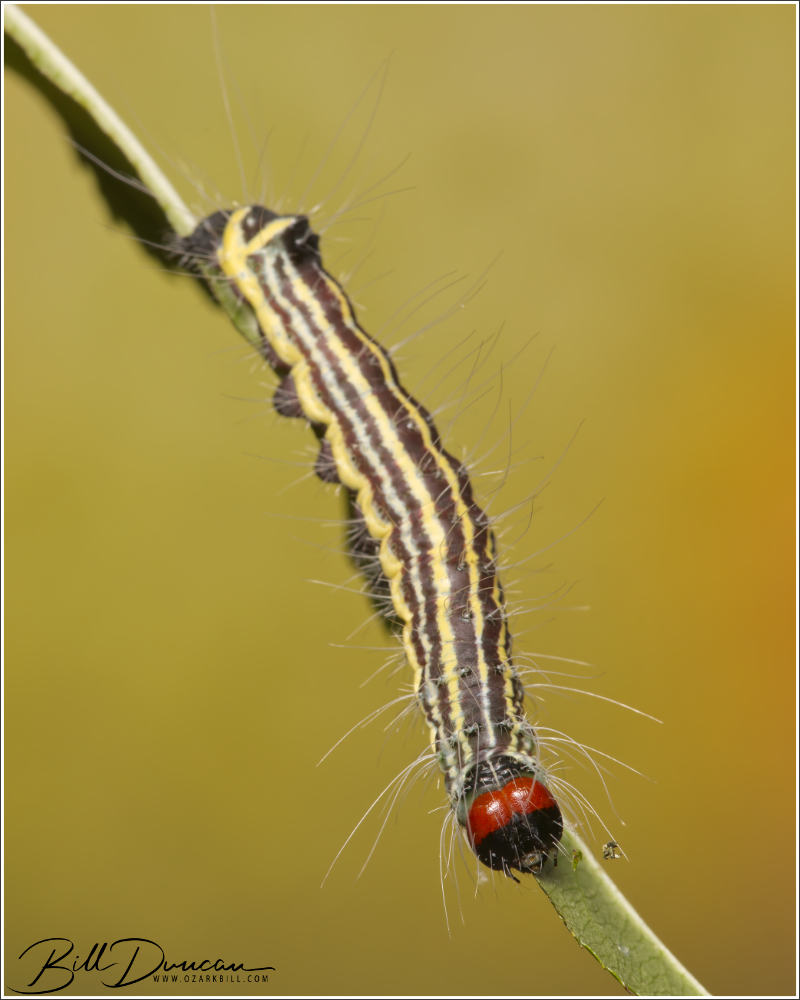
This first cute little one I found at Englemann Woods N.A. in Franklin County, MO in late June. I wish I had taken more photos. I think this could be one of the punkies (fam. Nolidae), but it might also belong to one of the other spiney families.
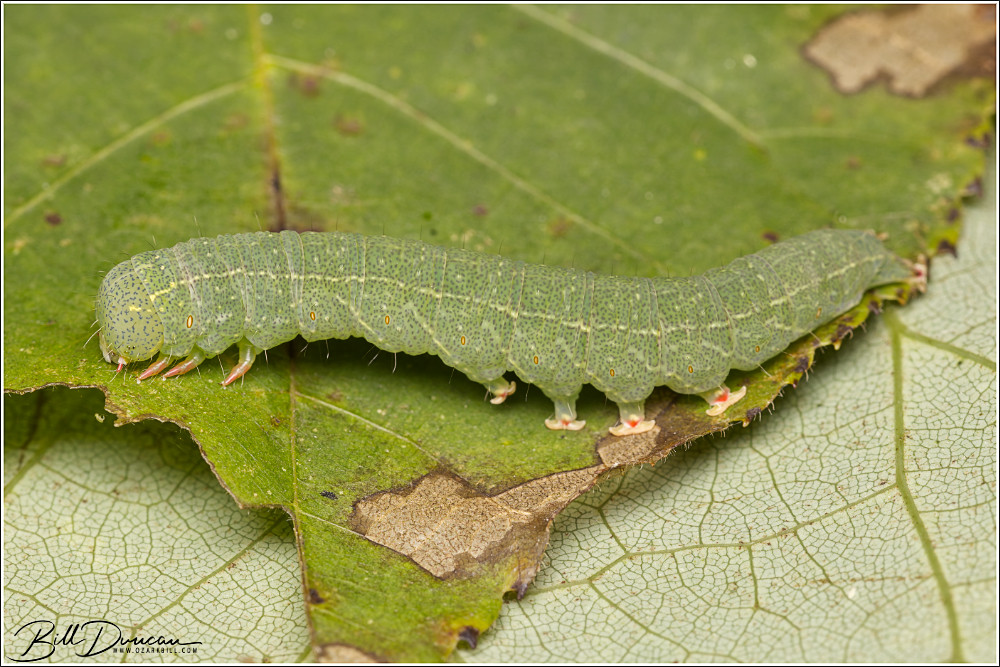
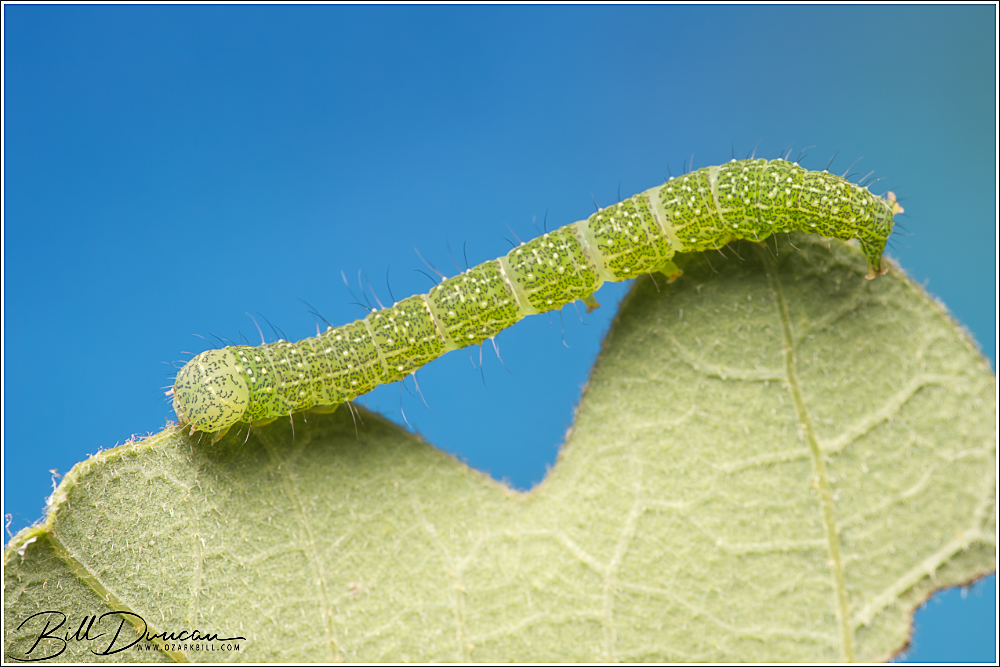
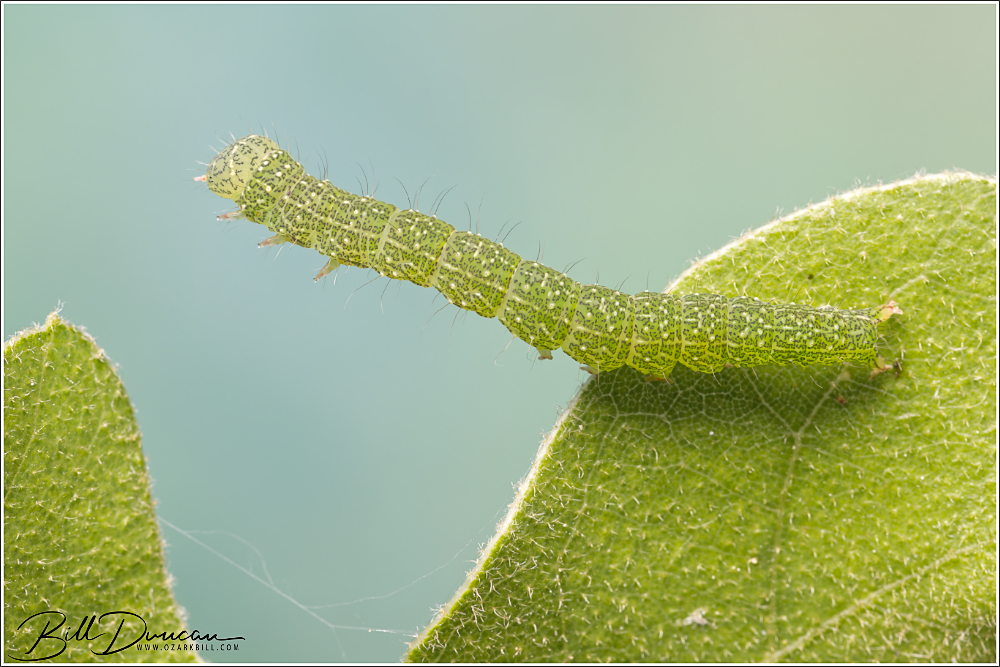
This next one is part of a group I really loath to try to identify – nondescript green cats. I’ve gone through the guides numerous times but simply couldn’t find a perfect match. It most likely belongs to the Noctuidae family, but that doesn’t narrow it down very far. This was also found at Englemann Woods N.A. in late June and found on white oak (Quercus alba).

Next up is also a group that I haven’t gotten the hang of yet. This is likely a tiger moth (subfam. Arctiinae), but I’m not sure where to begin there. Found at Prairie Garden Trust on July 6th. Host plant not recorded.
Finally, a cat that I found in a leaf shelter of Vitis aestivalis at Kaintuck Hollow in Phelps County on July 13th. I believe this might be Herpetogramma aeglealis (fam. Carambidae) but it’s not close enough for me to be certain.
I missed getting photos of Mydas clavatus (fam. Mydidae) on group photo outings, I believe, for three straight years. I seemed to be somewhere else and my “friends” failed to let me know… 😉 Well, back in July, I finally got lucky and found this one nectaring on some Pycnanthemum at Prairie Garden Trust in Callaway County, MO on a WGNSS Photo Group trip.
These are downright fascinating insects. The larvae of mydas flies feed on beetle larvae that reside in soil or rotting wood. The adults, who are Batesian mimics of spider wasps (Pompilidae), apparently feed solely on nectar and can be found in the heat of the day skimming across the prairies to find their favorite flowers.