"What a thousand acres of Silphiums looked like when they tickled the bellies of the buffalo is a question never again to be answered, and perhaps not even asked." -Aldo Leopold
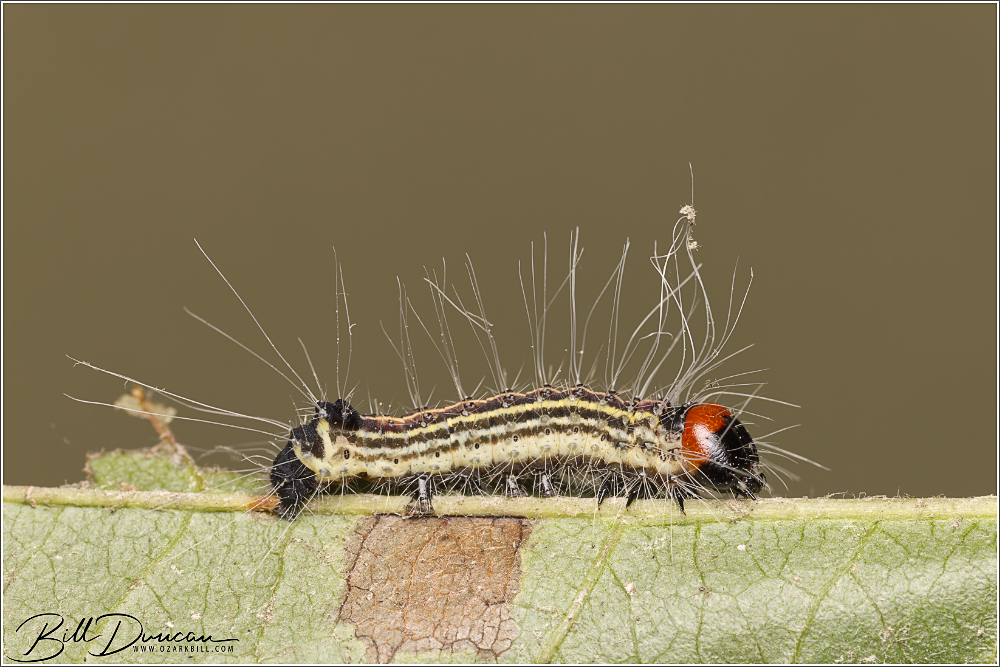
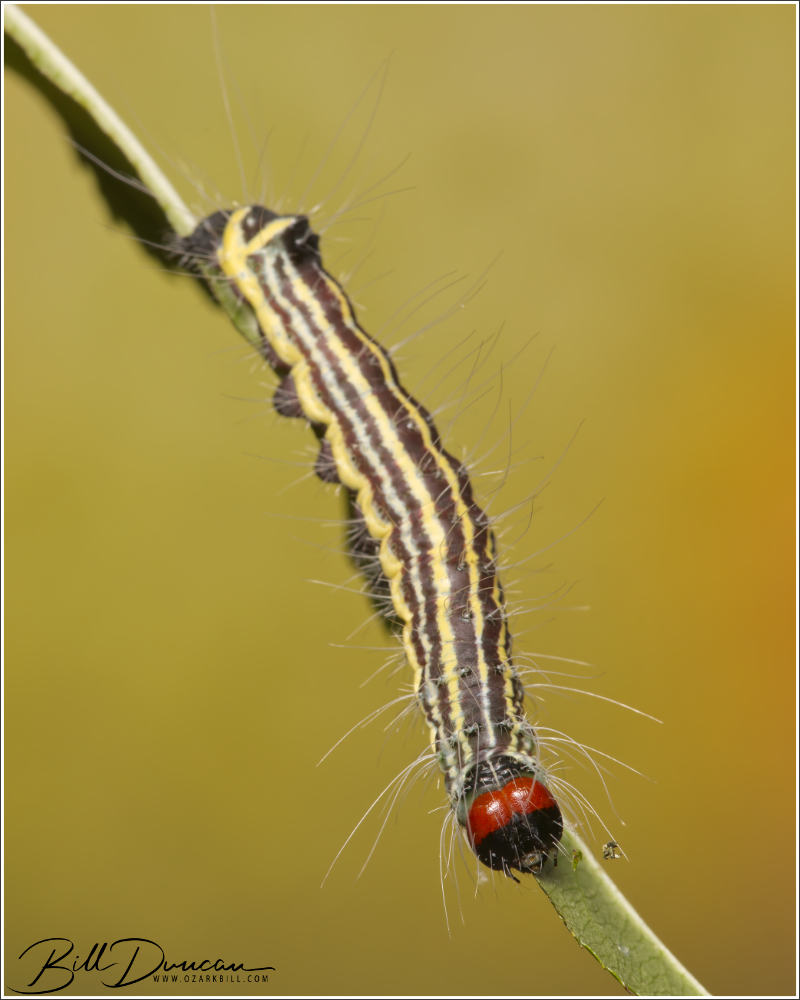
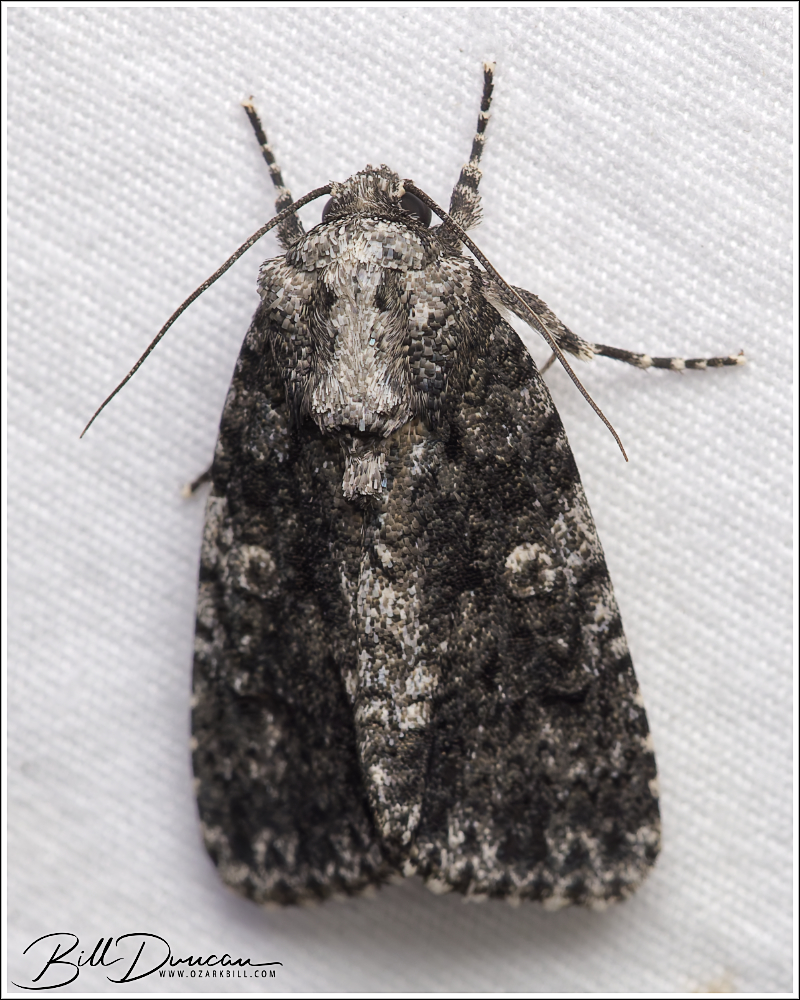
The Hebrew Polygrammate hebraeicum fam. Noctuidae (Hodges#9285) Host plant: black gum (Nyssa sylvatica) Date found: 16, Aug, 2025 Location found: Council Bluff Lake, Iron County, MO Notes: Common and specific names come from apparent resemblance of adult moth’s pattern to Hebrew characters. This was found during the WGNSS joint Entomology and Nature Photography Groups’ outing to Council Bluff Lake.
Radcliffe’s Dagger Acronicta radcliffei fam. Noctuidae (Hodges#9209) Host plant: black cherry (Prunus serotina) Date found: 16, 25, Aug, 2025 Location found: Cuivre River State Park, Lincoln County, MO; Council Bluff Lake, Iron County, MO Notes: The final instar pictured here is dramatically different than earlier instars.
Question Mark Polygonia interrogationis fam. Nymphalidae (Hodges#4420) Host plant: NA Date found: 16, Aug, 2025 Location found: Council Bluff Lake, Iron County, MO Notes: Two individuals found at this date and location. One was found on sassafras and the other on redbud. Typical hostplants include elm and hackberry. One individual pupated in contained overnight, further suggesting that both were pre-pupal and collected on plants during wandering. This was found during the WGNSS joint Entomology and Nature Photography Groups’ outing to Council Bluff Lake.
Red-spotted Purple Limenitis arthemisastyanax fam. Nymphalidae (Hodges#4522) Host plant: Found on black cherry (Prunus serotina) Date found: 02, Aug, 2025 Location found: Trail of Tears State Park, Lincoln County, MO Notes: Three caterpillars of this species were found at this date and location.
Here is another case of very similar caterpillars between two closely related species. The first clue to identity should be the host plant. In our region, Limenitis arthemisastyanax host primarily on black cherry (Prunus serotina), while Limenitis archippus (Viceroy) host primarily on willows (Salix sp.).
Caterpillars of L. arthemisastyanax are visually similar to those of , L. archippus although adults of these two species are very dissimilar. However, there are visual cues that can be used to tell them apart. Caterpillars of L. arthemisastyanax are generally less spiny, the humps over dorsum at A2 are larger and the “antlers” are more clubbed than the viceroy.
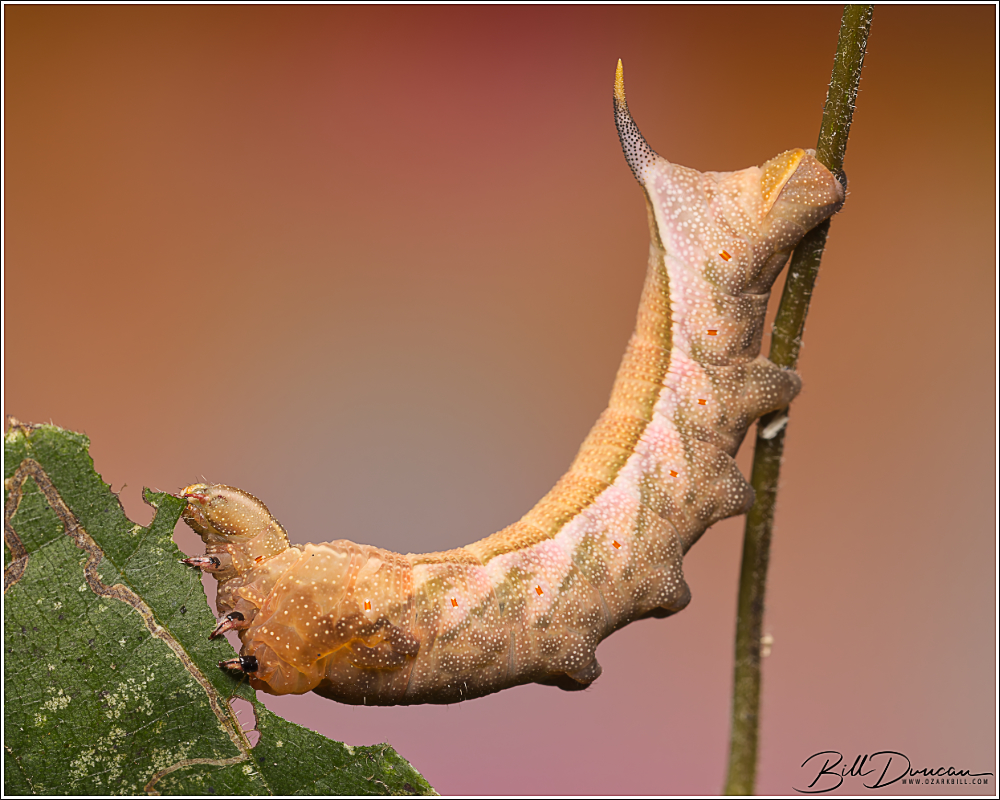
Red-humped Caterpillar Moth Oedemasia concinna fam. Notodontidae (Hodges#8010) Host plant: Found on redbud (Cercis canadensis) Date found: 16, Aug, 2025 Location found: Council Bluff Lake, Iron County, MO Notes: Shown in defensive posture with tail raised above its head. This was found during the WGNSS joint Entomology and Nature Photography Groups’ outing to Council Bluff Lake.
Virginia Creeper/Hog Sphinx Darapsa myron fam. Sphingidae (Hodges#7885) Host plant: Six individuals were found on this date and location: grape (Vitis sp.)-5, Virginia creeper (Parthenocissus quinquefolia)-1 Date found: 16, Aug, 2025 Location found: Council Bluff Lake, Iron County, MO Notes: This one showing the autumn/pre-pupal warm/brown coloration. All other individuals found were green. This was found during the WGNSS joint Entomology and Nature Photography Groups’ outing to Council Bluff Lake.
Saddleback Acharia stimulea fam. Limacodidae (Hodges#4700) Host plant: Sassafras (Sassafras albidum) Date found: ~02, Aug, 2025 Location found: Trail of Tears State park, Cape Girardeau County, MO Notes: Three caterpillars were found at this date and location. One was found on pawpaw (Asimina triloba) and two on sassafras (Sassafras albidum).
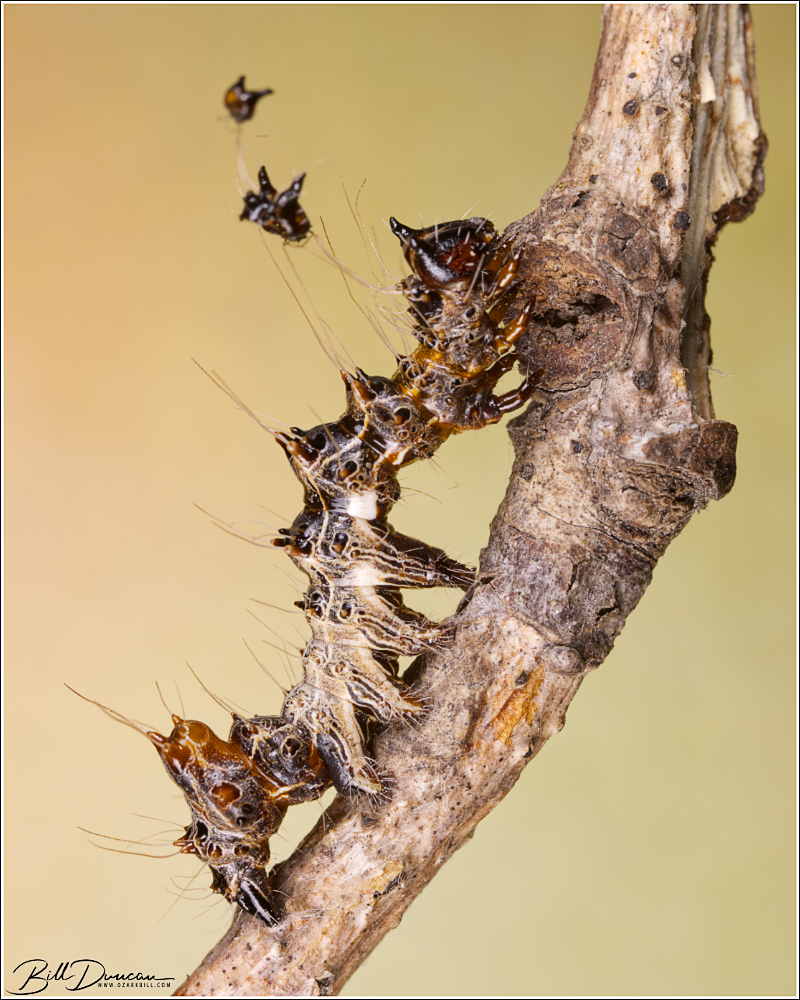
Harris’s Three-spot Harrisimemna trisignata fam. Noctuidae (Hodges#9286) Host plant: buttonbush (Cephalanthus occidentalis) Date found: ~16, Aug, 2025 Location found: Franklin County, MO Click here to see the adult moth Notes: Part spider and part bird dropping, this caterpillar is absolutely astounding. Note the empty head capsules that the caterpillar retains with each successive molt. It has been shown that these caterpillars use these to thrash at potential parasitoid wasps and flies that approach while attempting to deposit eggs on their would-be hosts.
Special thanks to Eva Wiedeman who found this individual in her neighborhood and brought it to our WGNSS fieldtrip at Council Bluff Lake. Photographing this caterpillar was a prime objective for me this season. Now I just need to find one on my own and hopefully a larger 4th instar!
Giant Leopard Moth Hypercompe scribonia fam. Erebidae (Hodges#8146) Host plant: Found on herbaceous plant species (sp not recorded) Date found: 05, Jul, 2025 Location found: Logger’s Lake Recreation Area, Shannon County, MO Notes: Early instar. Later instars look much different.
In late July, Chris Brown and I enjoyed a night of blacklighting at Engelmann Woods Natural Area in Franklin County, MO. Coincidentally, this was exactly one year to the day from a blacklighting session I had here in 2024. I have also done this during July in previous years at this same location. It is interesting seeing the patterns of the same moth species as well as others that might not have shown up to the sheet on previous occasions.
Here are a few insects that I thought I would share here.
Eudryas gata (beautiful wood nymph)
We found at least four Eudryas gata (beautiful wood nymph) resting on vegetation nearby the lighted sheet. I feel this species is perfectly named. Although the adult form is technically a bird-dropping mimic, it is still beautiful along with the caterpillar.
Marathyssa inficita (dark marathyssa). This is a bizarre little moth that is often attracted to our lights. This species caterpillar hosts on sumac (Rhus sp.) and poison ivy (Toxicodendron radicans).
Tarache aprica (exposed bird dropping moth)
Tarache aprica (exposed bird dropping moth) is a small but striking member of the Noctuidae family. The caterpillar, which I have yet to find, is also a bird dropping mimic.
Acronicta afflicta (afflicted dagger moth) fam. Noctuidae, hosts on oaks
It’s always a pleasure to find a fresh Dryocampa rubicunda (rosy maple moth)
Nadata gibbosa (white-dotted prominent)
Nadata gibbosa, the white-dotted prominent is a common Notodontid. We frequently find their caterpillars during our hunts on oak trees.
Plagodis alcoolaria (Hollow-spotted Plagodis)
Datana sp.
I have discovered that members of the Datana genus can be difficult to narrow down to species in both adult and larval forms. This moth pictured above exhibits patterns that could match D. contracta, major, and drexelii. Perhaps having this specimen collected and in-hand, the species could be determined, but not with this single photo.
Harrisimemna trisignata (Harris’s three-spot)
The find of the night for me was two beautiful Harrisimemna trisignata (Harris’s three-spot) moths. I have seen the adults before but never managed to get a good photograph. This is probably number one on my caterpillar list to find one day.
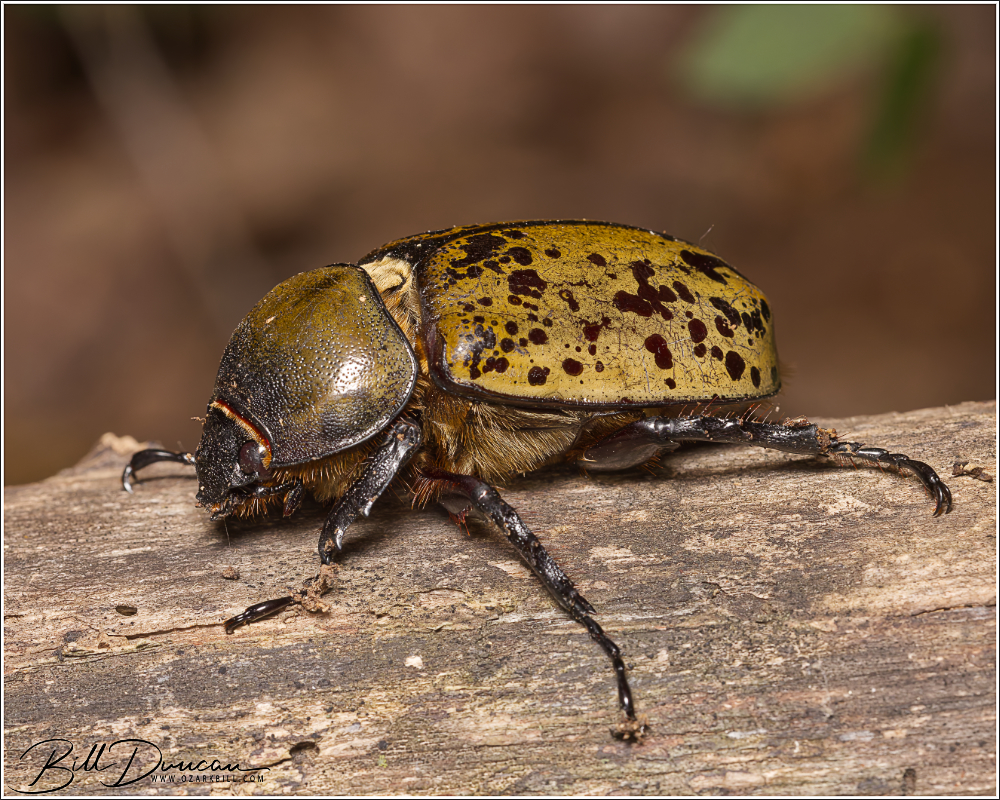
Dynastes tityus (eastern Hercules beetle)
I believe this is the forth Dynastes tityus I’ve come across and they have all been females. Maybe next time, I hold on to a female in a cage to see if she can attract a male for me.
Eacles imperialis (imperial moth)
It seems that Eacles imperialis are now a sure thing at a blacklighting event at Engelmann Woods. Usually around midnight, you can expect at least a couple to visit.
That’s all from this night. I’m looking forward to a blacklighting session with the WGNSS group this coming weekend. It should be great and I will plan on sharing what we find here.










 A Thousand Acres of Silphiums