Bell Mountain Willderness Loop Trail – Success!

Surprisingly, I found myself in the St. Francois Mountains again yesterday.  I decided to finally attempt the full loop trail within Bell Mountain Wilderness.  I have hiked to the summit and back the same way several times over the past five years or so, a hike that is approximately ten miles.  The loop requires you go down the other side, follow and cross “Joe’s Creek” and its feeder streams along the way and then ascend Bell once again before going back down to the southern trail head.  It wound up being just short of a 13 mile trek.
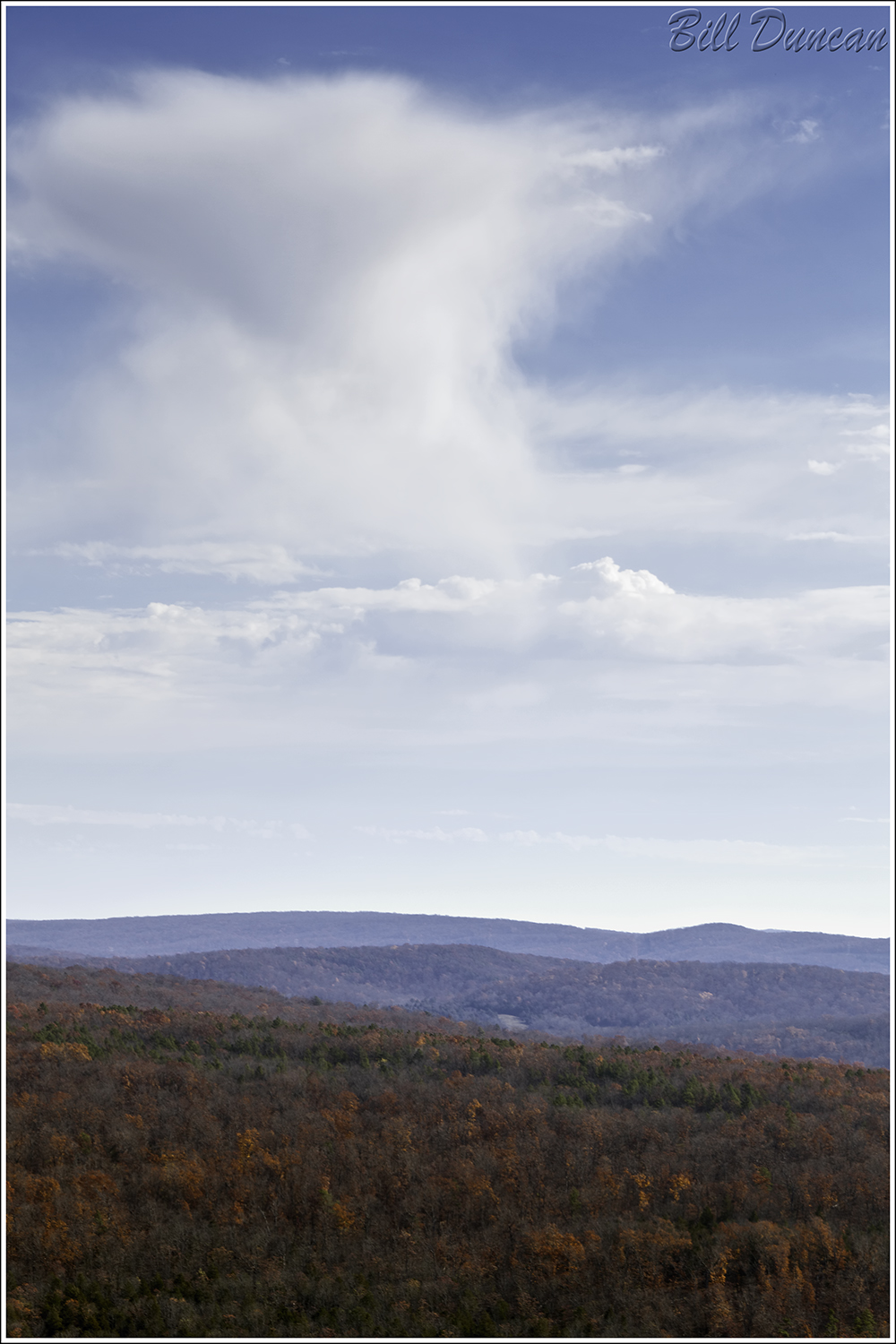
“St. Francois Mountains – Late Autumn – 2012″
Technical details: Canon EOS 5D Mark II camera, EF70-200mm f/4L IS USM @ 127mm, ISO 100,  f/16, 1/10 sec

An “Indian Summer” kind of weekend assured I was not the only one with the idea of hiking this summit.  Normally a place where you would be unlikely to see another person, I crossed paths with close to 40 hikers, most of which seemed to be carrying camping gear.  I started the the trail promptly at 8:00 when the temperature was still pleasantly in the low 50s.  Unfortunately when I arrived back at my car  around 2:00 the temp was in the mid 70s, a bit on the warm side for hiking such a challenging trail.

“The Burning Bush″
Technical details: Canon EOS 50D camera, EF17-40mm f/4L USM @ 26mm, ISO 160,  f/18, 0.4 sec

The images above and below this text showcase what makes this area so special – the Ozark glades.  These pinkish, lichen-covered, rhyolite/granite boulders protrude from thin soils and create igneous glades.  This specific habitat is associated with several specialized plant and animal species.  In periods of hot and dry weather these areas seem completely abandoned, but will come alive following a drenching rain.  The image posted below was subjected to a “hand-painted” treatment in computer post-processing.

“Changes″
Technical details: Canon EOS 50D camera, EF17-40mm f/4L USM @ 28mm, ISO 100,  f/11, 0.25 sec

The image below this text documents a perplexing problem with officially designated wilderness areas.  As the law was written, no human management of the land, of any kind, can be performed.  While this law includes items you want a “wilderness” to be protected from, building of structures, new roads, logging and grazing, etc., it also includes management for the protection of habitats.  Although glades exist primarily due to shallow soils and dry, higher elevations, periodic fires also play a key role in limiting the succession of habitat type.  Fires, both natural and anthropogenic in origin, played a key role in controlling secondary succession shrubby tree species such as sumac, sassafras, and especially the eastern cedars.  In many well-managed lands across the Ozarks, prescribed fires are doing their part to control this succession and preserve these habitats.  On wilderness areas, prescribed fires are not legal.  Modern fire-prevention in private and public lands also drastically reduces the occurrence of natural fire.  The glades on Bell Mountain and its nearby slopes are all being choked by eastern cedars.  Given enough time this potentially put many Ozark glade areas at risk as the succession continues to include various oak and hickory species.

“Bell Mountain Glade in Autumn″
Technical details: Canon EOS 50D camera, EF17-40mm f/4L USM @ 26mm, ISO 100,  f/16, 1/8 sec

Bell Mountain is bordered by Shut-In Creek on the east, which has helped carve the distinction between Bell Mountain and nearby Lindsey Mountain.  This creek bottom is a short, but extremely sharp drop from the summit, and the creek is a perennial spring-fed water source.  Joe’s Creek borders the western side of Bell Mountain and is also partially spring-fed.  These two bodies provide many a backpacker with a source of water.  I can’t wait to try exploring this creek after a good wet period.
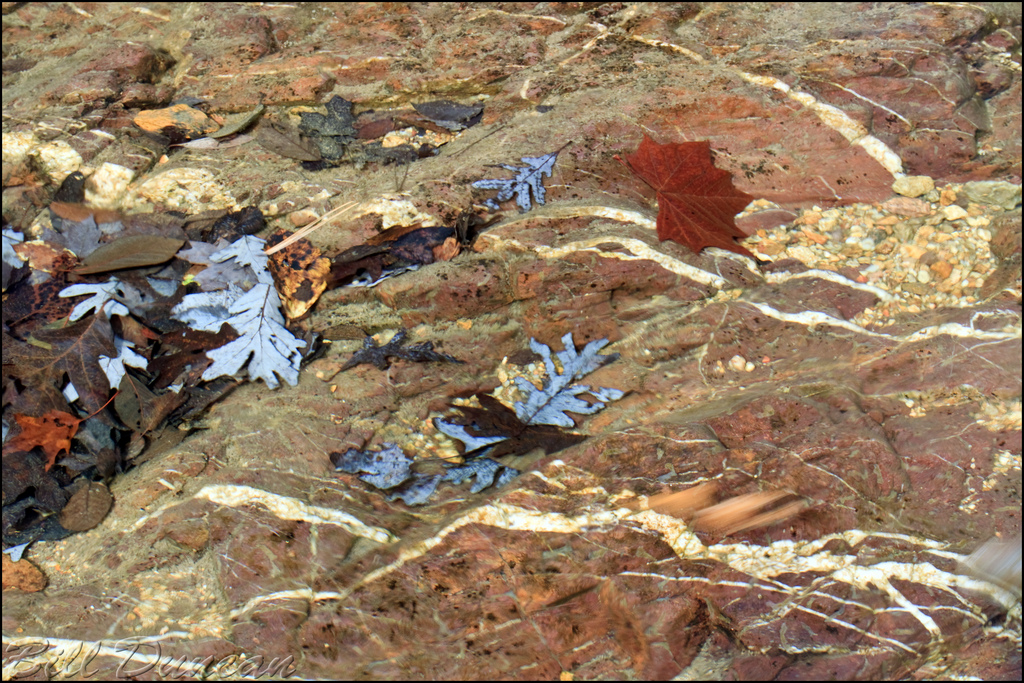
“Shut-In Creek Bottom″
Technical details: Canon EOS 50D camera, EF-S60mm f/2.8 Macro USM, ISO 200,  f/16, 1/4 sec

An Autumn Hike Along the St. Francis

I started my autumn vacation early on a Saturday morning with a hike along one of the prettiest of Ozark Streams, the St. Francis River.  I was joined by my new friend, Stephen, who knows these waters quite well.  While I had previously visited a couple of the destinations I’ll be describing, I had long wanted to take the hike between two of Missouri’s great shut-ins – Tiemann Shut-Ins and those located downstream a couple miles at Silver Mines Recreation Area.  Stephen and I met at the trail head at the USFS Silver Mines Rec Area, located in Madison County near the towns of Fredericktown and Arcadia.

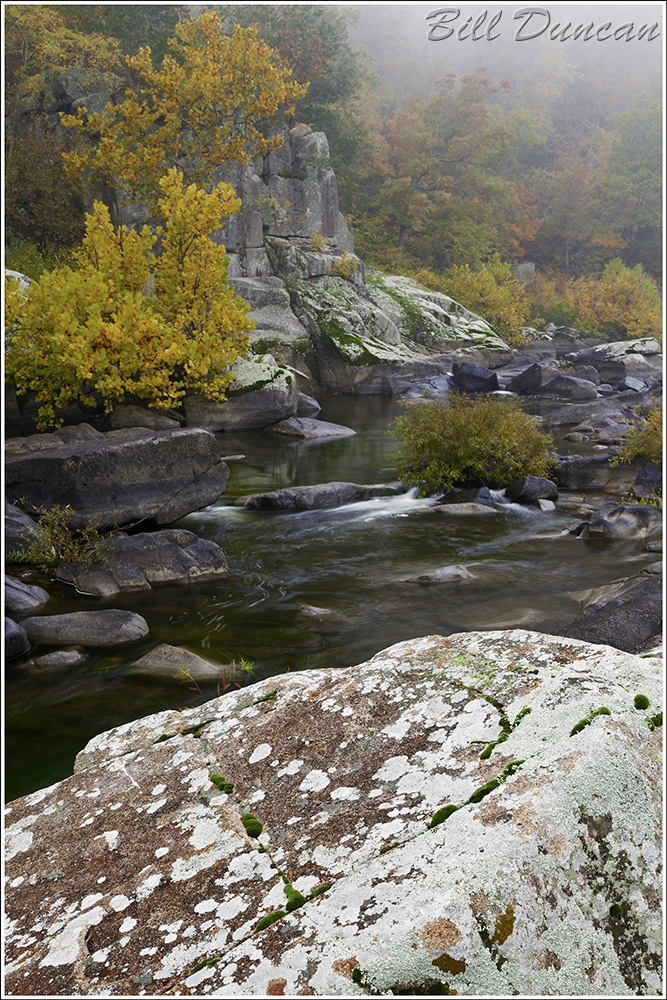
“Store of Summer Rains″
Technical details: Canon EOS 5D Mark II camera, EF24-105mm f/4L IS USM @ 58mm, ISO 100,  f/11, 2.5 sec

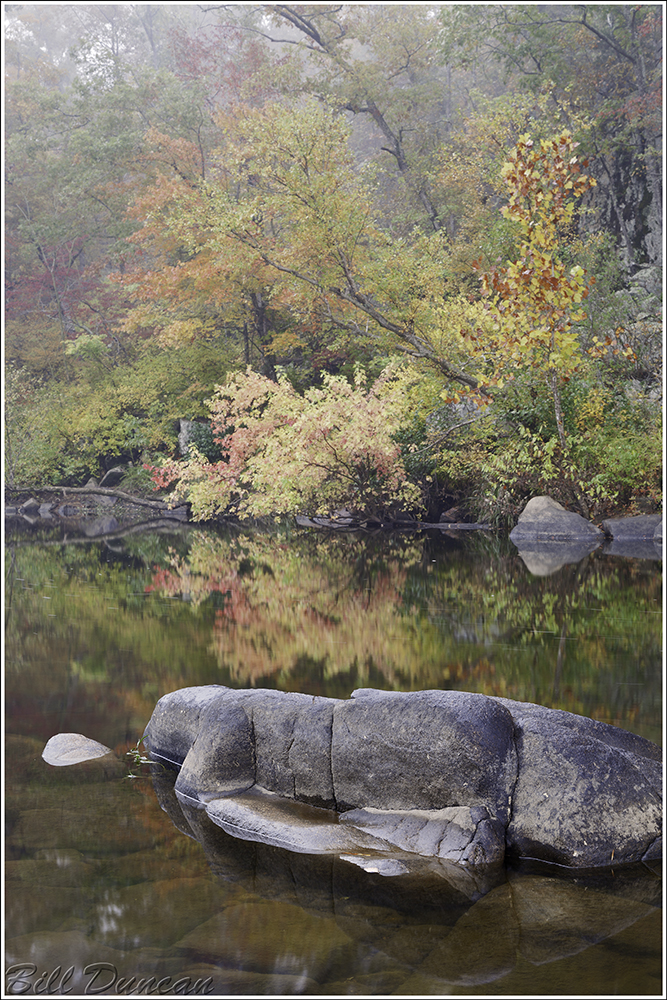
There is a relatively easy path between these two points, but Stephen and I followed along the river, jumping from boulder to boulder for most of the stretch.  We were pleasantly surprised arriving near dawn to find a nice blanket of fog.  While fog tends to lessen contrast considerably in a photographic frame of mind, the lighting helps those wonderful fall colors pop.  In person, eyes are drawn to a bright warm maple growing between riverside rocks.  Once my camera was out, we were in danger of spending the entire day within the first quarter mile of our hike.  I do appreciate Stephen’s patience as I took the time to set up the tripod and repeatedly dove into my bag to swap lenses.

“Solid Out of Liquid″
Technical details: Canon EOS 5D Mark II camera, EF24-105mm f/4L IS USM @ 58mm, ISO 100,  f/11, 1/5 sec, Orton processing in PS CS6

The St. Francis is one of the more productive of Missouri’s Ozark streams.  While this means you won’t see the crystal clear waters of the Black, Current, or Eleven Point, the mass of life and biological diversity is more obvious.  Moving along the banks one is forced to path-find between Ozark Witch Hazel and Sandbar Willow.  Organic matter deposited on rocks makes food for algae and makes any wet surface as slippery as ice.  A hike-ending fall was a possibility in the early part of the day.  More than 50 species of fish have been documented in this river and this stretch is home for the St. Francis Crawfish, an endemic species to the St. Francois Mountains and a species of conservation concern.

“Sweet Kisses″
Technical details: Canon EOS 5D Mark II camera, EF100mm f/2.8L Macro IS USM, ISO 400,  f/6.3, 1/25 sec

Although making Stephen a bit apprehensive, I was completely stoked that were able to cross paths with five cottonmouths, including this cute little juvenile.  This one I spotted almost on the trail as he flapped his bright-white mouth at me, mere inches from my boot.  My first thought was of a small moth or butterfly flapping its wings in alternating bright dorsal and dull ventral aspects.  Taking a second, closer glance I was able to pick out this well-camouflaged beauty.  I think Stephen will pay me well to save the story of what happened when we came upon a larger relative of this guy in the crevice of a couple of boulders.  😉

“Einstein Mine Dam On The St. Francis″
Technical details: Canon EOS 5D Mark II camera, EF24-105mm f/4L IS USM @ 65mm, ISO 100,  f/11, 1/25 sec

Here you have a view of the granite block dam built to supply power to the milling operations of the nearby Einstein Mine.  The mine did not last long and is now a nice home for bats.  Did you know that Missouri has almost continually been first in lead production of the USA for almost two centuries?  Today Missouri produces nearly 90% of the nation’s lead and 75% of its zinc as well as large amounts of iron, silver and copper.  This area is of great interest to geologists.  The rock you see in this post, primarily granites and rhyolites, are among the hardest and oldest exposed rocks on the planet.

“Endless Forms Most Beautiful And Most Wonderful″
Technical details: Canon EOS 5D Mark II camera, EF24-105mm f/4L IS USM @ 67mm, ISO 100,  f/13, 0.6 sec

Many thanks to Stephen for being a great guide and showing me a lot along this hike.  I definitely would not have been able to find as much on my own.  We passed Mud Creek Shut-ins and eventually found ourselves at Teimann Shut-Ins, described as the largest shut-ins in Missouri.  Located within Millstream Conservation Area, Teimann SI is truly impressive.  This spot has a great deal more potential than Johnson’s SI for photography and is on a much larger scale.  I do not know for certain, but I imagine Stephen is contemplating the diverse biological community and if these “endless forms most beautiful and most wonderful” go about their existence without contemplating us.

“Wayward Rivulets In Autumn Flowing″
Technical details: Canon EOS 5D Mark II camera, EF24-105mm f/4L IS USM @ 40mm, ISO 100,  f/16, 1 sec

It took almost the entire day to meander over the boulders to Millstream Gardens.  It was getting so late that in the end, we took the relatively straight and flat trail back to our cars, arriving just after sunset.  We topped it off with a nice meal in nearby Farmington.  I couldn’t have asked for a better way to start off my autumn break.  This was just the beginning to a fun week across the Missouri Ozarks.  I look forward sharing more real soon.

The Dichotomy of Autumn

Is there more of a season with dramatic ups and downs than autumn?

Good: cooling temperatures that are often a respite to a long, torrid summer

Bad: the inevitable freezing temp, rains and gloomy weather that will show up sometime in November

Good: the astounding autumnal palette that the fortunate can find, depending on where you live

Bad: picking up those leaves and cleaning gutters after the show

Good: the backing of the clocks in losing “daylight savings”

Bad: going back to school

Good: feasts of the late summer/fall harvest season

Bad: knowing that in a month or two you’ll have better luck growing a second head than finding something worthwhile of being called a “tomato”

Good: apple season!!!!

Bad: end of the baseball season

I think I’ve made my point.  No other season is packed with so many highs and lows.  I’d be hard pressed to find many complaints about spring.  Even the most diehard winter fanatics must feel the hope and renewal that warming temperatures and fresh greens that spring in spring.  Autumn will always remain a season of two faces for me.  Now I can’t wait for the winter resident birds to show up!  Come on winter!

“Autumn’s Dichotomy″
Technical details: Canon EOS 5D Mark II camera, EF24-105mm f/4L IS USM @ 32mm, ISO 100,  f/16, 1/6 sec

Autumn Explodes in the Ozarks!

Following the winter that never was of 2011/2012 came one of the hottest and driest summers on record in the Ozarks.  Of course the autumn would be some sort of disappointment, right?  Boy was I pleasantly surprised!  Sarah and I have taken an October vacation, exploring the Ozarks, looking for color for about four years straight.  Even if our trip coincided with “peak color”, more often than not that peak wasn’t necessarily anything to jump up and down about.  Well, this year was nearly everything I dreamed an Ozark autumn should be.

Every tree tried on it’s best outfit a couple of weeks ago.  The black gum and dogwood were draped in their dark warm shades of reds and violet.  The maples were a schism of warm tones – sometimes on separate trees, sometimes with contrasting leaves on the same tree, and often with a mix on the same individual leaf!  My personal autumn favorite, the grand sycamore was gloriously showcased in yellows, burnt umber and mild reds that set off so nicely it’s bright, ivory bark.  Hickories, normally easily forgotten as the dull yellow leaves drop so quickly, were an incandescent display of quintessential amber.  Even the usually boring – white oak wasn’t going into its winter nap without a show, bringing out a variety of mild warm tones before dropping brown to become part of next year’s forest floor.  As usual, the small sumac and sassafras brought their best to stop you in your tracks.
This was darn-near too much!  Driving hundreds of miles and putting tens of miles on the trails I wanted to stop every five minutes and find a composition.  There was the problem.  Everywhere I looked was a potential composition, but actually putting something together was often a tremendous difficulty!  I now truly understand the concept of chaos in the biological world.  There were periods of frustration as I realized I wasn’t going to be able fulfill my desire to nail all the potential autumn shots that I dreamed about.  As I begin delving into and processing the several hundred images I took that magical week, I can only hope I nailed a few images.  Over the next several weeks I hope to post a lot images here with some info or story behind it.  Hopefully not all of the photos will be the typical cliche’.  Geez, are there any autumn photos that aren’t?

“Explosion of Autumn in the Missouri Ozarks″
Technical details: Canon EOS 5D Mark II camera, EF24-105mm f/4L IS USM lens zoomed during exposure, ISO 100,  f/20, 1/5 sec

Mondays Are For The Birds – American Redstart

It is late summer/early autumn and the warblers and other songbirds are moving en masse south to their tropical wintering grounds.  Bring your binoculars to one of several wooded lots in the St. Louis metropolitan area this time of year and you’re almost sure to find one of the birds pictured here, the American Redstart.  I am calling this particular bird a mature female, although it is possible this may be an immature female or first year male.  Females and young males have yellow where adult males are always dressed for Halloween in reddish orange and dark browns.  This observation has prompted many a birder to call these guys the “American Yellowstart” .

This is one of the easiest warblers for new birders to identify, not only for its flashy coloration and pattern but for its particular behaviors as well.  These guys will usually position their wings low and drooped when sitting still and almost always are fanning their flashy tail feathers.  These birds are quite active and display a lot of “flycatching” behavior and will actually hover-preen.  Watching them hunt is a treat and as they catch flying insects you can literally hear these little guys snapping their beaks shut.  They can be quite responsive to pishing.

As mentioned above, this bird is heading south where it will over winter somewhere between northern Mexico and northern South America.  It has an extremely large breeding range, nesting anywhere between the gulf states and Alaska where it can find deciduous or mixed deciduous/coniferous forests.  These guys will also readily nest in secondary woodlands and forests, making them one of the few species who has not been altogether troubled by logging.

I wish this guy the best in her/his long journey south.  I am getting quite addicted to shooting these guys just when they are heading out.  I’m already looking forward to the spring.

“American Yellowstart”

Technical details: Canon EOS 7D camera,  EF400mm f/5.6L USM lens, ISO 640,  f/5.6, 1/100 sec

Limitless Composition

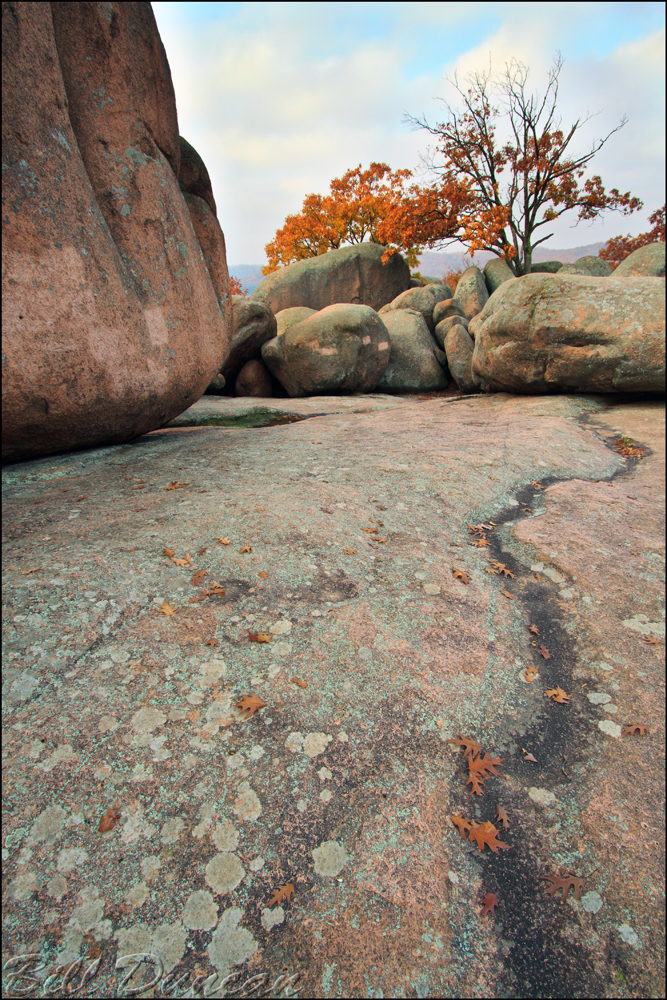
I’ve been paying a lot more attention to Elephant Rocks State Park lately.  I am seeing there is a never ending supply of potential terrific photographic compositions (not that the one below is one of these).  Add all the potential compositions with all the variables that light can bring to this place and throw in the different seasons and potentials for weather and you wind up with a place I should be visiting at least once a week!  I need to find out how to make this happen.  😉

This image was obviously taken with a wide focal length and is a composite of a couple different exposures so that I could keep some detail in this amazing autumn sky.  Some oak leaves contribute with lichen and the natural texture of the rocks for some foreground interest, and a dark lead-in line is present created by what I believe is a path water has drained off this shelf for who knows how many years?

While visiting one of my favorite places in the St. Francois Mountains, Lower Rock Creek Wilderness, I met a father and son visiting the Ozarks for the first time from Wisconsin.  I was able to give them suggestions for other places to see during their short visit, Elephant Rocks being one of them.  Needless to say they thought this location was fascinating and them, I and many others finished the day by watching a spectacular sunset amongst the boulders.

Technical details: Canon EOS 7D camera, EF-S10-22mm f/3.5-4.5 USM lens @ 11mm, ISO 100,  f/16, 1/15 sec

Location Spotlight: Piney Creek Ravine Nature Preserve – Part One

In the north-western region of the Shawnee National Forest of Illinois lies one of my latest finds.  Located south-east of Chester, Illinois (birthplace of Popeye the Sailor) Piney Creek Nature Preserve will undoubtedly provide plenty of opportunities for me to spend my time during any season of the year.  This place is special due to the geological and biological wonders it hides amidst the seemingly endless seas of corn and soybeans that pack every flat place Illinois has to offer.

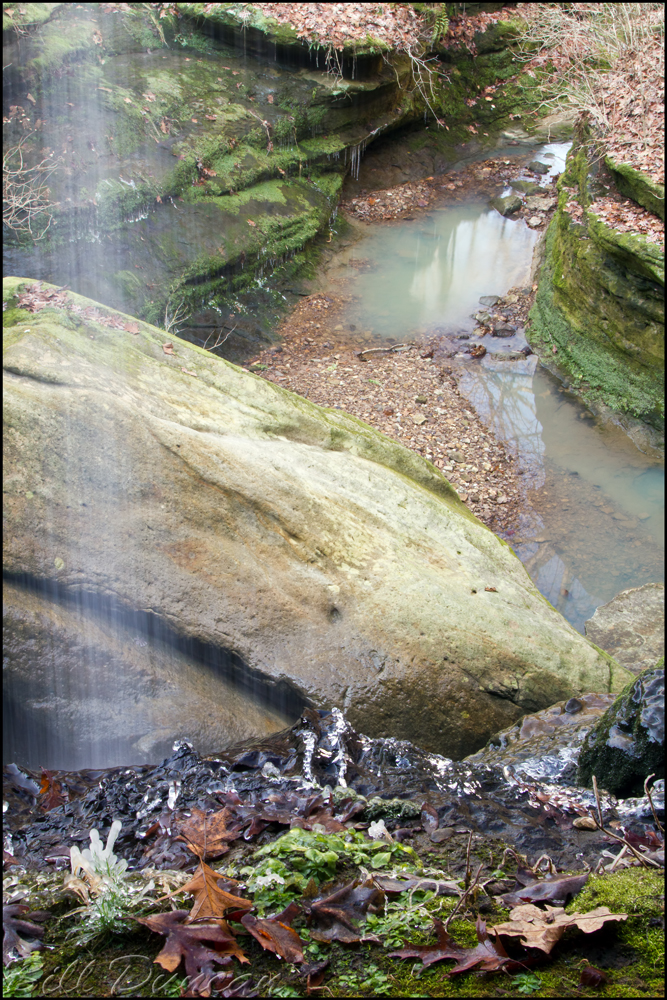
Technical details: Canon EOS 7D camera, EF-S10-22mm f/3.5-4.5 USM lens @ 18mm, ISO 160,  f/14, 1.6 sec

Unlike the tall bluffs and hills of the Shawnee region further to the south, this spot was subjected to recent glacial activity and the ravine was partly created by glacial melt-waters eating away at the sandstone – the primary rock of Southern Illinois.  The vegetation found here is more similar to that seen in the Missouri Ozarks to the West than that of the Shawnee region to the South-east.  This is one of only a few places in Illinois the short-leaf pine can be found naturally.

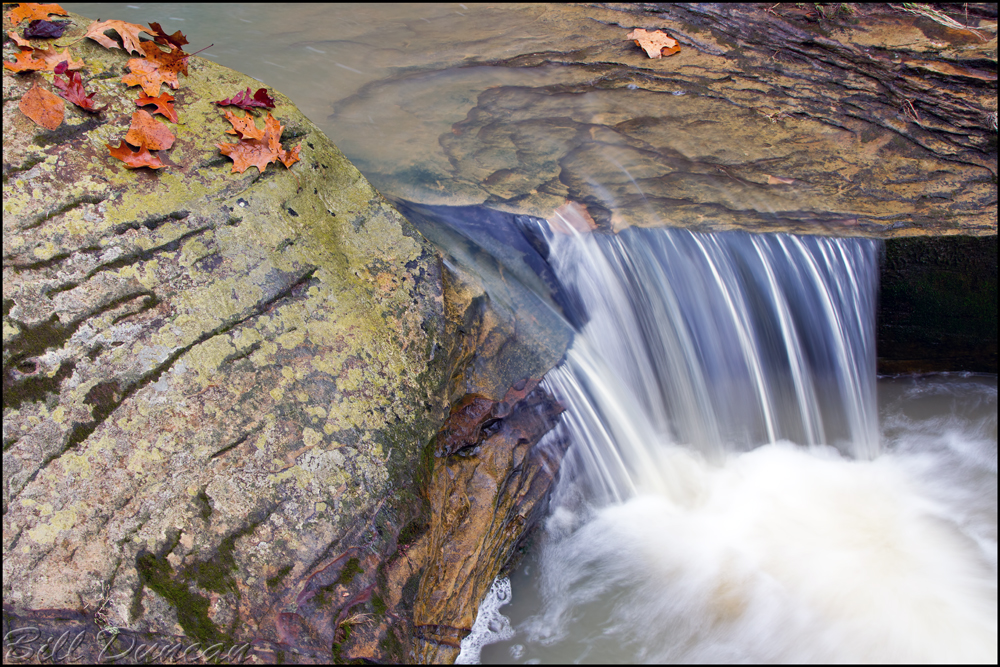
Technical details: Canon EOS 7D camera, EF24-105mm f/4L IS USM lens @ 32mm, ISO 320,  f/20, 1.3 sec

I have not yet been here during the growing season but it looks and sounds to be a very high-quality natural site.  I’m sure this will be a place for finding spring time ephemerals as well as summer wildflowers; however, the geology is the star of this attraction.  I’ve hiked this ~two-mile trail twice and I’m not even close to understanding the path of the streams and the contours of the canyon walls, or how many waterfalls can be found here.

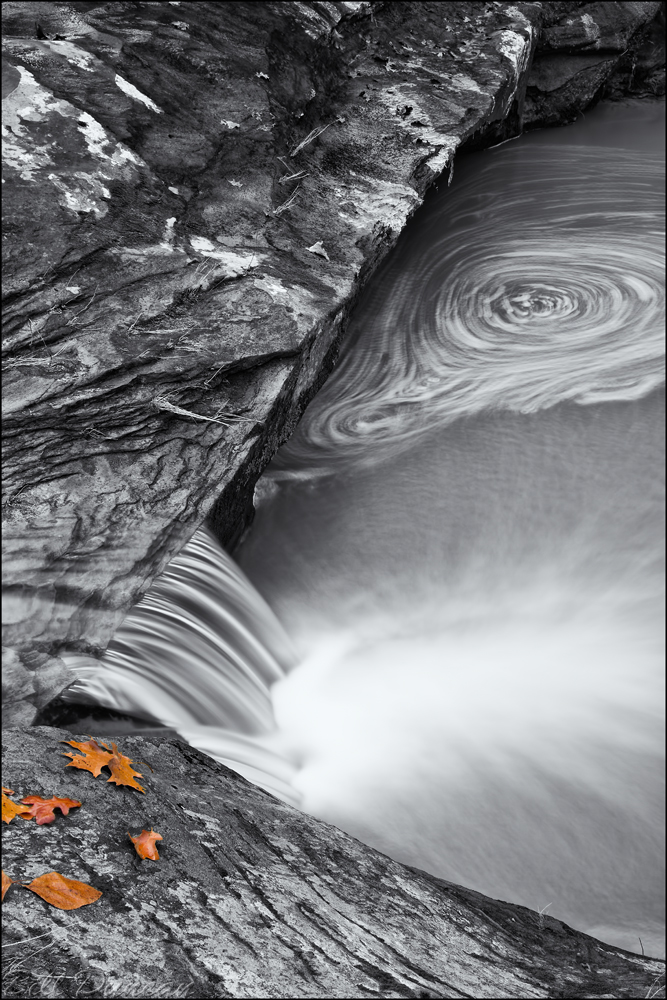
Technical details: Canon EOS 7D camera, EF24-105mm f/4L IS USM lens @ 28mm, ISO 100,  f/11, 1/4 sec

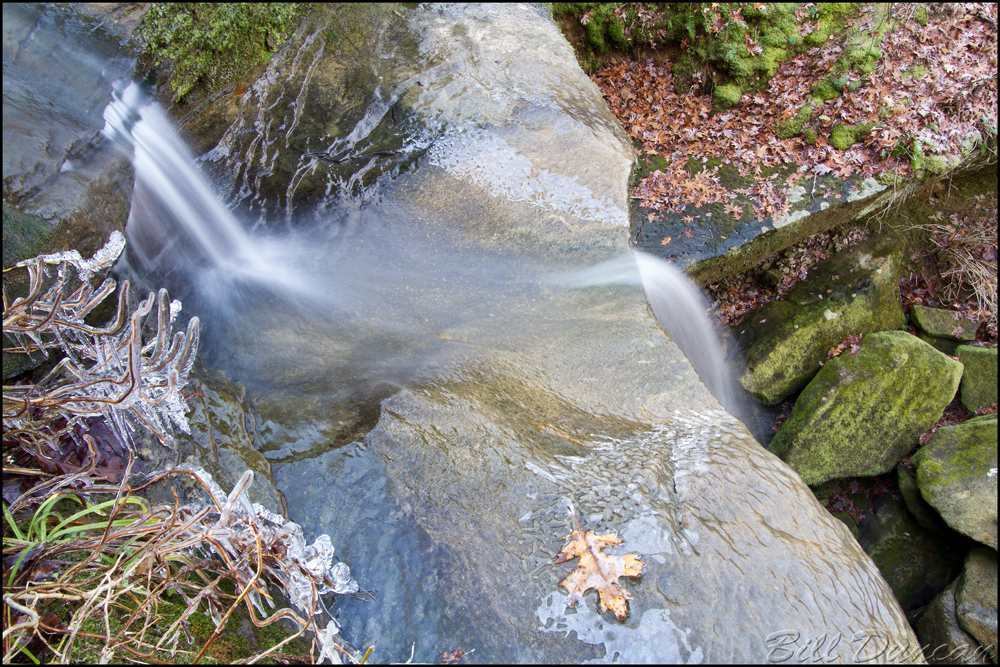
The hike is wonderful, although caution must be taken.  Hiking up and down the and along the rim of the canyon provides amazing views of this natural amphitheater in winter.  Going bushwhacking to obtain better viewpoints of the geological, biological and archeological (petroglyphs and pictographs from 500-1550 Common Era are located at this preserve) subjects can be risky.  Similar to the nearby “Little Grand Canyon” there are plenty of ways to get yourself seriously injured or killed in this ravine.  Boots equipped with extra traction devices (i.e. crampons) are recommended for hiking in sub-freezing temperatures and felt-bottomed footwear is definitely useful when walking over the biology-covered slick rocks of the stream floor.

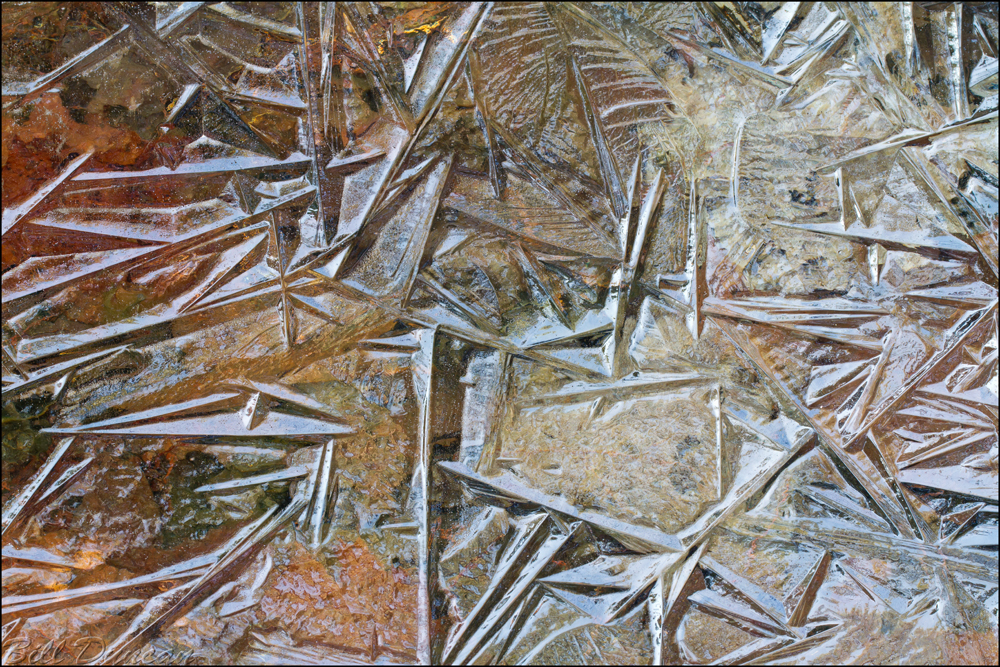
Technical details: Canon EOS 7D camera, EF24-105mm f/4L IS USM lens @ 28mm, ISO 100,  f/14, 6 sec

I was fortunate to be able to visit this spot about a week or two later.  This second visit was after a period of rain for about 24 hours followed by a brief-lasting snow.  The extra water and the freshly fallen snow (I arrived just when the snow stopped) made this place look entirely new and different.

Piney Creek Ravine is relatively close (1.5 hour drive) and I definitely look forward to many more trips here and to the other beautiful locations that the Shawnee National Forest in Southern Illinois has to offer.

I just hope nobody figures out how to grow corn in a ravine like this.  😉