Fountain Bluff Petroglyphs – Part One

Technical details: Canon EOS 7D camera, EF-S10-22mm f/3.5-4.5 USM lens @ 10mm, ISO 100,  f/16, 0.4 sec

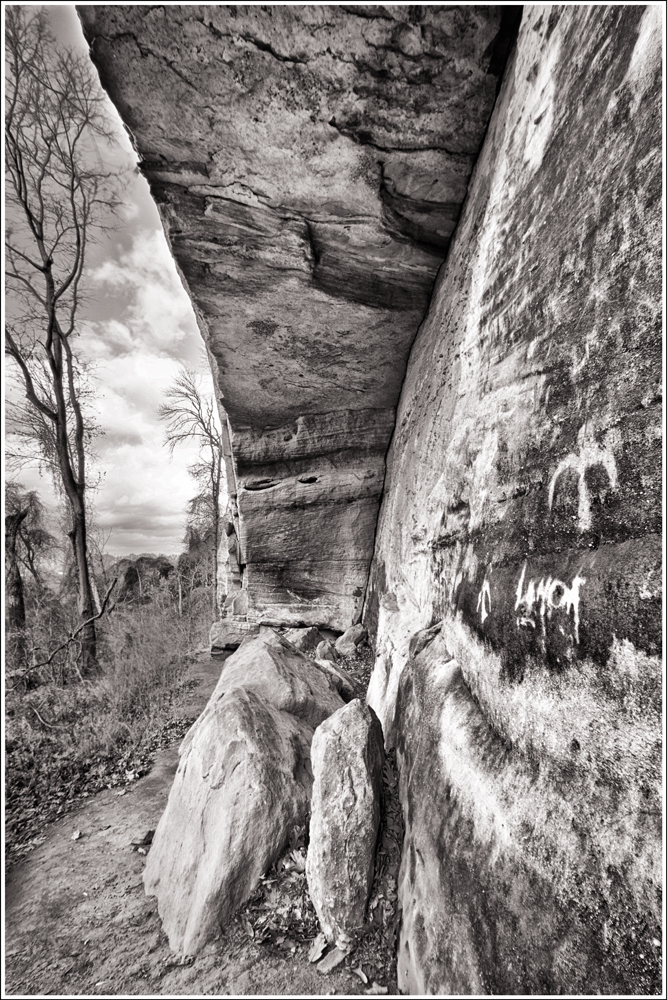
Today we are taking a trip to the eastern Shawnee region of southern Illinois.  A un-glaciated area of tall limestone bluffs, hilltop pine and deciduous forests, riparian forests and woodlands and swamps all created and arranged by the vision of the Father of Waters, our mighty Mississippi River.  Underneath an overhang at the bottom of a particularly beautiful bluff called Fountain Bluff lies an ancient art gallery, in which the aborigines of the Archaic/Woodland/Mississippian cultures carved their art into the tough sandstone.
Technical details: Canon EOS 7D camera, EF24-105mm f/4L IS USM lens @ 24mm, ISO 160,  f/4, 1/25 sec

These petroglyphs lead one to ask all sorts of questions.  I’d say we know very little of the meaning of these images and the people who created them, although it is fun to speculate on the who, why and how these works were made.  Instead of rehashing the information we do know from another source, I will point you to the following location to find out more about this site: http://www.naturealmanac.com/archive/fountain_bluff_sta/fountain_bluff.html
Technical details: Canon EOS 7D camera, EF24-105mm f/4L IS USM lens @ 24mm, ISO 160,  f/4, 1/25 sec

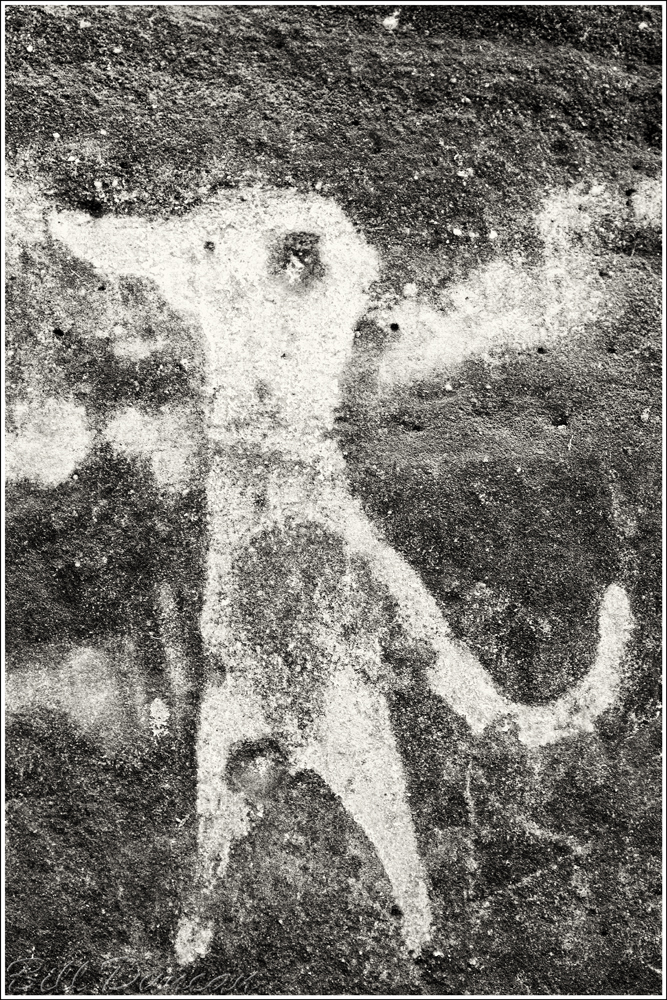
I find this to be one of the more interesting petroglyphs at this particular location.  From what I’ve read, some experts on this subject matter  think this is a spirit or deity while others believe it is simply an artistic representation of a bird in perched repose.  Whatever the truth, it is a gem of this type of feature in this too-often overlooked region.
Technical details: Canon EOS 7D camera, EF24-105mm f/4L IS USM lens @ 24mm, ISO 160,  f/4, 1/25 sec

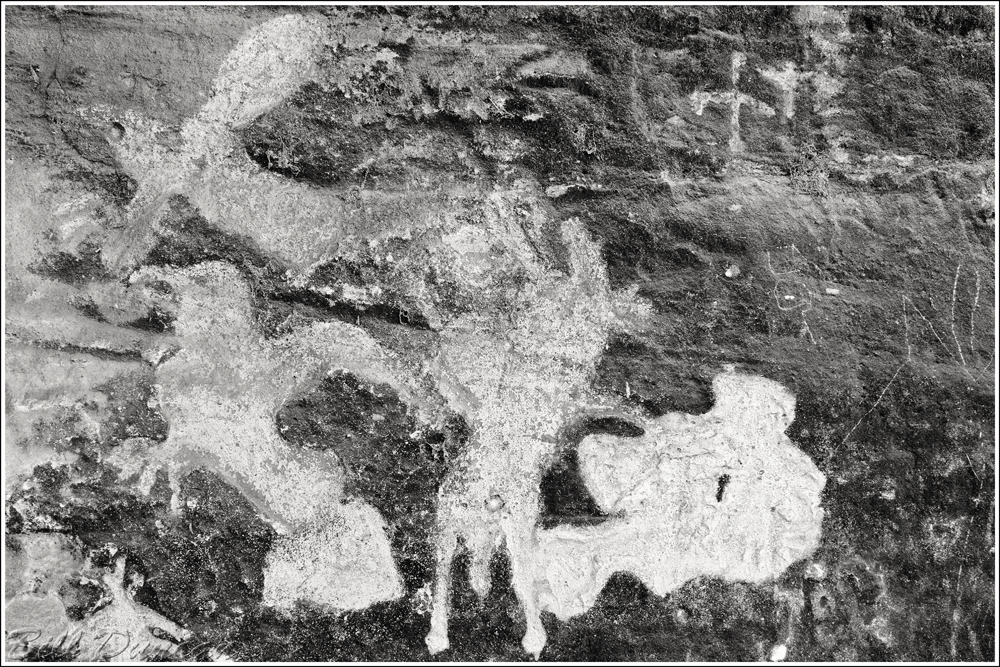
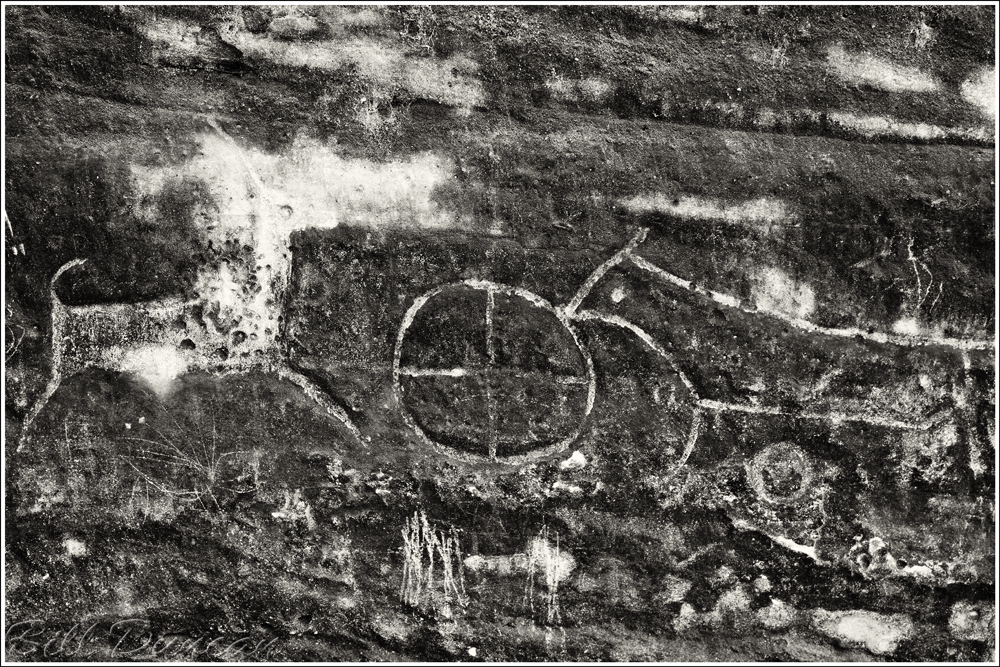
This is another of the more famous scenes at this spot.  It looks to be a white-tailed deer and a dog or wolf on either side of a crossed/quartered circle.  I find the quartered circle very interesting.  Reading a bit on the subject of pre-columbian art work, I discovered that petroglyph analysis is a very subjective science.  There are numerous theories as to what exactly the quartered circle represents.  These theories range from representations of stars, the directions of the compass, the earth itself, the earth-wind-fire-water elements, the four seasons, directional markers that depict spiritual locations, and even symbols depicting an early form of Christianity.  It seems to me we have no idea what these symbols represented in these cultures.  What really fascinates me about these forms is that they were found across North America in time and space.  Seemingly unrelated cultures from northern Canada to southern Mexico were known to use the quartered circle in petroglyphs and pictographs.  This may be coincidental, or as the Cahokia Mounds metropolis location shows, the trade routes of the Mississippian culture were quite large.  Cultural icons, along with trade goods were likely exchanged across surprisingly large distances.

Forgive me if I seem to know nothing of what I am discussing.  It’s only because I don’t!
Technical details: Canon EOS 7D camera, EF24-105mm f/4L IS USM lens @ 28mm, ISO 160,  f/5, 1/30 sec

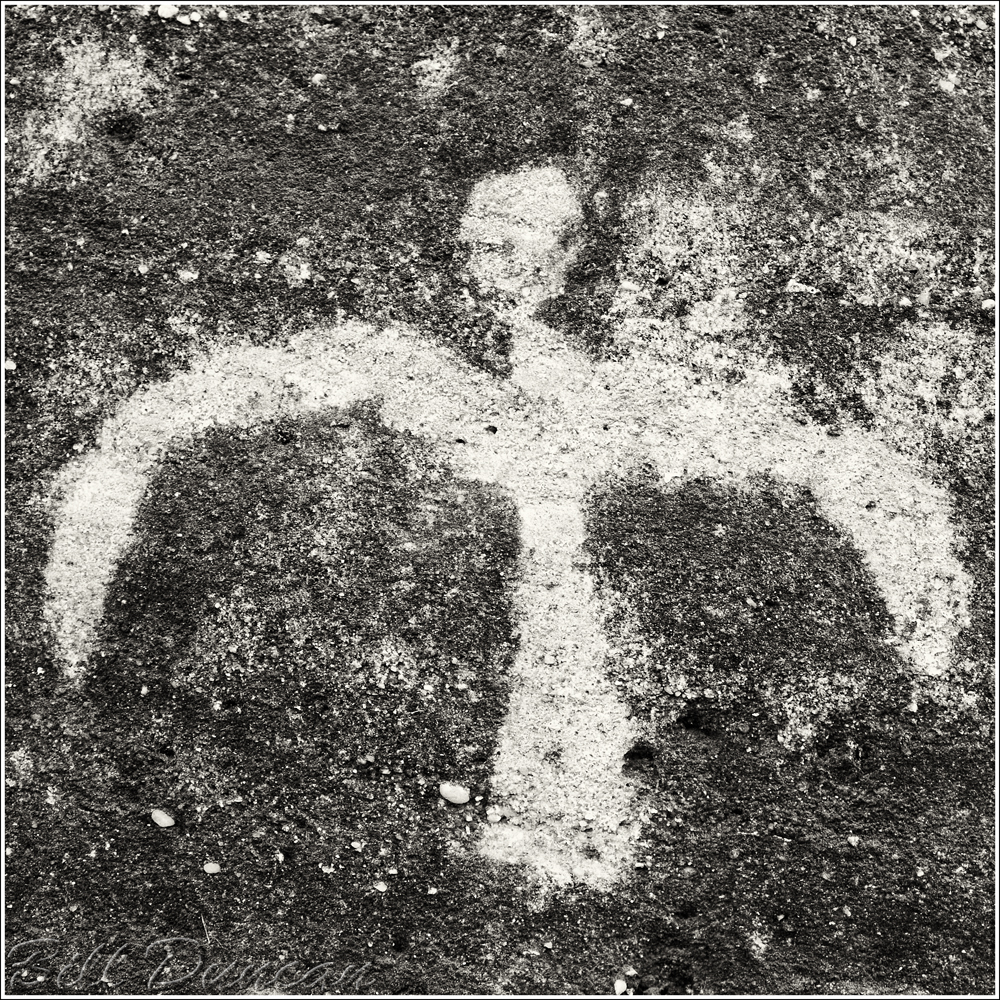
The petroglyph in the image above might be my favorite.  I am of the opinion, I think, that the face seen on the head of this bird is likely do to the changes in time that this spot has seen.  However, once you see the the face, looking down and to the left of the frame, it is impossible to not wonder if this was a deliberate carving.  If so, this is one intimidating form.

I want to give my unlimited thanks to Taylor Reed, a fantastic landscape photographer from the Shawnee region, for providing me directions to this location.  Please visit Taylor’s web site and consider buying several prints of his to decorate your walls.

I will not respond to email to provide directions to this location from people I do not know.  This site is relatively well known and can be found with enough research.  There are other petroglyph spots along this same bluff that I have not yet found.  It is a gorgeous set of bluffs with other geological features and I can’t wait to get down there again to do some more exploring.
Location Spotlight: Devil’s Shadowbox

Early European settlers and pioneers of the Missouri Ozarks were said to be tough, rugged and individualistic.  The Ozarks were and still are a difficult place to “make a living”, especially  based on traditional agricultural methods.  I will suggest that these settlers had little imagination when it came to naming the geologic and other natural features of their newly found homeland.  In “The Geologic Wonders and Curiosities of Missouri”, Beveridge lists no fewer than 80 features with Devil in the title.  This includes 25 “Devil’s Backbones” and close to ten “Devil’s Den’s”.  Beveridge makes the interesting comparison of the Missouri Ozarks naming conventions to those of the south-western United States which use Angel in a large number of their names for geological features and rarely use Devil.  This is likely due to the cultural differences between the settlers of the Ozarks, largely Scots-Irish, and the Latin/Spanish influences of the American south-west.  Beveridge accounts for no named surface feature in Missouri with Angel in the monicker.

Technical details: Canon EOS 7D camera, EF24-105mm f/4L IS USM lens @ 24mm, ISO 160,  f/14, 1/3 sec

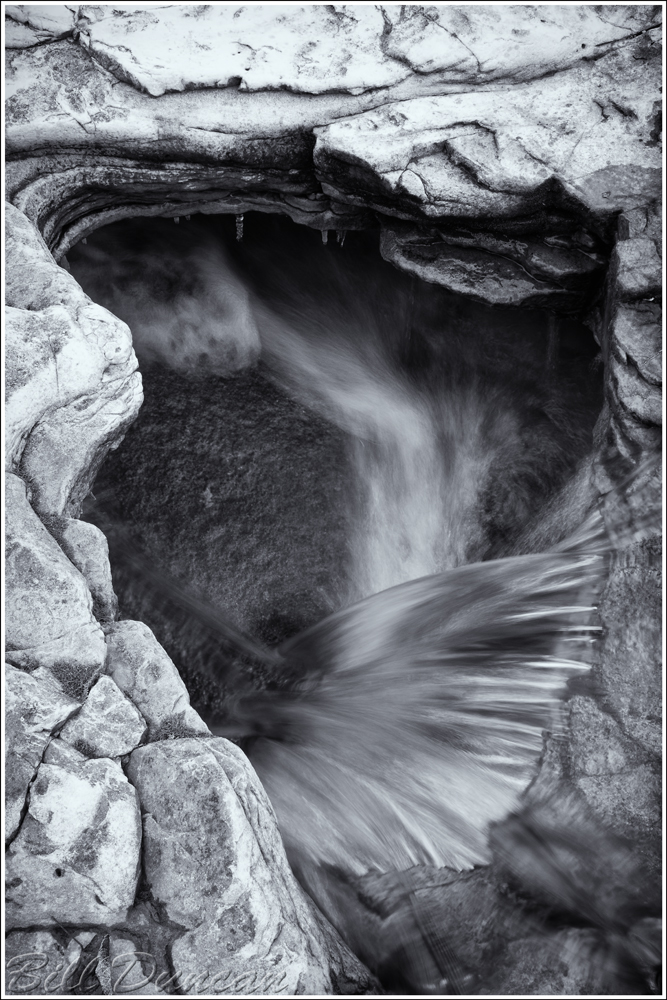
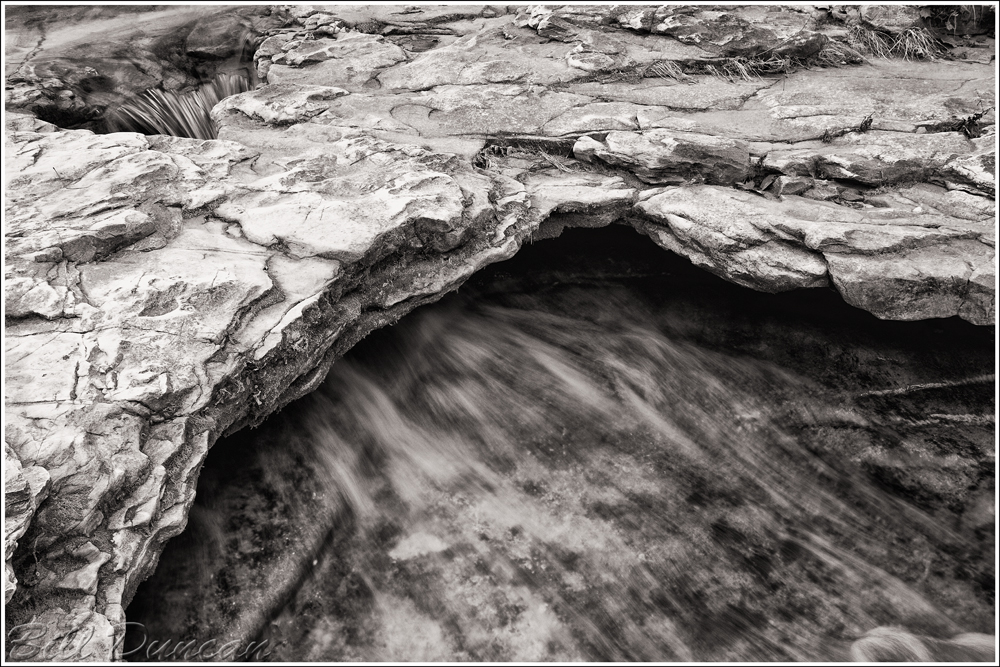
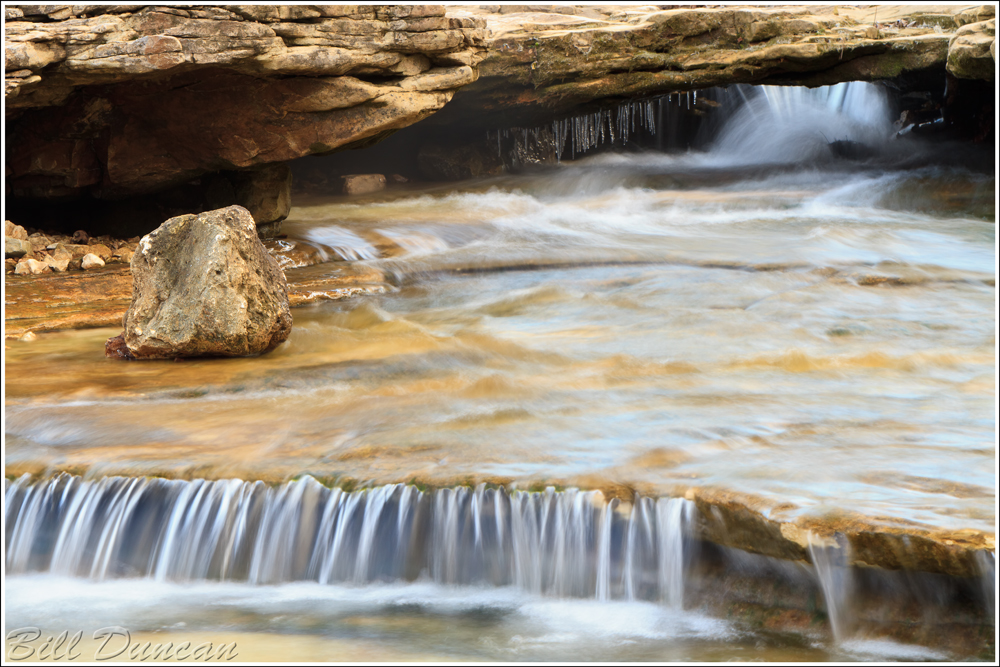
My goal for this particular winter’s morning was to find a “Devil’s Den Hollow” purported to be found in Warren County in the northern Ozark area.  I believe I was pretty close to finding the location, with several runs of rapids and waterfalls so excellently described in Beveridge’s book, but ultimately gave up because it seemed to be surrounded by private property.  I was able to find this little feature presented in this post.  I am unsure whether it has an existing name of its own, but I am calling it Devil’s Shadowbox to continue our Ozark naming convention.

Technical details: Canon EOS 7D camera, EF24-105mm f/4L IS USM lens @ 65mm, ISO 100,  f/14, 0.8 sec

Devil’s Shadowbox was also on private property but was literally feet from the road.  I decided to beg forgiveness if necessary and spent an hour working the scene.  I didn’t see another person the entire time I was there.  The water level was low enough that I could stroll through the creek with my Gortex-lined hiking boots.  My feet did stay dry but the water had to have been close to the freezing mark and my feet where painful and numb by the end.

Technical details: Canon EOS 7D camera, EF24-105mm f/4L IS USM lens @ 32mm, ISO 100,  f/16, 0.8 sec

This relatively un-flashy feature actually had a few small pieces that came together nicely.  Above you can see a short (4-6″) shelf that crosses the stream.  This shelf lies just downstream from the hole/natural arch.  There may be some potential here depending on what the spring foliage looks like.  Too much water, however may take something away from the geology that is visible under these conditions.

Technical details: Canon EOS 7D camera, EF24-105mm f/4L IS USM lens @ 24mm, ISO 160,  f/14, 1/5 sec

I really do try and respect the rights of the property owners while out on my expeditions.  The problem is finding out who owns the property in question and how to contact them to ask permission.  From what I’ve read, in most circumstances the owners of the property have no problems allowing hikers, photographers and explorer types access to their property.  If you have any familiarity with this feature or have any knowledge concerning Devil’s Den Hollow in Warren County, Missouri please let me know.  I will be forever grateful to find out anything else that would help me find and make a lawful visit to the waterfalls and other features this place promises.

Bill Duncan: ceibatree@gmail.com

Migrating to What End?

Technical details: Canon EOS 7D camera, EF400mm f/5.6L USM lens, ISO 100,  f/5.6, 1/320 sec

The Snow Goose ranks right up there with the warblers, in my opinion, in a peculiar sector of the natural world that lie conspicuously under the noses of the vast majority of our neighbors who have no idea they even exist.  Take one of your friends outside for a spring-migratory birding experience.  Explain to them that the population of the bird we call Snow Geese stands at more than five million and that the majority of these birds travel twice a year through the Mississippi River Flyway Migratory Corridor, which ranges from eastern Nebraska and Kansas to Eastern Illinois.  In February and March, find a nice open piece of high land within 50 or so miles of either side of the Mississippi River and let them watch with binoculars or scope as groups of birds ranging from 50 to 5000 birds or more travel back to Canada for their nesting season.  Similarly to the beautifully colored and tiny wood warblers who travel through Missouri northward bound mainly during the months of April and May, your friend or neighbor will most likely tell you that they had no idea these beings even existed, much less spent some time in the trees or skies right outside their own front doors.

The Snow Goose population may actually be a harbinger of things to come for the human species.  Low numbers of traditional predators combined with the fact that these birds are both extremely difficult to hunt (compared to other water fowl) and are not a source of desirable meat are resulting in this species’ increasing population to a critical mass.  These birds taste for a particular diet in their nesting grounds and as stated above, low levels of predation, are pushing this species very close to a population crash.  Current research is showing that Snow Geese are currently experiencing increased levels of starvation and disease incidence.

In my opinion, this could be analogous to the human population’s pace of continued growth with too little concern for population control and resource management.  As long as political “leaders” focus the majority of their efforts on up to the minute economic concerns, rather than the long-term prosperity of our planet and the resources of the commons, we will continue towards a similar state.


Arctic Oscillations and the Winter that Never Was

Technical details: Canon EOS 7D camera, EF100mm f/2.8L Macro IS USM lens, ISO 320,  f/14, 1/13 sec

According to weather scientists, yeah those experts so closely related to our news meteorologists, the jet stream and the current “positive oscillation” is to blame for much of the continental United States lack of anything resembling winter this year.  The problem is that the jet-stream is in a negative phase, or dropping southerly in places like Alaska, much of Europe and Russia.  While where we reside, here in the Ozarks for example, the jet-stream is far to the north, allowing warmer air fronts to reside across the country.  Those places I just mentioned are getting lots of winter with lots of that white stuff we saw on holiday cards and gift wrap about a month ago, while we are in a sort of limbo between autumn and spring.
The reason I bring this up is that, as I mentioned in a previous post, there is a lack of typical winter photography opportunities this year.  The past few outings I have been making my subjects more typical of what I would normally shoot during the warmer months.  During a nice, leisurely and of course, warm hike yesterday looking for one of the harder to find shut-ins along a creek in the Courtois Hills I found a patch of short trees that were loaded with lichen.  In these mild and wet times that we’ve been having (normally seen in spring and fall), the lichen appear to be thriving.

Lichen, a fusion of two normally separate living taxa – a fungus and an algae – are a treasure of diversity, harbingers of the state of the environment in which they are found, beautiful and are still not well appreciated or celebrated by the common public.  Experts in lichen taxonomy use many characteristics in concluding the correct identification of these fascinating life forms.  The largest primary groupings to consider in determining what lichen you are dealing with is to determine is whether the lichen is foliose – flat and leaf life-like with lobed margins, fruticose – branched and stem-like in appearance, or crustose – crusty, splotchy, almost stain-like.  Following this generalization, the expert then goes into more specific characteristics in determining the identification.  Is the lichen corticolous (lives in trees), or is it saxicolous (lives on rocks)?  The expert in lichen taxonomy will consider the upper and lower surfaces of the lichen body, the cilia and isidia (hair-like projections), the strong-hold structures that hold the lichen to its substrate, the apothecia and perithica (fruiting bodies), and similarly to the fungi, the actual chemistry of the lichen itself will hold clues to identification.

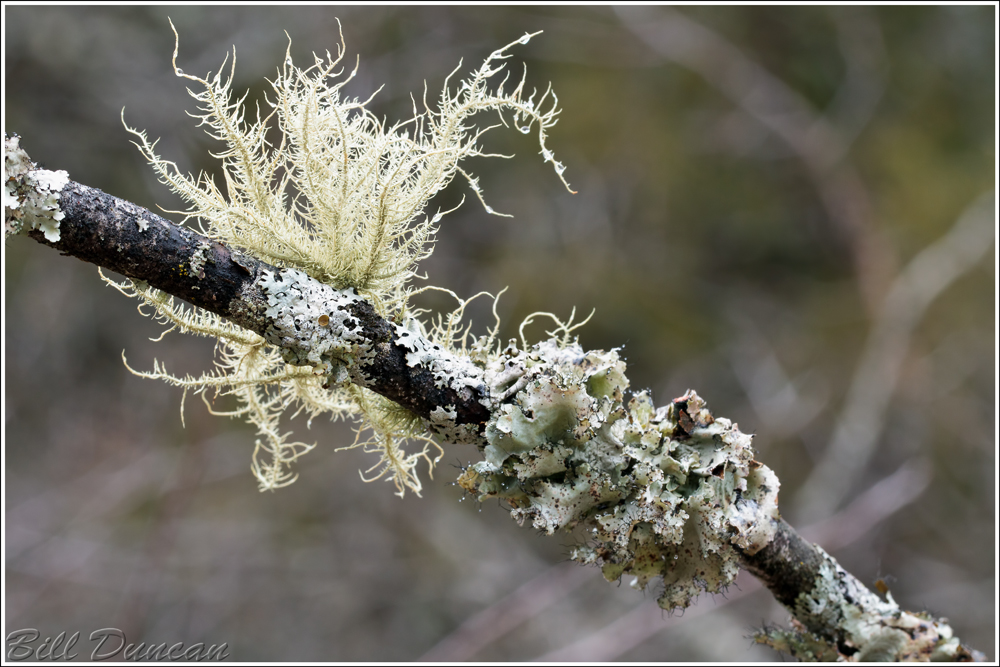
So what are the two lichens captured in the image above?  These are my best guesses and I am far from an expert in lichen identification.  The left-most lichen is the fruticose, bloody beard lichen – Usnea mutabulis.  The other, ruffled lichen I cannot ID for sure.  I should have collected some notes of it in the field.  But, I have narrowed it down to either the salted ruffle lichen – Parmotrema crinitum or the cracked ruffle lichen – Rimelia reticulata.  If you are someone who knows their lichen and can tell me what I have just through the information in this photograph, please let me know.

The Ozarks of southern Missouri are rich in lichen diversity and the Ozarks are home to several endangered lichen forms.  If you tire of botanizing, birding, mushroom hunting or whatever else brings you out in the field, consider having a go at the lichens.  They are a fascinating subject.

P.S.  One of the last things I expected to happen in early February occurred to me yesterday.  Leaving my first stopping point I found two ticks on my pants.  I wasn’t too concerned.  I sprayed the remainder of a can of deet spray on my pants and continued my Saturday adventures.  Mistakenly I didn’t give myself a full check upon returning and did not find the tick that was feeding on me until this morning, at least 12 hours after the tick had probably attached itself.  Now I get the fun of wondering if I’ll come down with some tick-borne illness over the next month.  I believe this is still a relatively rare thing in Missouri, but still.


Ice Is Nice (When You Can FIND It)

Technical details: Canon EOS 7D camera, EF24-105mm f/4L IS USM lens @ 60mm, ISO 100,  f/13, 1/20 sec

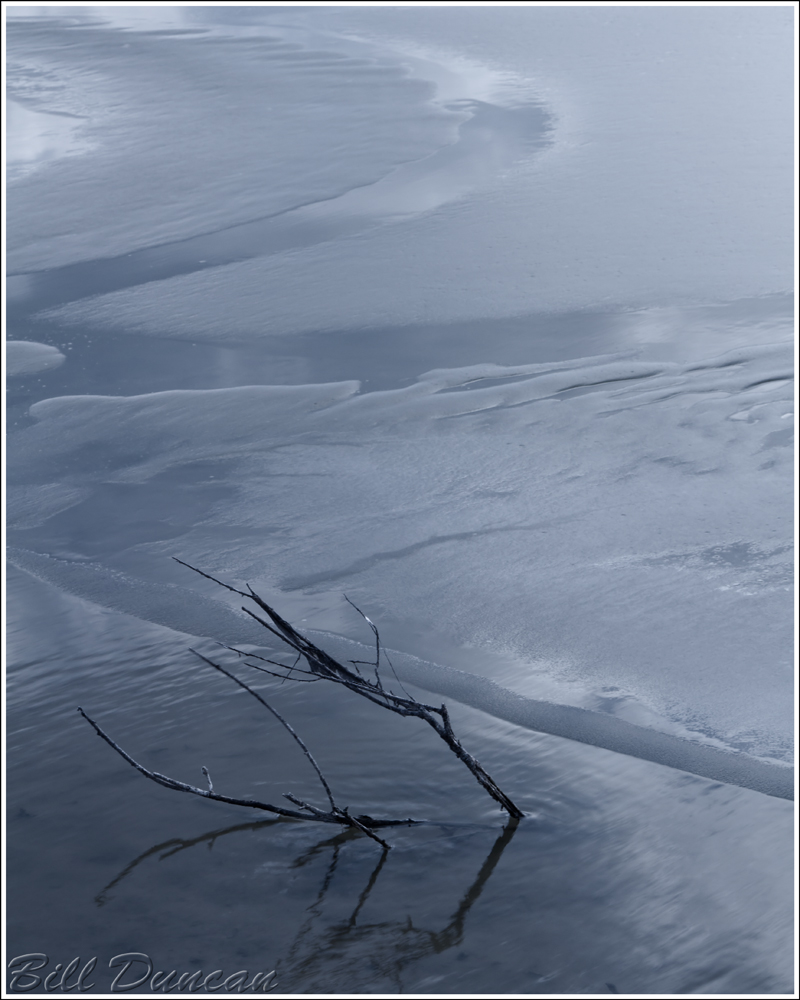
Photographing ice is a nice challenge for the nature photographer.  Negotiating the landscape itself when covered in snow and ice is the first obstacle and finding safe passage in both transporting yourself to the scene and then within the scene is obviously critical.  Nailing the exposure in camera is crucial in making an ice image that works compared to one that falls short – ice and snow have their obvious challenges as being bright subjects that can confuse the camera in automatic exposure modes.  Composition is a challenge, as many ice shots are all about pattern and flow through the rectangle and may not be focused on an apparent subject.  Finally, color and white balance of the image needs to be carefully scrutinized.  There are lots of options here.  Will you leave the scene cold?  This is a popular choice for winter images, or is there reason to warm it up?  Will it be in color or will you convert to B&W?  If you do go monochrome, color toning leaves you with more potential options.

Technical details: Canon EOS 7D camera, EF100mm f/2.8L Macro IS USM lens, ISO 320,  f/14, 1/6 sec

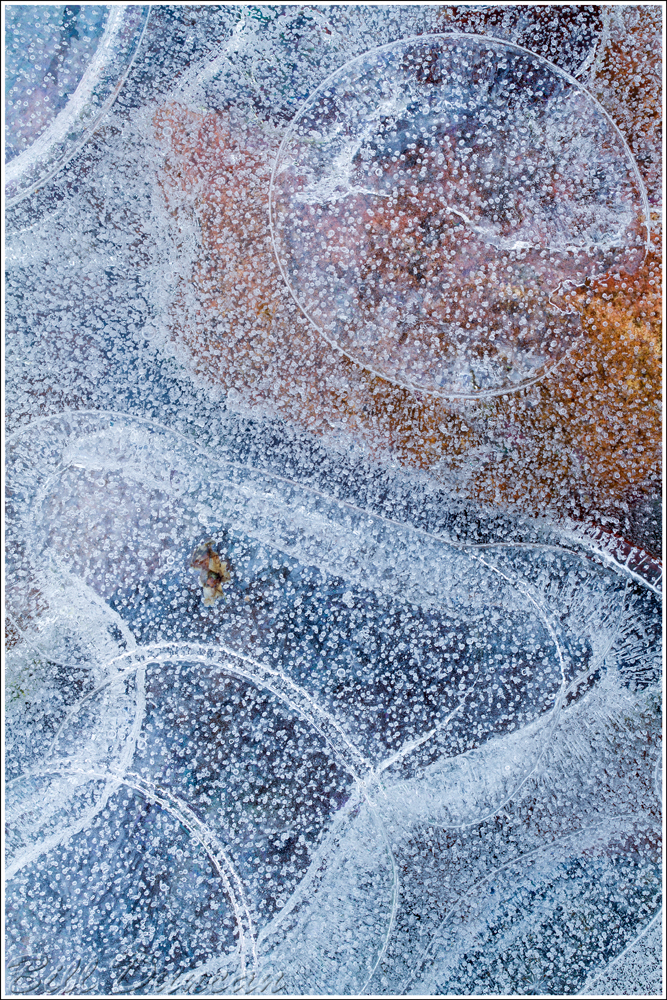
I naturally tend to process the winter images I’ve been able to produce toward the cool end, either through white balance decisions or in monochrome toning.  The image presented above is a more neutral or even warm image.  These leaves, which had fallen weeks earlier in mid-autumn were approximately two feet under the surface of this stream which runs through Hawn State Park in the beautiful St. Francois Mountains.  A layer of ice about one inch thick provided the first layer of texture and the warm mosaic the fallen leaves of the stream bottom provided another.

Technical details: Canon EOS 7D camera, EF100mm f/2.8L Macro IS USM lens, ISO 100,  f/18, 1.6 sec

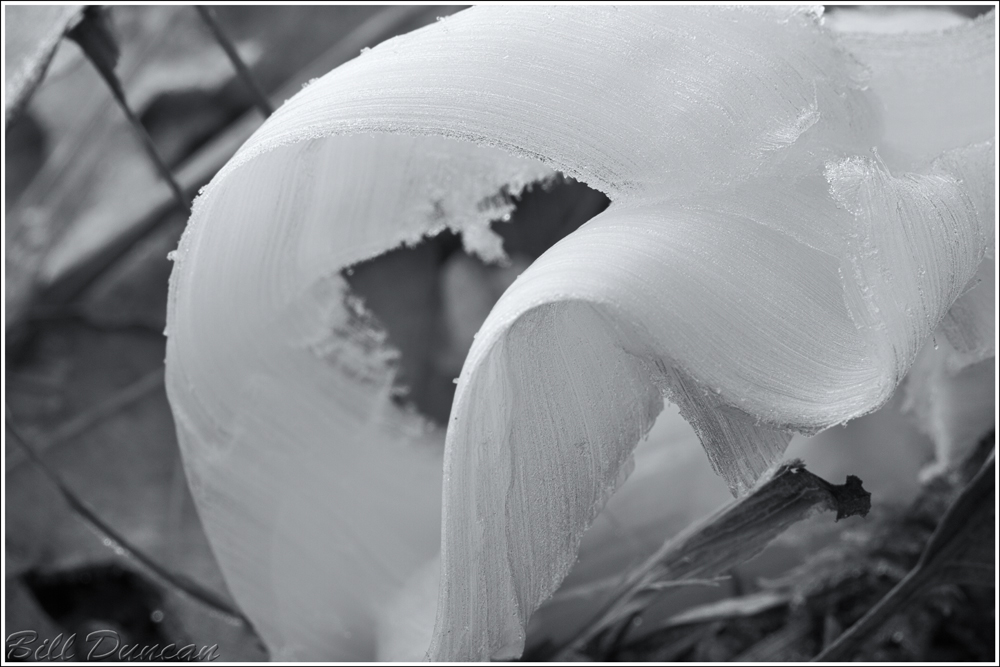
The crystalofolia.  Ive blogged about these once before.  This particular beauty was quite intricate.  I tried to convey a sense of three-dimensionality and capture the detail one can only really see through the magnification of a lens.

Technical details: Canon EOS 7D camera, EF100mm f/2.8L Macro IS USM lens, ISO 100,  f/11, 1 sec

You don’t have to read the title of this post to know that winter is MIA this year across much of North America.  This past spring I purchased my all wheel drive-all the time Subaru Forester, replacing a good vehicle but one of the worst winter vehicles to drive you can imagine.  For years, I had to either stay home or borrow the wife’s front-wheel drive vehicle if I wanted to make an outing into the snow and ice.  My anticipation for this winter season has been growing ever since.  Nothing was going to stop me now from the winter image making opportunities I dreamed about finding in some of my favorite places in the Ozarks and northern Missouri.  Never did I imagine the Mother Nature would play a cruel prank and give me what is to date the mildest winter that I can recall.   I have been able to make a few winter photographs this year, including the ones in this post.  But come on, I bought a pair of ice cleats for my hiking boots!  If February continues the way it started here in Missouri, I’ll be the first to sign the “Let’s eat Punxsutawney Phil in a stew of his own juices” petition.

Happy Groundhog Day.

Birds of the Great Confluence – Part One – Riverlands MBS and Confluence SP

The Great Rivers Confluence is the area where North America’s two largest rivers, the Missouri and the Mississippi, meet together and flow as the Mississippi.  This confluence is just north of St. Louis, Missouri and provides many opportunities for birds along the Mississippi migratory flyway to find the habitat they need.  These areas provide great opportunities for bird-watchers, hunters, and other outdoors types and go by names such as Riverlands Migratory Bird Sanctuary, Jones Confluence State Park, Columbia Bottom Conservation Area, Marais Temps Clair CA, and a handful of other public properties that have been given mandates based on conserving the basic habitat that wild birds and our other wildlife kin rely upon for their existence.

I have been bird watching in this region for about five years and taking bird photographs here for the last two or three.  In this post, I will be showcasing six of my favorite images I have made at Riverlands MBS and Confluence SP.  I will feature another group taken at Columbia Bottom CA, which sets on the south side of the Missouri River at another time.

Technical details: Canon EOS 50D camera, EF400mm f/5.6L USM lens, ISO 640,  f/5.6, 1/800 sec

The bird pictured above is an Osprey, also known as the Fish Hawk and is one of several species of conservation concern that benefit from the types of refuge that Riverlands and the other preserved and well-managed habitats in the confluence region provide.  These birds feed almost exclusively on fish so it is of no surprise that these birds utilize the Mississippi River and surrounding waterways during their migration for their supper.  These birds will use man-made structures, such as telephone poles to build their nests.  At RMBS you can find special structures designed for this specific purpose.  To my knowledge, these structures have not been used but the birds have nested in trees nearby for the past several years.

Technical details: Canon EOS 50D camera, EF400mm f/5.6L USM lens, ISO 400,  f/5.6, 1/640 sec

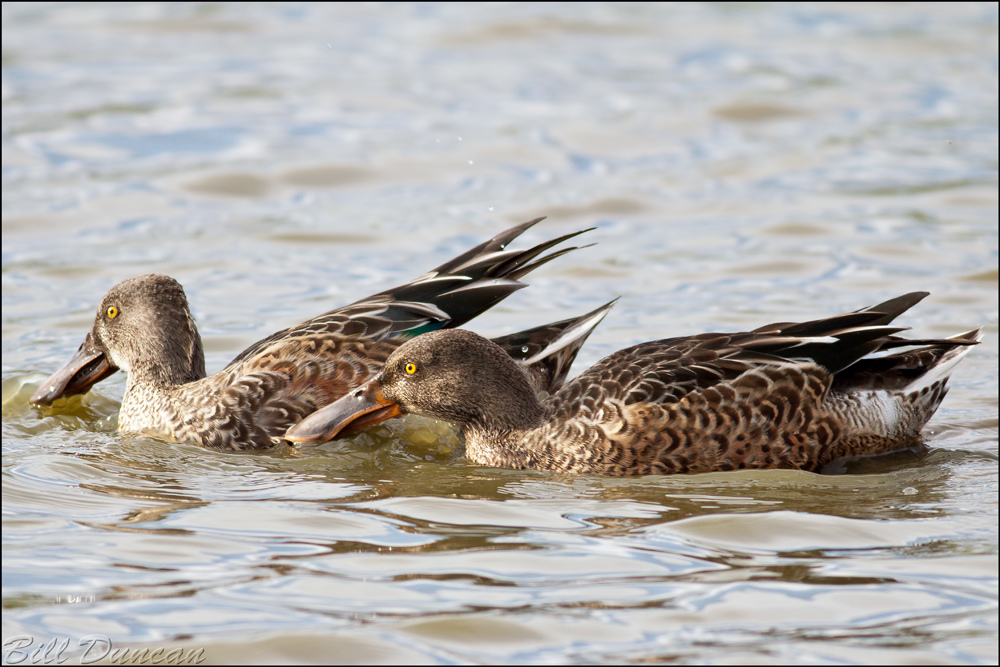
Probably the best known group of birds that rely on the habitat of the confluence region are the waterfowl.  In this day and age, hunting has been one of the bright spots in conservation and management of the types of habitat that ducks and swans rely on during migration.  Without hunters and the money they spend we probably would have lost much more land to development along the Mississippi flyway than we have.  The number of waterfowl hunters has decreased over the past few decades, while the number of bird-watchers, nature photographers and other conservation-minded types has increased.  This is somewhat ironical because organizations that have relied on funds generated from hunting to purchase, protect and manage wetlands are now experiencing budget shortages.  Bird-watching, photography and hiking do not, naturally put money back into the system.  If a new method of fundraising is not found, we may be facing a crisis in the management and protection of these wetlands and the chance to procure new properties for this purpose.  An obvious solution would be for private donations to be given by anyone interested in the protection of these habitats.  Anyone can purchase Duck Stamps, which monies go into managing habitats in which migratory waterfowl rely.

http://www.flickr.com/photos/ozark_bill/6135882341/in/set-72157622457983078/lightbox/

Technical details: Canon EOS 50D camera, EF400mm f/5.6L USM lens, ISO 640,  f/5.6, 1/400 sec

Other groups of birds, the waders, shorebirds, songbirds and others also rely on the habitat found at Riverlands.  This Yellow-crowned Knight Heron, for instance, is a species that is seldomly found here.  One early August morning I came across a group of these juveniles who were making their way south through the Mississippi flyway together.  As you can see, their colors and patterns make them difficult to spot in almost any natural habitat.

Technical details: Canon EOS 50D camera, EF400mm f/5.6L USM lens, ISO 250,  f/6.3, 1/1600 sec

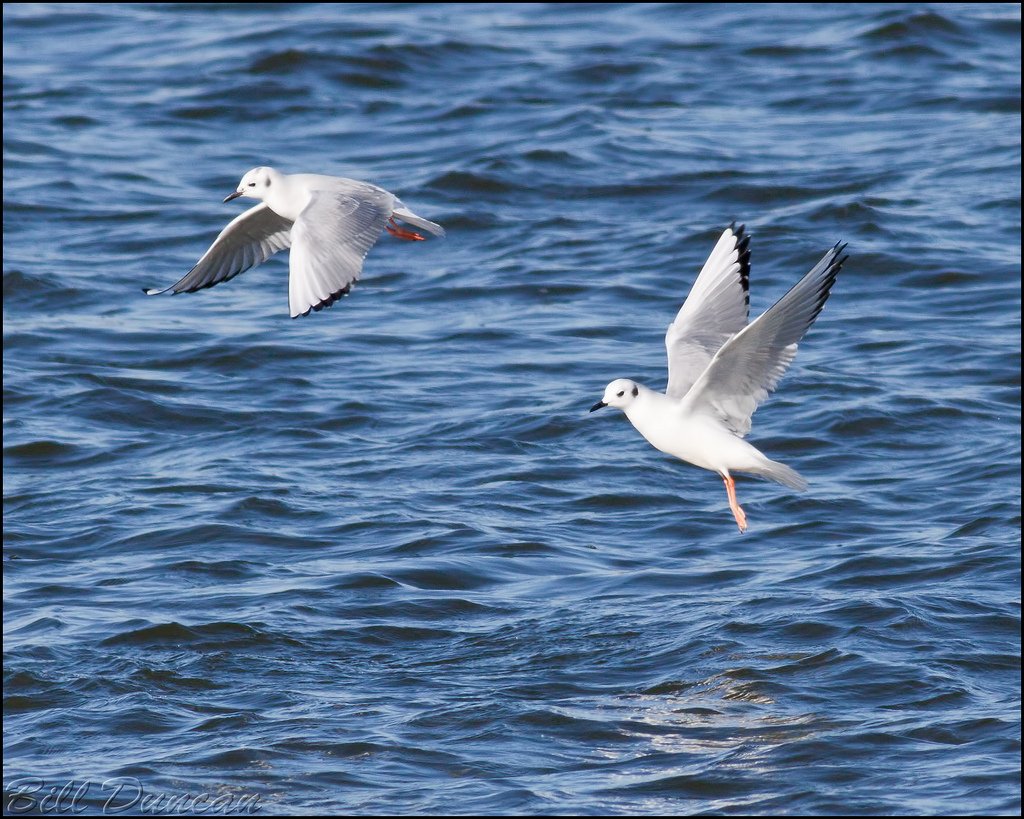
Winter gulls are a very challenging group of birds to identify.  During normal winters, unlike the tropical winter we are experiencing this year, several rare northern migrants can be found along the dam and other man-made structures.  During the dead of winter it is not uncommon to find groups of experienced birders shivering under the frigid temperatures and gale-force winds at the lock and dam at Riverlands looking at hard to distinguish, rather drab gulls through 60X scopes hoping to find that rare gull to add to their year list.  I have done a little of this myself and it can become addicting!  These cute and graceful Bonaparte’s Gulls are rather earlier migrants that favor warmer weather than many other gulls.

Technical details: Canon EOS 50D camera, EF400mm f/5.6L USM lens, ISO 400,  f/5.6, 1/800 sec

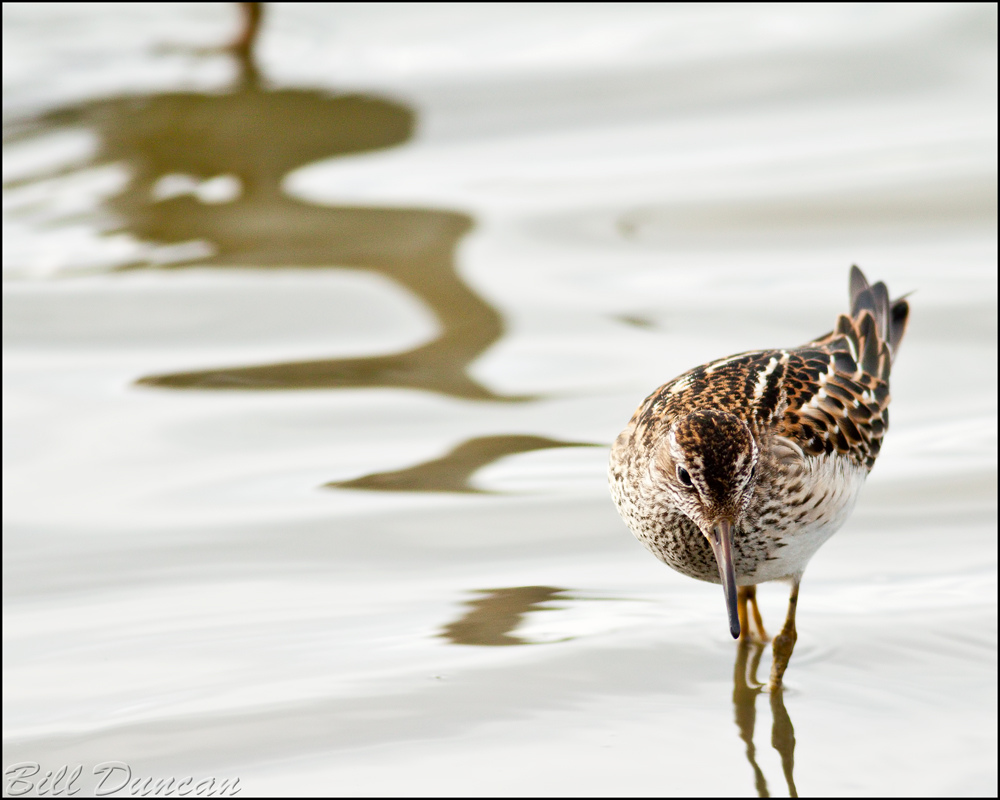
Another challenging group of birds that will have the uber-birder skipping work, church and ignoring family is the shore-birds.  These birds, whom I have recently become enamored with, move through the confluence region mostly during March-May in the spring and August-October in the fall.  These are beautiful, photogenic and biologically fascinating and diverse birds.  The shorebirds are almost strictly a migratory group concerning the confluence region.  These birds have some of the largest migratory routes in the animal kingdom and their routes across Missouri and Illinois vary and can be tricky in predicting.  Farming and other land development practices are hurting this group badly across their migratory route.  Most species of shorebird have pretty narrow requirements or preferences when it comes to the particular habitat and water depth they need to thrive.  Managing a wetland becomes troublesome when the specific needs for a species is considered and skilled management practices are a must.  Unfortunately, almost half of the shorebirds of the new-world are experiencing declining populations, due almost solely to man-made influences.  Serious action needs to be taken to preserve these populations.  You can read more about this by reading the United States Shorebird Conservation Plan.

Technical details: Canon EOS 7D camera, EF400mm f/5.6L USM lens, ISO 400,  f/5.6, 1/800 sec

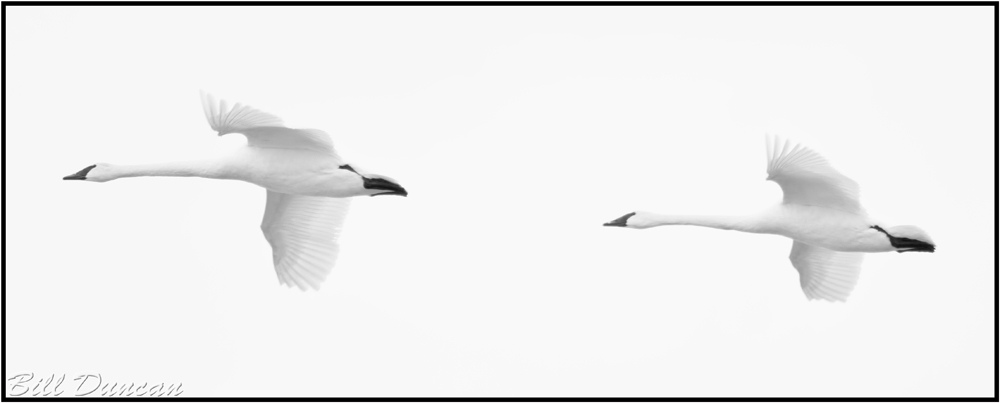
Next to the Bald Eagle, the Trumpeter Swan may be the most recognized bird species of conservation concern that calls the confluence region home during the winter.  Upwards of 400 of these birds and lower numbers of the similar, Tundra Swan can be seen in a single day at Riverlands and surrounding area.  These birds are rugged survivors that spend the majority of their day searching the surrounding farm fields for wasted grain and overnighting in the sanctuary’s water bodies.  These birds, the world’s heaviest that are still capable of flight, are a treasure to watch and photograph.

I often tell people that photographing birds is simultaneously the most rewarding and the most frustrating experience I can think of.  For each of these six images that I am relatively proud of there are at least 500 that were unusable.  Fortune favors the prepared photographer who understands not only how to use their equipment, but understands the behavior of the birds they are after.  Getting close is key, but not getting so close as to disturb the natural behavior and sense of security these wild animals should expect to have.  This is often a fine line.

The confluence region where the Big Muddy and the Father of Waters join was once one of the greatest wetlands areas in all the temperate regions of the world.  Farming and urban sprawl have made considerable changes to these natural habitats.  We can do something to maintain and potentially repair some of what has been lost.

Location Spotlight: Piney Creek Nature Preserve – Part Two

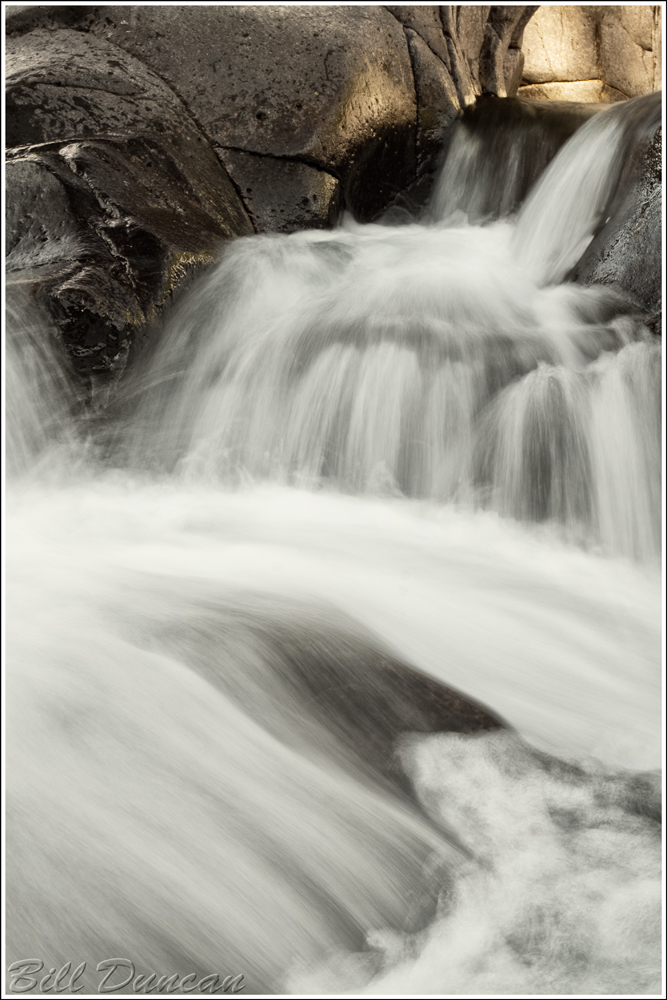
Technical details: Canon EOS 7D camera, EF-S10-22mm f/3.5-4.5 USM lens @ 12mm, ISO 100,  f/16, 0.6 sec

Ten days following my first visit and hike into Piney Creek Nature Preserve I arose early and left the house during one of the two appreciable snowfalls we’ve had this winter in our region so far (I was very sick on the second snowfall and could not enjoy it).  Prior to the temperature drop we had inches of rain during the previous day and I realized that places such as this should have a significant amount of water flowing through their streams and intermittent waterfalls.  Following a careful drive through the snow, I arrived two hours later almost the exact second the snowfall stopped.  This makes photographing a little easier without worrying about the equipment getting wet, but it would have been nice to hike in the falling white stuff for a while.

Technical details: Canon EOS 7D camera, EF24-105mm f/4L IS USM lens @ 24mm, ISO 200,  f/13, 0.8 sec

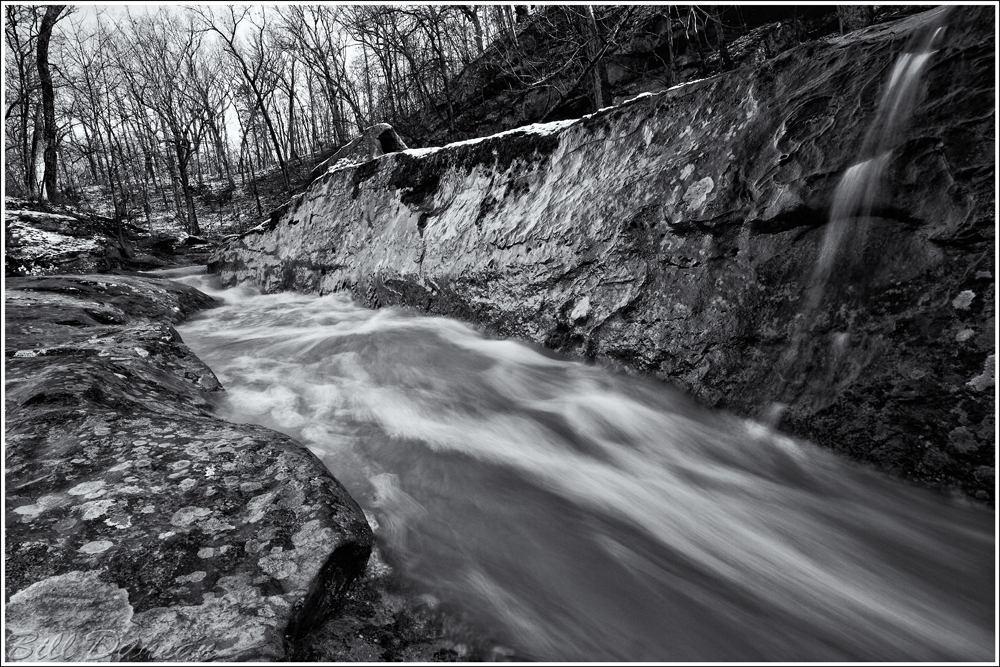
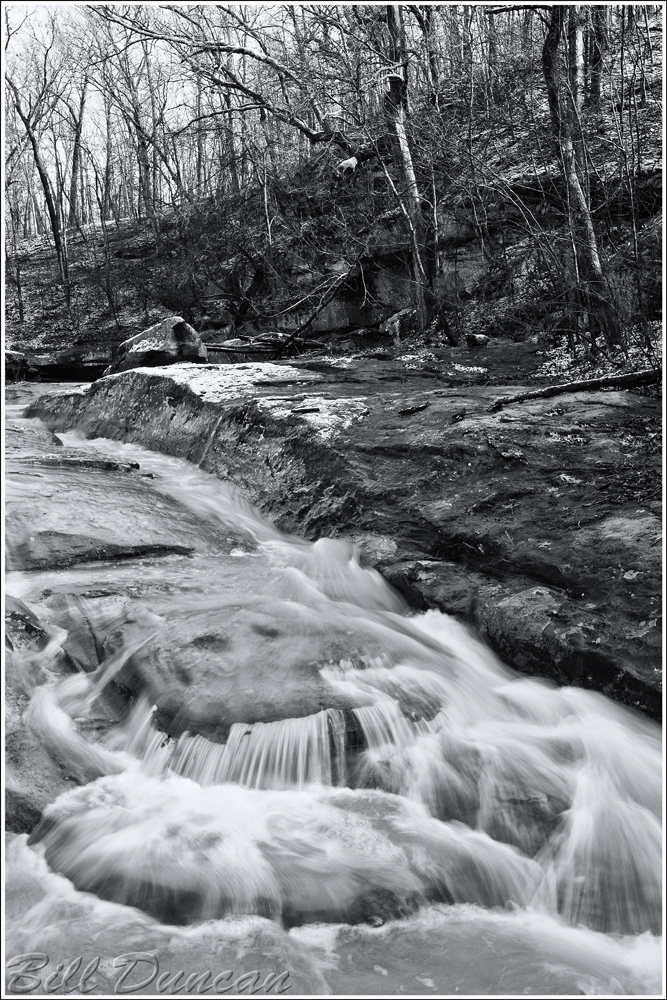
The image above was the first waterfall I heard.  To get here required a short bushwhack off trail and down into the ravine.  A hiking pole and crampon/spikes on your boots are definitely helpful in doing this.  The rock in this area was extremely slick, with ice on top of algae/slime.  I was very cautious moving on the rocks to set up this shot, realizing that the rock sloped toward the stream and loosing my footing would prove disastrous. Because of the higher water and treacherous footing the available compositions were somewhat limited.  Considering how poorly I function with too many options, this was not exactly a bad thing!

Technical details: Canon EOS 7D camera, EF-S10-22mm f/3.5-4.5 USM lens @ 21mm, ISO 100,  f/16, 0.3 sec

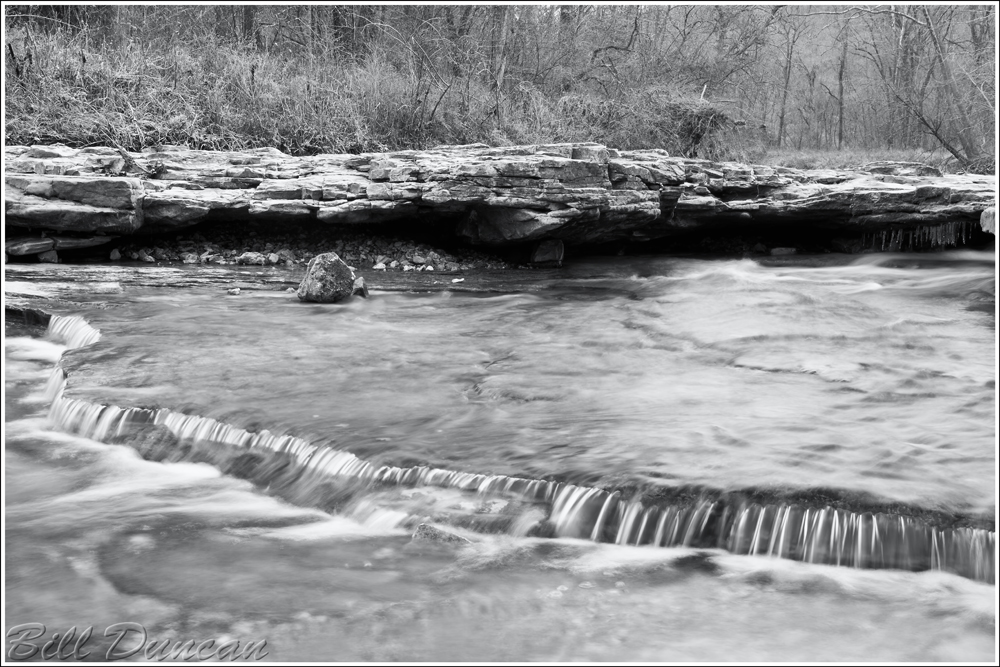
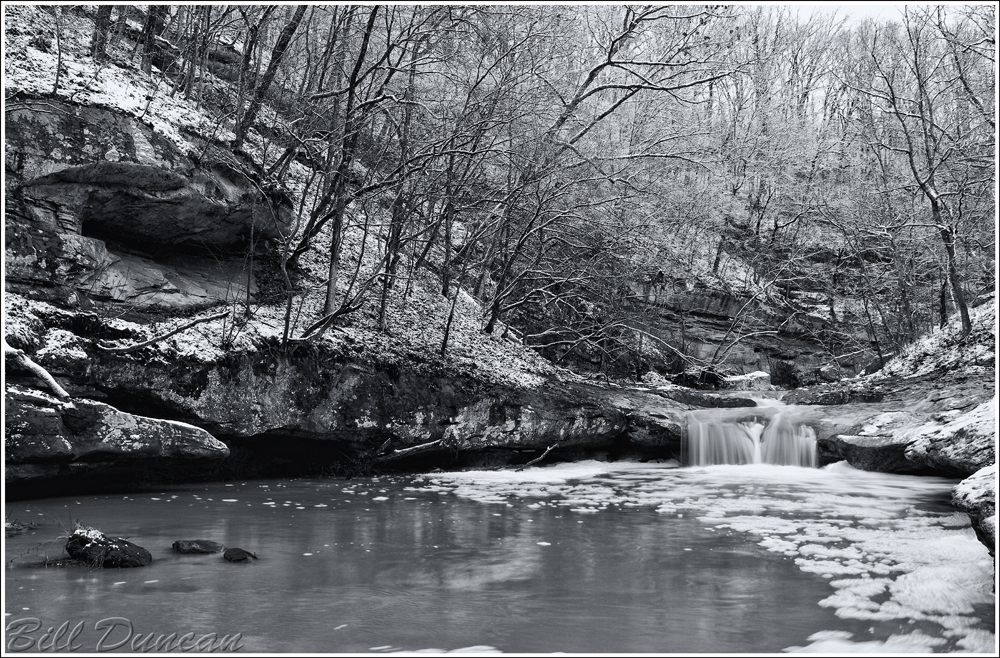
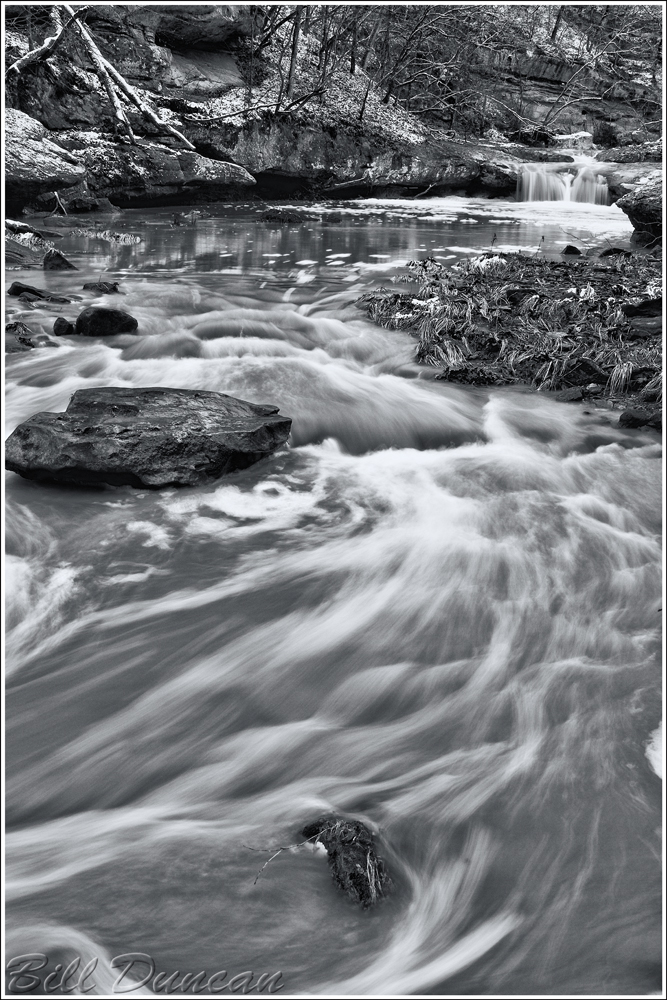
This cascade pictured above is a section of a longer series of twists and drops found closer to the back side of the hiking loop.  The water here skips shallowly over rock shelves and narrow chutes and takes occasional breaks in what appear to be quite deep pools.  When I made it to this section of the reserve the cloud cover was almost completely gone and blue skies were above.  The sun that would completely melt this fresh snow by the time I drove home this day was just beginning to peak over the bluff.  I realized that I would soon be faced with high-contrast shadows and harsh glare off the landscape scenery and I needed to grab every capture I could in the limited time available.  Sometimes it is also best to work with a deadline.  😉

Technical details: Canon EOS 7D camera, EF24-105mm f/4L IS USM lens @ 24mm, ISO 200,  f/14, 1 sec

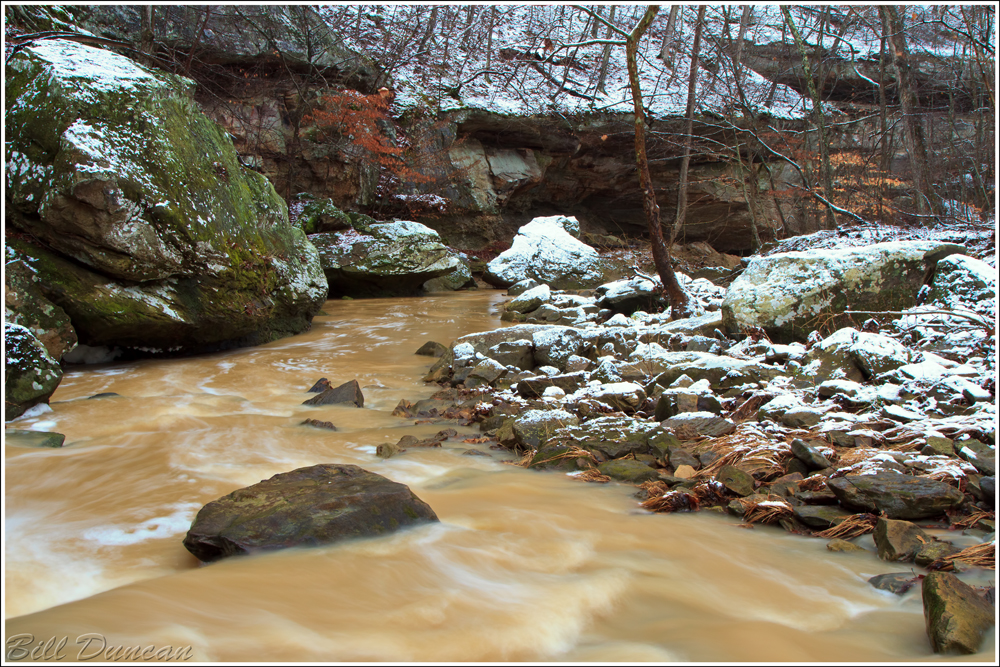
You can see that the previous one to two day rain brought a lot of soil into the stream.  Because of this, I felt most of the images would be presented best in monochrome.  I did want to present what one of these scenes looks like in color, however.  This one had some greens and reds to provide a little contrast between the browns of the water and rocks and white snow.

Technical details: Canon EOS 7D camera, EF24-105mm f/4L IS USM lens @ 24mm, ISO 160,  f/16, 0.8 sec

This place has a lot more to offer than what I present here.  There were at least two other significant waterfalls that I could see or hear, but the terrain with the snow and ice on precipitous ravine sides caused me to think wisely against trying to get within good photography distance.  Definitely something to try during better weather this spring.  I’ll be looking forward to my next visit to Piney Creek Nature Reserve.  Maybe I’ll even plan on paying a visit to the Popeye museum along the way in the town of Chester.

Location Spotlight: Rock Between Two Soft Places

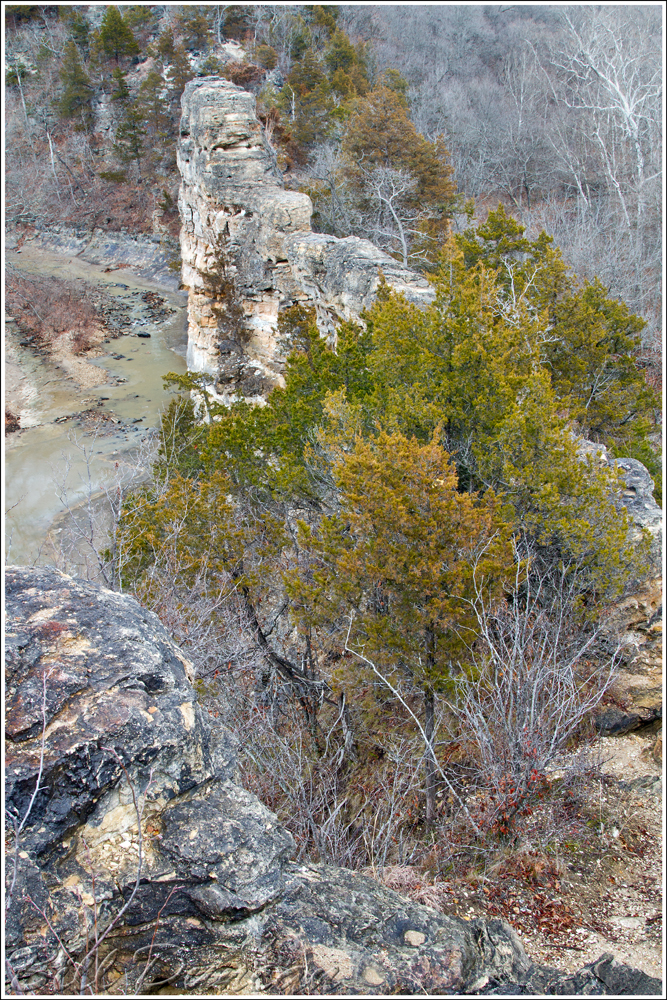
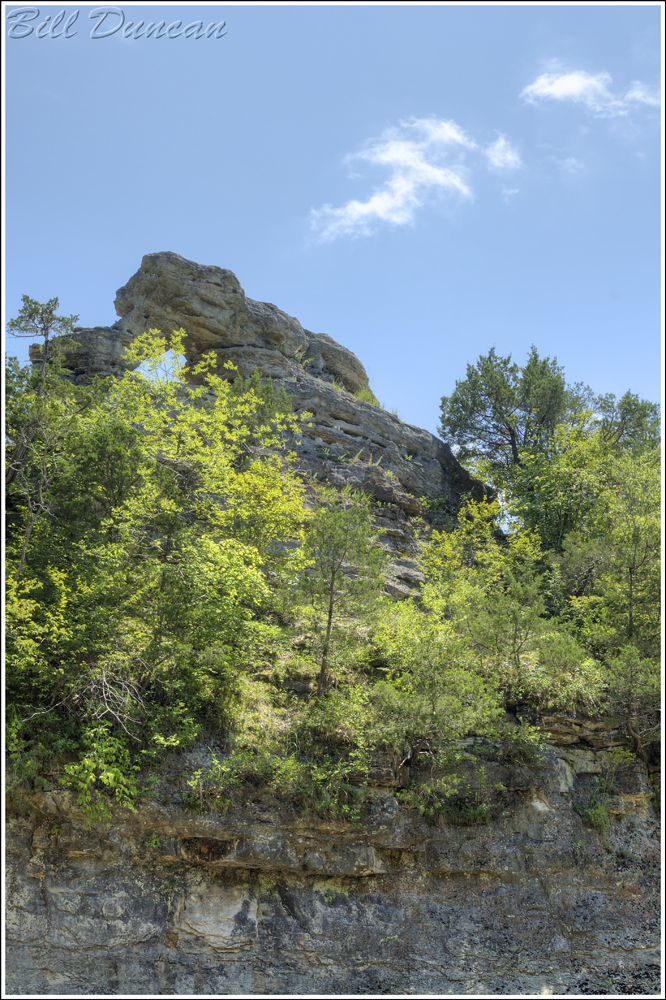
The Pinnacles, also known as “Boone County Pinnacles Youth Park” is a Missouri State Designated Natural Area located approximately 12 miles north of Columbia.  The geologic structures know as The Pinnacles formed between two parallel Ozark streams, Silver Fork and Rocky Fork.  These streams running closer and closer to one another have formed this erosional structure (senile ridge) that is approximately 75′ high and 1000′ in length.

Technical details: Canon EOS 7D camera, EF24-105mm f/4L IS USM lens @ 60mm, ISO 160,  f/13, 1/4 sec

The Pinnacles are composed primarily of Burlington Limestone, with a small amount of sandstone to act as a “cement” in some places.  This fact was the inspiration of the title of this post.  These two streams are quite quickly, in a geological perspective, eroding this separation between them.  Limestones are very easily eroded by forces of weather and flowing water.  On this visit I easily found fossil crinoids in the rock, a feature Burlington limestone is known for.

Technical details: Canon EOS 7D camera, EF24-105mm f/4L IS USM lens @ 24mm, ISO 160,  f/18, 1/4 sec

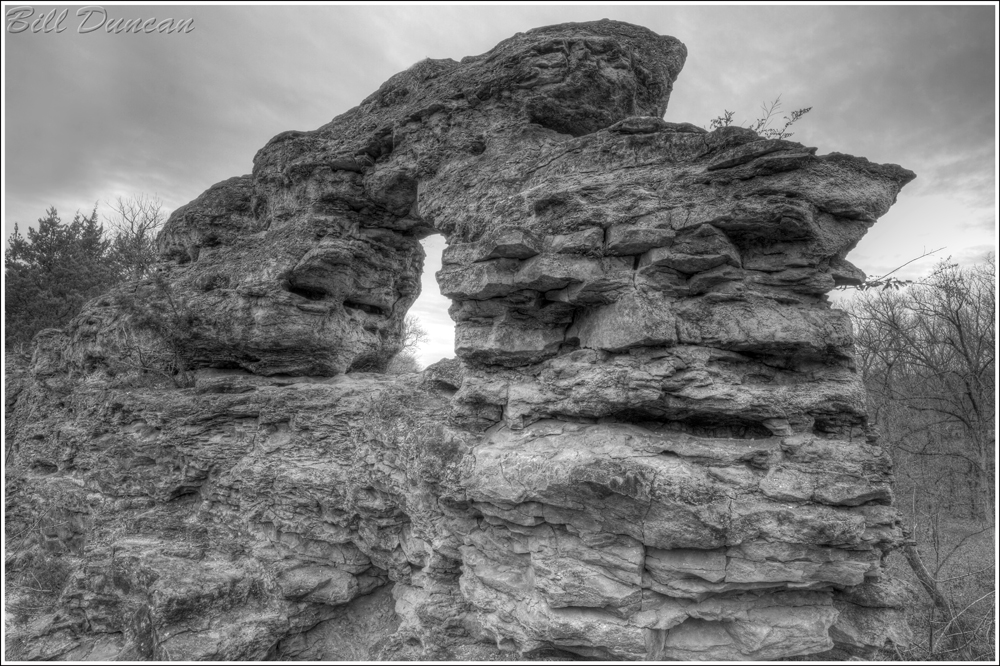
The most recent time I visited here the weather was quite poor.  During one of the sporadic sleet and freezing rain showers I took shelter under one of the windows, or natural arches, that erosion has carved in the rock.  While I was waiting out the weather I was able to take a close look at the composing rock.  The amount of cracks and other signs of erosion was eye-opening.  While I was sitting there, bits and pieces of rock were literally falling off the overhanging arch and landing around me.  It takes little imagination to realize the effects that changing mid-western seasons along with ebbing flows of the streams are having on this feature.  Geologists reckon this rock feature has only a couple thousand years left, so if you plan on visiting, do it soon!

Technical details: Canon EOS 7D camera, EFS10-22mm f/3.5-4.5L IS USM lens @ 13mm, ISO 160,  f/16, HDR blend of two images

If you do plan on visiting and bushwhacking your way across the stream and up onto the rocks, take care!  There are numerous spots that one wrong step could potentially be your last.  On top of the risks of being swept away by high water in crossing the stream and falling from the top of one these spires, there is the usual risk associated with the Northern Missouri Ozarks – private property.  Apparently one side of this site is bounded by a stretch of property owned by a particularly cranky old man.  I was warned by a regular visitor to stay clear of that side of the park as he will not hesitate to accost hikers that stray too far.  Unfortunately one of the two shallow spots I have found to cross the stream is located in what seems to be his property.

Technical details: Canon EOS 7D camera, EF24-105mm f/4L IS USM lens @ 28mm, ISO 160,  f/16, 1/2 sec

The eastern red cedar, which is really a juniper, loves limestone.  This species is a long-lived pioneer invader that will be one of the first trees to grow in a disturbed area or any area that other species find undesirable.  Because it will grow in crevices along bluffs and shallow, rocky soils that often lack resources needed to grow quick and large, small trees can often be over 600 years old.  In fact, the oldest documented individual of this species was recorded in Missouri and was found to be 795 years old!  This species is currently taking over much of Missouri’s knob-top glades found throughout the Ozarks.  Cedar is not tolerant of fire and the suppression of natural and man-made fires on modern private land as well as public lands such as the Mark Twain National Forest is allowing cedars to take hold in these habitats where they were historically controlled.  But, this is a subject for another post.

Technical details: Canon EOS 50D camera, EF17-40mm f/4L IS USM lens @ 28mm, ISO 100,  f/16, HDR blend of four images

Just a stone’s throw south of The Pinnacles is a “shelving rock” style of shut-in (not pictured).  This feature was formed by erosional forces of Silver Fork as the creek runs dead-on into limestone bedrock and is forced to make a sharp left turn.  This shelter is 40′ deep, 10′ high and 125′ long.  Although it looks like the shelter is often flooded during high waters, I am sure this was used by pre-Colombian man.

The Pinnacles is another destination for the landscape photographer in the Missouri Ozarks that offers a diversity of photo ops depending on time of day, weather and the season.  It is also a high quality biological habitat even though it is so close to a a major metropolitan area.  With luck and continued proper management this location will continue to be a place visitors can come to appreciate the geologic and natural features that the Missouri Ozarks offers and once offered in much greater abundance.

Much of the information used in this post was found in “Geologic Wonders and Curiosities of Missouri” by Thomas R. Beveredge.  This is a highly prized book in my collection.  I only wish someone would update and revise with GPS coordinates!


Sophia M. Sachs Butterfly House

“So, where are we going?  To see Sophey having sex?” my wife questioned me when I woke her early on one of our shared days off during the past holiday break.

No, I replied.  “We are getting up early to get some breakfast and then on to the Sophia M. Sachs Butterfly House.  We have to get there by 9:00 to beat the crowds of older and younger people that will surely be troublesome as well as everyone with a camera phone who is trying to take a masterpiece of a butterfly.  We have to get there early so that the butterflies are not fully warmed by the slow winter sun and become too active to shoot easily.”

Technical details: Canon EOS 7D camera, EF100mm f/2.8L Macro IS USM lens, ISO 160,  f/14, 1/30 sec

These subjects at this location are definitely a challenge.  What makes it even worse is that on a colder winter day you cannot expect to go directly in to the high temperature and high humidity environment and start shooting.  You will find that your cold equipment has condensation all over it.  Sure, you could try wiping the glass surface of your lens over and over until the condensation is all but gone, but you shouldn’t.  Think about it.  If the moisture is building on the outside of your camera and lens, then any moisture that is suspended in the air inside your equipment will also condense – condense all over the intricate electronic circuits that make up your expensive camera and lens package that you saved for so long to purchase.

Technical details: Canon EOS 7D camera, EF100mm f/2.8L Macro IS USM lens, ISO 200,  f/14, 1/30 sec

So what to do now?  Well, if your equipment is much colder or warmer moving from one environment to another you only have a couple of options.  You could do nothing and wait for all signs of condensation to dissipate before powering your equipment, thereby being relatively certain there is no condensation on those electrical connections that you do not want to short.  Or, you can seal your equipment in a zip-lock bag.  Leave your equipment in the bag and allow it to reach the temperature of the new environment.  The air in the bag will not be nearly as humid as the air in the greenhouse, or whatever warmer environment you have moved to.  Once the equipment has reached the same temperature, take it out of the bag and you will not see the condensation.  This second option would be the most desirable, if you remember to pack appropriate-sized zip-lock bags.

Technical details: Canon EOS 7D camera, EF100mm f/2.8L Macro IS USM lens, ISO 320,  f/16, 1/40 sec

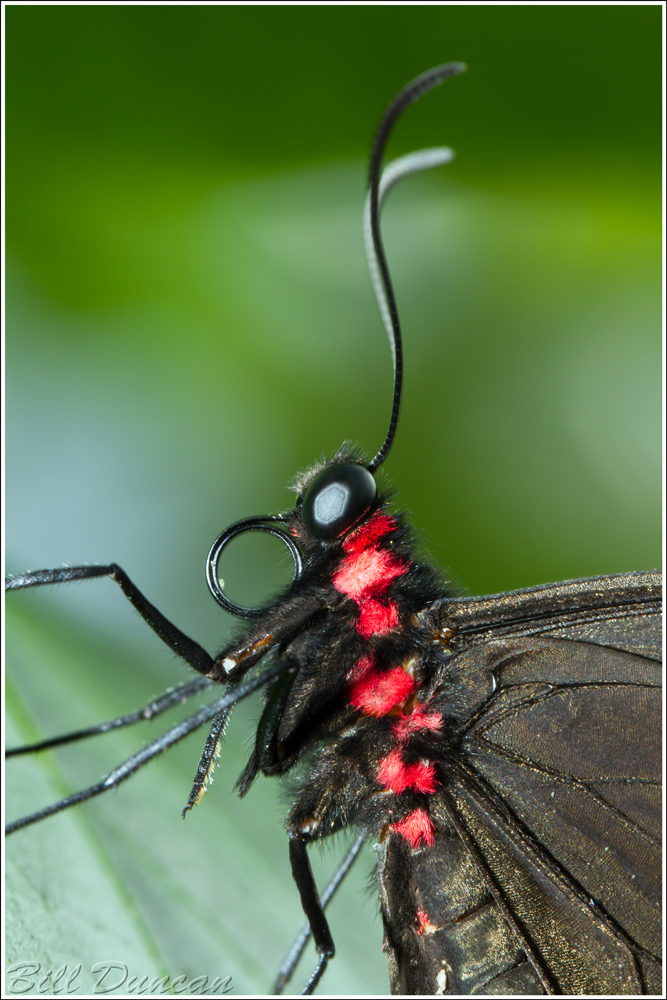
There are many techniques and equipment combinations one can use for macro photography and I have used several different combinations and techniques.  For insects, distance is obviously important and focal length and focusing distance should be a primary consideration when making your decisions about what equipment to purchase.

Technical details: Canon EOS 7D camera, EF100mm f/2.8L Macro IS USM lens, ISO 200,  f/11, 1/40 sec

I would love to see the Butterfly House have one or two “photographers hours” a week.  I picture a day where they open the house early for an hour or so for only photographers.  There would be no school groups, no kids trying to rip the animals wings off.  This could be a great opportunity for us to get some great practice in for the summer insect season.

Technical details: Canon EOS 7D camera, EF100mm f/2.8L Macro IS USM lens, ISO 320,  f/16, 1/60 sec

Location Spotlight: Johnson’s Shut-Ins State Park

Located near Graniteville in Reynolds Co, MO Johnson’s Shut-Ins is one of the largest and pleasingly aesthetic shut-ins found in the state.  This is another spot found in the geologically intriguing St. Francois Mountains of the Missouri Ozarks.  Formed by one of the meandering forks of the Black River, cascades, chutes and potholes have been formed in Taumsauk rhyolite, the ~1.5 billion year old rock that makes up the majority of this spectacular geologic feature.  This rhyolite, which is a cousin to granite, is extremely hard and resistant to wear, so the water acts mostly upon joints or fractures in the rock and carves these areas down smooth to form the Ozark’s recreational fun zone that many people enjoy today.

Technical details: Canon EOS 50D camera, EF17-40mm f/4L USM lens @ 17mm, ISO 100,  f/16, 0.6 sec

Unfortunately, this park was irreversibly changed following the December 2005 disaster when a wall of the Ameren UE hydroelectric reservoir failed and a resulting 1.3 billion gallons of water ravaged the Johnson’s Shut-In SP and surrounding area.  This water rushed down the hillsides in less than 12 minutes.

Technical details: Canon EOS 50D camera, EF70-200mm f/2.8L USM @ 105mm, ISO 100,  f/13, 2 sec

A true example of an anthropogenic induced disaster upon nature, the water scoured everything in its path down the Profit Mountain slopes to clean bedrock.  This resulted in the loss of near pristine habitat that made up several officially designated Natural Areas, but has given geologists an interesting, uninterrupted view of the granites, rhyolites, sandstones and dolomites that are the primary rocks of the St. Francis Mountains.

Technical details: Canon EOS 50D camera, EF17-40mm f/4L USM @ 17mm, ISO 100,  f/16, 1/8 sec

Do a web search to view images immediately following the disaster and you can see it is amazing that the area was able to be cleaned up and facilities rebuilt to the current state that they are about six years later.  There is a boulder field near the current entrance to the State Park.  I was told by a Park official those boulders weigh in the neighborhood of three to 30 tons a piece and that none of them are close to the same place they had been prior to the disaster.

Technical details: Canon EOS 50D camera, EF17-40mm f/4L USM @ 38mm, ISO 100,  f/16, 0.3 sec

I’ve seen some amazing photographs taken before the reservoir collapse contrasting the shut-ins against maple trees in brilliant autumn foliage.  It seems most of the maples around this spot are gone and there hasn’t been a very good autumn show here in the four or so years I’ve been interested in nature photography.  This is a real shame.  However, when I think about these types of disasters, whether man-made or natural I try and put it into a geological or biological perspective.  In these perspectives this type of disaster is a temporary change or setback.  In the equivalent moment of a breath of the earth this type of activity will be erased from the landscape and nothing but the slightest evidence or mere suggestion of this event shall be evident.

Of course, with the continuing onslaught of the human landscape, these events, multiplied over small number of generations are leading to devastating changes to the biosphere and are adding up to what looks to be one of the six largest extinction events in history.  Considering the primary purpose of this reservoir is to provide extra power to the St. Louis Metropolis, it makes me wonder how long civilization will continue to take and take from the commons without giving serious consideration to the important things.

Technical details: Canon EOS 50D camera, EF17-40mm f/4L USM @ 17mm, ISO 100,  f/18, 1/4 sec

Do I have to say this is a location I will be visiting for as long as I’m able?