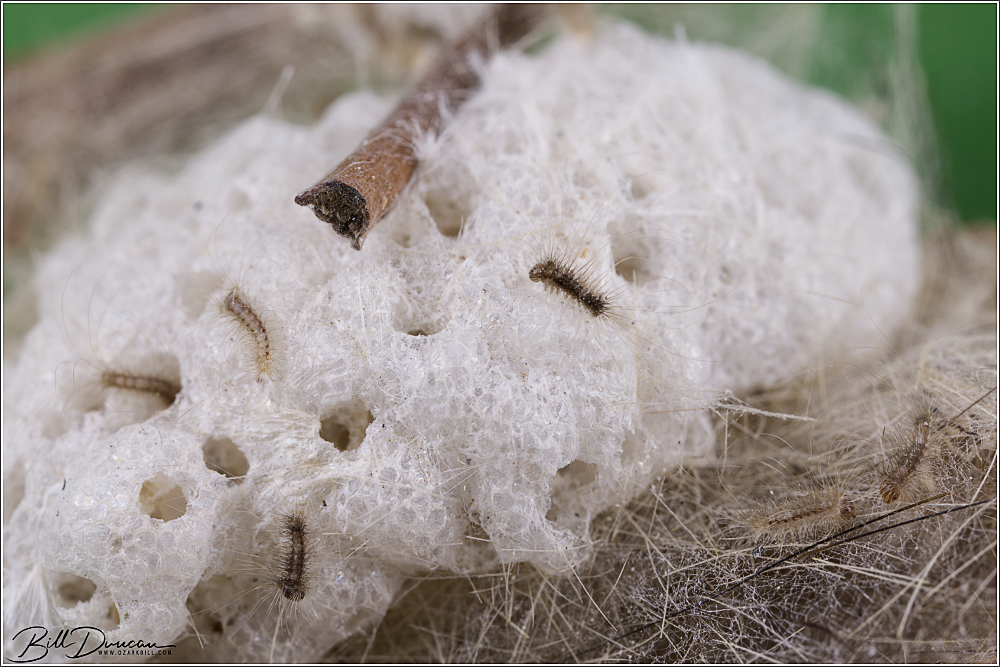
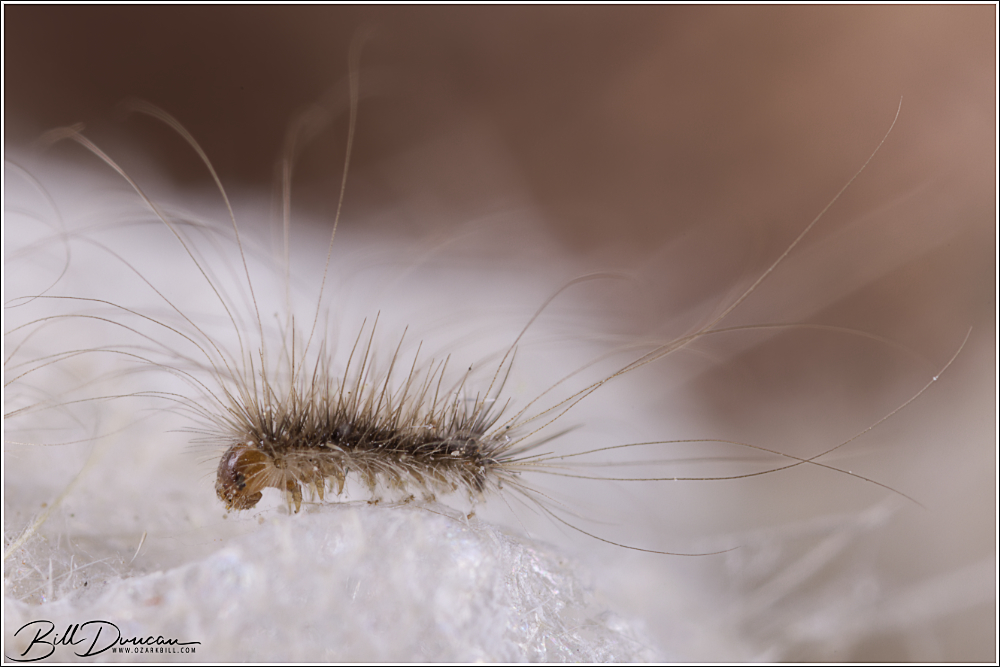
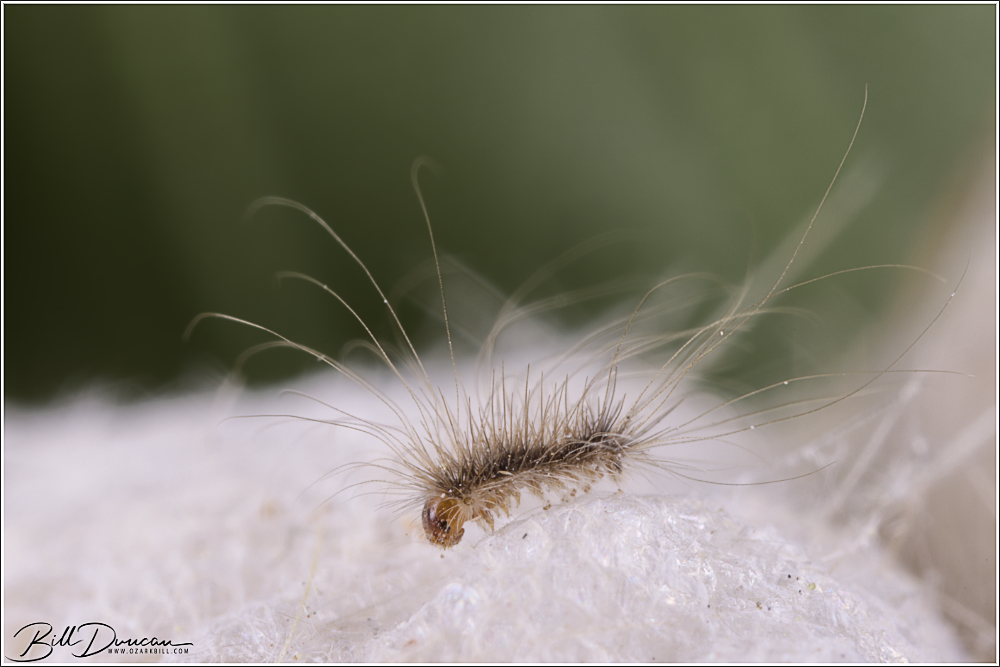
Orgyia leucostigma babies!

I posted about the Orgyia leucostigma (white-marked tussock moths) that I reared last year to adulthood and documented their breeding and oviposting on my back porch. In mid-April, the young had emerged from their egg case after overwintering on the porch. Here are some photos of these extremely tiny little ones. It was a pretty difficult task as these guys were not much larger than an average grain of sand. Additionally, shortly after emerging they just wanted to spin a thread and balloon away on the wind, which is their primary method of dispersing. I used a small paintbrush to try and gently move them to some leaves, but their threads would quickly get wrapped around their long setae. After getting some photos, I left most of them to disperse in the backyard.

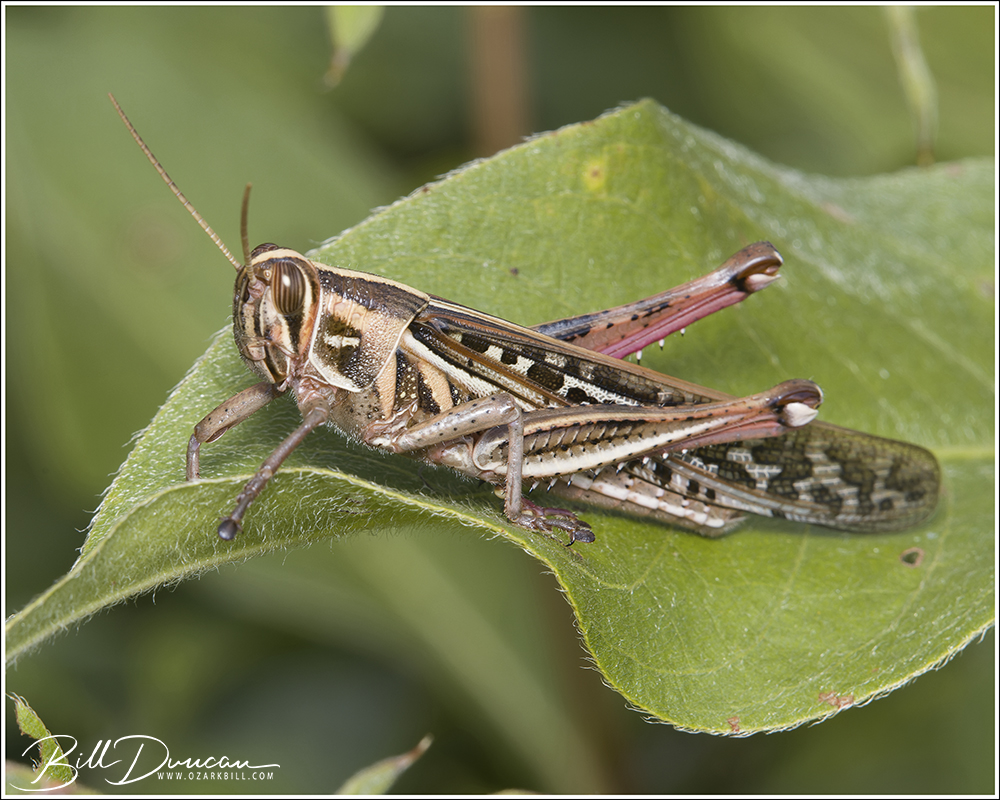
A Trio of Hoppers

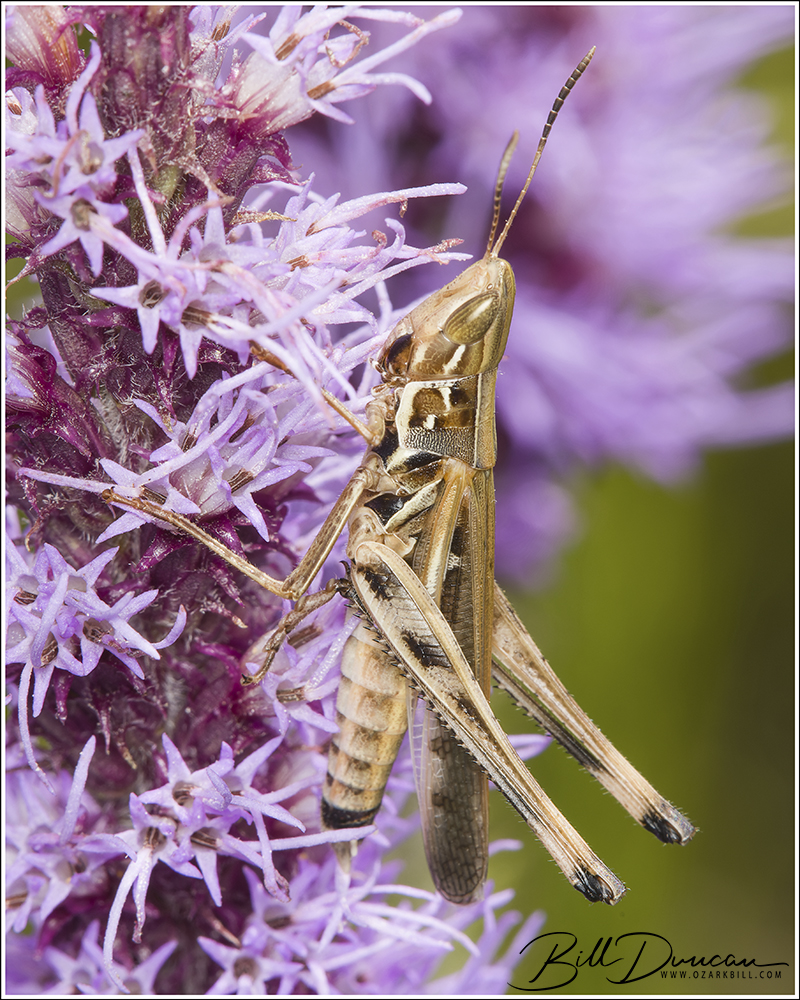
Here are a few handsome Orthopterans from the 2023 season.

Syrbula admirabilis, is known by the common name – admirable grasshopper. Photographed at Horn Prairie Grove LWR.
Orchelimum nigripes, the black-legged meadow katydid prefers wetland habitats. This individual was found at Marais Temps Clair C.A. in St. Charles County, MO.
This American bird grasshopper (Schistocerca americana) was also photographed at Marais Temps Clair C.A. in St. Charles County, MO.

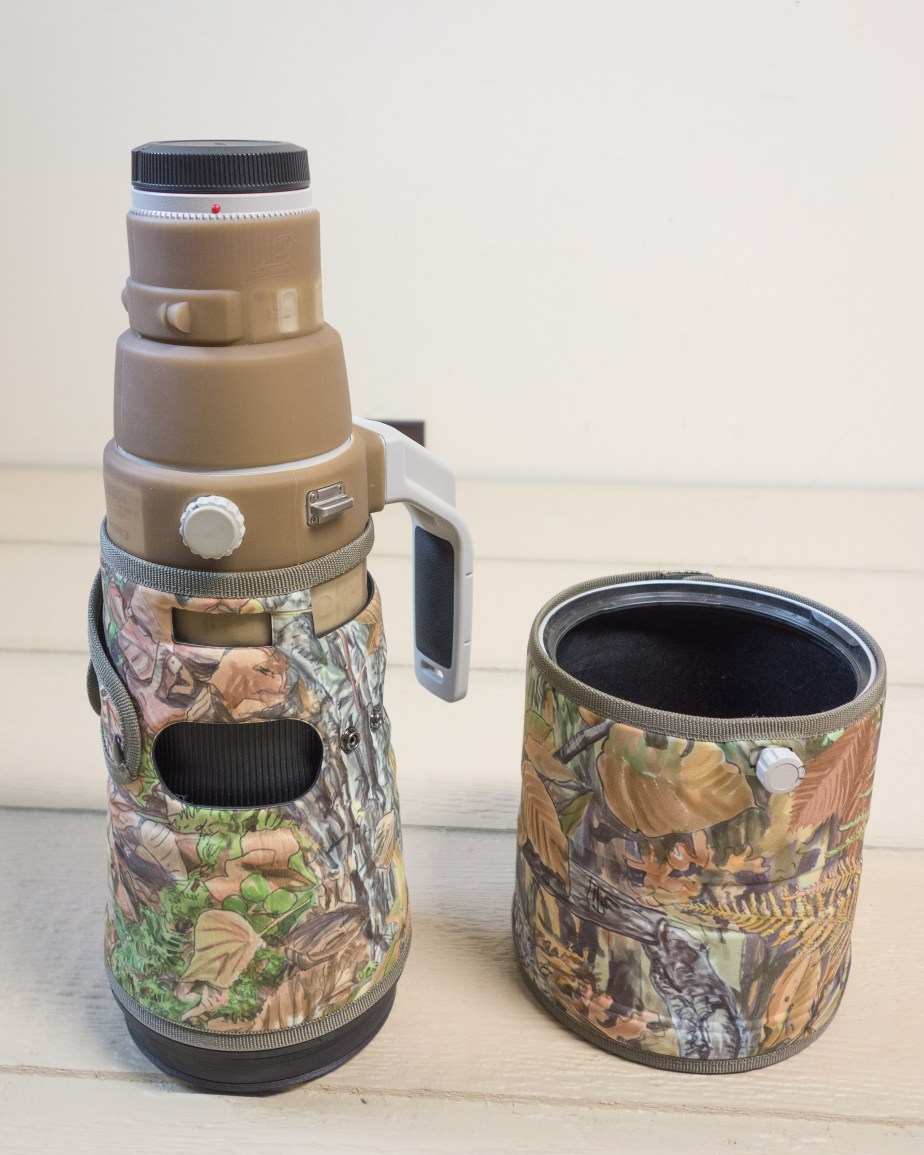
For Sale – Canon EF 500mm f/4L IS II USM

About a year and a half ago, I moved into Canon’s mirrorless platforms with the full-frame Canon R5. It’s been a fantastic body but the one thing missing was not having the extra reach that the crop-sensor of my 7D mkii provided. Since it doesn’t look like Canon is planning on coming out with a semi/pro APS-C body in the R mount anytime soon, I made the decision to do something even better and upgrade to the 600mm f/4 lens. Consequently, I am selling my Canon EF 500mm f/4L IS II USM.

Asking price is $5,250 – non negotiable and for local buyers only at this time. To see more photos and information, please see my Facebook Marketplace listing.

OZB’s Favorite Images from 2013!

Yeah, I know.  We are almost through two months of 2014, however that’s possible.  But, I really wanted to make a post like this (I still don’t have all of 2013’s images processed) .  I know it’s popular in the photo-blog community, but I think it really is a nice way to cap the year.  I had quite a time in narrowing this list to ten.  I’m not saying these are my best images of the year, but these are the ones I found to be the perfect combination of capturing something special, being meaningful for me and being at least competently captured.  Follow the links to the posts that each image was featured in.  I apologize to the images that did not make the list.  😉

Here we go…

#10) “Confluence Contradiction”

Taken on a trip to Big Spring this April, this one was something I had never seen in all of my visits to this feature.  Sarah and I were really excited to see the Current in high water and I was lucky to make this image before the water from the river had overtaken the blue colored spring effluent later on this day.

10

#9) “Autumn Regality”

Taken early one cloudy autumn morning following an evening storm, the diffused light, and saturated foliage worked well with the complacent attitude of the alpha buck.

9

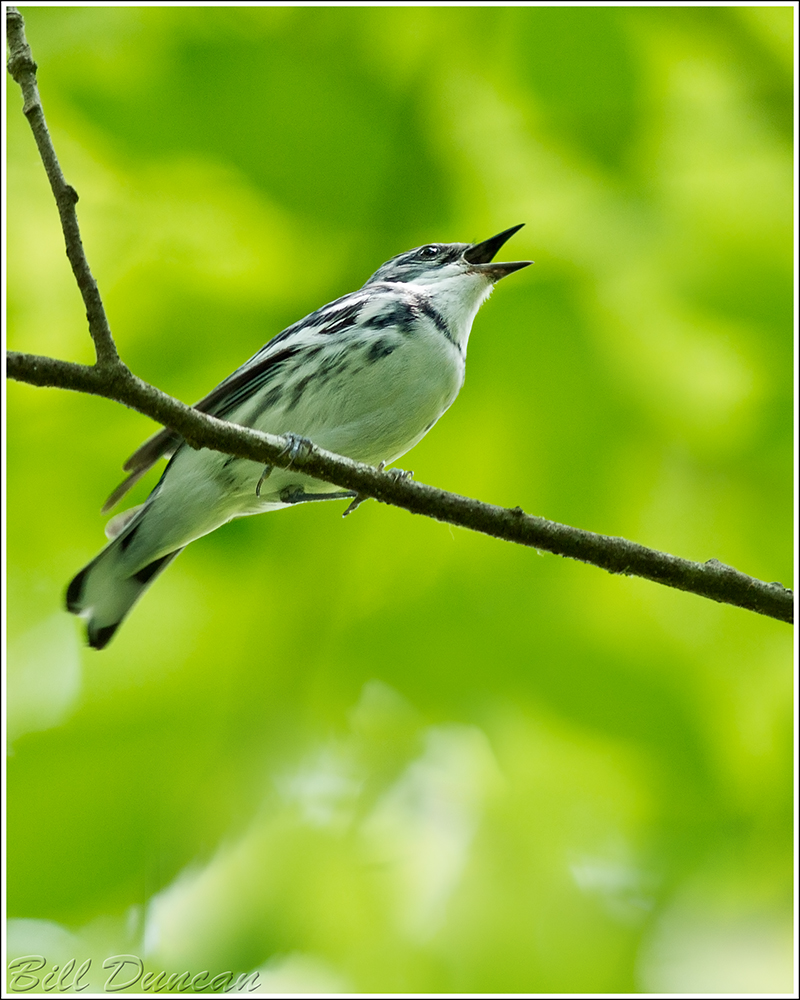
#8) “Singing Cerulean”

Observing multiple Cerulean Warblers was one of several things that made putting up with the heat and insects worth our while.

8

#7) “Greater Prairie Chickens in Flight, February 2013

Lifers for both Steve and me, spotting and photographing two of Missouri’s literal handful of Prairie Chickens was the highlight of our trip to Prairie State Park last winter.

7

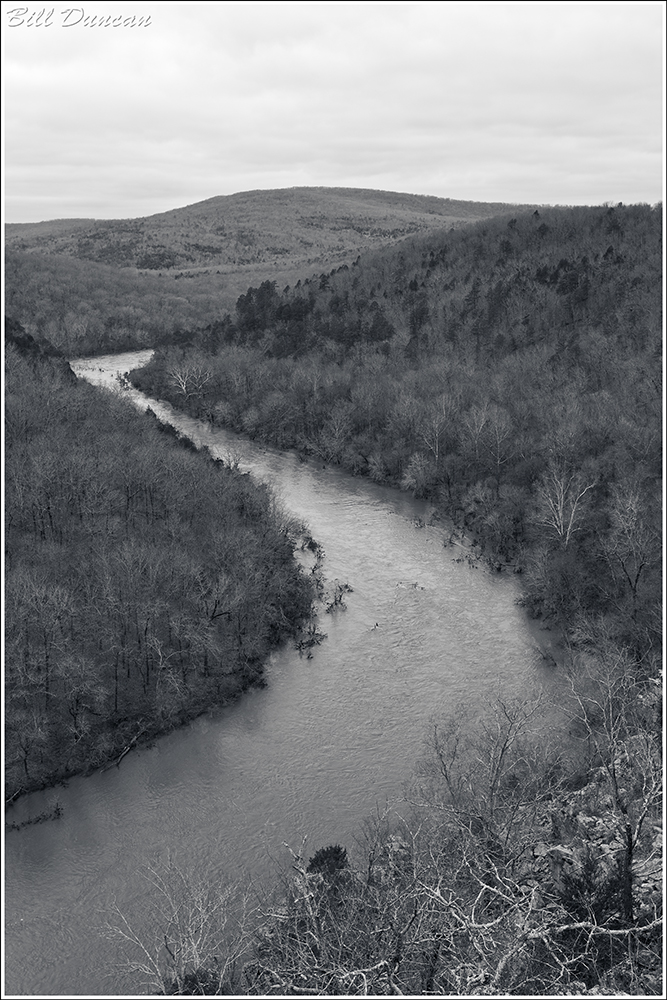
#6) Untitled composition taken at Lee’s Bluff on the St. Francis River

This was a recent finding for us, and one in which I hope to get back to soon and often.  This relatively easy S-curve was but one of many potential compositions that I tried to capture.

#5) Untitled composition of Short-Eared Owl

I’ll never forget the day when we were able to watch multiple SEOW up close and personal.  The highlight was taking a shot of this one perched on an MDC sign at B.K. Leach C.A.

5

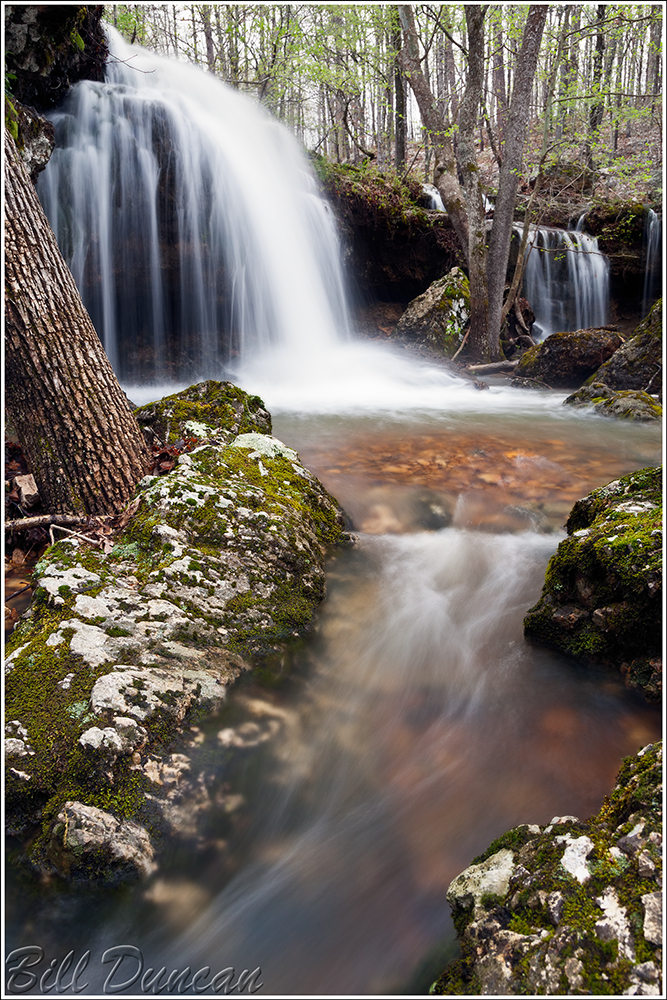
#4) “Coward’s Hollow”

I had been looking for this spot since I first started exploring the MO Ozarks several years ago.  This year I was able to find it, and just after an incredible amount of rain!

4

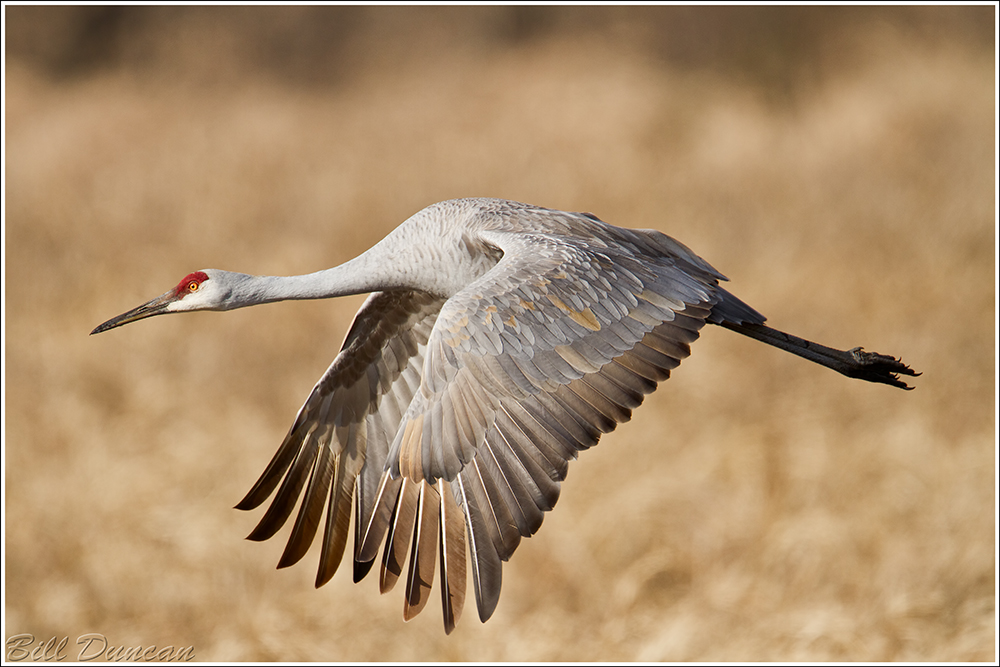
#3) Untitled composition of Sandhill Crane in flight

Taken with my newest bird lens, I was in the right place at the right time to squeeze off this keeper.

3

#2) Star Trails at Dunn Ranch Prairie

Among so many other unforgettable experiences from Steve’s and my trip, the chilly July night spent working on my first serious attempts at astro-photography ranks near the highest from 2013.

2

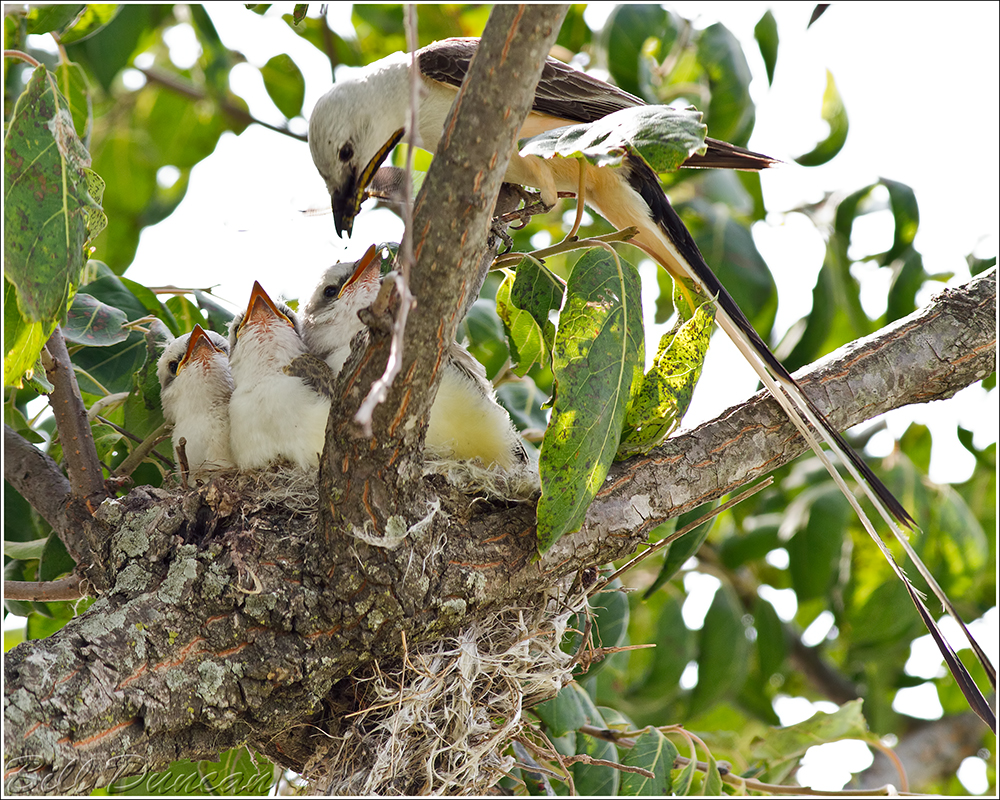
#1) “Are You Sure It’s Dead?”

With my medically documented disorder for decision making, it’s an official miracle that I was able to narrow down the subject and the specific image for the top spot in my favorite images of 2013.  Finding such a nest at just the right place and time to observe these parent Scissor-tailed Flycatcher raising a healthy brood was such serendipity.  This image was taken at Tucker Prairie C.A., the first stop of this particular journey.  We were torn between watching these guys until fledging and heading on to the other great spots along our route.

Well, I hope I did my 2013 collection justice with this list.  I can’t imagine 2014 could top the experiences of last year.  If the experiences and associated photographs of 2014 even come close in comparison, I will truly be a fortunate creature.  Happy New Year.

Ozark Bill

1

The Ascent

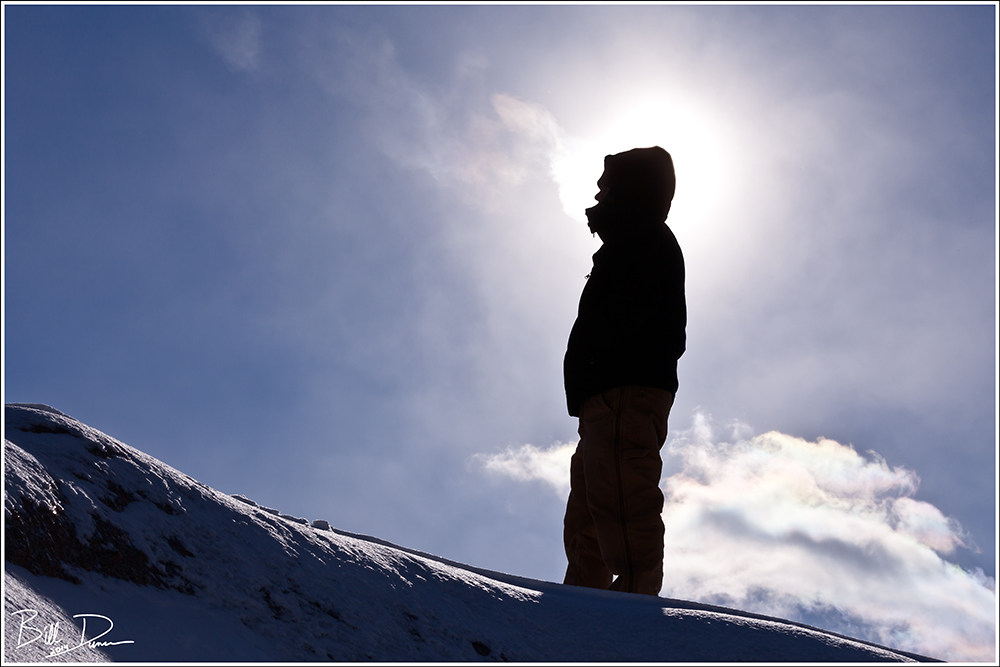
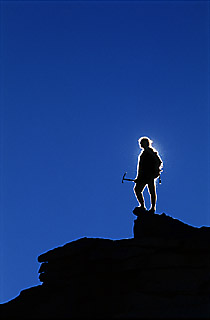
No, Steve and I did not take a daytrip to make it to the summit of K2 or one of the other Himalayan peaks, although we easily could.  This image was made on one of this winter’s sub-zero days at Elephant Rocks.   I had an idea of the image I wanted to make that may showcase an optical effect that Galen Rowell made famous called “diffraction fringe“.  By putting oneself in the shadow of your back-lit subject at just the right difference and position, one may see a ring of hot light that outlines the silhouette of the subject.  This proper geometry of sun, subject and camera (including optical settings)  is just one requirement to observe and capture this effect.  The other, as far as my understanding allows is the need for dry, clean air.  On this particular day we had temps below zero degrees Fahrenheit and the air was as dry as could be with no interference from any noticeable smog.  With the air quality requirement met, it was simply a matter of trying to position the model (Steve) at the correct position between myself and the sun.  This part was more difficult in this setting and ultimately led to us missing our ultimate goal.  Trying to work this out in minus 30 degree windchill proved our undoing.  I could only ask Steve to climb so many boulders in this type of weather, which seemed to be increasingly affecting our mood and thought process the longer we were in these elements.  Ultimately, I did not achieve the diffraction fringe.  I am not sure as to the reasoning for this failure.  I feel the geometry of our positioning, afforded by the placement of boulders and the limited availability of where I could position myself was the biggest factor.  Getting the required distance that I believe necessary was impossible.  Other factors that could have played a part were not having the most appropriate focal length and aperture settings, the air quality not being as suitable as I thought and perhaps the quality of the optics I was using.  Many of these optical phenomena are the result of imperfection in lens design.  Galen took most of his images with older generation optics that were often lower quality compared to today’s standards.

I’m not exactly sure what the reason for the failure in acquiring this diffraction fringing was. I guess this was just a very long explanation of an image I thought turned out to be pretty successful anyway.  I look forward to trying this one again one day.

IMG_7743

Blue-Grey Gnatcatcher Nest at Shaw Nature Reserve

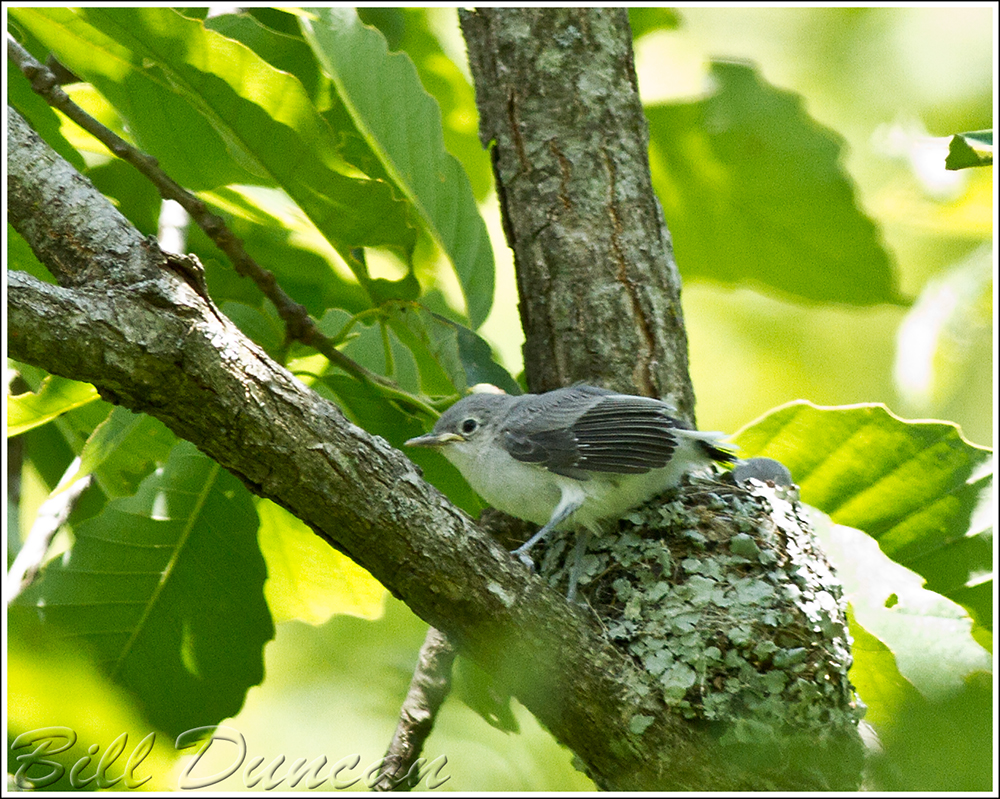
I made a couple posts earlier this year regarding a BGGN test that we discovered at St. Francois State Park.  Later, in early June, Steve and I found an active and very successful nest located in a Chinquapin Oak in the savanna-glade area of SNR.  These busy parents were looking to successfully raise five new Gnatcatchers!  One or two of the chicks were leaving the nest for brief occasions and it looked as if the chicks were within days of fully fledging.   Gnatcatchers move so fast that without finding a nest, it would be most difficult to ever catch them in a photo.  It was a real treat watching these guys and I hope you enjoy a few moments of this day.

The first we noticed of this scene was a plumper than normal Gnatcatcher sitting on a branch.  Since plump and sedentary are never adjectives I would use to describe this species, it was cause to make further observations.  Moving around the tree a bit afforded a bettter view and allowed us to find the nest in the crotch below.

IMG_6852

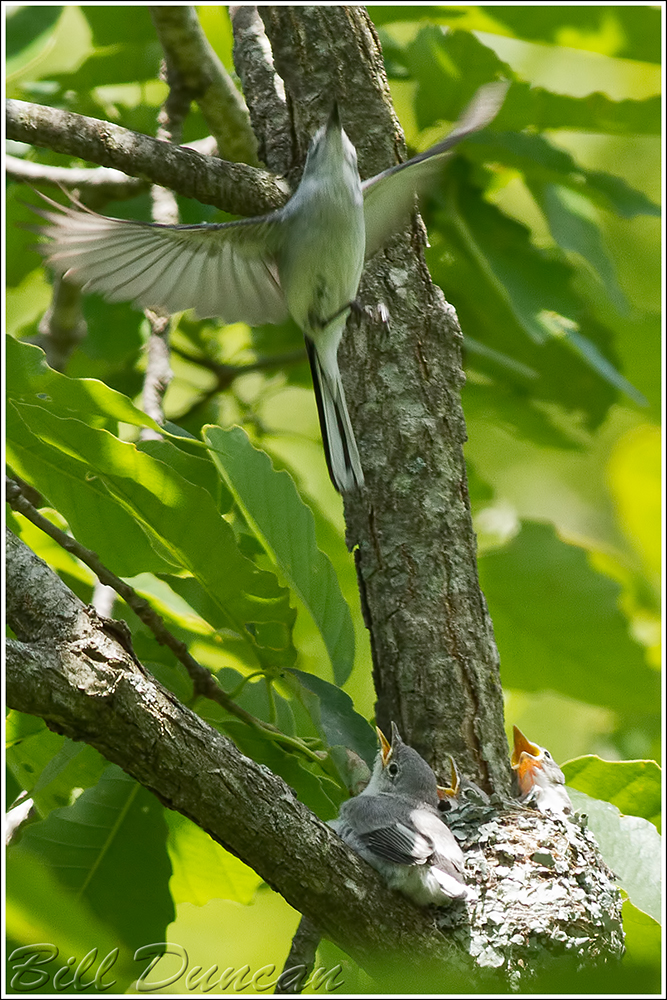
Here you can see the primary difference between the chicks and their parents.  The chicks lack the impressive, long tail of the adults, so perfectly used in tight flight and balance.

IMG_6981

Both parents work feverishly.  Below you can see both parents at the nest at one time, dad above and mom below.  In this photo, somehow, all five chicks are in the nest bowl at the simultaneously.

IMG_6982

Master insect hunters, this image shows mom offering a large green lep to the nest.  You can’t get any closer to actually eating your greens… 😉  Once again, all five chicks are in the nest.

IMG_7044

Finally, off flies one of the parents.  If it’s bright enough to see, it’s bright enough to hunt.

IMG_6935

The Scour

An infra-red look at the scour in the earth resulting from the collapse of the Taum Sauk Reservoir on Profit Mountain.  The IR treatment really pronounces the newly constructed reservoir as the dark monolith to  waste that it is.  The clouds were caught just perfectly as the light is approximating the same path that the 1.3 billion gallons of water took on it’s way down the Mountain.  In the foreground are young cottonwood and sycamore that have started since the flood in 2005.

IMG_6028

The Scour

A Walk Through Blue Spring Natural Area

This past June, Steve and I took a walk through one of the highest quality woodlands our Ozark hills have to offer.  The short hike from the head of the spring to the Powder Mill trail-head and back offered an amazing diversity of life.  Here are just a few of the things we were able to find and capture on camera.

Nothing can be mentioned about this location without first discussion of the spring itself.  The Osage Indians referred to it as “Spring of the Summer Sky”, a most apt description for a spring who’s appearance defines the color blue.  And in summer, when the flow is not overly encumbered by the suspension of dissolved limestone from heavy rains, the crystal-clear waters afford a look to the bottom of the spring, some 250 feet below the pool’s surface.

IMG_4637

“Blue Spring Run”

The small nooks and crevices carved over the ages into the limestone and dolomite that overlook the spring pool make the perfect shelter for the Eastern Phoebe to make their nests.  Most folks have likely seen the nests of this species under overhangs on human-made structures.  It has only been within the last year that I have been fortunate enough to observe these nests in their more natural of settings.  A perfectly placed snag within the spring’s pool makes for a fine resting place for a young Phoebe that is taking a break from the carrying on that was taking place near these nests.  It was also a great place and time for us to take a break and take in everything this spot has to offer.

IMG_7194

Eastern Phoebe on a Snag

Back on the trail a few minutes later Steve and I were pleased to find this guy.  A first for the both of us, this Dung Beetle was moving this “resource” with full conviction.  We couldn’t figure out where she was moving it, but she was sure not going to let us get in her way.  When gently stopped she would climb to the top of her ball and let it be known that it was claimed.

IMG_4656

King of the Hill

Here’s a little “motion pan” to give an idea of the speed at which she could move her grocery towards its future larder.

IMG_4662

The Cache”

Our primary goals for this early summer day where to see if we couldn’t find and photograph any or all of three of the more rare warblers that are known to nest in this area.  These would be the Swainson’s, Cerulean and Hooded Warbler.  Although we did get a few confirmed vocalizations from a Swainson’s, we could not get our eyes on the sneaky guy through all the vegetation.  A few quick and loud playbacks did, however, coax 4-5 male Cerulean Warblers to descend from the forest canopy in order to meet the new male who had apparently set up shop amidst their territory cluster.

IMG_7493

Singing Cerulean”

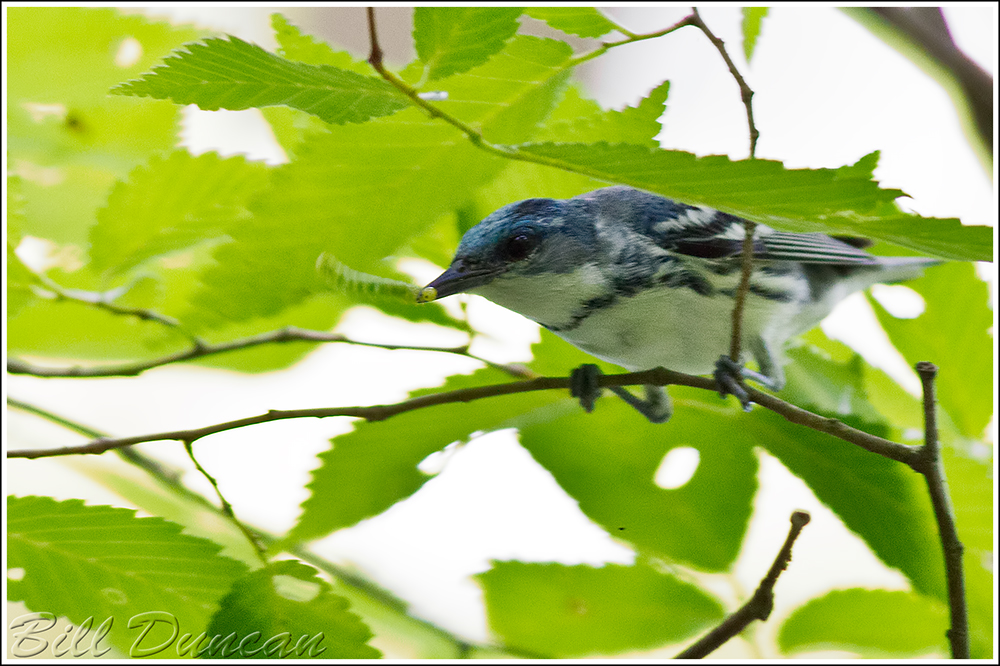
This was a sweeter treat for us than spending time with Willy Wonka (Wilder not Depp) and Heather Graham in a chocolate factory.  They seemed totally curious and intrigued as they moved among lower branches, foraging and singing as they went.  Did you know this species has suffered more than 70% population decline since the 1960’s?  Approximately 500,000 birds are the current population estimates and habitat destruction and fragmentation continue to threaten this species.  Check out The Nature Conservancy for more information on this great bird, and consider checking out Cerulean Blues.

IMG_7329

Cerulean with Insect

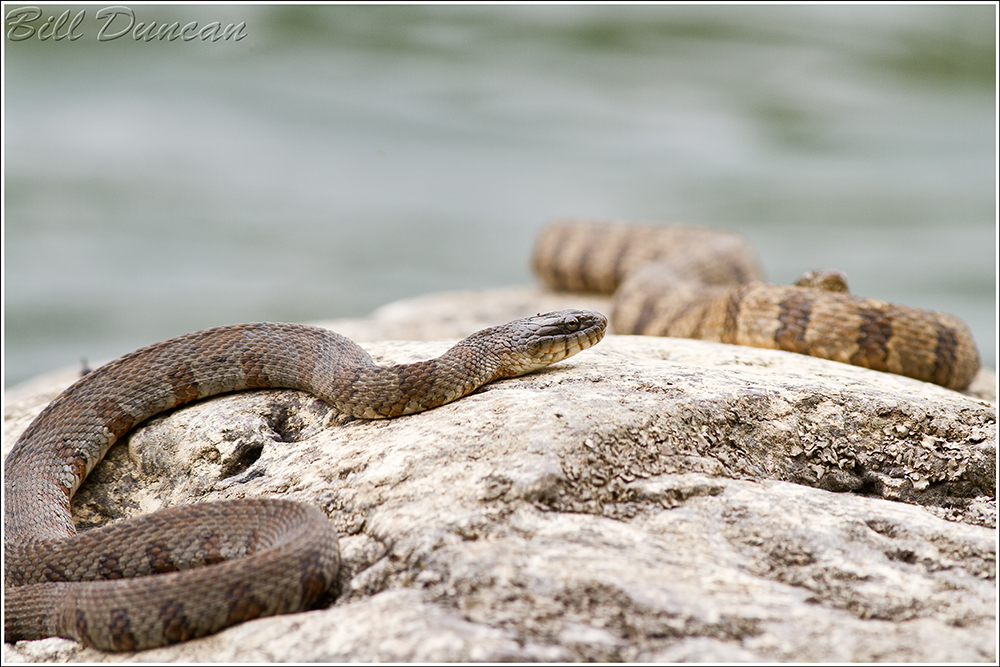
Finally, I present a pair of gorgeous Northern Water Snakes that were basking on some exposed rock not to far from shore along the Current River.

IMG_7563

Basking Water Snakes”

They’re Allowing Ozark Bill to Present in an Art Show!?!?

SNR Art Show Advert 1

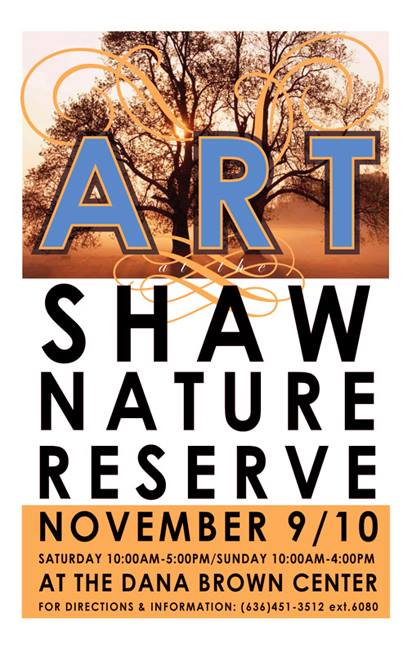
That’s right my friends.  I am excited to announce that OZB will be presenting his work (~75 unique prints will be available) at Art at the Shaw Nature Reserve 8th Annual Show & Sale to be held this autumn.  I would love to meet and say hello to all of you who have given me support through our relationships via Flickr and A Thousand Acres of Silphiums over the years.  Don’t worry, there will be real artists there as well!  😉  So, if you are willing and able to be there, I look forward to meeting you in person!  Here are directions to SNR.

1167659_598533243503251_896997702_oI would also like to announce that Ozark Bill is now on Facebook!  It is definitely a work in progress, but for now, I am posting what images will be available at the show.

Dunn Ranch Prairie, July – 2013 Post One: Astrophotography

I had been wishing to visit Dunn Ranch Prairie in Harrison County, Missouri for a few years.  Part of the Grand River Grasslands, Dunn Ranch, along with Prairie State Park to the south is one of the two largest contiguous prairie habitats in Missouri.  Fortunately, Dunn is home to about 1000 acres of original, unplowed prairie alongside parcels that are in various stages of prairie reclamation via reconstruction activities by The Nature Conservancy staff.  With help from contacts at TNC (Hi and thanks Amy, Hillary and Randy!) and a recently found twin brother, Steve, who is as willing, able and interested in getting elbows deep in whatever Nature and the outdoors puts in our path, I had that opportunity as part of a five day excursion to the western half of the State.  We made stops to visit other prairie and marsh remnants nearby, but Dunn Ranch and adjacent Pawnee Prairie were our base.  I hope to provide tidbits of information about these endangered habitats and discuss some of the trials that TNC faces in these reclamation efforts and provide hopefully interesting accounts of Steve’s and my excursion in future posts where I plan to discuss birds/wildlife and landscape photography.  This first post is dedicated to astrophotography.
IMG_5168

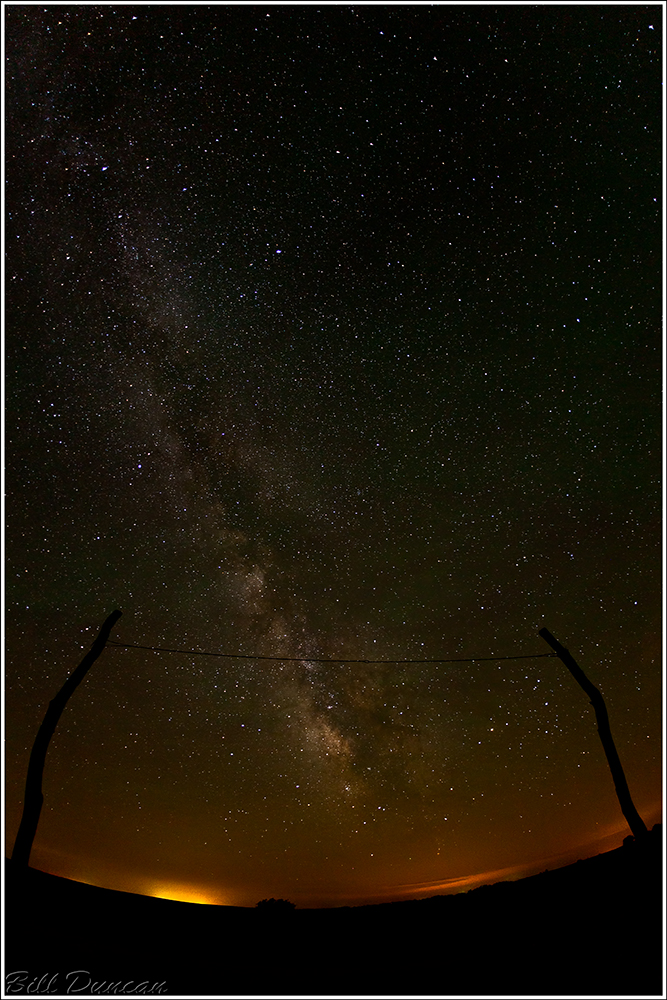
Astrophotography has been of interest to me for some time now.  Being born and raised in urban environments, I can count on one hand how many times I’ve been able to witness a dark, clear sky – relatively free from light pollution.  Making images of this type of sky was one of the major goals for this trip.  Even without the aid of telescopes and tracking mounts, astrophotography with the dSLR can be a fulfilling challenge.  I scoured the web for months prior to the trip, trying to find techniques and tips for success.  With so much to consider, I knew this was going to be a mostly trial and error experience.

The internet is full of great “how-to” articles on how to go about making nice astrophotographs, so I will not go into too much detail.  We were fortunate in a number of ways concerning the environmental conditions for this endeavor.  First, obviously, one needs clear skies.  The first couple of days (and nights) were a bit overcast, but on the night all these images were taken, we had a mostly clear sky.  Second, for taking photos of stars, it is optimal to have little or no moon.  On this particular night, the moon was just a couple days past “new”.  But, that did not matter because the moon was almost in perfect sync with the rising and setting of the sun.  On this night, the fingernail moon was below the horizon by 10:00.  So, we had two important factors in our favor.  Other issues to consider are light pollution from ground sources.  We thought we were on the winning side here, being so far removed from any city of significant size.  What we came to discover is how much the camera’s sensor will pick up artificial light sources.  Even well past midnight, all the images I made show glow from the horizon, illumination that was not noticeable by the human eye.
Startrails Dunn 1

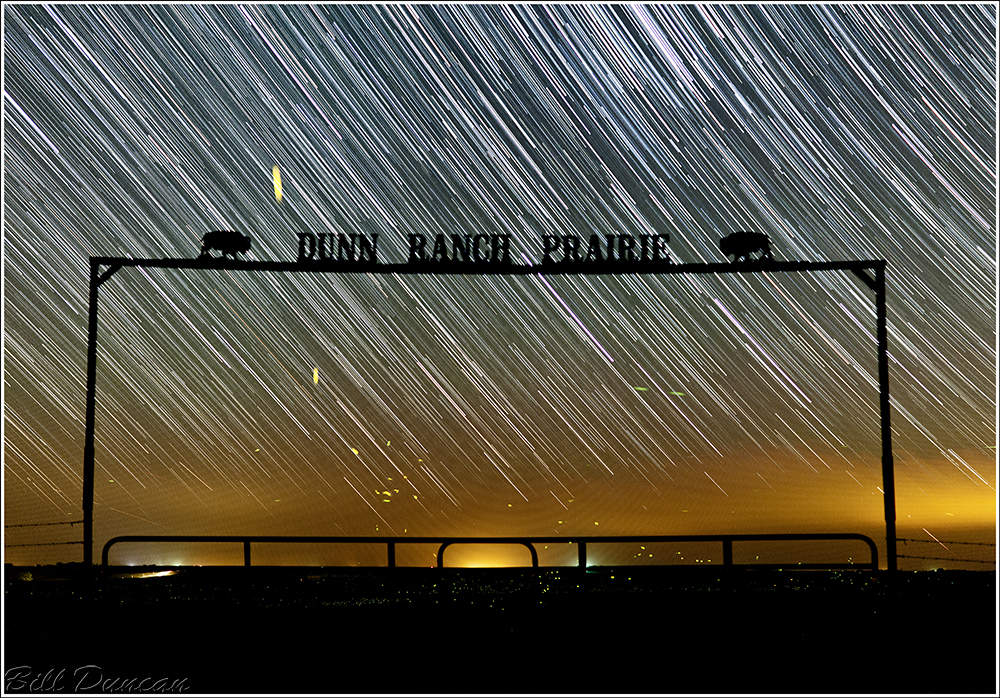
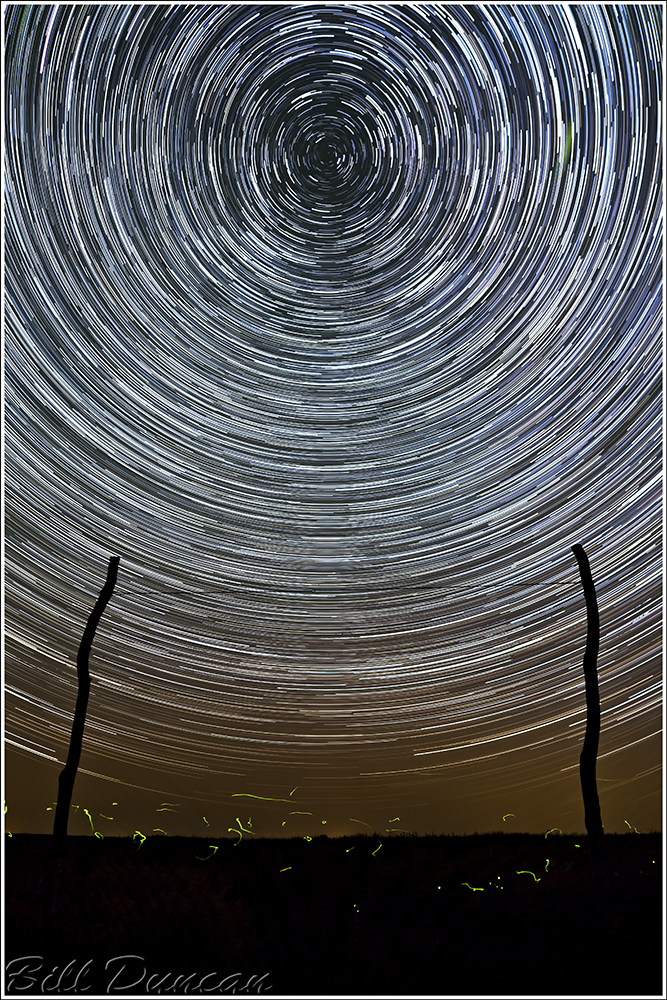
One other potential headache for consideration is aircraft and satellites moving through your frame.  Depending on the specific technique you use to create a star-trail image like the one above, you will either have one long exposure of up to an hour or longer, or a series of shorter images taken in continuous fashion and combined later in the computer.  Either way, in most areas of our country you will pick up the light signatures of these aircraft in your images.  I was quite surprised by the numbers of these trails that were picked up on the camera’s sensor.  In making the two composite-made star-trail images in this post I spent several hours painstakingly removing these by hand from hundreds of individual images used to generate these composites.   The yellowish green lights are trails from lighting bugs that collected over these images.  I decided to leave these alone.
IMG_5561

Although it may be pretty, a photograph of the stars alone with normal focal lengths usually holds little lasting interest.  I knew that to make something interesting and to relate it to place, I needed to find something unique and attractive to position in the foreground.  This would make a complete image.

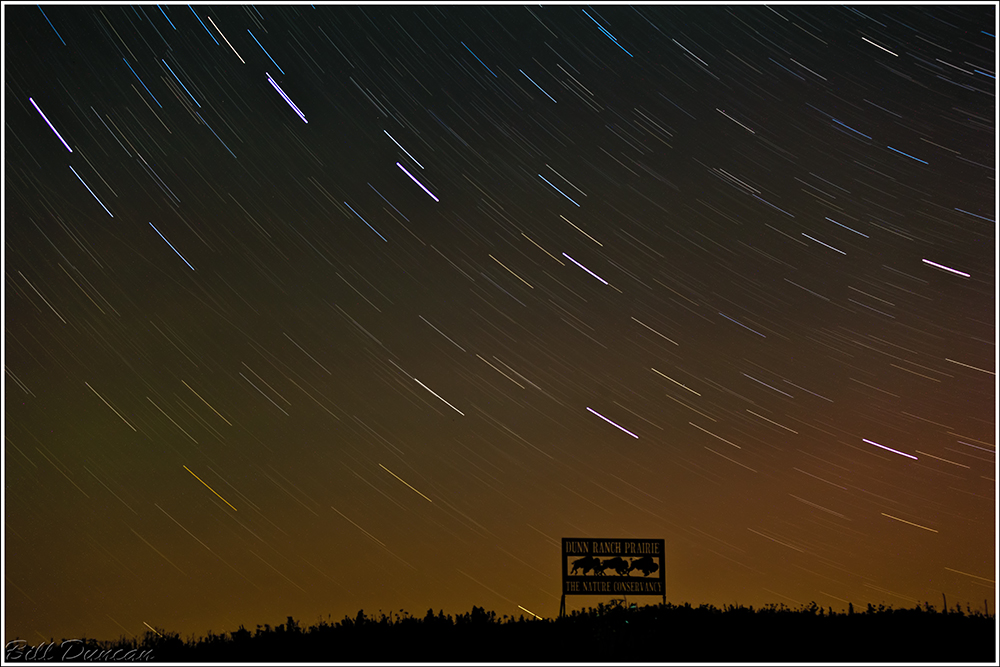
The couple of days or so before this evening, I was checking out the landscape around Dunn, looking for these potential foregrounds and asking Steve to help me remember their locations and the general directions in which they faced.  These cut-steel/iron signs were quite popular with the different ranches in the area and I assume someone makes them locally.  I fell in love with this one on a prairie hillside at Dunn and knew I had to try this.  Unfortunately, this was getting quite late into the morning and I did not have the energy left to give it my all.  I used a longer focal length because of the distance of the sign from the road.  This gives a somewhat pleasant side effect of allowing for star trails to record in less time than it takes for a wide angle composition.  This image is one exposure of about 11 minutes.  If I had known the potential here, I would have given it more thought and probably put together a longer composite series to lessen the horrible noise and IQ observed in the RAW image.  Oh well, maybe next time.  Oh yeah, in this photo, the light pollution from the horizon works pretty well in back-lighting the sign and making some nice silhouettes of the prairie forbs.  We tried a bit of light painting, but it came nowhere close to this.

P.S. Can you name the constellation caught in this image above?
Startrails Dunn 2B

The image above I believe is my favorite of my astrophotography attempts.  I wish I could say I did my homework and knew exactly where the north star was and positioned it oh so perfectly between the gate posts.  Steve and I could not say for certain (Do you know how many stars there are up there!?).  All I did was try my best to center the gates in the middle of the frame as best we could in this dark night.  I wish I could say I knew exactly how long (how many exposures) I wanted/needed to get the rotating perspective seen here.  All I did was decide that I would try and fill an entire eight gig memory card.  This equated to about 350 13-second exposures for a total “exposure time” of about 75 minutes.  I did not even know how I was going to stack these together in the computer.  I knew there were a few specialty software as well as a manual option in PS.  I tried three different freeware apps and discovered the last one I tried, “Startrails” gave me the best results.  Anyway, this image will always remind me of sitting in the road with the camera doing its work, enjoying a couple of good beers with Steve and listening to wildlife: coyotes howling on three sides of us in the distance, Henslows Sparrows singing like it was the middle of the day and a presumable deer that walked just off the road past us less than 10 feet away.  I have no idea if the deer could see us or knew that we were there.
IMG_5566

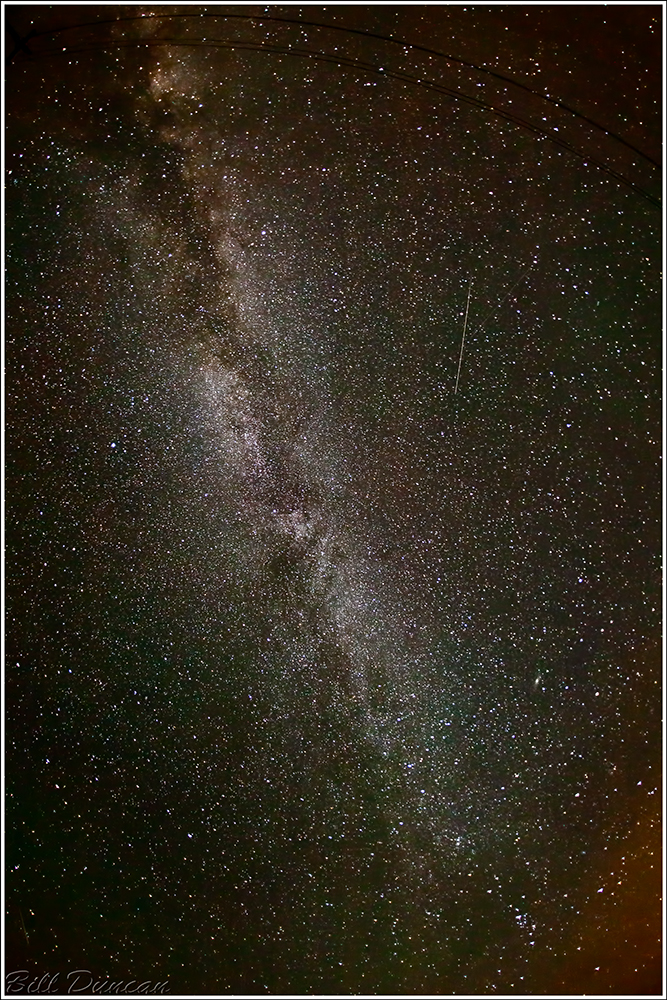
I say with all sincerity that I would trade the benefits of living in a large metropolitan area just to have the privilege of viewing night skies like this on a regular basis.  How did we agree to give this up?  I guess this issue ranks up there with the question of my foreskin.  Nobody ever asked me and I’ll likely never have the opportunity to get it back. ;=)

Anyway, this was one hell of an experience and I can’t wait to give it another try.