Seven Days of Mina Sauk Falls – Day Three

Technical details: Canon EOS 7D camera,  EF24-105mm f/4L IS USM lens @ 40mm, ISO 200,  f/11, 1/4 sec

It wouldn’t be a trip to the St. Francois Mountains in January through March without finding some Ozark Witch Hazel in bloom.  These small shrubs love the sandy, acidic soils found along streams in this region.  The flowers of these guys really put out some fragrance!  If you find yourself in a large patch of these during a particularly warm day, the smells of vanilla and other sweet spices and floral notes can almost be overpowering.  In this image, I tried to feature a branch of one of these plants that carries both new blooms from this year along with spent fruit cases from last year – many of which that still hold seed.  I used a gold portable reflector to increase the warmth of the branch and its flowers.  This branch is featured nicely in front of a couple of picturesque falls that can be found high on the set of falls and cascades that make up Mina Sauk.

Seven Days of Mina Sauk Falls – Day Two

Technical details: Canon EOS 7D camera, EF-S10-22mm f/3.5-4.5 USM lens @ 10mm, ISO 160,  f/14, 0.6 sec

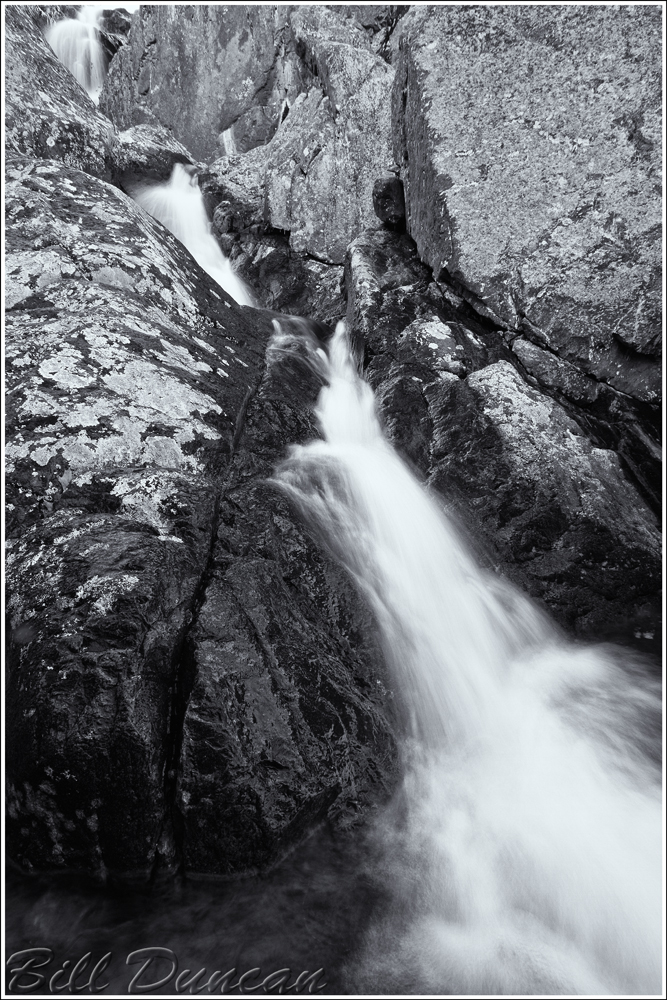
I estimate the vertical distance in this image in the neighborhood of 60-80 feet or more.  The ultra wide angle utilized in this image takes out a lot of that scale for the viewer.  I should have placed a kitten or something in the near foreground to capture that scale, I know.

The cascades and falls begin much higher up the mountain than this particular section.  Here is where the falls begin their more vertical descent.  This is a good example of the fractures (joints) that form in this super hard and dense rhyolite and granite.  The water slowly works its way in between the cracks and given enough time, water wins.

Thorny Creek Shut-in

Technical details: Canon EOS 7D camera, EF24-105mm f/4L IS USM lens @ 32mm, ISO 250,  f/14, 0.5 sec. Orton effect applied in PS Elements 9.

One of my several lifelong photo projects is to find and photograph every interesting shut-in I can within the Missouri Ozarks.  What is a “shut-in” you may ask?  A shut-in is a section of a river that is forced to move through resistant, igneous rock, such as the rhylolite pictured above.  Because the igneous rock is much tougher to erode, the water is often forced through narrow passages resulting in picturesque cascades, drops, chutes, steps, shelves, potholes, waterfalls and other sensory pleasing features.  Beveridge listed near 90 Shut-ins in Missour and most of these are located within the sturdy St. Francois Mountains.  Shut-in was originally an Appalachian term that was brought by the first white settlers in the Ozark region. It is now a term that is almost entirely used by Ozark residents.

This particular shut-in, on a small tributary of the Current River called Thorny Creek is located not to far from where the creek meets the Current.  It is also quite close to the three spectacular shut-ins of Rocky Creek and the rugged shut-ins type cascades of Prairie Hollow Gorge.  This location would actually have been easier reached by boat from the Current River.  Not knowing all that much about boating and not having access to one if I did, I hiked about two hours one way to make my way here.  I was quite pleased with myself upon reaching my goal as some amount of bushwhacking was required and I was not completely sure of where the location was.  Using maps and GPS was crucial.

Finding and spending time at a shut-in is always a grand idea.  Often these location not only provide candy for the eyes and ears, but are great spots for having a swim, fishing, taking a nap as well as doing some nature watching.  Most of the Missouri shut-ins are found within high-quality forest habitat and it is usually easy to find an interesting plant in bloom or a bird stopping at the fresh flowing water for a drink.  If I’m going to find many of the other shut-ins I will definitely need to build my skills in reading maps as well as talking with land-owners when these locations might be found on private property.

Location Spotlight: Elephant Rocks

Technical details: Canon EOS 7D camera, EF24-105mm f/4L IS USM lens @ 28mm, ISO 160,  f/14, 1.3 sec

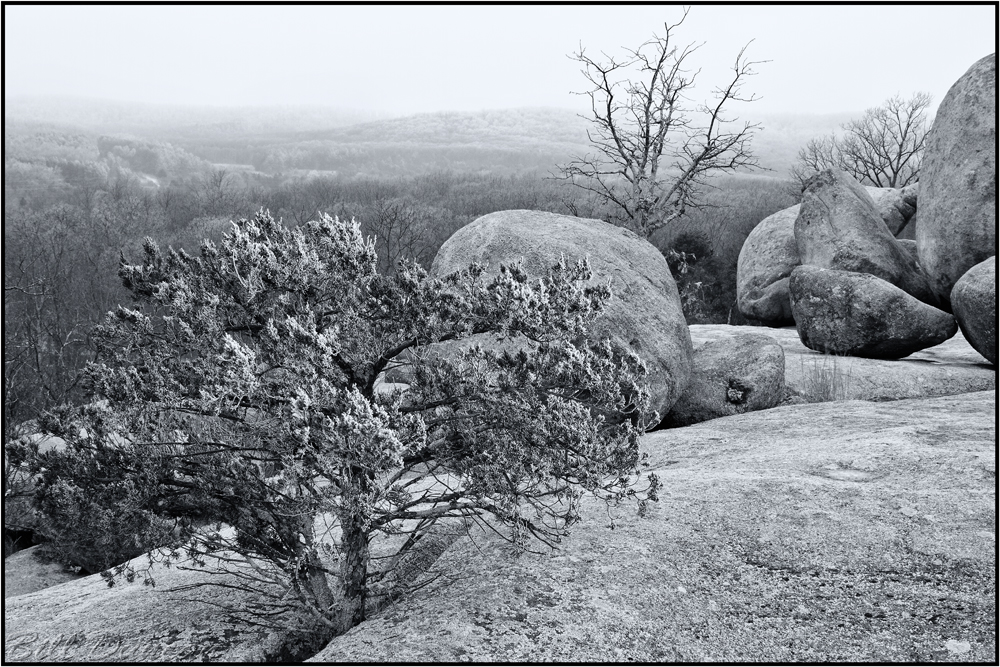
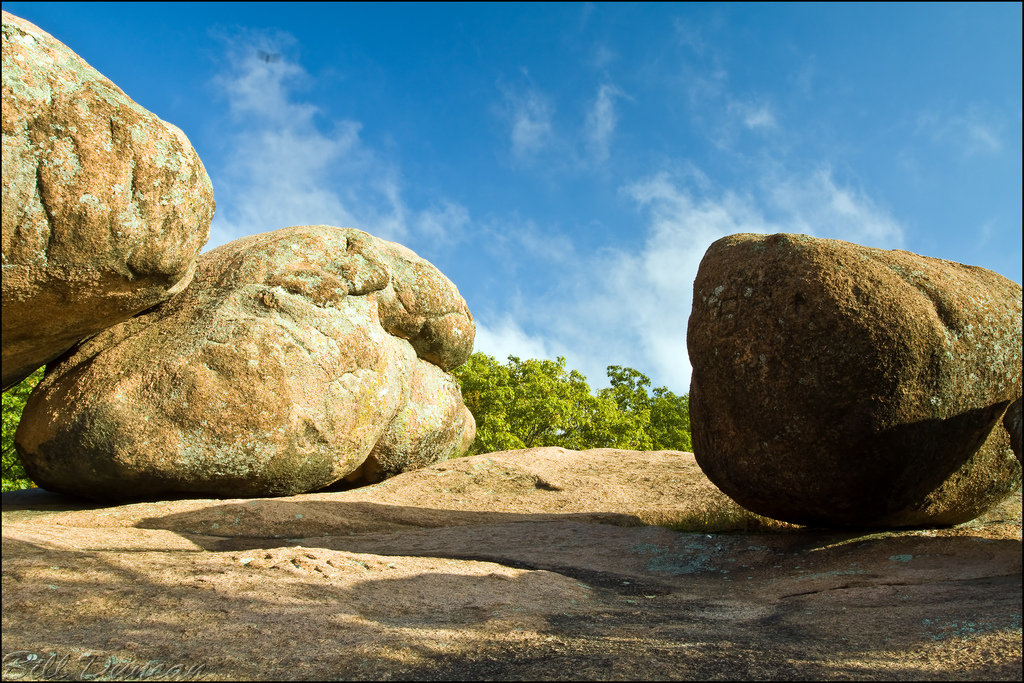
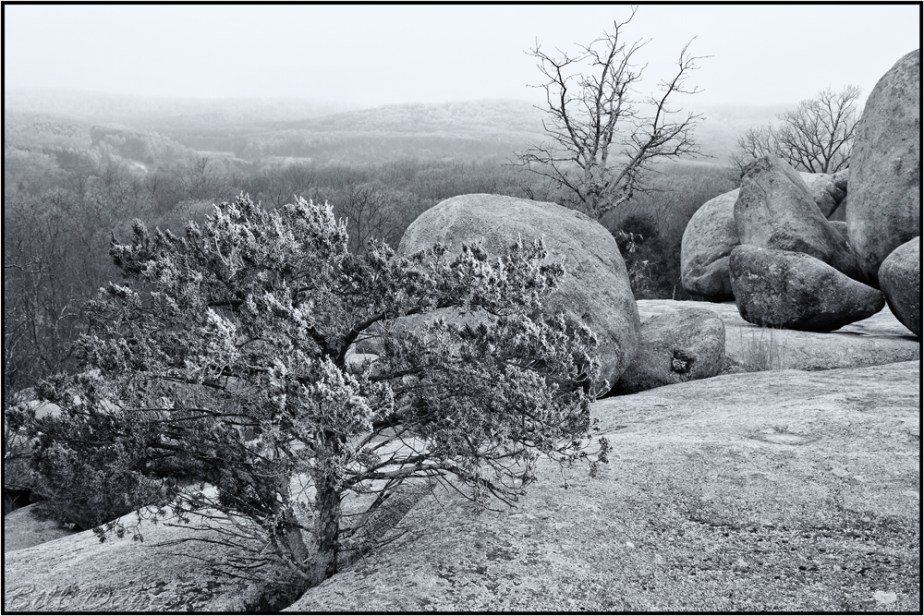
Today we’re traveling back south to my favorite region for landscape photography, the rugged and beautiful St. Francois Mountains.  This location, known as Elephant Rocks, is located in Iron County and lies about six miles north of Ironton and two miles west of Graniteville.  By the names of these towns can you figure out what the principle economic activities of this area were historically?  The primary features of this location, the elephants, are easy to see in the image below.
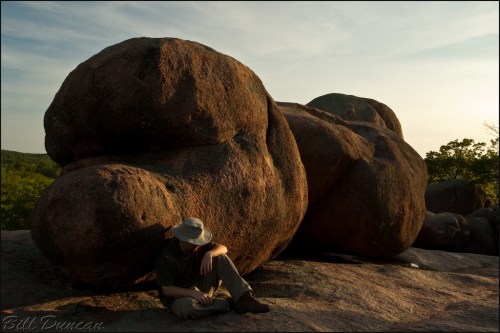
Technical details: Canon EOS 50D camera, EF17-40mm f/4L IS USM lens @ 17mm, ISO 100,  f/16, 1/6 sec

So what are these “elephants” and how did they get there?  Well first of all these rocks are composed of a pink-colored, Graniteville Granite, or more affectionately known as “Missouri Red Granite”.  Geologists discern between different types of granite based on mineral grain-size and color.  Missouri Red is actually one of the younger granites of the St. Francois Mountains, coming in at a mere 1.3 billion years.  Missouri Red, collected from quarries surrounding this feature was used as paving stones that covered most of St. Louis near the turn of the 20th century.  It was also used in parts of the Eades Bridge, the Jefferson National Expansion Memorial, the Missouri Governors Mansion in Jefferson City and in important buildings across more than a dozen cities in the United States.  It is still quarried today and used mostly for tombstones and counter-tops.
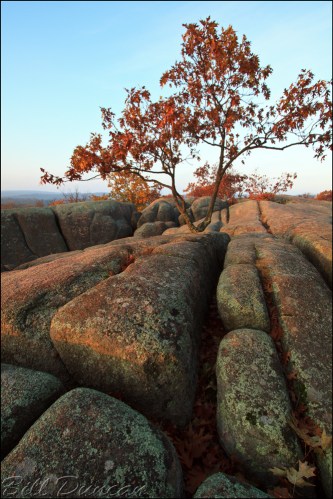
Technical details: Canon EOS 50D camera, EF-S10-22mm f/3.5-4.5 USM lens @ 10mm, ISO 100,  f/16, 1/6 sec

So, if you are reasonably educated in the discipline of geology and you were forced to guess how these boulders managed to be found here your first answer might be to suggest those great marble movers – the glaciers must have moved them here from up near Canada, right?  Sorry, the southern limit of intrusion of those sheets of ice was about where the Missouri River now flows about 150 miles or so to the north.  Hints upon the excepted mechanism of formation can be seen in the image above.

These boulders were formed by a process known as “spheroidal weathering”.  Before you reach for that tube of Preparation H, let me try to explain.  Sometime in the Pre-Cambrian molten rock was forced into the earth’s crust.  As the rock slowly cooled it formed long, nearly vertical joints, or fractures.  As time passed these rocks were covered with younger, sedimentary rocks.  When the Ozark Plateau was forced upward the resulting streams cut their way through this younger rock and eroded much of it away.  Erosional ground waters acted on the corners and edges of these granite joints quicker than on the surfaces and gradually increased these joints.  When the rocks were later exposed to the surface, erosion and weathering acted much quicker in forming the clean and rounded features of the boulders.  Plant life (tree and grass roots, lichen, etc…) also helped to chip away at the surfaces of these future boulders.  Eventually a tor – an exposed mass of bedrock, was left with these elephantine boulders now widely separated.
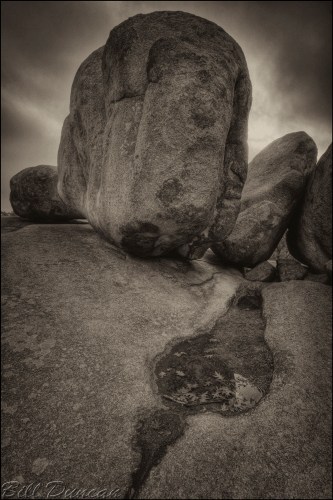
Technical details: Canon EOS 50D camera, EF-S10-22mm f/3.5-4.5 USM lens @ 10mm, ISO 100,  f/14, Photomatix-HDR blend of 9-images

Above you can see one of the more famous pachyderms who make this site their home, “Dumbo”.  This guy measures at about 27 feet tall, and with the incredible density of this granite (~160 lb per cubic ft) weighs close to 680 tons.
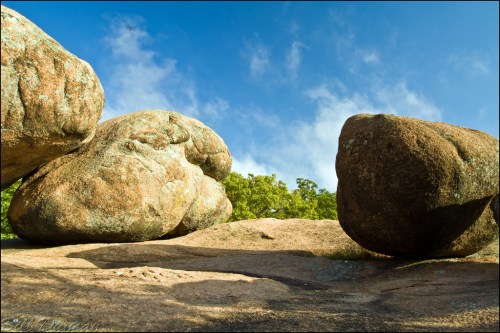
Technical details: Canon EOS 50D camera, EF17-40mm f/4L USM lens @ 19mm, ISO 100,  f/16, 1/6 sec

Not even the people of the “it will never run out” period of western U.S. expansion would destroy something as unique as Elephant Rocks.  Although there has been mining of granite, iron, lead and other minerals throughout this area, Elephant Rocks still looks pretty much as it did 200 years ago.  When a quarry worker reached “master stonecutter” status they would carve their names here upon the boulders and bedrock.  This gives the place an interesting human historical aspect.  Today, this location is protected as a Missouri State Natural Area and a State Park.  There is a very well done ~mile paved “braille trail” that circles through many of the features of the park.  The trail’s meandering allows the blind to feel some of the geologic features and braille signs are posted to explain what the person is experiencing.  I find this to be a fantastic development.  In my opinion our country does nowhere nearly enough to help the blind and these people are often forced into greater dependence and exclusion because our government refuses to take the smallest of steps.  Ever notice how the US paper currency is all the same size?
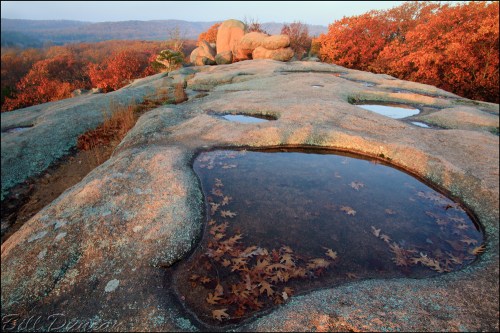
Technical details: Canon EOS 50D camera, EF-S10-22mm f/3.5-4.5 USM lens @ 12mm, ISO 100,  f/16, 1/10 sec

The tinajita, or panhole like those pictured above are more evidence of the weathering this exposed porphyry is being subjected to.  The process of seasonal freezing and thawing as water seeps ever deeper into minute cracks forms these shallow depressions that fill with water in wetter times allowing for animals like insects and frogs to have places to breed.
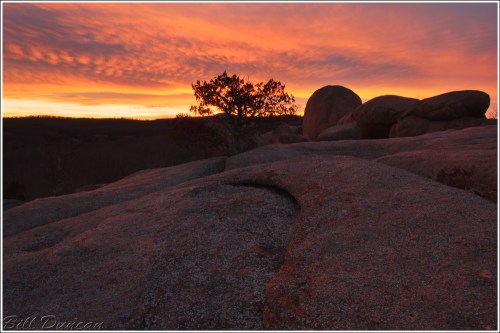
Technical details: Canon EOS 7D camera, EF-S10-22mm f/3.5-4.5 USM lens @ 15mm, ISO 100,  f/16, manual-HDR blend of 2-images

Elephant Rocks.  It comes as no surprise to those who live in the region – everything in the mid-western United States, but particularly the Ozarks is often overlooked in favor of the grand natural spectacles of the Rockies, the Appalachians, the South-West’s deserts and canyons, etc…  Well, Elephant Rocks is one location that should be on the bucket lists of any tourist, any rock-star landscape photographer or nature enthusiast.  It is a location deserving of being voiced-over by a James Earl Jones, Alec Baldwin or Brangelina in the nature documentary of the week.  I hesitate to scream too loudly, however. I have loved the times I’ve been able to spend hours here without seeing another bipedal ape and hope for many more

I’ve called this the place of unlimited compositions.  I have been fortunate enough to make a few images I really like and I look forward to many more visits over many more years to come to see what other compositions the place is hiding.

You can view more of the photographs I’ve taken at Elephant Rocks.      

Location Spotlight: Hughes Mountain Natural Area – Devil’s Honeycomb

Technical details: Canon EOS 7D camera, EF24-105mm f/4L IS USM lens @ 35mm, ISO 100,  f/16, 0.3 sec

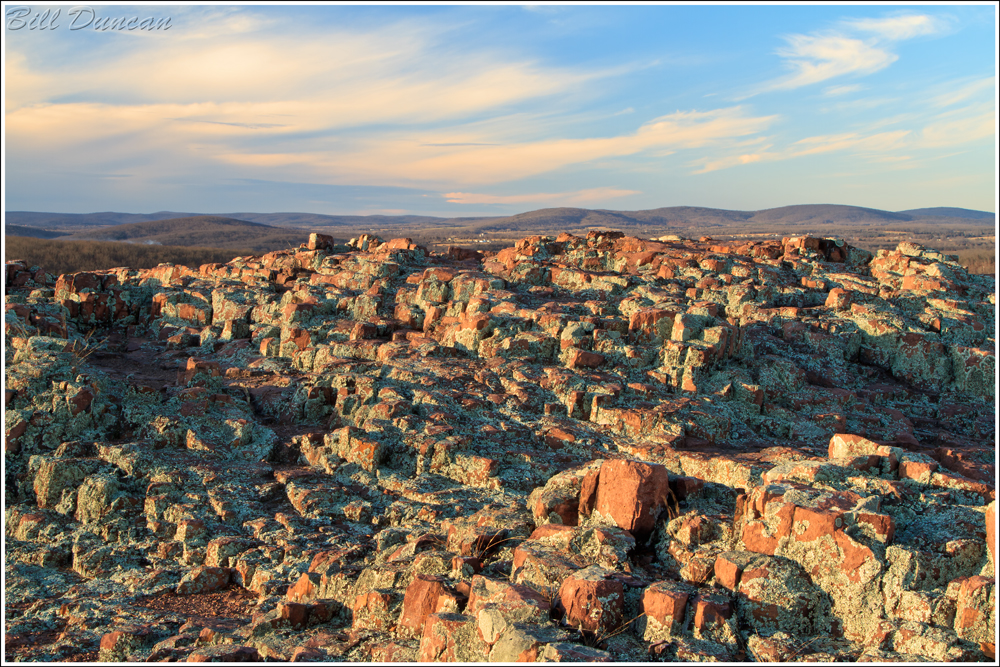
Three miles from the small old mining town of Irondale, along the north-western side of the St. Francois Mountains lies Hughes Mountain and the 1.5 billion year old rock that forms its namesake, the Devil’s Honeycomb.  As the precambrian rhyolite cooled near the surface it formed polygonal columns composed of four to six sides, 8-10″ in diameter and up to three feet exposed above the surface.  These fractures/joints in the rock are analogous to mud drying in the sun.  Looking upon these columns grouped together reminds one of a honeycomb pattern facing the heavens, hence the name – Devil’s Honeycomb.

Technical details: Panasonic DMC FZ50 camera, ISO 100,  f/9, 1/60 sec

In the image above you can see some of the details presented in the rock, the typically pink colored rhyolite is often stained with whites, yellows, greens and tans from the lichen that cover these exposed rocks.  This mountain was named after John Hughes, the first settler of this area who ran a grist mill from a nearby stream in the early 1800’s.

Technical details: Canon EOS 50D camera, EF17-40mm f/4L USM lens @ 40mm, ISO 100,  f/16, 0.25 sec

Only a handful of places on the planet have geological features similar to those shown here, Devil’s Tower National Monument in Wyoming being one such place.  I feel this place has a lunar landscape kind of feel and I tried to capture that in the photo above.

Technical details: Canon EOS 50D camera, EF17-40mm f/4L USM lens @ 20mm, ISO 100,  f/18, 0.25 sec

Walking from the car towards the summit one moves through a typical mixed oak/hickory woodland/forest found in this section of the Ozarks.  As you walk the ~ mile towards the summit the soils gradually become shallow and exposed rock becomes more and more noticeable.  Dry woodland, dominated by blackjack oak, eastern red cedar and black hickory, interspersed with glades become the dominant habitats toward the summit.  When you reach the top you are suddenly aware there is no more soil; the entire summit is a cap of igneous rock formations.

Technical details: Canon EOS 7D camera, EF-S10-22mm f/3.5-4.5 USM lens @ 17mm, ISO 100,  f/16, 0.8 sec

I can’t think of a better spot in the Missouri Ozarks to watch the sunset/rise.  I have hiked up this mountain at least ten times and have yet to get that beautiful, 50%-cloud covered sky that creates that furnace of a sunset that everyone looks for.  I hesitated to publish this post without that image, but who knows when I’ll have that kind of luck.  I do think that these five images show the diversity that the season, weather and time of day can provide your eye and images at this location.  There really is no bad time to make a visit here.

I really look forward to spending time on the summit during a summer thunderstorm, a January snow, a warm-Indian summer autumn day with changing colors, and of course that breathtaking sunset.  I wish you and yours the best in your natural outings wherever they may take you this coming weekend.  Get out there and think about something else beside the daily grind.


Location Spotlight: Turner’s Grist Mill & Spring

Technical details: Canon EOS 50D camera, EF17-40mm f/4L IS USM lens @ 21mm, ISO 160,  f/16, Photomatix-HDR blend of 6-images


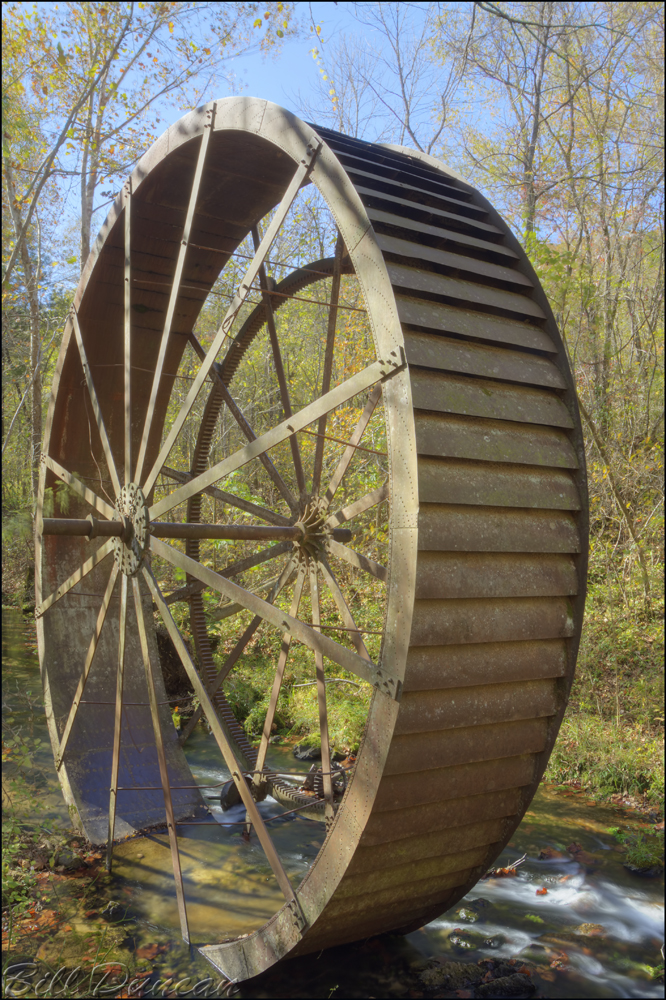
Turner’s Mill Spring lies deep in the Missouri Ozarks in Oregon County near the town of Winona.  The mill building and the whole supporting town of Surprise no longer exist; the ~25 foot tall overshot wheel, gears and concrete flume are the only obvious signs this location was ever inhabited.

Technical details: Canon EOS 50D camera, EF17-40mm f/4L IS USM lens @ 17mm, ISO 200,  f/13, 1.3 sec


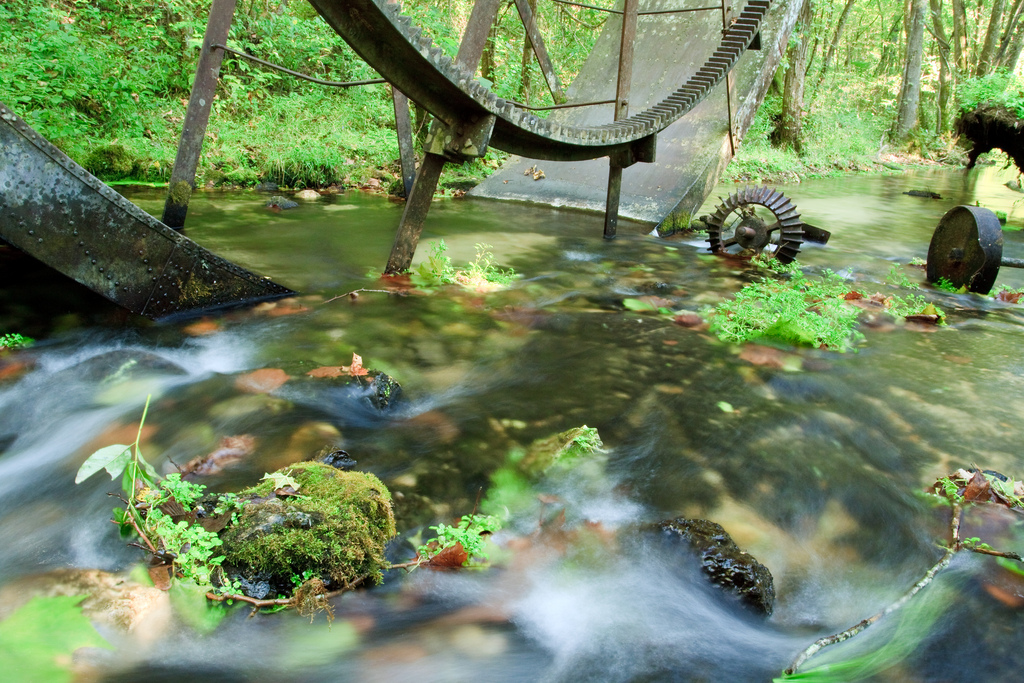
The immensity of the wheel and gears lying on the creek floor stirs the imagination into dreaming of what it took to get these materials to this rugged area in the middle of the 19th century.  I believe the area was dramatically cut and major roads (for the time) were installed.  The area now has been taken back by the forest and is a beautiful part of the public land of this area that includes the nearby Irish Wilderness, Ozark National Scenic Riverways, Missouri’s second largest spring – Greer Spring, and much more.

Technical details: Canon EOS 50D camera, EF17-40mm f/4L IS USM lens @ 35mm, ISO 160,  f/16, 3.2 sec

How did the town of Surprise get its unusual name?  It was named because of Mr. Turner’s astonishment that the petition he made for a U.S. Post office in his little dream town was approved.  The spring was used to power the area’s grist mill(s) from about 1850 until 1940.  Following the retirement of the mill the town of Surprise rapidly dispersed and Mother Nature quickly took over.  The image above shows the effluent about 500 feet or so from the exit of the spring’s mouth as it escapes down the side of a rather steep hill.

Technical details: Canon EOS 50D camera, EF17-40mm f/4L IS USM lens @ 27mm, ISO 160,  f/14, 1.6 sec

Here you can see the outlet of the spring as it flows at an average rate of 1.5 million gallons per day from the mouth of a cave.  This cave, which is located at the base of a 460 foot bluff is another reason that this area is a must-visit.  The lighting and other circumstances did not allow me to make any good photographs showing this steep bluff, but I look forward to trying to capture this one day.  If you look closely you can see some of the rock and concrete work that was used to shape the flume as well as the metal gate just inside the cave to keep modern knuckleheads from hurting themselves and the natural delicacies that reside within the cave.

Technical details: Canon EOS 50D camera, EF17-40mm f/4L IS USM lens @ 20mm, ISO 160,  f/14, 1/15 sec

A very quick walk following the creek that this spring creates takes you to this location where it empties into the Eleven Point River.  This river is a favorite of fishermen and float trippers and is an example of one of the prime waterways that can be found in the Missouri Ozarks.  The Turner Mill Recreation Area is a high quality habitat where an abundance of spring wildflowers and wildlife reside.  A day or weekend visit to this location is definitely worth the travel and I cannot wait to pay another visit.

Location Spotlight: Devil’s Shadowbox

Early European settlers and pioneers of the Missouri Ozarks were said to be tough, rugged and individualistic.  The Ozarks were and still are a difficult place to “make a living”, especially  based on traditional agricultural methods.  I will suggest that these settlers had little imagination when it came to naming the geologic and other natural features of their newly found homeland.  In “The Geologic Wonders and Curiosities of Missouri”, Beveridge lists no fewer than 80 features with Devil in the title.  This includes 25 “Devil’s Backbones” and close to ten “Devil’s Den’s”.  Beveridge makes the interesting comparison of the Missouri Ozarks naming conventions to those of the south-western United States which use Angel in a large number of their names for geological features and rarely use Devil.  This is likely due to the cultural differences between the settlers of the Ozarks, largely Scots-Irish, and the Latin/Spanish influences of the American south-west.  Beveridge accounts for no named surface feature in Missouri with Angel in the monicker.

Technical details: Canon EOS 7D camera, EF24-105mm f/4L IS USM lens @ 24mm, ISO 160,  f/14, 1/3 sec

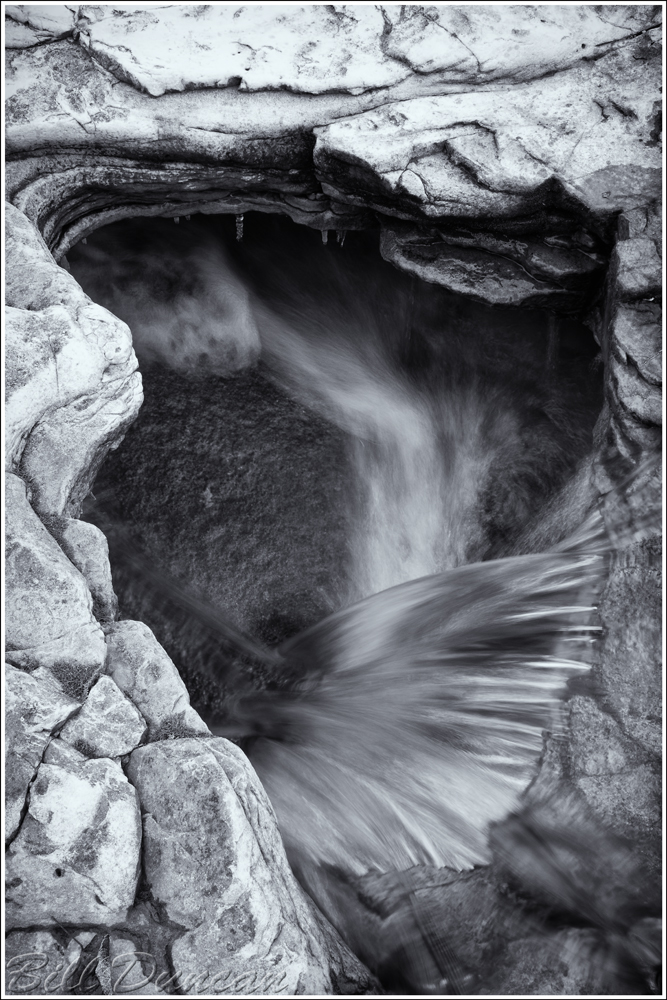
My goal for this particular winter’s morning was to find a “Devil’s Den Hollow” purported to be found in Warren County in the northern Ozark area.  I believe I was pretty close to finding the location, with several runs of rapids and waterfalls so excellently described in Beveridge’s book, but ultimately gave up because it seemed to be surrounded by private property.  I was able to find this little feature presented in this post.  I am unsure whether it has an existing name of its own, but I am calling it Devil’s Shadowbox to continue our Ozark naming convention.

Technical details: Canon EOS 7D camera, EF24-105mm f/4L IS USM lens @ 65mm, ISO 100,  f/14, 0.8 sec

Devil’s Shadowbox was also on private property but was literally feet from the road.  I decided to beg forgiveness if necessary and spent an hour working the scene.  I didn’t see another person the entire time I was there.  The water level was low enough that I could stroll through the creek with my Gortex-lined hiking boots.  My feet did stay dry but the water had to have been close to the freezing mark and my feet where painful and numb by the end.

Technical details: Canon EOS 7D camera, EF24-105mm f/4L IS USM lens @ 32mm, ISO 100,  f/16, 0.8 sec

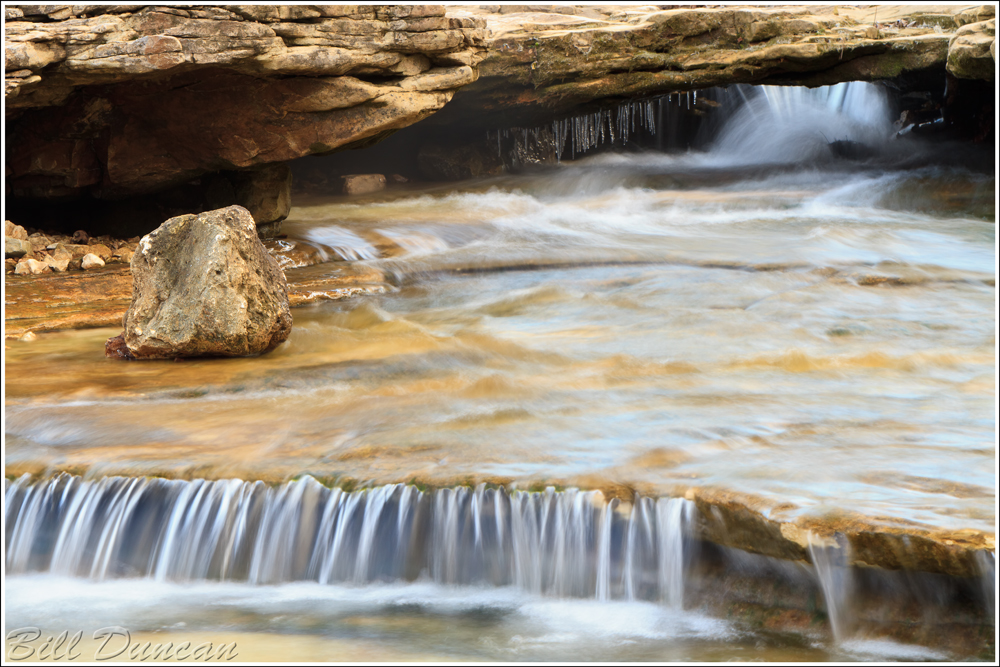
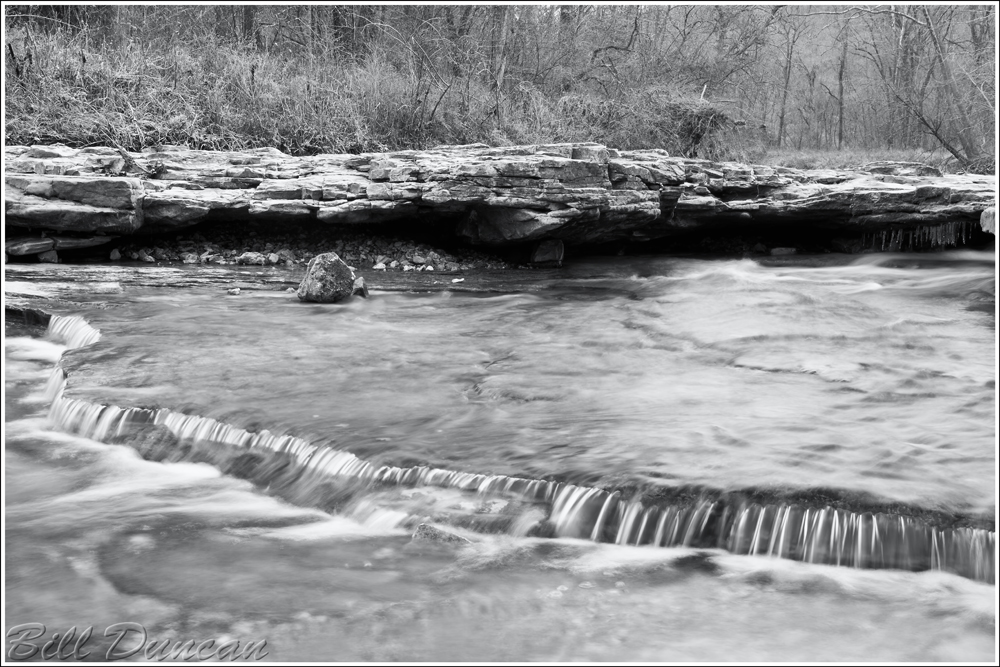
This relatively un-flashy feature actually had a few small pieces that came together nicely.  Above you can see a short (4-6″) shelf that crosses the stream.  This shelf lies just downstream from the hole/natural arch.  There may be some potential here depending on what the spring foliage looks like.  Too much water, however may take something away from the geology that is visible under these conditions.

Technical details: Canon EOS 7D camera, EF24-105mm f/4L IS USM lens @ 24mm, ISO 160,  f/14, 1/5 sec

I really do try and respect the rights of the property owners while out on my expeditions.  The problem is finding out who owns the property in question and how to contact them to ask permission.  From what I’ve read, in most circumstances the owners of the property have no problems allowing hikers, photographers and explorer types access to their property.  If you have any familiarity with this feature or have any knowledge concerning Devil’s Den Hollow in Warren County, Missouri please let me know.  I will be forever grateful to find out anything else that would help me find and make a lawful visit to the waterfalls and other features this place promises.

Bill Duncan: ceibatree@gmail.com

Arctic Oscillations and the Winter that Never Was

Technical details: Canon EOS 7D camera, EF100mm f/2.8L Macro IS USM lens, ISO 320,  f/14, 1/13 sec

According to weather scientists, yeah those experts so closely related to our news meteorologists, the jet stream and the current “positive oscillation” is to blame for much of the continental United States lack of anything resembling winter this year.  The problem is that the jet-stream is in a negative phase, or dropping southerly in places like Alaska, much of Europe and Russia.  While where we reside, here in the Ozarks for example, the jet-stream is far to the north, allowing warmer air fronts to reside across the country.  Those places I just mentioned are getting lots of winter with lots of that white stuff we saw on holiday cards and gift wrap about a month ago, while we are in a sort of limbo between autumn and spring.

The reason I bring this up is that, as I mentioned in a previous post, there is a lack of typical winter photography opportunities this year.  The past few outings I have been making my subjects more typical of what I would normally shoot during the warmer months.  During a nice, leisurely and of course, warm hike yesterday looking for one of the harder to find shut-ins along a creek in the Courtois Hills I found a patch of short trees that were loaded with lichen.  In these mild and wet times that we’ve been having (normally seen in spring and fall), the lichen appear to be thriving.

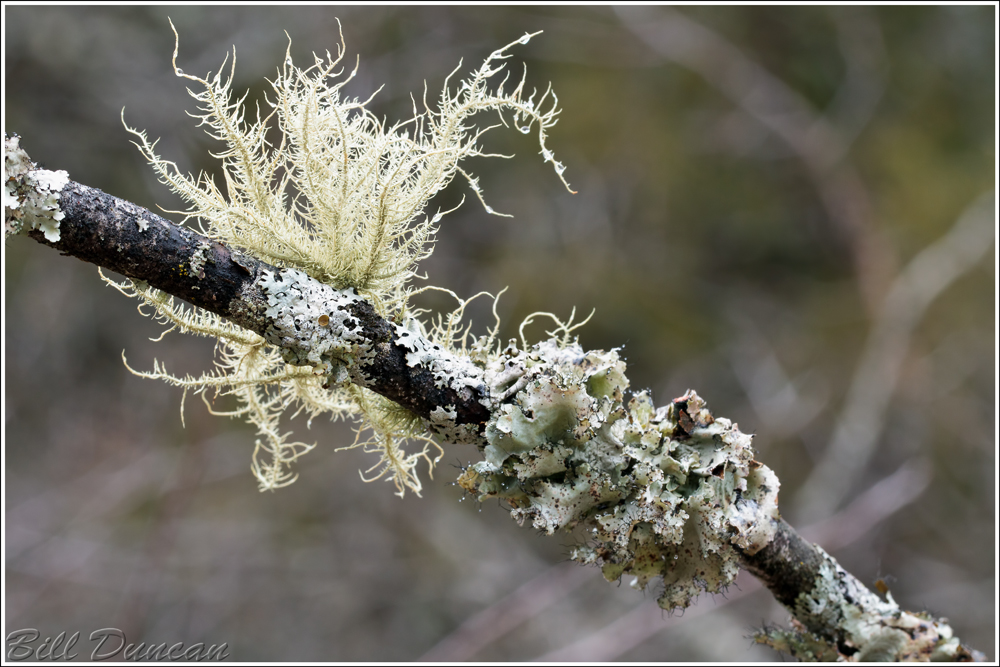
Lichen, a fusion of two normally separate living taxa – a fungus and an algae – are a treasure of diversity, harbingers of the state of the environment in which they are found, beautiful and are still not well appreciated or celebrated by the common public.  Experts in lichen taxonomy use many characteristics in concluding the correct identification of these fascinating life forms.  The largest primary groupings to consider in determining what lichen you are dealing with is to determine is whether the lichen is foliose – flat and leaf life-like with lobed margins, fruticose – branched and stem-like in appearance, or crustose – crusty, splotchy, almost stain-like.  Following this generalization, the expert then goes into more specific characteristics in determining the identification.  Is the lichen corticolous (lives in trees), or is it saxicolous (lives on rocks)?  The expert in lichen taxonomy will consider the upper and lower surfaces of the lichen body, the cilia and isidia (hair-like projections), the strong-hold structures that hold the lichen to its substrate, the apothecia and perithica (fruiting bodies), and similarly to the fungi, the actual chemistry of the lichen itself will hold clues to identification.

So what are the two lichens captured in the image above?  These are my best guesses and I am far from an expert in lichen identification.  The left-most lichen is the fruticose, bloody beard lichen – Usnea mutabulis.  The other, ruffled lichen I cannot ID for sure.  I should have collected some notes of it in the field.  But, I have narrowed it down to either the salted ruffle lichen – Parmotrema crinitum or the cracked ruffle lichen – Rimelia reticulata.  If you are someone who knows their lichen and can tell me what I have just through the information in this photograph, please let me know.

The Ozarks of southern Missouri are rich in lichen diversity and the Ozarks are home to several endangered lichen forms.  If you tire of botanizing, birding, mushroom hunting or whatever else brings you out in the field, consider having a go at the lichens.  They are a fascinating subject.

P.S.  One of the last things I expected to happen in early February occurred to me yesterday.  Leaving my first stopping point I found two ticks on my pants.  I wasn’t too concerned.  I sprayed the remainder of a can of deet spray on my pants and continued my Saturday adventures.  Mistakenly I didn’t give myself a full check upon returning and did not find the tick that was feeding on me until this morning, at least 12 hours after the tick had probably attached itself.  Now I get the fun of wondering if I’ll come down with some tick-borne illness over the next month.  I believe this is still a relatively rare thing in Missouri, but still.


Ice Is Nice (When You Can FIND It)

Technical details: Canon EOS 7D camera, EF24-105mm f/4L IS USM lens @ 60mm, ISO 100,  f/13, 1/20 sec

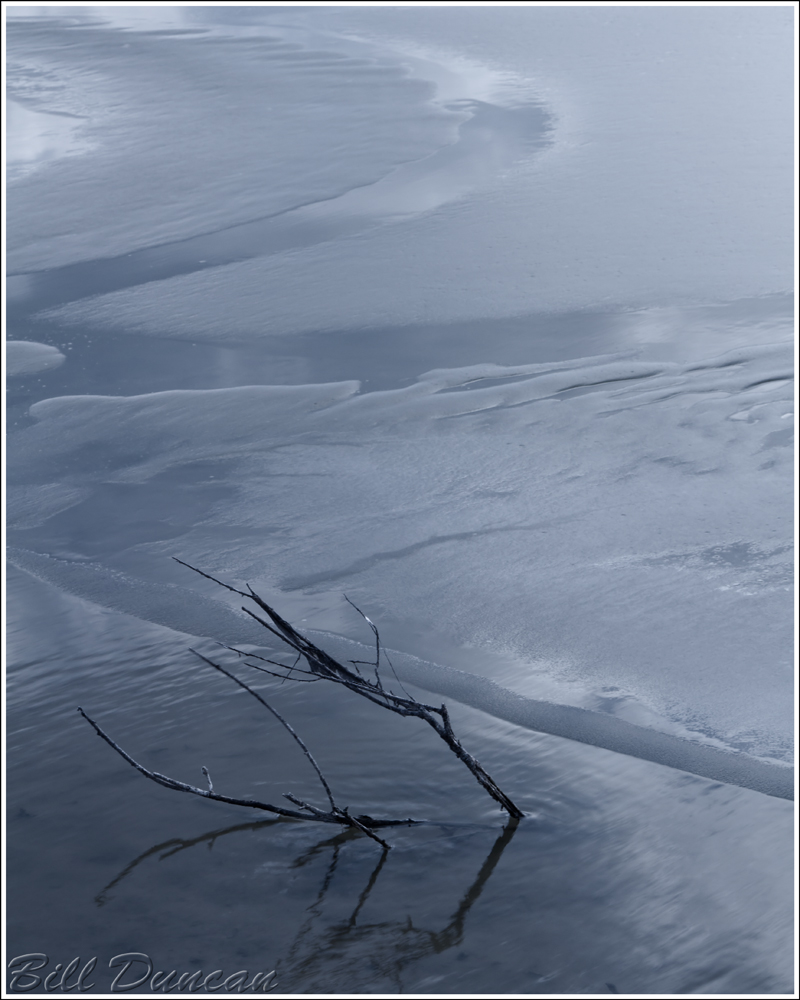
Photographing ice is a nice challenge for the nature photographer.  Negotiating the landscape itself when covered in snow and ice is the first obstacle and finding safe passage in both transporting yourself to the scene and then within the scene is obviously critical.  Nailing the exposure in camera is crucial in making an ice image that works compared to one that falls short – ice and snow have their obvious challenges as being bright subjects that can confuse the camera in automatic exposure modes.  Composition is a challenge, as many ice shots are all about pattern and flow through the rectangle and may not be focused on an apparent subject.  Finally, color and white balance of the image needs to be carefully scrutinized.  There are lots of options here.  Will you leave the scene cold?  This is a popular choice for winter images, or is there reason to warm it up?  Will it be in color or will you convert to B&W?  If you do go monochrome, color toning leaves you with more potential options.

Technical details: Canon EOS 7D camera, EF100mm f/2.8L Macro IS USM lens, ISO 320,  f/14, 1/6 sec

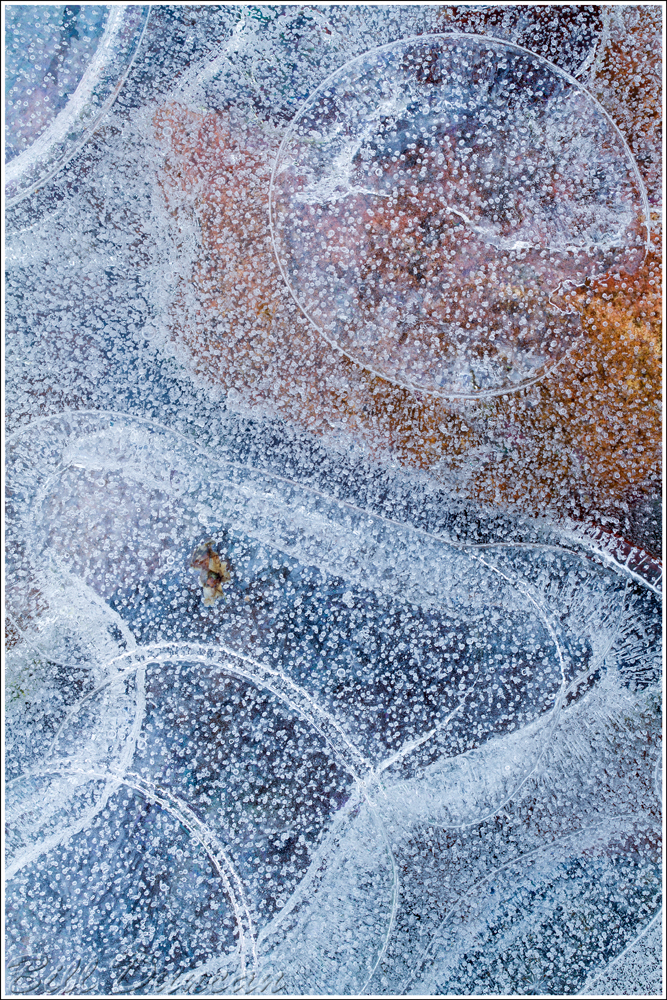
I naturally tend to process the winter images I’ve been able to produce toward the cool end, either through white balance decisions or in monochrome toning.  The image presented above is a more neutral or even warm image.  These leaves, which had fallen weeks earlier in mid-autumn were approximately two feet under the surface of this stream which runs through Hawn State Park in the beautiful St. Francois Mountains.  A layer of ice about one inch thick provided the first layer of texture and the warm mosaic the fallen leaves of the stream bottom provided another.

Technical details: Canon EOS 7D camera, EF100mm f/2.8L Macro IS USM lens, ISO 100,  f/18, 1.6 sec

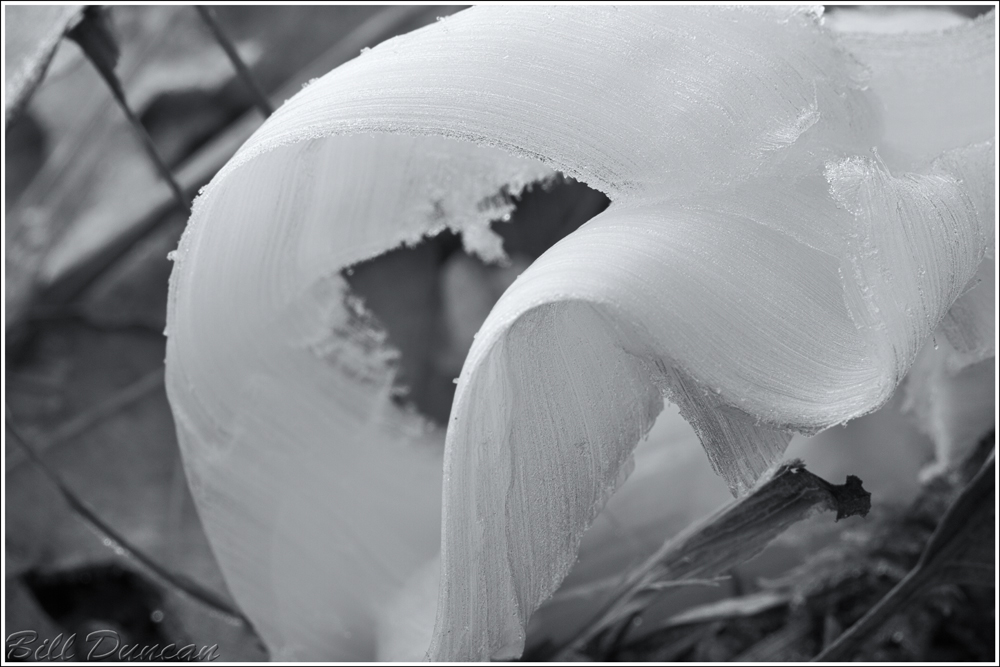
The crystalofolia.  Ive blogged about these once before.  This particular beauty was quite intricate.  I tried to convey a sense of three-dimensionality and capture the detail one can only really see through the magnification of a lens.

Technical details: Canon EOS 7D camera, EF100mm f/2.8L Macro IS USM lens, ISO 100,  f/11, 1 sec

You don’t have to read the title of this post to know that winter is MIA this year across much of North America.  This past spring I purchased my all wheel drive-all the time Subaru Forester, replacing a good vehicle but one of the worst winter vehicles to drive you can imagine.  For years, I had to either stay home or borrow the wife’s front-wheel drive vehicle if I wanted to make an outing into the snow and ice.  My anticipation for this winter season has been growing ever since.  Nothing was going to stop me now from the winter image making opportunities I dreamed about finding in some of my favorite places in the Ozarks and northern Missouri.  Never did I imagine the Mother Nature would play a cruel prank and give me what is to date the mildest winter that I can recall.   I have been able to make a few winter photographs this year, including the ones in this post.  But come on, I bought a pair of ice cleats for my hiking boots!  If February continues the way it started here in Missouri, I’ll be the first to sign the “Let’s eat Punxsutawney Phil in a stew of his own juices” petition.

Happy Groundhog Day.

Location Spotlight: Piney Creek Nature Preserve – Part Two

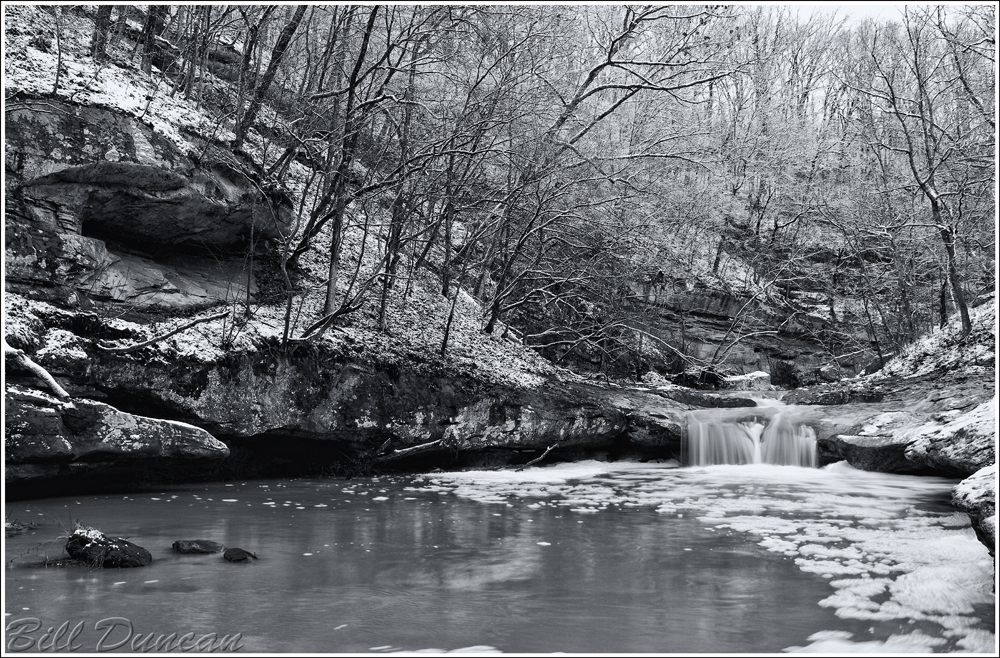
Technical details: Canon EOS 7D camera, EF-S10-22mm f/3.5-4.5 USM lens @ 12mm, ISO 100,  f/16, 0.6 sec

Ten days following my first visit and hike into Piney Creek Nature Preserve I arose early and left the house during one of the two appreciable snowfalls we’ve had this winter in our region so far (I was very sick on the second snowfall and could not enjoy it).  Prior to the temperature drop we had inches of rain during the previous day and I realized that places such as this should have a significant amount of water flowing through their streams and intermittent waterfalls.  Following a careful drive through the snow, I arrived two hours later almost the exact second the snowfall stopped.  This makes photographing a little easier without worrying about the equipment getting wet, but it would have been nice to hike in the falling white stuff for a while.

Technical details: Canon EOS 7D camera, EF24-105mm f/4L IS USM lens @ 24mm, ISO 200,  f/13, 0.8 sec

The image above was the first waterfall I heard.  To get here required a short bushwhack off trail and down into the ravine.  A hiking pole and crampon/spikes on your boots are definitely helpful in doing this.  The rock in this area was extremely slick, with ice on top of algae/slime.  I was very cautious moving on the rocks to set up this shot, realizing that the rock sloped toward the stream and loosing my footing would prove disastrous. Because of the higher water and treacherous footing the available compositions were somewhat limited.  Considering how poorly I function with too many options, this was not exactly a bad thing!

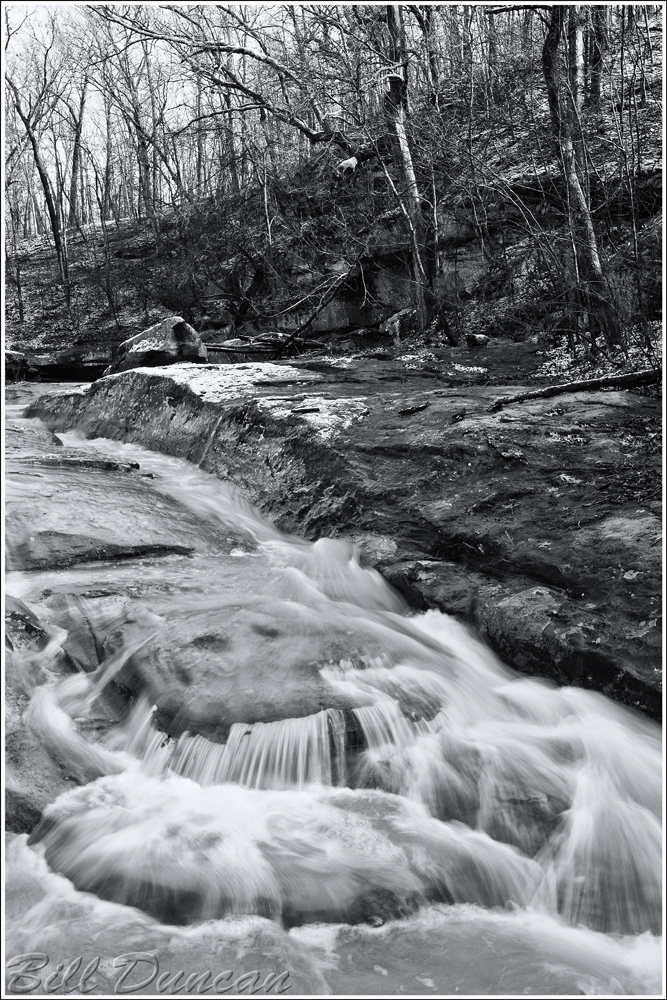
Technical details: Canon EOS 7D camera, EF-S10-22mm f/3.5-4.5 USM lens @ 21mm, ISO 100,  f/16, 0.3 sec

This cascade pictured above is a section of a longer series of twists and drops found closer to the back side of the hiking loop.  The water here skips shallowly over rock shelves and narrow chutes and takes occasional breaks in what appear to be quite deep pools.  When I made it to this section of the reserve the cloud cover was almost completely gone and blue skies were above.  The sun that would completely melt this fresh snow by the time I drove home this day was just beginning to peak over the bluff.  I realized that I would soon be faced with high-contrast shadows and harsh glare off the landscape scenery and I needed to grab every capture I could in the limited time available.  Sometimes it is also best to work with a deadline.  😉

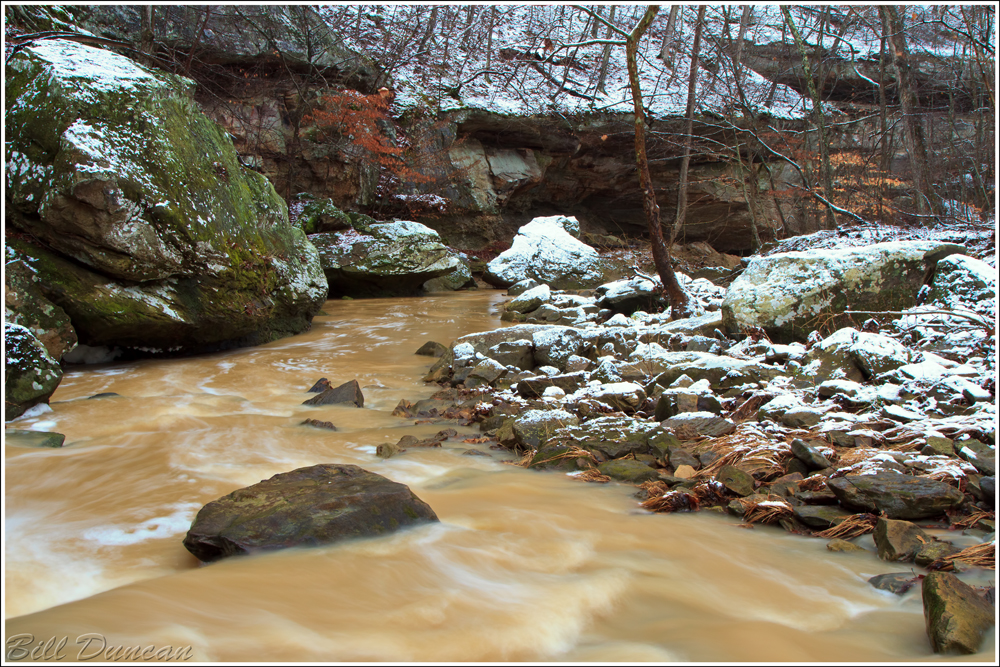
Technical details: Canon EOS 7D camera, EF24-105mm f/4L IS USM lens @ 24mm, ISO 200,  f/14, 1 sec

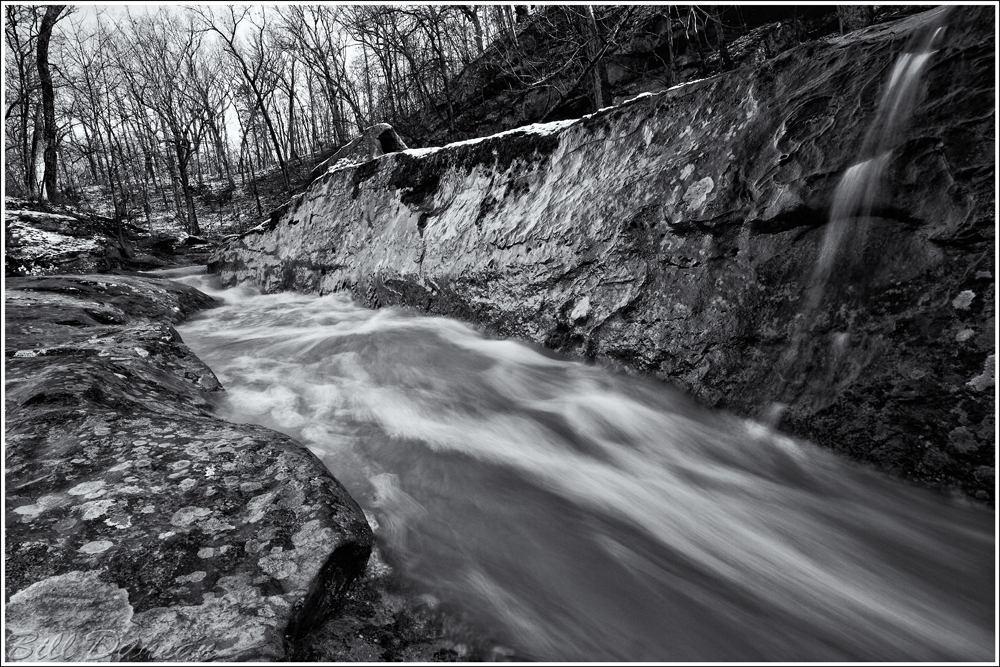
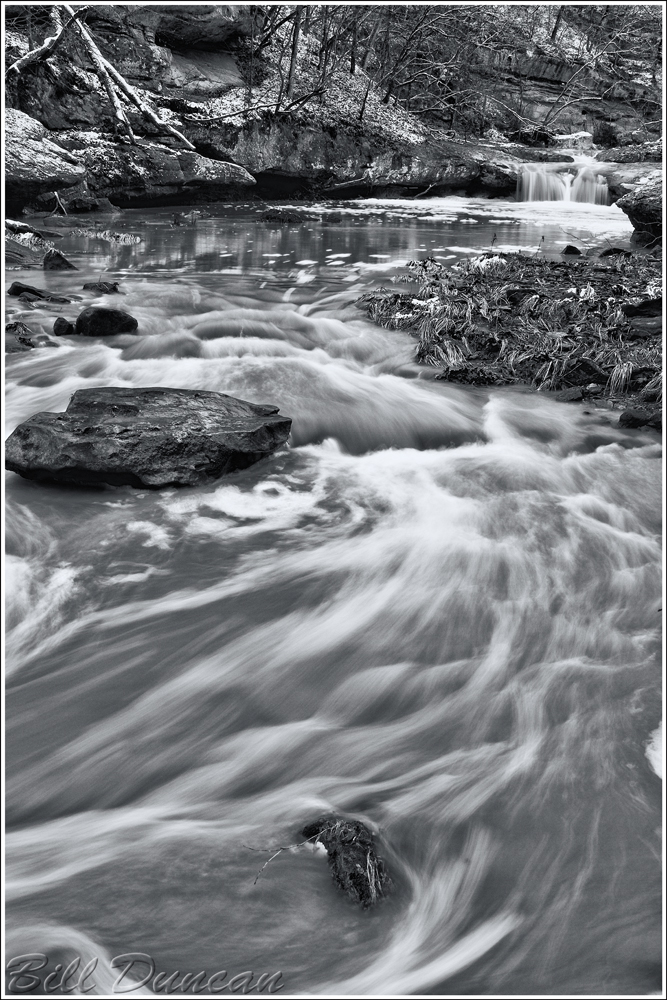
You can see that the previous one to two day rain brought a lot of soil into the stream.  Because of this, I felt most of the images would be presented best in monochrome.  I did want to present what one of these scenes looks like in color, however.  This one had some greens and reds to provide a little contrast between the browns of the water and rocks and white snow.

Technical details: Canon EOS 7D camera, EF24-105mm f/4L IS USM lens @ 24mm, ISO 160,  f/16, 0.8 sec

This place has a lot more to offer than what I present here.  There were at least two other significant waterfalls that I could see or hear, but the terrain with the snow and ice on precipitous ravine sides caused me to think wisely against trying to get within good photography distance.  Definitely something to try during better weather this spring.  I’ll be looking forward to my next visit to Piney Creek Nature Reserve.  Maybe I’ll even plan on paying a visit to the Popeye museum along the way in the town of Chester.