"What a thousand acres of Silphiums looked like when they tickled the bellies of the buffalo is a question never again to be answered, and perhaps not even asked." -Aldo Leopold
I imagine the conversation may have went something like this…
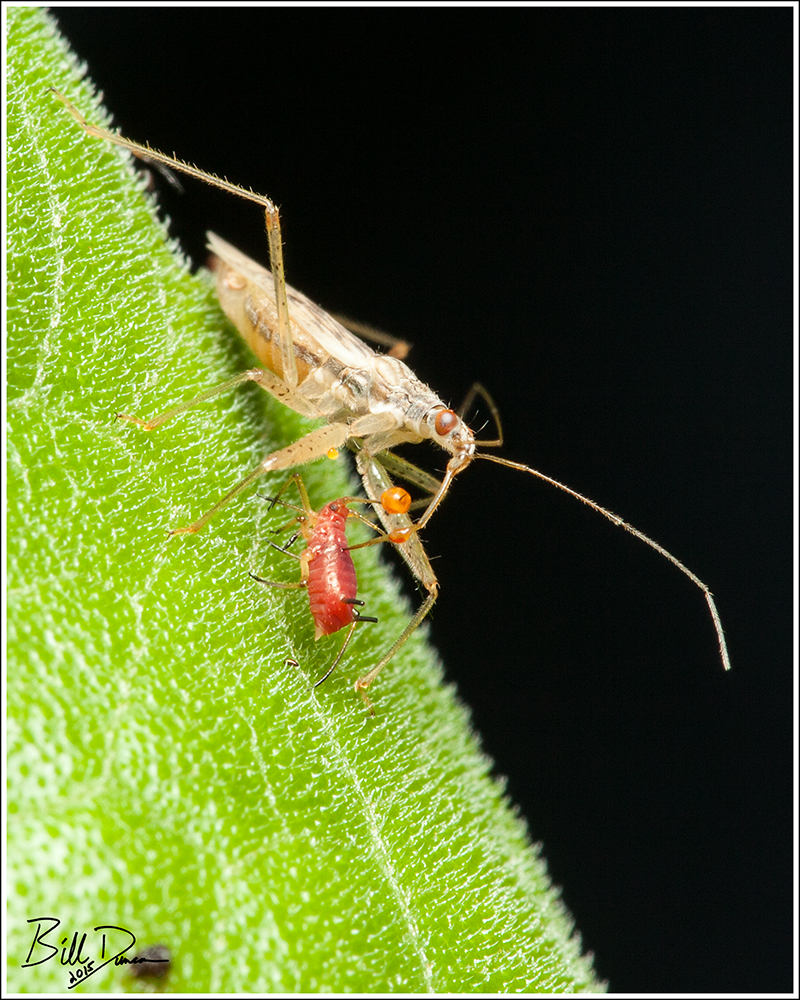
Aphid (with a cockney accent, of course): “Oh, hello, who are you then?”
Damsel: “Name’s Damsel…” “Oh, that’s a lovely name. My name is Aphid.” “No, I think I’ll call you ‘Sugar Bag.’ “ “Sugar Bag? Now that doesn’t sound Aghhh!…”
😉
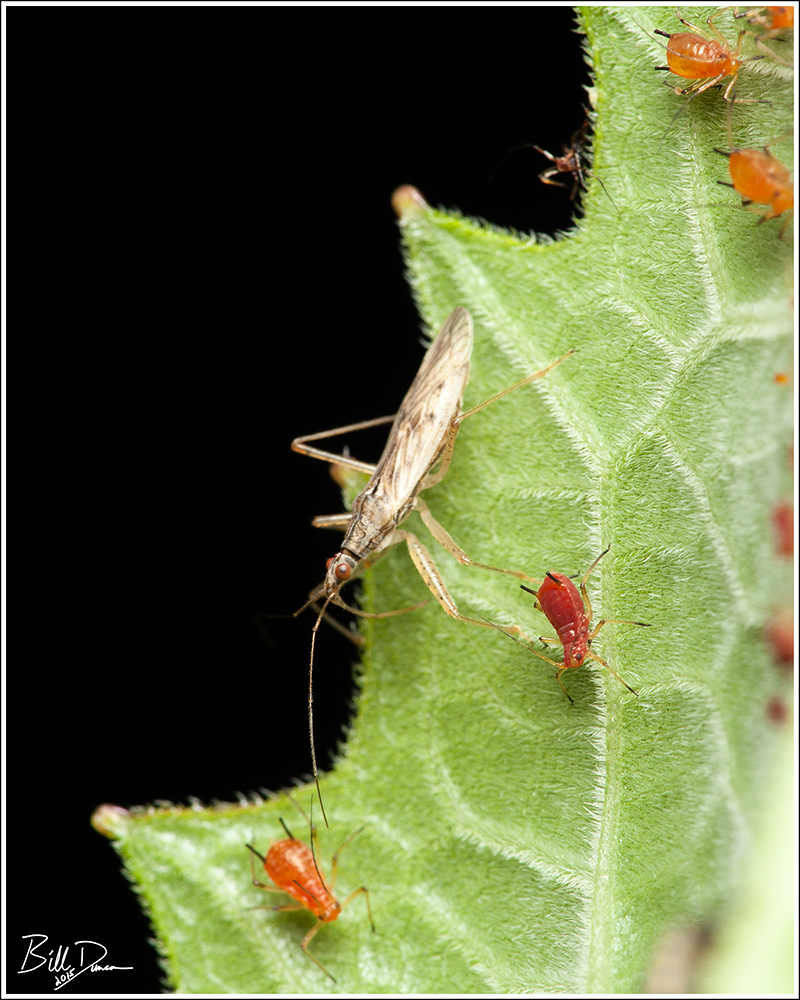
Sugar Bag
I caught a glimpse of this guy early one morning patrolling around the surfaces of my rosinweed and decided to watch. I didn’t wait long to observe the hunt. This bug is definitely in the family Nabidae, and I am going to call this one the common damsel bug, Nabis americoferus, due to it matching a few photos and the fact that this is considered to be the one of the most common hemipterans in the United States.
Nabis
I have read that these guys overwinter as adults and have a wide selection in the prey they choose. It seems that if it is smaller than they are, or close in size at least, they will poke it and suck out their hemolymph. Like I said, “damsel” in name only…
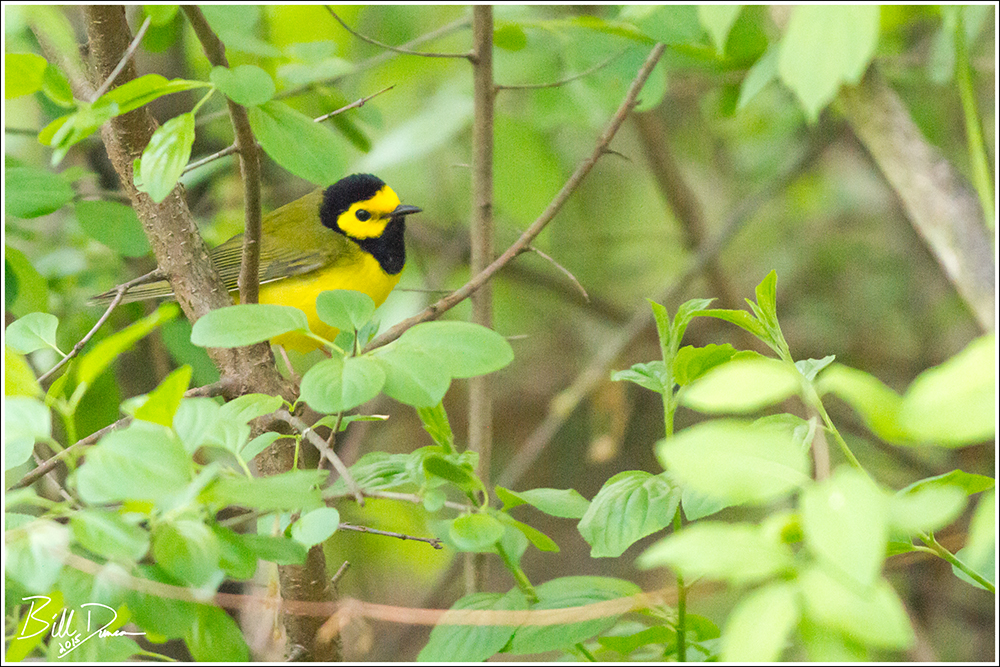
Here are a couple of pics of a Hooded Warbler that visited a favorite birding spot of mine a couple of weeks ago. Quite low light on a cloudy early morning, so I apologize for the grain and poor detail.
Before we get to a few birds from this spring… Why do people like Adobe Lightroom so much? I know it definitely helps in cataloging my images and I am better off than what I was before, but the hassle and bugs I have to deal with… Just yesterday, we lost power during the storms and then next time I was able to load up LR, all my settings went back to default! I guess I should be thankful that all of my images appear to be in the right spot. Computers…
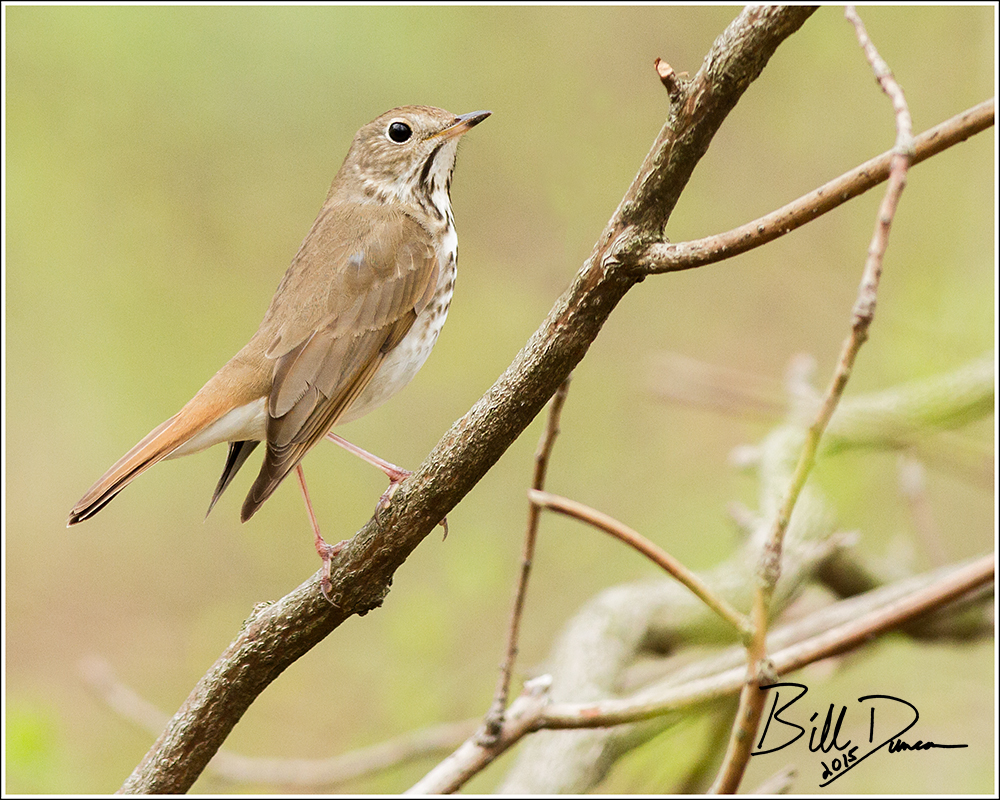
Hermit Thrush
Such a silent bird. Whenever I am lucky enough to cross its path, it is almost always found by eyesight. This guy patiently hung out with me for a bit.
Hermit Thrush
Mallard Drake
Pretty much a staple in the pond at my working location. Sometimes I don’t seem to bother them, while others I cause them to flush.
Mallard Drake in Repose
Brown Creeper
I have seen these guys all over the place this spring. Always one of my favorites, it has been a real treat to seem them so regularly the past two weeks.
Greetings on this wonderful spring weekend. I spent a few magical hours at Shaw Nature Reserve yesterday. Spring migrants have begun to arrive and I was quite fortunate to gather a nice list for this time of year as well as some great looks. For reasons not worth mentioning, I did not have my bird lens, but enjoyed the day and the hike, nonetheless.
A bit of a different subject matter for me today. Normally I won’t speak much to gear on this blog. But, when I find something I find interesting, that I think is a great value and that might help fill a void in someone else’s kit, I will try and mention it here.
Today I will be doing two things: 1) giving a quick review of a new product from LensCoat and 2) giving a rundown of the new travel kit I have put together for when I want a supertelephoto in a light and easy to transport package.
I have used a number of LensCoat products, including the Lens Coats, Hoodie Lens Caps, Rain Coats and Gimbal Cover. The latest from LensCoat that has gotten me all excited is the Travel Hood.
The LensCoat TravelHood
I know what you are thinking; “Holy cow, where can I get a cylinder just like that one!” Yes, unless you are a big-lens photographer, particularly one that uses a rather disappointing Canon product, there will be nothing in this post that grabs your attention. Let me give you some background that will explain two reasons this is so exciting for me.
Chances are, if you have owned or used a Canon supertelephoto lens, then you know about a particularly horrendous design flaw concerning the tension screw that holds the lens hood to the lens body. The lens hood is designed to be removable in order to turn it around for easier storage options. The problem is that these tensioning screws tend to wear out and not behave as intended, leading to a good deal of hassle to get these things tightened down. I’m sorry I don’t have the engineering background to describe such a simple problem, but trust me, both the lens hoods for my 500mm f4.5 and 500mm f4 I.S. have been showing this on occasion. OK, so just order a new tension screw, right? Nope. Both of these lenses are out of production and, if one were able to easily find one, they are not easily replaced. OK, so just order a new lens hood. How much could it cost for an aluminum or carbon fiber tube? When I have seen these available, they have been at or above $600. You can find some folks on the web that have the do-it-yourself capability of being able to make something out of plexiglass, carbon fiber, plastic plant pot, etc… I am not one of those fortunate ones.
Another and more important reason I have been looking for an alternative is space and weight savings in moving and storing this equipment. Even with turning the lens hood around, it still takes up a good amount of space in addition to the giant lens itself. I have slowly been working on developing a light and space saving means to take a large supertelephoto lens, in my case my 500mm f4.5 in a smaller, less conspicuous bag. The LensCoat TravelHood has helped me to do just that.
I wanted a bag I knew would make it through any interpretation of the carry-on rules and I found a minimalist, inexpensive bag that has plenty of compartments and adjustments in this Sandpiper bag pictured below. Even the name is perfect… 😉
Sandpiper Pack
This pack should work great for trips that will require air travel, – either work, business or combination. When I want to minimize weight, bulk, and setup time, I have been carrying the gear seen below in this bag with good success.
OZB’s Light Kit
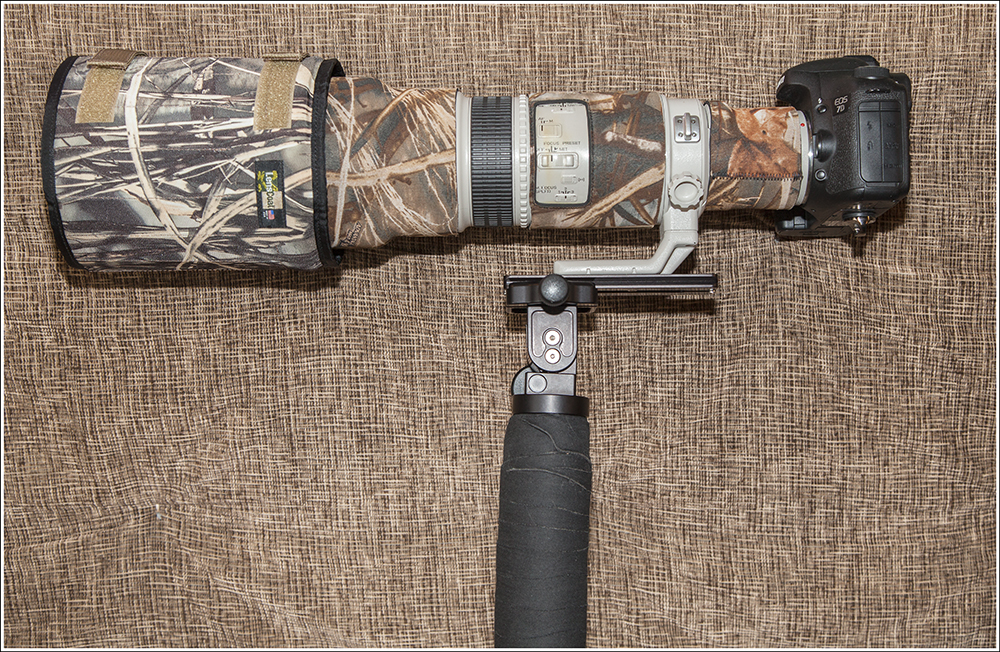
My light telephoto kit includes the 500mm f4.5 lens, the Canon 7d camera body (stored detached from the lens), the TravelHood (stored collapsed), a short and light monopod (MeFoto) – good, but I would not want to use gear that is any heavier with this one, and a monopod head that I picked up used (Kirk brand). This has been working great. In an upcoming trip to Puerto Rico, I plan on traveling with this gear along with a landscape lens or two, binoculars, a laptop or tablet, a field guide and all the necessary accessories for such a trip. Because the Sandpiper bag has no protective padding to speak of, I bought the cheapest foam sleeping pad I could find and have lined the inside and bottom of the bag with this. Everything is nice and snug and relatively well balanced.
I wanted to make a point about all the options that are currently available for smaller supertelephoto that are available on Canon systems. I already owned this lens and want to take advantage of its superior imaging, but if you are starting from scratch and want to stay smaller, lighter and cheaper, there are some very nice options out there, both from Canon and third party lens manufacturers.
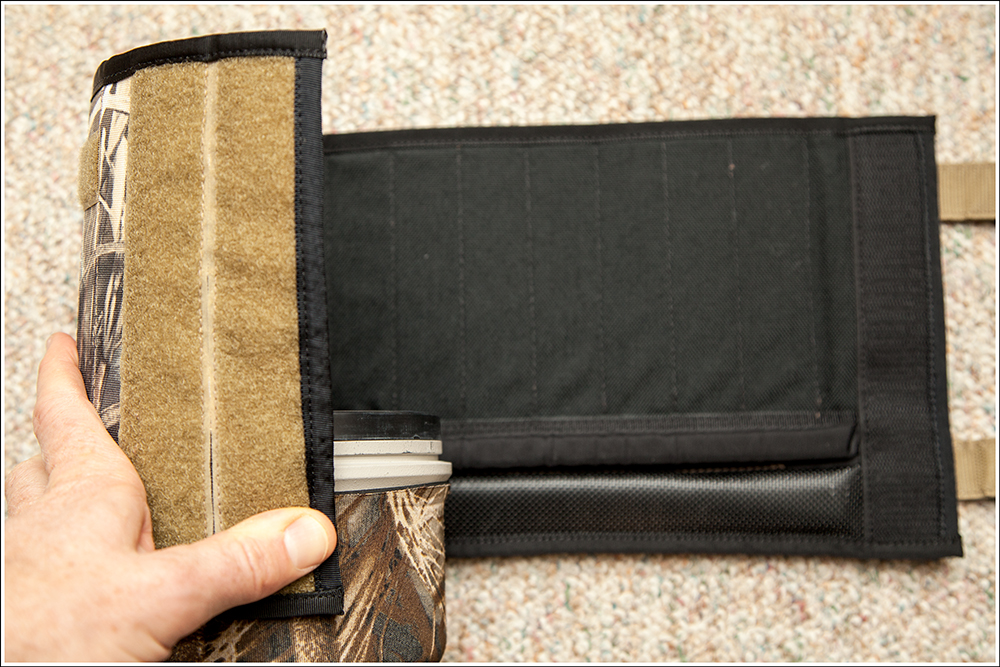
Back to the Travelhood. Here is the simple item unfolded.
LensCoat TravelHood
The materials are good quality, there are a number of colors available for the outside and the inside is black, as expected. Only time will tell, but the velcro and other materials look as though they will last, although ask me again in a couple of years after a few hundred uses. The fit is nice and snug and the hood keeps its shape. I have taken it through some thick brush and it comes out as well as the original hood. It stays in place and does not become deformed under normal to slightly rough handling. I think it should even work a bit as a shock absorber in case you drop your rig, but, obviously not as much as the original, hard hood.
To place the hood, the designers have created a kind of tongue-in-groove fit that is easily followed.
Well-Fitting
Simply follow this around and tighten the velcro support straps. A little practice is needed, as you want the velcro tight enough to keep the hood attached as well as keep its cylindrical shape. Too tight and you might deform the shape, resulting in partial blockage of the field of view. The current hoods are actually designed to fit a couple of specific Canon and Nikon lenses, but it looks as though there is enough of a range that it should fit many older supertelephotos. Contact LensHoods if you want their opinion.
Fasten the Velcro
I’ll be sure to update if my opinion of this product significantly changes or if there are any new developments. Here is what the working kit looks like put together…
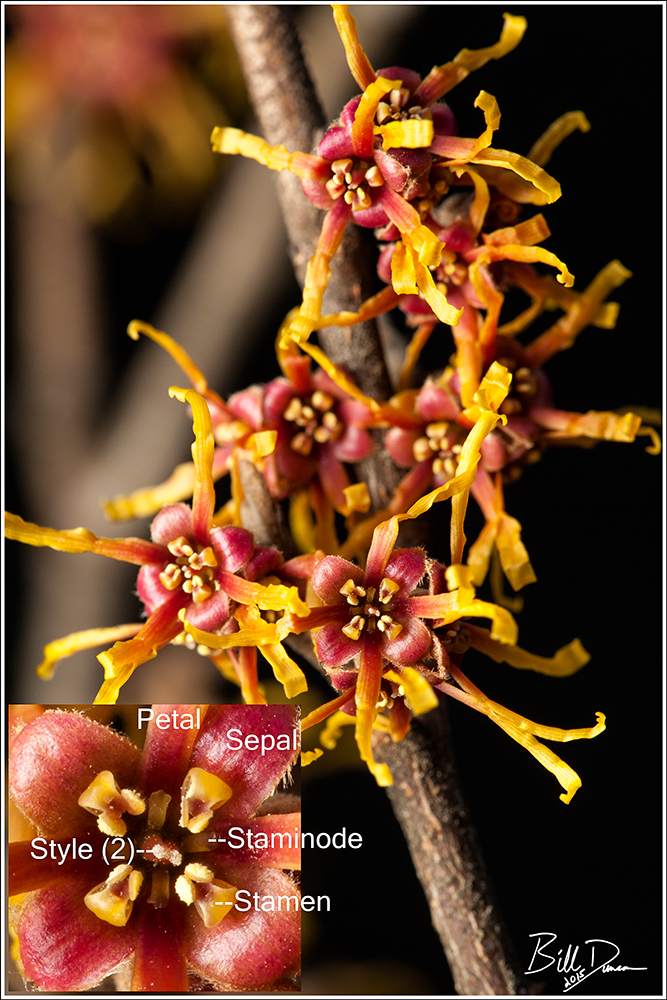
From one of my favorite birds to one of my favorite plants, the shrub known as Ozark Witch Hazel (Hamamelis vernalis).
Ozark Witch Hazel
I have featured and discussed this plant a number of times on this blog and on Flickr over the years, but there were (and still are) a number of things I did not know and hoped to discover about this fascinating shrub of the Ozark Highlands. As the species name vernalis suggests, these shrubs flower from January through late March, while their sister species, the more easterly Common Witch Hazel (H. virginiana) blooms in the fall. There may be some overlap in flowering and hybridization might actually occur in certain circumstances, but I was unable to find anything that suggests how frequently this might take place.
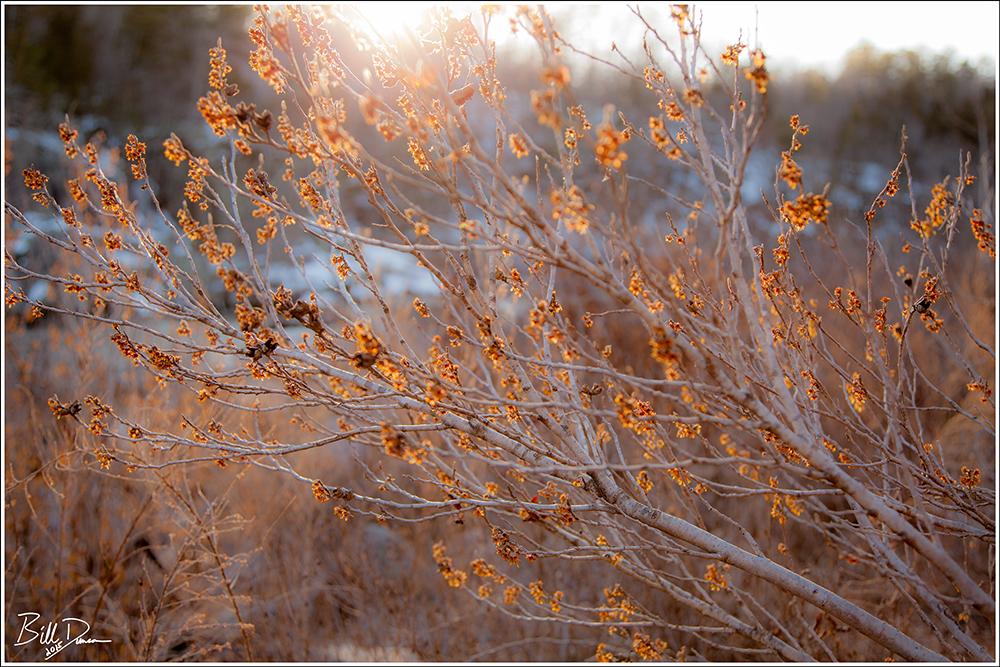
Here is an image I made this year. Notice the snow and ice in the background.
The Winter Blooms
One of the things I wanted to get to the bottom of, either through direct observation or finding in literature is what are the specifics of pollination for a shrub that blooms in the winter months? Nearly all of the scholarly articles I could find dealt mostly or exclusively with H. virginiana, but I believe that we can assume that most of these results can be used to describe OWH as well. There are several things to consider. The first and perhaps most logical consideration is that the plant may predominantly self pollinate or rely on wind-pollination. A couple of papers suggest that although self-pollination does occur, self-fertilization does not, making the species self-incompatible, so we can eliminate that option. The potential for being primarily gravity or wind-pollinated does not make sense when considering that the plants put some considerable resources into making colorful flowers with a noticeable and pleasant odor. The flowers of OWH have all the classic signs entomophily – brightly colored, nectar producing, fragrant, large, sticky pollen, with male and female structures found in close proximity to one another.
The long strap-like petals of these flowers (see photo below) will unfurl on warmer days and odors increase, thus suggesting the strong likelihood of attracting diurnal pollinators.
OWH – Yellow Flowered
Assuming there must be an active pollinator that moves the sticky pollen from plant to plant, what are the potential options for such an insect species in the Ozark Highlands? An interesting article written by Bernd Heinrich of popular science writing fame gave one possibility, at least for the more eastern H. virginiana. In this paper he recorded that winter-active moths he was researching used that shrub’s flowers as a food source. This has been picked up by a number of writers on the internet who have jumped to the conclusion that these moths must be the primary pollinators of the North American Witch Hazels. However, as these primarily warm-colored (preferred by bees) flowers often roll their petals closed and cease odor production at night, the case for nocturnal moths as pollinators should be considered fortuitous at best, and not a reliable vector for pollination by this plant.
Witch Hazel Flower Anatomy
I wanted to visit a good stand of blooming OWH on a warm, sunny day in early February or March and see if I could identify and hopefully photograph a pollinator. No such luck. We were able to see a few small midge-like flies and a few native bees surrounding the plants, but photographing one while visiting a flower was to be impossible. Next time I will bring my handy corn syrup in order to coax pollinators to stay a while longer. To get an answer, it was off to the literature. In a study focused on Common Witch Hazel, insects of six orders were identified as visiting flowers. Of these, flies (order Diptera) were most prevalent and comprised 73% of floral visitors and 52% of the identified species, followed next by Hymenoptera (bees, wasps and ants).
Why flower during colder months? Advantages and disadvantages can be identified with a little thought. What are the advantages of an entomophilous plant that opens its doors for business in the colder months? Not many plants will be flowering in such cold conditions, therefore, on warmer days that allow for flying insects to move about and earn a living, there will be little competition and most pollen collected and moved from flower to flower will be of a compatible, intraspecific origin. In contrast, insects moving about in mid June might be carrying loads of pollen from a number of species, and if these other species provide a higher quantity or superior quality of nectar and pollen, you might find yourself unable to be cross-pollinated.
This strategy is not as clear-cut of an advantage as it may sound, however. It has been found that the North American Witch Hazel have a pretty poor flower to fruit ratio – with a less than 1% fruit set on average (the average fruit set in angiosperms is close to 25%). This makes sense. If you bloom in the winter then there will be generally fewer pollinators, and in particularly long and harsh winters fruit set can and has been documented to fall to zero in Common Witch Hazel. One thing the Hamamelis do to assure that a minimum number of successful seed are produced is by increasing the number of flowers. It has been studied and determined that these plants produce more flowers than similarly sized shrubs. So, although the success rate of each flower is generally poor, when factoring in the number of flowers produced per plant along with the fact that these plants are usually found in dense stands, the total number of seed produced per season is enough to keep the population sustained.
Another of the fascinating natural history notes of the North American Witch Hazels are their means of seed dispersal. These plants exhibit what is termed “explosive dehiscence”, similar to another Ozark native – the Jewelweed. The drying fruit capsules split suddenly, ejecting the seed(s) contained within up to three meters. In the following photo you can see an empty fruit case some time after it has expelled its seeds. An observer will notice another interesting characteristic in the photo. These plants hold onto their spent fruits long into the next season, in this case the plant is in full bloom with its next flowers while still holding onto last years spent fruits.
Explosive Remains
For now, that is about all I have to say and share about the Hamamelis of the Ozark Highlands. If you find yourself in a sandy stream-bed within the St Francois Mountains during the first quarter of the calendar year, be sure to keep your senses open and prepared for an unexpected blast of spring.
Ozark Witch Hazel in Bloom
Please note – other than a few easy observations and a little bit of thought, I produced no original work in the written portion of this post. If I was worth my carbon, I would have cited the source of each work I used within the text, but this is my blog, so I don’t have to. Instead, here is a list of works I consulted in writing this.
Anderson, G.J., & Hill, J.D. (2002). Many to flower, few to fruit: The reproductive biology of Hamamelis virginiana (Hamamelidaceae). American Journal of Botany, 89(1): 67-78.
Bradford, J.L., & Marsh, D.L. (1977). Comparative studies of the Witch Hazels Hamamelis virginiana and H. vernalis. Arkansas Academy of Science Proceedings, 31: 29-31.
De Steven, D. (1982). Seed production and seed mortality in a temperate forest shrub (Witch-Hazel, Hamamelis virginiana). Journal of Ecology, 70: 437-443.
Gapinski, A. (2014). Hamamelidaceae, Part 1: Exploring the witch-hazels of the Arnold Arboretum. Arnoldia, 72(2): 2-17.
Yatskievych, G. (2013). SteyerMark’s Flora of Missouri Volume 3 – Revised Edition.
“Knowing the place and the hour, you seat yourself under a bush to the east of the dance floor and wait, watching against the sunset for the woodcock’s arrival. He flies in low from some neighboring thicket, alights on the bare moss, and at once begins the overture: a series of queer throaty peents spaced about two seconds apart, and sounding much like the summer call of the Nighthawk.”
-Aldo Leopold, A Sand County Almanac–
Peent!
Whether for a hunt, photograph or just to watch, knowing an animal’s favored habitat, the likelihood of finding them at a particular time (circadian and calendar), and specific behaviors are crucial for finding a species of focus. The American Woodcock, also known as a Timberdoodle or Bogsucker, arrives early in the spring to its preferred display grounds.
Young forest is required for nesting Woodcock, and to observe their courtship displays one must find their preferred singing grounds. Woodcock prefer young, dense, successional forest that is somewhat on the wet side, with marsh or forest streams nearby. The singing grounds are typically located in an opening with mixed grassland habitat. An optimal location would be a treeless opening large enough for several males to establish their ground and that allows room for flight. Around 10-15 minutes after sunset from late February to late April, the males slowly begin to peent (see video below) usually from a more covered location. As darkness takes over, the males will venture out onto their preferred open grounds to allow the girls the best possible views. A nice spot for this in Missouri is often a mowed path through native grassland habitat.
After a series of peents, the male jumps into a spiraling flight while emitting a twitter due to stiff feathers that he takes advantage of in his performance. Upon reaching 300 feet or so, he heads back to ground, this time in a zig-zag fashion and making a peculiar liquid-like warble, which sounds to me like an alien’s egg-timer counting down to a perfect soft-boil. While on the singing grounds, you may on occasion be “buzzed”; however, there is no need for alarm, as their eyesight at night is supposedly very good. This “sky-dance” as Leopold so perfectly described it, ends approximately 35 minutes or so after sunset. It is possible to hear them vocalizing and dancing throughout the night, but it is nothing compared to the concert that is just on the darker side of crepusculum.
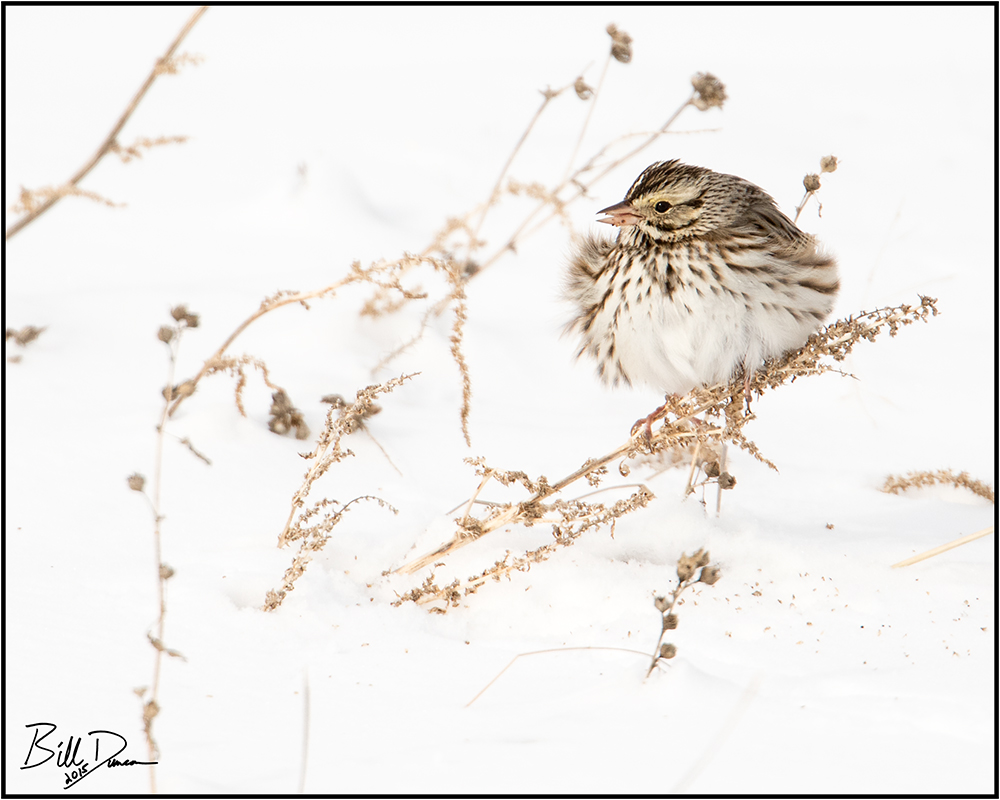
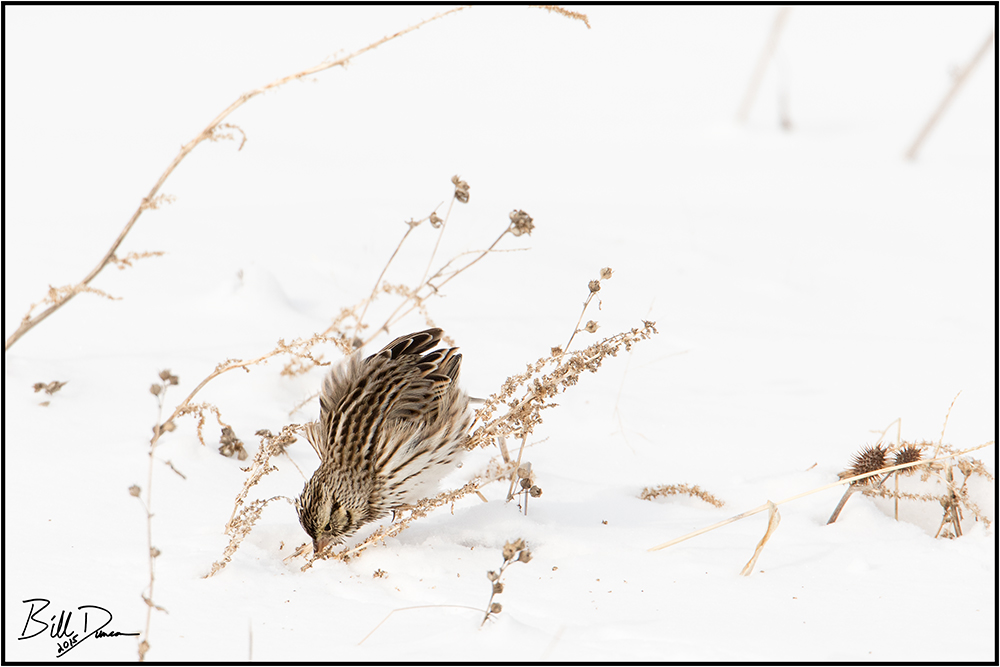
Happy first day of spring! To celebrate the outgoing winter, here are a couple shots of a Savannah Sparrow making a living in the snow. These were taken at Clarence Cannon NWR.
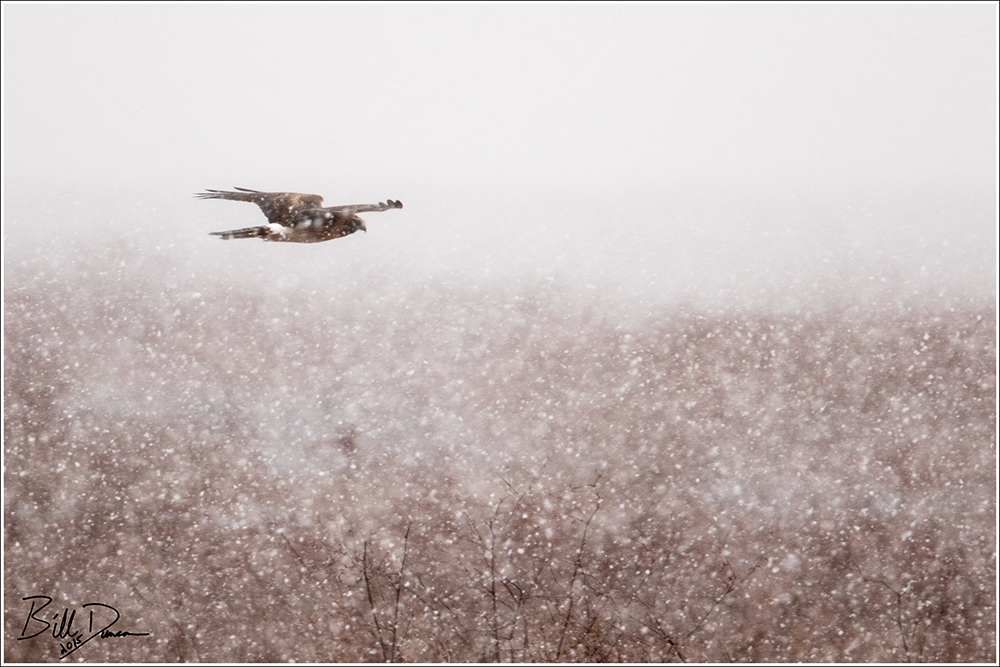
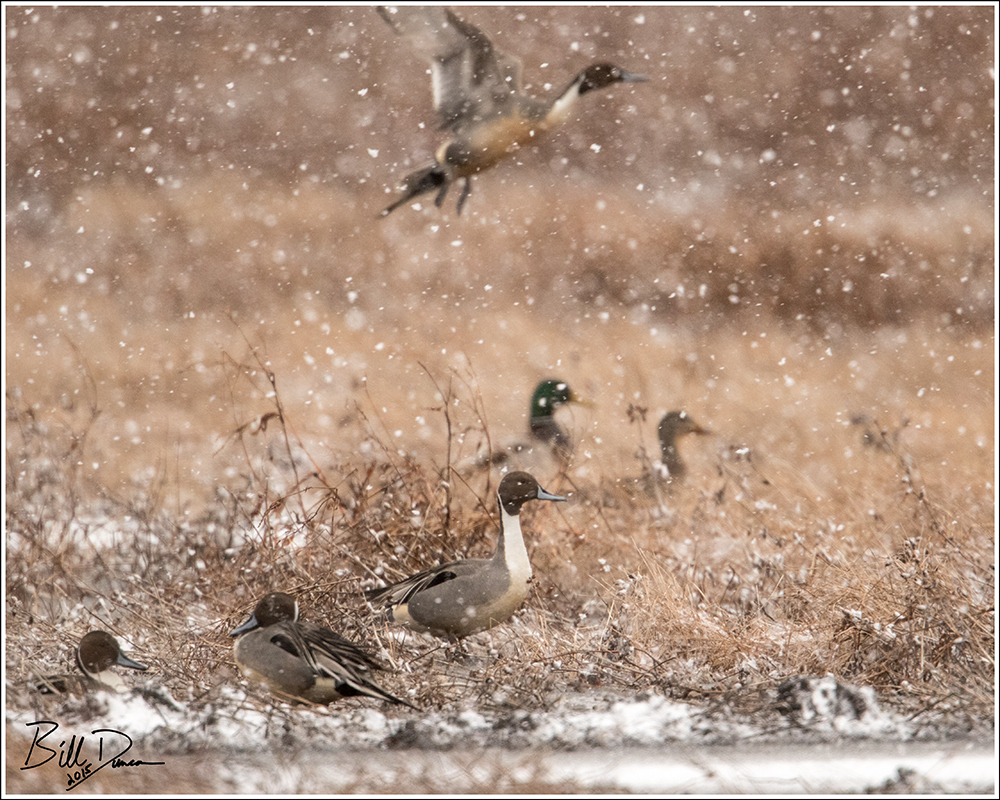
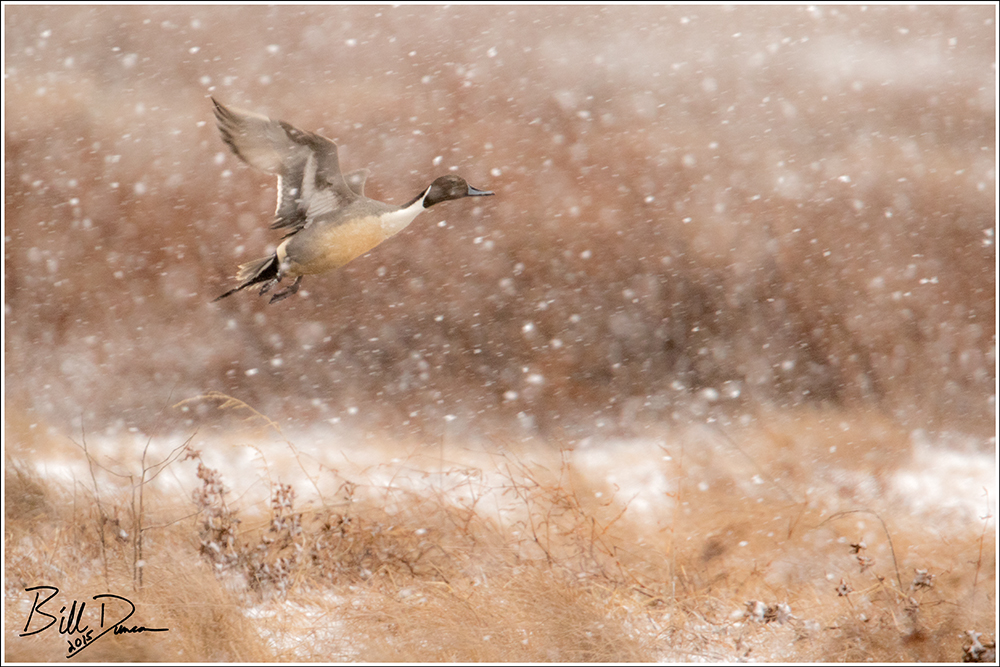
This past Saturday I headed up north on Highway 79. Knowing that the frigid temps and predicted winds of 30 mph + would not afford many great opportunities, the chance of snow in these areas made me think that something interesting could happen. Here are a few I thought worthy to share.
Harrier Still HuntingSnow Falling on PintailsFebruary
















 A Thousand Acres of Silphiums