"What a thousand acres of Silphiums looked like when they tickled the bellies of the buffalo is a question never again to be answered, and perhaps not even asked." -Aldo Leopold
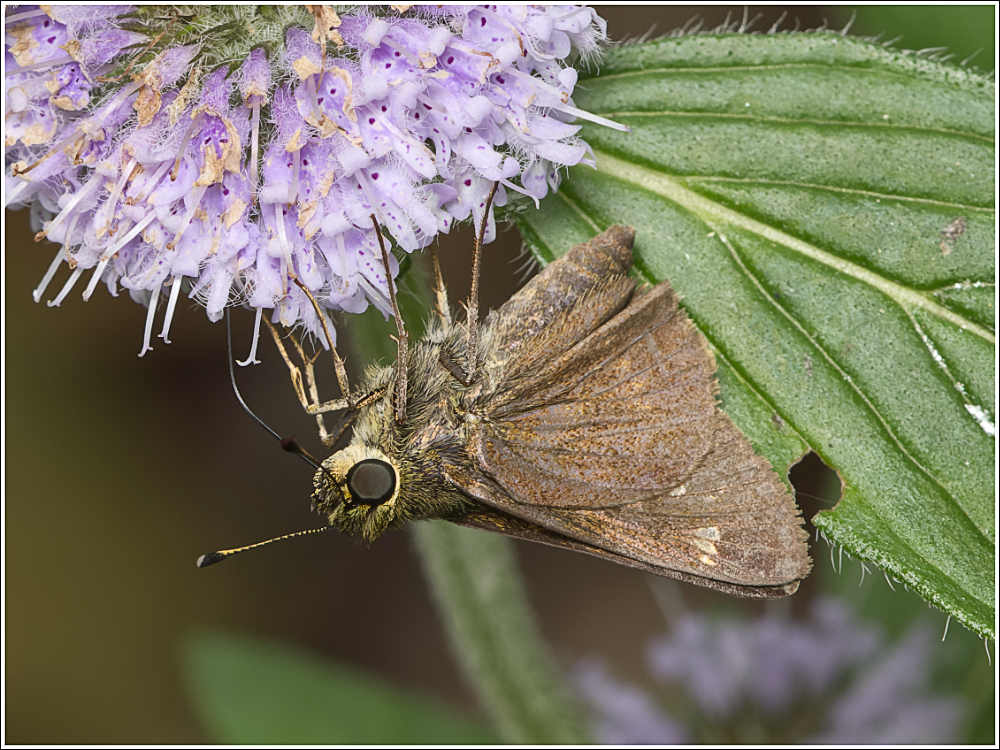
The fellas and I spent a few hours this spring hunting for a few butterflies in Phelps and Franklin Counties. We finally had some success locating the rare golden-banded skipper after numerous attempts over the past two or three seasons. We were hunting in the right place, but not in the exact right spot. Thanks to our friends who shared the location of their original find.
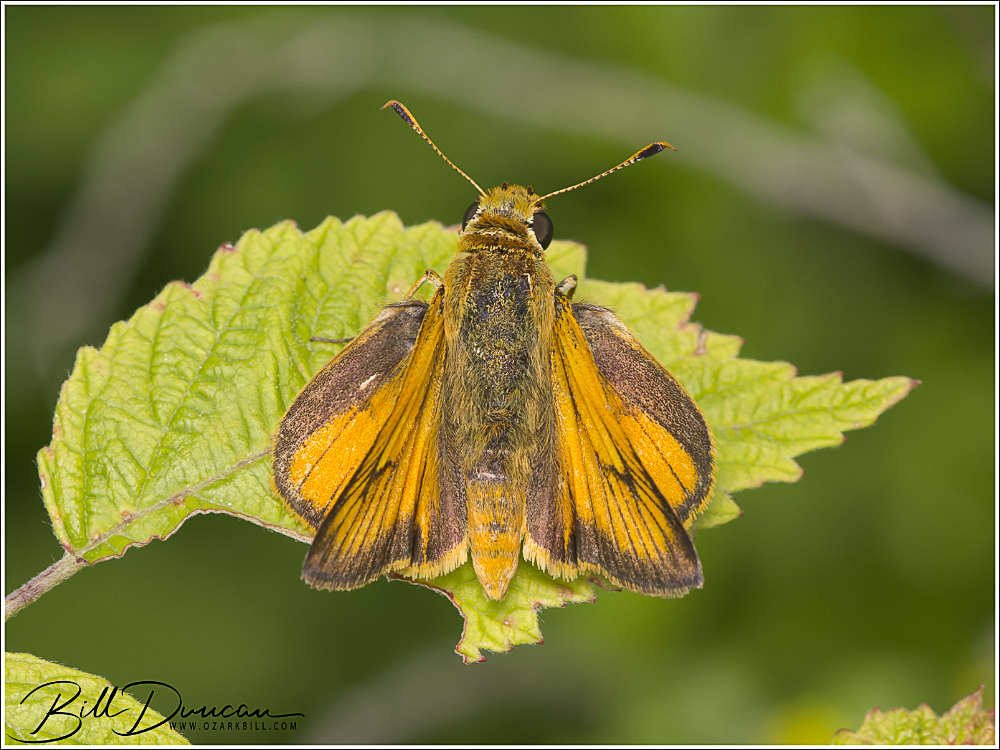
The Golden-banded Skipper (Telegonus cellus)
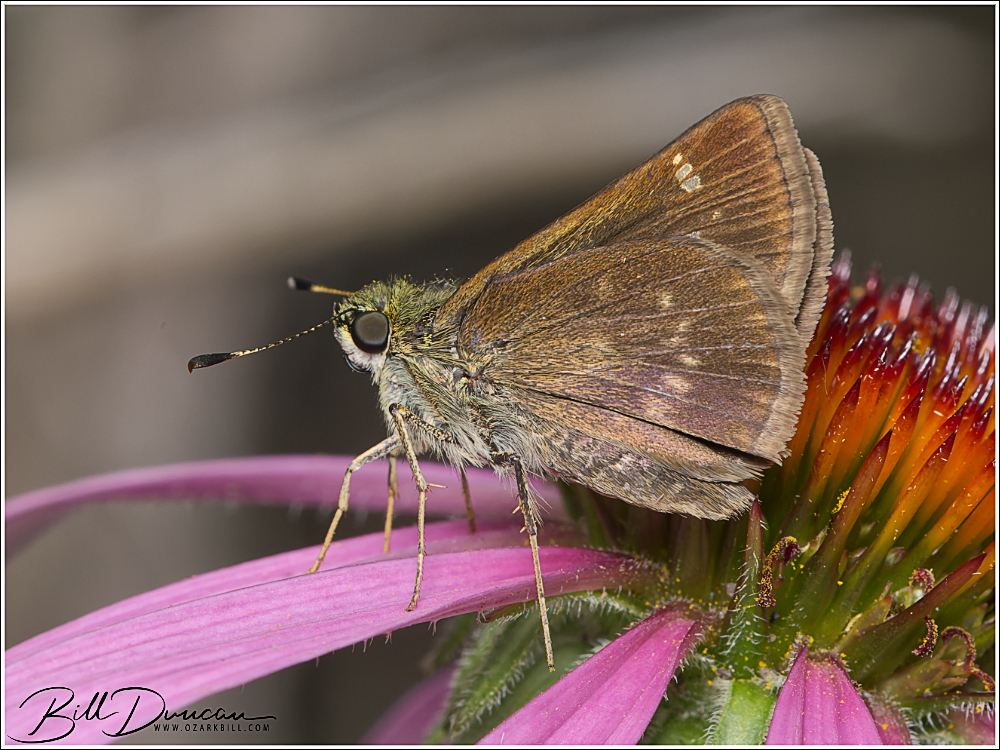
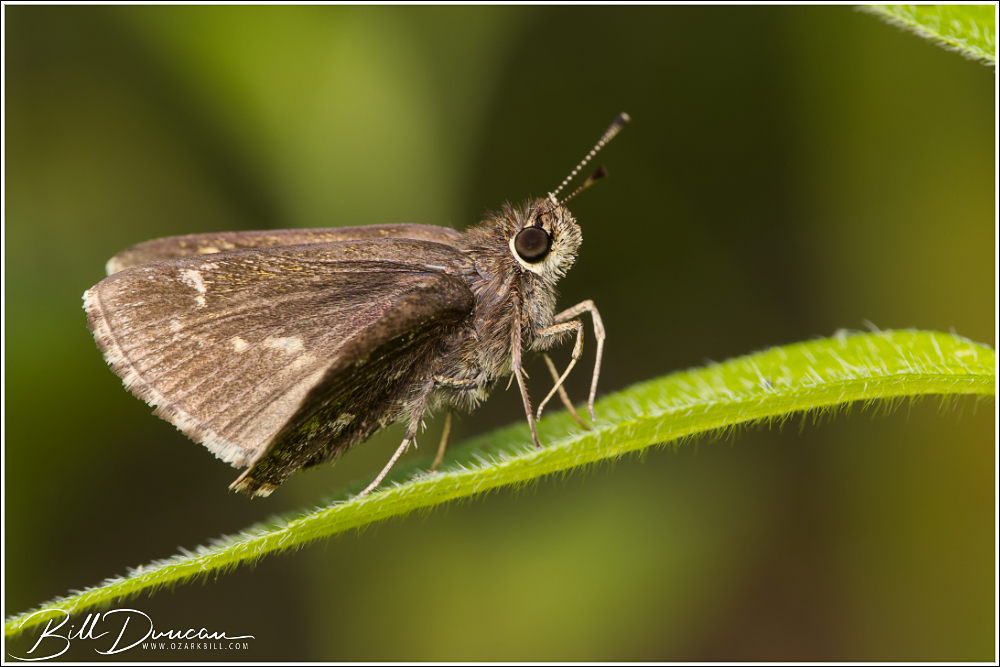
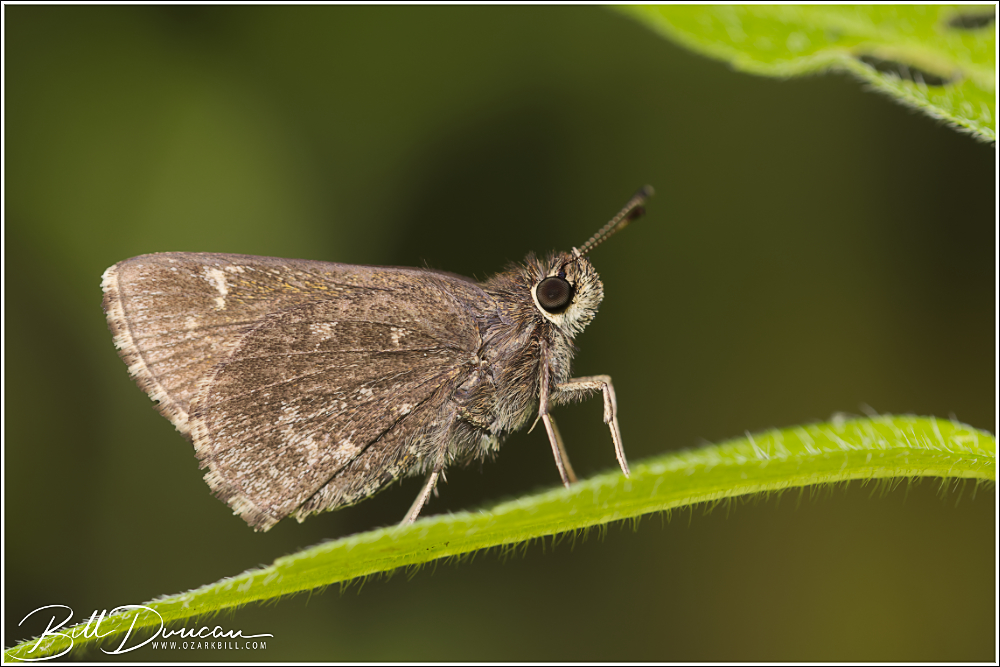
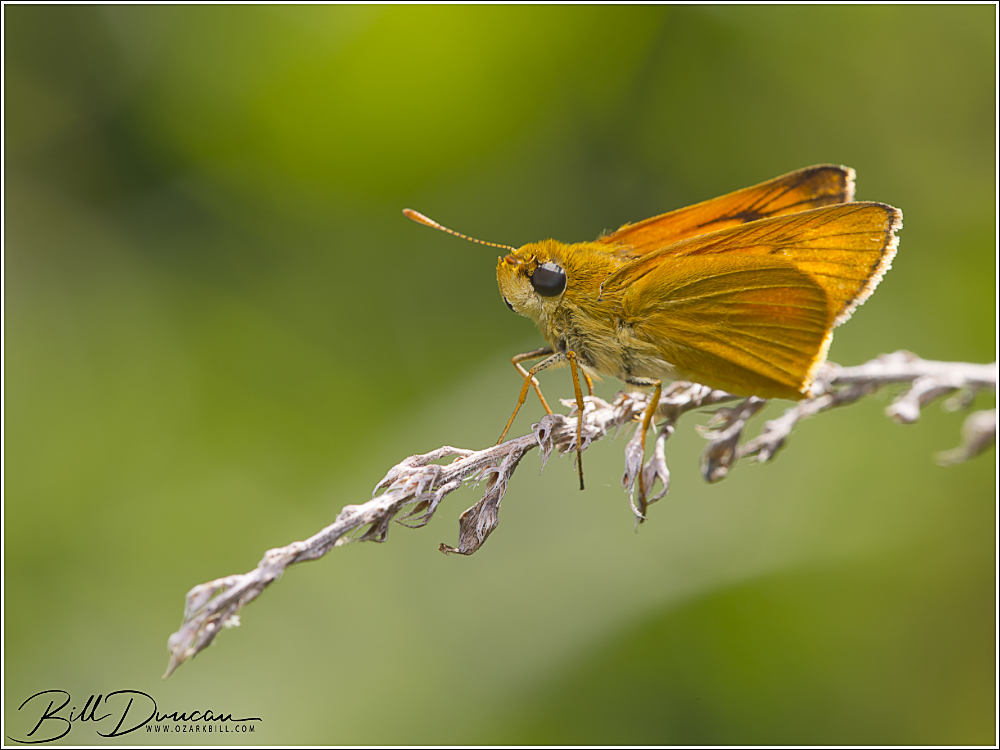
In order to find and identify the rare skipper butterflies (Hesperiidae), one must first find and take lots of photos of the more common species. There are so many skippers that look very similar to each other and even with taking photos, I found it to be a painful chore to come to the correct identification on many of these. Many thanks to CA Ivy from Butterflies and Moths of North America for helping me get the proper IDs on the following.
Little Glassy Wing (Pompeius verna)
Northern Cloudywing (Thorybes pylades)
Bell’s Roadside-Skipper (Amblyscirtes belli)
Delaware Skipper (Anatrytone logan)
Least Skipper (Ancyloxypha numitor)
Zabulon Skipper (Poanes zabulon)
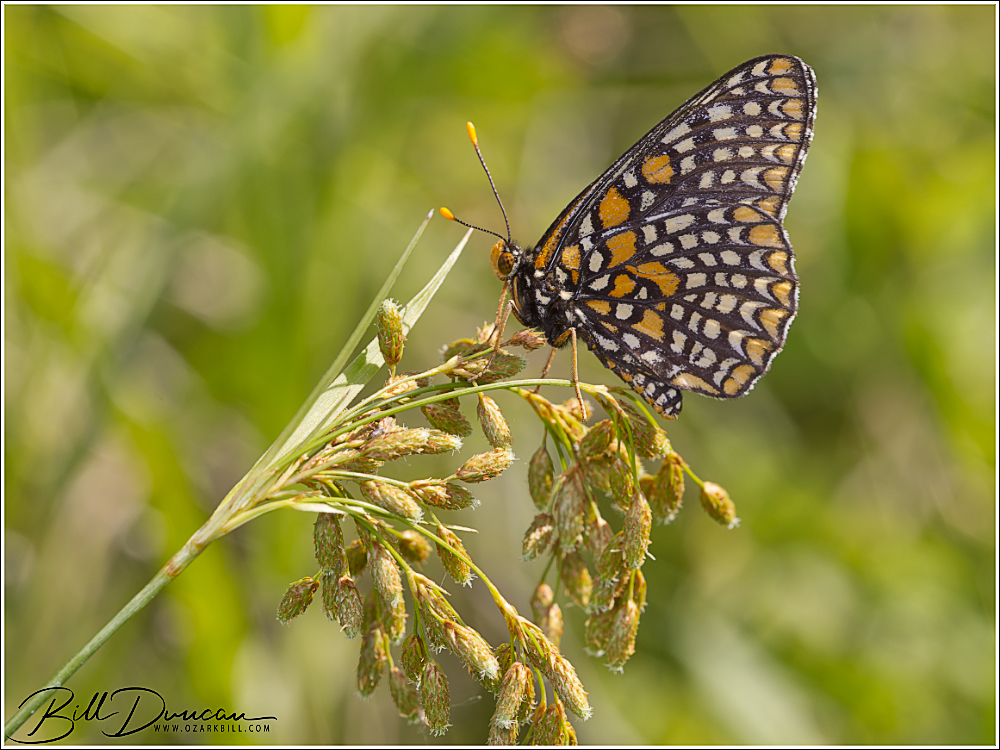
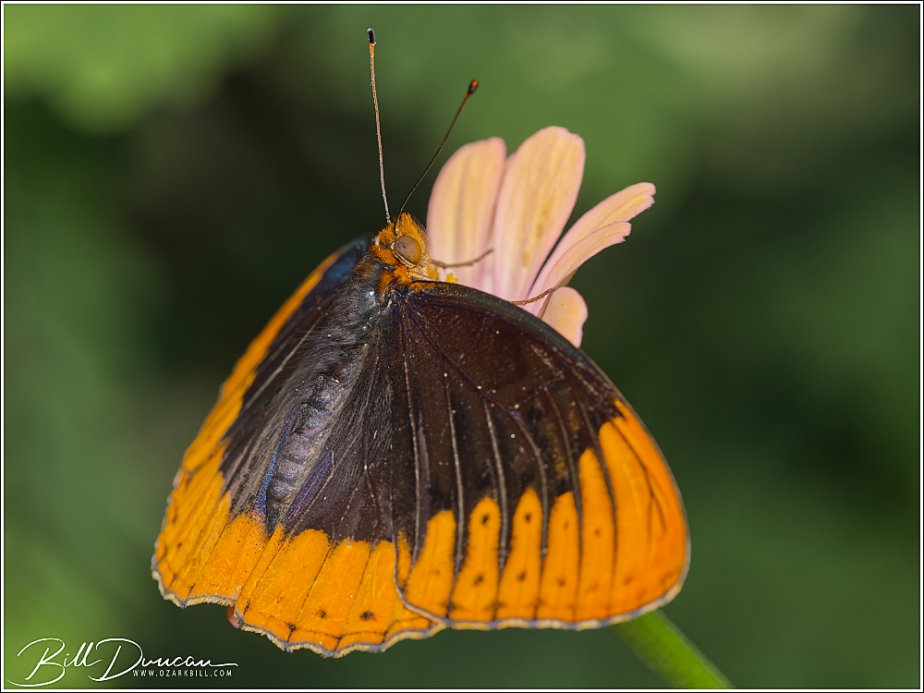
We found other leps besides skippers, including quite a few of the Ozark Baltimore Checkerspot (Euphydryas phaeton ozarkae).
It was so nice to see something with these colors and patterns that wasn’t a dang Pearl Crescent. This one is the Silvery Checkerspot (Chlosyne nycteis).
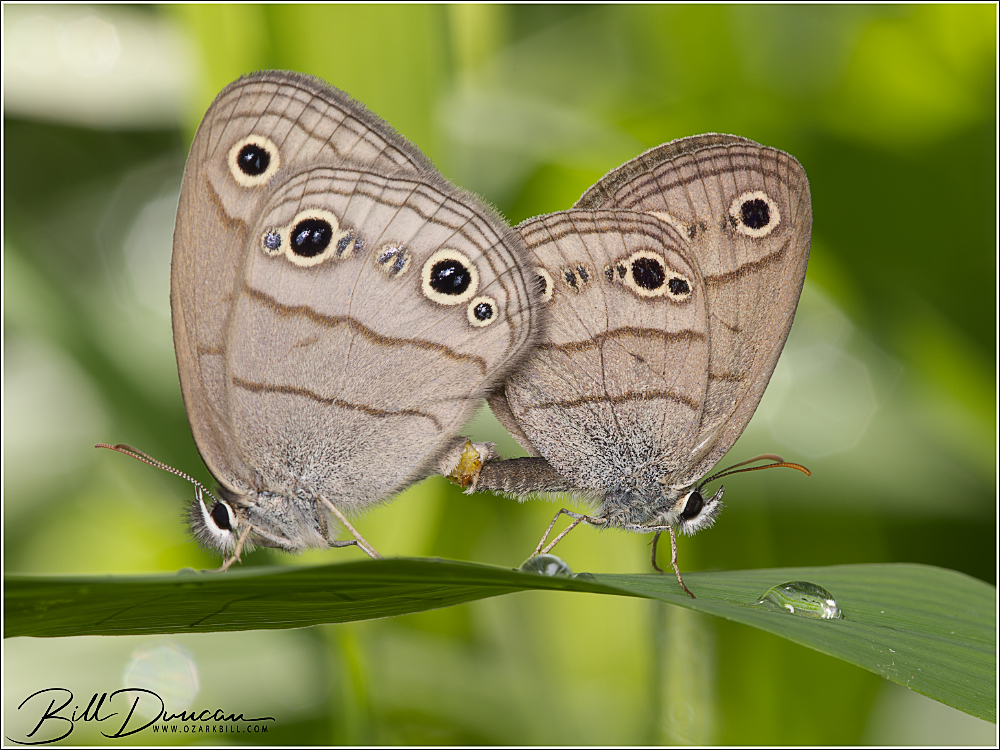
I’ve struggled for years to get a photo of the Little Wood-Satyr (Megisto cymela). I finally found the trick to get them to stay put for a few seconds… 😉
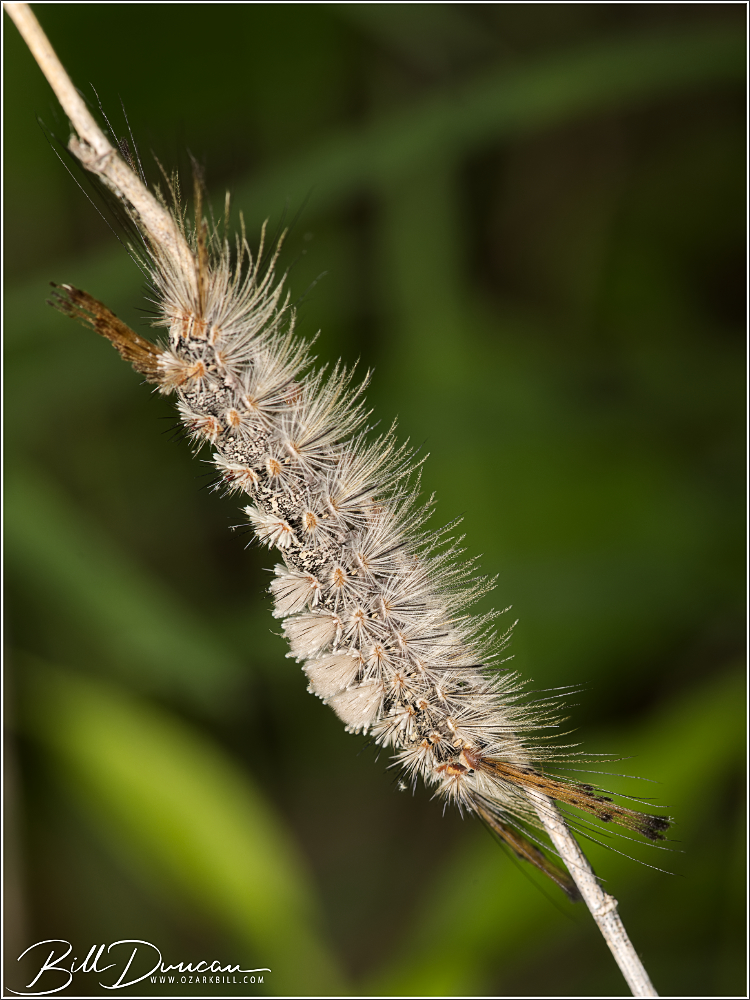
Casey and I stumbled across this first for me – a gorgeous Tephra Tussock Moth (Dasychira tephra) caterpillar.
Not another lep, but we had a few of this fantastic species – the Saw-combed Fishfly (Nigronia serricornis) associated with a fen and creek we were searching in.
It has been suggested that we might be seeing a very good moth and butterfly season this year due to birds and other predators filing up and raising their young on the Brood XIX periodical cicadas. From my anecdotal experiences, this seems to be true. Hopefully I can find more caterpillars over the summer if this continues to be the case.
Early this month the WGNSS Nature Photography Group traveled to the southwest part of the state. Our primary destination, the Roston Native Butterfly House, is a real treasure that I never get tired of visiting.
Officially considered as an accidental species in Missouri, the Dianna fritillary (Speyeria diana) has a strong population in the mountains of northwest Arkansas.
The Roston Native Butterfly House was established to create a haven for local butterfly species and to educate the public about their ecological significance. Its history is rooted in conservation efforts and the desire to preserve native butterfly populations threatened by habitat loss and environmental changes.
Another fritillary, the great spangled (Speyeria cybele)
This native butterfly house, located within the Springfield Botanical Garden, was created and named in honor of Dr. Bill Roston, an MD of the small town of Forsyth, MO who had an avid interest in conservation and pollinators. Today this lovely location is curated by Dr. Chris Barnhart and his wife Deborah.
A couple individuals at slightly different stages of pupation. These are the larvae of the viceroy (Limenitis archippus) which resemble bird droppings.
Pictured above is a caterpillar of the silver-sided skipper (Epargyreus clarus).
The Barnharts and their staff of volunteers do an incredible job of rearing several native butterfly species and maintain a nice population of their required host plants within the house. The Barnharts welcome several thousand visitors each year and do an excellent job in educating the visitors on the life histories and conservation stories of the butterflies they raise. Chris and Deborah always eagerly support our small group visits and often go out of their way to help us get the photographs of the butterflies and caterpillars we are after.
The Roston Native Butterfly House is a great place to see many of the swallowtail species found in our region, like this newly emerged giant swallowtail (Papilio cresphontes).
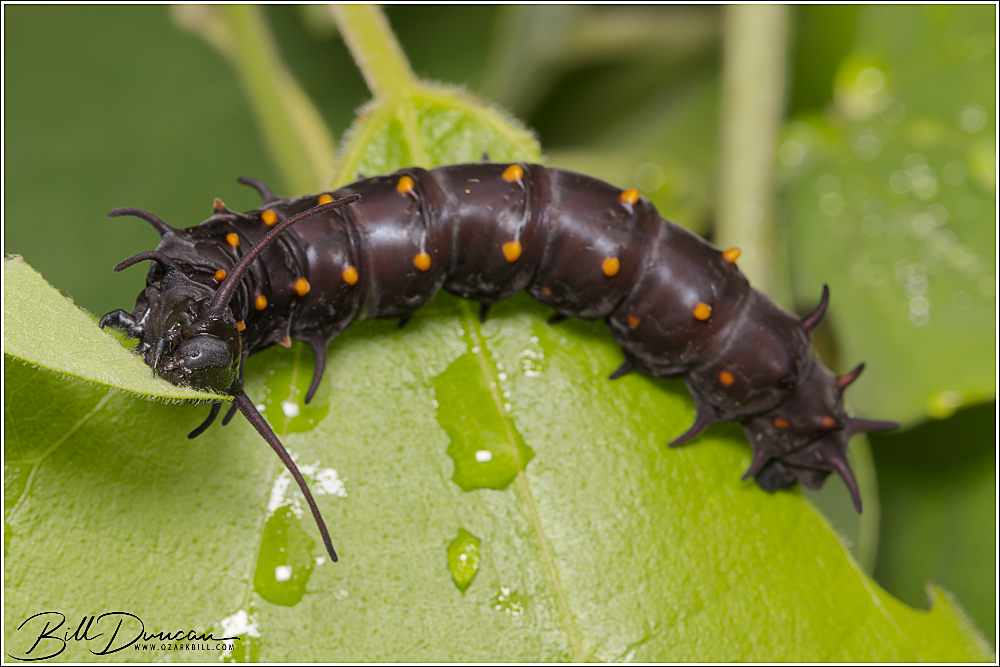
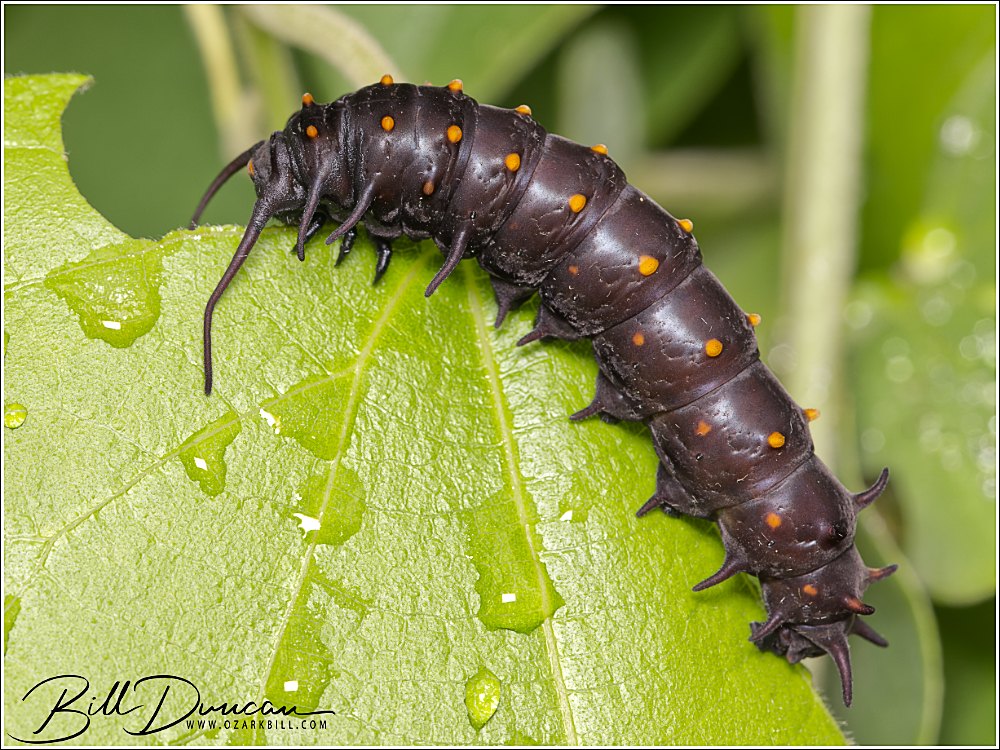
Here are a couple of shots of the incredible larvae of the pipevine swallowtail (Papilio troilus). These cats are typically very conspicuous feeders, relying on their aposematic coloration to warn predators of their poisonous disposition.
Native to Florida, Cuba and the Bahamas, the Atala butterfly is an excellent example of a specialist. The Atala (Eumae atala) feed only on the coontie cycad (Zamia integrifolia). You might notice that this member of the Lycinidae (hairstreaks) family also shows aposematic coloration in both larval and adult forms. This is to warn predators of the neurotoxic secondary plant compound – cycasin, that they ingest from their cycad hosts and carry with them for their entire lives.
Related to the common hairstreak butterflies seen in our own backyards, the Atala butterfly is a tropical representative of this family native to Florida.
The Barnharts go to great lengths to rear the Atala butterflies. They bring back larvae from cycad farms (that really don’t want them) in Florida and must make sure they raise and overwinter enough cycad plants for them to raise the cats to their adult forms.
Nothing against the typical butterfly houses that tend to showcase tropical species from around the world, but I would sure like to see more strictly native butterfly houses like the Roston Native Butterfly House. As I hope my photographs show, not only are the natives spectacular, but showcasing them in this type of setting helps to educate its visitors on the species they might see in their own neighborhoods or while out on the trails.
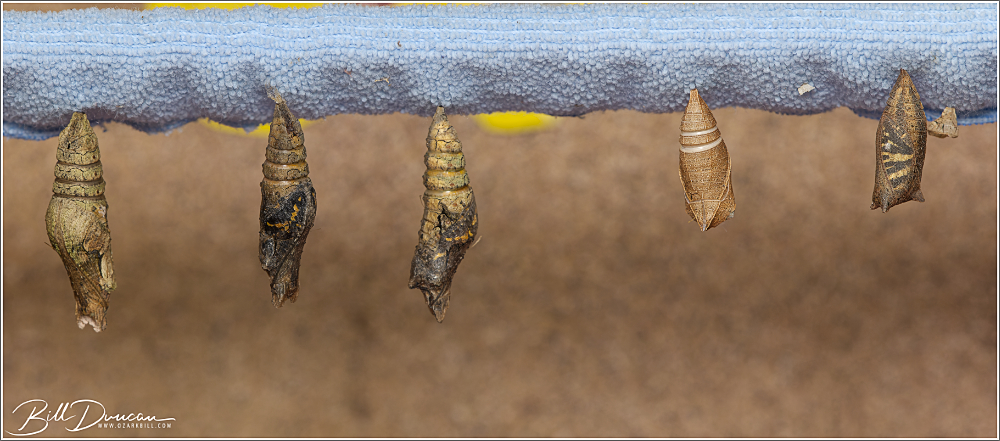
Chrysalises of the various native butterflies can usually be observed when visiting the Roston Native Butterfly House in Springfield, MO.
A great big thank you to Chris and Deborah for always being gracious hosts. We are looking forward to more visits.
Back in early May of this year, a small group from the WGNSS Nature Photography Group headed out to visit some glades in Washington County, Missouri. Being a relatively wet and cool spring, we expected the glades to be lush and full of blooming wildflowers. These specialized blooming plants and their associated pollinators were our planned primary targets for this beautiful Saturday.
Unfortunately for us, the timing of our visit did not seem to be optimal. We found very few plants in bloom and even fewer interesting butterflies and skippers that we were hoping to find. However, I noticed something about this particular glade that Casey had steered us into. Looking around, I noticed that there was very little sign that foot traffic or rock tipping had occurred recently – something that plagues the more popular glades in Missouri.
Normally, I loathe the thought of rock-tipping – the process of lifting rocks in sunny natural areas in order to find reptiles, amphibians and arthropods. As I alluded to above, this activity can be highly over-practiced and is often accompanied by people harassing or collecting the animals found. In large and popular glades, the signs of rock tipping can be abundantly clear. Just look for large flat rocks that have obviously been moved and are no longer in close contact with their underlying soil substrate. In this case, because we were on the lookout for improvised subjects and the fact that this area has not seen much pressure from others, we decided to carefully tip a few to see what we might find.
Little did I know what a treat we were in for. With tipping over just a few stones, we were able to find close to 20 prairie ring-neck snakes (Diadophis punctatus arnyi), including one albino! The prairie ring-neck is a small, slender snake native to prairies and other grasslands in the central United States.
An albino prairie ring-neck snake (Diadophis punctatus arnyi)
These snakes can reach up to 14 inches in length, but seem much smaller due to their slender build. This species primarily feeds on small invertebrates such as earthworms, slugs, and insects, but may also consume small amphibians and other reptiles. The prairie ring-neck snake is considered an opisthoglyphous colubrid, meaning they possess small fangs in the rear of their mouths along with a very mild venom. They are completely harmless to humans as they will very rarely attempt to bite, relying instead on a foul-smelling musk that they emit along with exposing their orange and red warning colors on their undersides in order to dissuade predators. On rare reports of bites to humans, the reaction has been described as a mild discomfort or stinging sensation, akin to a nettle sting or a sting from a sweat bee.
A typically colored prairie ring-neck snake
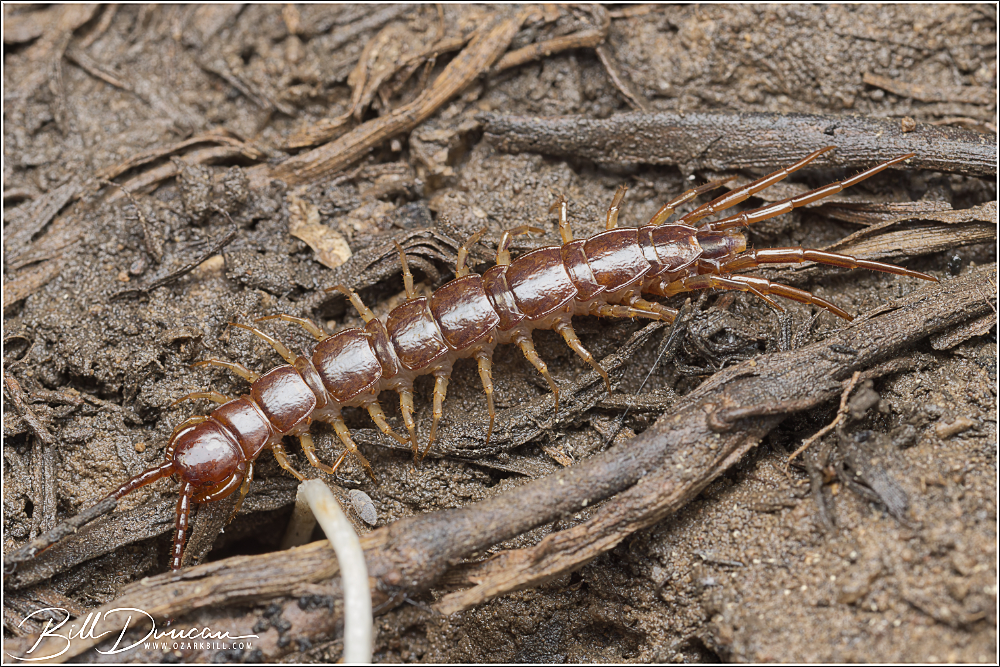
Rock tipping can also yield a number of interesting invertebrates. Although we did not find any tarantulas or black widows that can be found in this manner, we did find Missouri’s only scorpion and a common centipede.
The striped bark scorpion (Centruroides vittatus)
The rock centipede (Lithobius forficatus)
When we were done with our subjects we made sure they all found their way back safely underneath their rock dwellings.
Today I am showcasing an example of biological pest control that I came across in my own neighborhood in late April of this year. The image below shows a bronzed cutworm moth larvae (Nephelodes minians) in the Family Noctuidae that has been parasitized by a Braconid wasp in the genus Cotesia. This is a very species-rich genus of parasitoids, but there is a fair chance of this species being C. marginiventris. Thanks very much to Alex Soohoo-Hui for his assistance in narrowing down the identification of this minute wasp.
A deceased bronzed cutworm (Nephelodes minians) caterpillar in the final stages of hosting its parasitoid Braconid brood.
The bronzed cutworm is a very common moth that feeds on various grasses, including crops like maize and other cereals as well as turf grasses. I consistently find these cats or their chrysalis whenever I dig a new hole in the yard.
When I found and collected these animals, the last couple of wasp larvae were finishing up spinning their cocoons.
After the wasp deposits her eggs on the host, the wasp larvae feed on the caterpillar internally, being careful not to do much damage to vital organs. The host will never survive, but the parasitoids must ensure that it stays alive long enough for the brood to reach maturity. Often, the caterpillar will still be alive when the wasp larvae emerge and begin to spin their cocoons and will defend itself and its parasites from potential predators.
Three cocoons showing the doors that the adult wasps chewed their way out of.
In this case, the caterpillar seemed dead. I collected it and took it home with hopes of rearing out the tiny wasps to photograph and identify. In about four days, I came home to find 15-20 adult wasps had emerged.
The adult wasps are extremely tiny, measuring 2-3 mm. In order to have a chance at getting photographs, I placed their enclosure into the refrigerator for a minute or two. The wasps in the accompanying images might appear dead, but they perked up within a couple of minutes. After getting my photographs, I released the brood into my backyard to continue their pest control services.
A Braconid wasp in the genus Cotesia, potentially C. marginiventris.
A couple more looks at this diminutive but effective parasitoid.
Anyone with a bit of knowledge about the St. Francois River of southeastern Missouri has probably heard of or has even visited the well-known stretch of the Tiemann Shut-ins that create the great series of class 1-3 rapids that experienced kayakers long to ride. The stretch of this river between Millstream Gardens and Silver Mines Recreational Area is one of the most scenic and biodiverse areas of the Show-Me State.
This spring I was turned on to three new-to-me shut-ins in the St. Francois watershed that I should have visited long ago. At first, it was surprising to me that these three geological features are not more well known. However, once I found out a little of the difficulty of getting to these locations, I am now not surprised at all.
Looking up Turkey Creek
The St. Francois Watershed The geological history of the St. Francois River watershed is a tale written in stone, shaped over millions of years by dynamic processes. At its core lies the ancient Ozark Plateau, characterized by its resilient dolomite and limestone bedrock, remnants of a bygone era when shallow seas covered the region. Erosion and uplift sculpted the landscape, carving out rugged hills, steep bluffs, and winding valleys that define the watershed’s topography today.
Upper Stouts Creek Shut-ins
Within the embrace of the St. Francois River watershed thrives a rich tapestry of ecological diversity, harboring a multitude of habitats that support an abundance of plant and animal life. The forested slopes of the Ozarks provide refuge for a myriad of tree species, from towering oaks and hickories to delicate dogwoods and redbuds. Beneath the canopy, a lush understory of ferns, wildflowers, and mosses carpet the forest floor, while clear, spring-fed streams meander through the landscape, sustaining populations of freshwater mussels, fish, and amphibians.
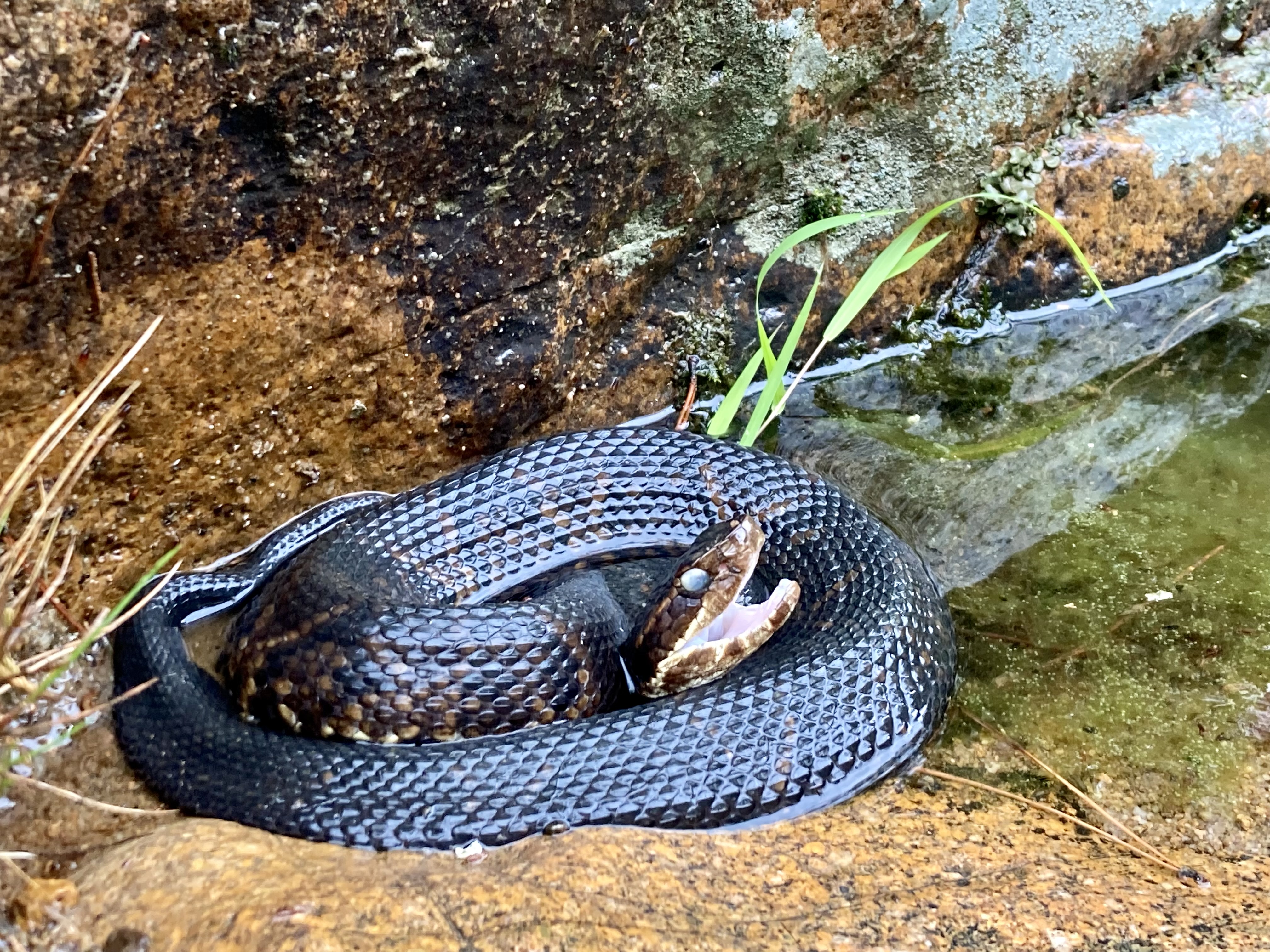
The traveler to the shut-ins of the St. Francois River watershed should always be on the lookout for cottonmouths.
The river itself serves as a lifeline for countless species, offering vital habitat and nourishment along its meandering course. From the elusive Ozark hellbender to the Bald Eagle, the St. Francois River watershed supports a diverse array of wildlife, including many species of conservation concern. Endemic flora and fauna, such as the Ozark chinquapin and the Hine’s emerald dragonfly, find sanctuary within the watershed, highlighting its importance as a stronghold for biodiversity.
About Missouri’s Shut-ins Shut-ins are a testament to the enduring forces of nature. Formed over many thousands of years, these unique rock formations are the result of a complex interplay between water erosion and geological upheaval. The shut-ins, characterized by narrow channels and cascading waterfalls, are formed when swiftly flowing streams encounter resistant igneous bedrock, creating natural barriers that redirect the flow and sculpting the surrounding landscape into breathtaking formations.
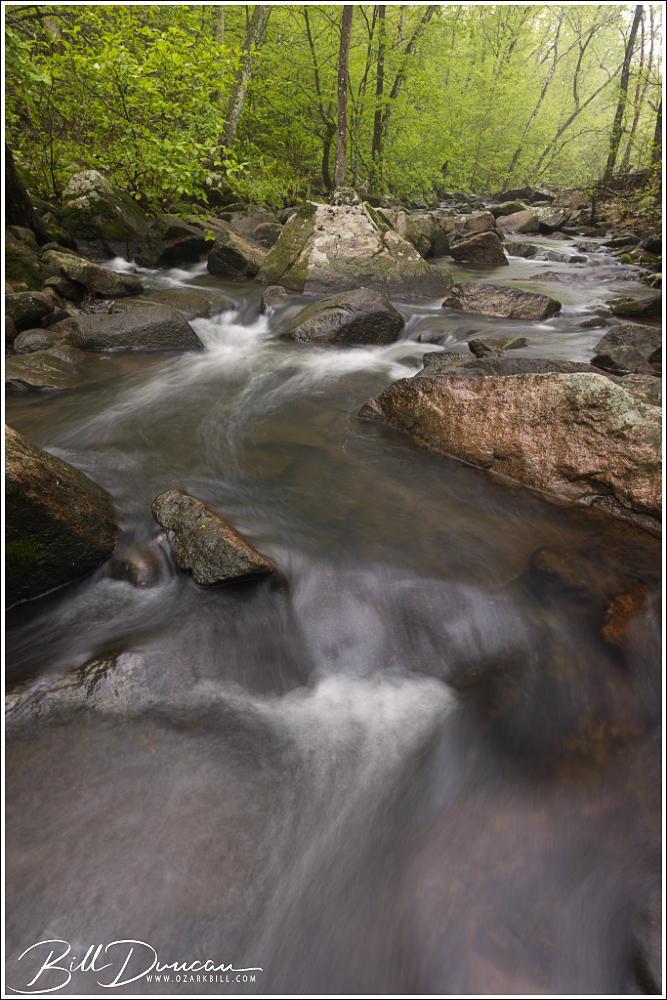
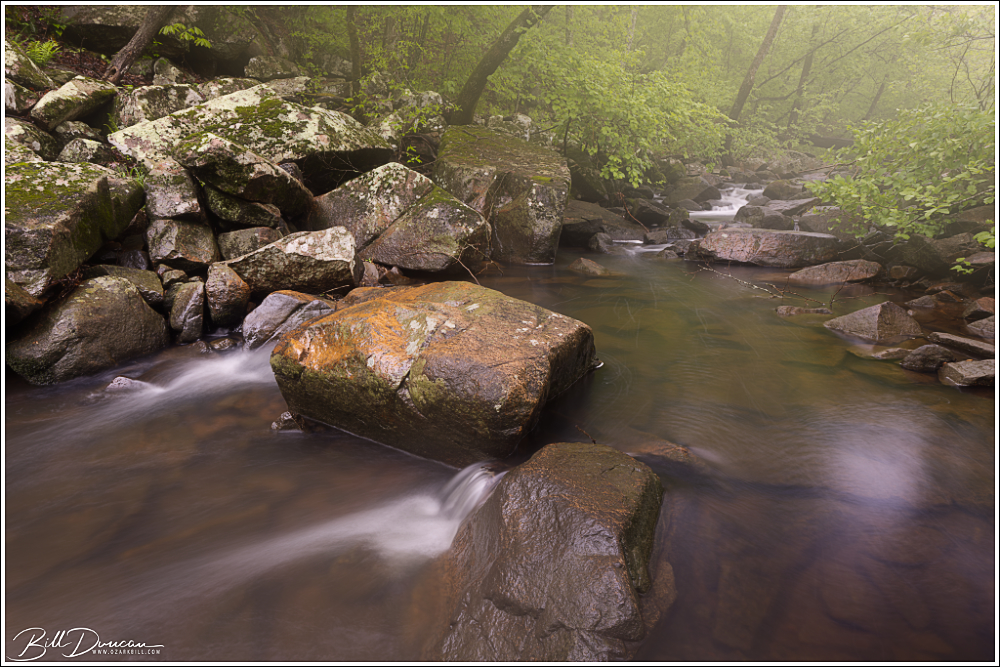
Humidity in these creek beds is usually very high, creating fog and haze. Turkey Creek Shut-ins.
Beyond their stunning beauty, shut-ins are also home to a diverse array of flora and fauna. The cool, clear waters of the shut-ins provide a habitat for various aquatic species, including aquatic invertebrates, freshwater mussels and fish. Along the rocky banks, towering hardwood forests thrive, offering refuge to an abundance of wildlife, from songbirds to white-tailed deer. The unique microclimate created by the shut-ins supports a rich tapestry of plant life, including rare species adapted to the harsh conditions of the rocky terrain.
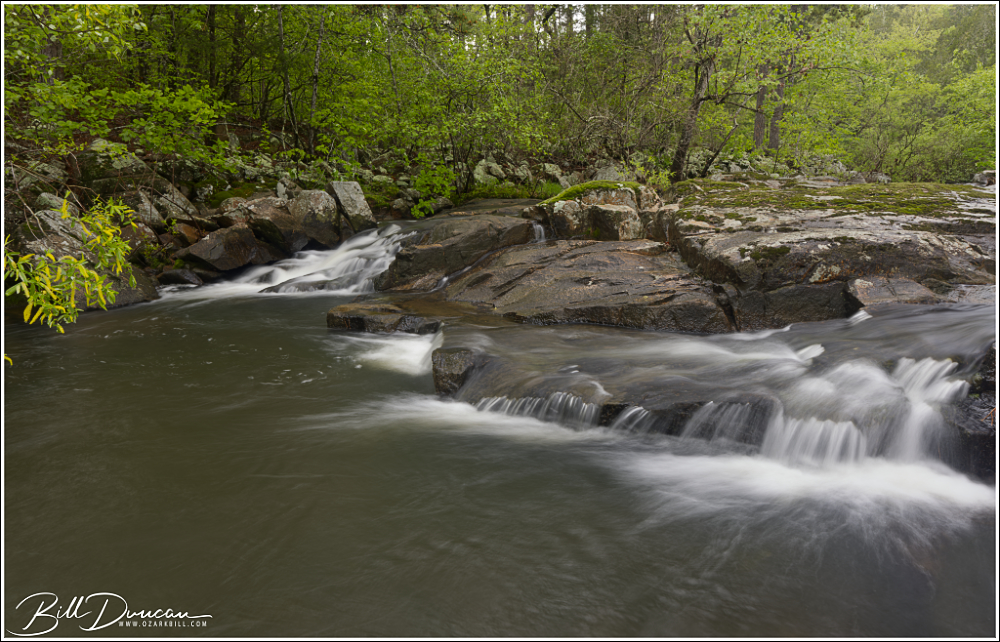
Upper Stouts Creek Shut-ins One of the main feeding branches of the St. Francois River, Stouts Creek contains a number of picturesque shut-ins. Casey and I had noted this particular one driving by for years but had never made the stop. We had to trespass a little to get our shots, but the folks who own this property are, theoretically at least, supposed to be inclined to forgive those who trespass. We spent just a few minutes here and were in and out without incident.
Upper Stouts Creek Shut-ins
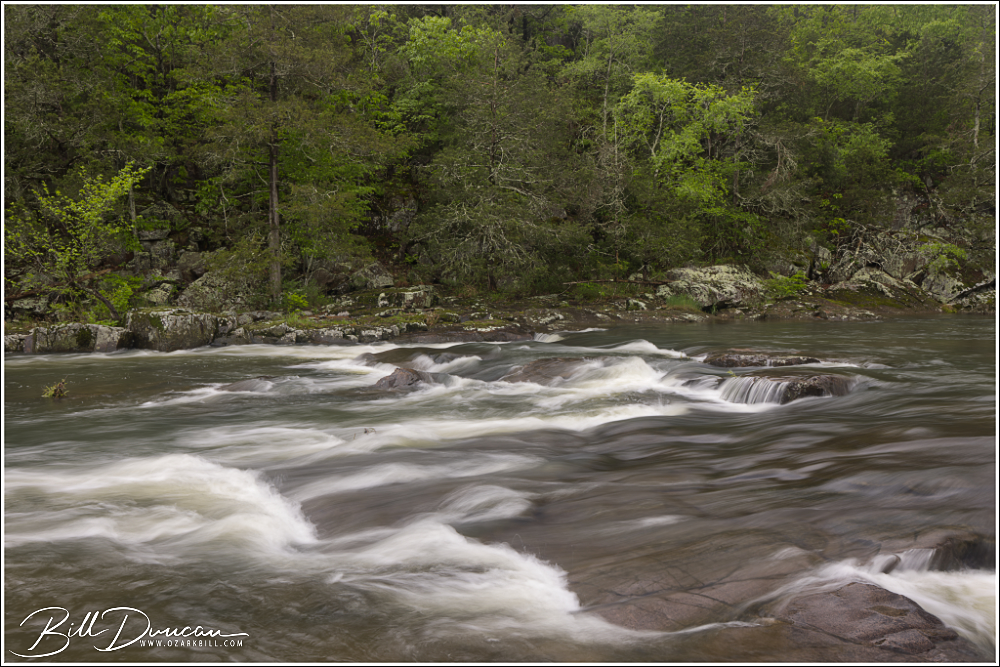
Turkey Creek Shut-ins Flowing from the north, Turkey Creek empties its contents into the east side of the St. Francois River, just upriver from the historic Silvermines Dam. Getting to the Turkey Creek Shut-ins requires either a treacherous hike along the creek from the confluence, or a slightly less arduous bushwhack up and over a highland to the sight of the more picturesque parts of the shut-ins. Taking the easier way means missing portions of the shut-ins but will also result in fewer potential run-ins with cottonmouth snakes and ankle-snapping rocks.
Turkey Creek Shut-ins
Swimming holes abound in shut-ins like these at Turkey Creek.
Turkey Creek Shut-ins
Mud Creek Shut-ins Mud Creek Shut-ins are definitely one of the most memorable shut-ins that I have had the pleasure to visit – not only because of their classic St. Francois Mountain beauty, but due to my story in reaching them. As is the case with Turkey Creek Shut-ins, these shut-ins can be reached by paddling the St. Francois River. However, I doubt my kayak skills would service safe passage across the class-3 rapids of this stretch of the river, especially while carrying expensive camera gear.
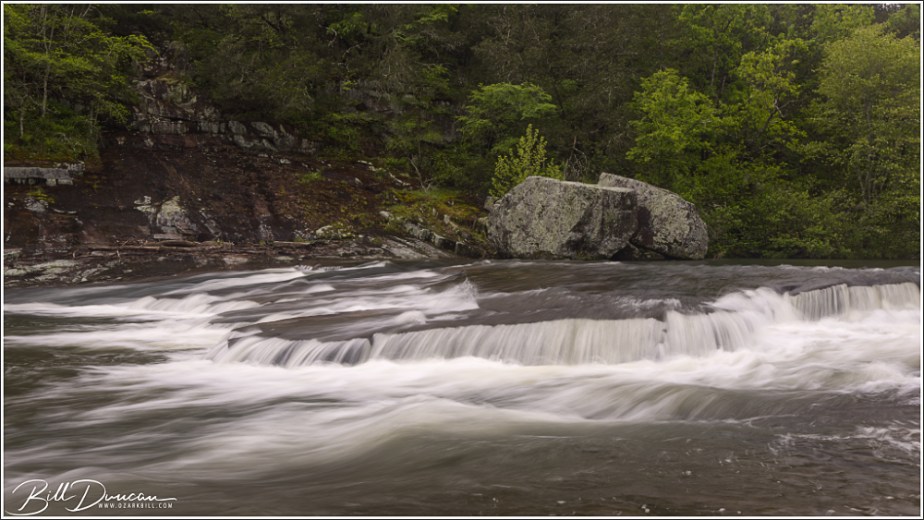
Moving upstream along Mud Creek from its confluence with the St. Francois, one first gets to view this very nice waterfall.
The next best option? Footing it across. I began this trek from the parking lot of the Silvermines Recreational Area. In times of high water, the low footbridge across the St. Francois River can be underwater, so I recommend parking on the north side of the river and paying the ridiculous $5.00 to park your car for a few hours.
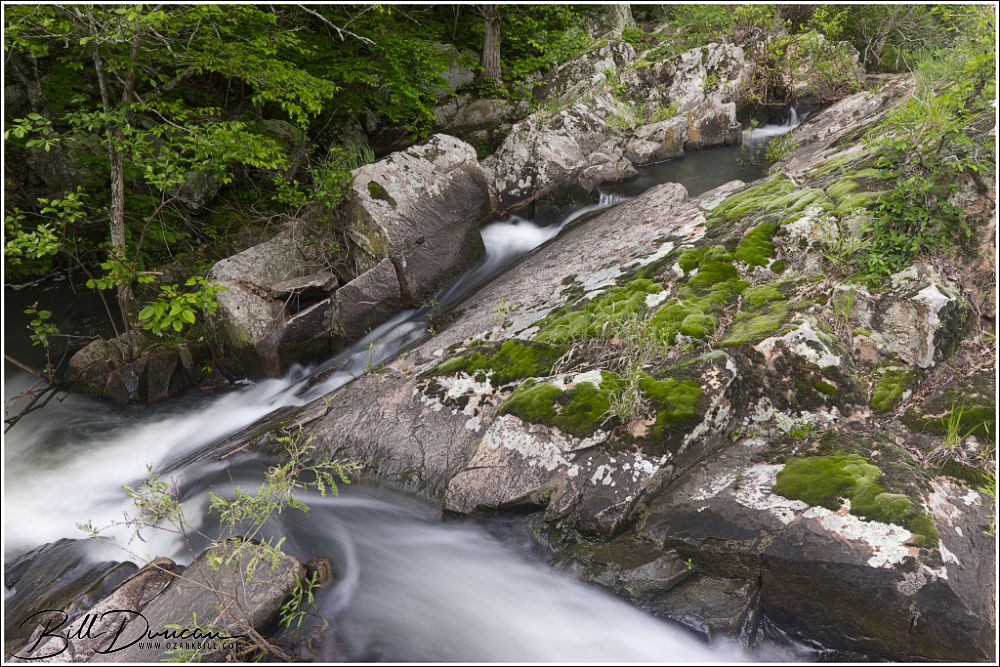
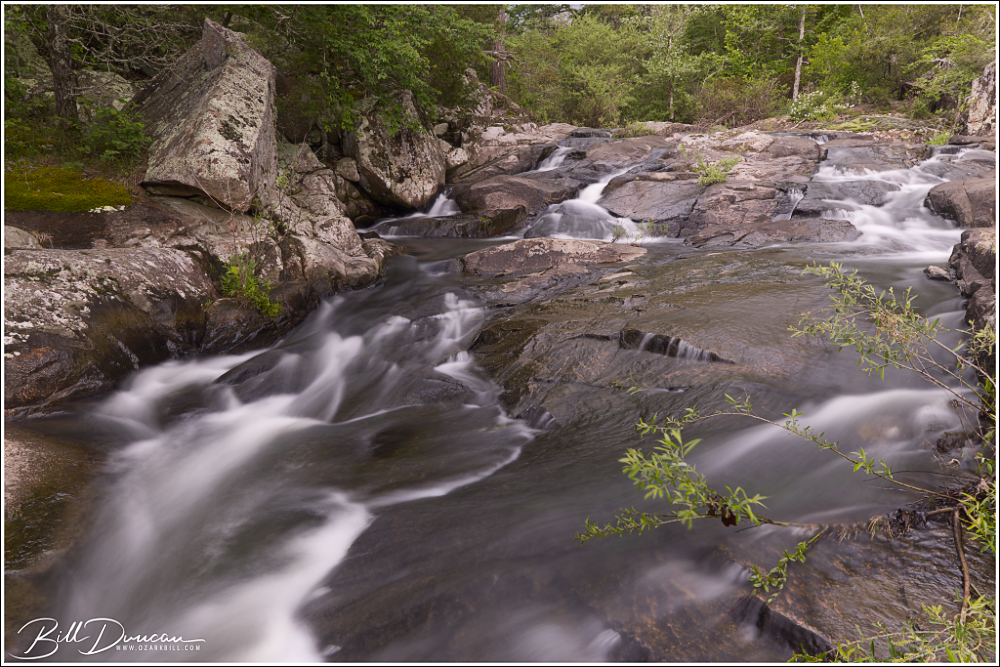
The water finds multiple pathways against the rock as the creek races down the ravine.
From the parking area, I took the “trail” that runs upstream along the north side of the river until I got to the namesake mines. From here, it was steep climbing until I eventually ran into an old two-track that allowed for some switch-backing until I eventually rose from the river’s ravine into a more upland forest. Although the topology here was more manageable, fallen trees were everywhere, presumably from strong storms of recent years. The bushwhacking got frustrating, especially with the need to eat a spider or two every five to ten steps! Using my GPS, I kept the river to my right side and generally headed to the northeast to where Mud Creek meets the St. Francois. I should have headed much further to the north, but I kept finding myself heading back into the boulder-strewn ravine of the river. Eventually, I learned my lesson and rose to the highest elevation possible and made a direct line to where the GPS told me the confluence would be. Finally arriving, I realized I was then facing the hurdle of heading back down the ravine to the confluence. I could hear rushing water from the east and the north, shut-ins along the river and creek, respectively. I chose my point to descend into the ravine, not knowing if this would take me to sheer cliffs that would force me back up to try again. I eventually stumbled into the relatively small river bank that was thick with twenty foot tall alder and witch-hazel thickets.
Mud Creek Shut-ins
Clearing these thickets, with water halfway up my wellies (I got my first pair of Gumleaf boots recently, so I can no longer call these muck boots), I was finally able to see the confluence. Navigating around huge boulders, I began clambering up Mud Creek and almost immediately came upon the nicest waterfall of these shut-ins. About this time, the sky began to darken. Most of my trek to this point was in mostly sunny skies, making me wonder if the overcast skies forecasted for this afternoon where ever going to happen. Now I was hearing thunder and watching dark skies closing in quickly from the west.
Porphyry and swirls
I realized I probably had limited rain-free time with the shut-ins so I got to work, moving myself and my gear from one point of interest to the next upstream. This type of landscape photography is not for the faint of heart! Due to the sharp sides of the ravine, I was forced to cross the creek several times, negotiating deep pools, fast-moving water and slippery rocks. On several occasions, I used my tripod as an extra set of legs, helping me stabilize myself while crossing the creek.
Mudd Creek Shut-ins
Getting about a half mile upstream from the confluence, the shut-ins widened, opening up to large sections of exposed granite. It was around here that I decided the storm was not going to pass me by, but come right down on me. The thunder was getting closer and more frequent. I put my camera bodies and lenses into individual Ziplock bags and put the rain cover over my bag just when the sky opened up with torrential rains. It was then that I realized I was on the wrong side of the creek to get back to where I needed to be. I also sensed the waters in Mud Creek were starting to rise. The opposite side of the creek this far upstream looked like near-vertical cliffs, but I knew I probably did not have time to head back downstream to a point where I made the crossing earlier. I found the closet point to make a relatively safe crossing and found myself with just a few feet between the steep rise of the ravine and the creek that seemed to be increasing inch by inch. I found some handholds and started climbing. Spiders be damned!
St. Francois Mountain Beauty!
I climbed as carefully as possible, making progress while the rain came down in sheets and lighting danced across the sky directly above me. In five to ten minutes I made it up the approximately 400 feet of increased elevation and reached the top of the ravine. Not liking the idea of clambering down the opposite side of the ravine to get back to the mines, I decided a better route back would be to stay in the uplands and head north to Highway D to get back to my car. That was another two-mile bushwhack, back through the fallen trees, my wellies filling up with rain water, and limited visibility. I eventually made it to the road, finding my way safely back to my car. Not wanting to ruin my seat with my soaking wet cloths and not having a dry change of cloths, I striped to my boxer-briefs, put a towel down on my seat and drove the two-hours home. Thankfully I did nothing to raise the attention of any authorities on the way. 😉
I’d Like to thank Casey Galvin, Kathy Bildner and midwesthiker.com for the information that helped me reach these fantastic locations!
Pachysandra procumbens (Family Buxaceae), commonly known as Allegheny spurge or mountain pachysandra, is a species of flowering plant native to the southeastern United States. Many thanks to Pete, who turned us on to this small group of plants that was found in Forest Park in St. Louis City. Not native to this region, this was obviously planted there at some point.
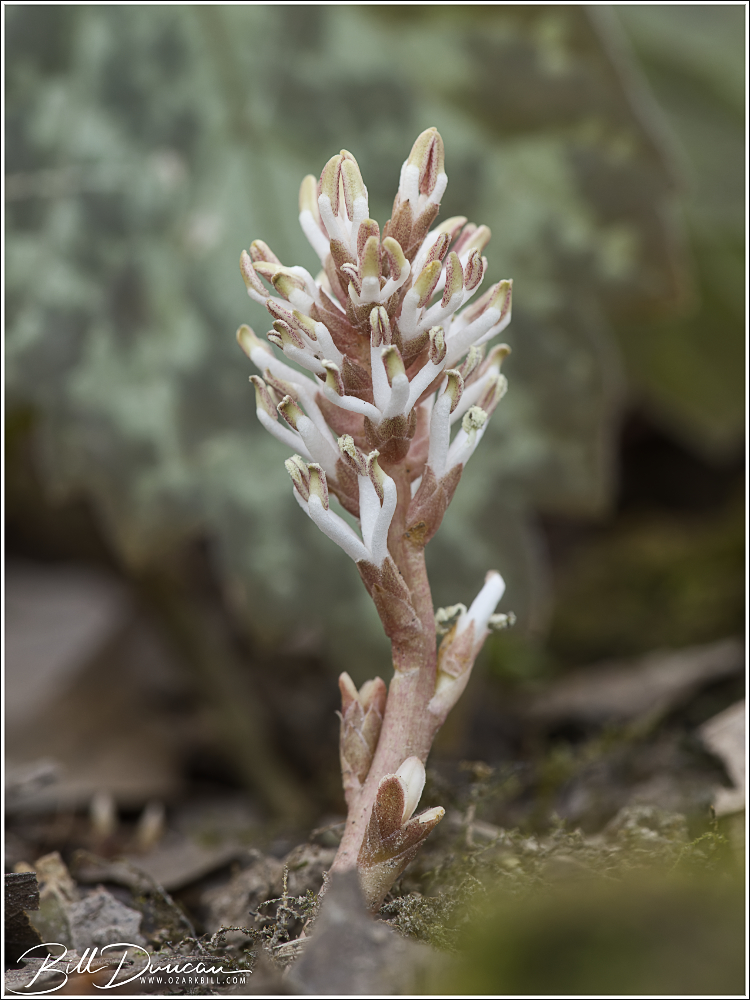
A newly emerging inflorescence of Pachysandra procumbens.
Pachysandra procumbens has a delicate and unique appearance. Its leaves are larger and serrated, with a distinct purple-bronze coloration in the spring that matures to a glossy green throughout the growing season.
A prime inflorescence of Pachysandra procumbens against a backdrop of its leaves.
In the spring, Pachysandra procumbens produces small, white, bottlebrush-like flowers that are highly attractive to pollinators such as bees and butterflies. These flowers give way to small, berry-like fruits that add further interest. This plant prefers moist, well-drained soil and is partial to full shade. The inflorescence are small, but definitely worth a close look.
During the first couple of seasons in our front-yard wildflower garden, the deer took a liking to this Manfredavirginica (F. Asparagaceae). This prompted me to start spraying its foliage with deer deterrent last year. This had the desired effect and I was happy to see and photograph the blooms of this plant, which are primarily pollinated by large moths such as the sphinx moths. The blooms will also be visited by Ruby-throated Hummingbirds.
Inflorescence of Manfredavirginica.
This species is typically found in dry, rocky and alkali soils, so I was not sure how it would like the clay pan in our yard. I’m happy to say that it is putting on new leaves this spring. I’ve lost a few plants in the garden during the past winter and I’m glad to see this one coming back.
I’ve had a little more luck recently with the Wild Turkeys in the neighborhood woods patch. During my last couple of session, the hens in this group have roosted immediately above the patch of ground I cleared of bush honeysuckle. Previously, they roosted in trees a quarter mile up the hollow. This is problematic because I haven’t been able to set up quietly enough not to flush them. I was able to call in a few of the Toms, although this is hit or miss. They love hanging out and strutting in the backyards of the streets that border the hollow. We call back and forth and they are obviously trying to get me to come to them. Finally, on this occasion, they couldn’t stand it so came in to find the hen (me) that was sounding so pretty. They did not come all the way into my prime shooting lane, but I made the best I could of it.
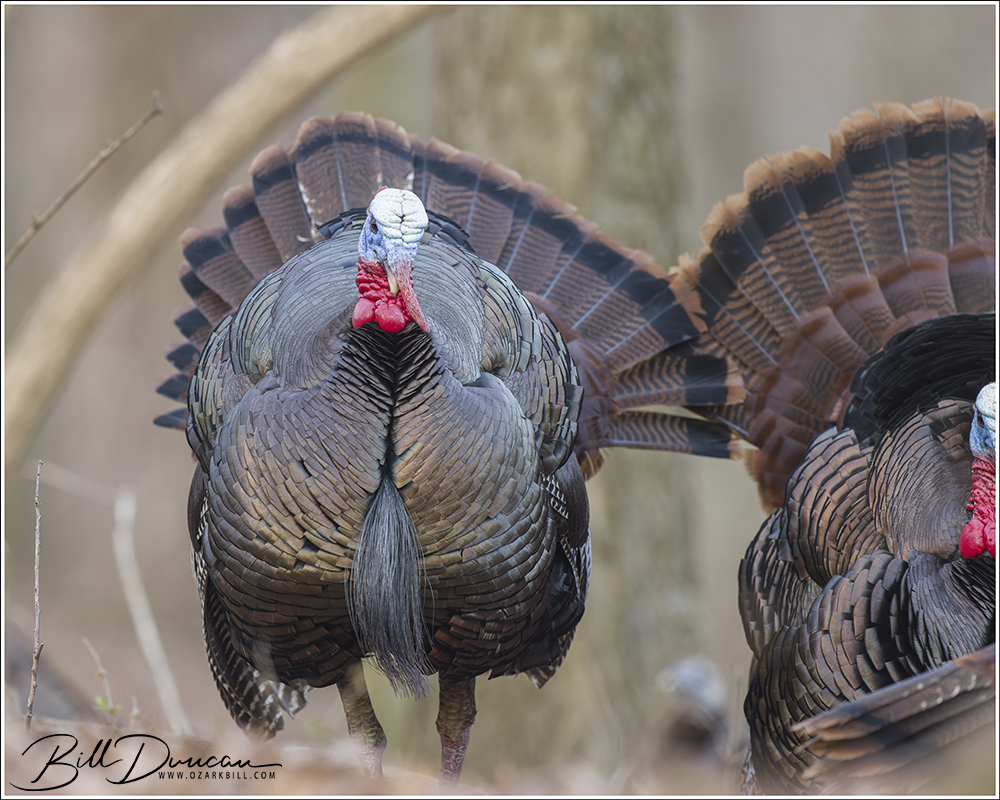
A couple of Toms looking for love.
I have read and am beginning to learn how keen their sense really are. I need to be careful with calling as they come in. When they enter the area, they tend to ignore the decoys altogether and instead look directly in my direction. They know precisely where the calls emanate. Turkey hunters will often call at the location they wish the birds to appear and when they hear the Toms coming, they move into their shooting position. This is kind of hard to do when using a bag blind and where the birds can see a long distance. The small geography I am working in has some limitations.
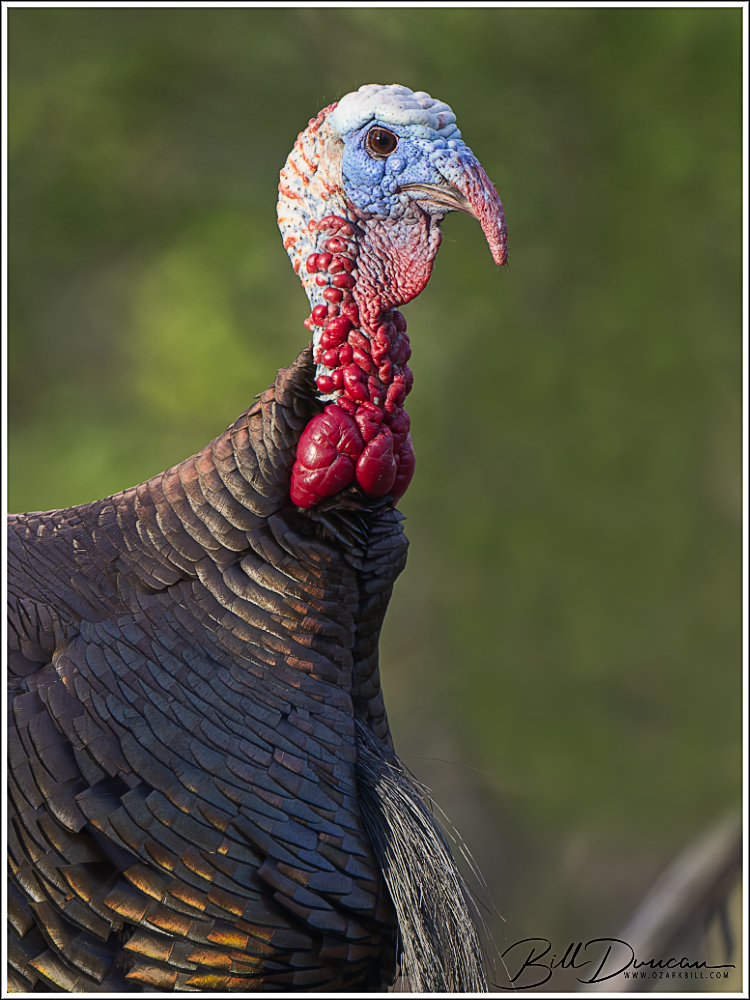
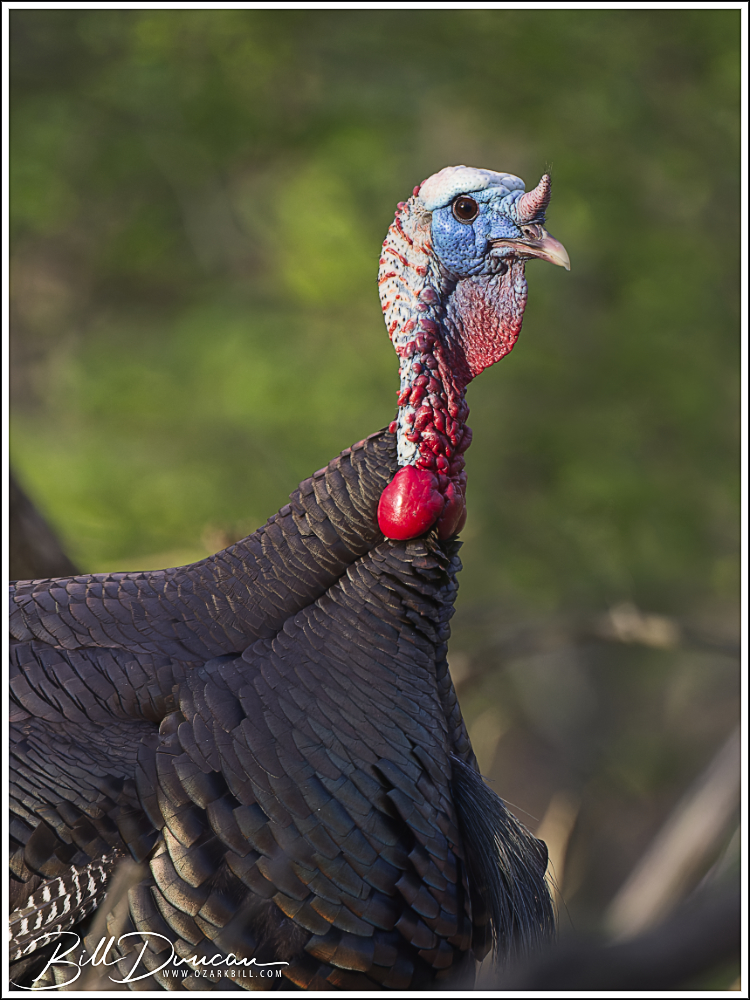
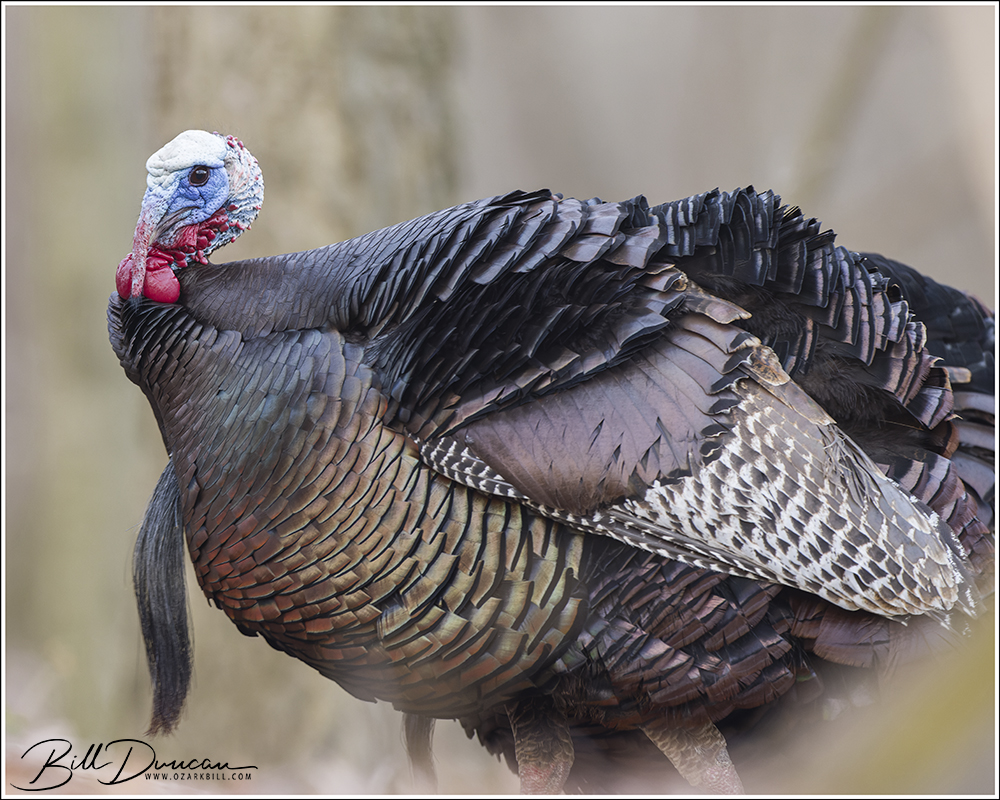
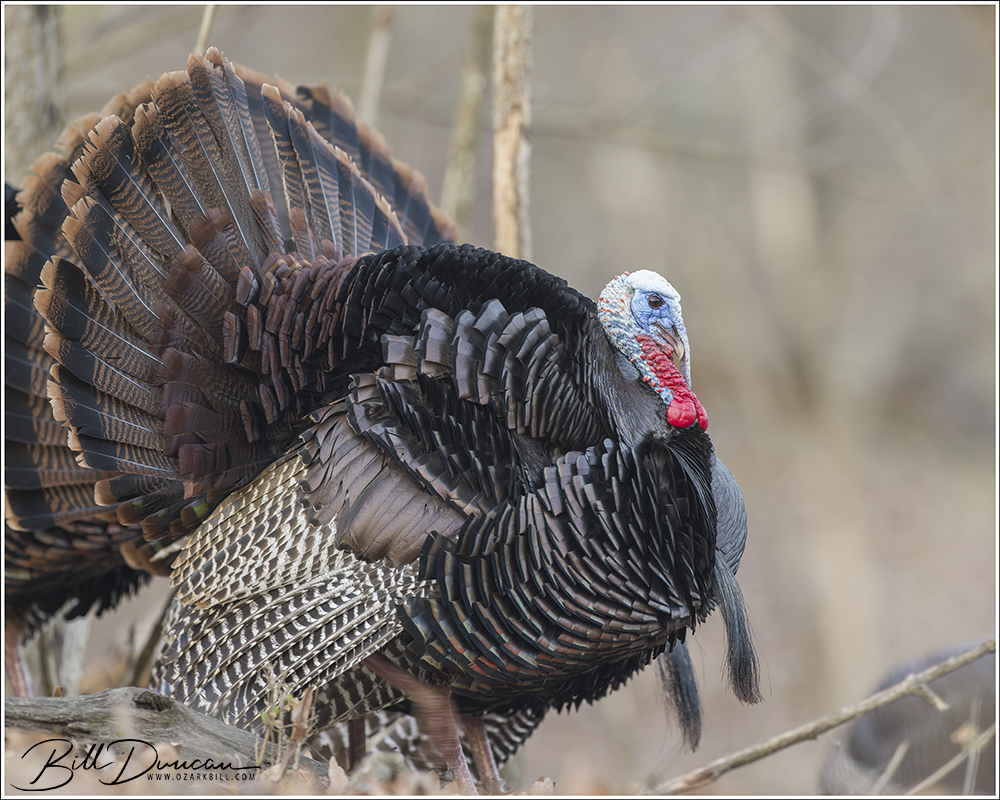
With the county’s colors boldly displayed, I think the Wild Turkey would have been a great national bird.
The snood (the dangling appendage that is overhanging this bird’s beak) is quite interesting. Until watching these guys recently, I was not aware of what control they had over it. When excited and wanting to display, they fill it with blood and it can turn a bright red.
When the birds are more alert and not displaying, the snood is kept erect like a horn as seen here. The transition takes only seconds.
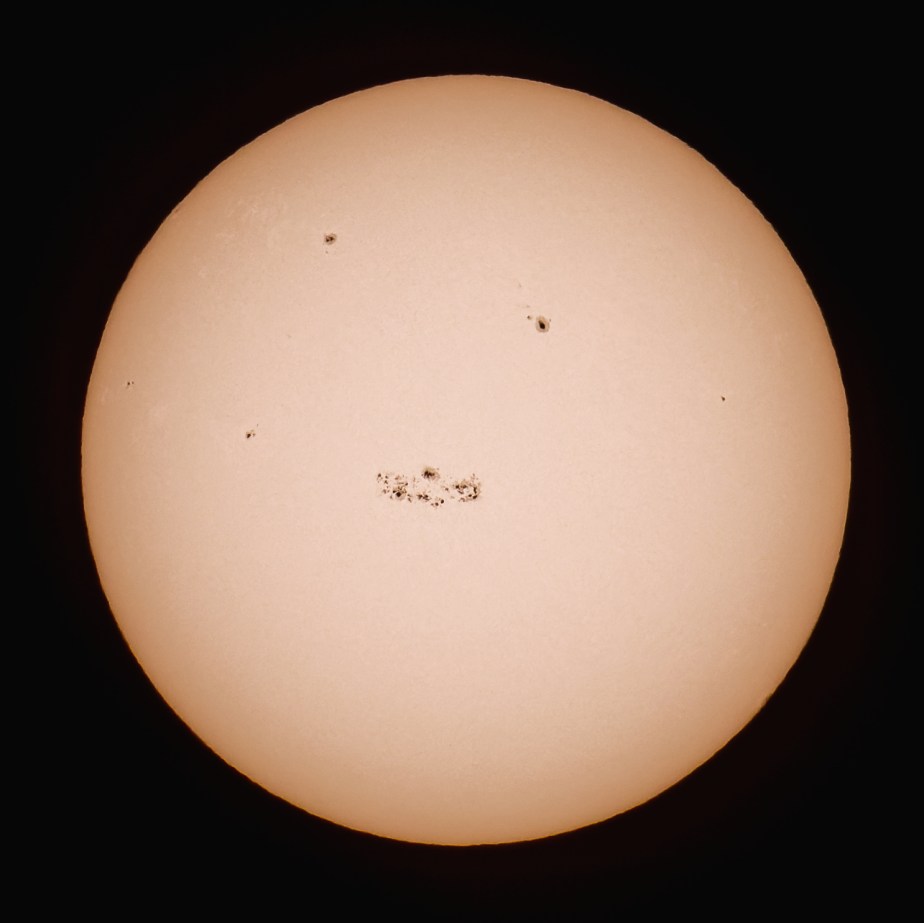
At the time I am writing this, a cool new app I have, EclipseOne, tells me the next Great American Eclipse will occur in 12 days, 13 hours, 22 minutes, and 2 seconds at my primary viewing location. There is not much time left to do your planning and practicing!
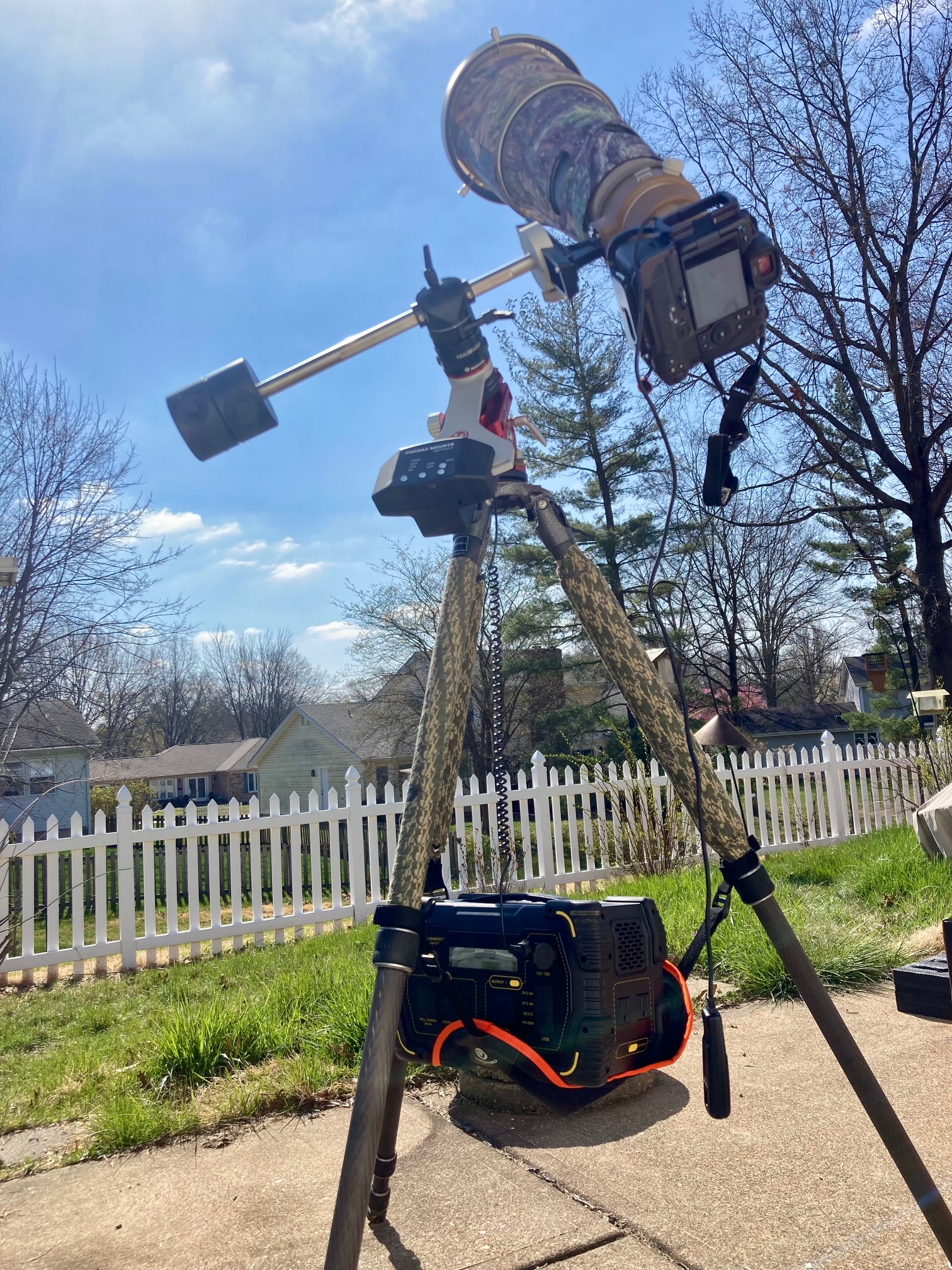
This past weekend, I put in a practice session – testing out the lens and camera combination, the solar finder and solar filter that will be going over my lens, and most importantly, using my tracker to track the sun as it moves across the sky. If you have an astro-tracking device that you might use for applications like deep-sky imaging or astro landscapes, I highly recommend you consider using this for the upcoming eclipse.
I know the question you might have before you even ask it. But how do we polar align in the daytime? True, you won’t be able to get precise polar alignment without the nighttime stars to guide your efforts, or at least without a lot of extra work. However, precise P.A. is not necessary to enjoy the benefits. I simply did my best to align the tracker facing north using a compass. I then tested the amount of time it took for the sun to move one of its diameter with and without using the tracker. This was easy because in my particular lens/camera combination, the circle that represents the spot-metering option was almost precisely the same size as the sun. Without the tracker it took only one minute and 22 seconds to move one of its diameter across my frame. With the tracker engaged (don’t forget to put your tracker in solar-tracking mode!), it took 22 minutes and seven seconds to move the same distance. Yes, there is a bit of drift due to imperfect PA, but this means I need only reposition the sun to the center of my frame once or twice an hour while using the tracker as opposed to doing this step 10 times or more an hour. Saving this kind of time during the big event will be a great benefit!
My imaging rig as it will look like on April 8th. I had to use both counterweights to balance this!
If you are planning to photograph the eclipse on April 8th, hopefully you have gotten your planning done, dusted off your solar filter and gotten some practice. If not, there’s still time, assuming we have some clear skies between now and then.
Wishing you all the best of luck on the big day and that the only rain we’ll see are Sol’s golden rays coming down from the clearest of skies!
After spending a couple years studying and picking up gear like decoys and a slate call, I was finally ready to try photographing wild turkeys. I’ve been out on this pursuit a few times this season and have had mixed success, telling me I still need a lot of practice and plenty of patience.
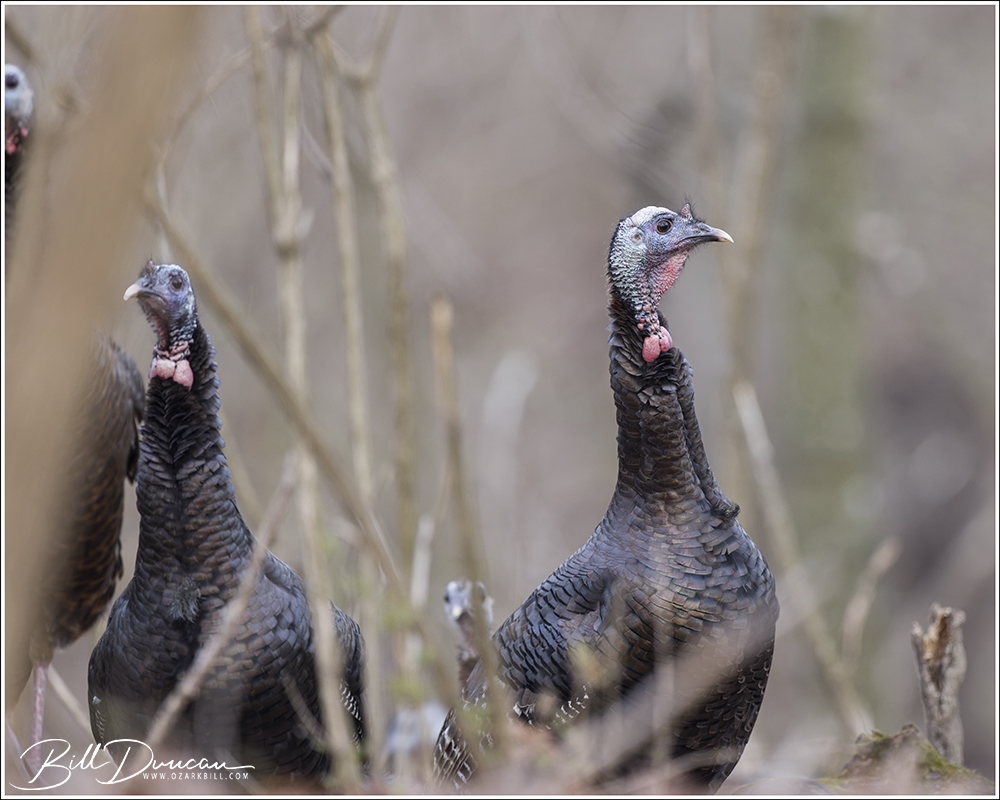
These hens were looking around for their potential rival – me!
On my morning walks I discovered that a couple of wood lots in the neighborhood common grounds held a nice little population of these birds. I figured this would be a great start for my “turkey hunting” career as these turkeys would be somewhat used to people, have seen limited, if any hunting pressure, and lived about a mile from our front door. This close vicinity to me is a huge plus. To optimize chances for success, it’s important to get out to their location and setup in my bag blind before first light. Having this close opportunity means that I don’t have to get up and drive an hour away to get to my destination before dawn.
One of approximately ten toms that I encountered on this morning.
Because these wood lots are so small, I knew that I will be setup close enough so that they can hear my turkey yelps, cuts and clucks, as pathetic as they may be. But on this occasion, everything seemed to work nicely – too nicely, in fact. I did not expect such nice results so soon. Shortly after setting up and as the light began to increase to levels I could see without a headlamp, I heard gobbles and yelps up in the hollow where this wood lot is located. This wound up leading to my first learning of the day.
Where is that hussy!?
Figuring it would probably take some time to coax them into my area, I began hitting the pot call with my best impersonation of a hen who lost her way. In less than five minutes, my decoys were being swarmed by close to 20 birds, a nearly perfect mix of hens and toms. I could not get an accurate count because of my ground-level position and the trees and other obstacles blocking my view. This was too early! I was shooting with a much slower shutter speed and high ISO than I was comfortable with. Shooting at 1/50 sec. using a 600mm lens is rarely a recipe for success. I wound up with a lot of shots that were ruined by the movement of the turkeys. Thankfully, with my spray and prey attitude, I wound up with enough keepers to make me happy.
Wish I had a snood…
I learned other things on this morning. First, 600mm might be a little too long, at least for these neighborhood turkeys. Something in the 400-500mm range would be more appropriate. If possible, moving further from the decoys might work well, but at this location, it is not possible to find clear shooting lanes of great enough length due to vegetation and rolling topography.
Being so close to these birds who had no clue I was there was such a thrill!
I’ve been back to this location and opened up my shooting lane more by cutting out bush honeysuckle and dead scrub that blocks my view.
After speaking with a couple of turkey hunting friends of mine, it appeared that most of the toms I photographed could be considered two-year old birds, due to the length of their beards and spurs.
After just a few minutes of searching for the apparent lost hen, the group lost interest and headed up the hollow to congregate in the neighborhood yards. I was quite pleased to have been able to call this group of birds in and then leave without having burned myself. They had no clue I was there and I was able to breakdown and leave without causing them any stress.
Not a legendary double-bearded tom, but a couple of bros strutting side by side.
My next goal is to get out to some of our local Conservation Areas to try my skills at some “wilder” turkeys before hunting season begins. This will require some hiking and listening for gobbles. I would also love to find an opportunity to shoot “field turkeys.” This will entail setting up along the edge of forest and field, and hopefully allow me to have clearer shooting lanes and better light.
Still looking
Like I mentioned, this is a new endeavor for me. I did not group up hunting, but I am attempting to learn the same set of skills that hunters use. If you have any tips or tricks, I would appreciate hearing them.




































 A Thousand Acres of Silphiums