Disappointment at the Gnatcatchers’

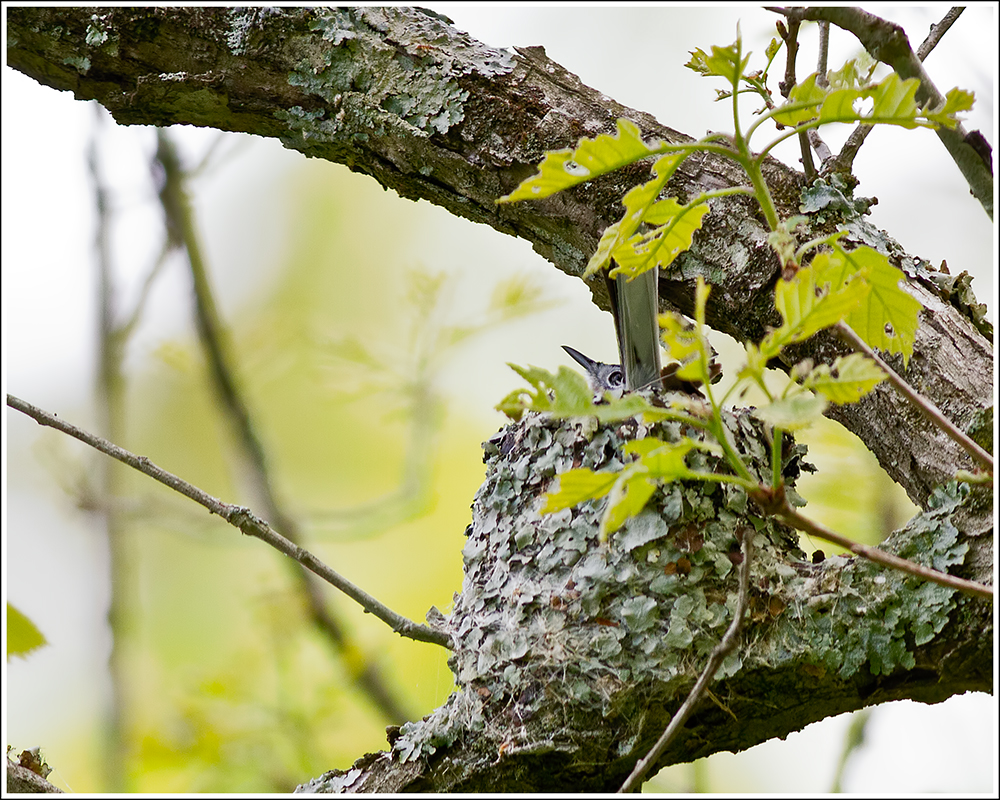
Steve selflessly checked on the Gnatcatcher’s nest at St. Francois SP late this past week to give me an update to help plan for the weekend.  When he arrived he watched as the pair appeared to be deconstructing the nest and moving the materials!  This was surprising as they definitely were incubating eggs when I had visited about five days prior.  We found one description of this kind of behavior in Harrison’s Eastern Bird Nests:

“Unusual characteristic of this bird: it tears up a completely or partly completed nest and reuses the material to build nest nearby.  Author has seen this several times; believes that awareness of possible discovery during building may be cause.”

I have a few pieces of evidence to possibly explain why they would move a nest in which they were already incubating a clutch.

1) They built this nest ~20 feet above a rather popular State Park trail and the numbers of people walking underneath caused them to seek a different spot.

2) Egg predation.  Someone found the nest and relieved them of their brood.

3) Cowbirds.  The BHCB activity was apparent around the nest when I visited.  Perhaps they snuck an egg in and the host birds discovered the ploy?

I guess we will never know.  Steve tried his best to follow the “contractors” as they moved their building materials to the new construction site.  Their speed and the fully-leaved trees made this an impossible task.  Oh well, maybe next time.

IMG_3999

“Housing Crisis”

Technical details: Canon EOS 7D camera, EF500mm f/4.5L USM lens, ISO 640,  f/6.3, 1/200 sec

Blue-grey Gnatcatcher Nest Update

I spent a little time watching and shooting the BGGN nest this past Saturday.  Here are a few notes: -Nest is in action.  I believe there are likely eggs in the nest.  Not yet hatched.  One parent will stay on the nest continuously.  Every 5-10 minutes the other parent would come by and give a few quick, low call notes.  The parent on the nest will reply with a similar vocalization most, but not every time, and then leave to where the other parent is calling in nearby branch or tree.  The new parent then takes its place on the eggs.  The nest never stayed open for more than 45 seconds.  Cowbirds were definitely in the area and I believe are probably aware of the nest.  Migrant songbirds were everywhere.  Here is a quick list of birds I had in the parking lot or at the nest. TEWA OVBI REVI BLWA COBI GCFL PEWE SWTH NOWA LOWA SCTA.

If I make it back there this weekend, there is a good chance I could see feeding of the chicks.

IMG_3975

“BGGN Nest Update – May-11 2013”

Technical details: Canon EOS 7D camera, EF500mm f/4.5L USM lens, ISO 640,  f/6.3, 1/200 sec

An Endangered Species Visits Monsanto’s World Headquarters

One of my favorite things about my job is that I work at one of the best songbird migration fall spots in the St. Louis metropolitan area.  On Monsanto’s Creve Coeur campus is found a parcel of “unused” wooded acres that are set aside for wildlife and employee recreation.  A couple miles of trails and associated edge habitats makes for prime spots for the birders of our campus to work on a very unique form of repetitive stress injury, which we call “warbler neck” 😉  And birders do we have!  I have been fortunate enough to learn so much from a handful of world-class birders in the six years or so I have been dabbling in birds.  We are now entering the last few wonderful days of the songbird migratory peak within our section of the country.  What I wanted to share in this post is an experience we had a couple of weeks back that will likely never happen again.

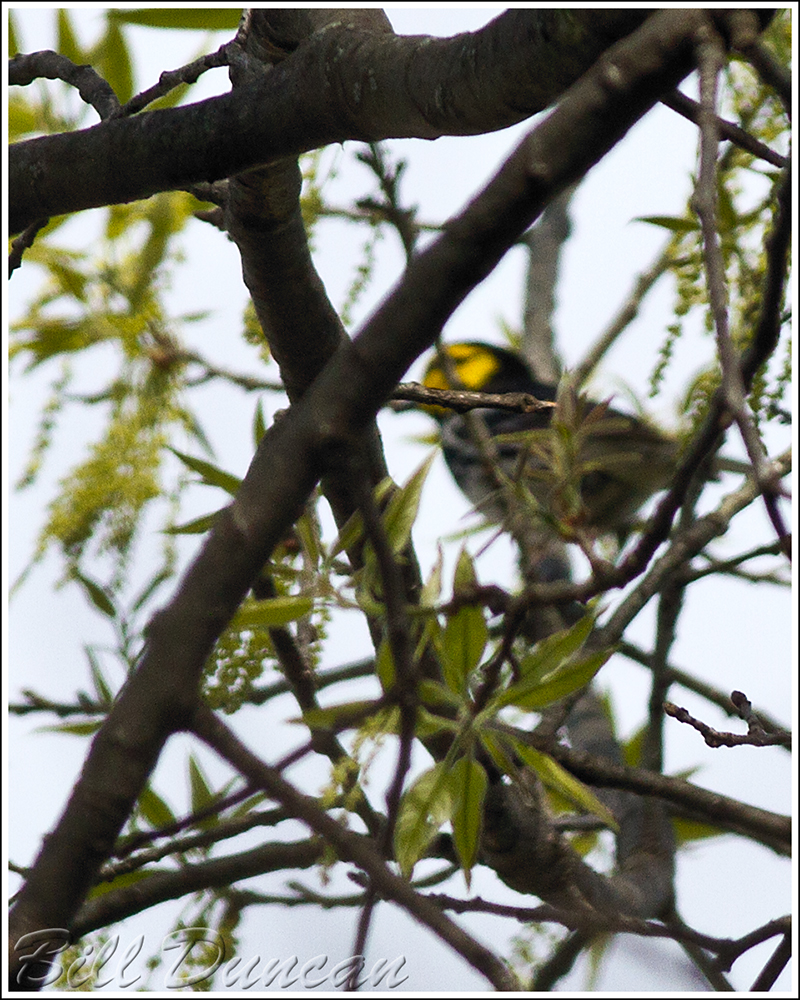
On Thursday, April 18th a terrific storm front moved through the Ozarks in a general southwest to northeasterly course.  Sarah and I took this Thursday and Friday off from work and spent it down in the Current River watershed.  On Friday, my coworker and avian super-freak, Josh Uffman,  found what looked to be a very odd-looking and sounding Black-throated Green Warbler.  At first, he did not realize what he stumbled upon and went to look this up in the field guides.  He then realized his discovery, the arguably most endangered Wood Warbler to be found on this continent, the Golden-cheeked Warbler.

Nesting in only specific woodlands containing Ashe Junipers in central Texas, GCWA numbers have declined dramatically by the clearing of these habitats.  One bit of disgusting information I read while researching this was that just prior to the placement of this bird under federal endangered species act protection and the IUCN red-list, much of this bird’s critical habitat was cleared by landowners who selfishly wanted to profit from these resources.  The most current numbers I could find give estimates of between 5,000 and 10,000 breeding pairs.  It is most likely that this bird was moved along by this storm.

What is nice for me is that this bird stayed on our campus for a relatively long period of time.  When I arrived on Monday it was still here.  It was very difficult to get good looks and with nearly two hours of hunting I was awarded with less than 60 seconds of viewing time.  The photo below is the best that I was able to achieve.  I do think I was the last person to see it on our campus as it was not found the following day.  My photo is usable for documentary purposes, but please have a look at Josh’s great pics and videos taken in days prior.

IMG_2680

“Golden-cheeked Warbler!”

Technical details: Canon EOS 7D camera, EF500mm f/4.5L USM lens, ISO 640,  f/7.1, 1/1250 sec

The Halcyon Days

It’s surprising how often these guys take to yawning.  The poor things spend the first couple months or so stuck in the nest, so what else do they have to do?  I’m sure this time for them lasts forever, just like those endless days of summer youth do for us.  Do they reminisce as they move on through the years of those days spent packed in a tube with their siblings?

IMG_2130

“The Great Yawn”
Technical details: Canon EOS 7D camera, EF500mm f/4.5L USM lens, ISO 800,  f/5.6, 1/100 sec

Mondays are for the Birds – Great-horned Owl Nest

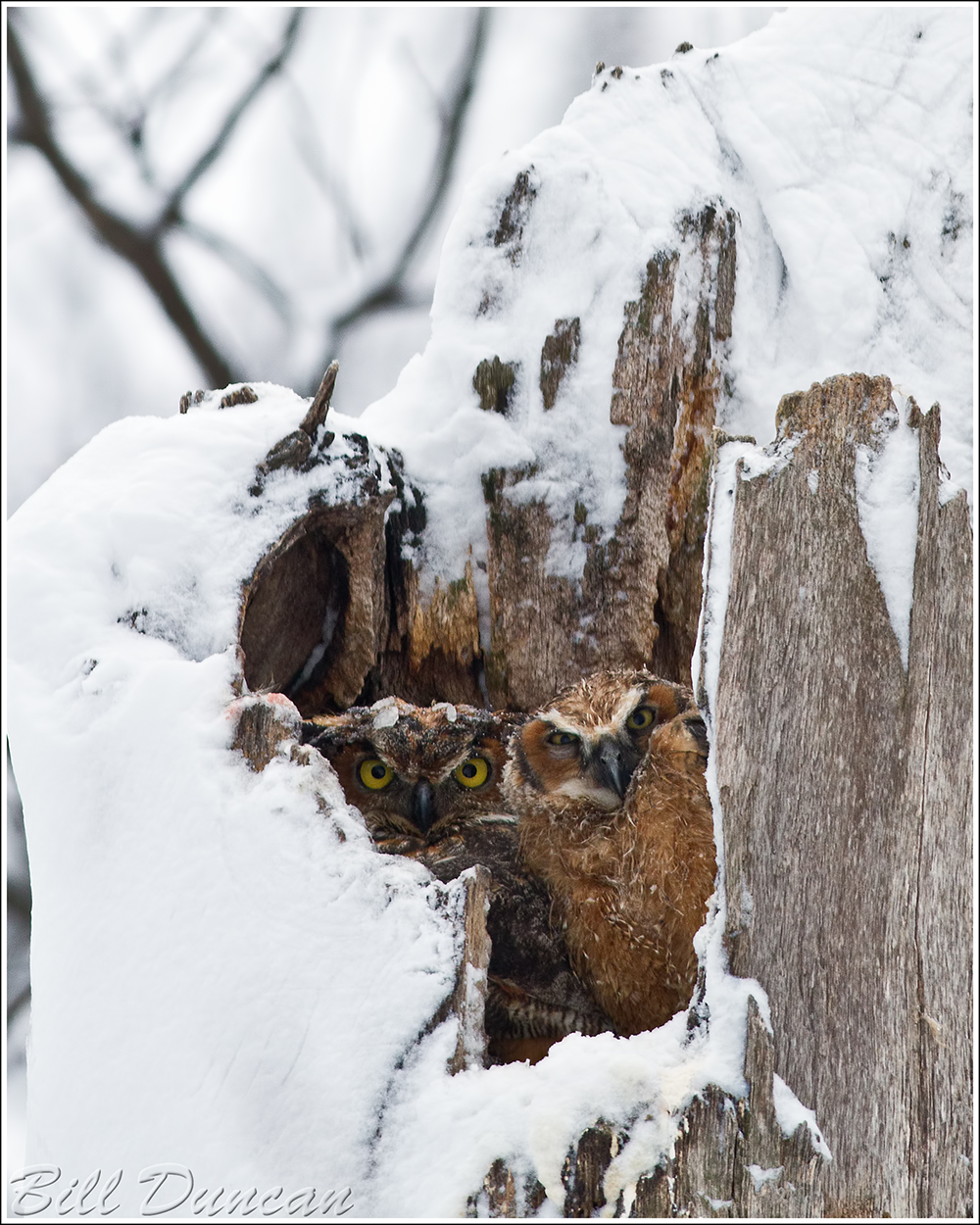
This image was taken of a GHOW nest this year that was located in a park not too far from my house.  The owlets have recently left the nest, but will be dependent on mom until near the end of this summer.  This pair of “Cat-Owls” have used this cavity in this snag for their nest site for at least the past three years.  I will be sharing more images taken from the nest over the next week or so.

IMG_1653

“Three Owlets”
Technical details: Canon EOS 7D camera, EF500mm f/4.5L USM lens, ISO 640,  f/6.3, 1/160 sec

Mondays are for the Birds – Red-tailed Hawk

Today’s photo is one of the Red-tailed Hawks that make a home in St. Louis’ Carondelet Park.  This is indeed, a wild bird.  Of course Sarah was with me on a Sunday when we arrived here looking to photograph some of the Crossbills that visited us this year.  While keeping my eyes peeled on the hemlocks for the Crossbills, I heard Sarah whisper, “Do yourself a favor and slowly look up”.  I did and found this hawk perched ~15″ from me!  Even once it discovered I was there it did not flush immediately but stayed and looked around a while.

Oh yeah, the MO chapter of The Nature Conservancy has prepared a slide show containing some of my bird photographs along with some pathetic creature.  Please feel free to have a look by clicking: Missouri Birds: Images From Bill Duncan

IMG_8175

“Happy Birds!”

Technical details: Canon EOS 7D camera, EF500mm f/4.5L USM lens, ISO 640,  f/5.6, 1/320 sec

“It is delightful to observe the assembling of these feathered people from the woods and reedy isles; herons white as wave tops, or blue as the sky, winnowing the warm air on wide quite wing; pelicans coming with baskets to fill, and the multitude of smaller sailers of the air, swift as swallows, gracefully taking their places at Nature’s family table for their daily bread.  Happy birds!”

-John Muir-