"What a thousand acres of Silphiums looked like when they tickled the bellies of the buffalo is a question never again to be answered, and perhaps not even asked." -Aldo Leopold
Here are a few of the members of the Noctuidae family of moth caterpillars we found in 2023. Commonly know as “owlet moths,” this is a very diverse clade that is still continuing to be revised and divided. Until recently, this was the largest lepidopteran family. A number of economically important members are found in this family, such as armyworm and cutworm species.
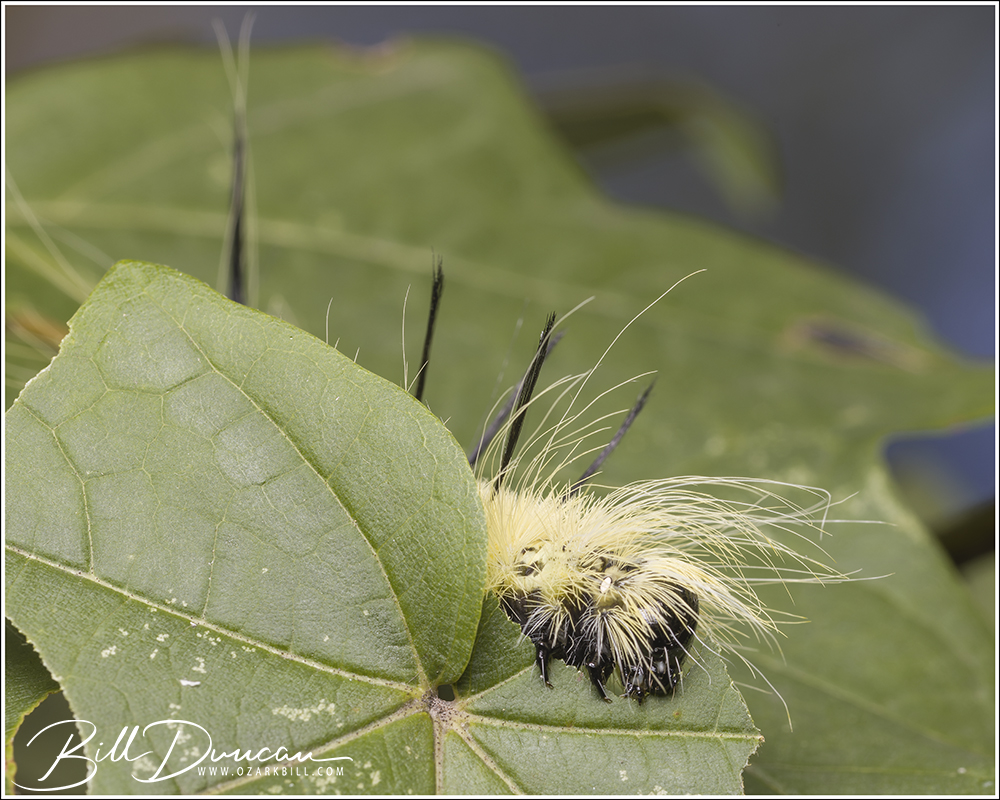
American Dagger Moth (Acronicta americana) Noctuidae, Hodges#9200 Rarely a day on the hunt goes by without finding one or more of these little beauties. This guy was not perturbed at all by us stopping to watch. It continued to chow on the leaf as I photographed it.
Two-spotted Oak Punkie (Meganola phylla) Noctuidae, Hodges#8983.1 Found on Quercus alba (white oak).
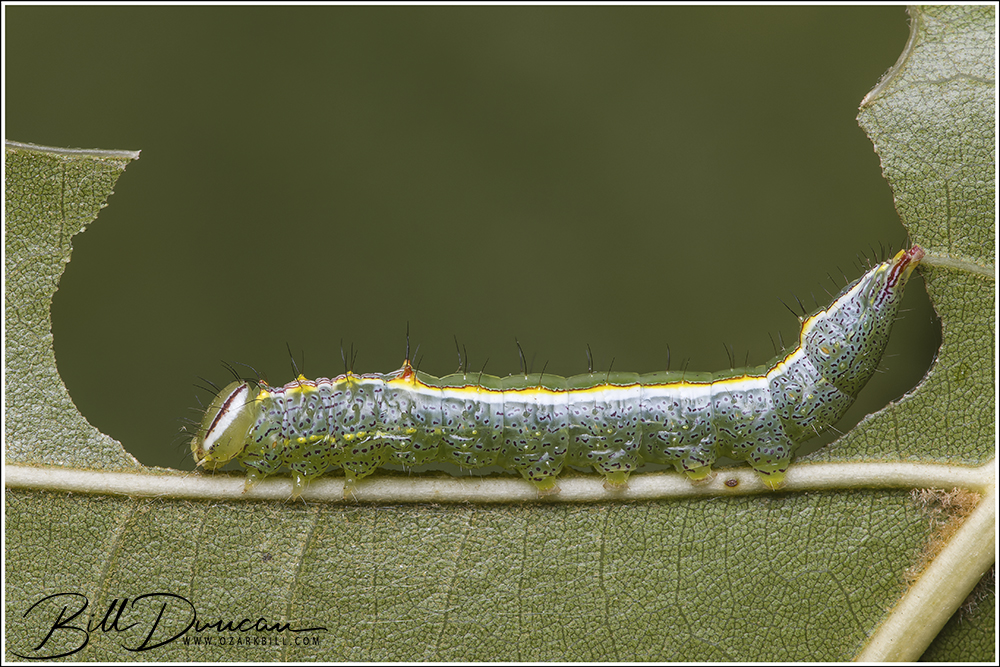
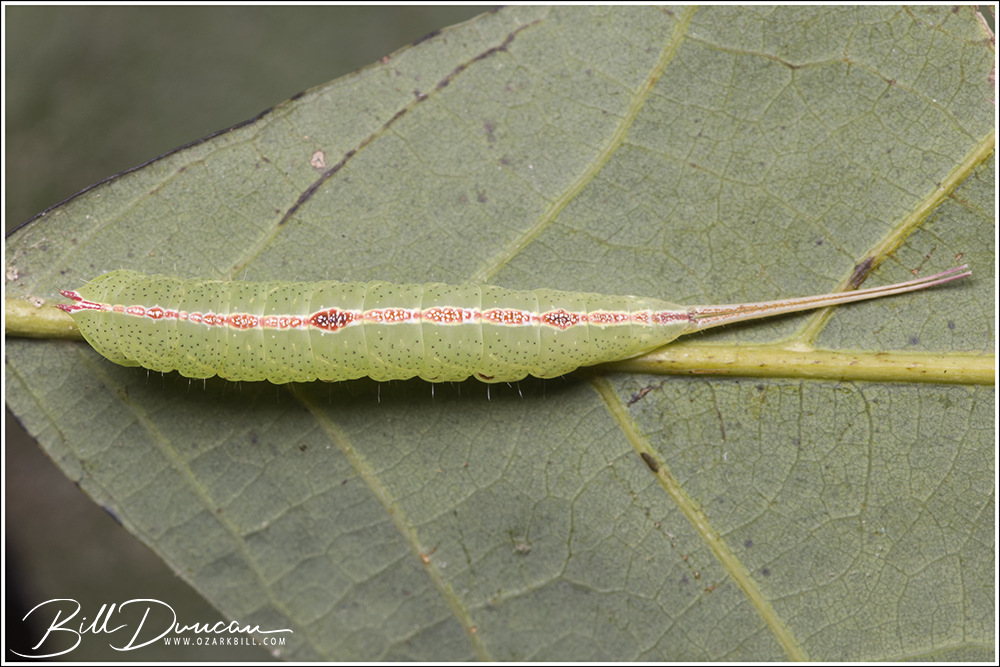
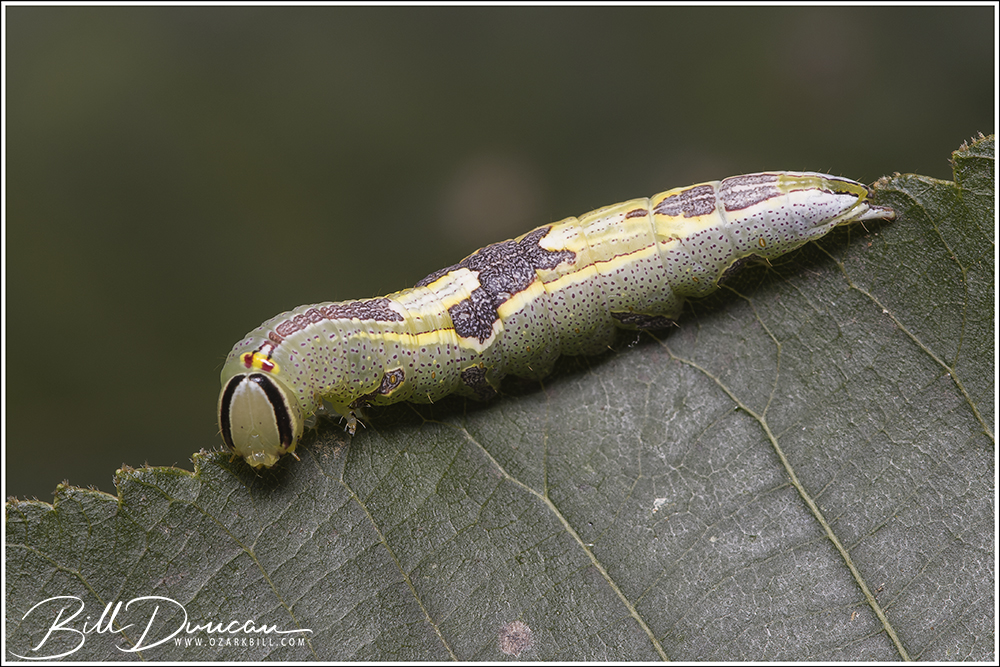
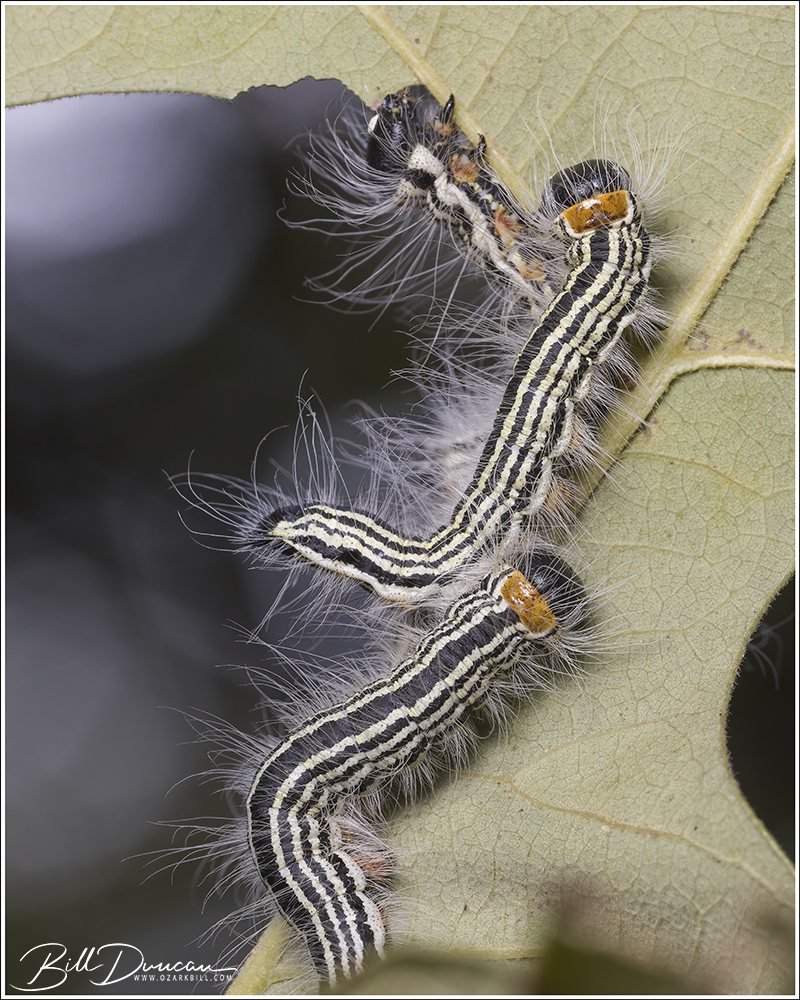
Eclipsed Oak Dagger (Acronicta increta) Noctuidae, Hodges#9249 Not that I keep great records but I am pretty certain that this one is by far the most abundant caterpillar we come across while looking on oaks. I probably find five of these to one of other species on oaks. There are a few similar species. The second one may be a different species of Acronicta.
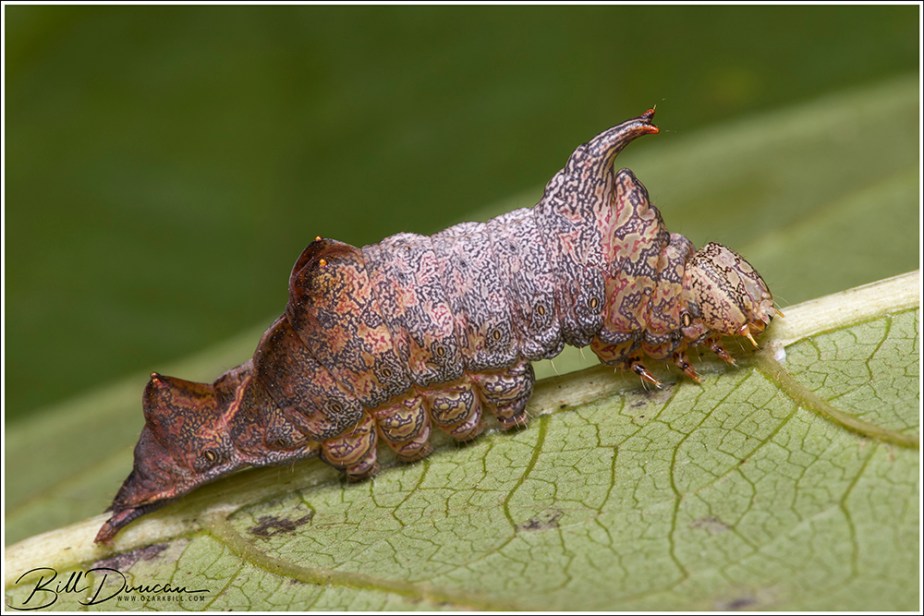
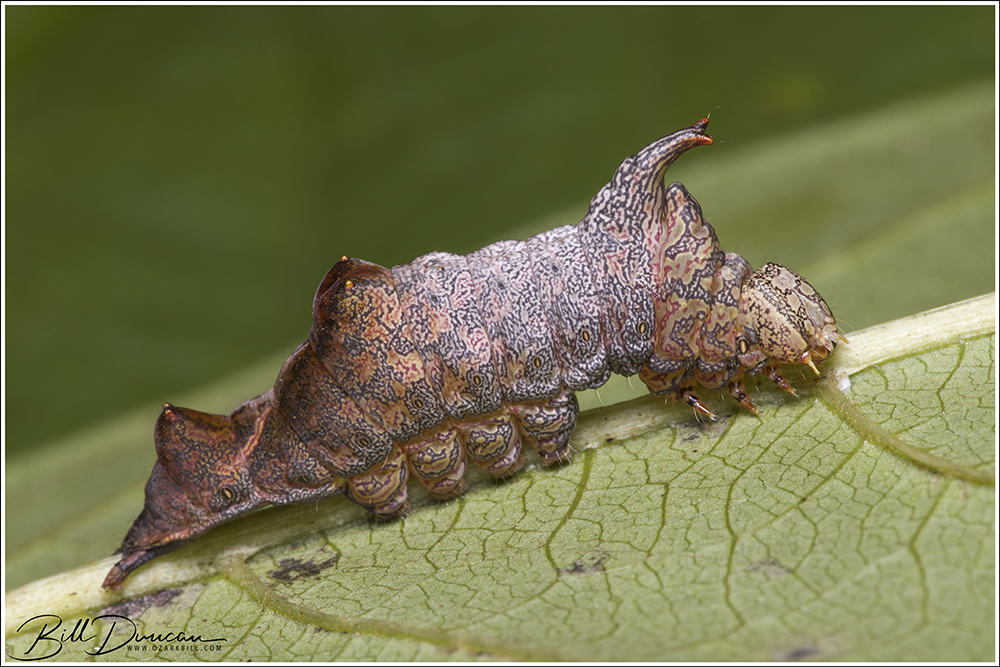
Noctuidae (Acronicta sp.) This is what I get for not taking photos of some of these from multiple angles. Not even the experts on iNaturalist could get this guy to species using this one image. It was a gorgeous and large caterpillar.
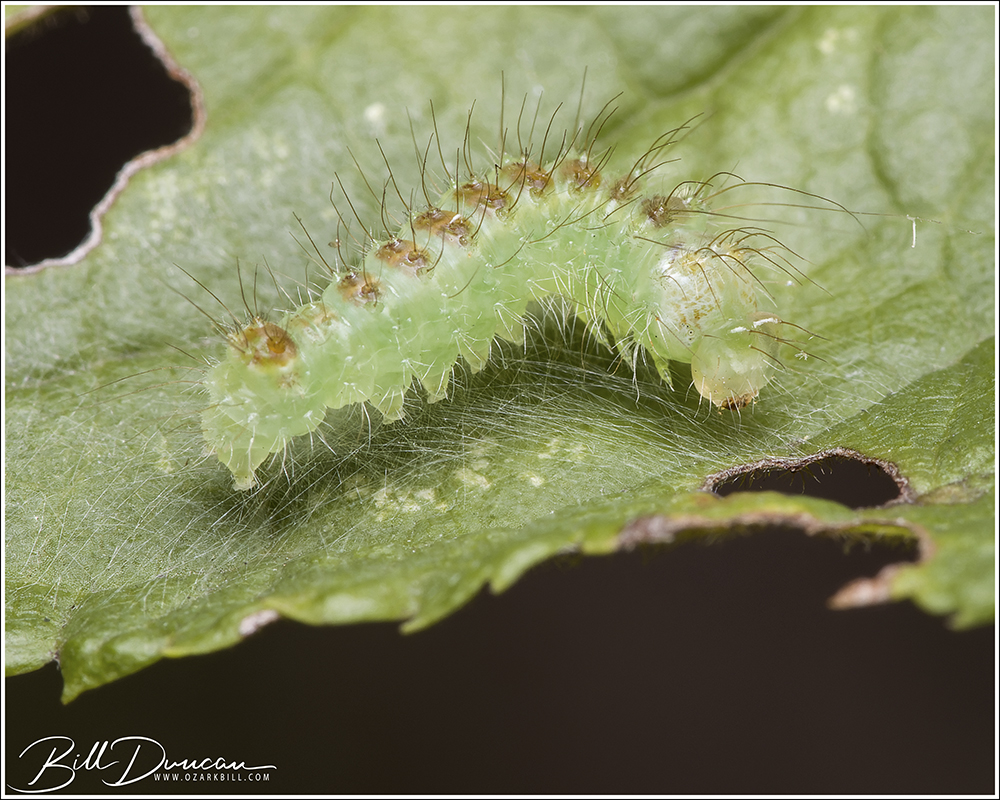
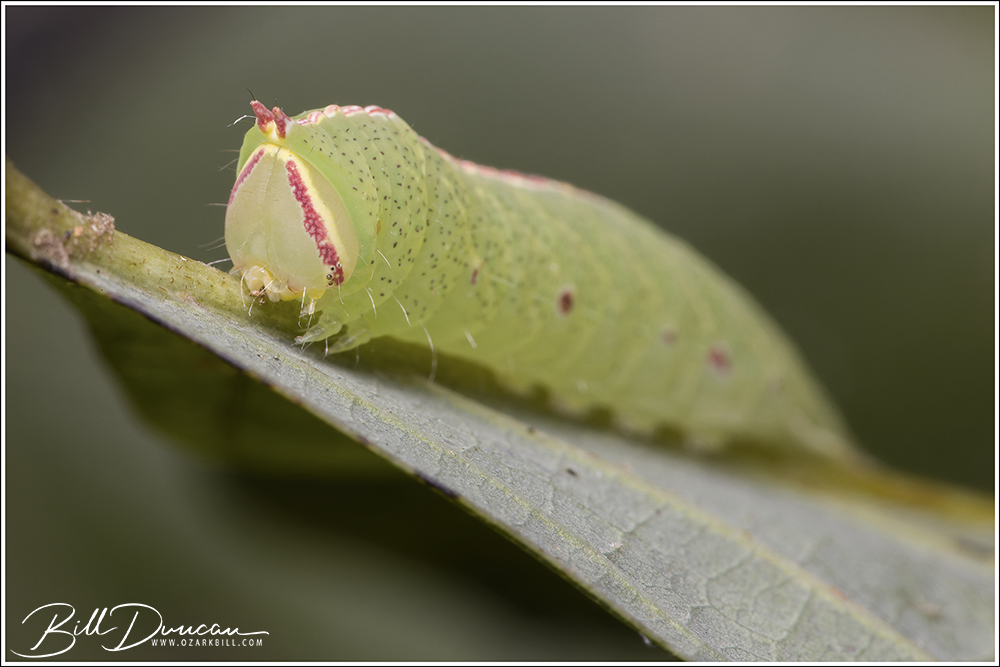
Gold Moth (Basilodes pepita) Noctuidae, Hodges#9781 Finally – I am sharing a cat that does not feed on woody plants. Also, a rare case of a moth that is gorgeous in both adult and larval forms. Unfortunately, this was a pretty early instar and does not show the bright and contrasting colors of older caterpillars. The gold moth feeds exclusively on Verbina species (wingstems, crownbeards).
I have long waited to find and photograph the eastern jack-o’-lantern mushroom (Omphalotus illudens). With as dry as this past summer and autumn have been, this has been a terrible year for finding mushrooms of most types. So, I was quite surprised when Pete Kozich sent me a photo showing a large bunch O. illudens growing around a dead hardwood stump at a nearby location in St. Charles County. We arrived shortly after the beginning of astronomical night in order to be able to capture the bioluminescent glow that this species is well known for.
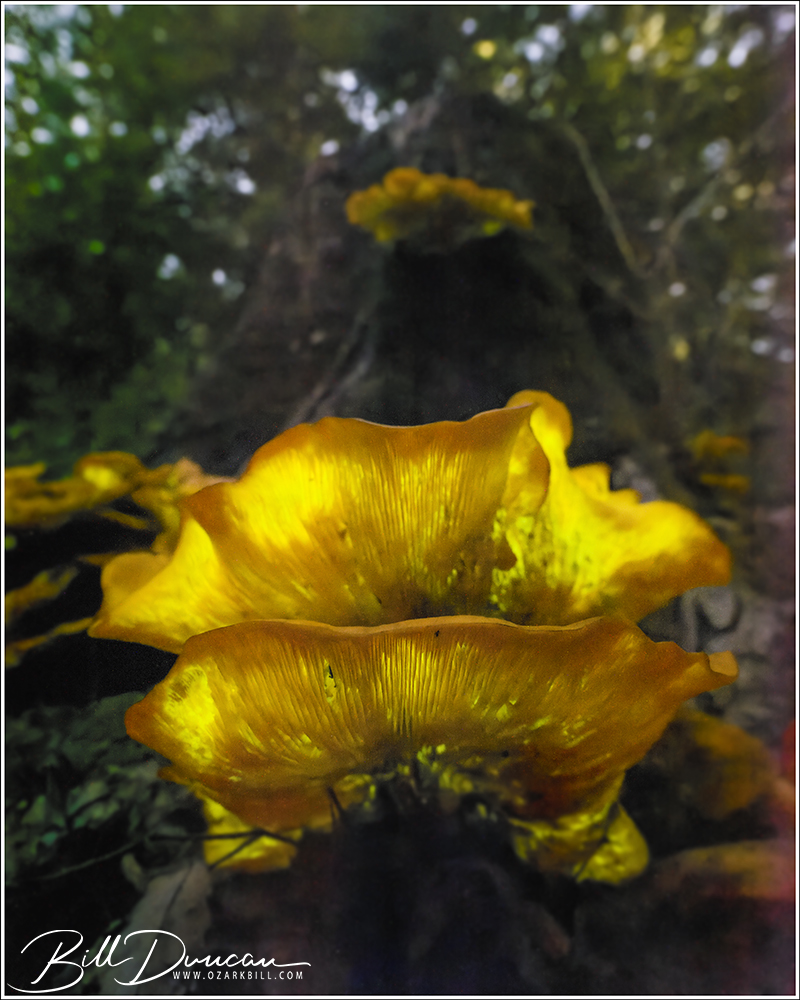
Eastern jack-o’-lantern mushroom (Omphalotus illudens) photographed at night with an artificial light source. Photo by Pete Kozich.
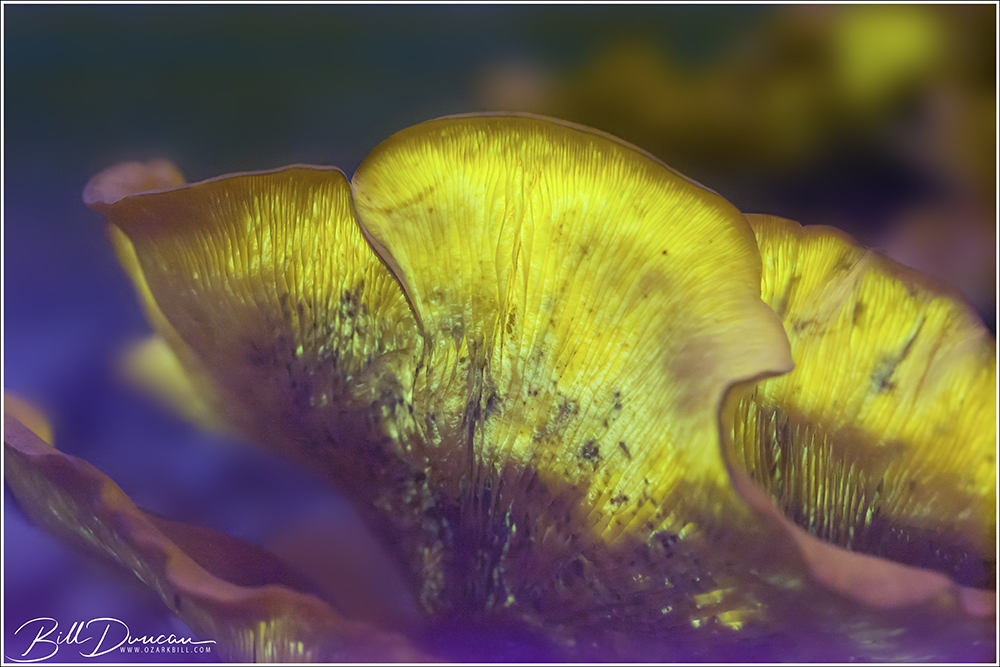
The pale yellow-green bioluminescence, colloquially known as “fox fire,” is only found in the lamellae (gills) of fresh mushrooms. We were somewhat disheartened when we arrived, finding the majority of the group to be well past their prime. Thankfully, there were still a few caps that were fresh enough that we could perceive the glow with our dark-adapted eyes and with the camera.
A five-minute exposure showing bioluminescence of the eastern jack-o’-lantern mushroom (Omphalotus illudens).
Bioluminescence in the Fungi kingdom is quite rare. Of the approximately 100,000 described fungi, only 71 species have been reported expressing this trait, all within the Order Agaricales, or gilled mushrooms (Stevani et al., 2013). The cause of the bioluminescence in fungi is due to the activity of the enzyme luciferase working on its substrate – luciferin. The selective advantages of concentrating these compounds around the gills of the mushrooms are not exactly known, but it has been hypothesized that light emitted from bioluminescent fungi attract nocturnal arthropods that may aid in the wider dispersal of spores (Oliveira et al., 2015). Pete and I noticed a number of insects, namely craneflies (Tipuloidea), which were hanging around the gills of the fresh mushroom caps. Whether the bioluminescence or the rotting mushrooms surrounding these caps were the primary bait drawing these insects, I can only speculate.
A wide-angle view of the foxfire from the eastern jack-o’-lantern mushroom (Omphalotus illudens).
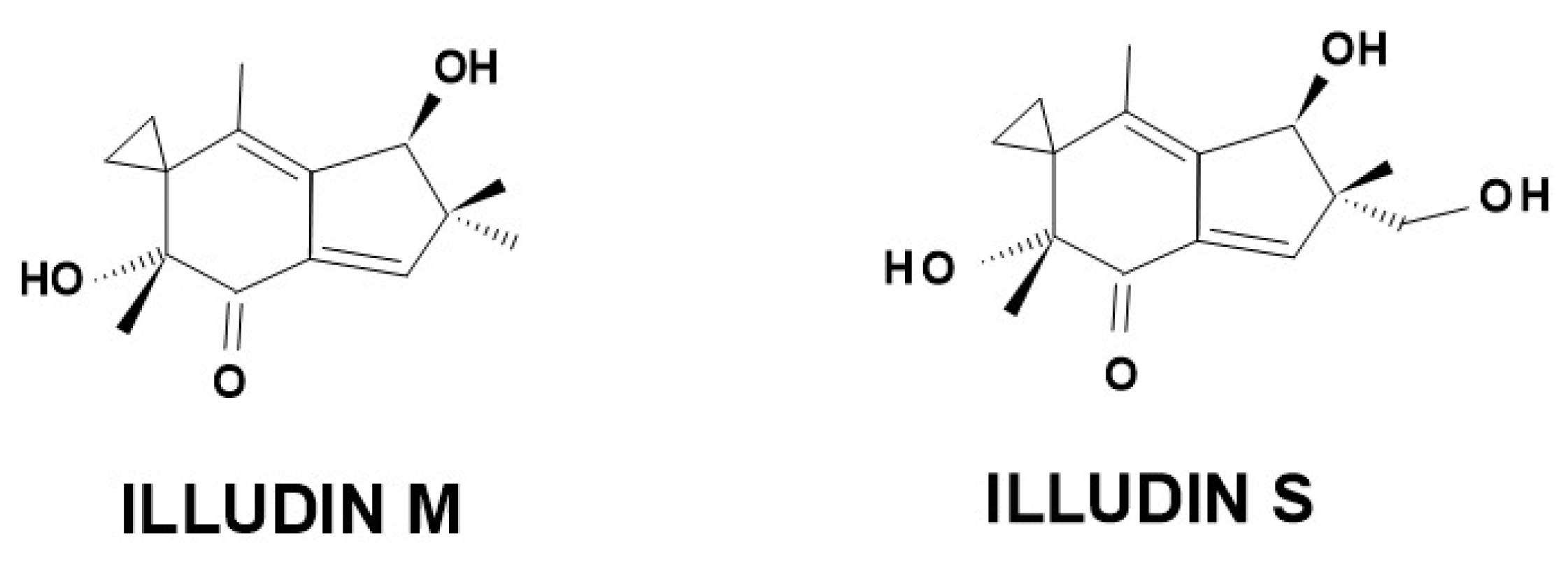
Although these mushrooms slightly resemble and smell as wonderful as a basketful of sweet chanterelles, the jack-o’-lanterns are not too be eaten! This species produces the sesquiterpenes – illudin S and illudin M, chemical compounds formed as secondary metabolites in the fungus . The illudins are quite toxic and will make one extremely sick when eaten. There is an upside found here, however. Illudins are known to be antineoplastic and are now being used in the development of anti-cancer drugs.
Chemical structures of illudin M and illudin S compounds
Photographing O. illudens can be a challenge. These are best photographed when fresh caps with exposed lamellae are present. A night around the new moon would be most optimal. The two photos shown here, depicting the bioluminescence, were taken with the following camera settings: ISO 3200, f/4, and 5-minute exposures. In retrospect, I probably exposed these for too long. The bioluminescent glow would have been better emphasized with a bit darker of an exposure. These might look as though they were taken with some sunlight or artificial light source, but I can assure you it was very dark with only the light from a near-full moon.
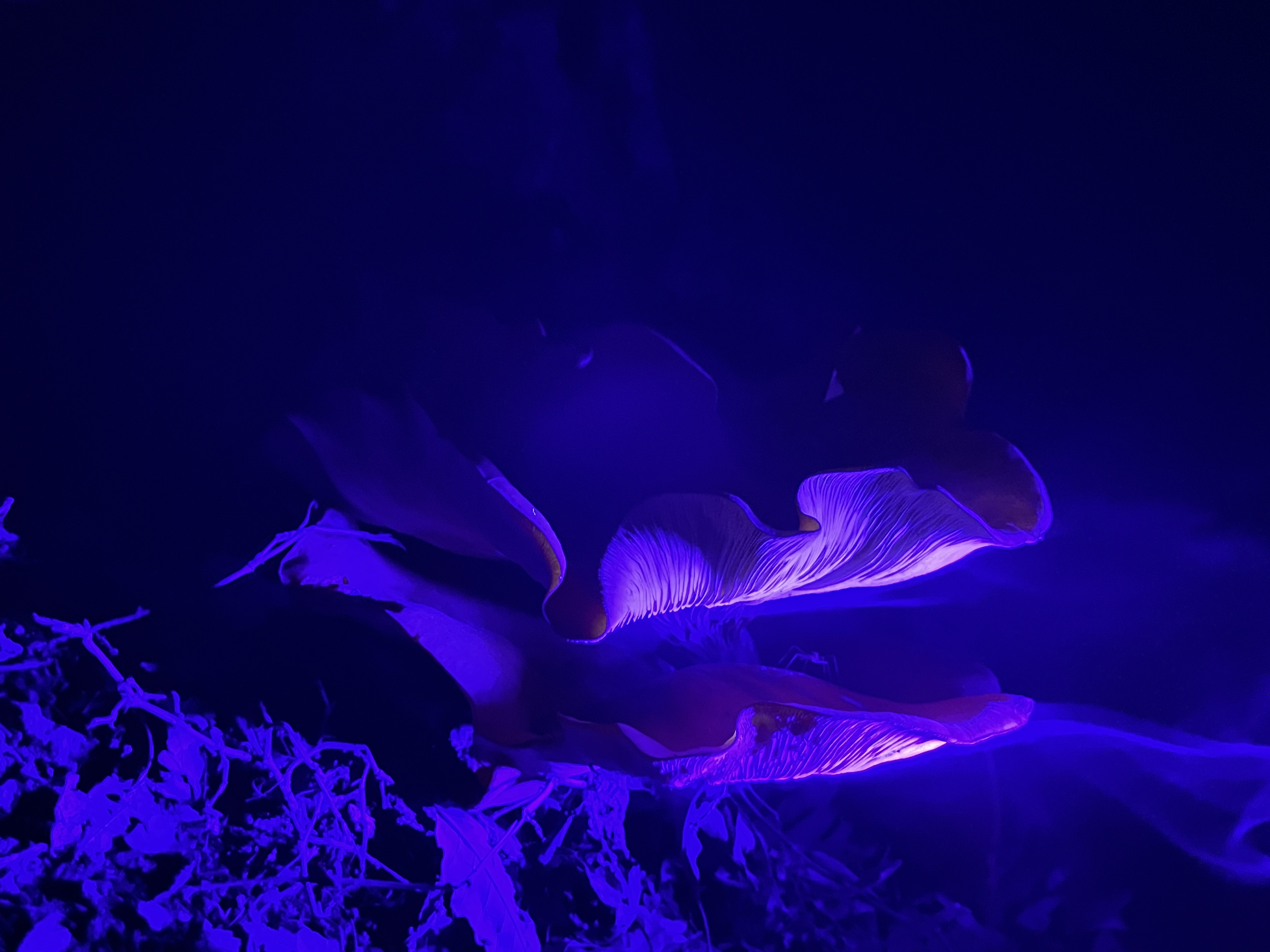
With side-lighting one could see the spores poring from the gills of the mushrooms. Pete Kozich photographed this with side-lighting provided by a UV flashlight.
Another thing I wish I would have thought of doing is to collect a cap or two and brought them home to photograph in a perfectly dark room. In doing this, the only light available would be that from the glowing mushroom. Ah well, we now know of a good stump that houses this fungus. With luck, we can try again next season a bit earlier and try this again.
Happy Halloween!
REFERENCES
Oliveira A.G., C.V. Stevani, H.E. Waldenmaier, V. Viviani, J.M. Emerson, J.J. Loros, J.C. Dunlap. Circadian control sheds light on fungal bioluminescence. Curr Biol. 2015 Mar 30;25(7):964-8. doi: 10.1016/j.cub.2015.02.021. Epub 2015 Mar 19.
Stevani, C.V., A.G. Oliveira, A. G., Mendes, L. F., Ventura, F. F., Waldenmaier, H. E., Carvalho, R. P., & Pereira, T. A. (2013). Current status of research on fungal bioluminescence: biochemistry and prospects for ecotoxicological application. Photochemistry and Photobiology, 89(6), 1318-1326.
Today I am featuring the more interesting larvae we found of the Notodontidae Family, commonly known as the prominent moths. This is a widely distributed and diverse family with close to 4,000 species described worldwide. Hosts for this family are mostly woody plants and we often find these feeding on oaks and hickories.
Variable Oakleaf Caterpillar (Lochmaeus manteo) Notodontidae, Hodges#7998 Finding a lot more than I decided to photograph, this aptly-named species feeds primarily on oaks (Quercus sp.) and is highly variable in coloration and pattern. This is a species you may get tired of finding when focusing on oaks during your searches.
Mottled Prominent (Macrurocampa marthesia) Notodontidae, Hodges#7975 We found a few of these guys this year and I find these to be very handsome little cats.
Heterocampa pulverea, Notodontidae, Hodges#7990.1 Until recently, this was a pretty large genus, containing close to 50 species. A couple of years ago, armed with molecular data, this genus was split and now contains 18 species. This one was found on a WGNSS group outing at Pickle Spring Conservation Area in early September.
Orange-banded Prominent (Litodonta hydromeli) Notodontidae, Hodges#7968 We found this guy on another WGNSS outing while looking for the bumelia borer beetle (Plinthocoelium suaveolens). We did not find our target that day but I was thrilled to find this cat that previously I did not know existed. This is another specialist that only feeds on the gum bumelia (Sideroxylon lanuginosum).
Saddled Prominent (Cecrita guttivitta) Notodontidae, Hodges#7994 This is a very common species that feeds on oaks and until recently belonged in the genus Heterocampa.
White-streaked Prominent (Ianassa lignicolor) Notodontidae, Hodges#8017 Also known as the lace-capped caterpillar, this is one of many caterpillars in this family that hide in plain sight. You will almost always find these sitting on the section of leaf they have previously eaten, using their coloration and patterns to look like a diseased or senescent portion of the leaf. These can be quite tricky to find until you get the right search engine installed in your brain.
Red-washed Prominent (Oedemasia_semirufescens) Notodontidae, Hodges#8012 Although considered fairly common, this was the first year I was finally able to find one of these outstanding cats. This species is quite polyphagous, feeding on almost any native woody plants. One of the two we found this year was feeding on pawpaw (Asimina triloba).
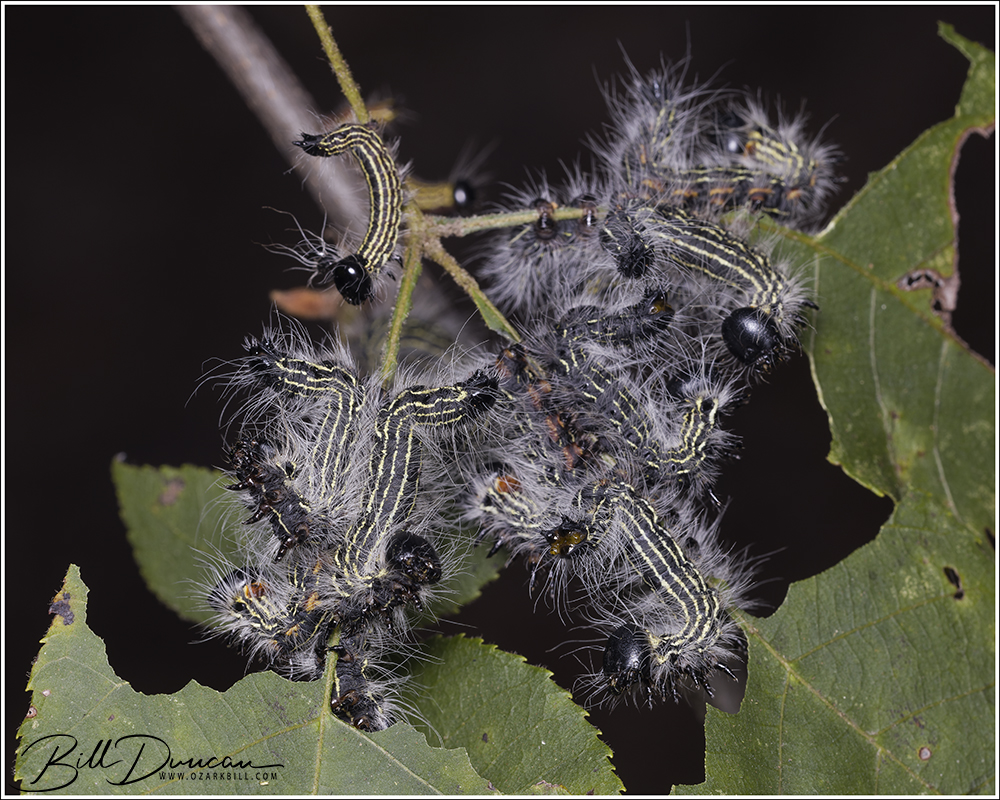
Datana Caterpillars (Datana sp.) Notodontidae Most notodontids are solitary. But certain groups, like these Datana are gregarious and can be found in large groups even in later instars.
Contracted Datana Caterpillars (Datana contracta)
A group of datana caterpillars (Datana sp.)
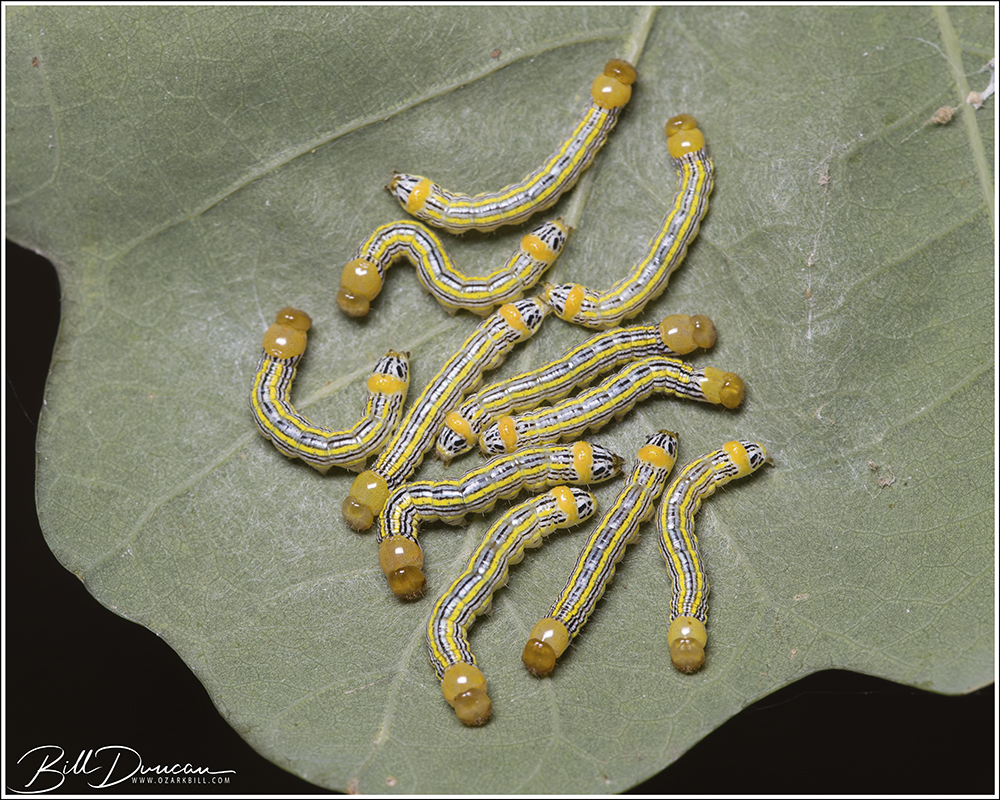
Symmerista Prominents (Symmerista sp.) Notodontidae Another gregarious taxa, the Symmerista are notoriously difficult to identify to species in both larval and adult phases.
Symmerista sp. caterpillars
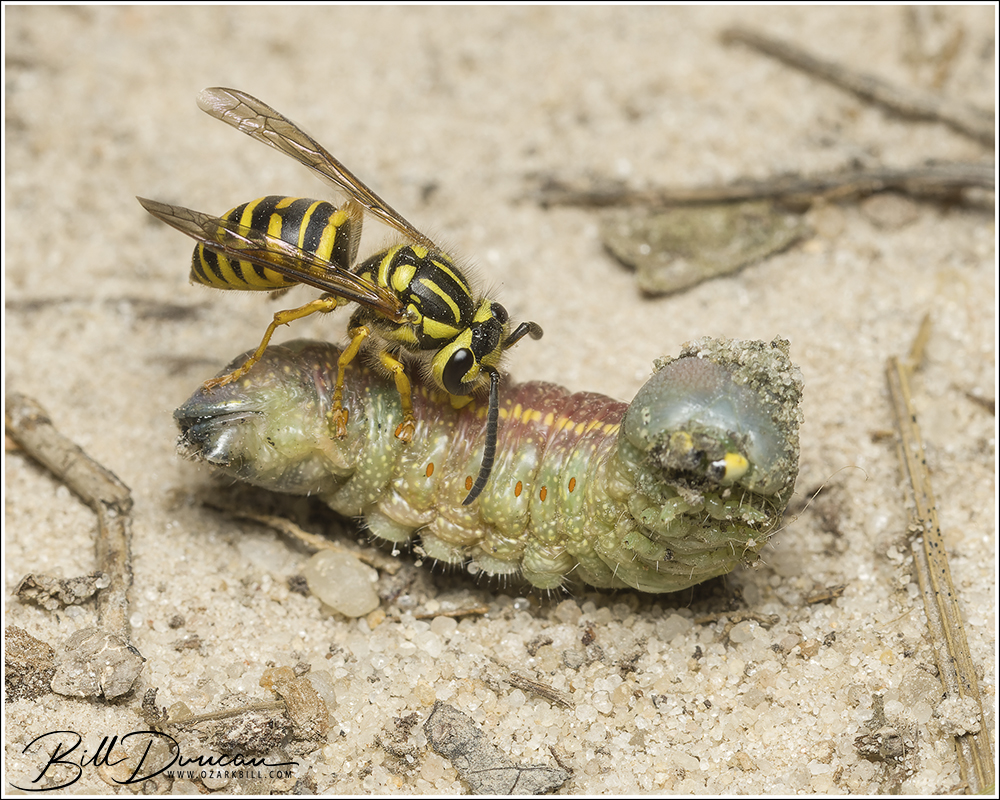
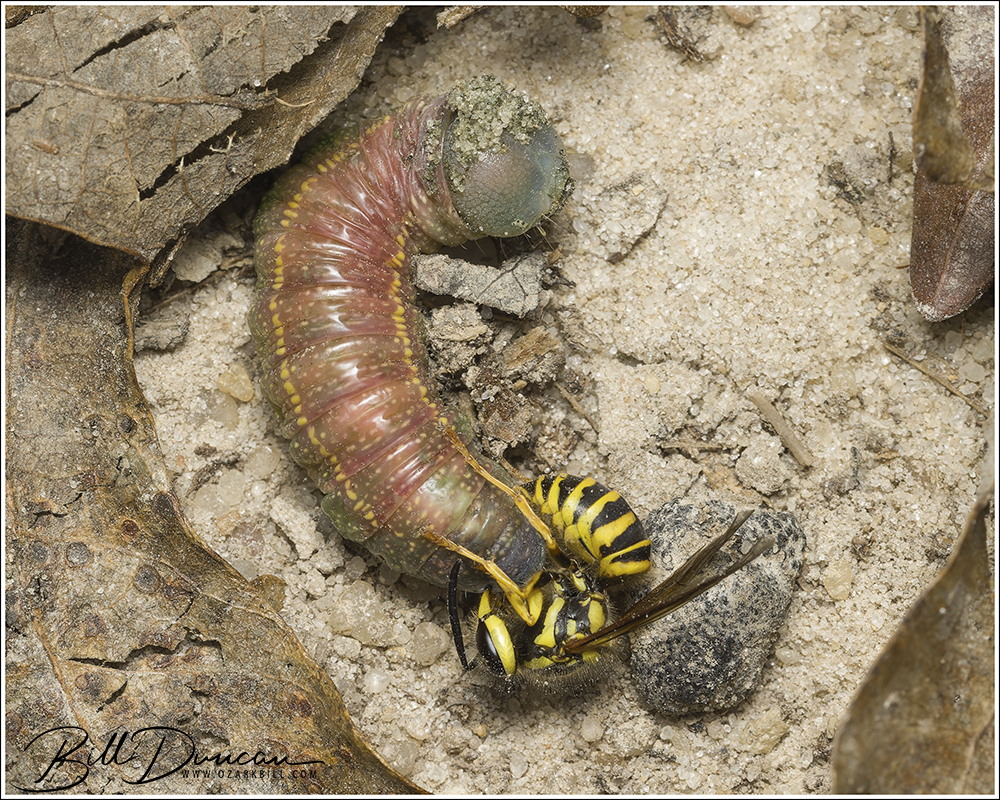
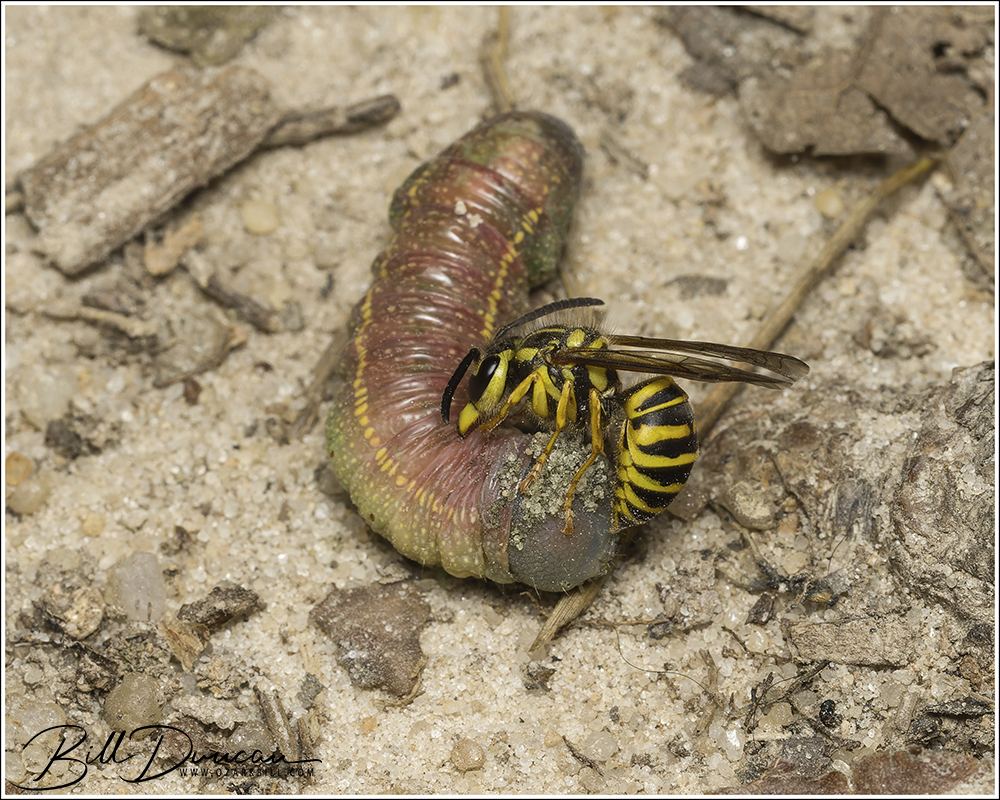
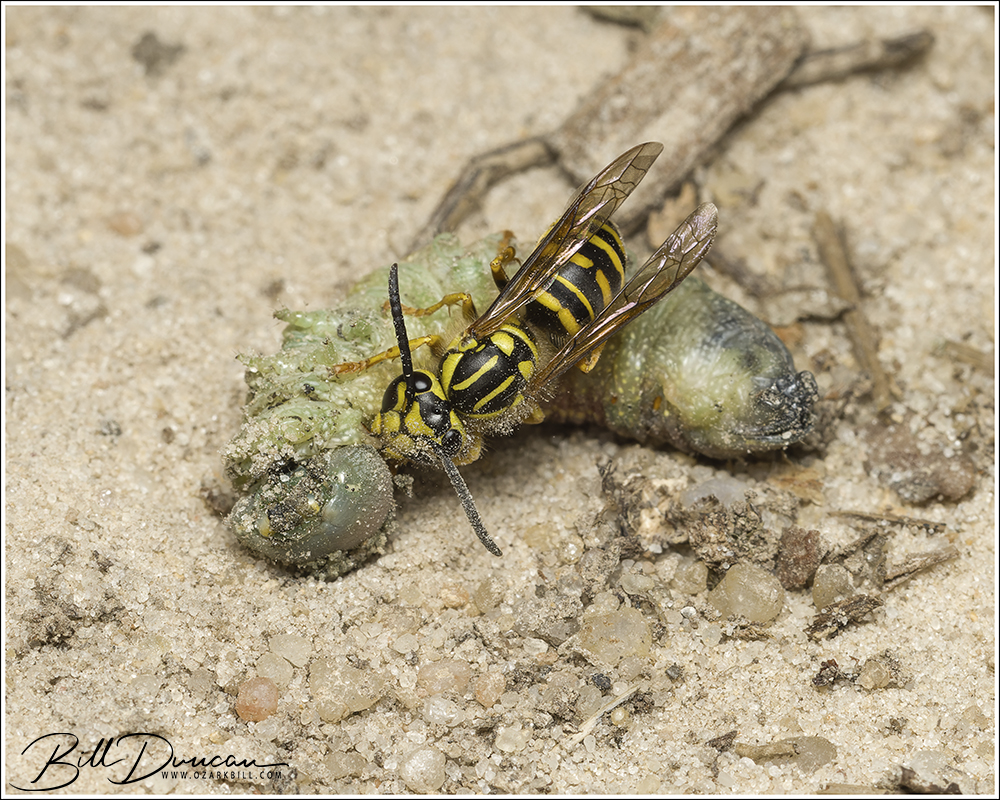
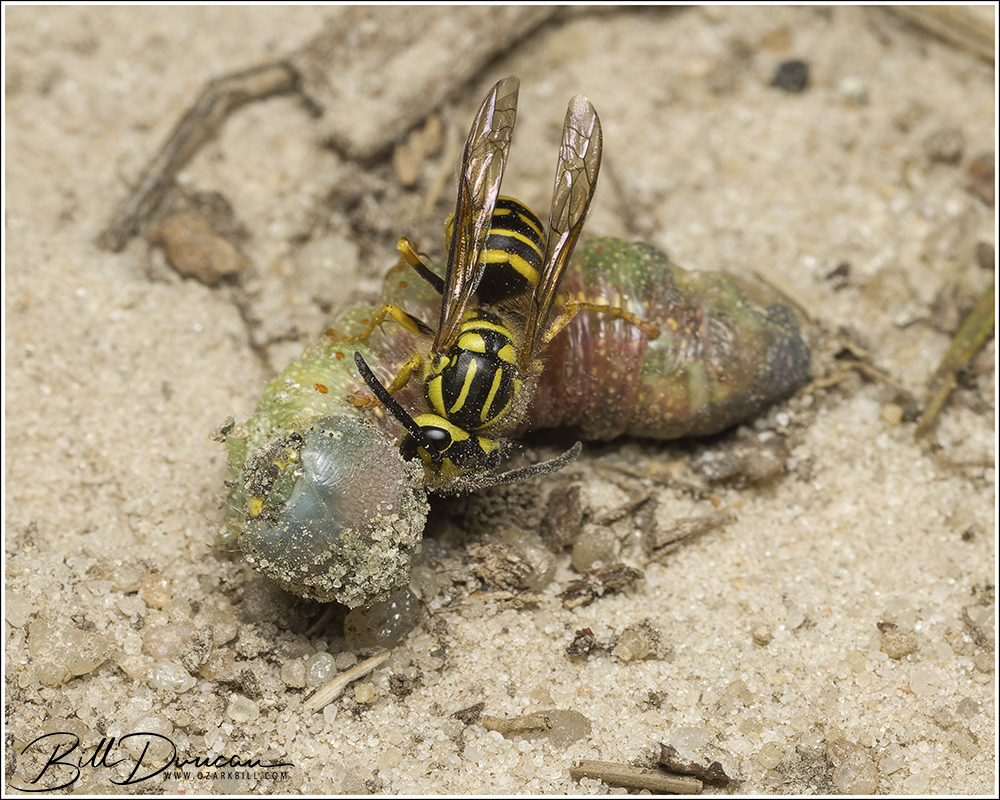
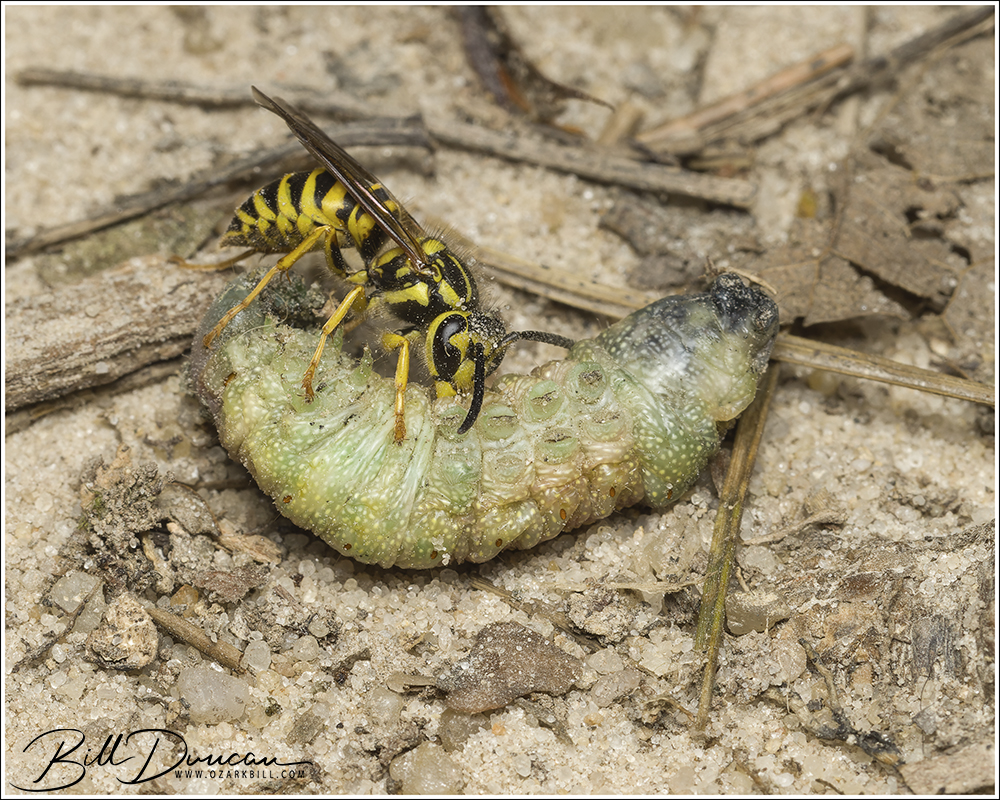
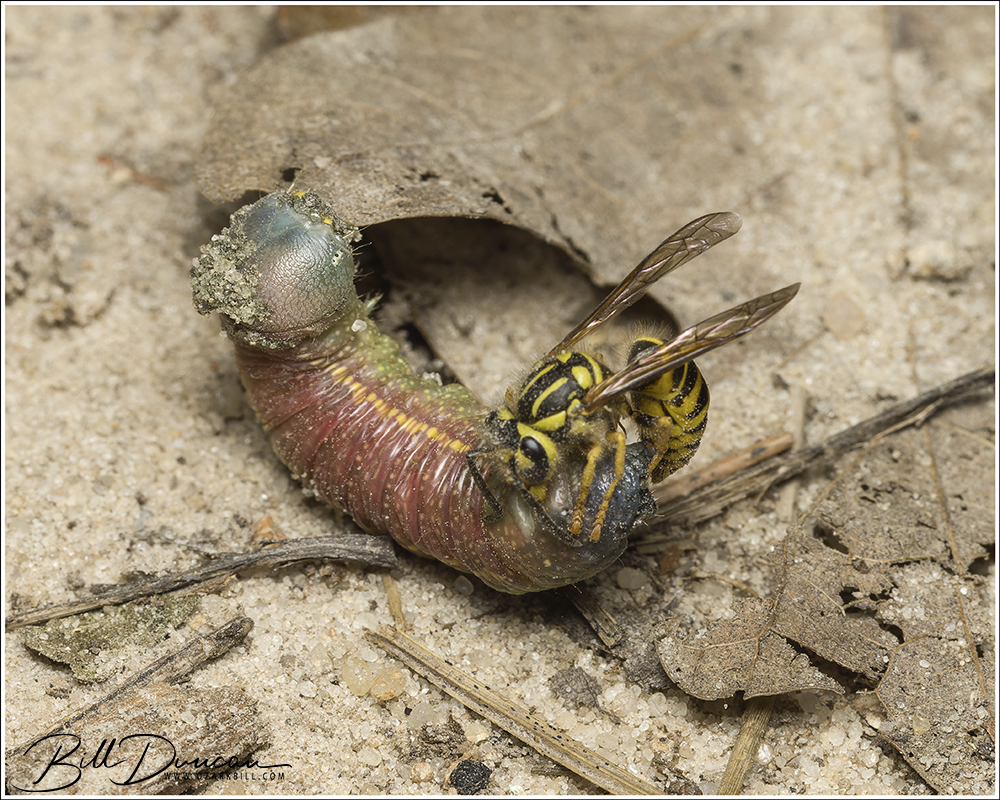
White-dotted Prominent (Nadata gibbosa) Notodontidae, Hodges#7915 Perhaps the most common caterpillar we find on our hunting trips, the white-dotted prominent can be found in large numbers on oaks. We find these so often that I rarely even tell the others in the group when I find them. But here we find a common species in a not so common situation. We came across this one on its way to find its pupation spot that would likely be in the ground or leaf litter. You can tell this was the case by the reddish or maroon coloration. Many caterpillars will change to this type of coloration immediately before they begin the pre-pupal stage. Unfortunately for the caterpillar, some southern yellowjackets (Vespula squamosa) found it as well. We watched the drama unfold as the wasps continued to sting and bite at the poor creature that will not likely make it to adulthood.
To continue with the Halloween week theme, tonight I am presenting an image that represents something that nearly became a horror story. Not that I am considering any of these spiders, snakes or any native creatures I photograph to be scary at all. It just happens that I have several of these “spooky” critters lined up in the photo queue at the right time, so to speak.
This nearly became a horror story for me because I was literally one step away from standing on this snake. Casey and I were walking the the Lost Valley Trail at Weldon Spring Conservation Area in St. Charles County, looking for late season caterpillars. On the way back to the car, not far from the parking lot, I just happened to catch the outline of this snake lying across my path before taking a step that would have put my sandal-clad foot down right on top of it.
It tuned out to be a really chill snake, allowing us to photograph it where it laid. I tried to coax it into a coiled position with a stick but it instantly retreated into a burrow underneath some leaf litter just off the trail.
As I mention frequently, I absolutely love this area. It is so rich and diverse. It has beautiful hills and forest structure and lies a mere thirty minutes from our house.
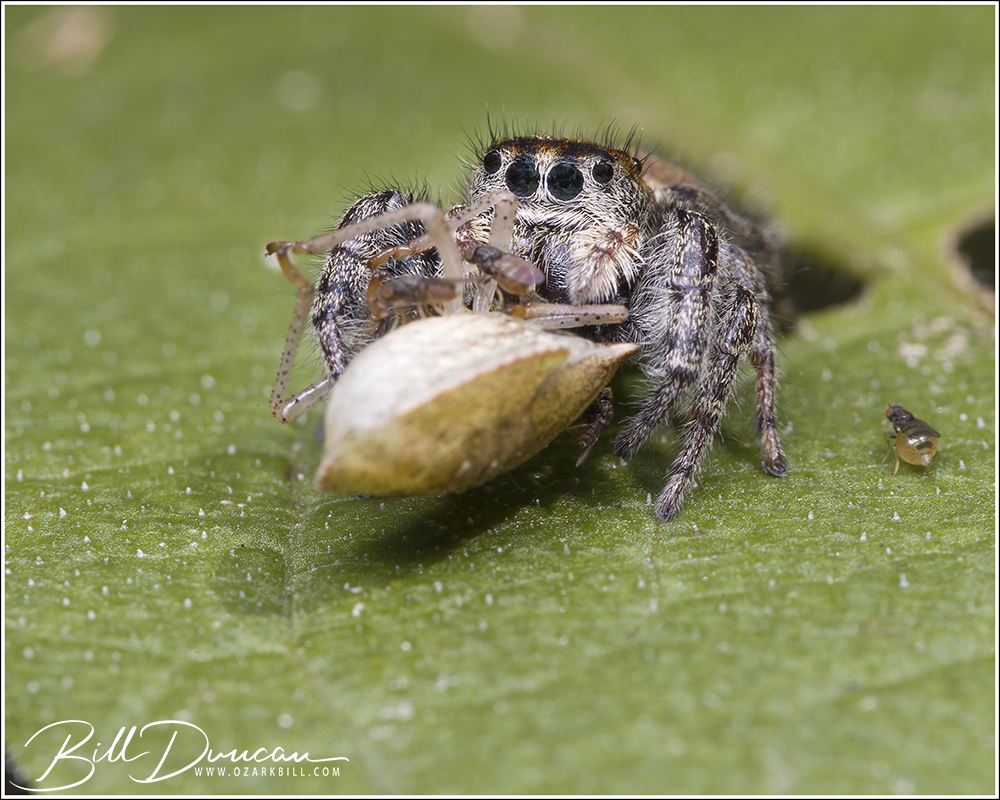
We found this little one on a cat hunting trip at Horseshoe Bend Natural Area in Texas County, MO in mid September. Check out the little flies hanging around hoping to scavenge some bug juice, much like the the vultures and other scavengers that might be found around a lion’s kill.
From my count, there are at least ten members of this genus that could be found in Missouri, but I think I have got the correct identification. Please let me know if you would suggest otherwise.
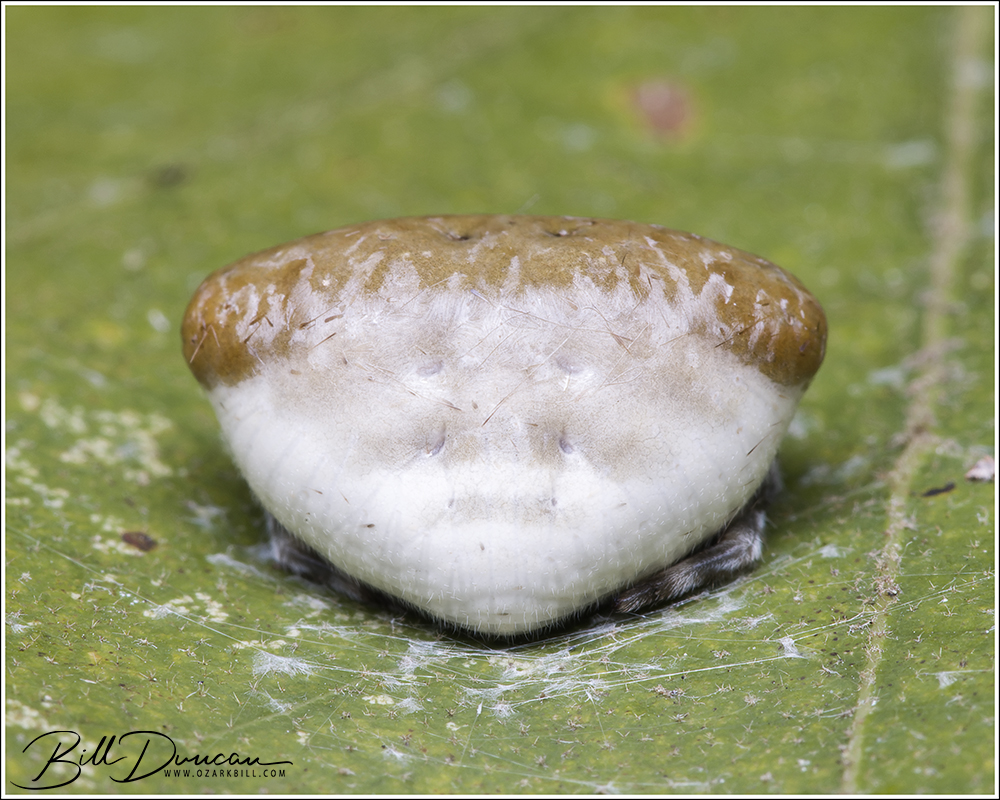
On a cat hunting trip to St. Francois State Park in September, Casey and I had the great fortune of finding one of the coolest spiders in the state – the toadlike bolas spider (Mastophora phrynosoma). Females of this species are well known for their unique hunting method. By day, they sit around, often out in the open, looking very much like a bird dropping. At night, instead of building webs, they move to the edge of a leaf or twig and hang a single line of silk with one or more sticky globules attached – their “bolas” that they use to ensnare moths and other flying prey. See this great video by the BBC for a demonstration of this.
This is the second year in a row I’ve had the fortune in finding one of these girls. If I’m lucky enough next year, I’ll be sure to try my hand at catching her hunting behaviors with the camera.
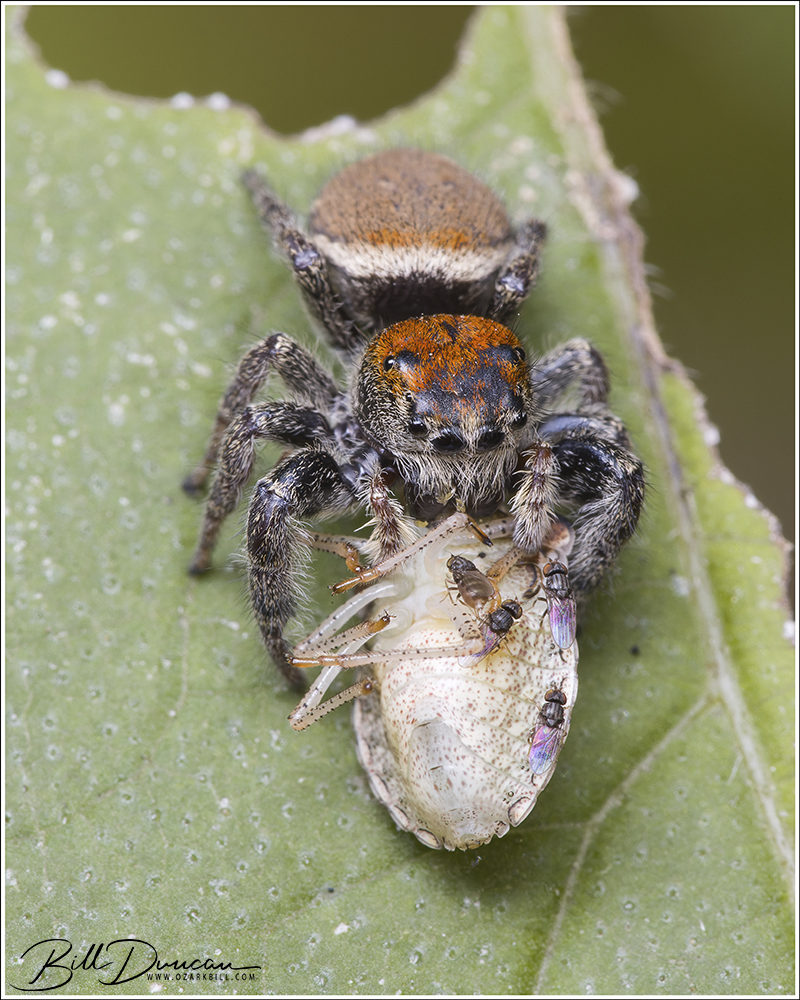
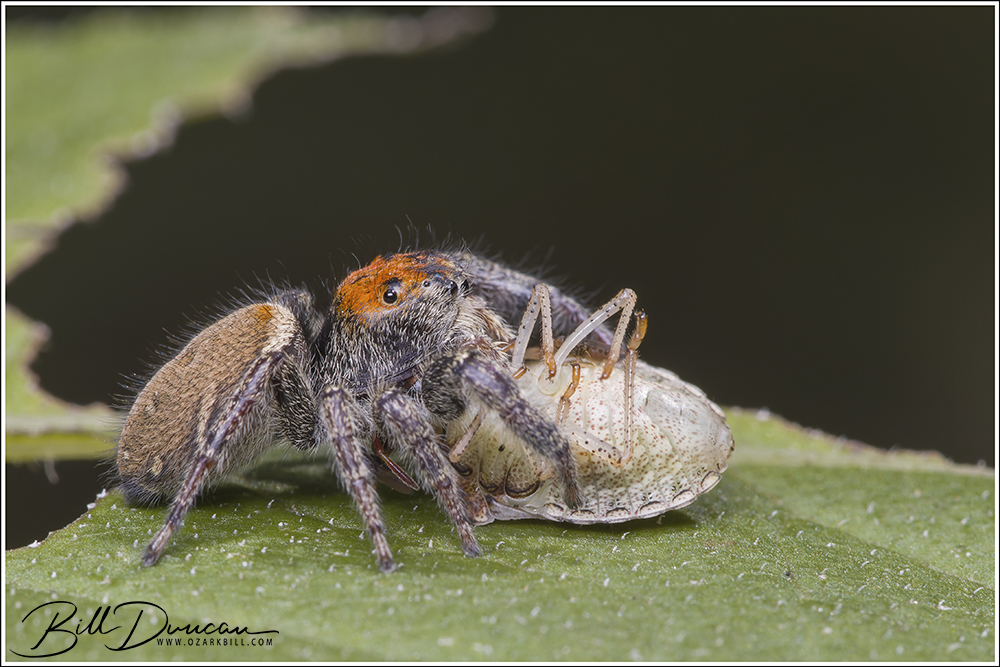
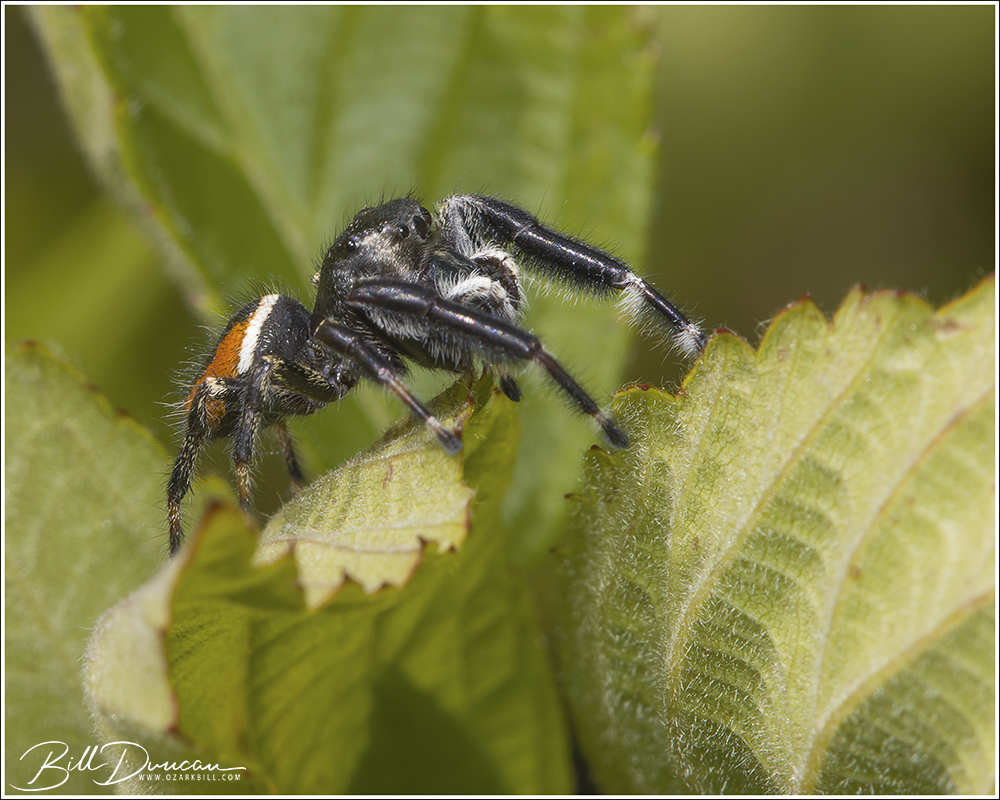
Time to get into the season by sharing a brilliant spider for October. This brilliant jumping spider was photographed back in July at Horn’s Prairie Grove LWR. This is one of several jumping spiders that are believed to be mimics of the Mutillidae family of wasps, better known as “velvet ants.”
In early October of this year, while hunting for autumn migrating sparrows among the marshy grasslands at BK Leach Conservation Area, I came across this cooperative Merlin. As you can see in the photos, this bird appeared to be having the same poor luck as me at finding sparrows or any passerines whatsoever. I watched it catch and consume four dragonflies in the hour or so I sat watching from my car. They are known to prey on dragonflies and other large insects but birds make up the majority of their diet.
Another thing I found interesting in watching this bird is that it seemed to prefer sitting on the power lines although there were plenty of telephone poles and some dead snags available in the area. One of the things I’ve read about Merlins in some field guides, and have heard from my birding mentors over the years, is that when you see a small falcon perched on a wire it will almost always be a Kestrel. This is the third time I have come across Merlin sitting on wires that I can remember. But, I am sure it is still the case that they prefer more natural perches in general.
There are two subspecies of Merlin that can be found in our area during migration and winter. This bird appears to be a juvenile Taiga/Boreal (ssp. columbarius).
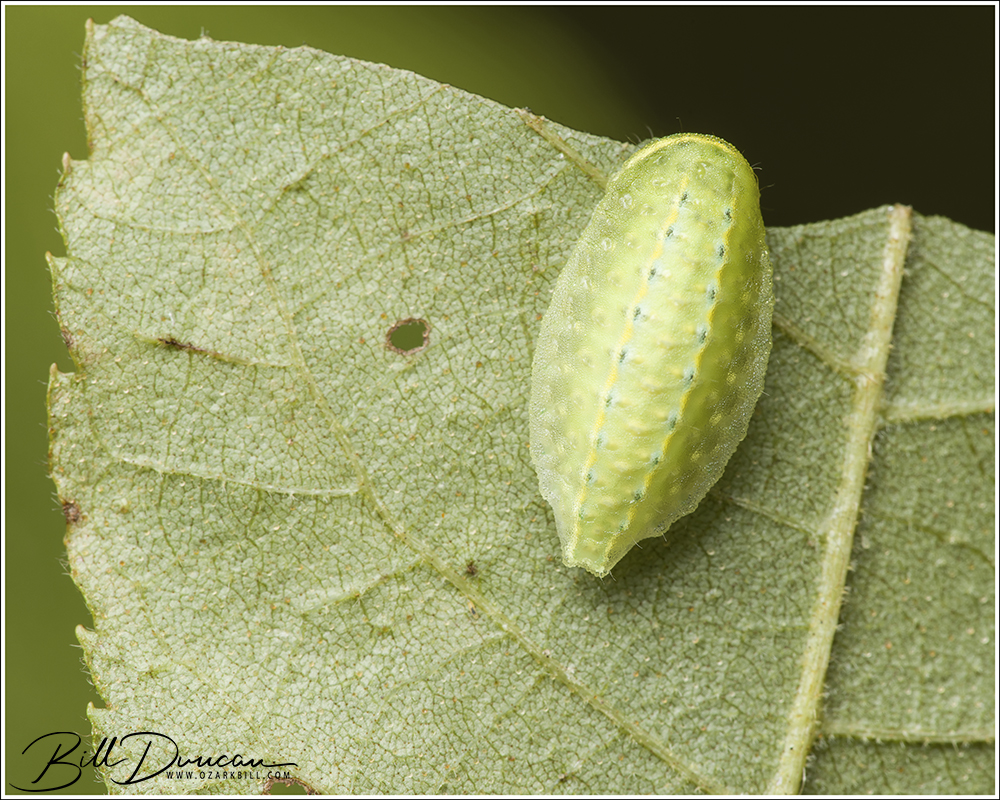
I got back into serious hunting of caterpillars beginning in late August of this year. On some trips, I hunted with a nice group of friends and on several others I went on solo outings. All in all, it was a lot of work and, at times, I wondered if the payoff was worth the time and effort. However, like I’ve said before, anytime spent in quality spots in the outdoors is time well spent. In this first post, I am sharing, as no surprise to those who know me well enough, images of larvae from my favorite family of Leps – the Limacodidae, otherwise known as the “slug moth” caterpillars.
Red-crossed Button Slug Moth (Tortricidia pallida) Limacodidae, Hodges#4653 By far the most abundant slug we found this season was the red-crossed button. I did not collect good enough records to put a specific number of the individuals found, but it would be close to 25.
Nason’s Slug Moth (Natada nasoni) Limacodidae, Hodges#4679 This is another one that is usually found in goodly numbers during the hunting season. We found a few, but not nearly as abundant as in most years.
Stinging Rose Caterpillar Moth (Parasa indetermina) Limacodidae, Hodges#4699 Always a pleasure to find, the stinging rose caterpillars will vary considerably in the amounts of the yellow, white, black and red colors.
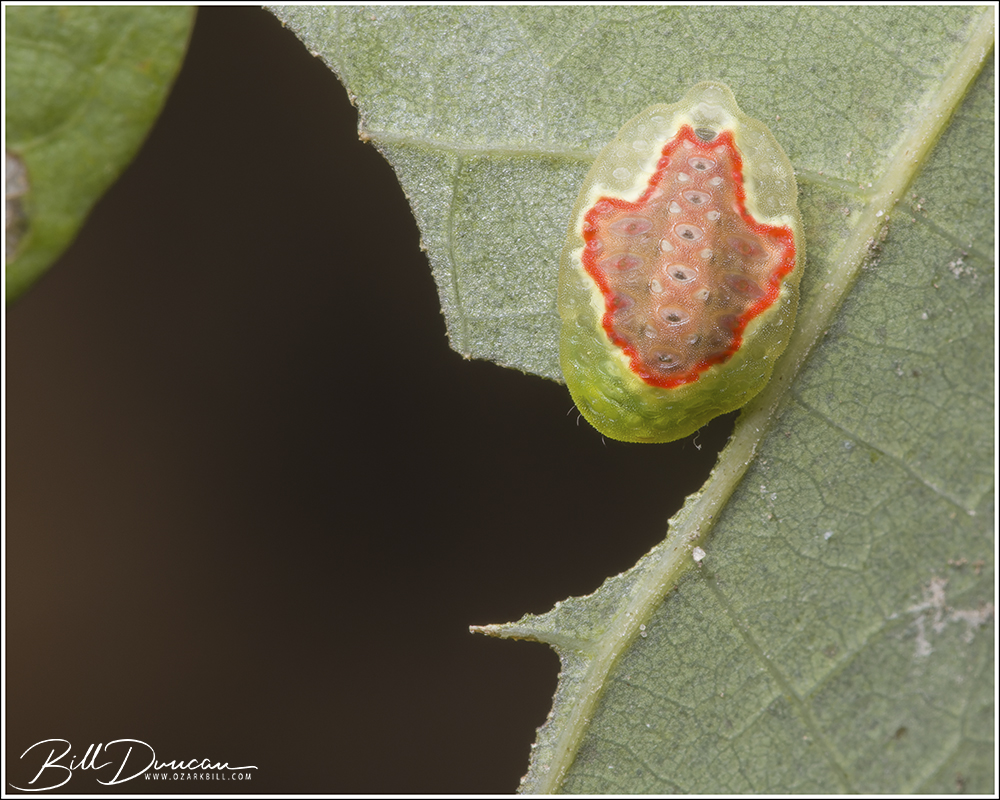
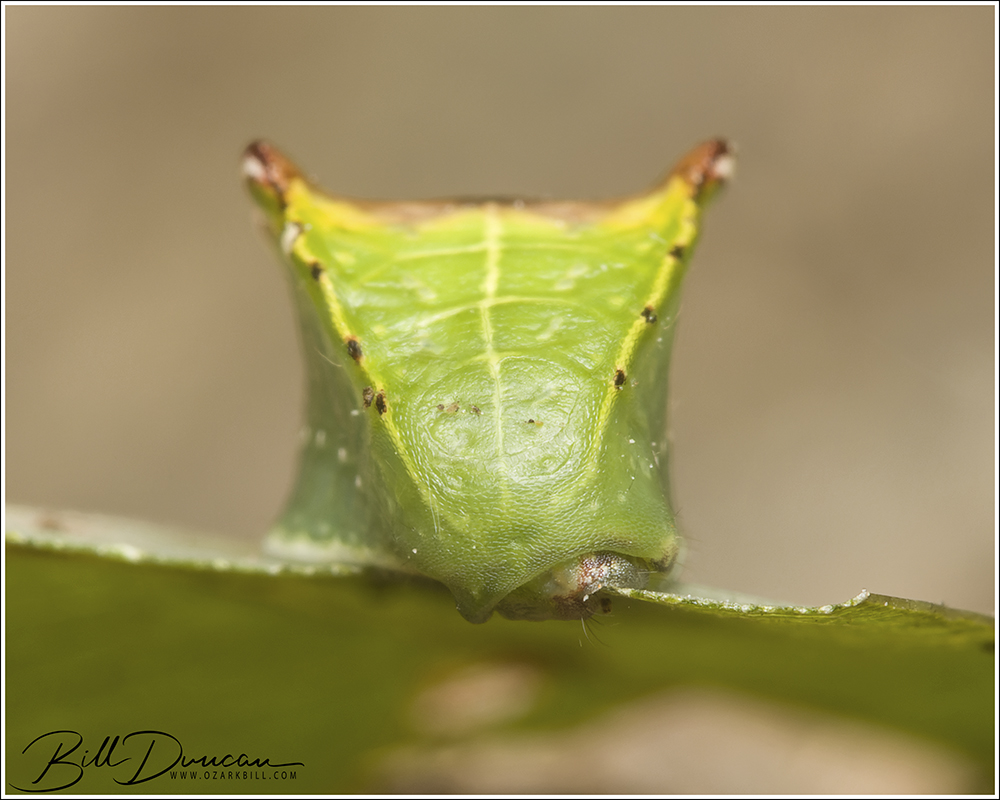
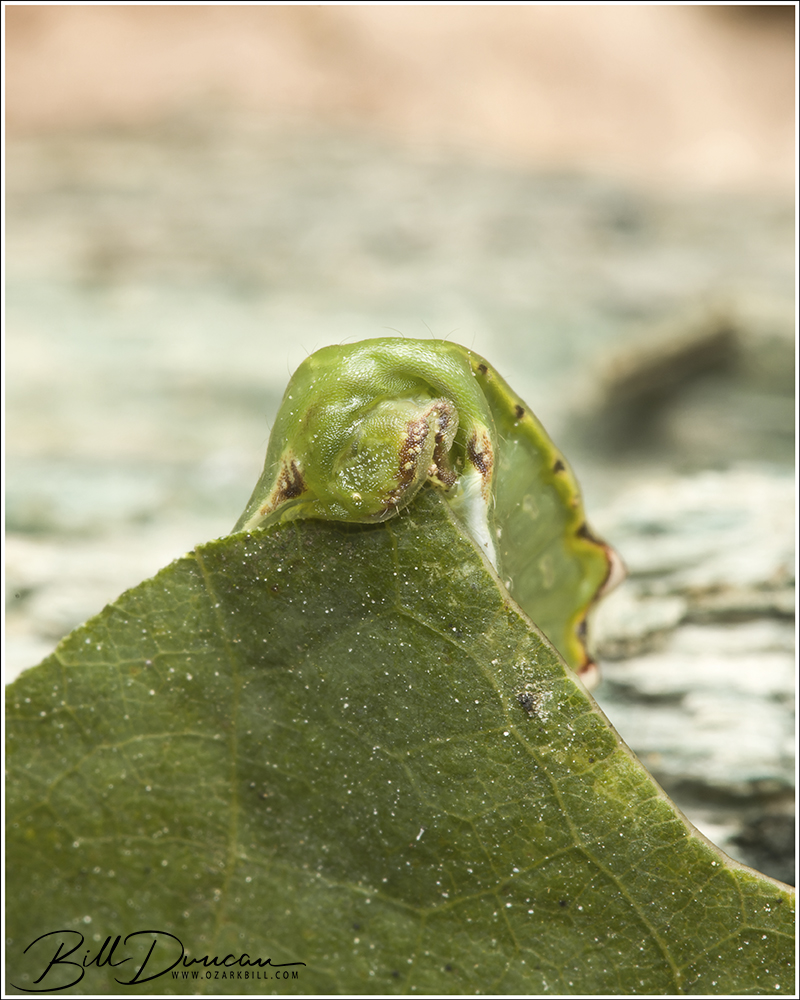
Skiff Moth (Prolimacodes badia) Limacodidae, Hodges#4671 Another slug that can be quite variable in colors and patterns, the skiff moths can often be found on the tops of leaves. This is opposed to most of the cats in this family being located on the undersides of leaves. As you can see in the one pictured here, these guys are patterned to appear as easily-overlooked spots of necrosis on late-season green leaves.
Inverted Y Slug Moth (Apoda y-inversum) Limacodidae, Hodges#4667 Overall, I was a little disappointed in the numbers and diversity of slugs we found this season, however this species and the following one are not always encountered every season. I believe this is only the third cat of this species I have been able to find.
Beutenmueller’s Slug Moth (Isochaetes beutenmuelleri) Limacodidae, Hodges#4675 Until this year, I have only been able to see one caterpillar of the Beutenmueller’s slug, better known as the “spun-glass” slug. This year I found three! I’ll never get tired of seeing these.
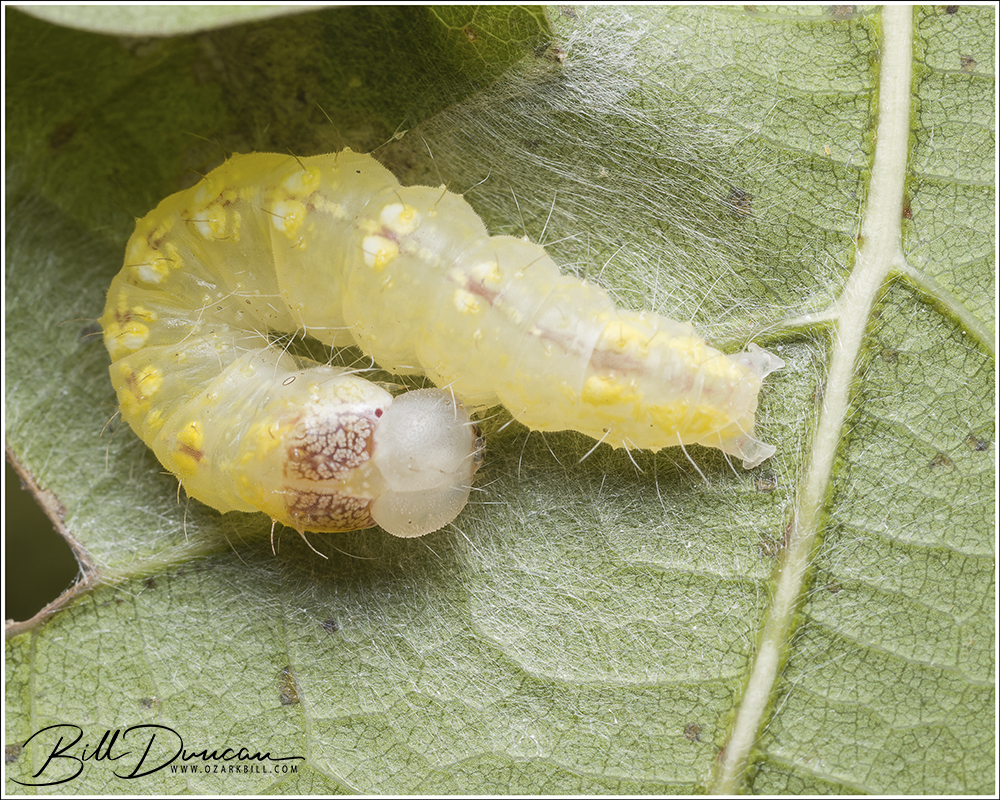
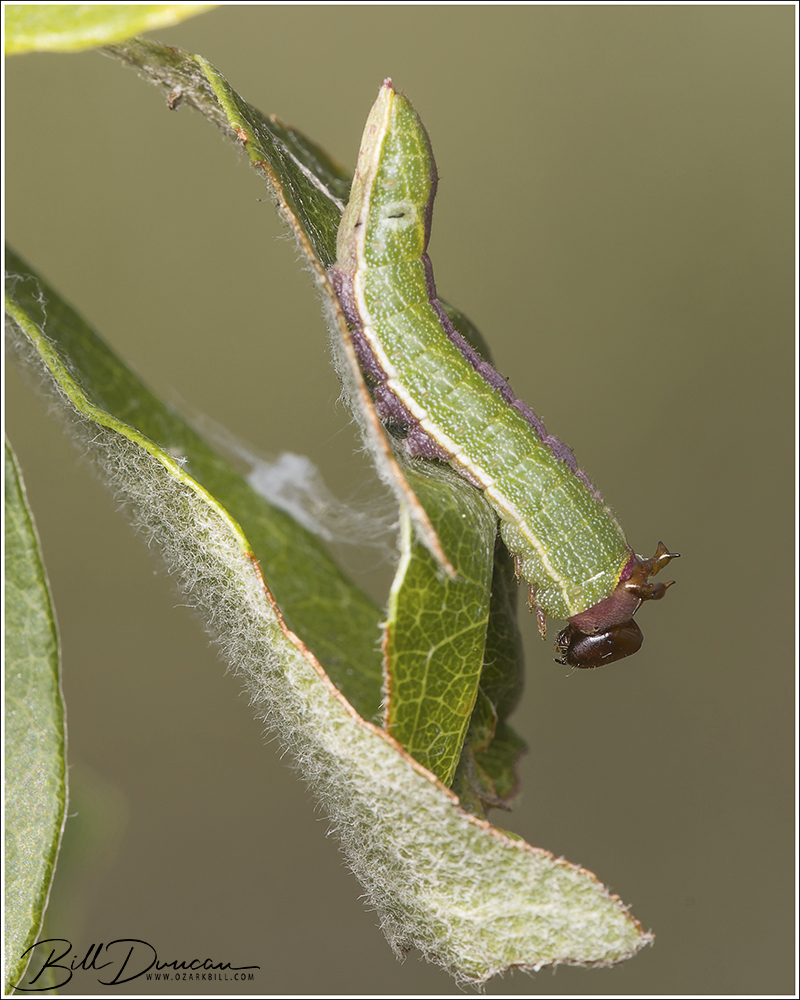
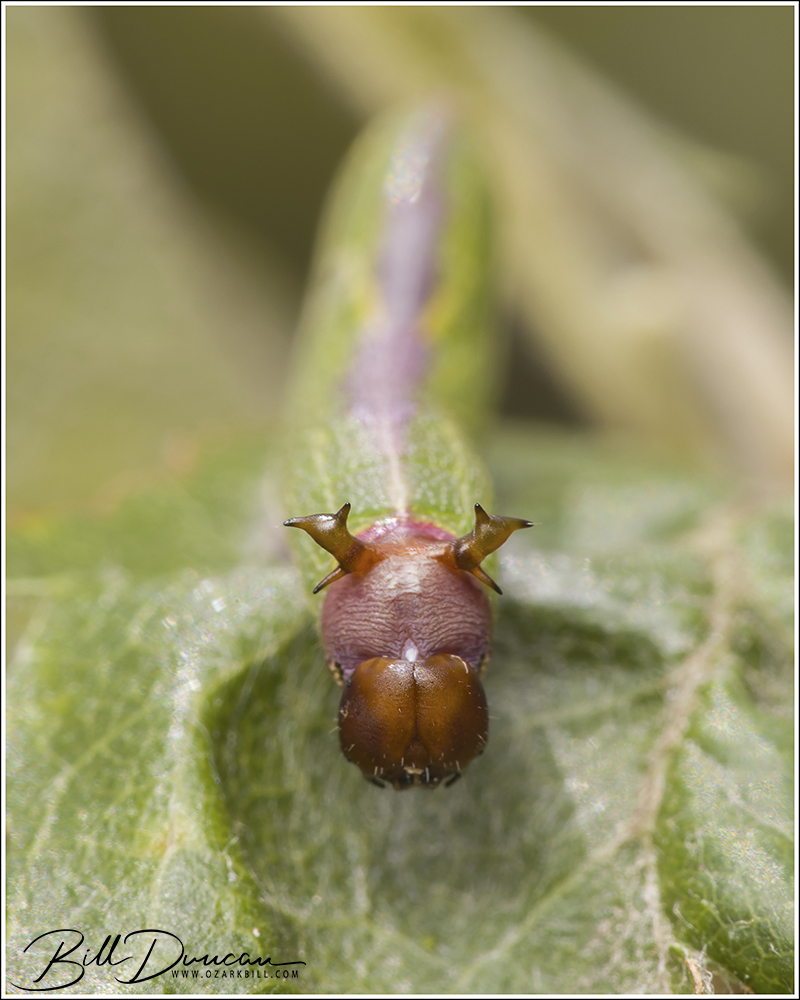
Unknown Limacodid This mid-instar cat could potentially be one of several species. I think there is a chance it could be the – jeweled tailed slug moth (Packardia geminata), but it is most likely a yellow-shouldered slug (Lithacodes fasciola). I wish I would have thought to bring it home to rear. In the know and have a better idea on the identity of this one? Please let me know in the comments below.
Shagreened Slug Moth (Apoda biguttata) Limacodidae, Hodges#4669 In the picture below of this shagreened slug, you can see a couple of the traits that are distinctive to the Limacodidae. First, it is quite common that the slug cats will eat the leaves in a more horizontal direction, squaring off the leaves, so-to-speak. Most other caterpillars will eat circular notches in the leaves as they feed. Second, although difficult to see in this picture, is the distinctive frass the caterpillar is dropping. Limacodid frass is distinctly shaped, with one section being notched to “fit” along side the ones before and after. Interestingly, monarch (Danaus plexippus) and likely other groups also share this trait.
Hag Moth (Phobetron pithecium) Limacodidae, Hodges#4677 Either we were out too early, in general, or the hag moth cats, AKA “monkey slugs,” were later than usual. I found quite a few mid-instar monkey slugs this season but not a single late-instar. I was too lazy, or perhaps disappointed, to pull out the big rig to photograph any of these, so here is a cellphone shot. The reason I wanted to share this is to show the interesting feeding behavior of cats at this stage of their development.
Notice the wavy, white to lime-green patches on the top of this leaf? This is indicative of how this younger monkey slug is feeding. Instead of free-feeding and consuming the entire leaf, this guy is feeding like a skeletonizer or a leaf-miner, in that it is scraping the top layer of the leaf. In this photo, you can see fresh scraping areas and ones that are much older, suggesting that this cat has been living on this leaf for some time. I suppose it likely that early to mid instars of all species in this family feed in this way, but I am not usually out hunting in early to mid summer to have observed this before.
A mid-instar hag moth caterpillar, feeding by scraping off the top layer of the leaf surface. BTW, the caterpillar is in the upper left section of this photo. 😉
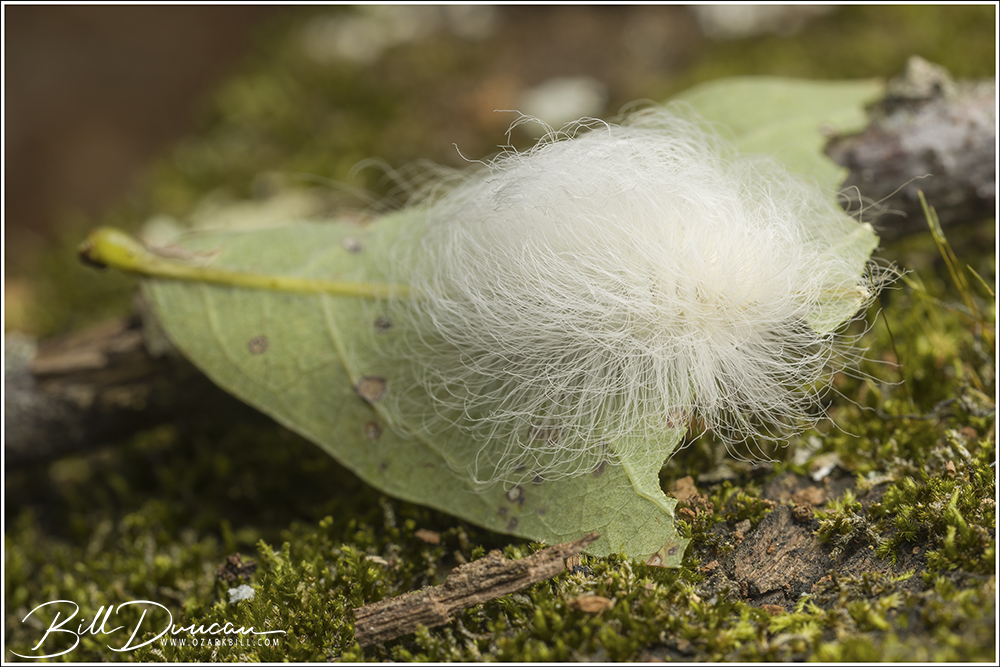
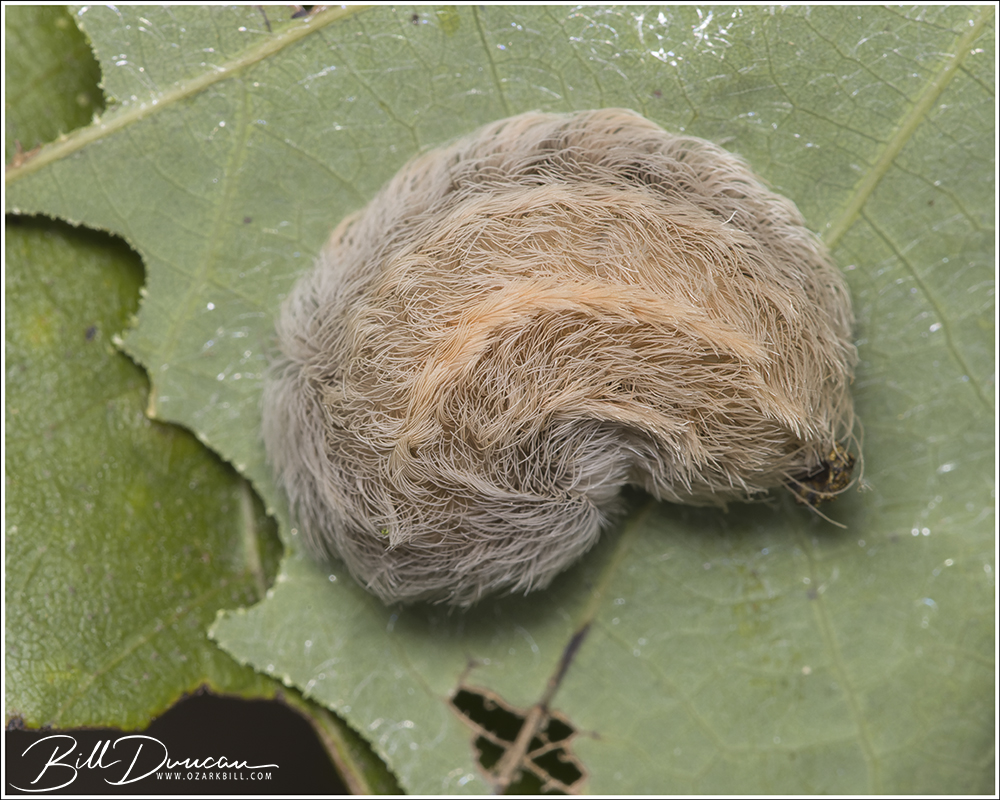
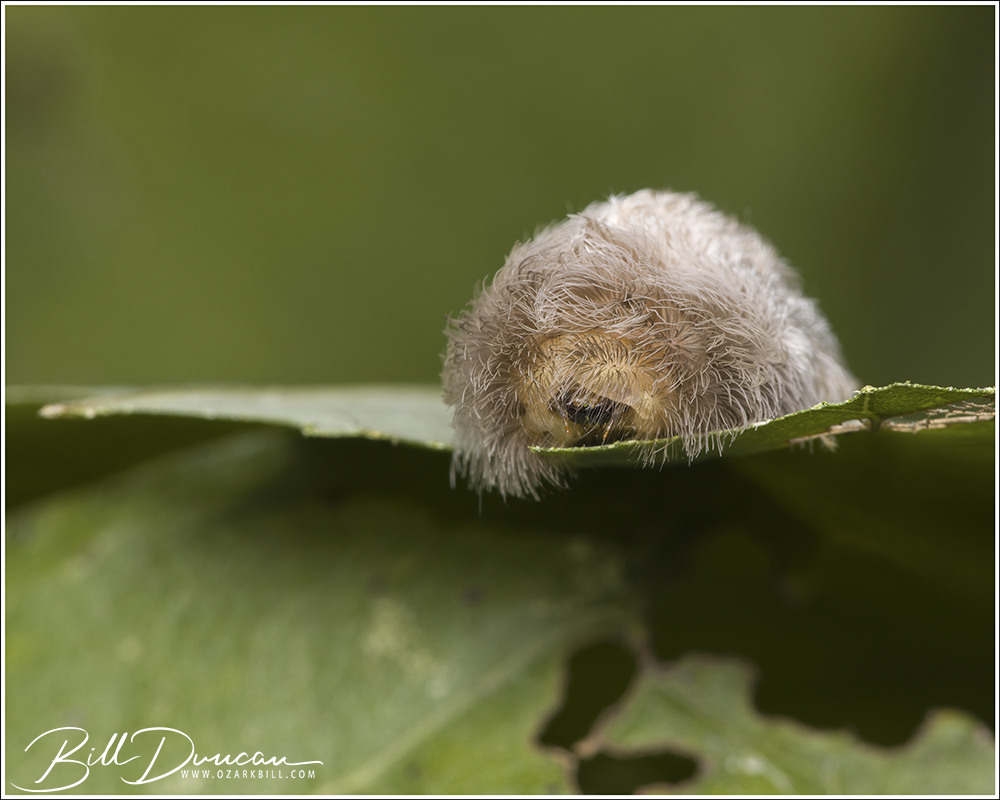
Black-waved Flannel Moth (Megalopyge crispata) Megalopygidae, Hodges#4644 Technically, not a Limacodidae family member, the black-waved flannel moth is in the closely related family, Megalopygidae, within the same super family (Zygaenoidea), which include not only the slugs and flannel moths, but leaf skeletonizer moths as well. We regularly find this species on our late-season outings. This year I was able to find and photograph two different stages. The earlier instars are fluffy white in appearance, while the final instars are colored in warmer browns.
Remember, these guys are not for petting. Descriptions vary, but the hairs on these have been described as highly irritating to downright dangerous, potentially requiring a hospital visit.
A mid-instar of the black-waved flannel moth (Megalopyge crispata) in its fluffy white coat.
Late instars of this species are draped in reds and browns. Some have suggested they can look like the top of a recent “president’s” head.
I believe these are all of the photos I have to share of the Limacodidae from this past season. Thanks for visiting and please let me know if you find any errors in my identifications by making comments below.
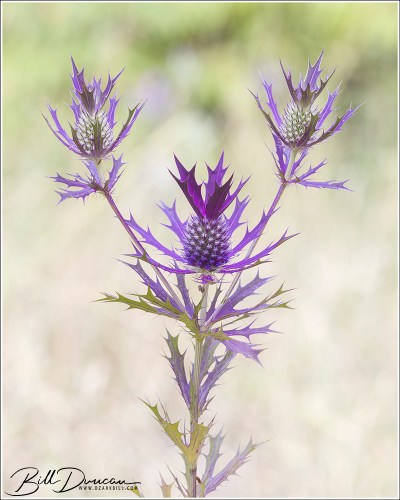
Just across the border into Kansas, Pete and I found Eryngium leavenworthii (Leavenworth’s Eryngo). Along with species like rattlesnake master and creeping eryngo, this is quite a diverse and fascinating genus.
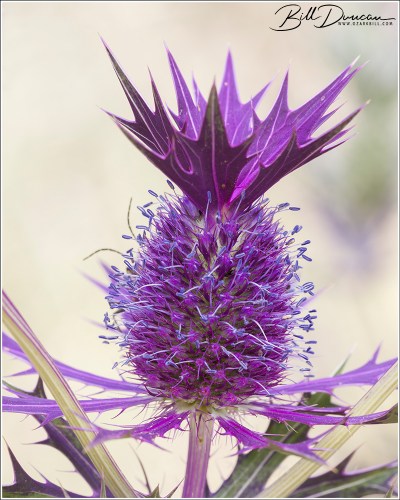
The level of purple varies in individual plants, but as you can see in the following photos, virtually every part of the plant – stems, leaves, bracts and flowers, have some bit of purple.
Eryngium leavenworthii (Leavenworth’s Eryngo)
Even the anthers and filaments of Eryngium leavenworthii are blue/purple.
The flowers of these plants were really drawing in the pollinators. Here are just a few of the insects we observed visiting.
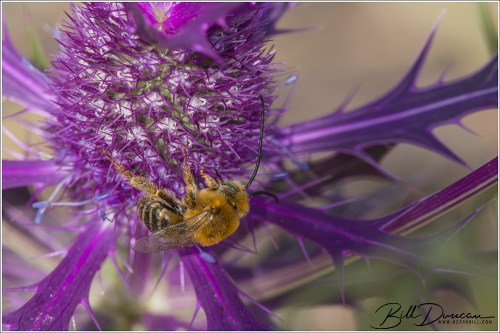
A long-horned bee, probably in the genus Melissodes, visits Eryngium leavenworthii.
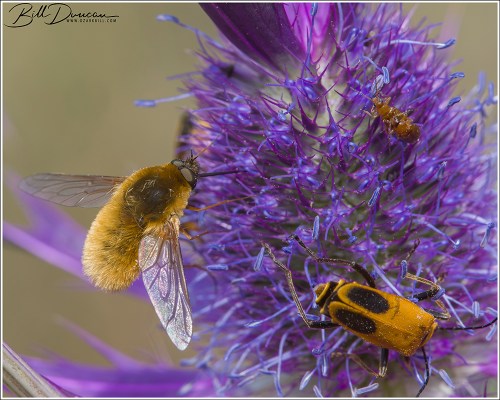
A bee fly (Bombylius sp.) and some beetles nectaring on Eryngium leavenworthii.
This plant does well on poor, dry soils and they are apparently very deer resistant. I might have to introduce these to the garden if I can find them available in a local nursery.























 A Thousand Acres of Silphiums