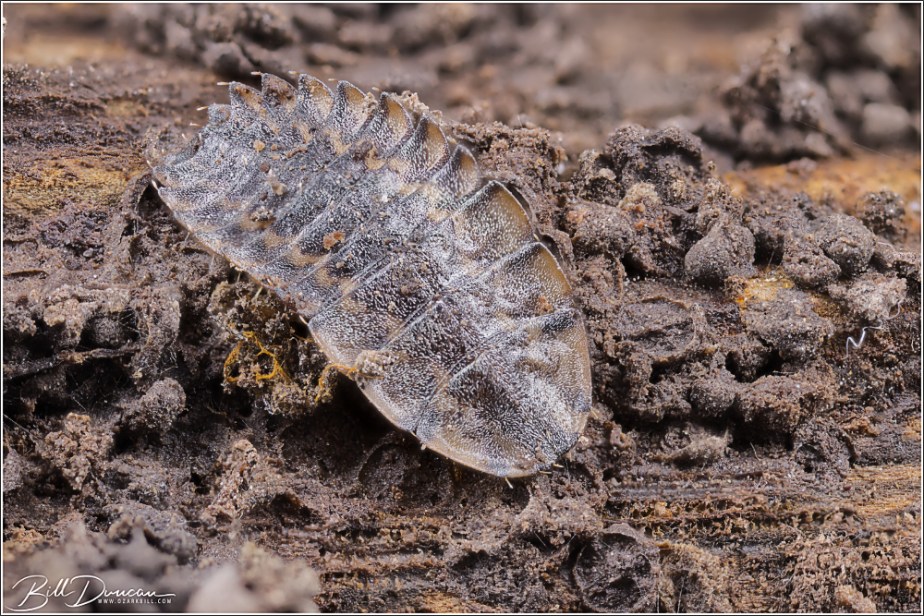
There’s an entire world of tiny creatures living beneath our feet, many measuring just a few millimeters in length. Springtails, pseudoscorpions, mites, and countless other arthropods inhabit the leaf litter, soil, and decaying wood of Missouri’s forests. I’ve long been interested in photographing these organisms, but capturing their intricate details presents some considerable technical challenges. Recently, I’ve been experimenting with a new-to-me approach that may help overcome some of those limitations: high-magnification, handheld focus stacking.
Those who have dabbled in high-magnification photography quickly realize how small the depth of field (DOF), or the zone of acceptable sharpness, becomes. The higher the magnification, the shorter the resulting DOF, sometimes resulting in a plane of focus that may be less than a millimeter! In typical photography, the photographer will likely “stop down” the aperture to increase the DOF, or the area of the images that has acceptable focus. This can be done to a limited extent in high-magnification macrophotography, but with considerable tradeoffs.
At high magnifications, another factor comes into play: effective aperture. As magnification increases, the effective f-number becomes considerably larger than the aperture selected on the lens. For a conventional macro optical system, the effective f-number can be approximated by multiplying the selected f-number by one plus the magnification. For example, at 1:1 magnification, a nominal aperture of f/8 behaves approximately like f/16. At 2:1, that same setting becomes f/24, and at 5:1, it reaches an effective f/48! As the effective f-number increases, less light reaches the sensor for a given exposure time, and diffraction becomes more pronounced. Although stopping down increases depth of field, diffraction can reduce the fine detail recorded in the image. The precise relationship varies somewhat with lens design, but the practical lesson is the same: stopping down too far at high magnification can produce disappointingly soft images.
Focus stacking is the process of taking multiple photographs at different focus distances to create a single composite image with a greater depth of field than any individual exposure. This technique is nothing new in macrophotography. To avoid the diffraction and light loss that leads to poor image quality, photographers have been building composite images to increase the DOF in their images primarily using tripods and focusing rails. More recently, automated focus bracketing, in which the camera adjusts the lens focus between exposures, has become increasingly popular. Some cameras can even combine these images internally to produce a finished focus stack.
At the extreme magnifications I’m interested in, many specialized lenses are entirely manual focus, while autofocus and automated focus bracketing may become impractical or unavailable. Additionally, using traditional focus stacking techniques, requiring the use of tripods, focusing rails, and cumbersome lighting equipment, makes this a herculean task in the field. This is where handheld focus stacking comes into play. I was originally turned on to this technique by a couple of very talented YouTube photographers: Alexis Tinker-Tsavalas (@naturefold), and Trey Wardlaw (@Xx7trey).
Handheld focus stacking removes the tripod and requires the photographer to find the subject in the viewfinder and take as many photographs as necessary to cover the area of their composition that they want to be in sharp focus. Rather than adjusting the lens’s focus between exposures, the photographer moves the camera slightly forward or backward while taking a rapid series of photographs. This moves the plane of sharp focus through the subject, allowing the individual images to be combined later into a composite with greater depth of field. Make no mistake, handheld focus stacking is not easy. At high magnification, each focus “step” is likely to be fractions of a millimeter! The photographer will need just the right equipment to get this job done. This includes a well-diffused flash, operating at relatively low power to allow rapid recycling. A high frame rate is also beneficial, allowing the photographer to capture the necessary images before the subject moves, provided the flash can keep up and sufficient overlap is maintained between successive planes of focus. The more frames per second the photographer can manage the easier this technique becomes. I won’t go much further in depth about this technique. If you would like to learn more about this, I suggest you watch the videos from Alexis and Trey.
On a recent very warm mid-November day, Miguel and I visited Shaw Nature Reserve in Franklin County, MO to give this technique a try. Unfortunately, we did not have a lot of luck finding the very small targets like springtails and pseudoscorpions we were hoping for. Rolling over lots of fallen wood, we did find plenty of interesting subjects and got our feet wet in this challenging technique. I did find one yellow-bodied globular springtail but it did not stay around long enough for me to get started.
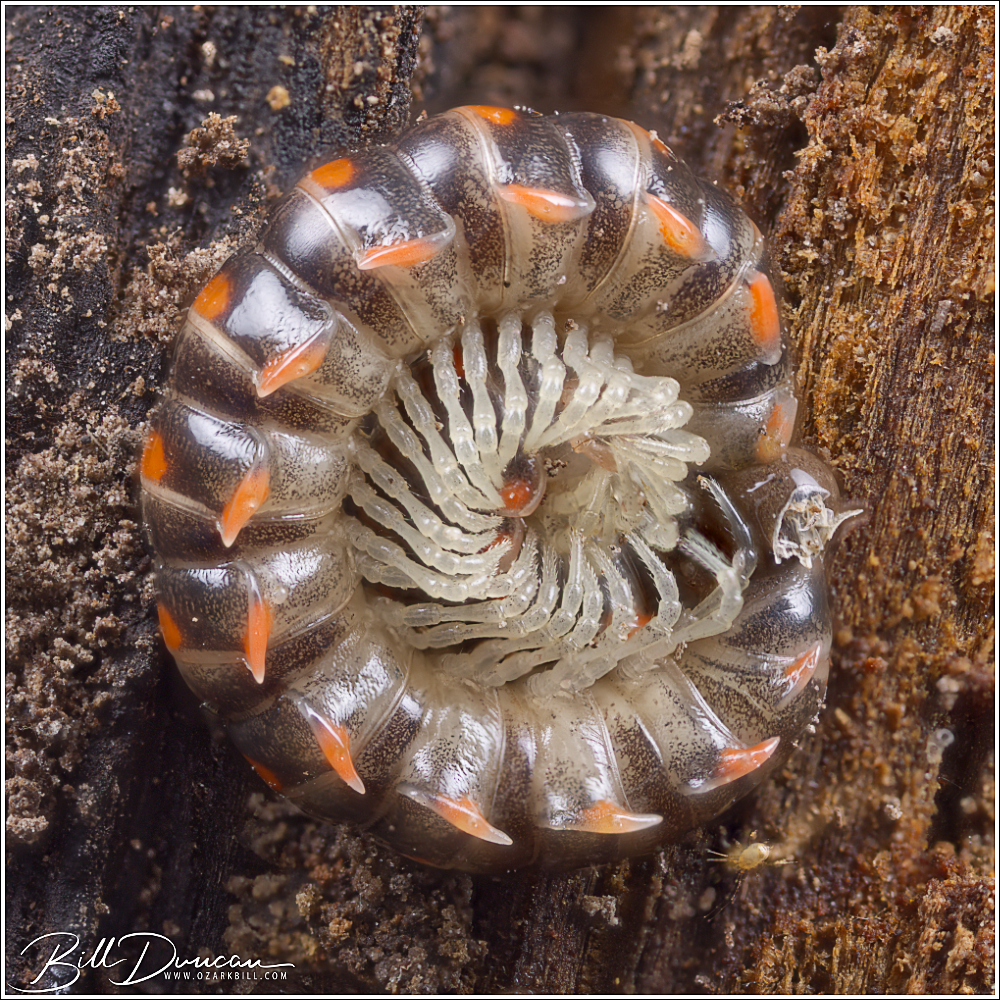
Among the more common organisms we encountered were the flat-backed millipedes (Euryurus spp.). Since I was using the Canon mp-e 65mm 1x–5x, expecting much smaller subjects, I struggled with fitting many of these millipedes into frame. I gently encouraged this individual to curl up long enough to take this series of stacks.
One thing I quickly learned in trying this technique in-situ was that my equipment is not optimized for this type of work. Although I am very happy with my twin flash and its multiple layers of diffusion, the main diffuser and the bracket that holds the flashes to the end of the lens were often getting in the way. At high magnifications, I need to get very close to the subject. In nearly every situation in working with subjects on the undersides of fallen logs, I found that the diffuser, the bracket, or both were impeding my ability to get close enough or to cover the distance I needed to move while taking the photos that comprised the stack. I often found myself removing the main diffuser to get around this problem, which then led to less optimal lighting for the scene.
After returning from the field, I gave this technique a quick try with my Godox v860iii speedlight and homemade diffuser. I found this worked great and gave me very fast flash recycling times (faster than my twin light). However, with the “zoom” movement of the end of the MP-E 65 mm lens when changing magnification, this will be very cumbersome to use in the field. So, Sarah gave me an early Christmas present, and I have ordered the AK diffuser for my particular camera/lens/flash setup. Theoretically, this should give me optimal diffused light across the frame no matter what magnification I have the lens at while being much less of a pain to get the distances I need to be from my subjects. I’m keeping my fingers crossed that this will be the ultimate solution that I need to excel in this technique.
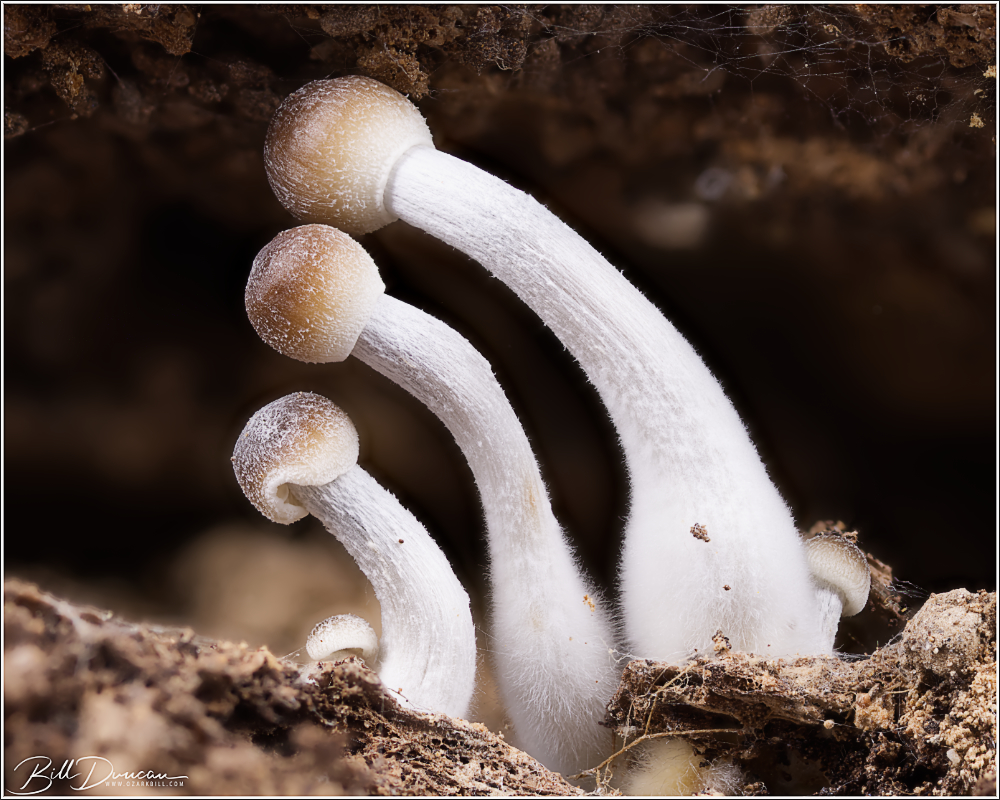
Probably my most successful stack of the day were of these tiny mushrooms. This was a relatively easy stack to conduct. They were in a position where my equipment was unobstructed and, unlike most of the arthropods, they did not move a bit!
An unexpected and pleasant discovery was finding three different kinds of caterpillars. Yes, finding caterpillars in the cold seasons is possible. Many moth and butterfly species spend the winter in the caterpillar stage, sheltering in leaf litter, beneath loose bark, or in other protected locations. A smaller number, including the deadwood borer moth (Scolecocampa liburna), actually live and feed within decaying wood.
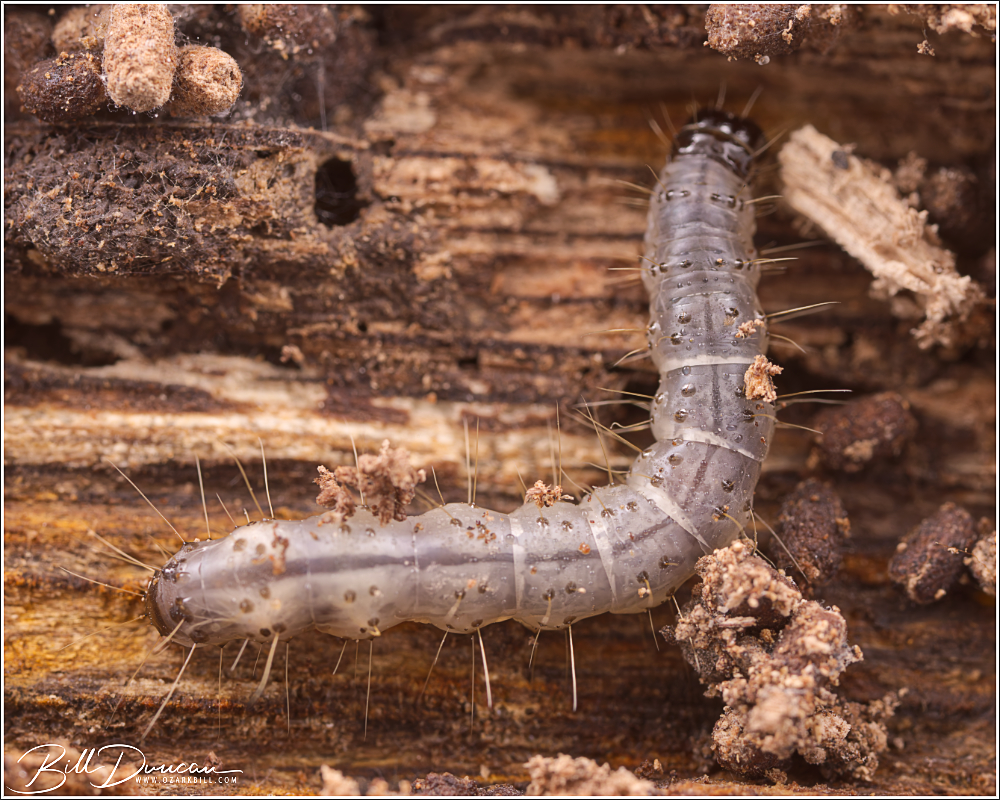
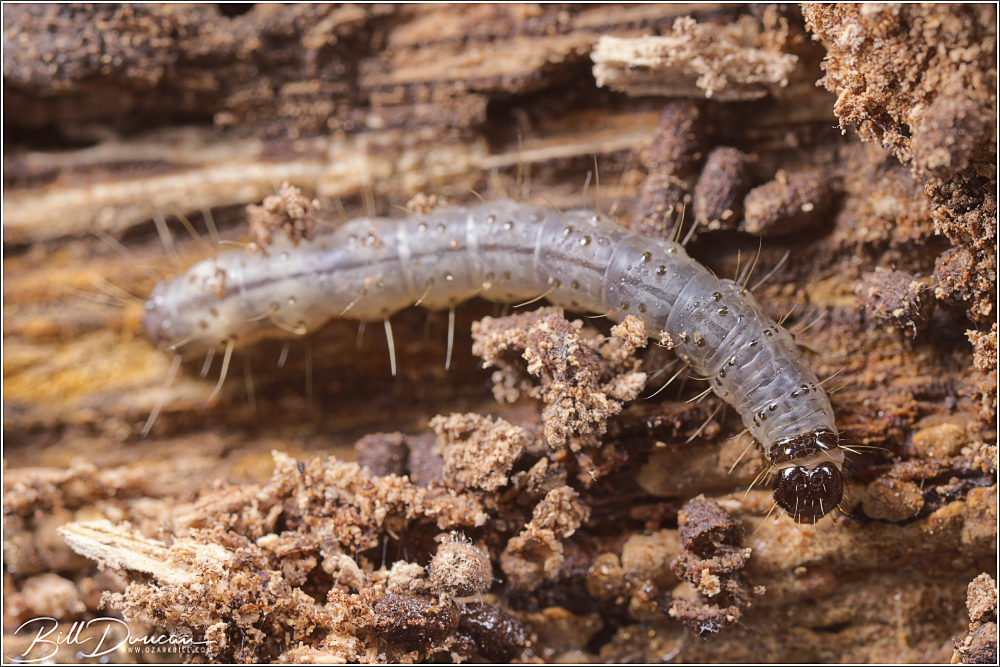
Scolecocampa liburna (deadwood borer moth) Erebidae. A rare example of a caterpillar that feeds on decaying wood rather than on live plant material! Canon EOS R5, Canon MP-E 65mm f/2.8 1–5× Macro, f/8, 1/200 sec., ISO 640, single image.
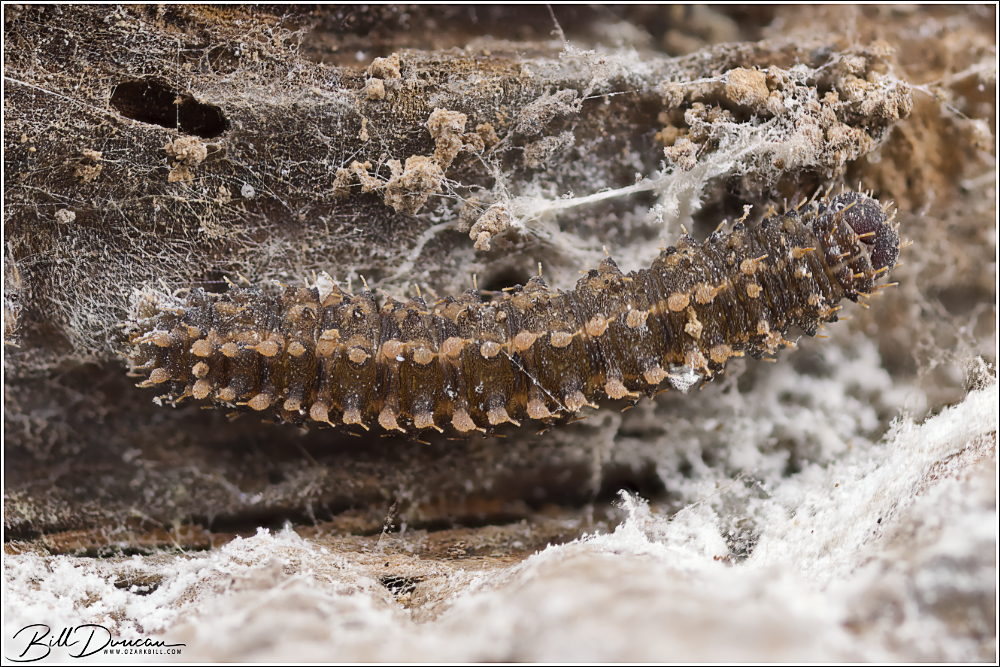
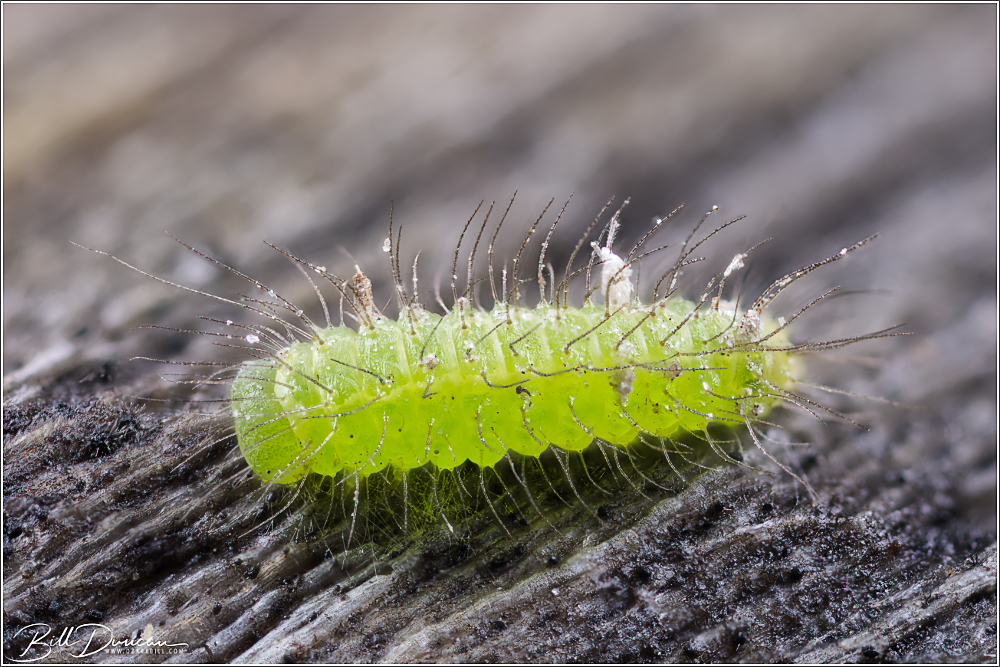
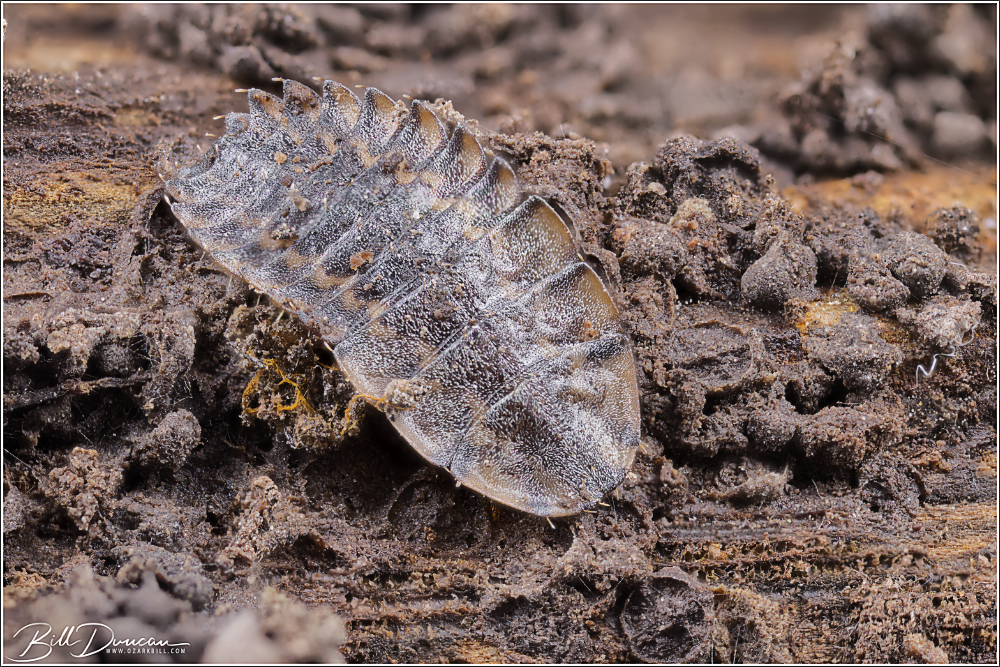
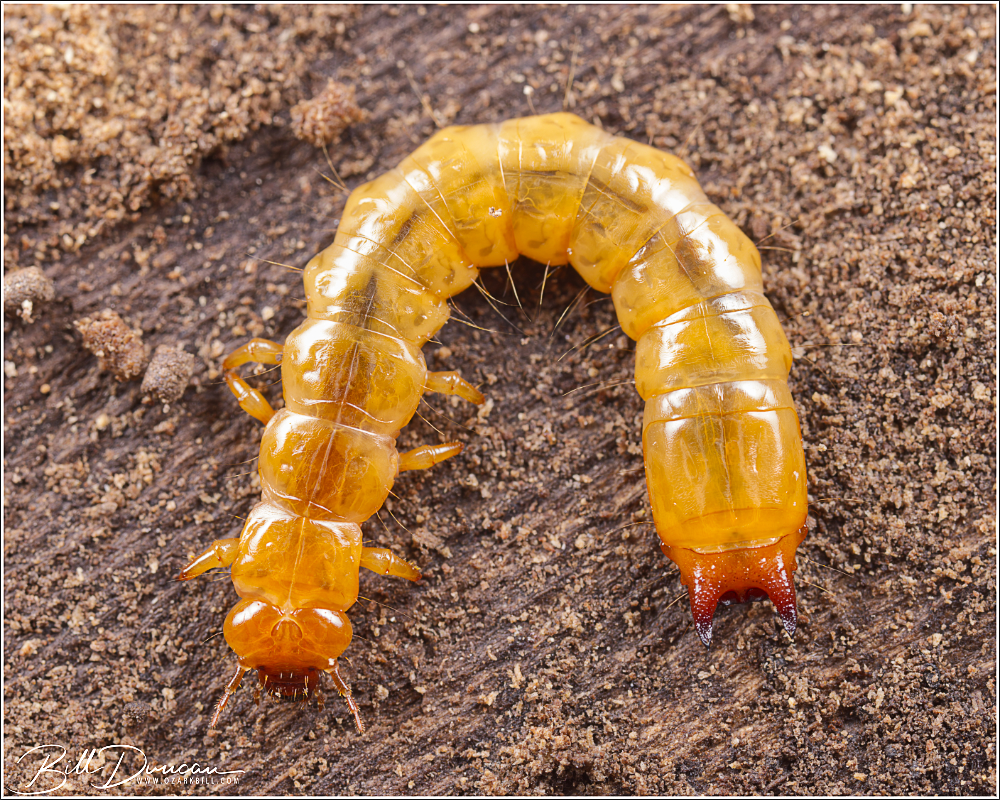
Of course, a day looking under fallen rotting logs would be incomplete without finding a number of beetles. We encountered several larvae of Dendroides, a genus of fire-colored beetles (Pyrochroidae) commonly associated with decaying wood.
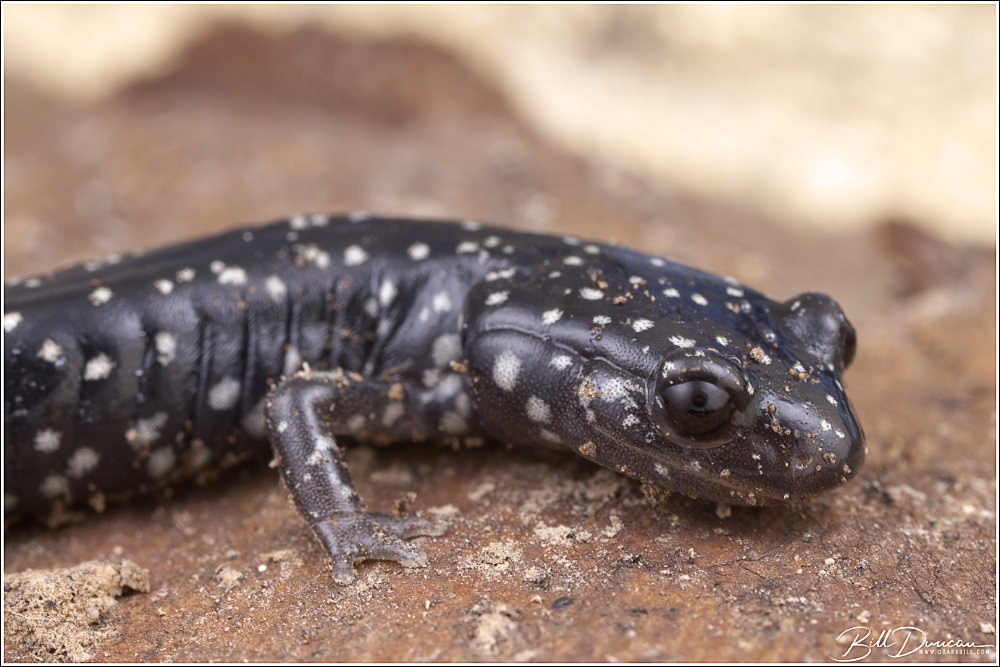
Another great benefit of looking under fallen wood is the chance at finding salamanders. Miguel and I found three of these western slimy salamanders (Plethodon albagula). With our more typical macro lenses back in the car, we were forced to use our high-magnification lenses to attempt some photography of these cuties.
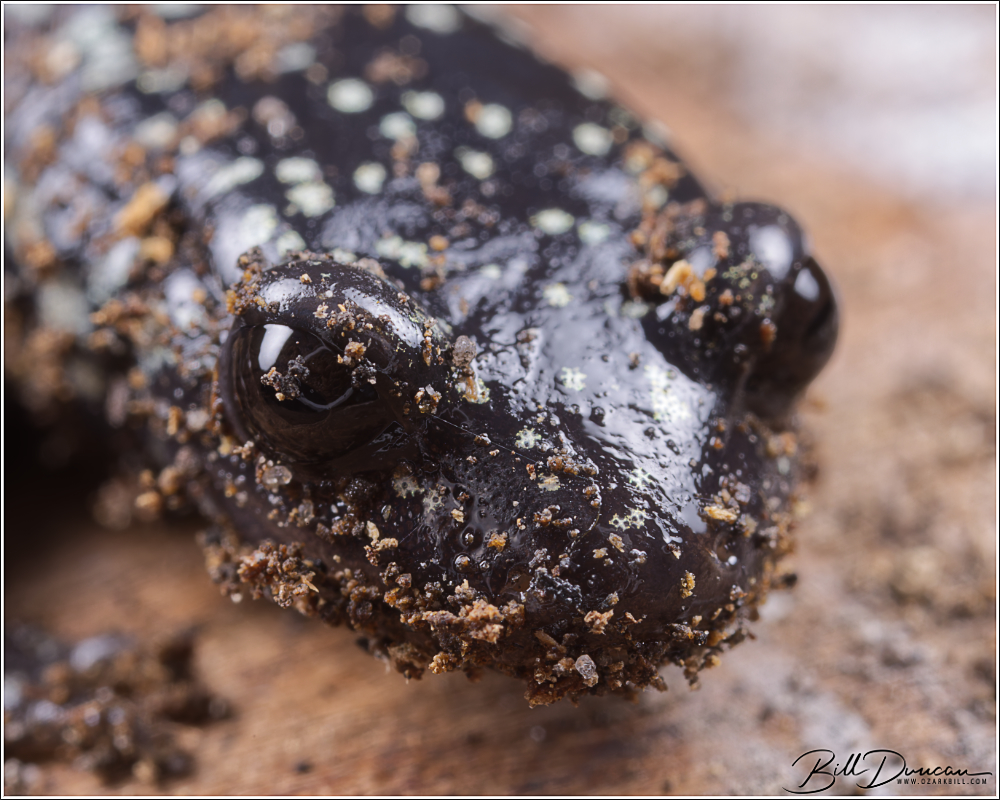
Although my first serious attempts at in-situ, high-magnification handheld focus stacking were far from perfect, I came away encouraged by the possibilities. With a few equipment adjustments, a good deal more practice, and some improvement in my ability to locate suitable subjects, I think this technique will become a valuable addition to my photographic toolbox.
Perhaps just as importantly, this outing reminded me how much life can be found in Missouri’s forests, even in November. Beneath fallen logs and loose bark, an extraordinary variety of organisms continues to go about its business, largely unnoticed by those of us passing overhead. I look forward to spending more time exploring this miniature world and, hopefully, bringing some of its inhabitants into sharper focus.
Thanks for the visit!
-OZB


Remarkable work on this, Bill. I think you’ve made significant progress on this first trial run.