"What a thousand acres of Silphiums looked like when they tickled the bellies of the buffalo is a question never again to be answered, and perhaps not even asked." -Aldo Leopold
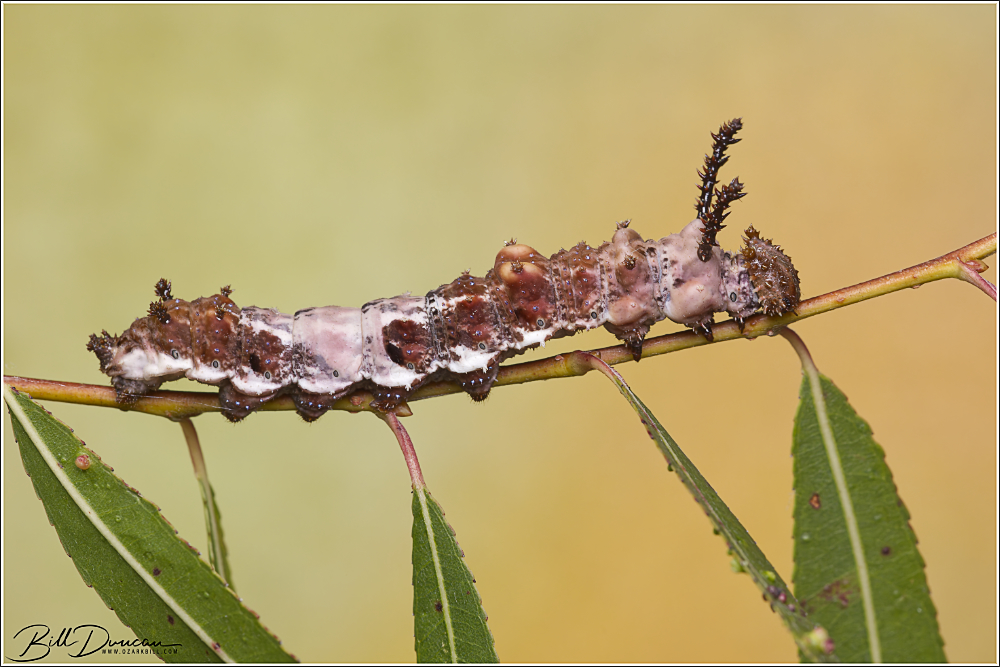
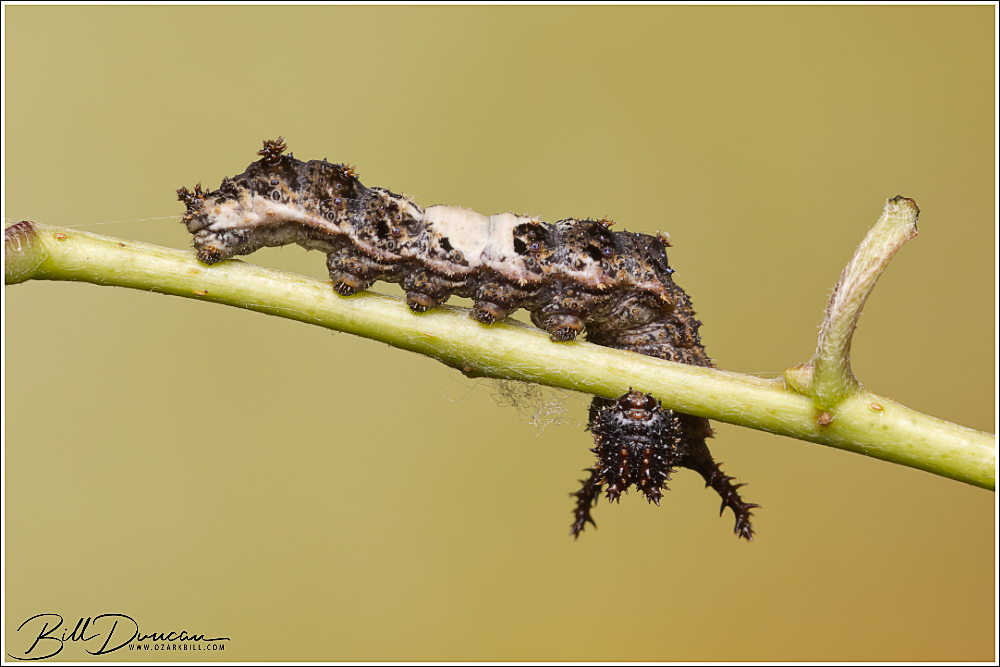
Viceroy Limenitis archippus fam. Nymphalidae (Hodges#4523) Host plant(s): Found on willow (Salix sp.) Date(s) and location(s): 15 September, 2025 – Creve Coeur Lake Park, St. Louis County, MO; 16 September, 2025 – Johnson’s Shut-ins State Park, Reynolds County, MO Notes: This species is visually similar to another bird dropping mimic, the closely related red-spotted purple (Limenitis arthemis). Although phenotypic characteristics can be used to verify, host plants should be the primary resource used. In Missouri, the viceroy will almost always be found on willow, while the red-spotted purple is most likely to be the caterpillar on black cherry.
Hackberry Emperor Asterocampa celtis fam. Nymphalidae (Hodges#4557) Host plant(s): Found on hackberry (Celtis occidentalis) Date(s) and location(s): 31 August, 2025 – Tyson Research Center, St. Louis County, MO Notes: This species is generally considered as bivoltine, meaning there are two broods per season. The second generation overwinters as caterpillars. Third-instar caterpillars climb down their trees to spend the winter hidden in hibernacula (leaf shelters) that they create among the leaf litter. The following spring they climb back to the treetops to complete their lifecycle with the newly emerged leaves.
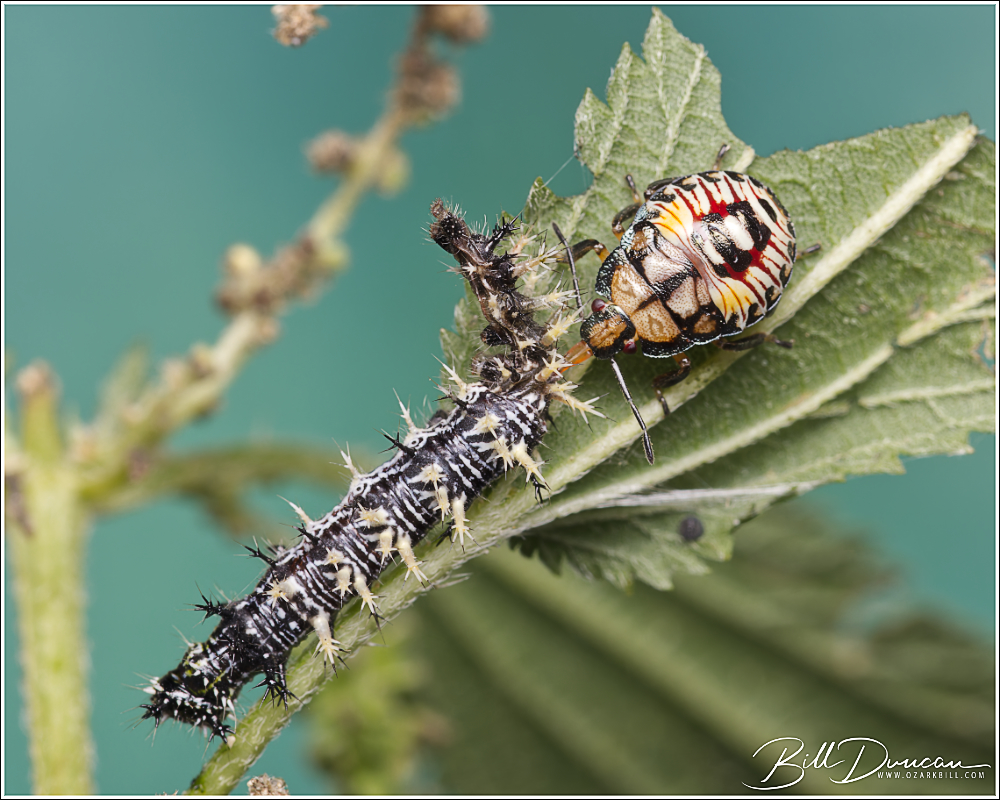
Comma Polygonia c-album fam. Nymphalidae (Hodges#4421) Host plant(s): nettle (Urtica sp.) Date(s) and location(s): 17 Sep, 2025 – Little Creve Coeur Ecological Area, St. Louis County, MO Notes: This poor caterpillar has fallen prey to one of its many enemies, in this case a nymph of Podisus maculiventris (spined soldier bug).
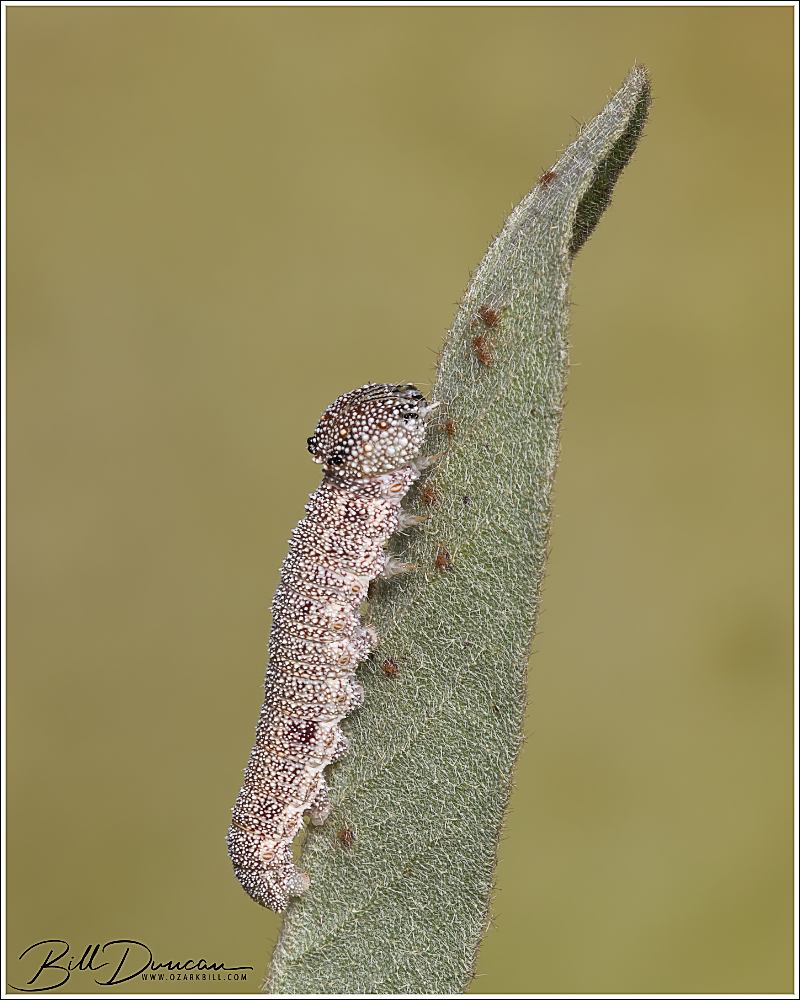
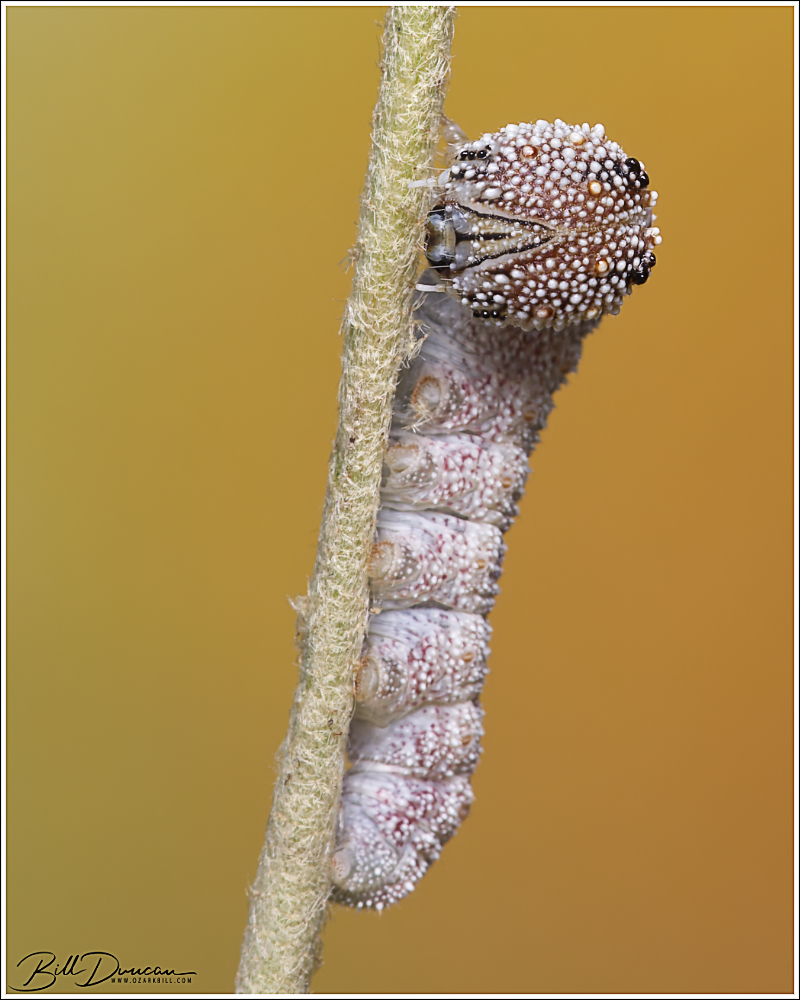
Goatweed Leafwing Anaea andria fam. Nymphalidae (Hodges#4554) Host plant(s): Found on prairie tea (Croton monanthogynus) Date(s) and location(s): 16 Sep, 2025 – Johnson’s Shut-Ins State Park, Reynolds County, MO Notes: Tonight I feature another target species that I had the good fortune of photographing this season. After finding a number of these caterpillars during a botany trip, Pete Kozich guided me back to the location several days later. Many thanks, Pete! We feared we may have been too late this season. Most of the host plants had severely senesced. But, after a hard search, we were able to find two larvae that had not yet pupated.
The goatweed leafwing is an extreme specialist, feeding only on members of the Croton genus. The apparent distribution of this species is something I find interesting and would love to find out more. I searched in several places this year that had an abundance of several Croton species but with no luck. Looking at the iNaturalist map shows this species to be most abundant in Texas, Oklahoma, Arkansas and Louisiana. They are regularly found in Missouri up to the Missouri River.
We also found a hairstreak caterpillar on the prairie tea. This is most likely a grey hairstreak (Strymon melinus).
Question Mark Polygonia interrogationis fam. Nymphalidae (Hodges#4420) Host plant: NA Date found: 16, Aug, 2025 Location found: Council Bluff Lake, Iron County, MO Notes: Two individuals found at this date and location. One was found on sassafras and the other on redbud. Typical hostplants include elm and hackberry. One individual pupated in contained overnight, further suggesting that both were pre-pupal and collected on plants during wandering. This was found during the WGNSS joint Entomology and Nature Photography Groups’ outing to Council Bluff Lake.
Red-spotted Purple Limenitis arthemisastyanax fam. Nymphalidae (Hodges#4522) Host plant: Found on black cherry (Prunus serotina) Date found: 02, Aug, 2025 Location found: Trail of Tears State Park, Lincoln County, MO Notes: Three caterpillars of this species were found at this date and location.
Here is another case of very similar caterpillars between two closely related species. The first clue to identity should be the host plant. In our region, Limenitis arthemisastyanax host primarily on black cherry (Prunus serotina), while Limenitis archippus (Viceroy) host primarily on willows (Salix sp.).
Caterpillars of L. arthemisastyanax are visually similar to those of , L. archippus although adults of these two species are very dissimilar. However, there are visual cues that can be used to tell them apart. Caterpillars of L. arthemisastyanax are generally less spiny, the humps over dorsum at A2 are larger and the “antlers” are more clubbed than the viceroy.
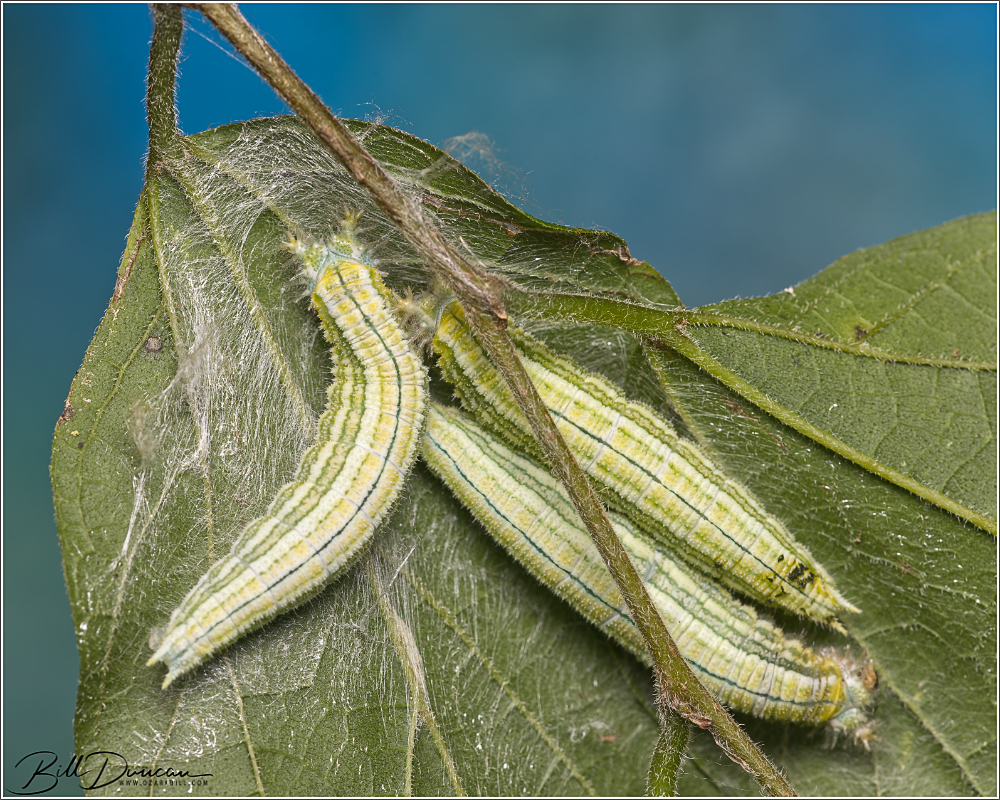
Tawny Emperor Asterocampa clyton fam. Nymphalidae (Hodges#4562.1) Host plant: Found on hackberry (Celtis occidentalis) Date found: 09, Aug, 2025 Location found: BK Leach Conservation Area, Lincoln County, MO Notes: Hackberry emperor (A. celtis) do not communally feed or house together in late instars as pictured here.
Silvery Checkerspot Chlosyne nycteis fam. Nymphalidae Host plant: yellow wingstem (Verbesina alternifolia) Dates found: 30, Jun, 2024 Locations Found: Young Conservation Area, Franklin County, MO Notes: This species overwinters as third instar caterpillars.
I was happy to final start working on getting some butterfly and skipper photos in 2023. I joined the local North American Butterfly Association and really enjoyed getting out on a few of their counts. I’m still learning the diurnal moths (butterflies) and have a ways to go before I can call myself competent. Here are a few photos from the Nymphalidae family to share from 2023.
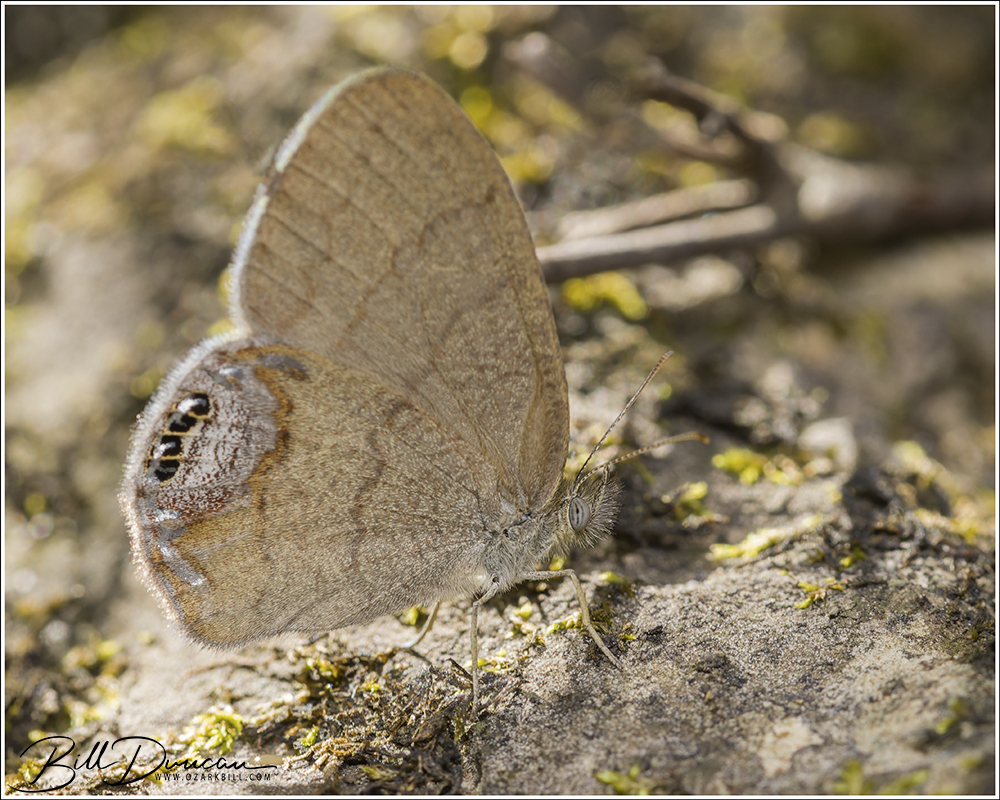
Gemmed Satyr (Cyllopsis gemma)
This gemmed satyr was an unexpected find while visiting St. Francois State Park in September. Not long ago this species was restricted to extreme southern Missouri. They now seem to be continuing a northern expansion in their range. Quite a few butterflies have eyespots that are found on different locations of their wings, presumably to make them look like much larger organisms as well as to persuade would-be predators to attack something beside the vulnerable true heads. I have recently read that some have hypothesized the spot on this species wings developed to mimic certain jumping spiders. In my photo I think this looks to be highly plausible – with the two primary eyes centered around a grey backdrop that looks very much like a jumping spider to me.
Viceroy (Limenitis archippus)
Once believed to be a pure example of Batesian mimicry in a complex with the monarch and queen butterflies, some evidence now suggests that the viceroy may be distasteful to predators, providing evidence that this is instead should be considered a case of Müllerian mimicry. This is turning out to be quite the complex case to understand, with some reports suggesting that the host plant that a particular individual viceroy was raised on determines whether or not it is distasteful. Other work has suggested that gene complexes that may differ between populations of viceroys determines distastefulness. More work is needed to determine what exactly is going on here. This photo was taken on a NABA walk ate Marais Temps Clair C.A. in September.
Red Admiral (Vanessa atalanta)
Photographed at Marais Temps Clair C.A. in early October, the red admiral is a lover of nettles, feeding solely on members of the Urticaceae family.
Painted Lady (Vanessa cardui)
Famous for its migration, the painted lady hosts on numerous species of Asteraceae.
American Lady (Vanessa virginiensis)
Being strictly found in the new-world, the American lady can be distinguished from the painted lady by the number of spots on the ventral sides of the hindwings. As seen in the photo above, the American lady has two large eyespots whereas its cousin, the painted lady, has four. Photographed at Horn’s Prairie Grove LWR in July.










 A Thousand Acres of Silphiums