An Early Hike on the Ozark Trail – Marble Creek Section

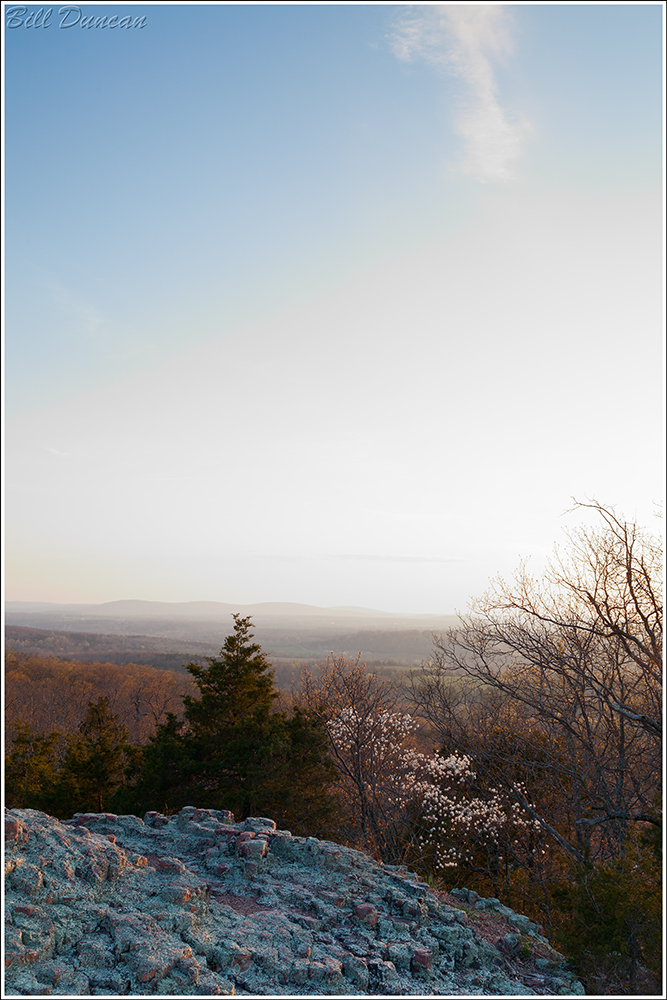
During my fall break I finally visited Crane Lake for a hike on a beautiful autumn morning.  There was not a cloud in the sky and the colors were really popping.  The hike was just perfect and I had several interesting wildlife encounters, including watching a Bald Eagle nearby along the shore as soon as I left my car.  The primary tree in this image is the short-leaf pine, the only native pine of the Missouri Ozarks and definitely a characteristic species of the St. Francois Mountains.

“An Early Hike on the Ozark Trail″
Technical details: Canon EOS 5D Mark II camera, EF17-40mm f/4L USM @ 17mm, ISO 160,  f/16, 0.6 sec

Mondays Are For The Birds – Red-shouldered Hawks

Although I still have quite a few images from this year’s nest in my “to process” list, this one may be my favorite pic for the year.  In this image the smallest chick, who was always the last to be fed, is looking up at mom and seeming to wonder where her share of the latest kill was.  Mom is taking a break after tearing apart and passing out the meat.  She has a look around before taking again to the wind to find more.  While watching the nest I was always excited to see this small one be able to swallow down a large piece of meat and I was always prompted to send the camera’s mirror flapping.

“Hungry Eyes”

Technical details: Canon EOS 7D camera,  EF400mm f/5.6L USM lens, ISO 400,  f/6.3, 1/160 sec

Defining Irony

Who or what is your favorite Halloween story or character from pop culture?  Many of us would say “The Exorcist” or give you the name, Freddy, Jason, Leatherface or Tammy Faye Bakker. Before you say another word, let me tell you what I did this Halloween evening.  I spent a little more than two hours in a dentist’s chair getting three fillings and a root canal.  “The horror!”  Actually, my dentist is great and much better than I deserve.  After spending the first 25 years of my life making candy, cookies and ice-cream the staple of my diet (no exaggeration, trust me) and exercising less than optimal dental care, I have been paying the price to the dentist for the past 12 years or so.  The thought of all those wonderful Halloweens coming back to haunt me in this way!  Ironic horror, or not ironic at all?

Take care of your teeth, kids.

Today’s photo is not really representative of autumn, but it is an example of something I’d prefer to be munching on these days and about as close to a Halloween image as I could come up with.  This sulfur shelf polypore is more commonly known as chicken of the woods.  It is so named due to a texture that is similar to that of chicken meat.  The one sample of this I took for eating was quite tough; most often the outer edges of the youngest leaves are most fit for eating.  I do look forward to trying this again with a more sophisticated recipe.  Unfortunately I had my bird equipment on this outing and this was as best an image I could make of it.

What is my favorite horror movie moment?  This Bill Murray character.  “I’m sure I need a long, slow root canal”

I’m going to go cry now…

“Sulfur Polypore”

Technical details: Canon EOS 7D camera,  EF400mm f/5.6L USM lens, ISO 1000,  f/5.6, 1/400 sec

The Dichotomy of Autumn

Is there more of a season with dramatic ups and downs than autumn?

Good: cooling temperatures that are often a respite to a long, torrid summer

Bad: the inevitable freezing temp, rains and gloomy weather that will show up sometime in November

Good: the astounding autumnal palette that the fortunate can find, depending on where you live

Bad: picking up those leaves and cleaning gutters after the show

Good: the backing of the clocks in losing “daylight savings”

Bad: going back to school

Good: feasts of the late summer/fall harvest season

Bad: knowing that in a month or two you’ll have better luck growing a second head than finding something worthwhile of being called a “tomato”

Good: apple season!!!!

Bad: end of the baseball season

I think I’ve made my point.  No other season is packed with so many highs and lows.  I’d be hard pressed to find many complaints about spring.  Even the most diehard winter fanatics must feel the hope and renewal that warming temperatures and fresh greens that spring in spring.  Autumn will always remain a season of two faces for me.  Now I can’t wait for the winter resident birds to show up!  Come on winter!

“Autumn’s Dichotomy″
Technical details: Canon EOS 5D Mark II camera, EF24-105mm f/4L IS USM @ 32mm, ISO 100,  f/16, 1/6 sec

Sunshine On My Shoulders Makes Me Happy

Hi everyone.  It’s an absolute gorgeous Saturday here in the northern Ozarks.  I hope the weather is to your liking wherever you are reading this.

This post is dedicated to my grandmother, Genny, who is currently recovering from a health crisis.  Sarah and I are so glad you are getting better and we wish you all the best in a speedy recovery.

Today’s post is a result of one of the magical times I spent recently at Ellis Island at Riverlands.  During an evening hike I noticed I was in the middle of a huge mayfly hatch.  There seemed to mayflys in the millions.  This rang the dinner bell for migrating passerines for miles around the confluence!  This was definitely one of the coolest bird experiences ever for me.  The bird pictured below, a Yellow Warbler, was one of near 50 of this species I came across.  Also in huge abundance were Black and White Warblers, Empidonax Flycatchers, Red-eyed Vireo and many others.  Thirteen total warblers, four vireos and a large handful of other species were all gorging on this insect feast.  The swarm, so thick the flies were perching on me, lasted until sunset and unfortunately I had limited opportunities for getting decent lighting for photographs.  That was frustrating, but being able to watch this natural wonder was reward enough.

This is one of those species that I’ll always remember the first time I found.  It was a springtime male perched on a dead branch singing his heart out and touched by the morning sun.  I never truly saw the color yellow until that morning!  The image bellow does that guy no justice.

Enjoy the weekend and remember, in Missouri, dove and teal are in season so hunters will be out there doing their thing.  There are places nature watchers and hunters use in close proximity, so be careful and considerate.

“Sunshine On My Shoulder”

Technical details: Canon EOS 7D camera,  EF400mm f/5.6L USM lens, ISO 400,  f/5.6, 1/800 sec

King’s Realm

In the field, the brief views I was fortunate enough to get suggested to me this was a Virginia Rail.  The Virginia is only about half the size of the King and this obvious difference should usually make the identification quite easy.  Unfortunately my brief, distant and mostly obscured view of this bird did not allow me to get a good estimate on the bird’s size.  Once back home with the photo and field guides open I began to doubt my original ID call.  I listed as many reasons to feel KIRA as VIRA.  I quickly realized I needed help and rushed the photo and my thoughts to the three wise men of the birding community I knew would love the challenge.  The single photo was less than the smoking gun I was hoping it was.  All three agreed it was most-likely a King Rail, but there is still room for doubt.  Although a photo of a Virginia Rail would have added a new species to my bird-photo-life-list it always makes me happy to find and watch a bird of conservation concern, as is the King.

You can see in this “bird in habitat” photo just the sort of habitat that rails and other waders need.  Rails love to be in water about up to their knees with plenty of vegetation to use for cover.  Most shorebirds like the mud, while larger waterfowl, obviously like a little more water.  Heron Pond at RMBS is being managed to provide the habitat these groups of birds need.  Check out a few images of young KIRA I took a while ago.

“King Rail”

Technical details: Canon EOS 7D camera,  EF400mm f/5.6L USM lens, ISO 640,  f/5.6, 1/400 sec

The Marsh Chicken

This post/photo is dedicated to Paul Bauer, master birder, bird photographer, and steward – a responsible agent in the development and management of Heron Pond and other features of Riverlands Migratory Bird Sanctuary.  Thank you, Paul, for leaving something worthwhile.

The Sora, or as I like to call them the Marsh Chicken is a small but quite abundant rail.  They definitely are one of the easier to view rails to be found during migration, but I found out how common they can be during a magical morning spent recently at my usual haunt at RMBS.  Arriving just before dawn I wandered the slow hike to a nice spot to watch the marsh of Heron Pond while waiting for the ol’ Sumatra brew to kick in.  I had the entire place to myself for most of the next two hours, standing still and counting the birds.  Besides being reminiscent of a chicken, I think Pete Dunn’s description of their bill as “candy-corn-shaped” to be quite fitting and a good field mark for identification.  These guys are often vocal and at certain times of the year their whinny-type calls and grunts can be heard all day long.  Being a rail these guys are definitely timid and spend a good amount of time hidden within the vegetation.  However, I have found these guys to be much more willing to spend time on the open mud in search of food, making a run back to the greenery at the first sign of trouble.  My total count for this particular morning was 62 birds!  Looking around the pond it seems that you would not be able to run through the vegetation without kicking one of these guys with every step.  Standing relatively still allowed me to catch this guy in a photo probably no more than 15 feet from where I stood.

“Sora”

Technical details: Canon EOS 7D camera,  EF400mm f/5.6L USM lens, ISO 640,  f/5.6, 1/320 sec

As Noisy as a Mouse

More often heard than seen, this quite secretive wren rarely is found more than a few feet off the ground.  Like a mouse, these guys spend a great deal of time low in the tall grasses and sedge of wet meadows/prairies.  In July and August taking a walk in this type of habitat within their range will certainly guarantee you will hear their consistent staccato vocalizations as they work to define their small territories and keep rival males at bay.  Trying to lay the glass on these birds is much more difficult.  These guys rarely will respond to pishing, and if driven out of their particular patch of grass they will simply skirt above the grasses for a second or two before dropping back into the bush, yielding partial, unsatisfying glimpses at best.  To get this shot, I admit, I used a vocalization playback.  I played just a few bars and waited.  This guy was not happy with that!  He raced out of his hiding whole and began singing forcefully in attempt to send the potential usurper out of his territory.  I was happy with the few quick bursts of the shutter I was able to get and that was that.  He may have been a bit stressed, but I bet the burst of testosterone he received from successfully defending his kingdom more than made up for it.

“Sedge Wren”

Technical details: Canon EOS 7D camera,  EF400mm f/5.6L USM lens, ISO 400,  f/5.6, 1/1250 sec

Kid ‘n Play

This image is from a series I took early this summer at Colombia Bottom Conservation Area.  These two dancing birds were among a large group of Great Egrets competing for standing room only space in a shrinking pool that was loaded with fish.  These moves reminded me of the dancing and rhyming styles of that old hip hop dynamic duo of my youth, Kid ‘n Play.  If I ever get around to processing all the keepers from this series, you will definitely not want to miss the shot I took of the bird I was able to get to wear a “Kid wig”.  😉

Ain’t Gonna Hurt Nobody… We Just Dancin’ Ya’ll!

“Kid ‘n Play”

Technical details: Canon EOS 7D camera,  EF400mm f/5.6L USM lens, ISO 640,  f/5.6, 1/400 sec

Touched by the Sun

These glade coneflowers, Echinacea simulata, were found in peak bloom during a May hike at Valley View Glades Natural Area.  Pollen color separates this species from the near identical and more widespread pale coneflower, E. pallida, but some differences in growth habit can be seen as well.  Some species of Echinacea are considered threatened or endangered and loss of habitat and the removal of these plants by non-licensed hunters for the pharmaceutical trade are the primary threats.  There can often be found signs of plant harvesting and rock turning (looking for reptiles and arachnids for the pet trade) at this location and nearby Victoria Glad N.A.  It’s a pity that more cannot be done to protect these ever-shrinking habitats.

“Touched by the Sun″
Technical details: Canon EOS 5D Mark II camera, EF17-40mm f/4L USM lens @ 19mm, ISO 400,  f/18, 1/13 sec