"What a thousand acres of Silphiums looked like when they tickled the bellies of the buffalo is a question never again to be answered, and perhaps not even asked." -Aldo Leopold
Black Skimmer, Pea Island National Wildlife Refuge, N.C., USA.
Going to the archives to try and wrap up 2019, I want to share a few more birds taken in eastern North Carolina.
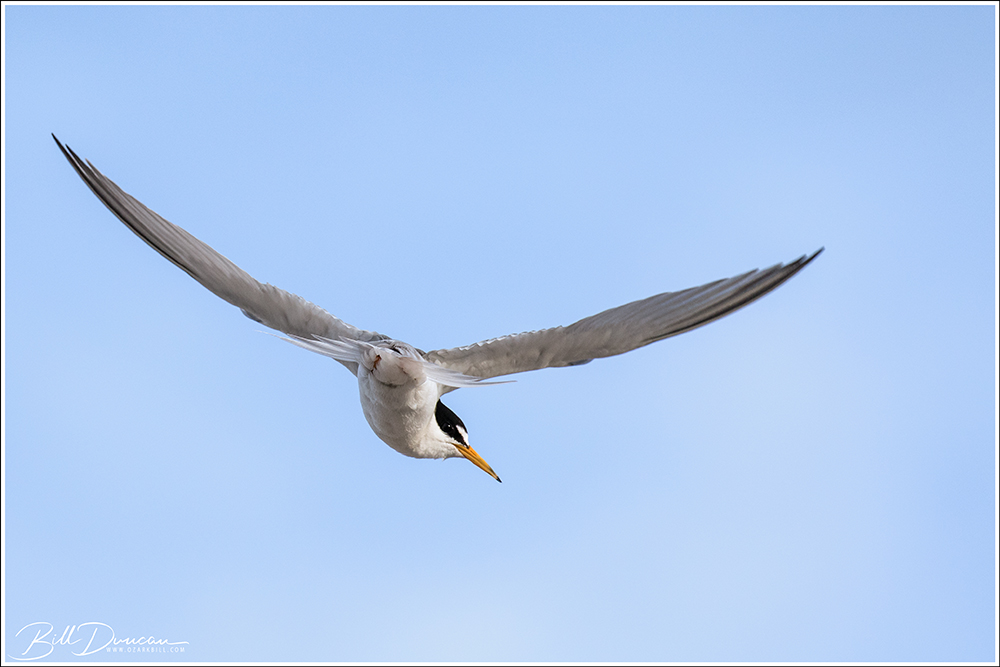
Least Tern, Pea Island National Wildlife Refuge, N.C., USA.
For me, the highlight of visiting Pea Island National Wildlife Refuge was visiting the Least Tern nesting colony. They put up a barricade to make sure you do not get to close to the nests and chicks, but it soon became obvious that the birds do a pretty good job at dissuading anyone from getting too close.
Least Tern dive-bombing the photographer. Pea Island National Wildlife Refuge, N.C., USA.
It was terrifying watching these birds react defensively, strafing and defecating until I moved back to a point they felt comfortable with. I remember I still had some of their ammunition on my camera body for at least six months before finally cleaning it off.
Least Tern, Pea Island National Wildlife Refuge, N.C., USA.Least Tern with fish, Pea Island National Wildlife Refuge, N.C., USA.
You have to look really close towards the center of their nesting arena to spot the chicks – the reason for their territorial behaviors.
Can you spot the Least Tern chick? Pea Island National Wildlife Refuge, N.C., USA.
During a walk along the interior, marsh portion of the refuge, this beautiful Common Tern flew by.
Common Tern, Pea Island National Wildlife Refuge, N.C., USA.
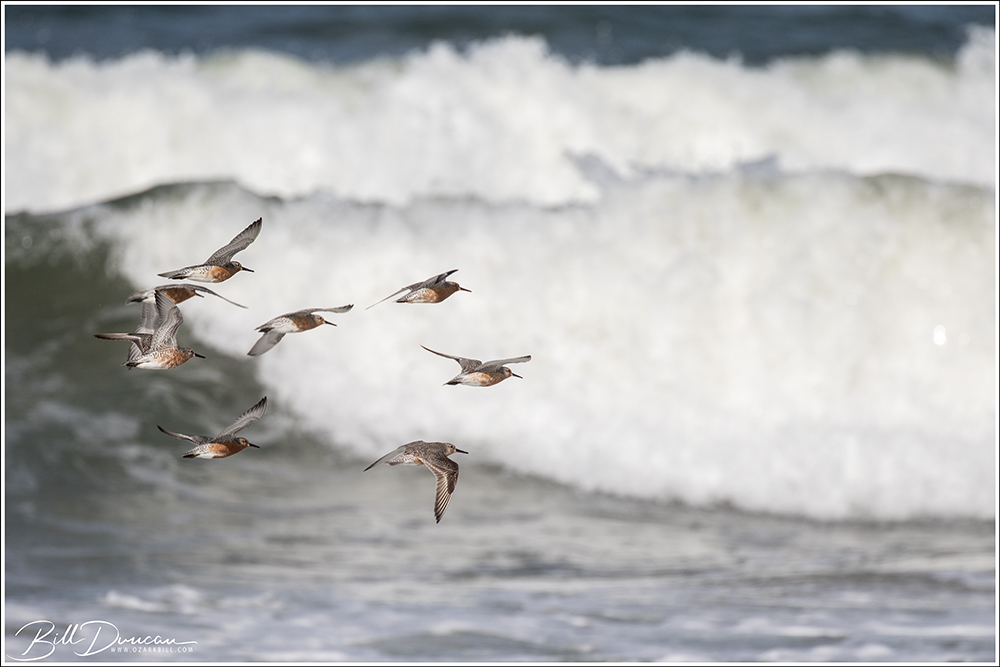
A real treat were my first looks and photographs of Red Knot.
Red Knot, Pea Island National Wildlife Refuge, N.C., USA.
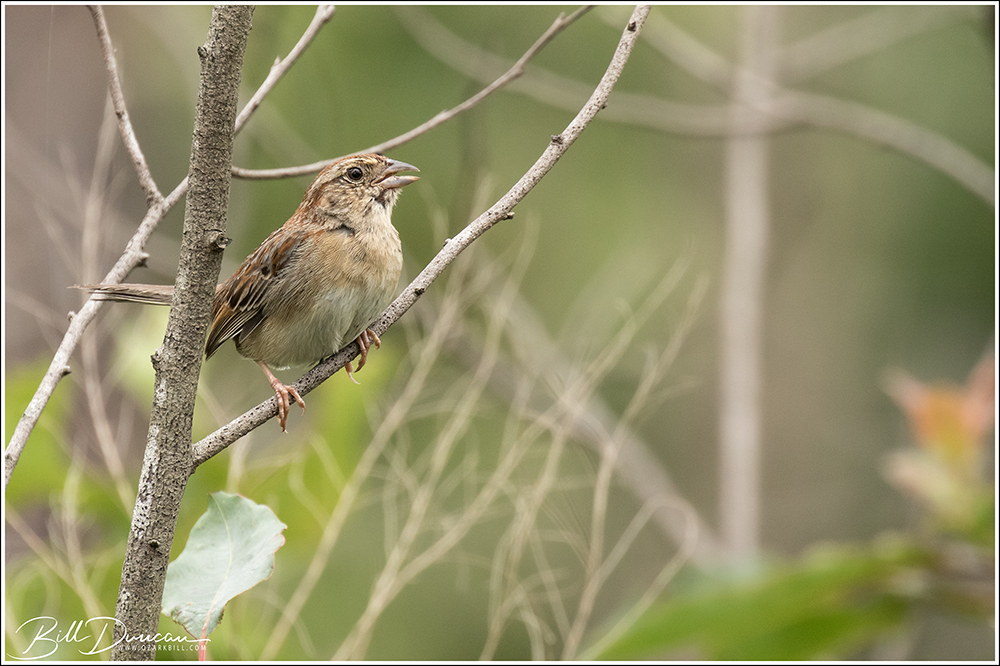
During the same trip, I was fortunate to visit a nice longleaf pine forest habitat at TNC’s Calloway Forest Preserve in Hoke County, NC. Here, along with the Red-cockaded Woodpecker, I got to find one of my southern favorites, the Bachman’s Sparrow.
Great Blue Skimmer (Libellula vibrans) found at Sand Pond Conservation Area in Ripley County, MO.
A few weeks ago Ev, Yvonne, Dave and I traveled south to try and find the first state record of the Brown Booby that was on the Current River just outside of Doniphan. Unfortunately, we were a day late and missed the bird. However, through the patient and educated eyes of Yvonne, we found several insects that made the trip worthwhile.
A head-on look at a Great Blue Skimmer (Libellula vibrans)
One of these that I was able to get some photos of was this striking great blue skimmer (Libellula vibrans). This is one of the largest of the skimmers and while not necessarily rare, it isn’t one you’ll come across very often in the St. Louis area.
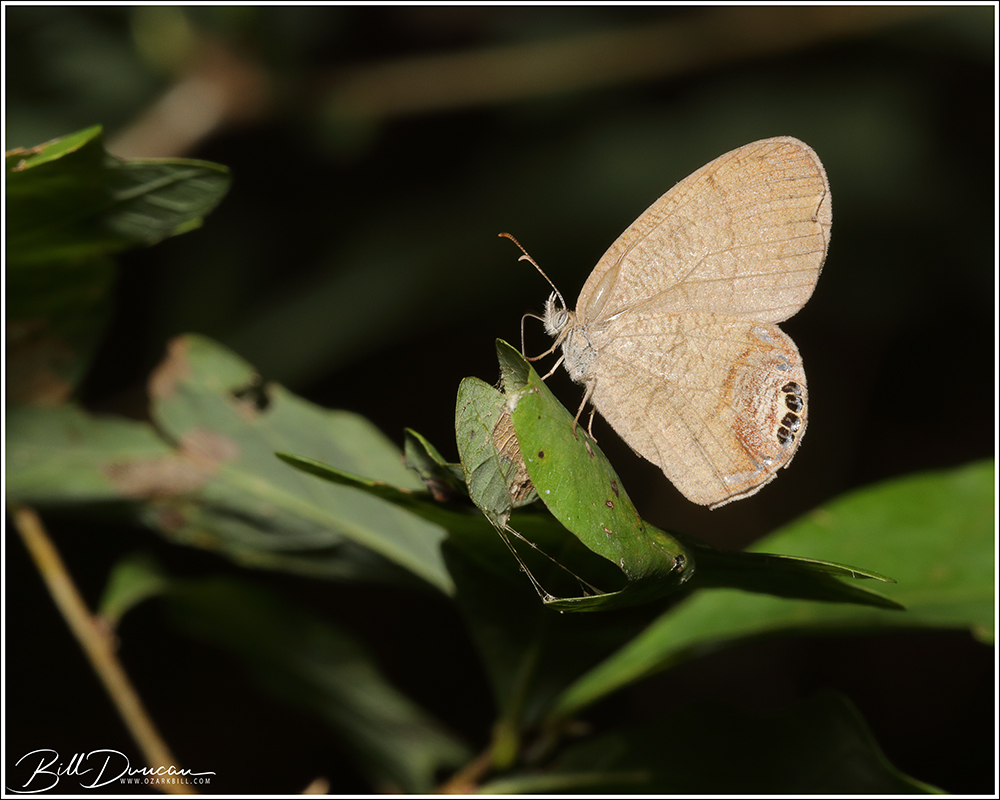
The Gemmed Satyr (Cyllopsis gemma)
We made a stop in Carter County before heading home to look for orchids. The orchids were a no-show, but Yvonne found her target species of the day – this gemmed satyr (Cyllopsis gemma) that we all had nice looks and photo opportunities with.
Although we missed out on our prized Booby, I’d say the Booby Prizes were well worth our time.
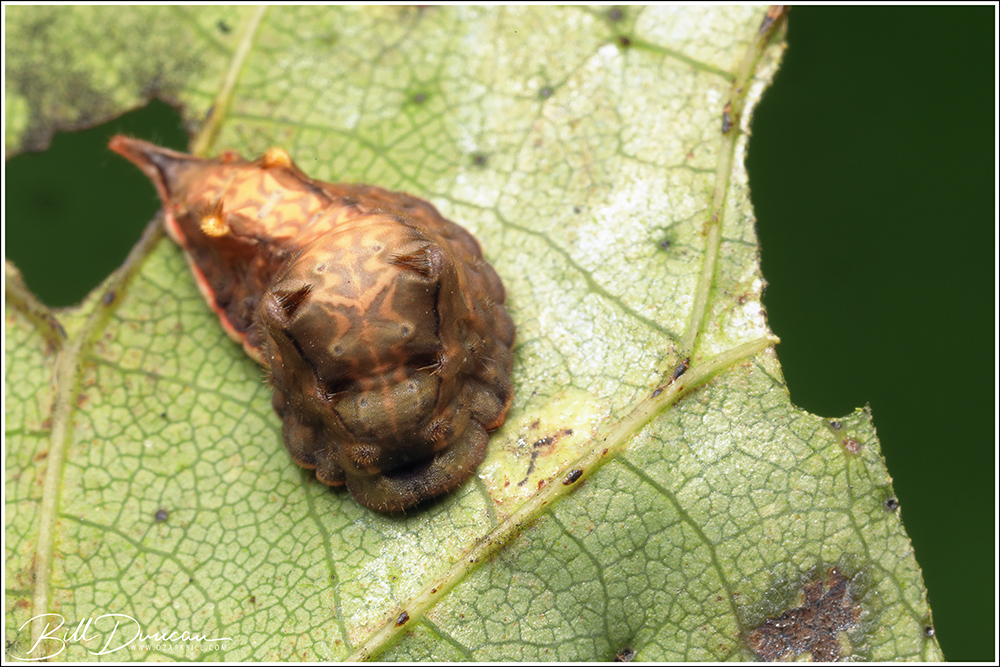
Spun Glass Slug Moth (Isochaetes beutenmuelleri). This animal is likely not in its last instar and should have even larger arms before its ultimate diapause.
Maybe I owe those of generation Y and the Millennials a bit of a silent apology. I too have been on a mission to ‘collecting them all.’ In my case, however, I think the objects of my search are far more brilliant, fascinating and mysterious than anything in the Pokemon universe could ever dream of being. For about the past four years, I have been occupied in late August to late September with finding all the slug moth caterpillars that can be found, or at least expected, in the state of Missouri.
Spun Glass Slug Moth (Isochaetes beutenmuelleri). This species, like most of the limacodids, are generalist feeders. The slug moths can be found on virtually any species of woody plant in Missouri.
Many thanks to Kyran Leeker for pointing me to a couple of hot spots she had found that contained some of the last species of slug moth caterpillar I needed to find and photograph – the spun glass slug moth, or Beutenmueller’s slug moth (Isochaetes beutenmuelleri). After hearing this, Sarah and I hit these locations soon after. My radar for these creatures was definitely in need of a re-calibration. I did not find a single slug moth caterpillar but Sarah found three, including this I. beutenmuelleri and two smaller parasa (Parasa chloris) – a species I had found before, but only had photographed with my cell phone. This was an exciting day indeed!
Spun Glass Slug Moth (Isochaetes beutenmuelleri). Sometime during late September to mid-October this little one will spin a cocoon and overwinter. In the spring it will then pupate into a non-feeding adult moth.
Although not as colorful or spiny as some of its more flamboyant relatives, the smaller parasa (Parasa chloris) is quite an interesting slug moth in its own right. Individuals can vary a lot in their patterns and are warmly toned with tans, oranges and pinks. I can’t get enough of looking at these guys.
Smaller parasa (Parasa chloris). Each of its humps is equipped with a few barbs that can inject an annoying, but not dangerous venom.Smaller parasa (Parasa chloris) with wood grain or marble-like pattern.Smaller parasa (Parasa chloris) with its head out of its protective hood.
Sarah found the following poor creature. Although you can’t help but feel sorry for it, I was glad to capture this natural history story. This little one was gregariously parasitized by approximately 15 braconid wasps, likely from the Microgastrinae subfamily.
Smaller parasa (Parasa chloris) parasitized by braconid wasps. Note the multiple stages of wasp development, from larvae that have completed their cocoons, to those still at work spinning their webs to larvae just emerging from their host. Their is no chance for the survival of this caterpillar.
These wasps were definitely in the process of preparing for their next stage of life. I have come across lots of caterpillars in the past that were parasitized by wasps like this, but always after the larvae had emerged and spun their cocoons and often after the wasps had cut the tops off and exited. This was very special indeed, finding them in this process. This was taking place much quicker than I had anticipated. It was plain to see the movement of the wasps and observe their progress. I had to take some video to capture this. I have sped the footage up by 1.5X to better showcase this activity.
Before I finish, I couldn’t help but think of one of my favorite Darwin quotes. Watching this footage a few times, I couldn’t help but agree with his reasoning.
In a letter to his friend and botanist, Asa Gray, Darwin wrote…
“With respect to the theological view of the question: This is always painful to me. I am bewildered. I had no intention to write atheistically, but I own that I cannot see as plainly as others do, and as I should wish to do, evidence of design and beneficence on all sides of us. There seems to me too much misery in the world. I cannot persuade myself that a beneficent and omnipotent God would have designedly created the Ichneumonidae with the express intention of their feeding within the living bodies of caterpillars …” -Charles Darwin
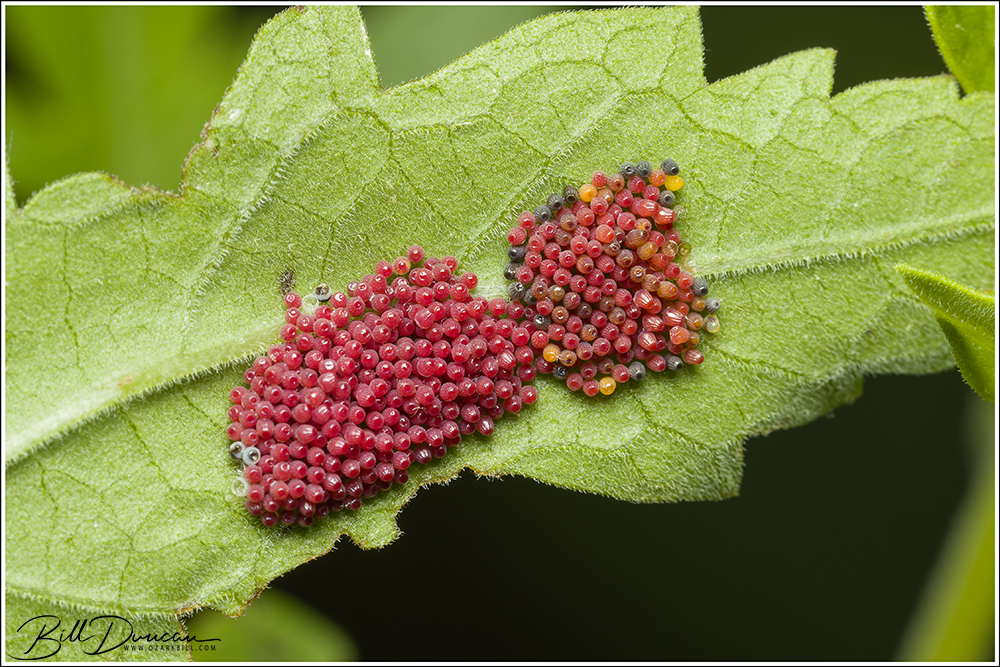
June 2023 Update In June of 2023, Casey, Pete, Miguel and I headed back to the same location in hopes of finding and photographing the adults of this species. Unfortunately, we were likely too late and could not find a single adult in flight. However, we looked over the site, looking closely at the Pedicularis canadensis to see if we might find females laying eggs. We had no luck with this and found no eggs nor larvae. Pete’s botanical eye did find a single Aureolaria grandiflora, where he found an egg mass. On closer inspection, I concluded that these were definitely butterfly eggs. A quick Google search confirmed that these were indeed checkerspot eggs! Now I need to photograph the beautiful adults and the absolutely stunning chrysalis of this species in order to capture every life stage of this fantastic creature.
Thinking on this further, on what has been described of this species (read more below), this makes perfect sense. We were not likely to find larvae on P. canadensis, nor find the females depositing eggs. Eggs are typically deposited on A. grandiflora, whereupon the larvae feed until the end of the season, moving on to finish this stage in the spring where the feed on P. canadensis.
Egg mass of Euphydryas phaeton ozarkae found on Aureolaria grandiflora
End of June 2023 update.
The Ozark Baltimore Checkerspot (Euphydryas phaeton ozarkae)
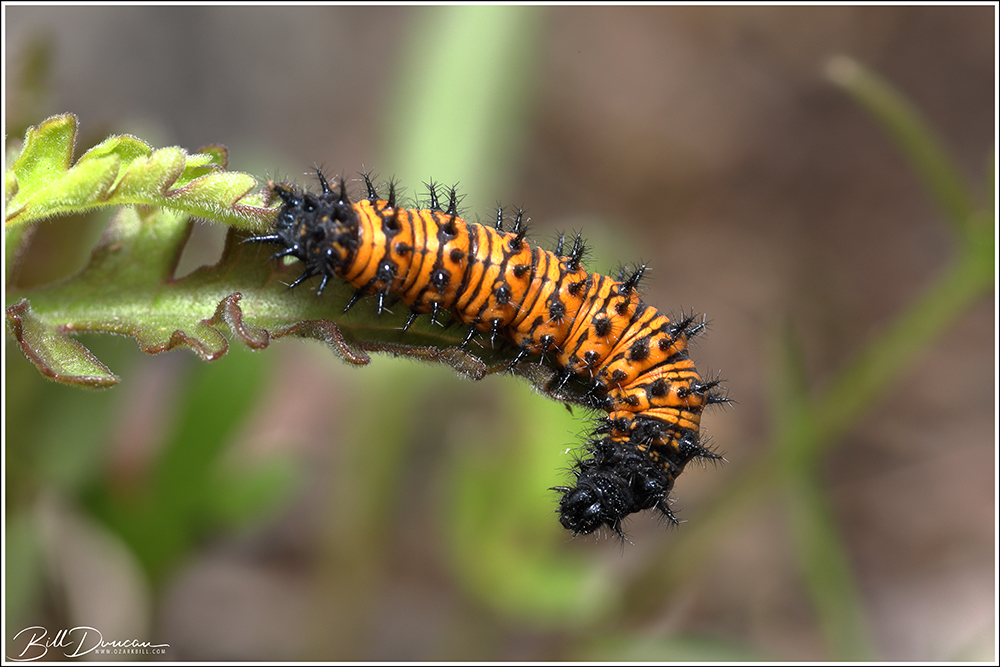
Early April, 2020, Casey and I head to the southwest corner of the state looking for multiple subjects. Our primary target of this trip was to check for caterpillars of a rare subspecies of the Baltimore Checkerspot (Euphydryas phaeton ozarkae). This subspecies occurs primarily in the Arkansas Ozarks, but can be found in extreme southern Missouri.
Does Euphydryas phaeton ozarkea deserve subspecies status?
The main distinction that separates this purported subspecies is habitat and host plant preference. The primary habitat for E. phaeton phaeton is marshy wetlands, while E. phaeton ozarkeaprefers oak woodlands. The primary host plant for E. phaeton phaeton are the turtleheads (Chelone sp.) while E. phaeton ozarkea primarily uses false foxglove (Aureolaria grandiflora). These animals will overwinter as caterpillars and then will often find new host plant species the following year – as shown in these photographs, they are using lousewort (Pedicularis canadensis). They will then pupate in May to June of their second year.
The Ozark Baltimore Checkerspot (Euphydryas phaeton ozarkae)
Browsing the literature, there seems to be some who question the legitimacy of the subspecific status of of E. phaeton ozarkae. Is this simply a case of an opportunistic generalist finding new ways to make a living in varying habitats, or is there a concrete genetic distinction between these two? From what I’ve been able to tell, there does not seem to be a consensus. If you are aware of any newer literature that might shed light here, please let me know.
March 2020 seems so long ago. Back at the beginning of the COVID 19 pandemic, when we were all getting used to social distancing, I remember watching this nest with a few other photographers. I only made it to the park on a few days and unfortunately did not cover much of the course of the two chicks’ development. But what little time I did have with them I managed to capture a lot of interesting behavior. I’m sorry if this one is a little long, but I had a hard time cutting things out. Scenes where mom and the chicks are looking horizontally or up and mom is giving her best defensive display was in response to a pair of Canada Geese that would sometimes buzz the nest, apparently interested in potentially taking over that prized knot hole for their own nest. Then there is another sinister enemy that I won’t spoil for you… 😉
I hope you will find this as entertaining as I do.
A bumblebee (Bombus sp.) barges its way into a Dutchman’s breeches (Dicentra cucullaria) flower for a nectar reward. Photographed at Beckemeier Conservation Area.
Just a few that I’ve processed that I wanted to share from this past spring.
A closeup of a fresh Prairie Trillium (Trillium recurvatum recurvatum) flower. Photographed at Beckemeier Conservation Area.
Did you know…? Trilliums are a favored spring food by white-tailed deer. An overabundance of deer, as is found across most of the eastern United States forests, can have detrimental impacts to trillium populations. In some regions these plants and many other plant species are extirpated from certain forests except within deer exclusion fences.
The enchanting Miami Mist (Phacelia purshii). Photographed at Englemann Woods Natural Area.
One of the first wildflowers that really caught my attention. Miami mist can often be found in large colonies. Unless you stop to take a close look, it may not be obvious what you are missing.
You have to be tiny to service the flowers of cutleaf toothwort (Dentaria laciniata), a task for which these diminutive sweat bees (Lasioglossum sp.) are perfect for. Photographed at Beckemeier Conservation Area.
Celandine poppy (Stylophorum diphyllum) photographed at Englemann Woods Natural Area.
I thought that celandine poppies were pretty common after visiting the large beds at Shaw Nature Reserve’s wildflower garden. I have now come to understand that they are generally pretty hard to find in Missouri forests. The name celandine comes from the Greek word for ‘swallow’, referring to the plant’s early blooming with the first arrival of the birds in spring.
During the most recent new moon, I finally took out my star tracker and kit to try my hand at photographing a deep sky object (DSO) for the first time. I knew this was going to be challenging and this first attempt would be more for learning than producing an image that I would be excited about. However, thankfully it was both – it was a beneficial experience in that I got practice in all the process surrounding making an image of this sort (I will go into details below), and at the same time the final image turned out better than I expected, especially considering the challenges I had. For those of you who don’t care about the process, you can stop reading here – I won’t blame you. For those of you interested, I will provide some of my notes and things learned. You can tell me if it was worth the hassle or not.
The Andromeda Galaxy (M31)
The Andromeda Galaxy is also known as Messier 31 and NGC 224. It is classified as a barred spiral galaxy and is about 2.5 million light-years from earth. It is the largest galaxy in our local galaxy group and is on a direct path to merge with our Milky Way in about 4.5 billion years.
Did you notice? In this image there is more than just the M31 galaxy. There are two other galaxies that move along with Andromeda. Messier 32 is on the bottom side of M31 at about four o’clock. M32 is a compact elliptical galaxy and is comprised of mostly older red and yellow stars that are densely packed. Messier 110 is above M31 in this image and is a dwarf elliptical galaxy. There apparently are at least 11 other satellite galaxies of M31, but none that are apparent in my image to my knowledge.
Collecting the data
For my first attempt, I traveled to the Astronomy Site at Broemmelsiek Park in Defiance, MO. This is an excellent place that provides several concrete platforms along with electrical access for those with equipment that needs it. I did not, but I was looking for an area not too far from our home to find as dark of skies as possible. The sky at this location (Bortle class 5) is darker than where we live (Bortle class 6) and is 25 minutes away. This is a pretty good site for viewing the night sky. I was really excited when I turned my birding scope at 60X power to Jupiter and was not only able to view the banding and colors of the planet, but could also make out four of its moons! However, there was still enough light pollution here to make serious astrophotography a bit of a challenge. Unfortunately, this was more of a challenge due to where M31 was located in the first half of the night. At this time of the year M31 rises from the NE sky and it was not until ~ 11:30 pm that the galaxy rose enough out of the skyglow of civilization to make me a little more comfortable.
For this attempt I was using a Canon 5d mk iv camera and a Canon 300 mm f/2.8 is mk i lens. I balanced this heavy kit on the Sky Watcher Star Adventurer Pro Pack star tracker. Because of the weight of this kit, I used an additional counterweight and bar to achieve balance. This is near the weight limit that this star tracker was designed to hold.
The first step in going about this is to get polar alignment with the celestial north pole. I won’t go into too much detail here, but I found this to be particularly problematic. After trying for 45 minutes I eventually decided I was “close enough” but definitely not at optimal alignment. Getting as close to perfect polar alignment is critical at longer focal lengths and exposure times in order to capture the stars as pinpoints of light. A big part of my problem here was working with the mounting “wedge” that comes with this tracker. I found it quite difficult to get the precise control that is necessary to align Polaris where it needs to be. I will eventually need to replace this wedge with one of higher quality.
After getting marginal polar alignment, my next step was to mount this rig, get it balanced and then point it at the target all while not moving the tripod at all! I am sure I moved it somewhat off the alignment that I managed to get. Because of the light pollution, I was unable to see M31 with my naked eye, which is possible under dark enough skies. This made locating M31 more challenging than I expected. With the help of star charts and astronomy apps on my phone, I eventually found it by taking shorter exposures with very high ISO to be able to compose close to how I wished. This probably took another 30 minutes.
With the mount polar aligned, the target in my sights and the tracker running, I was finally able to collect my data. My settings were as follows: 20 second exposure time, f4 and ISO 1600. A little explanation here is needed. With this tracker and kit, I could theoretically get between one and two minutes per exposure. However, with the imperfect polar alignment I knew I had and the fact this was my first attempt, I decided to go with a shorter exposure. For my aperture, I gave up a full stop of light. However, I was worried about how the stars looked fully open and decided at the last minute to close to f4 to gain a little in the IQ arena. I am not sure this was the best decision or not and will probably try wide-open next time..
I collected 265 “lights” before clouds, that were completely not predicted by all of my weather apps came in and closed me down for the night. Later I cut this down to 225 lights that were unaffected by clouds or airplane lights for a total exposure time of 1.25 hours. While in the field you are supposed to take “darks” – these are frames at the exact settings under the same environmental conditions but you throw your lens cap on. These images are then used by the computer programs to remove the digital noise that is produced during capture. Somehow I forgot to do this in the field and did not remember until I was slipping into bed at 3:00 am. So, I got out of bed and went outside to take them.
Processing the data
It may seem crazy looking at this image, but I spent around 12 hours processing this. Much of this time is due to me not being very familiar with what I was doing. I also prefer to process as manually as possible, and used no specialized plug-ins in Photoshop.
Prior to Photoshop, all of the data needs to be stacked in the computer by specialized software. I first tried to use Deep Sky Stacker (DSS) that I have used for this type of work before. However, I ran into problems. After loading all my lights and calibration frames the software refused to run and gave me typical ambiguous reasons. Doing some troubleshooting online it looks as though my data weren’t good enough – apparently my stars were not round or sharp enough and I could do nothing to get DSS to process my data. I then played around with a couple of other free astro-stacking softwares. Most of these were far too technical for me to easily learn them. I finally found Sequator and this worked great. It does not accept “bias” calibration frames, but I doubt that I could recognize their absence in the final product.
I then took the stacked image and went through the “stretching” process in Photoshop. This is where you increase the local contrasts, trying to bring out details in the arms of the galaxies, nebulosities, etc. There are a number of steps involved in this last bit of processing. Much of what I did I learned from Charles Braken’s book, The Deep-Sky Imaging Primer and YouTube videos from Nebula Photos, Peter Zelinka and others.
Conclusions and what I learned
I realize this type of image is built mostly by technology. There really is not much subjectivity when making images of deep-space objects. It either looks like the thing or it doesn’t. I also realize that there are people doing this that have much more appropriate equipment and knowledge and can produce a much better version of a DSO than I could no matter how much I practice. However, I have found it very rewarding to be able to produce an image of M31 myself, especially using camera equipment I already owned and use for other things.
Here are some things I believe I have learned and can potentially help me improve in my future attempts at making DSO images. If you are an experienced DSO imager and can offer any further suggestions, I would be very much appreciative!
Getting better polar alignment
Getting more practice should help here and I will try and do this on nights that I am not planning on shooting, potentially from my yard.
I have read and seen videos where people are suggesting upgrading the wedge mount and I will do this eventually.
Collecting more data
I believe I could pull more details from the galaxy’s disk, including colors by collecting more data. I was limited by clouds for this one, but next time I hope to get at least four hours. I know that some pool data collected from multiple nights, but that is another layer of complexity I probably do not need right now.
Finding darker skies
There is no doubt that skies with less light pollution will allow for better data collection at a faster rate. This will definitely help in pulling fine details and colors from DSO’s. There are light pollution filters, but I have heard mixed thoughts regarding their benefits.
Beware of dew
I knew this, but forgot to take the heating elements to wrap the lens barrel in order to prevent dew forming on the lens objective. Thankfully, the lens hood seemed to protect from this, but at the end of the night I did notice a thin haze of condensation on the lens.
Learn more on processing
There are numerous ways to skin this cat and I hope to learn more by watching more techniques on YouTube. With trial and error, I am certain that I can improve the final image by learning more here.
Other than the above, the only thing I can think of that would make a big difference is purchasing technology. People who really get into this use specialized telescopes, specially modified cameras, guided trackers run by computers, filters and much more. However, I do not intend to go down this road and believe I can produce images that will satisfy me with the equipment I already have.
If you have an interest in DSO photography and have the basic equipment, I urge you to give this a try. All you need is a camera and lens that is about 100 mm – 500 mm. A star tracker is definitely helpful but not required! You can shoot DSO’s with simply a tripod. Other than that you will need to learn just a few things on how to adjust the settings on your camera and where to point.
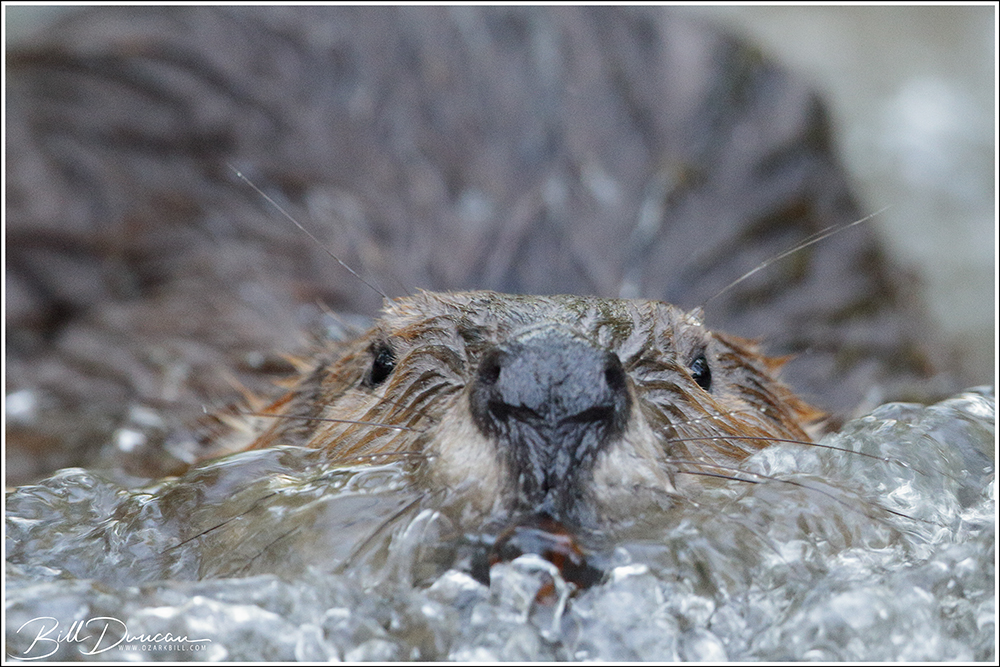
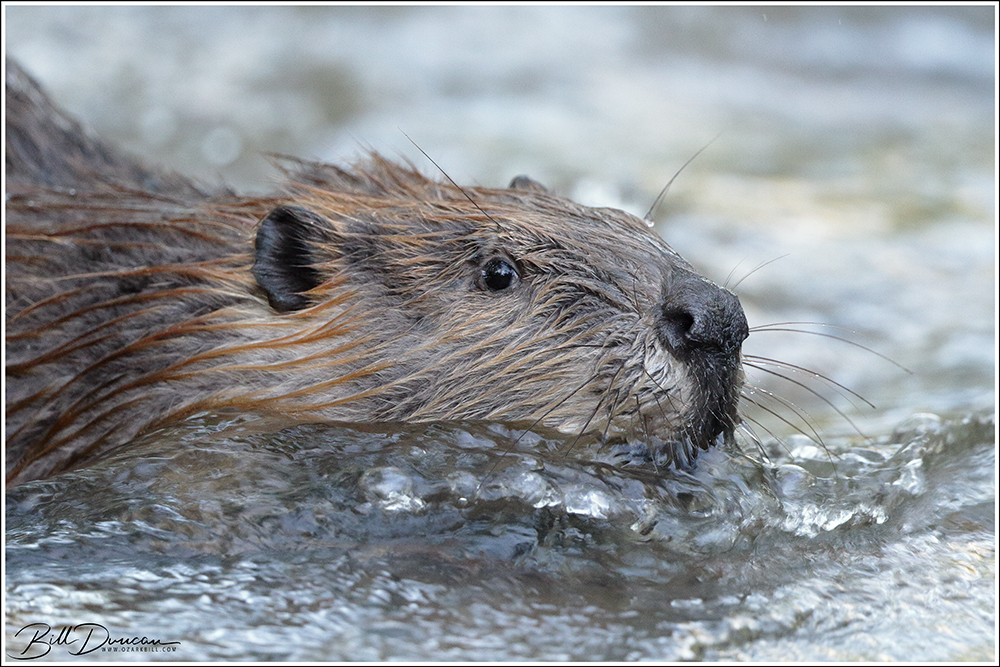
A North American beaver pushing its way upstream to get back to its den to spend the day.
Thought I was getting racy? These photos were taken at Weldon Springs CA this past spring when Dave, Miguel and I were hoping to score some photos of newly arriving birds. The birding was slow this day, if I remember correctly, but here is a fantastic example of why it is always worth while to get out as early as possible.
North American beaver (Castor canadensis)
While standing on a low-water crossing the guys and I noticed a mass coming upstream towards us. It didn’t take long to discover that a beaver was on its way and would have to get by us to reach its destination farther upstream. We all shot away with our long lenses until this guy got closer than our minimum focal distances. It hesitated a bit and hurried back downstream as Miguel moved to get in a different position, but eventually climbed up the crossing and moved to the other side. He was so close to us during its crossing that Dave could have potentially petted him if he had wanted to.
Striped Skunk (Mephitis mephitis)
This Stinkor was found in a nearby field later that same morning. The eyesight of both species is pretty awful. If you come across these guys, there is no need to be concerned. Simply move slowly and as silently as possible and you will likely have plenty of time to observe them without being noticed. I have had several close encounters with skunks and have never felt threatened with being sprayed.
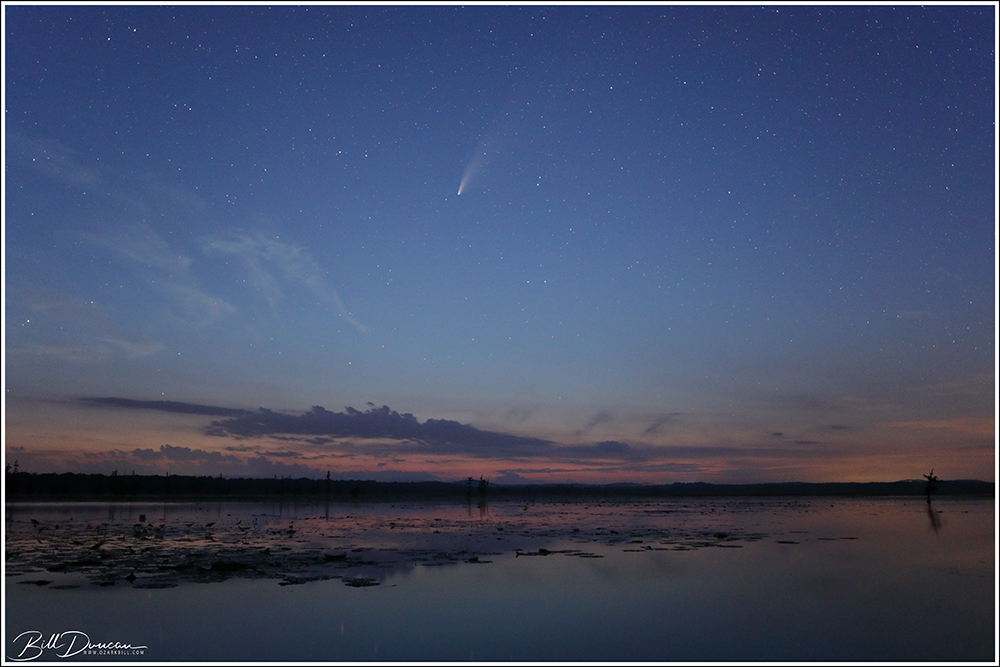
C/2020 F3 (NEOWISE) Comet in the northwest sky after sunset at Duck Creek C.A.
The NEOWISE Comet, whose actual name is C/2020 F3, was a pleasant surprise for the astronomical community who await such events as a newly discovered comet. First discovered in late March, the comet grew steadily brighter, eventually becoming the brightest comet to be seen in the northern hemisphere since Comet Hale-Bopp in 1997. According to the experts, this comet had an orbital period of about 4,400 years prior to making its latest trip through the inner solar system. It will now be another 6,700 years before beings on earth will be able to see it again.
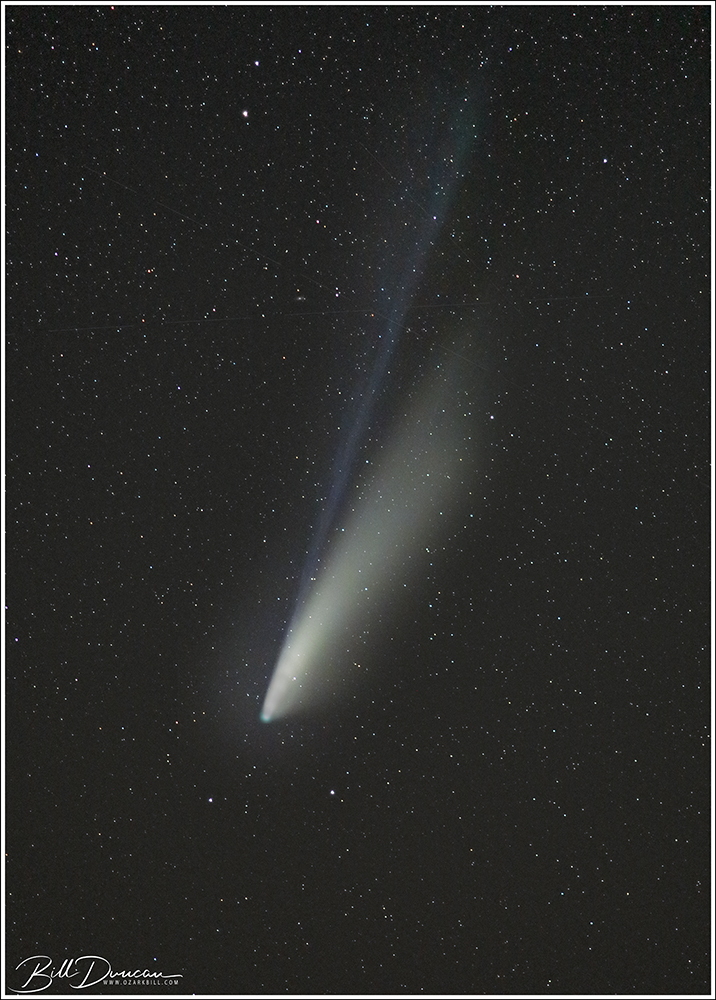
C/2020 F3 (NEOWISE) Comet image taken at 200 mm focal length
I have long had a very strong interest in astronomy and astrophotography and the current pandemic has allowed me to do quite a bit of studying on both topics. Hopefully soon I can get the practice in this area that I desperately need. Although it has some issues, I was relatively pleased at capturing the closeup of the comet pictured above.
Although I had a star-tracking mount that would have been perfect for this situation, I had not yet used it so I did not make this the first time. This image was “untracked” using a full-frame camera and a 200 mm lens. It is comprised of 20 “light” images (the actual photos of the comet) taken at 3.2 seconds per exposure. The aperture was f/2.8 and the ISO/gain was 6400. I combined these images with 10 “dark” frames for noise reduction purposes.
The processing here could be better and I might give it another try sometime. But, both tails of the comet are visible and I think the background stars came out alright as well.
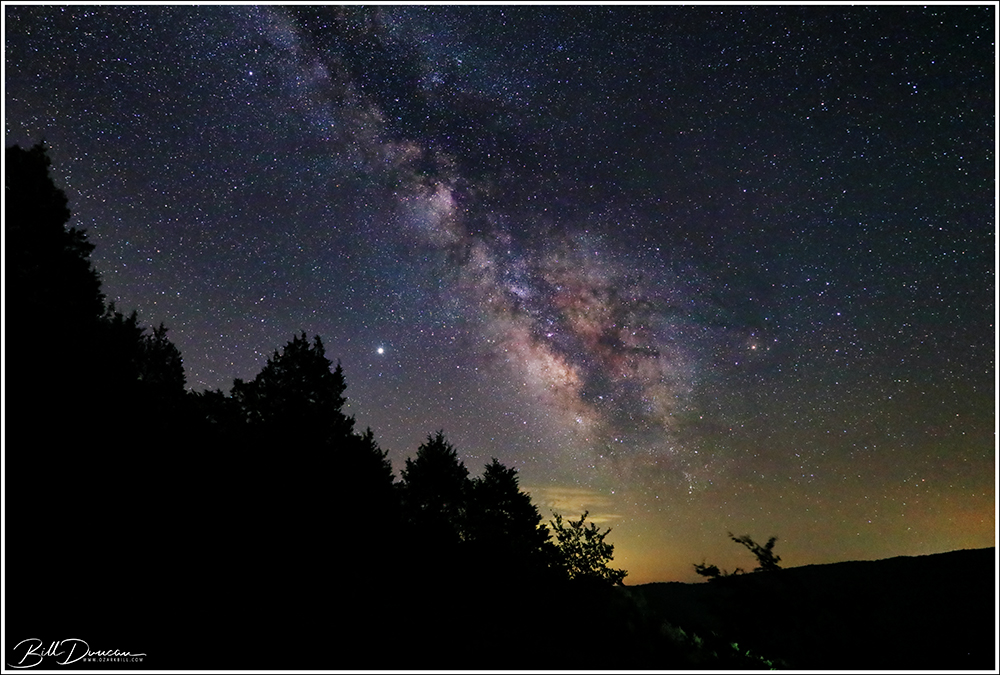
Milky Way at Lee’s Bluff, MO
After awhile the comet began to dive towards the horizon with the remnant glow from twilight. I happened to show up at Lee’s Bluff on the same night as accomplished Missouri nightscape photographer, Dan Zarlenga, and so we both turned our tripods around to the south and found this lovely scene. Here, the Milky Way has recently risen above a nice foreground of trees. Again, I wish I would have been a bit more prepared with a plan, but I guess this isn’t too bad.