"What a thousand acres of Silphiums looked like when they tickled the bellies of the buffalo is a question never again to be answered, and perhaps not even asked." -Aldo Leopold
Hummingbird Clearwing Hemaris thysbe fam. Sphingidae (Hodges#7853) Host plant: Found on nannyberry (Viburnum lentago) Date found: 23, Aug, 2025 Location found: Backyard of our subdivision home Notes: From what I’ve read and my minimal experience, this species’ caterpillars spend their days on the ground in the leaf litter and only come up to their host vegetation during the night. I found this one around midnight feeding on my nannyberry.
Edit – 21-Sep-25: I brought this guy in to rear on the back porch and on 16-September, I found the adult moth flying in the cage. After cooling it down a little to take some photos, I let it go into the backyard. See photos below.
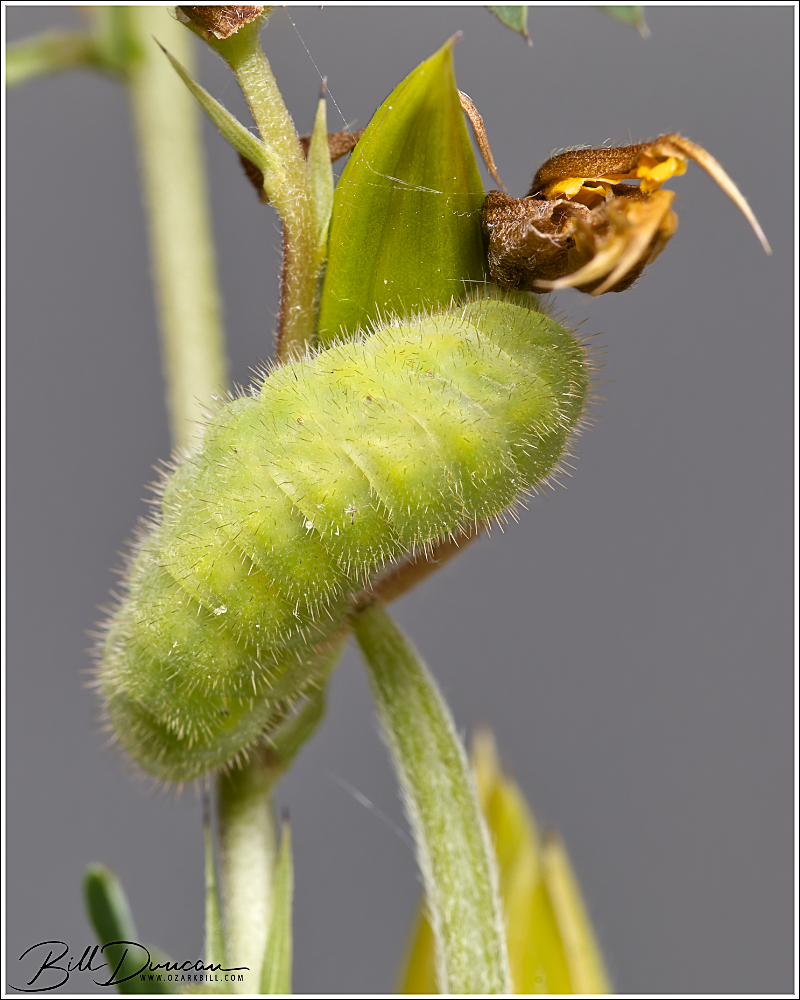
Gray Hairstreak Strymon melinus fam. Lycaenidae (Hodges#4336) Host plant: Found on partridge pea (Chamaecrista fasciculata) Date found: 07, Aug, 2025 Location found: Backyard prairie patch, St. Louis County, MO Notes: After years of searching for a hairstreak caterpillar, I found 11 of these guys in one evening while searching the backyard prairie with a UV flashlight. Plant partridge pea!
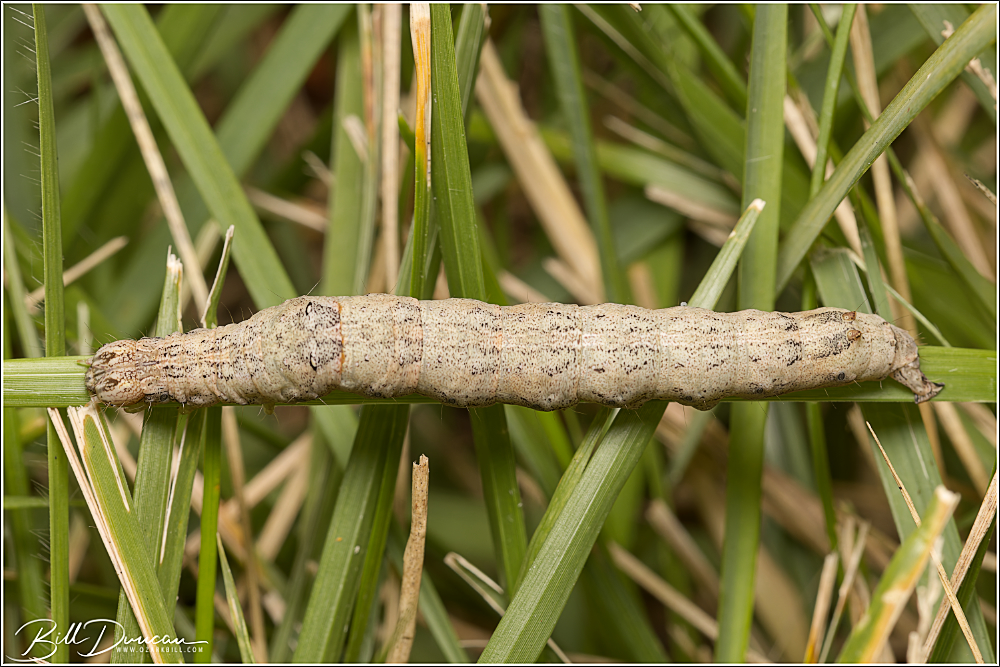
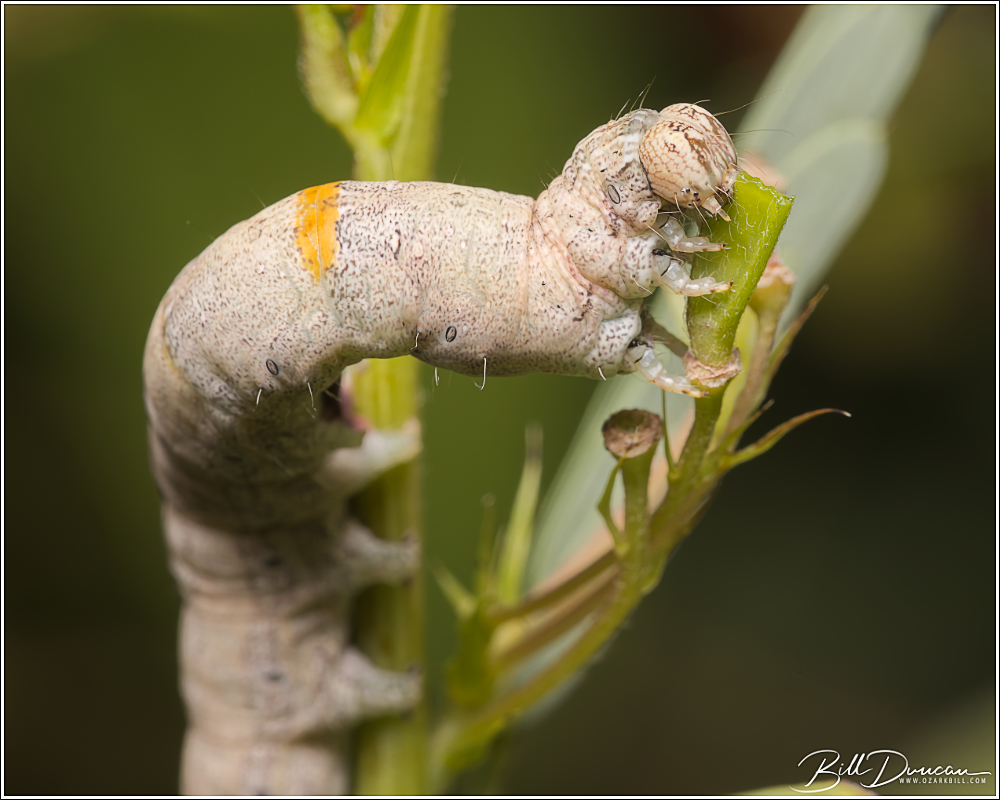
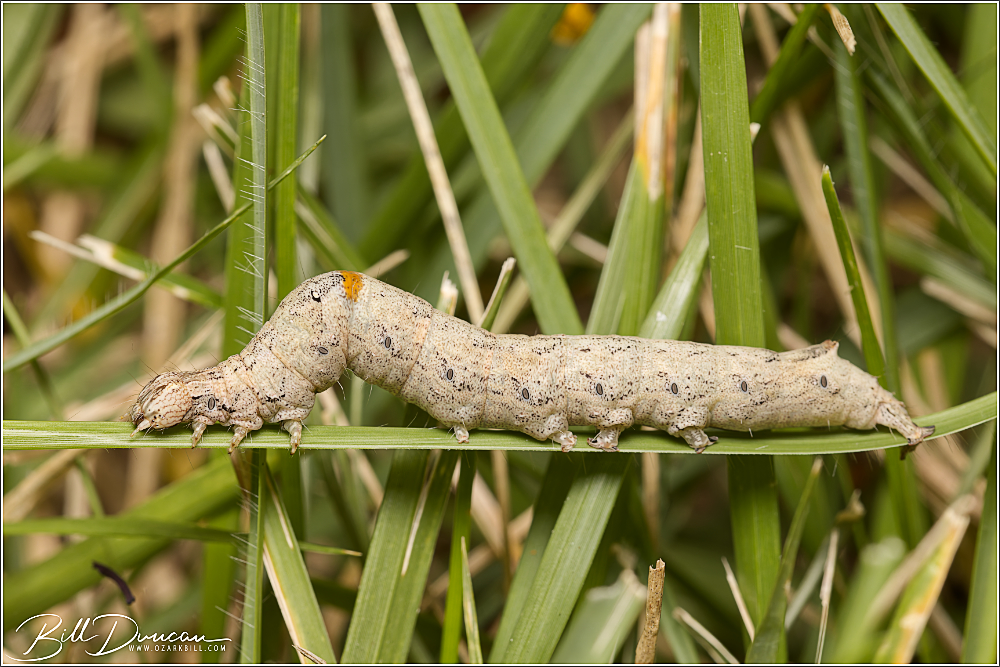
I’ve tried hunting for caterpillars among my native plants in the yard over the past several years, hoping to find some interesting caterpillars with very little success. This past weekend I was looking around my little prairie patch in the backyard with my UV flashlight and found something exciting. Two large caterpillars feasting on partridge pea (Chamaecrista fasciculata). It took me quite a bit of research to finally identify them as one of the Zale moths (Zale sp.) in the Family Erebidae. I am fairly certain this must be Zale lunata (lunate zale), but according to Wagner in “Caterpillars of North America” and “Owlet Caterpillars of Eastern North America,” Z. lunata and Z. minerea are nearly indistinguishable as larvae. However, because there are no records I could find of Z. minerea feeding on herbaceous plants and Z. lunata is known to feed occasionally on herbaceous plants, particularly those in the pea family, I think it is a safe bet to call these Z. lunata. To test this for certain, I hope to be able to find them again and try rearing one to an adult, which are easy to distinguish between these two species.
15-August update:
A couple of nights after taking these photos, I visited the prairie patch and found four of these zale caterpillars. I collected one and put it into a flight cage along with some freshly cut partridge pea.
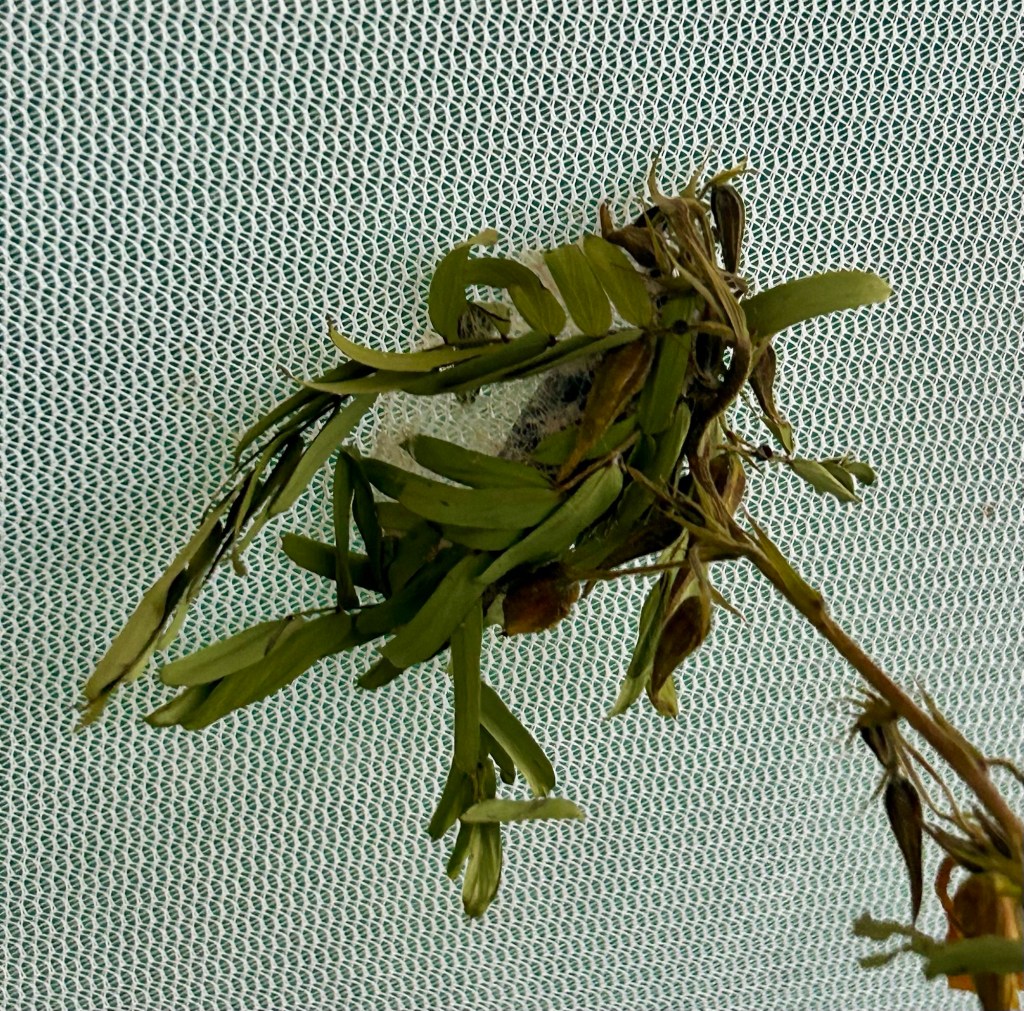
After not being able to find the caterpillar for the past two days, I finally discovered that it had pupated and has used some of the vegetation to cover its cocoon. There’s a chance it might eclose this year. If not, I’ll have to wait until the spring, assuming it survives that long. Here’s a photo of its pupation site.
Zale sp. cocoon
28-August update:
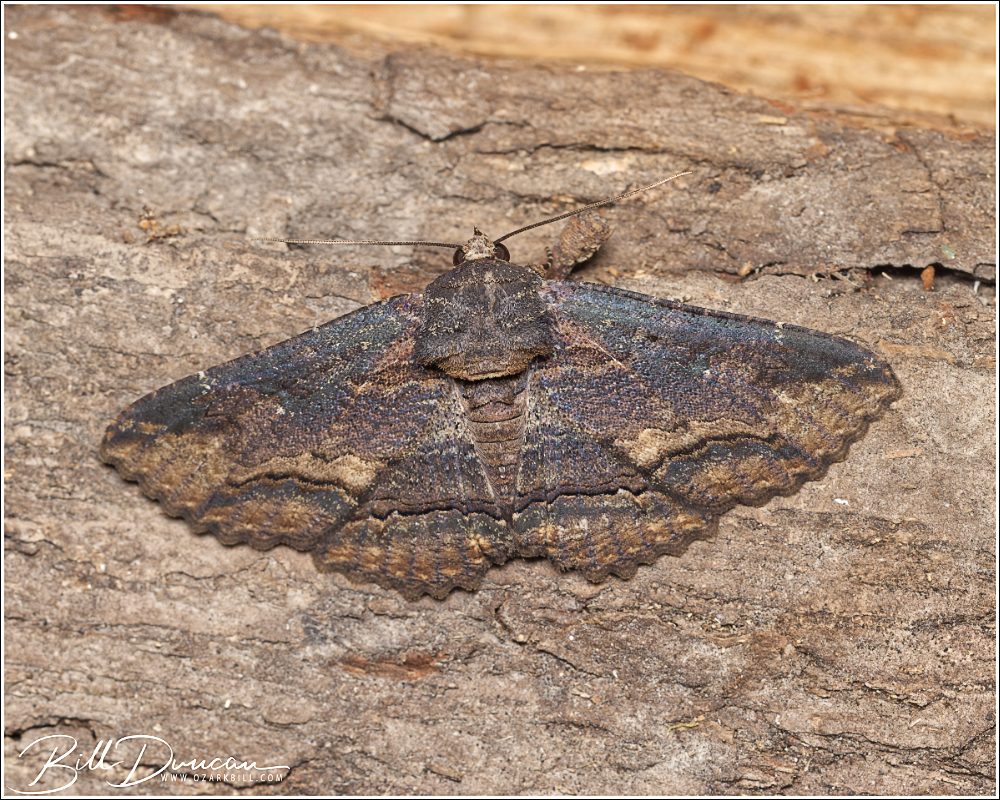
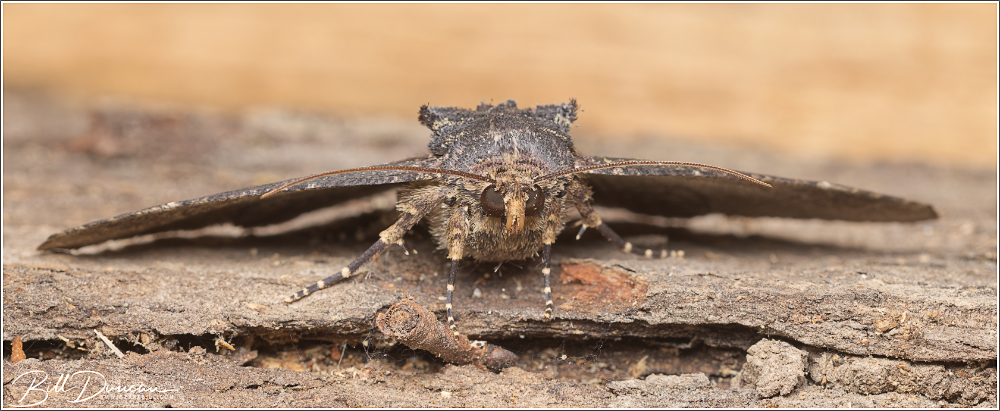
Upon returning from work today, I found that my Zale had eclosed! I took a few photos and I think we can now definitely say this is Zale lunata.
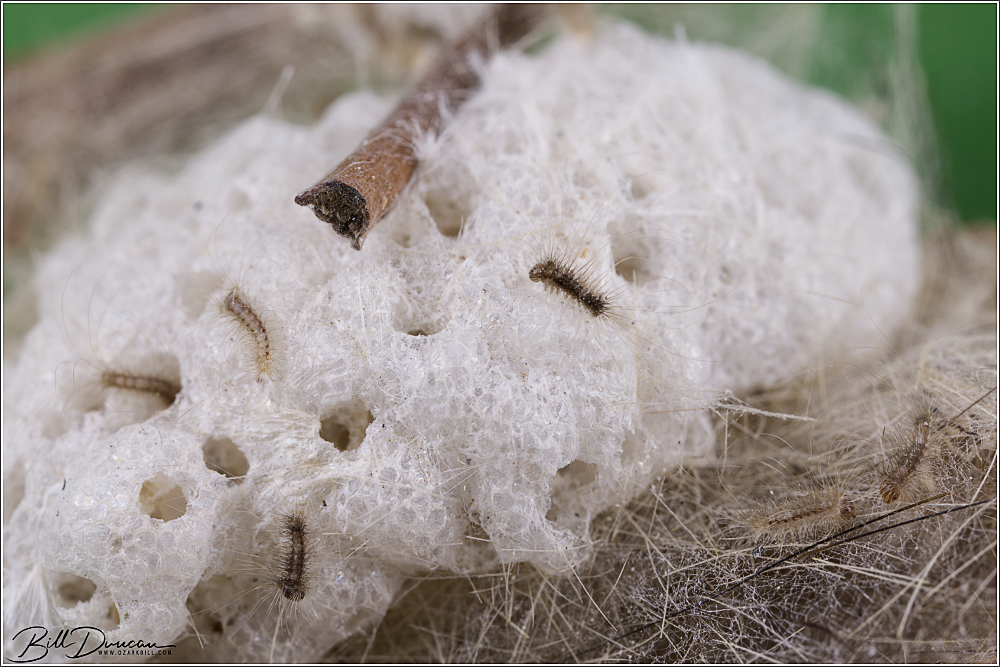
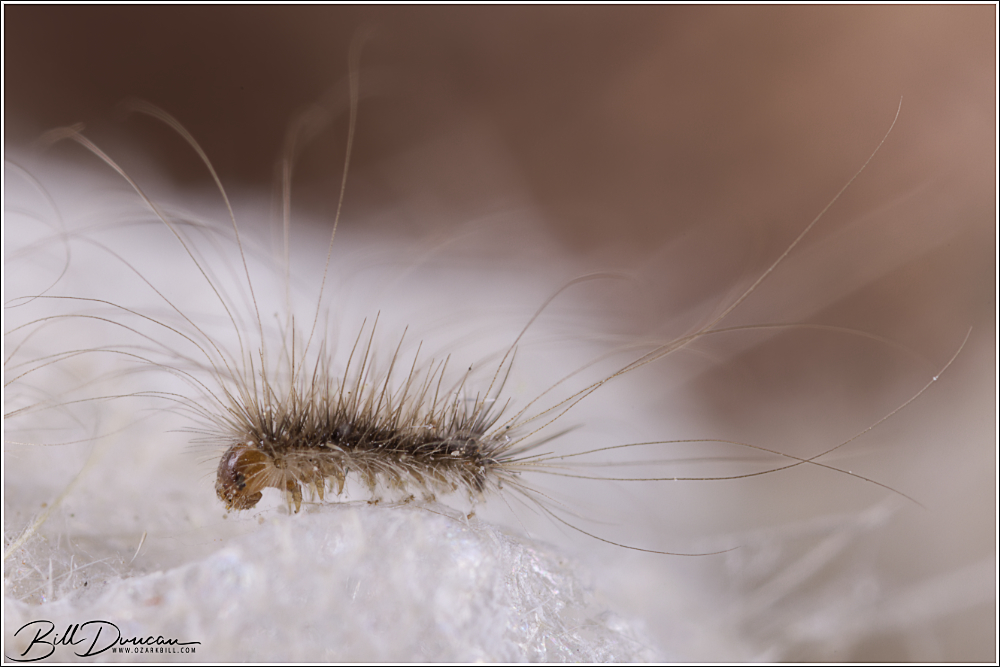
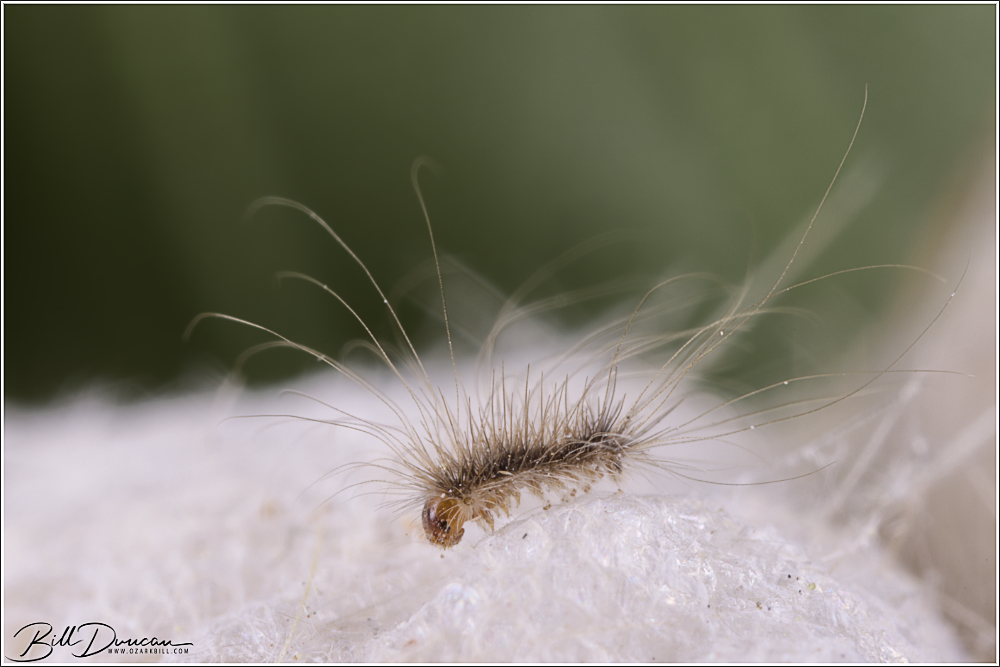
I posted about the Orgyia leucostigma (white-marked tussock moths) that I reared last year to adulthood and documented their breeding and oviposting on my back porch. In mid-April, the young had emerged from their egg case after overwintering on the porch. Here are some photos of these extremely tiny little ones. It was a pretty difficult task as these guys were not much larger than an average grain of sand. Additionally, shortly after emerging they just wanted to spin a thread and balloon away on the wind, which is their primary method of dispersing. I used a small paintbrush to try and gently move them to some leaves, but their threads would quickly get wrapped around their long setae. After getting some photos, I left most of them to disperse in the backyard.
In five years living in our current home, there has not been a single occurrence of any of the numerous, and often misbehaving, white-tailed deer of the neighborhood jumping the short fence that encloses the upper half of our backyard. I had gotten so convinced that we would never see a deer in this area that I put more deer-palate-friendly woody plants in this part of the yard and only have minimal protection against rabbits. The absence of deer from this enclosed portion of the yard, I suspect, is due to the relatively small area and closeness to the house. The fence is short and is an easy hop for the average deer.
Bucky on the first day we met. Notice the swollen front right leg.
About two weeks ago our new guest, Bucky, arrived. I had first seen Bucky early one morning as I was leaving the house for a walk. He was standing in the yard, very close to the side of our house. I hadn’t given it too much thought, but upon returning about an hour or so later, he hadn’t moved. As I got closer to the house, I guess I got a bit too close for his liking and he began to walk away. Then I noticed he had a very injured front leg. The leg, dangling and disjointed, was obviously of little use and Bucky was hesitant to put any weight at all on the appendage. He was able to move far enough that I eventually lost sight of him and I figured if I ever saw him again, he would probably be deceased somewhere in the neighborhood.
One of Bucky’s resting spots
A few days later as I was sleeping in during my holiday break, Sarah rudely woke me up and told me to look out the blinds. There was a buck lying down, damn near touching the edge of our screen porch inside the fenced area of our backyard! Well, I was concerned and perturbed and I went outside as fast as I could to persuade this brute to move on. Upon watching him get up and start moving, I discovered it was the deer I had seen several days earlier – Bucky! I stood in disbelief as this prime, but severely injured deer leaped over the fence with only three working legs.
Cleaning out the “deer feeder”
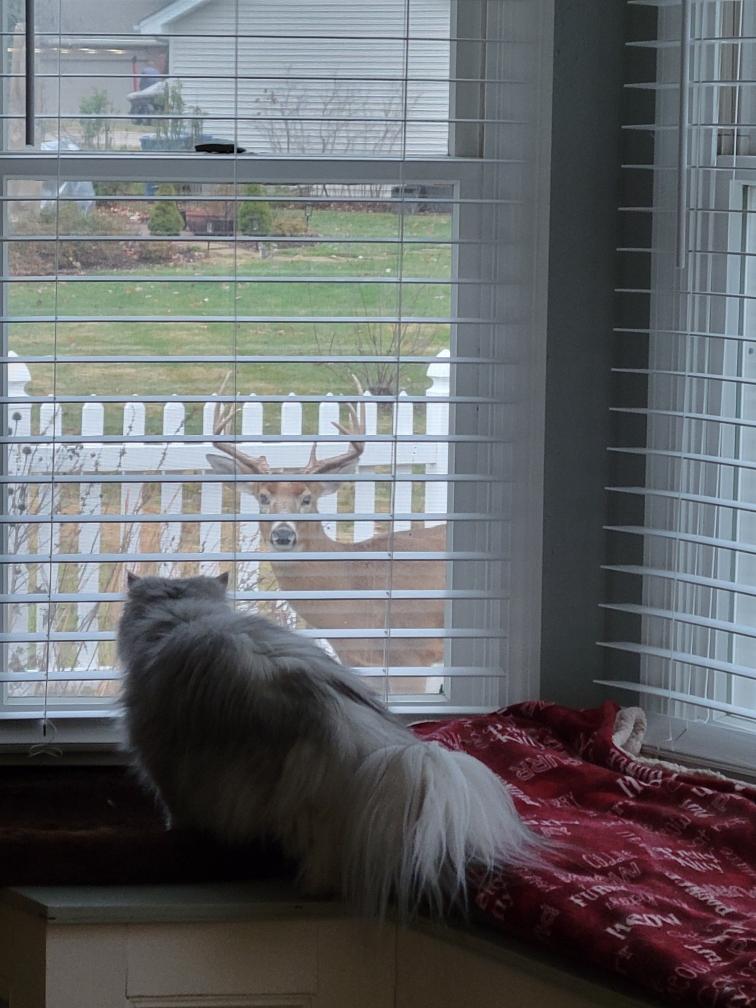
Moving this story along, Bucky has now been a regular visitor inside my fenced fortification. We do not see him every day, but he often arrives during the night to take his usual sleeping spot. By the looks of what he’s been dropping in the yard, he even seems to be getting plenty to eat. I imagine he might be using this spot to escape other large bucks in the area and potentially coyotes that I have heard in the neighborhood. I have sprayed my tasty woodies with deer repellent to dissuade him from nibbling but he has destroyed a couple of tree enclosures and has damaged, now for the forth time since planting, my poor nannyberry. Despite this, we have decided to let him squat. It’s a relatively secure spot for him to attempt to recuperate and he can access my lower bird feeder to get a little bite now and then. Hopefully in return, he can do me the favor of dropping those antlers in the yard.
Bucky and Phoebe getting acquainted
Time will tell whether Bucky will get back on his feet or not. He’ll definitely have to be tough to get through the weather we are having currently. It has been two days since we last saw him. If I find out anything else about his fortune, I’ll be sure to update here.
-OZB
January 10th update.
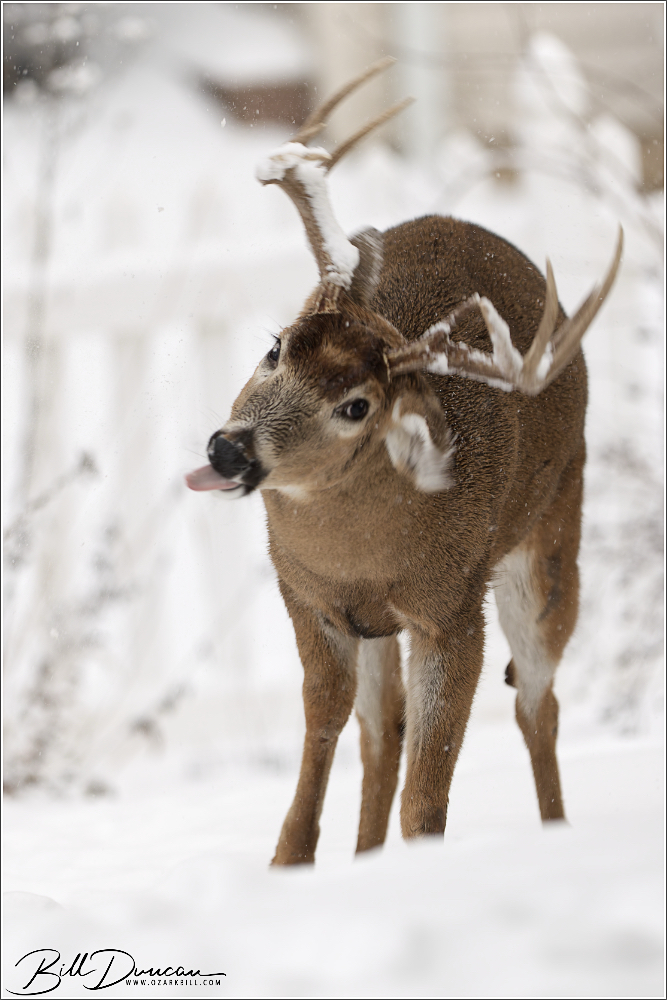
Bucky returned last night after not being seen for four days. Unfortunately I wasn’t paying attention as I fed the birds and by the time I noticed he had already stood up from his bedding area. I went and grabbed the camera and got some shots as he shook off some snow and did a little grooming. He then jumped the fence to make his daily rounds.
This autumn I was fortunate to have this really interesting experience with a common but fascinating moth species. I invite you to read about it and see the photography.
New documented host plant (Nymphaeaceae) and life history documentation for the highly polyphagous moth, Orgyia leucostigma (Lepidoptera: Erebidae), in eastern Missouri.
Orgyia leucostigma Smith, 1797 is a moth species in the family Erebidae that is found throughout eastern North America and is known to be extremely polyphagous. Commonly known as the white-marked tussock moth, O. leucostigma has been recorded using 166 plant species in 55 families as hosts, mostly consisting of deciduous plants, but coniferous and herbaceous plants have also been recorded (Robinson et al. 2023).
Larvae of Orgyia leucostigma feeding on Nymphaea odorata.
In early September 2024, I observed six mid- to late-instar larvae of O. leucostigma, each feeding on the leaves of Nymphaea odorata (Nymphaeaceae) that were growing in a small artificial “pond” in my St. Louis County, MO suburban yard. Unfortunately, these insects consumed every available leaf of N. odorata in the pond before they could pupate. The only other species in the pond available to them was the exotic Pontederia crassipes (water hyacinth), which they did not readily consume. I was able to locate and remove five final-instar larvae from the remnants of the original host leaves and placed them in an outdoor cage where they successfully switched to feeding on leaves of Quercus muehlenbergii and Q. imbricaria (both Fagaceae). Within seven days, all five larvae built cocoons to pupate within.
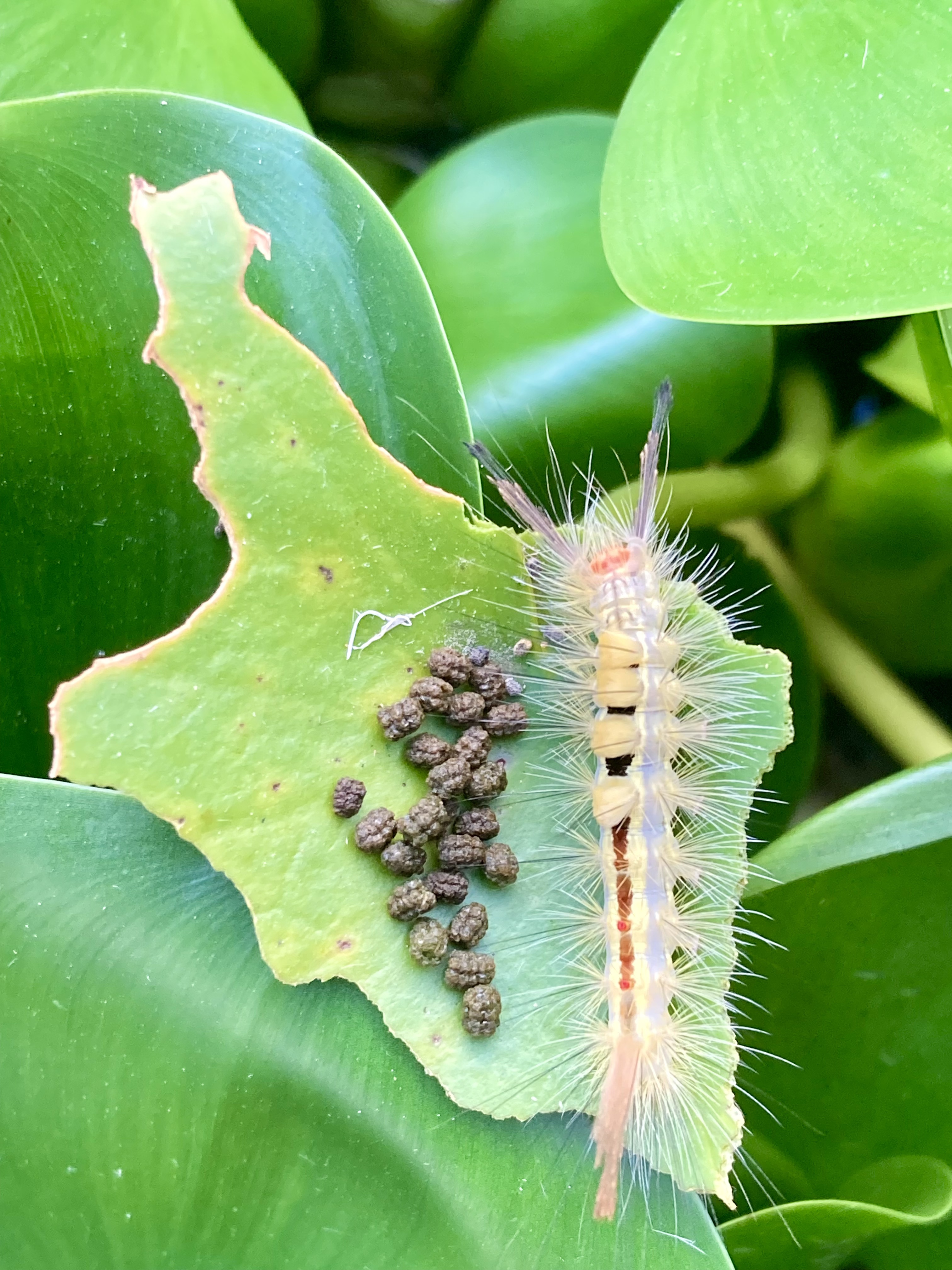
Larvae of Orgyia leucostigma running out of leaf. Leaves of exotic Pontederia crassipes (water hyacinth) seen surrounding hostplant leaf.
To my knowledge, this is the first documentation of a nymphaeaceous host plant for O. leucostigma, which expands the host range of this already highly polyphagous species by another family. Unfortunately, the caterpillars did not reach pupation feeding on N. odorata alone, so the ability of O. leucostigma to reach adulthood on this host cannot be confirmed yet. However, the fact that five larvae of O. leucostigma were able to reach the final larval instar feeding solely on N. odorata makes this highly likely.
Larvae of Orgyia leucostigma finishing its larval stage on leaves of Quercus imbricaria (shingle oak).
Life history of Orgyia leucostigma The lifecycle of O. leucostigma begins as an egg, typically laid in masses by the adult female. Eggs are laid in late summer or early fall on tree bark, branches, or other surfaces. A single female can lay anywhere between 100 to 600 eggs. These eggs are small, round, and white to pale yellow in color, and are coated in a protective frothy substance produced by the female to safeguard them from predators and environmental factors.
Two of five cocoons of Orgyia leucostigma that were raised primarily on the leaves of Nymphaea odorata.
Lepidopterans use a variety of strategies in overwintering. In the case of O. leucostigma, the eggs remain dormant over the winter, entering a state of diapause, a period of suspended development that allows them to withstand harsh winter conditions. They hatch in the spring when the weather warms, typically around late April or early May, coinciding with the budding of trees that will serve as food for the larvae.
One of five Orgyia leucostigma females that eclosed in late September and early October.
After hatching, the larvae emerge as small, hairy caterpillars. This larval stage is perhaps the most recognizable and distinctive phase of O. leucostigma. The caterpillars are known for their colorful and tufted appearance, with a series of tufts (or tussocks) of hair along their backs and two long black “pencils” of hair protruding from both the front and back ends. The body is primarily yellow or cream-colored, with a pattern of red and black markings.
One of approximately two-dozen male Orgyia leucostigma that were attracted to our screen porch, presumably by the pheromones released by the females.
As discussed above, the larvae feed on a wide variety of trees and shrubs, including both deciduous and coniferous species. In our area, oak, maple, and willow, are among the most common hosts. The larvae are voracious feeders and can cause significant defoliation when present in large numbers, which can lead to tree stress, although healthy trees typically recover without long-term damage.
The males found the stationary Orgyia leucostigma females once placed in their enclosure.
Once the larva has reached its final instar, it will spin a cocoon in a sheltered location, often on the trunk or branches of trees, beneath loose bark, or on the sides of buildings. The cocoon is made from silk and incorporates most of the caterpillar’s own urticating body hairs, offering added protection from predators.
Inside the cocoon, the caterpillar transforms into a pupa, a resting stage during which the most dramatic metamorphosis occurs. The pupal stage typically lasts 10-14 days, during which time the organism undergoes a complete transformation from a larva into an adult moth.
Upon completion of the pupal stage, the adult moth emerges. The adult form of O. leucostigma exhibits strong sexual dimorphism. The males are small, grayish-brown moths with a wingspan of about 25-35 mm. They have feathered antennae that they use to detect pheromones released by females from a considerable distance.
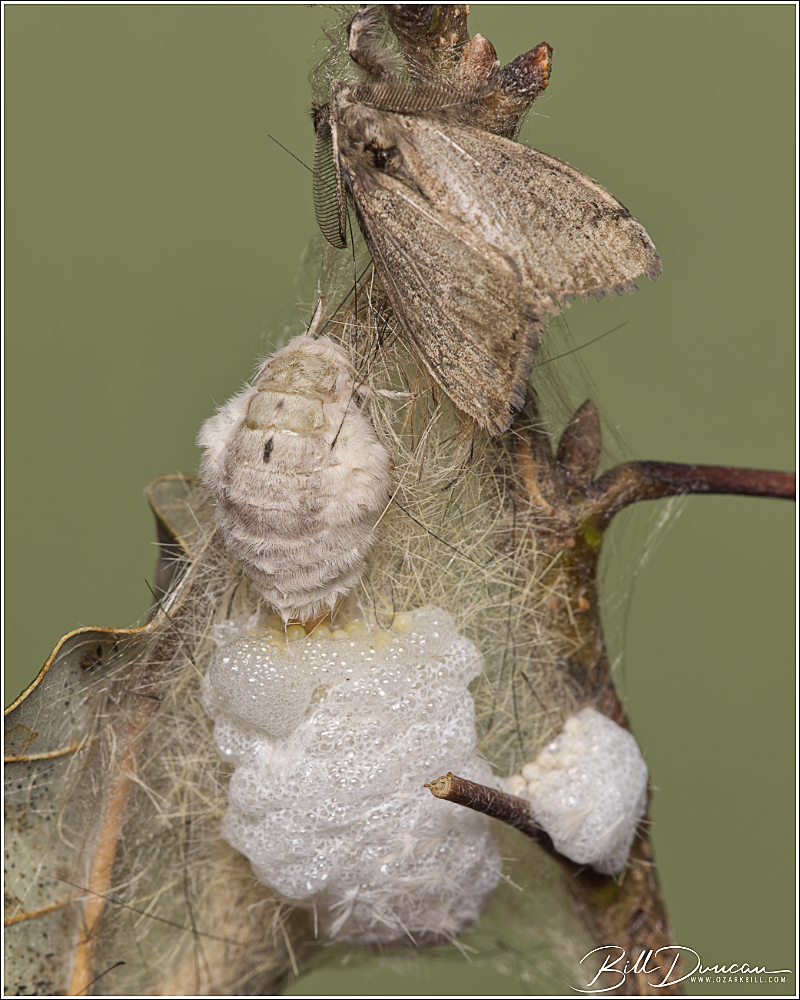
Within minutes of a presumed successful copulation, a female Orgyia leucostigma begins oviposition, forming a large foam-encapsulated egg mass.
In contrast, the females are wingless and remain on or near their cocoons after emerging. They are larger than the males and have a plump, cylindrical body covered with dense hairs. Since they are flightless, females rely on releasing pheromones to attract males for mating. After mating, the female lays eggs near the cocoon, starting the cycle again. The female typically dies shortly after laying her eggs, while the male lives a few days longer in search of other mates.
Due to the stationary habit of the females, it is fascinating that all dispersal is dependent on the larvae in this species. To do this efficiently, early-instar larvae will often “balloon,” letting out an amount of silk to catch the wind, thus allowing them to move to new areas much quicker than by crawling. This dispersal mechanism is also practiced by many spiders.
A worn male Orgyia leucostigma rests nearby as the female continues to oviposition.
In this specific case, all five of the pupa that I reared produced female adults and each of these eclosed exactly 10 days after cocoons/pupa were formed. At dawn of each morning following the females emergence, I walked the outside perimeter of our screened porch wherein the screened moth enclosure was contained. Each morning I found up to six male adult O. leucostigma that I captured and placed in the enclosure containing the females.
The extent of the egg masses of Orgyia leucostigma was astounding. The females were mostly eggs!
Mating appeared to be very brief and within minutes of contact by a male, each female began ovipositing. It was quite shocking observing the differences in size of the females before and after their egg masses where completed. See photos below that I attempted to document these changes.
A nearly completed Orgyia leucostigma egg mass along with her larger and older sister and a potential mate.
While observing and photographing these activities, I happened to notice that a jumping spider (F. Salticidae) was attacking one of the females prior to her ovipositing. The spider must have come from the oak branches that I placed in the enclosure to finish rearing the caterpillars. I took enough time to take a few photos of this and then removed the spider with a pair of forceps. I noticed a drop of hemolymph on the back of the female after removing the spider. However, the female did not seem too bothered by this and created her egg mass within a couple of hours of this incident.
A female Orgyia leucostigma that was attacked by a jumping spider (fam. Salticidae) that must have been hiding within the oak branches. The spider was removed and although it is likely the moth received a wound, she later completed ovipositioning.
Caterpillars of this species are often found during my caterpillar hunts. Sometimes they are so plentiful as to be annoying when hoping for rarer quarry. I had read about the stationary eggbound females of this species but had little hope of ever actually seeing one in person. I very much enjoyed documenting these activities and I will try my best at overwintering these egg masses to fruition.
Literature Cited
Robinson, G. S., P. R. Ackery, I. Kitching, G. W Beccaloni and L. M. Hernández (2023). HOSTS (from HOSTS – a Database of the World’s Lepidopteran Hostplants) [Data set resource]. Natural History Museum. Available from https://data.nhm.ac.uk/dataset/hosts/resource/877f387a-36a3-486c-a0c1-b8d5fb69f85a (last accessed 16 Sep 2024).
The year 2024 was a very notable year in our area. No, I’m not talking about the circus joke of an election coming up. Of course, I’m referring to the year of the Brood XIX periodical cicada emergence. Brood XIX, also known as the “Great Southern Brood,” holds a special place as a natural marvel. These periodical cicadas are a part of the Magicicada genus, known for their unique life cycle, which spans 13 years, culminating in a synchronized mass emergence.
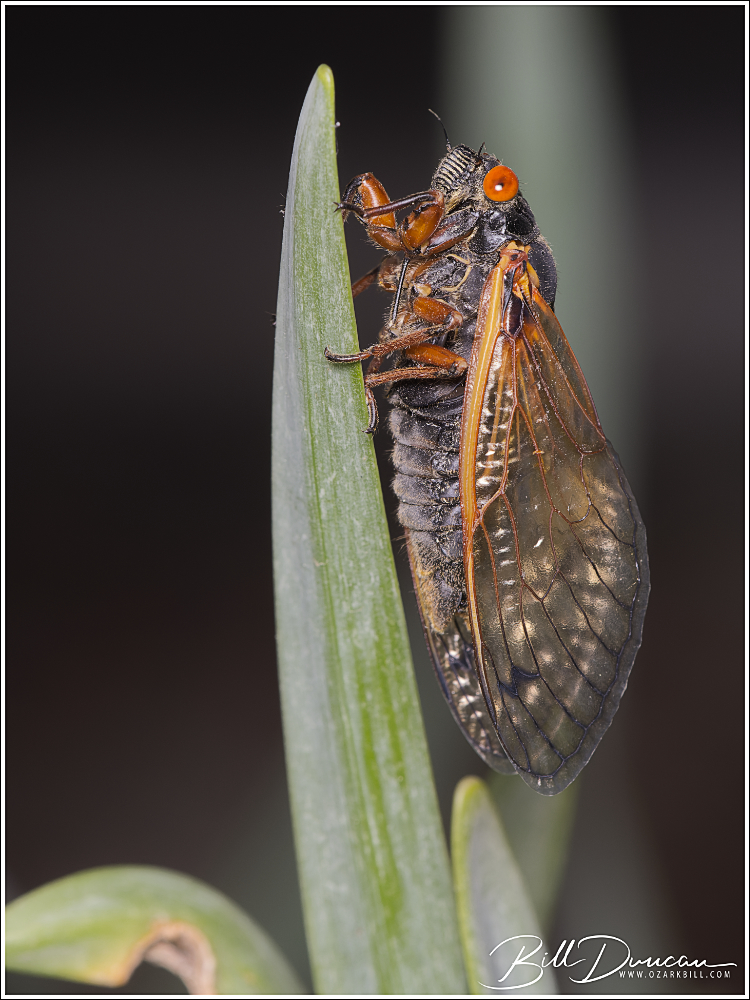
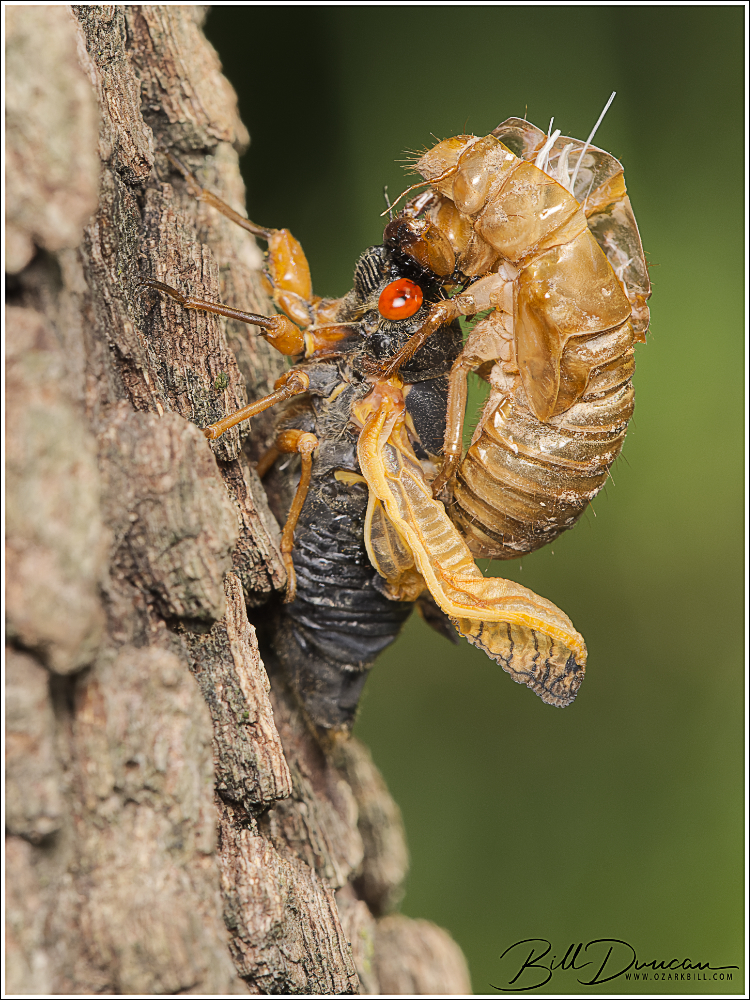
A newly emerged Magicicada tredecassini photographed on May-11
Unlike annual cicadas, which appear every year, periodical cicadas have a distinctive life cycle, emerging in massive numbers after spending 13 or 17 years underground. These insects belong to three distinct species groups, with Brood XIX being part of the 13-year group that is comprised of four species: Magicicada tredecim, M. tredecassini, M. tredecula, and M. neotredecim. Cicada broods are geographically isolated populations that emerge in synchrony, making their appearance not only rare but region-specific. Brood XIX has a vast range, covering at least portions of 11 states across much of the southeastern United States.
A newly emerged Magicicada tredecassini photographed on May-18
Life Cycle of Brood XIX The life of a Brood XIX cicada is primarily hidden underground, where they live as nymphs, feeding on sap from tree roots. For 13 years, they remain underground, quietly developing and maturing. Then, seemingly overnight, millions emerge from the soil in an overwhelming display of nature’s rhythm. Once they emerge, their primary purpose is reproduction.
Adult cicadas live only for a few weeks. During this time, males produce loud, buzzing mating calls using specialized structures called tymbals. These mating calls fill the air, creating a chorus that can reach deafening levels in regions with high cicada density. After mating, females lay eggs in tree branches, and once the eggs hatch, the nymphs fall to the ground and burrow into the soil, starting the 13-year cycle anew.
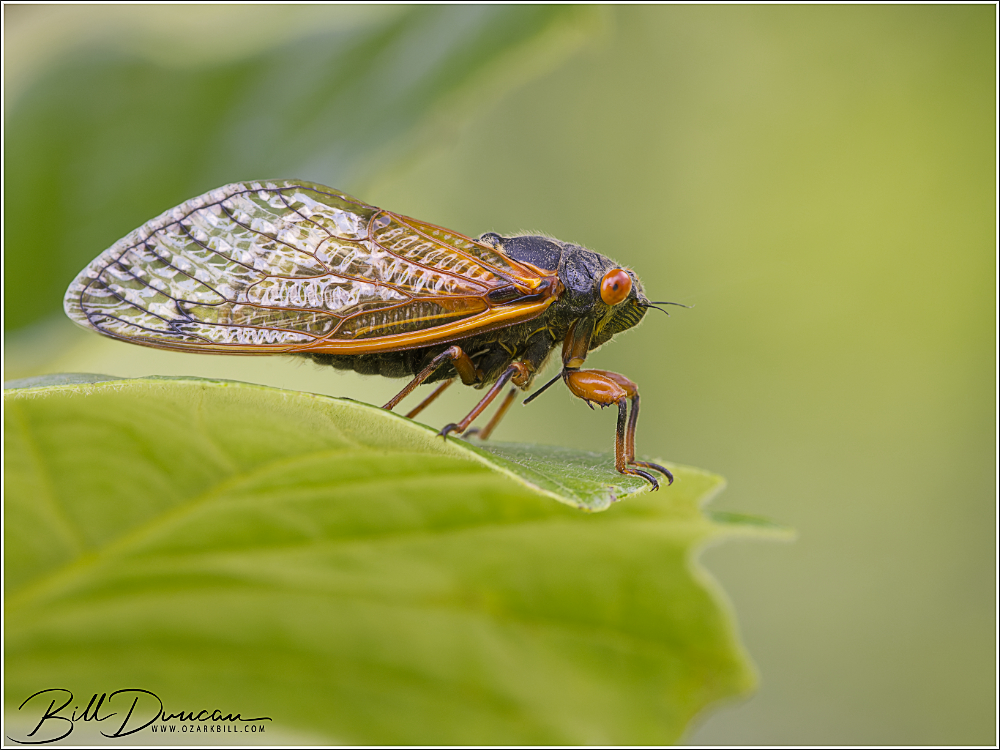
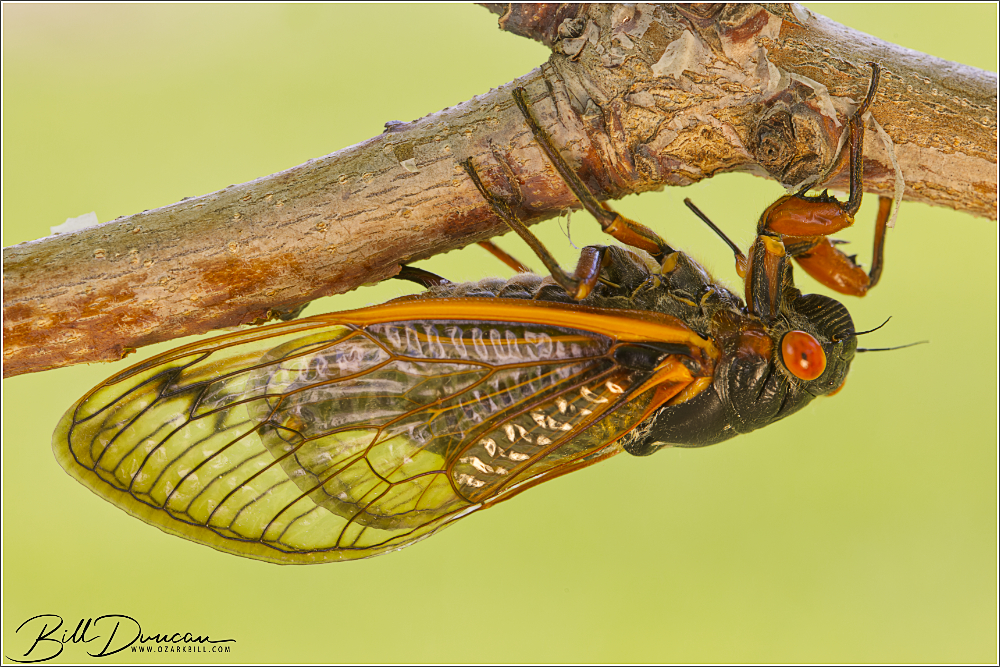
Magicicada tredecassini
The Mystery of Synchronized Emergence One of the most intriguing aspects of Brood XIX is the synchronized nature of their emergence. The question remains: how do they know it’s time to come out? Scientists believe cicadas track environmental clues, such as soil temperature, to time their appearance. When the soil reaches about 64°F (18°C), it signals that it is time for the cicadas to surface.
This poor guy was not able to emerge from its final larval form
The reason for their long, synchronized life cycles is believed to be a survival strategy known as predator satiation. By emerging in overwhelming numbers all at once, they reduce the likelihood of being completely eaten by predators. There are simply too many cicadas for predators to consume, ensuring that enough survive to reproduce.
Additionally, 13 and 17 are both prime numbers and this is not likely a mere coincidence. Because these intervals are in prime-numbered years, it is nearly impossible for these patterns to overlap with the breeding strategies of would-be predators.
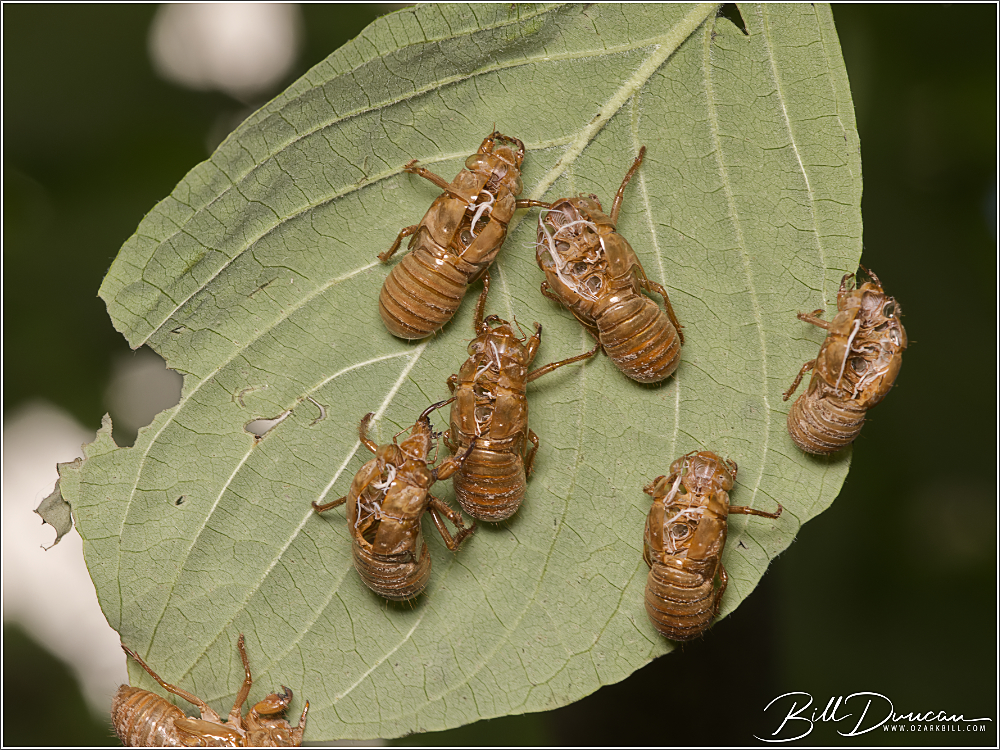
Periodical cicada (Magicicada spp.) exuviae
The Ecological Importance of Cicadas Though their emergence may seem disruptive, periodical cicadas play a vital role in the ecosystem. Their sheer numbers provide a feast for predators, from birds to mammals, and their death leaves behind nutrient-rich carcasses that fertilize the soil.
While some may find them a nuisance due to their loud calls and vast numbers, these insects do not pose a significant threat to crops or forests. Their presence is fleeting, and they leave behind a healthier environment in their wake.
Of the millions of cicadas that emerged in our neighborhood, many had issues with expanding their wings as shown here. These individuals become likely calories for others and will not be able to pass on their genes to the next generation.
That thin line… I’m sure you’ll agree that anyone with a shred of curiosity about the natural world would find what I shared here of immense interest. As a naturalist, I am still overwhelmed by what I observed for a few weeks in May in our suburban St. Louis County neighborhood. I spent many hours in amazed observation, watching them climb as freshly emerged adults, listening to their midday chorus and observing as my watch counted more than 100 decibels standing in our front yard.
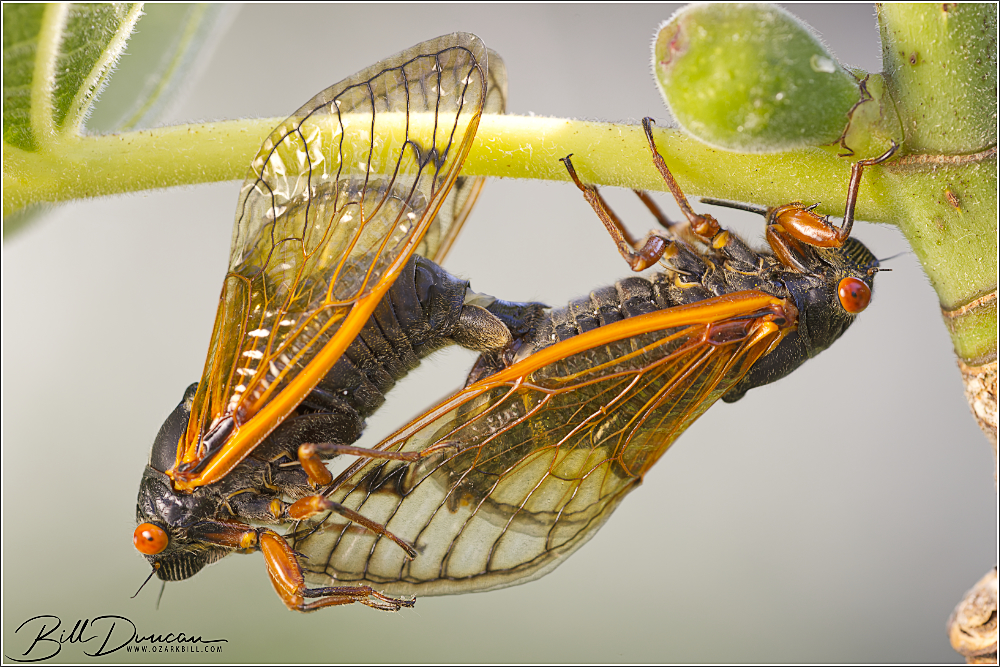
Mating Magicicada tredecassini
As mentioned above, it is true that in the grand scheme of ecology, these creatures provide nothing but benefit – except, if you are a young woody plant. This is where I found my my awe and fascination becoming replaced with a red, searing rage. For those who may not know, I have spent considerable time, effort, and money over the past four years planting approximately 50 trees and bushes in our once florally depauperate yard. The spring and early summer of 2024 were turning out to be absolutely perfect in regards to establishing woody plants. Temperatures were mild and rains were plentiful.
Although the periodical cicadas did not use my potted fig tree in the backyard for ovipositing, this pair of Magicicada tredecassini found it a fine place for “making babies.”
Then I slowly realized the numbers of cicadas emerging in our neighborhood and the pressure my plants were soon to receive from the thousands of ovipositing females that were looking for just what my yard provided. The ovipositors of the female cicada are sharp and literally metal-studded. These guys are as apt as beavers when working with wood. Heavy pressures from swarming periodical cicadas can and do kill young trees. Cicadas love young trees for depositing their eggs because there are plenty of branches that are the perfect size — about the diameter of a pencil. They especially love young trees that are exposed to the full sun. This makes tremendous evolutionary sense. A young tree that is in full-sun will typically have all the advantages for growing and will therefore more likely be around for the full 13 years that it knows its offspring will need to feed on its host’s roots. I will never forget shaking young dogwood trees in the front yard and watching as hundreds of cicadas swarmed off of them, most simply flying for 50 feet or so and turning right around to land in the same tree.
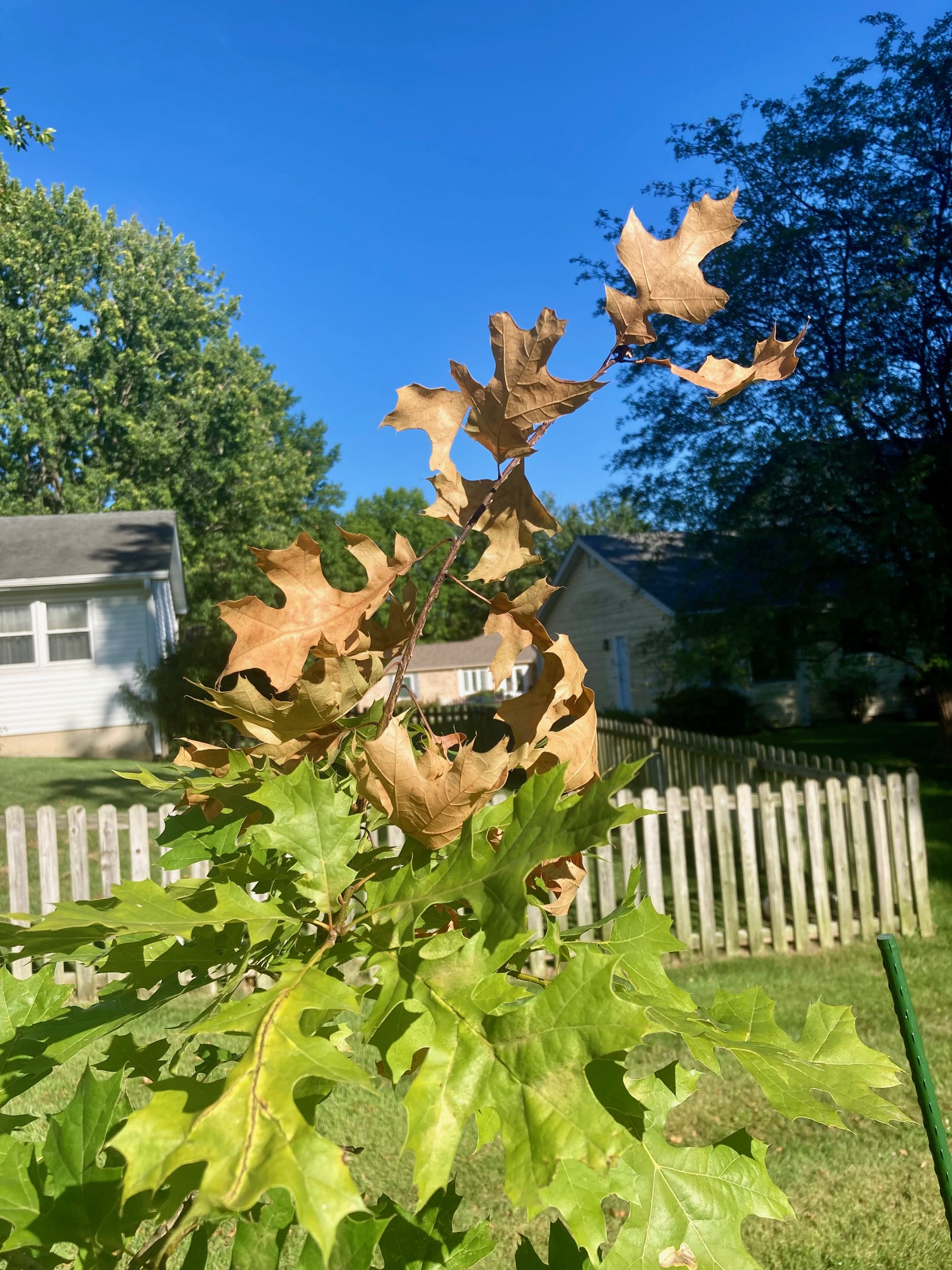
An example of the pressures of the Brood XIX cicadas on the young and establishing trees in our suburban yard.
Over the next month or so I watched as limb after limb on most of my trees browned and succumbed to the damage done by the heavy onslaught of ovipositing females. I filled several trash cans with limbs that were either self-pruned or that I removed once they were certainly dead. No tree in my yard has died at the time of my writing this, but most plants were significantly set back in their efforts in becoming established. I will have to wait and hope that most will make it through the coming winter season.
Magicicada neotredecim ovipositing on branches of Cotinus obovatus (American smoke tree).
I made a list of the 26 plants I recorded that were used for ovipositing by the Magicicada cicadas in our yard. With a couple of exceptions, this list comprises every woody species in the yard. I even recorded them ovipositing in the herbaceous forb, Penstemon digitalis.
List of plants used by ovipositing Magicicada Brood XIX cicadas in a St. Louis County yard in 2024 eruption. Amelanchier arborea, Amorpha fruticosa, Aronia melanocarpa, Asimina triloba, Carpinus caroliniana, Cephalanthus occidentalis, Cercis canadensis, Cornus florida, Cotinus obovatus, Diospyros virginiana, Euonymus americanus, Euonymus atropurpureus, Gymnocladus dioicus, Hamamelis virginiana, H. vernalis, Lindera benzoin, Nyssa sylvatica, Penstemon digitalis, Physocarpus opulifolius, Prunus americana, P. serotina, Quercus bicolor, Q. muehlenbergii, Q. shumardii, Sassafras albidum, Viburnum dentatum
Of the plants listed above, particularly high preference seemed to be for the redbuds, dogwoods and oaks. I’m not sure if there is really some taxa preference or if these particular plants simply had more of the best sized limbs.
“Flagging” injury on Quercus shumardii caused by cicada ovipositing“Flagging” injury on Cotinus obovatu caused by cicada ovipositing
A Magicicada sp cicada ovipositing on a stem of the herbaceous Penstemon digitalis.
With hopes of photographing the full cicada lifecycle, I collected quite a few stems from trees that were dropped due to the damage they received or that I removed myself. Unfortunately, my insect rearing skills need some work and I never did see a newly emerged cicada nymph. I did cut into some branches and photographed the eggs.
Eggs from Magicicada sp cicada that were inserted into the pith of Amorpha fruticosa stems. Up to 30 eggs may be inserted in each incision the female makes in the plant and a single female may lay up to 600 eggs in her life.
The next generation…? Despite the angst and dread this caused when wondering what would become of my woodies that I have spent so much time in watering and protecting from deer over the past several years, I was very pleased to live in a place that still had natural wonders such as this. If the damage caused to my trees indicates the potential success of the next Group XIX emergence, then I am happy and will look forward to the next time we see these guys, assuming I am fortunate enough to be here in 13 years. Hopefully enough of my trees will survive to help them on their way.
































 A Thousand Acres of Silphiums