A Flooded St. Francis

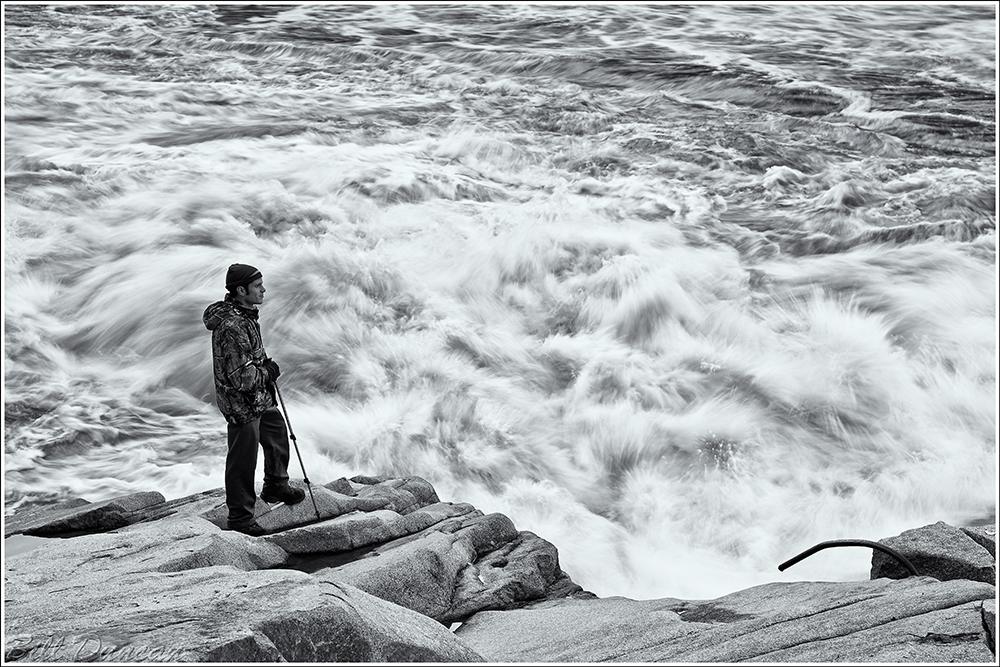
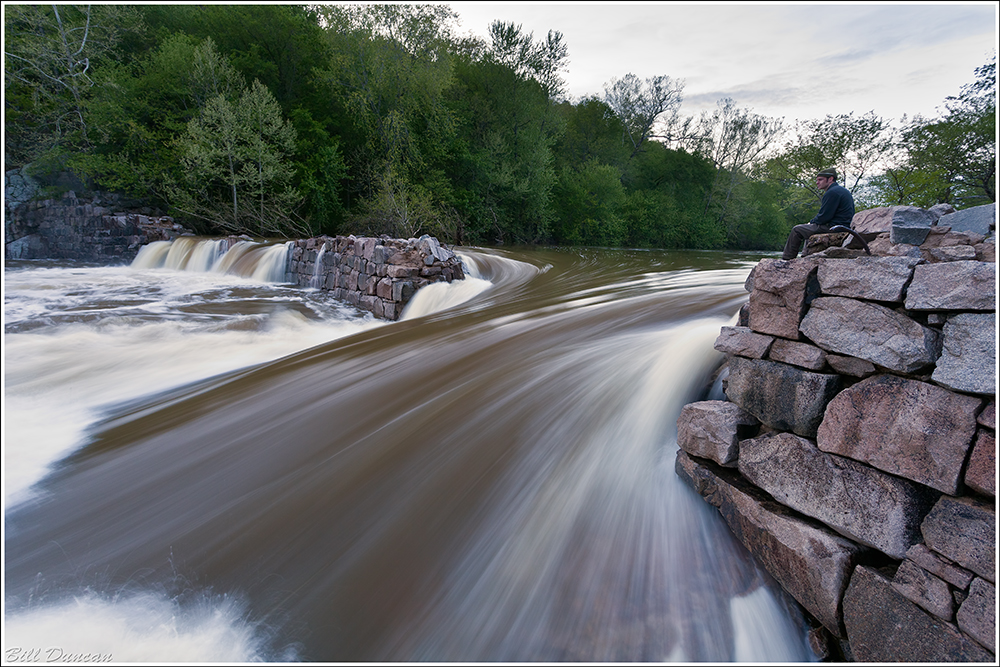
Early this May, Steve and I had the good fortune to visit a couple spots along our St. Francois Mountains the day after a front brought about three inches of rain to the area.  One of these spots was the Einstein Dam at Silvermines Recreation Area (St. Francis N.A.).  The power of the water surging through the breaks in the dam was mesmerizing.  A sense of near vertigo became apparent as I stared into the sheet of water that dropped nearly ten feet downstream.  I knew Steve would have almost no chance if he slipped into this torrent, but my photo needed some scale!  So I asked him to have a seat on the edge.

IMG_4449

We arrived with little light left, but tried to take it all in while I made a few images.  We had visited the previous autumn when the water was much lower

IMG_4420

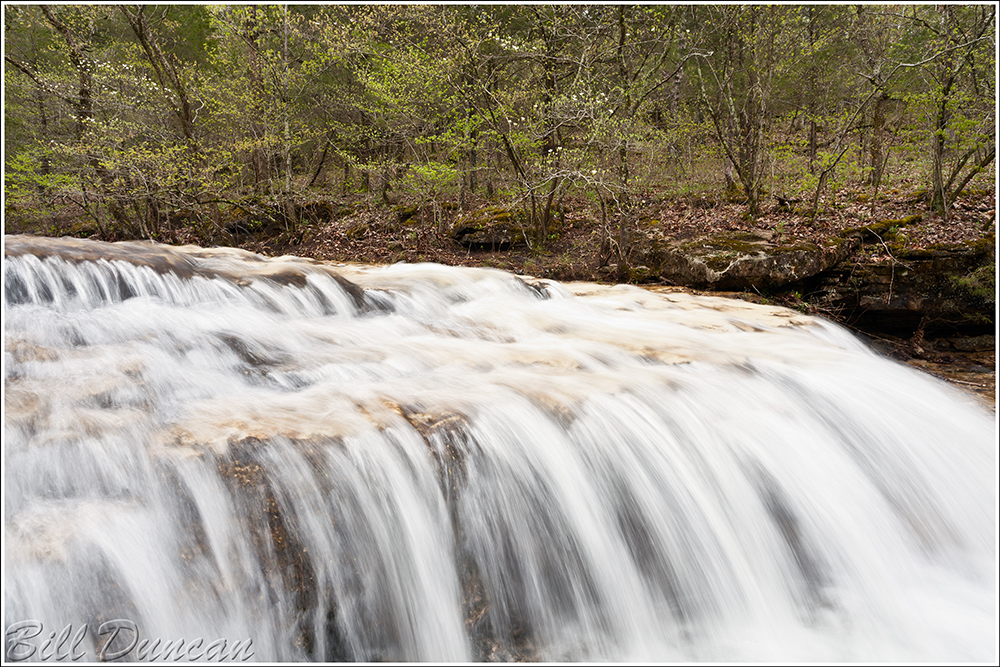
Imagine dropping into this in your kayak?  We pondered if this would be advisable or not.  If you think it doesn’t look all that bad from this photo, be sure to watch this.

IMG_4418 2

Water moving in every conceivable direction!

Enjoying the Gems Under Your Nose

I have often said I am more interested in the places the Ozarks have to offer compared to the possible visits to iconic destinations in the rest of the country.  I know I would love and appreciate those spots, of course.  But the millions of photographs generated are probably enough without my lousy contributions.  I am more interested in showcasing the animals and habitats that can be found in the Show Me State, the places with names that so many who live here have never even heard.  I’ve come to realize lately that I am guilty of ignoring a few places less than an hour’s drive from my doorstep that have a lot to offer, passing them by on my three hour drives to more exotic Ozark locations.  These places include Castlewood, Washington and Babler State Parks, Emmenegger Nature Park, Bush Wildlife and a handful of other Conservation Areas.  The place I’ve gotten to know much better this spring is the location spotlighted in this post, St. Francois State Park.

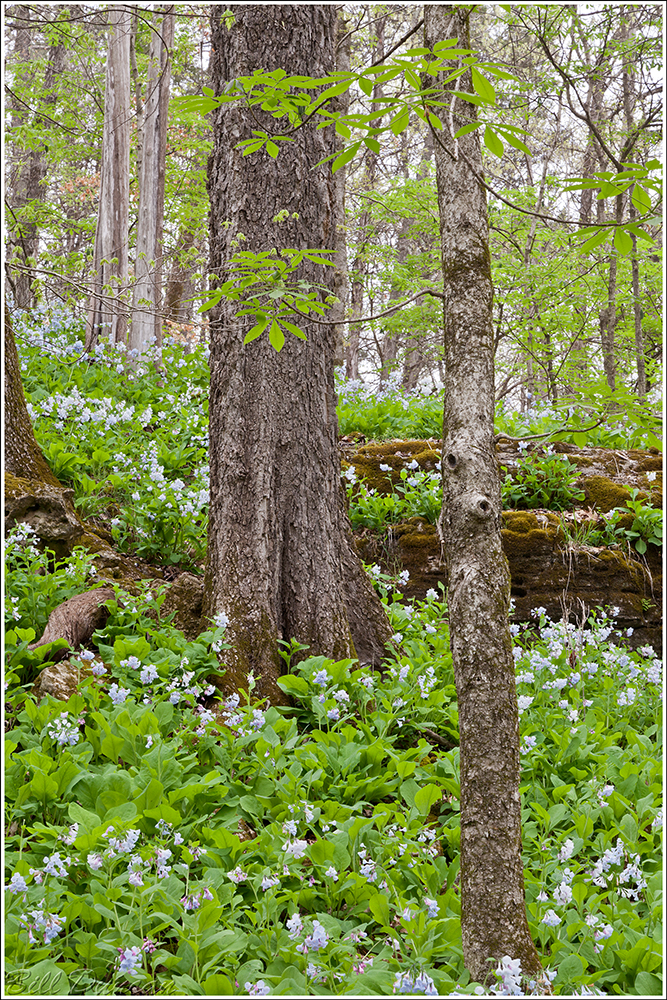
St. Francois SP, located just north of Bonne Terre, MO, has a lot to offer the nature lover.  I have now hiked the three primary trails and they each offer unique features that should satisfy any true Ozarker.  Sarah and I enjoyed a nice hike on the Swimming Deer Trail a couple weeks ago and stumbled across the best bunch of Bluebells I have seen personally.  I did not bring the camera on that hike, but later that week we took a few days break to travel south and made sure we stopped back here again.  I was hoping the show would still be ongoing and I was not disapointed.  We were even fortunate to have a nice overcast sky and relatively little wind.  So the poor photography is my own blame.  Picking out compositions that worked was more trouble than I anticipated, of course.

IMG_3770

“Bluebells and Limestone″

Technical details: Canon EOS 5D Mark II camera, EF17-40mm f/4L USM @ 23mm, ISO 320,  f/13, 0.3 sec

This trail also contains the largest number of Ohio Buckeyes that I have seen at one location in Missouri.  These trees and their emerging, distinctive leaves were found everywhere.  Along with Pawpaws, these small trees fit in perfectly beneath the larger oaks and hickories that dominate the upper canopy.  Pictured below is one of the larger buckeyes I found on this day.

IMG_3795

“Bluebells and Buckeyes″

Technical details: Canon EOS 5D Mark II camera, EF17-40mm f/4L USM @ 70mm, ISO 320,  f/18, 0.5 sec

Along with this great display of wildflowers and trees, the Swimming Deer Trail offers nice views into the Big River valley from atop tall bluffs that are adorned with the characteristic Eastern Red Cedars who are so adept at holding on to cracks and crevices to get the best possible looks as the seasons fly by.

IMG_3779

“Bluebells and Woody Vine″

Technical details: Canon EOS 5D Mark II camera, EF17-40mm f/4L USM @ 24mm, ISO 400,  f/16, 0.4 sec

I apologize for so many vertical compositions.  I once read a photography e-article that suggested this tendency was more typical of the “stand up, aggressive, masculine” (male) photographer, whereas women photographers (and painters I assume), who are assuredly the “weaker sex” are more apt to produce horizontal landscapes, obviously the more passive and prostrate the compositional choice.  If there is any truth to this hogwash, I wonder what it says about the artist who prefers the square ratio?  😉

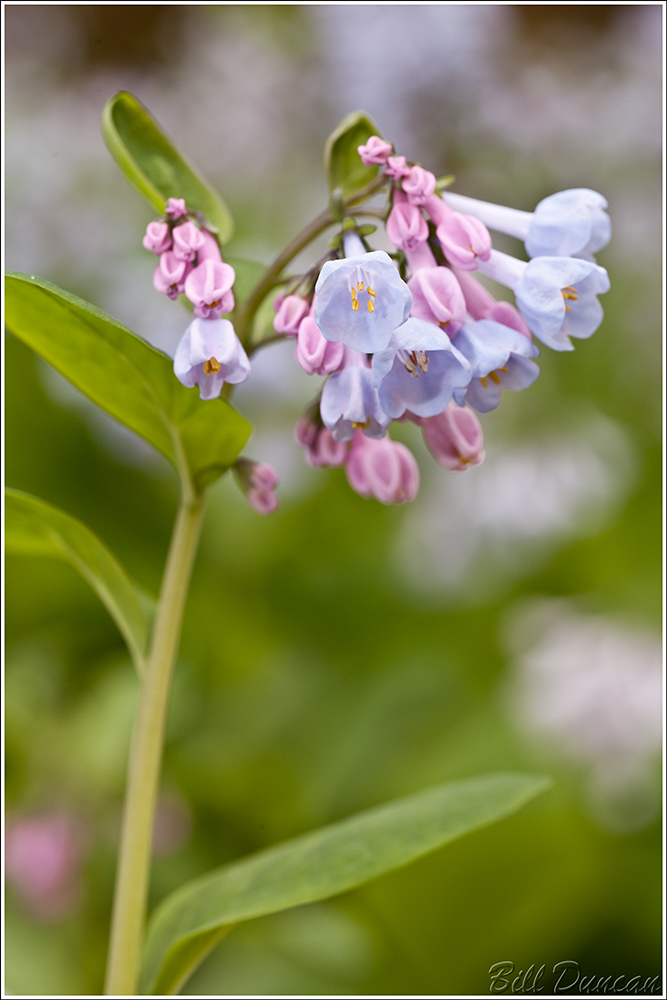
Anyway, back to the nature stuff, right?  Well, any nature photographer who still cares to keep his union badge has to shoot the cliched Bluebell macro shot, right?  Here it is.

IMG_3815

“Nature Porn″

Technical details: Canon EOS 5D Mark II camera, EF100mm f/2.8L Macro IS USM, ISO 160,  f/8, 1/10 sec

Of course, anywhere in the Ozarks at this time of year is going to be heaven for any birder who is worth their salt.  St. Francois SP is definitely no exception.  During my several visits over the last month, I loved listening and watching the nesting wood warblers and other songbirds as they busily setup their territories, build nests and feed themselves.  I used to think the Romanticists’ metaphorical descriptions of spring as a bunch of overly sentimental hogwash.  Now I find myself just as captivated by this line of interpretation as I do the underpinning that natural history presents.  What heaven is spring!

A week or so following Sarah’s and my trip, Steve gave me a guided tour of the last trail I had yet explored at St. Francois SP: “Mooner’s Hollow”.  A beautiful sloped-shelf waterfall, rocky outcrops and wonderful examples of spring ephemeral wildflowers along the river bottom of Coonville Creek Wild Area were the expected highlights.  What we were not expecting was the fortunate stumbling upon of a Blue-grey Gnatcatcher’s nest!  The second smallest bird in the state, these guys build a nest that is similar in size and construction to that of the state’s smallest, the Ruby-throated Hummingbird.  In the picture below you can hopefully get a look at the construction materials of plant fibers, spider webs, fur and lichen, which is used so beautifully to camouflage the nest.

I watched the nest for a couple of hours.  In this little time I noticed the pair did not stay at the nest, which makes me believe there were not yet any eggs.  The pair stopped at the nest for no more than 60 seconds.  During this time one of the pair would enter the nest, add a bit of lichen or other material they had brought, do a little manipulation and then they would leave again.  This would be repeated every 15 – 20 minutes.  I hope to visit the nest soon to see if eggs, or perhaps even chicks might be found.

IMG_2992

“Not Just Gnatcatching”

Technical details: Canon EOS 7D camera, EF500mm f/4.5L USM lens, ISO 640,  f/6.3, 1/320 sec

This spring I have been fortunate to spend a fair amount of time in the rugged, karst topography that is so unique to the Ozark Highlands.  This continues to bring to mind what it must have been like to travel and exist in this country before ‘modern conveniences’ were introduced to muddle the experience.  A great series of roads can take you to within a ten mile hike or less to basically any spot on the map in Missouri.  For now, I leave with a great quote from that Confederate bushwhacking bastard, Sam Hildebrand.  This is in reference to a cave that is apparently located within or nearby St. Francois SP.  A reason for further exploring some day.

“We passed quietly through Butler County, along the western line of Madison, then through St. Francois and across Big River to those native hills and hunting grounds of my boyhood, known as the Pike Run hills.  The reader must bear in mind that these hills possess peculiar advantages over any other part of the country between St. Louis and the Arkansas line.  They look like the fragments of a broken up world piled together in dread confusion, and terminating finally in an abrupt bluff on the margin of Big River, where nature has left a cavern half way up the perpendicular rock, now known as “The Hildebrand Cave,” mouth to which cannot be seen either from the top or bottom.”

IMG_4082 2

“Fragments of a Broken Up World″

Technical details: Canon EOS 5D Mark II camera, EF17-40mm f/4L USM @ 24mm, ISO 100,  f/14, 1/8 sec

Bill & Steve’s Excellent Adventure, or On Quest to find an Overland Route to Jam Up Cave

I had read about and viewed photos of Jam Up Cave along the Jacks Fork River for a number of years.  Every source I could find made specific mention that the only way was by boat along the river.  The case being that I am still most comfortable and knowledgeable on my lug-soled boots, I figured it would be a while before I got a chance to see it.  Then, in one of the recent cover stories from the MDC’s Conservationist, Brett Dufur highlighted the Upper Jacks Fork and mentioned Jam Up Cave that lies at the confluence of Jam Up Creek and the Jacks Fork.  This prompted my friend Steve and his father to find an overland route via the Jacks Fork Natural Area.  Within a few days of their visit Steve graciously showed me the way.  I have marked what I believe was our general route to the cave from a small pullout.  County Rd OO 491 can be accessed off of OO north of Hwy 60 just east of the town of Mountain View.

Jam Up Cave Route

The hike was not too long, but it deserves highest marks in terms of the difficulty of the terrain.  We bushwhacked our way mostly along ridge tops but enjoyed the burn of moving up near 500 vertical feet.  I had my first look at the end of Jam Up Creek, a losing stream that vanishes underground among boulders and rubble of the karst topography that dominates this watershed.  We then entered the rear of the cavern where we were treated to views like these.  Can you find Steve in this one?

IMG_3419

“The Grand Perspective″

Technical details: Canon EOS 5D Mark II camera, Sigma 15mm f/2.8 EX DG, ISO 400,  f/8, manual blend of three exposures

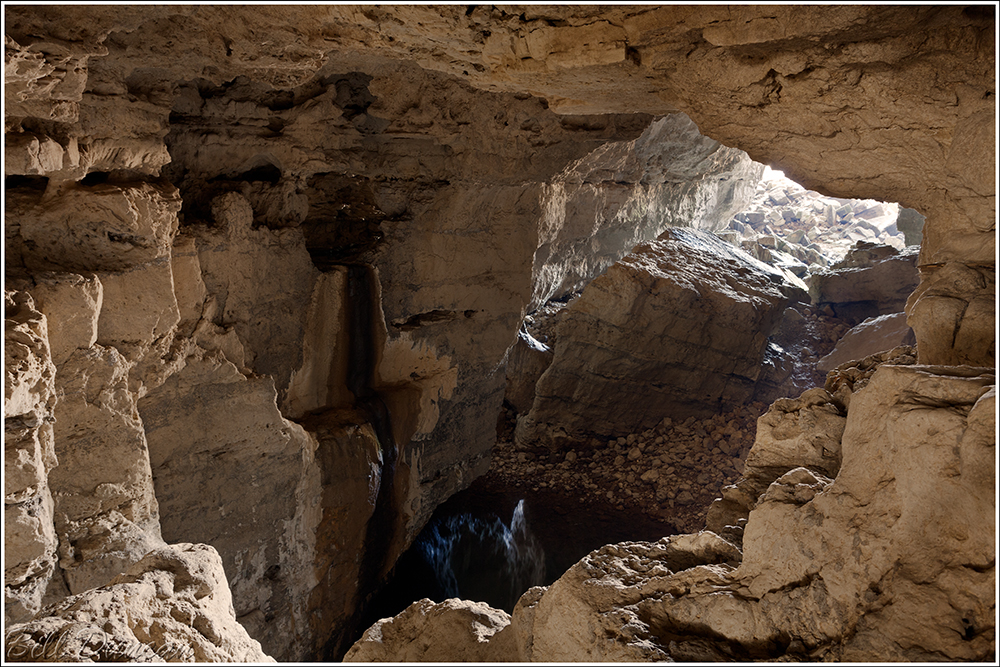
This next one is a bit deeper into the cave looking towards the front entrance across the forbidden pool.  The drop from this side to the pool would have been near 30-40 feet.  From both sides of the pool, impressive looks can be had of an underground waterfall.  Try as I might, I could not find an interesting way to make a photograph of it.  Did we find Smeagol?  We’ll never tell.

IMG_3449

“The Forbidden Pool″

Technical details: Canon EOS 5D Mark II camera, EF17-40mm f/4L USM @ 25mm, ISO 320,  f/11, manual blend of three exposures

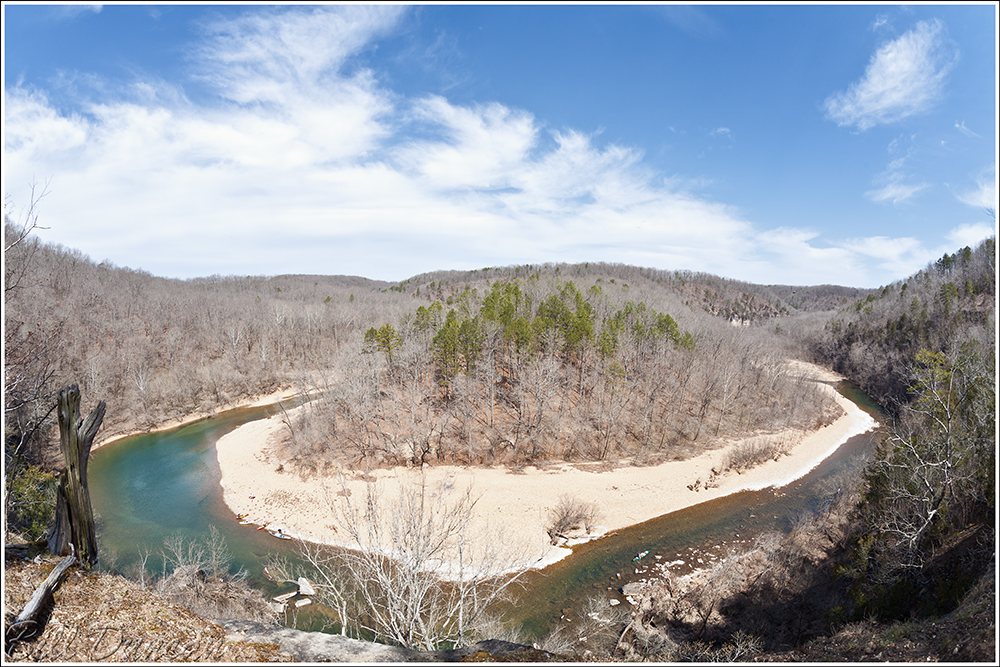
From here we made the climb out of the cave and up to the top of the bluff that offers great views of the Jacks Fork as it bends its way around the bluffs.  The ancient cedars attached to the edge of the bluffs were quite impressive and are not easily forgotten.

IMG_3363

“Jacks Fork Lookout″

Technical details: Canon EOS 5D Mark II camera, Sigma 15mm f/2.8 EX DG, ISO 100,  f/11, 1/100 sec

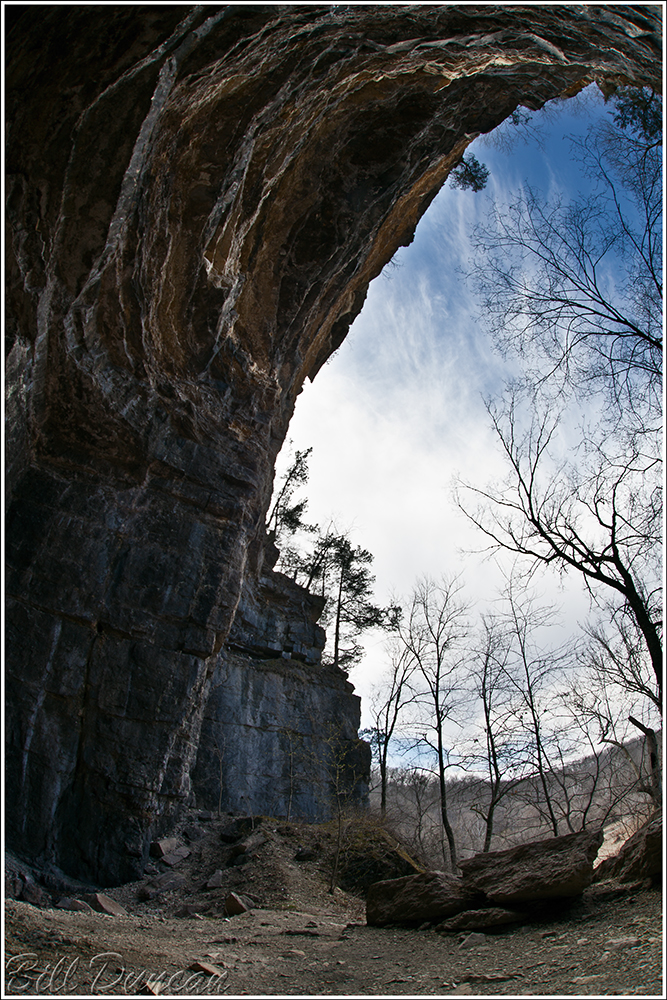
The “front door” of Jam Up Cave is this cavernous maw, the roof of which stands at over 100 feet high and nearly as wide.  This opening funnels into a much narrower tunnel that leads through a rubble field for ~500 feet to the other side of the forbidden pool that I discussed above.  This is a classic karst feature of the Missouri Ozarks and should rank up there with Grand Gulf, HaHa Tonka, the classic Ozark Springs and Devil’s Well.

IMG_3500

“Cavernous Maw″

Technical details: Canon EOS 5D Mark II camera, Sigma 15mm f/2.8 EX DG, ISO 100,  f/11, manual blend of three exposures

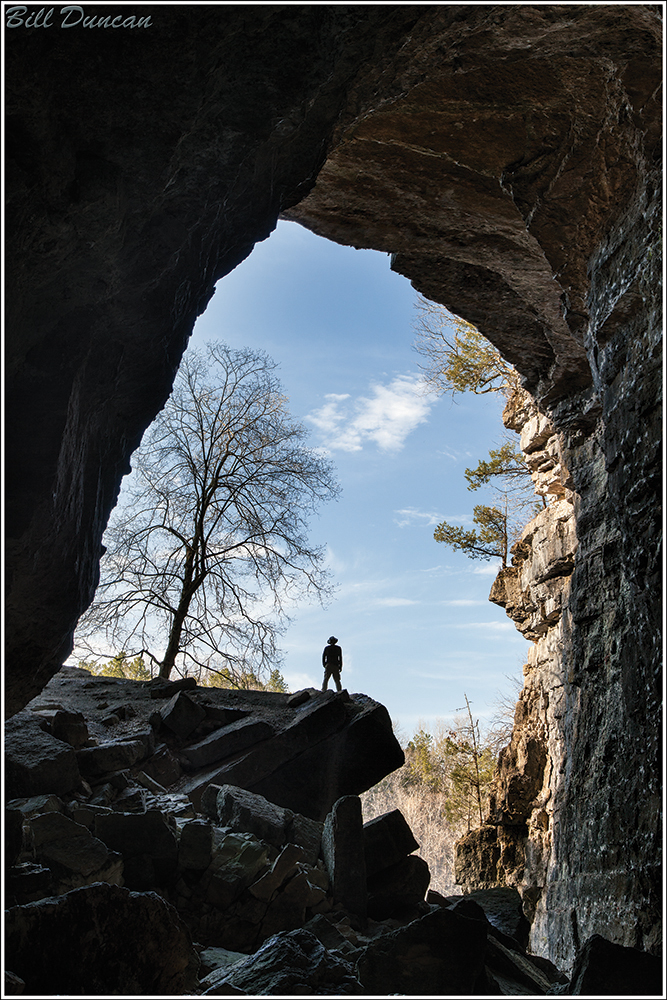
On the way out of the cavern we saw this impressive site and decided to give it a bit more sense of perspective by putting a certain pathetic creature into the scene.

IMG_3648

“Jam Up″

Technical details: Canon EOS 5D Mark II camera, EF24-105mm f/4L IS USM @ 47mm, ISO 160,  f/11, manual blend of three exposures

Why High Fructose Corn Syrup Sucks

I’ve mentioned my experience with my teeth before.  Today was just a cleaning, but when I saw this panoramic x-ray image of my mouth I had to have a copy.  The great folks at my dentist sent it to me.  Yeah, we’ve all seen the commercial.  HFCS is just fine when taken in moderation.  Well, so is smack, I’m sure.  Ever try doing just a little H?  Yeah, probably not.  Feel free to use this as a tool to inform your young ones that peanut butter cups are not a staple food.  😉

Ozark Bill's Choppers


Location Spotlight: North America’s Most Endangered Ecosystem, Tallgrass Prairie – Part II

So, a week or two after the weekend trip that Steve and I made to SWMO Sarah told me she had a hankering to go on a bird/photo trip to the same area.  She didn’t have to ask me twice.  😉  We loaded up the N.E.V. even though we were getting reports that the world had ended the day prior due to a dumping of snow and ice.  Not really knowing what to expect, I shoveled enough of the ice and snow to back out of our driveway and hit the road.  We were expecting to travel the whole way doing 30 mph or so and we knew we might even be forced to turn back if the conditions were too dicey.  Well, I guess it goes to show how unused to driving in winter weather we have become in this state, because once we got outside StL County, the roads were perfect the entire trip!  We did make our way north for a stopover in KC for some BBQ before heading back home, and they did get a foot or more of that weird white stuff, but by the time we made it there on Sunday, the roads were in pretty fair shape.

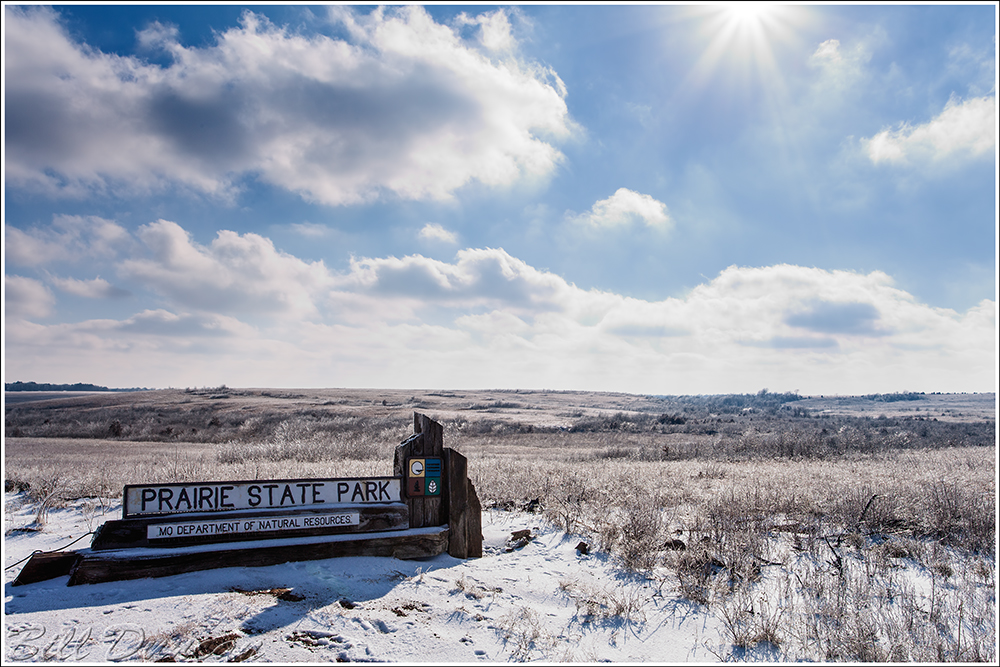
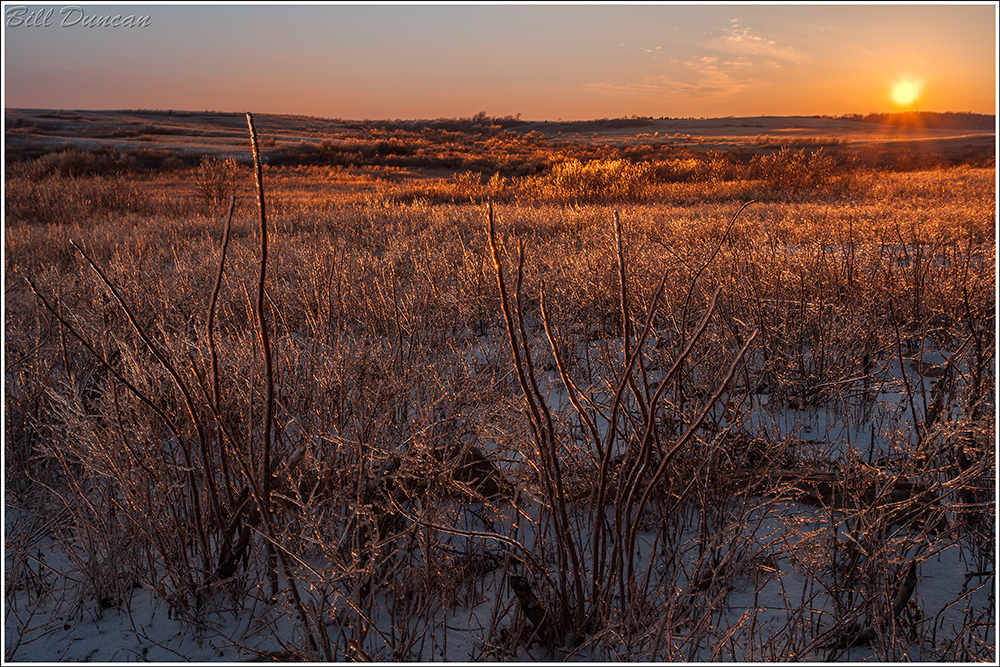
Okay, enough about our life, get with the picture making and depressing conservation talk, right?  We arrived at PSP with about a half day’s worth of light remaining to do some birding from the car, watch the bison, shoot some landscapes and visit the visitor’s center.  Dana was there, but he seemed pretty busy so we didn’t stop to chat this time.  The park was beautiful!  They had obviously received more of the “freezing rain” type of precipitation (on the east side of the state it was mostly “sleet” and snow), as nearly all the vegetation was enveloped in ice.  The look of the prairie was captivating as I hope I recorded in some of these images.  The sky was partially cloudy and moving quickly, and every five minutes the lighting changed dramatically pulling the eye this way and that from our vantage point from top of one of the higher hills.  After throwing a handful of fruits, nuts, grains and grubs into my mouth, I put the gear together, jumped onto the hood of the car and made this image…

     IMG_2872

“Welcome Back to Prairie State Park″

Technical details: Canon EOS 5D Mark II camera, EF17-40mm f/4L USM @ 29mm, ISO 100,  f/16, manual blend of two exposures

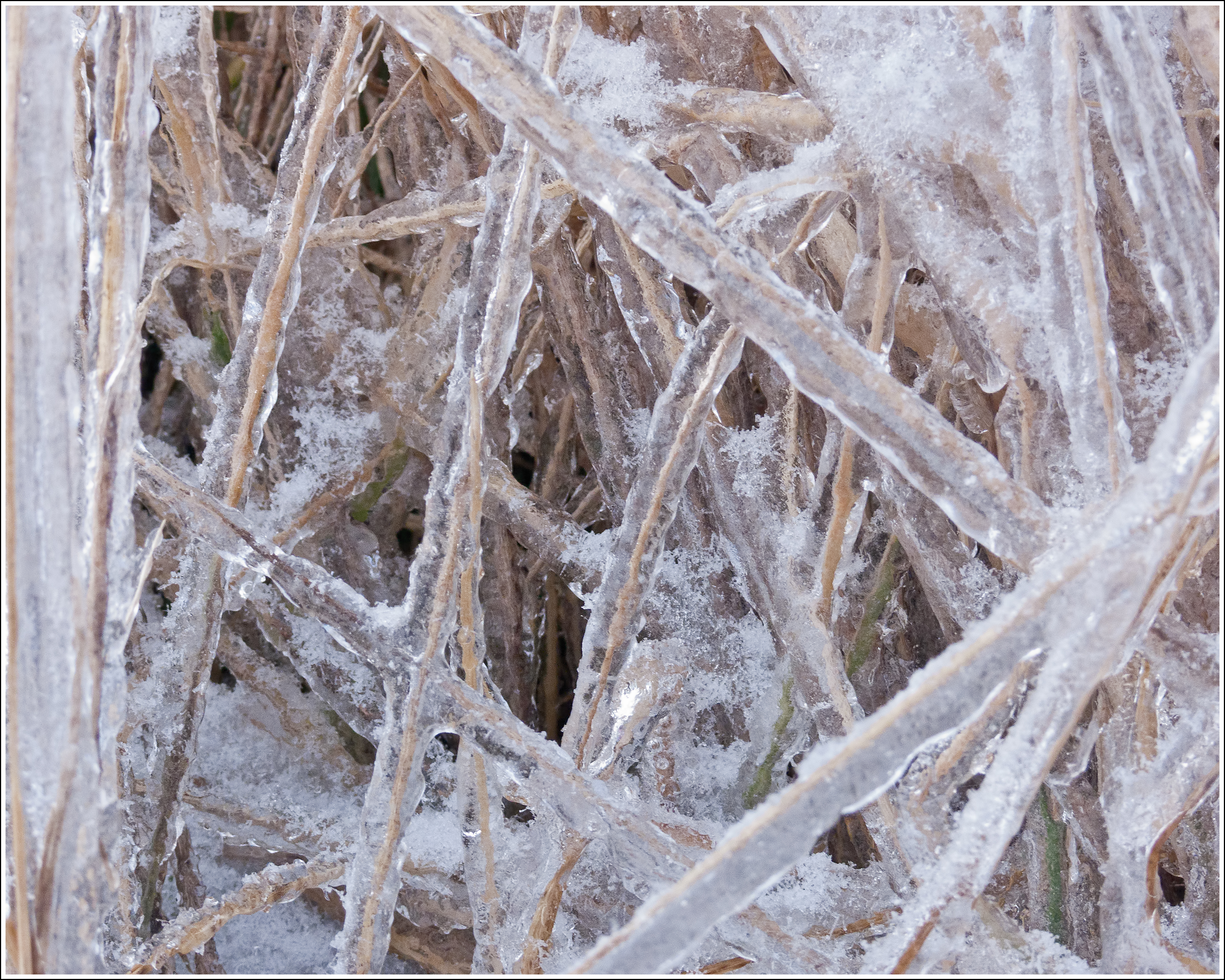
Sunlight was bouncing around the ice-encased grasses and branches.  The light did very little to battle the frigid temperatures and cruel winds on this lookout.  Sarah shot this closeup of what the prairie looked like.  I can’t say for certain, but I think this made it a little more difficult for the Harriers, Shrikes and Kestrels to catch their rodent prey.

P1070091

“Mighty Mouse’s Fortress of Solitude″

Technical details: Panasonic DMC-FZ50 Camera, 28mm, ISO 400, f/5.6, 1/250 sec, by Sarah Duncan

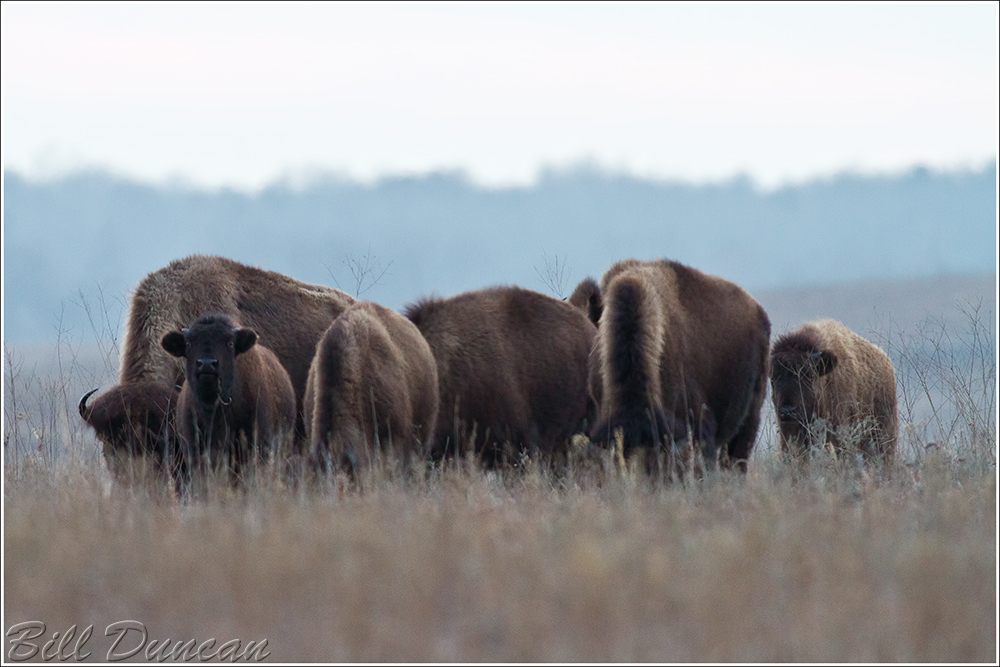
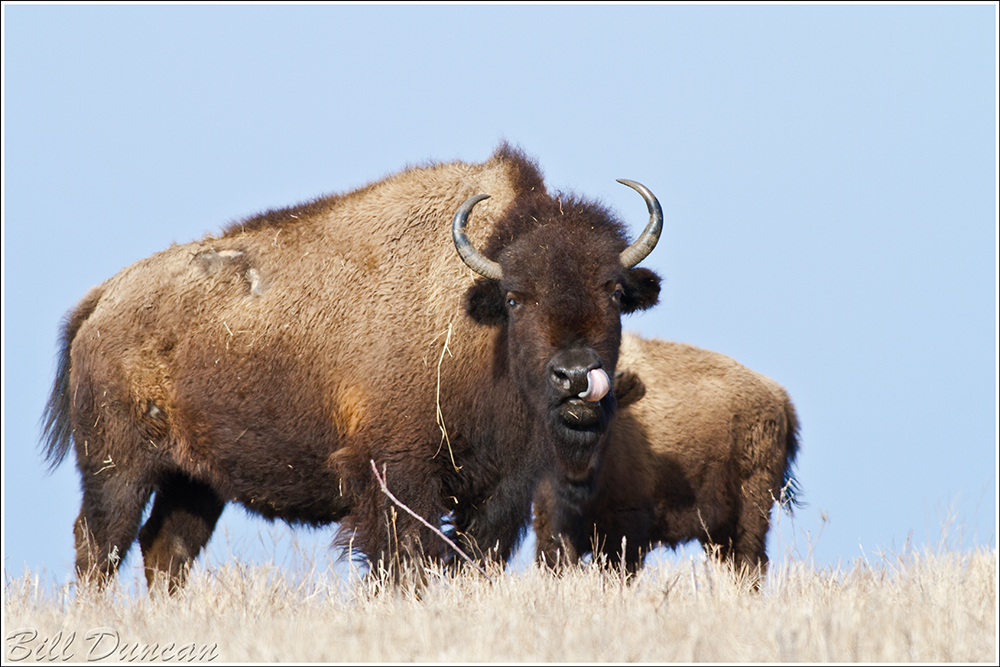
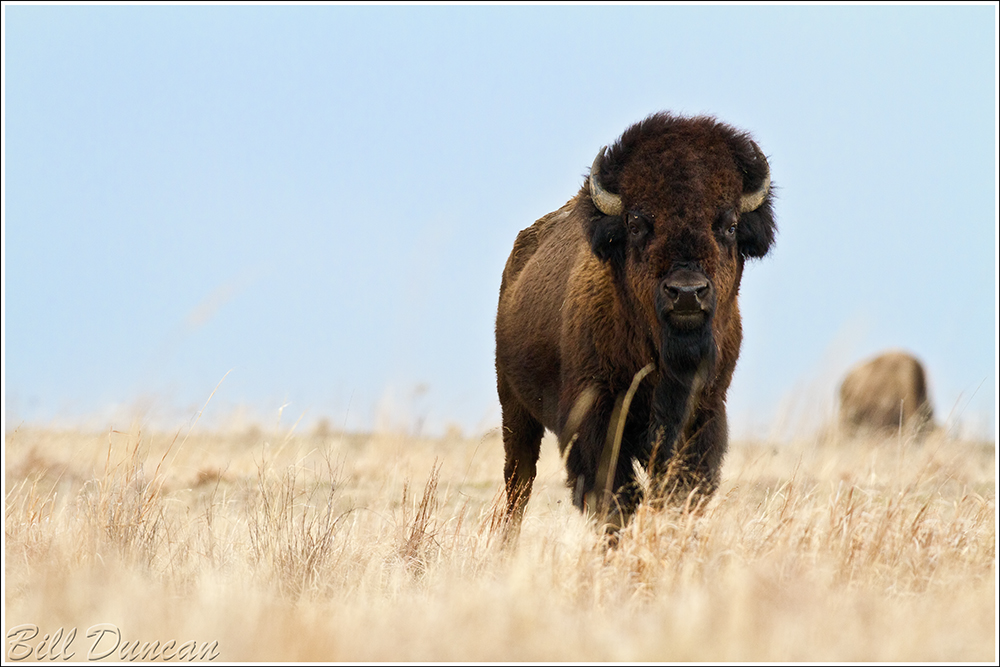
Don’t think I forgot about the bison.  Although we could watch them from afar during this visit, they were not close enough to the roads to take any photos.  Here’s one from the previous trip.  This is far from an artistic or technically perfect shot.  But, shooting at dusk with a 500mm and getting something usable with 1/40 second is pretty nice.  The rig was on a tripod, there was almost no wind, I used “live-view” and a remote cord to release the shutter.

IMG_0819

“The Inquisitor”

Technical details: Canon EOS 7D camera, EF500mm f/4.5L USM lens, ISO 1250,  f/5.6, 1/40 sec

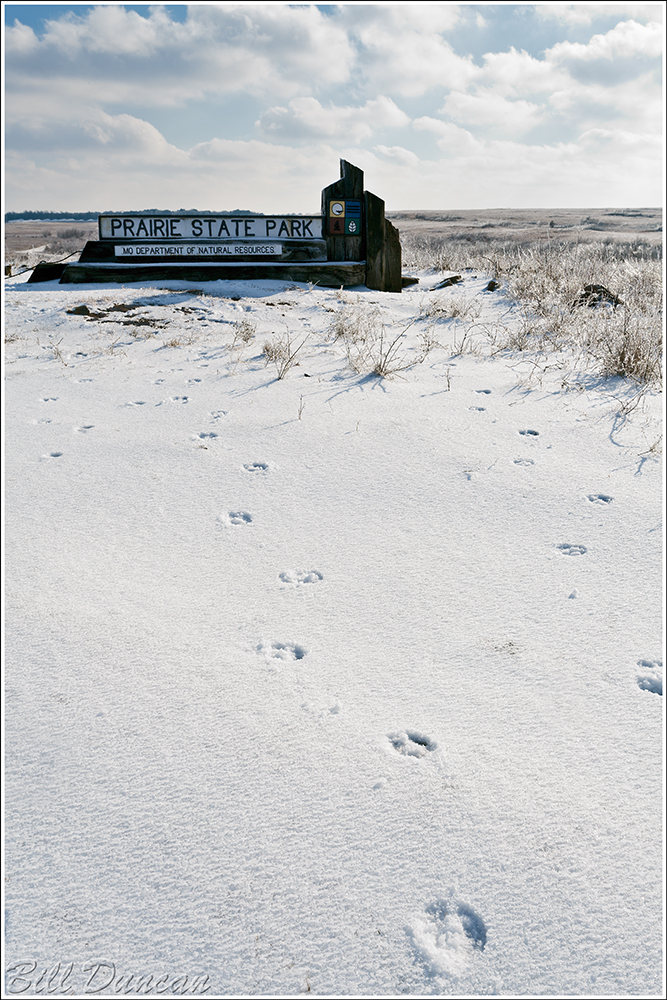
I’m still astounded by how much the bison will move in a day.  There isn’t a spot in the park that does not show signs of them.  Even though they were quite a distance away, the tracks we found in the snow declared they had been where we stood at least 12 hours previously.

IMG_2889

“The Forgotten Herd”

Technical details: Canon EOS 5D Mark II camera, EF17-40mm f/4L USM @ 33mm, ISO 100,  f/16, 1/40 sec

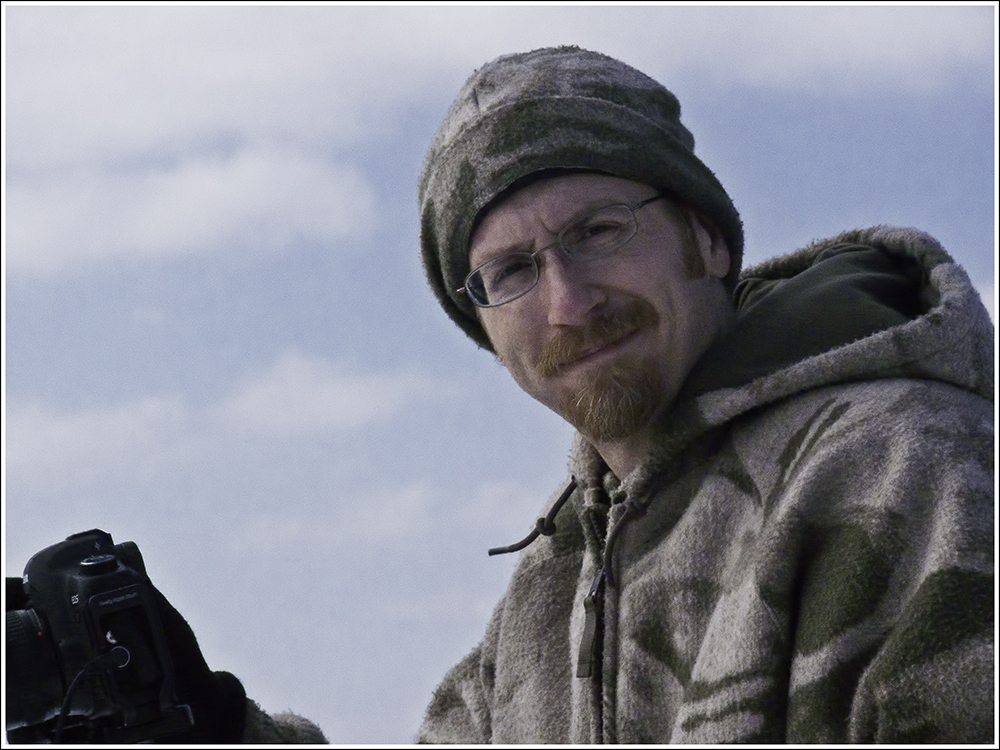
I know what you’ll think about this next image.  “Oh my! That pathetic creature must have stood outside under 17F and 30 mph winds for too long.  It must have been a painful death, his face being all contorted in that death-mask.”  Nope.  That is me…smiling.  It’s true.  I’m not sure, maybe it’s too many years of corporate America taking their toll.  Perhaps it’s the self-imposed, lifetime ban on cigarettes, Ben and Jerry’s and pig’s feet, but this is apparently how I smile now.  I’ve tried this in front of the mirror a few times since I saw this, and I’ve decided I won’t be doing it any longer.

P1070101

 “Pathetic Creature″

Technical details: Panasonic DMC-FZ50 Camera, 50mm, ISO 400, f/8, 1/640 sec, by Sarah Duncan

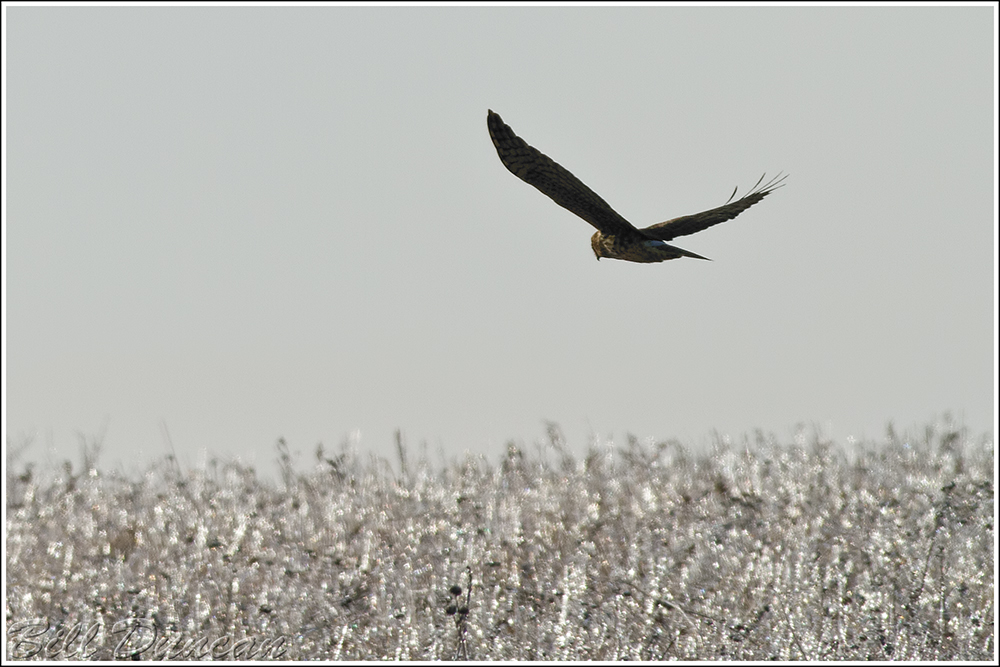
One of the more abundant bird species we observed during our visits in the prairies was the Northern Harrier.  As pictured below, their method of hunting is to fly low over the grasslands while listening for their prey.  These birds have keen hearing and specially developed facial disks like those of owls that help amplify sounds by directing them towards the ear.

IMG_1430

“Icy Heavens”

Technical details: Canon EOS 7D camera, EF500mm f/4.5L USM lens, ISO 400,  f/6.3, 1/4000 sec

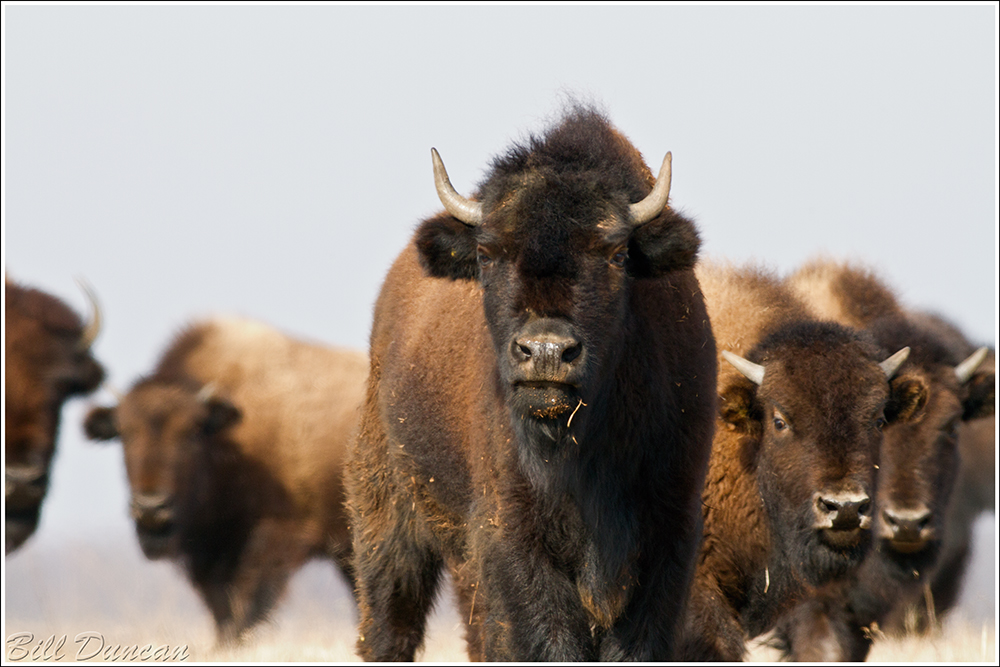
If I could do this, I wouldn’t have those crusty, woolen sleeves on these cold and windy days!  Look closely and you can see an example of something that plagues this herd.  Dana told us that they have a pretty bad time with conjunctivitis.  This has resulted in many of the animals having cataracts in one or both eyes as can be seen in this bull.  Good thing they have poor vision to start with?

IMG_0625

“Blind in One Eye, Can’t See Out the Other”

Technical details: Canon EOS 7D camera, EF500mm f/4.5L USM lens, ISO 400,  f/6.3, 1/640 sec

On our second day in SWMO, Sarah and I were dedicated to visiting a few prairies that we had not previously visited.  This was tough, because it meant leaving PSP.  But, we rose early and headed about 40 minutes north-east to the town of El Dorado Springs.  Our primary stops were two of the largest, eastern-most native tall-grass prairies – Taberville Prairie C.A. and Wah’Kon-Tah Prairie (Nature Conservancy and MO Dept of Conservation).  Because of the frigid temperatures, our hikes through these areas were limited and we spent most of our time birding from the car.  Wah’Kon-Tah, a term used by the Osage Indians to describe the “god-like” spiritual presence or life force that inhabits all things, was hilly and quite attractive.   A quick morning hike through a portion of Taberville resulted in very few birds, but many tracks were spotted, including coyote, in the fresh snow.

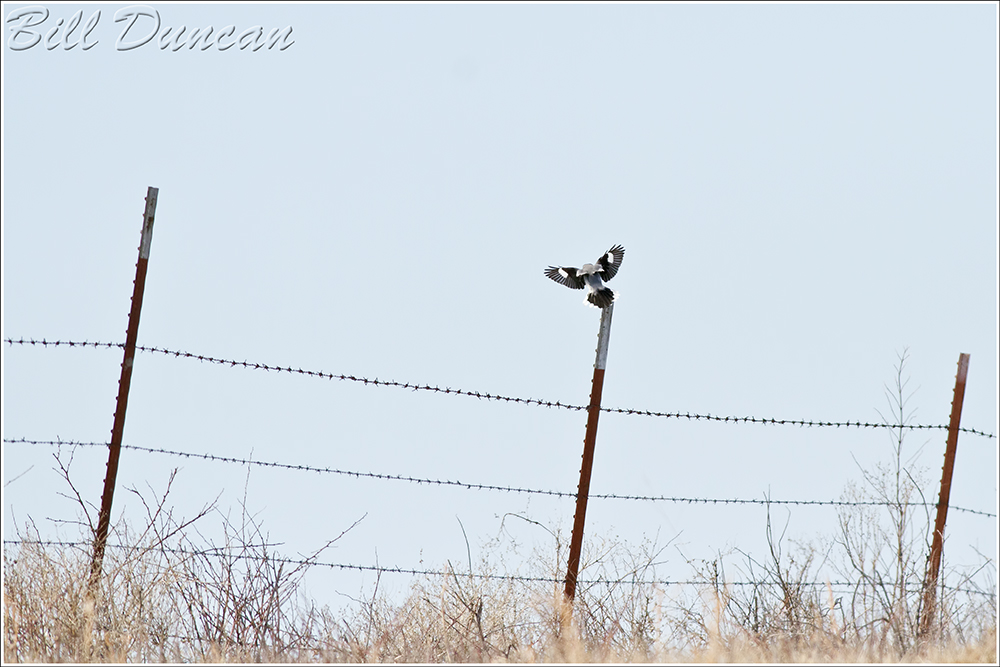
We also visited a couple of smaller prairies that were mere minutes away.  During a detour across snow and ice-covered farm roads to visit the backside of Monegaw Prairie C.A., we found our best bird of the day, a Loggerhead Shrike.  It was actively hunting while moving along a barbed-wire fence.

IMG_1447

“Loggerhead Shrike, February 2013”

Technical details: Canon EOS 7D camera, EF500mm f/4.5L USM lens, ISO 400,  f/5.6, 1/6400 sec

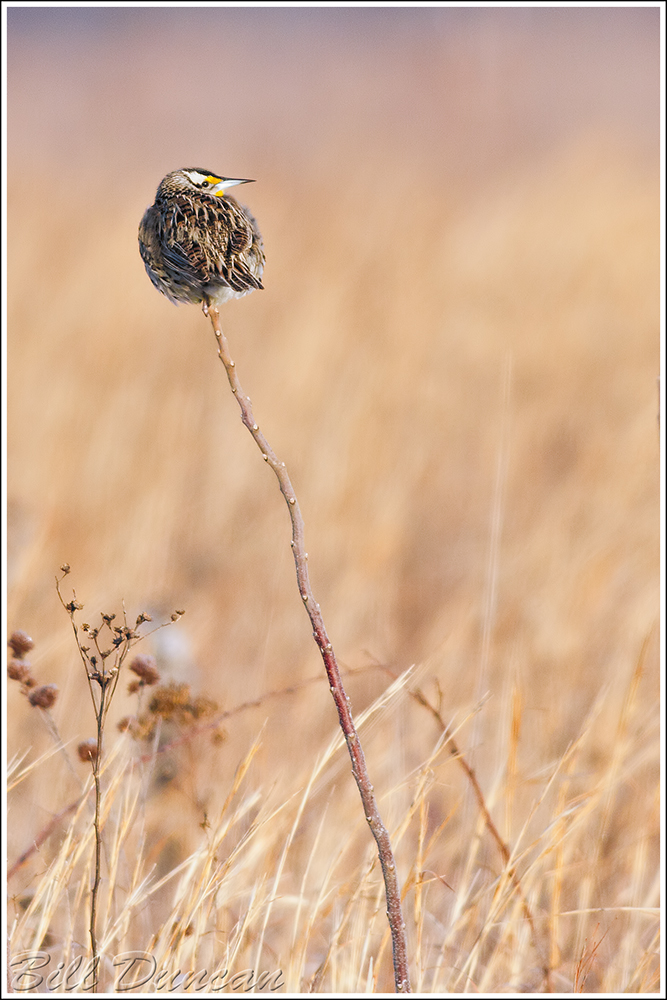
Another stop was the small, rectangular and down-right charming Schwartz Prairie.  This slice of prairie is owned and managed by the Missouri Prairie Foundation and is named for conservationists, Charles and Elizabeth Schwartz.  The Schwartzes worked directly towards prairie chicken conservation and were a fascinating couple.  Not only were they active conservationists, they were authors, film-makers and illustrators.  Libby and Charles were responsible for the superb field guide, Wild Mammals of Missouri, and Charles was the illustrator of Leopold’s landmark A Sand County Almanac: And Sketches Here and There.  I am looking forward to doing some more research on this couple and hopefully picking up some of their harder to find books and videos.  This photo of an Eastern Meadowlark was taken at Schwartz Prairie.

IMG_1444

“Prairie Land Ethic”

Technical details: Canon EOS 7D camera, EF500mm f/4.5L USM lens, ISO 400,  f/5.6, 1/1250 sec

So, that covers most of the highlights regarding the experiences and images I wanted to share from our recent prairie adventures.  A grand total of three short winter days are not nearly enough.  I am very much looking forward to future visits to the western side of the state, to witness these endangered habitats during the growing season.

“Whatever else prairie is—grass, sky, wind—it is most of all a paradigm of infinity, a clearing full of many things except boundaries, and its power comes from its apparent limitlessness; there is no such thing as a small prairie any more than there is a little ocean, and the consequence of both is this challenge: try to take yourself seriously out here, you bipedal plodder, you complacent cartoon.”

-William Least Heat-Moon-

IMG_2950

“Frozen Oceans of Grass”

Technical details: Canon EOS 5D Mark II camera, EF17-40mm f/4L USM @ 37mm, ISO 100,  f/14, manual blend of two exposures

Location Spotlight: North America’s Most Endangered Ecosystem, Tallgrass Prairie – Part I

I’m rooted in the prairie four generations deep, and those brown hills make the spirit rise in me.  It’s the land I do my dreaming in, the place where I’ve found peace.  Can you tell me why it is I’m going to leave?

-Candace Savage-

Ozark Bill has been most fortunate during the past few weeks.  I have been able to visit some public prairie lands in south-western Missouri during two overnight trips.  The first, and topic of this post, was a trip that Steve and I took to Prairie State Park, near Lamar, MO.  We had planned on visiting a potential five prairie remnants, but we soon discovered that our 1.5 days was a bare minimum to get to know PSP, so that was as far as we got.  A couple weeks later, Sarah and I made a similar trip.  Back to PSP and as well we visited a few prairies in the El Dorado Springs neighborhood.  That will be the subject of part two of this spotlight.

Did you know?  As the title alludes, Missouri has less than 1% of its pre-European settlement 155 million acres of prairie remaining.  Thanks to John Deere and his insidious prairie-busting invention, 99% of all tall-grass prairie was forever lost in less than 200 years of intensive agriculture.  Most of the land encompassing the 3700 acres of what is now called Prairie State Park is composed of original tall-grass prairie.  The reason it escaped the plow?  For the same reason much of the Flint Hills of eastern Kansas – the top soil contains large quantities of rock, which made it too difficult to plow.  Instead, ranchers have used these areas to graze domestic cattle.  Since we also wiped the American Bison off the map, this was something of a benefit to this ecosystem, as the tall-grass prairie benefits from grazing and fire disturbances.

Okay, enough of the depressing legacy our glorious westward expansion.  There must be something left to celebrate considering we were willing to spend nearly two thousand miles in the car.  Yes there is, and I hope to show what I can of what there is still to find by taking a winter trip to Missouri’s remnant prairies.
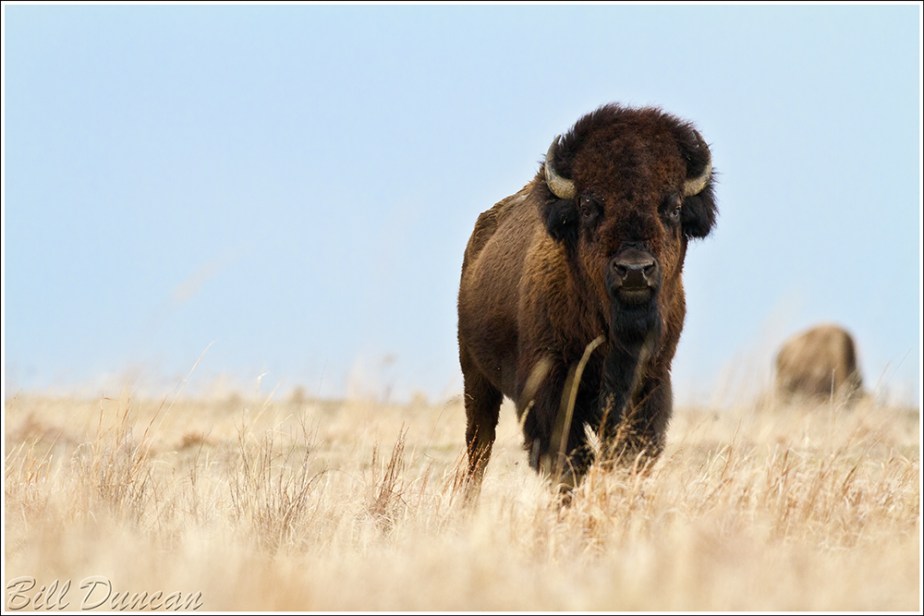
IMG_1100

“Betwixt & Between”

Technical details: Canon EOS 7D camera, EF500mm f/4.5L USM lens, ISO 640,  f/6.3, 1/640 sec

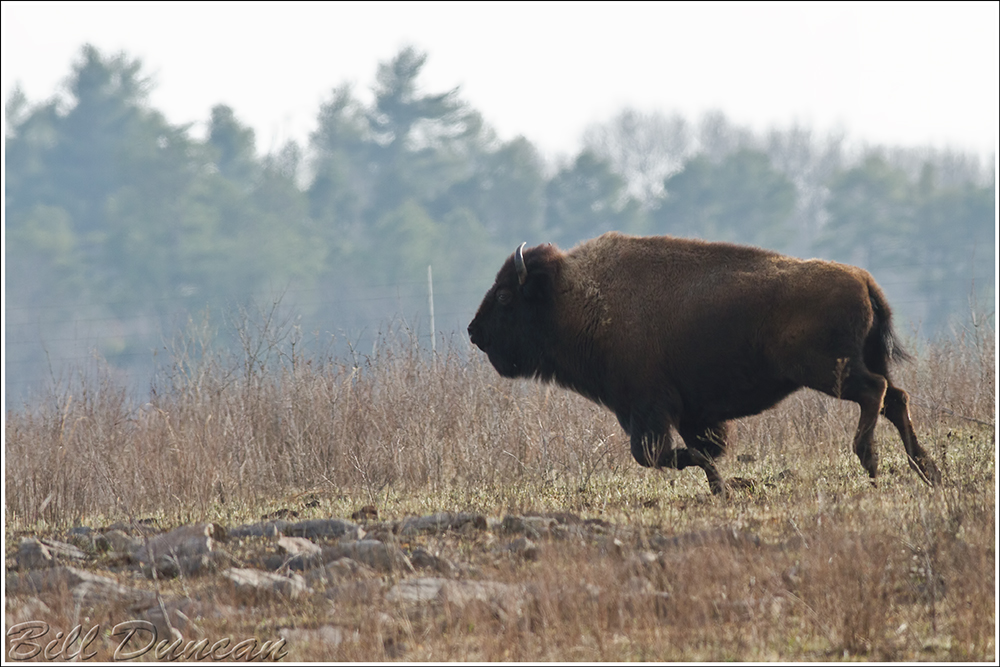
I can’t see a way of knowing the prairie without making multiple trips across the calendar.  Each of the green months will have a totally different blooming forb (more than 800 species in total) composition; similarly, each month of the calendar will have a new wildlife mix as migration consistently shuffles bird species.  The image of the bison above was named for the utterly fascinating behavior that these free-ranging animals demonstrated as Steve and I moved around the trails of PSP.  Signs on the drive into the park kept us focused on the fact that these were in fact wild-animals with unpredictable tendencies and not to get too close to them.  Well, this puzzled me, to say the least.  So, we asked for clarification from the nice fellow named Dana Hoisington, the visitor’s center naturalist. He gave us the detail we were looking for: 100 yards.  Okay, so while we where traversing the hills of the tall-grass, soaking up the breath-taking scenery and doing our best to find some interesting birds, we will gladly steer clear by maintaining the advised restriction from these one to two ton herbivores that can move at speeds up to 35 mph.  If we must.

We left the visitor’s center no more than an hour of arriving at PSP, hiking up the hill of what looked to be a pleasant, long hike.  In less than five minutes we came across two groups of the herd, both on opposite sides of the trail we were traversing.  The larger group comprised nearly 40 animals, the smaller came to about 10-15.  How aware they were!  They watched us with what appeared to be great curiosity, never lowering their gaze.  As we headed up the hill, in between the two groups, we noticed they were slowly moving towards us.  Curious.  They did not seem spooked, defensive or aggressive, so we decided to make our slow but steady progress up the hill, away from the visitor’s center.  We quickly realized that we would probably not be able to make it between the two groups before their progression would result in the three of our groups “meeting up”.  We decided to move back the way we came a bit, thinking that maybe the two groups were uncomfortable with the idea of being “split up” by two bipeds carrying too much optical equipment.  Imagine our increasingly apparent consternation at the fact that the two groups were now both moving towards us, NOT towards each other!  It seemed like someone forgot to tell the bison the 100 yard rule!  We increased our pace back to the visitor’s center at the same time that Dana was climbing the hill to assist us!  He told us this was very odd behavior that he had not observed before.
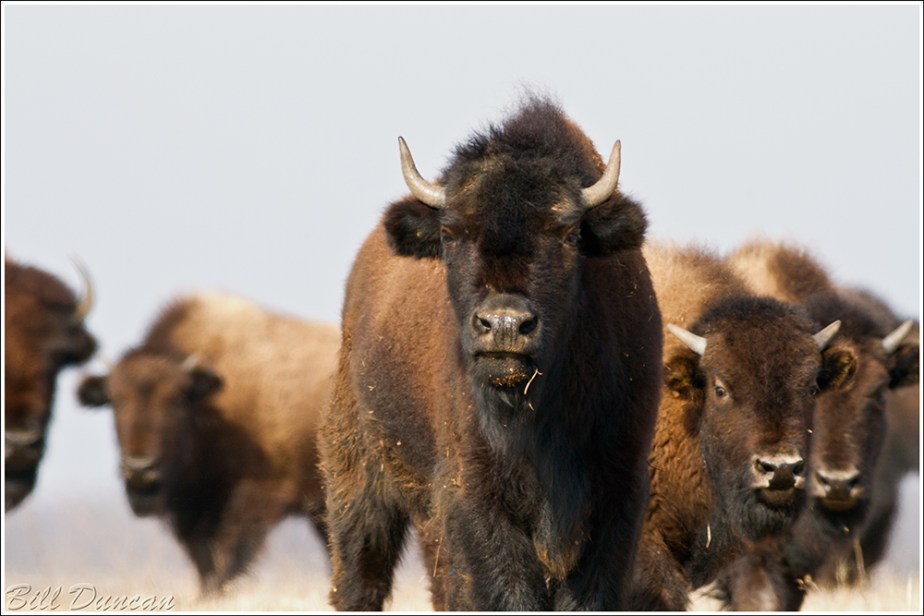
IMG_0649

“Tons of Fun”

Technical details: Canon EOS 7D camera, EF500mm f/4.5L USM lens, ISO 400,  f/6.3, 1/800 sec

The shot above was taken right before we really decided it was time to retreat.  They did not seem aggressive at all, but down right fascinated.  It would have been an irresponsible experiment, for sure, but I would love to have known what would have happened if we stayed still and let them continue towards us.  We eventually made our way around this coalesced herd and were able to get a nice walk through a good portion of the park.  The real puzzling part of their behavior is that during other instances of walking towards similarly sized groups, they had a totally opposite reaction of running.  Yes, running, galloping, I’m not sure the correct name, but wow.  After observing this, the silent question each of us had about what would we do if these limber bulks decided to charge us became mostly academic.  I do not believe there would be much that could have been done.  Ideas did come up: raise arms and tripods over head and yell with deep voice, play matador and dodge at last minute, roll into ball and protect head….  After seeing these guys slowly trod between feeding stations at places like Lone Elk Park, I am still astonished at observing the speeds at which they can move!  Next time I will need to remember to watch “Dances with Wolves” before I do this.
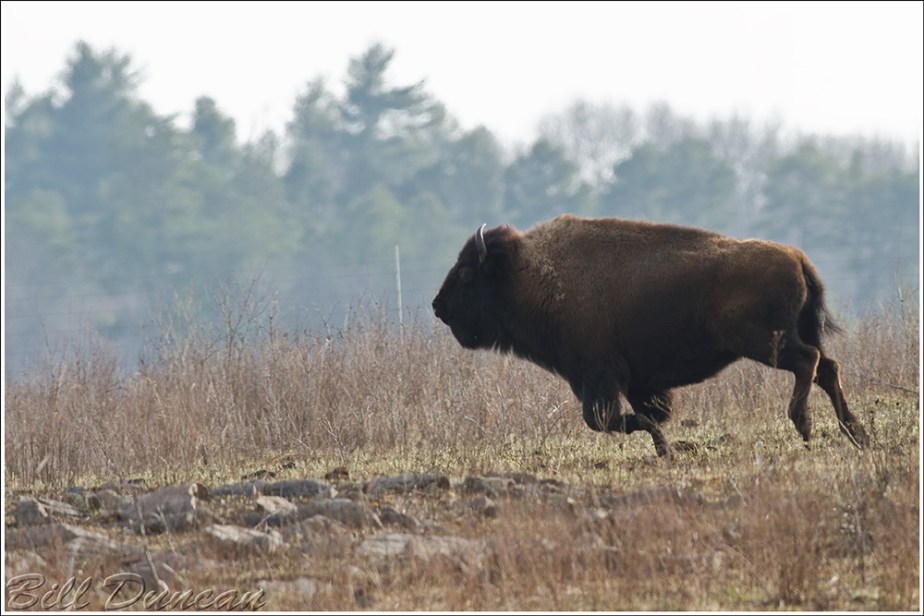
IMG_0724

“Terrestrial Thunder”

Technical details: Canon EOS 7D camera, EF500mm f/4.5L USM lens, ISO 640,  f/6.3, 1/1000 sec

Being able to witness the sound and feeling of small numbers of these animals thundering across the hills makes one wonder what it would have been like to observe endless thousands doing so across the great plains 200 years ago.  Shortly after spooking this group we came across the skeletal remains of two bison, minus the skulls.  It was interesting to observe the elongated vertebrate, located in the hump, that help support the huge, muscular neck of these animals.  An adult male bison’s head can weigh up to 500lbs, so it seems obvious the need for such support.
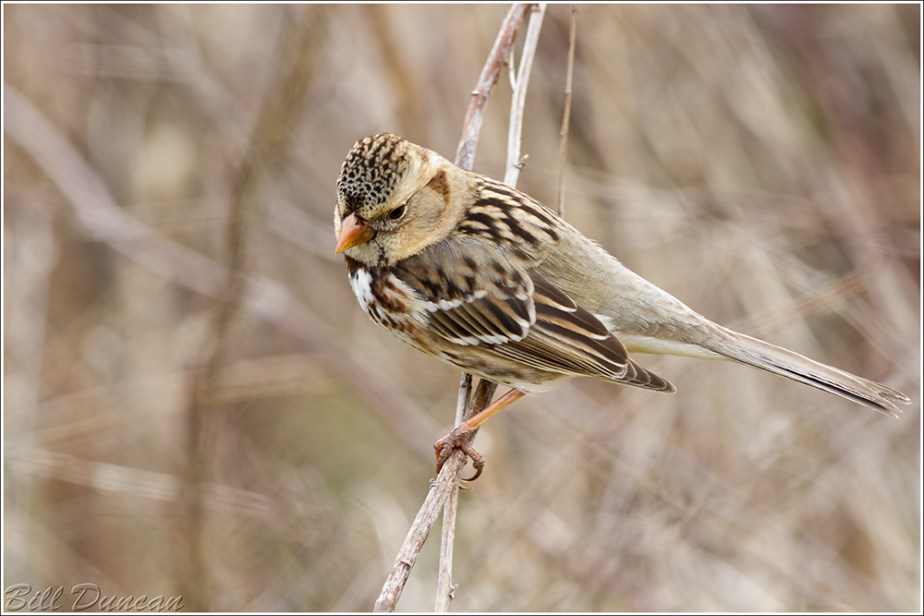
IMG_1097

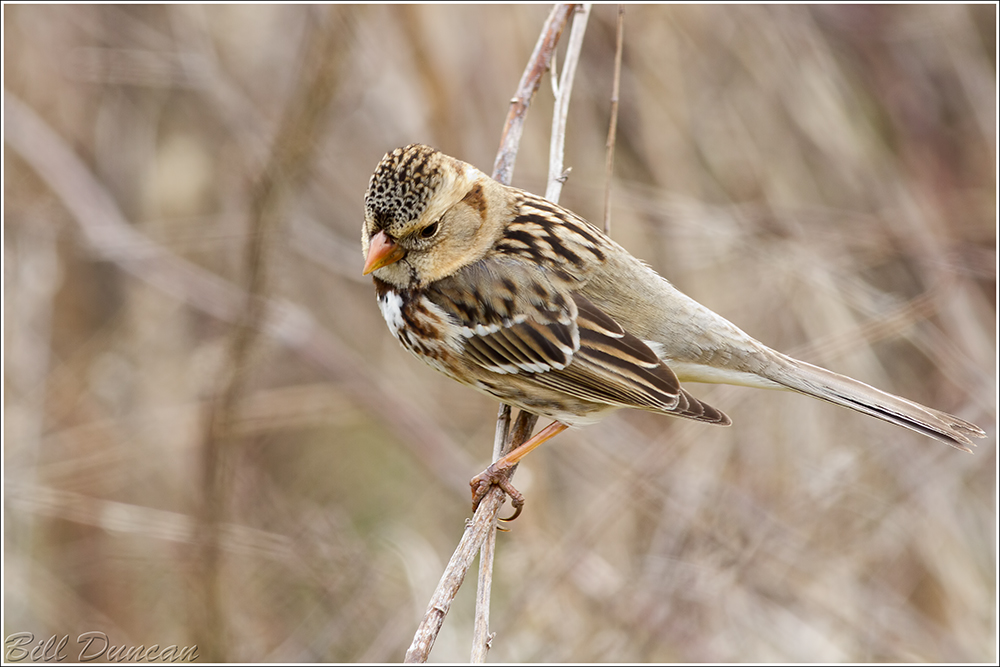
“Harris’s Sparrow, February 2013”

Technical details: Canon EOS 7D camera, EF500mm f/4.5L USM lens, ISO 640,  f/7.1, 1/200 sec

Harris’s Sparrow winter’s in a narrow band across the great plains and is rather common in western MO.  We were able to spot what must have been near 50 around PSP during our visit.  This was a new one for my bird species photograph list and a lifer for Steve.  The animal pictured above is a juvenile and does not yet have the characteristics black mask of the adults.

When we thought of the birds we had a chance to find and photograph during this visit an obvious short list came to mind: Greater Prairie Chicken, Prairie Falcon, Merlin, Rough-legged Hawk, Short-Eared Owl, Harris’s Sparrow.  For me, two species were at the top of that list, GPCH and PRFA.  I thought that at this time of year and the relative scarcity that we would have less than a 2% chance of finding Prairie Chicken and a much smaller chance at making photographs.

With a statewide population that once was a million or more birds, the GPCH flock in Missouri is now an estimated 500 birds.  The historical range of this species ran from the Atlantic coast, north to the lake states and well into central Canada, south into the Arkansas Ozarks and as far south as Texas.  The current range is now mostly centered around the middle plains states, including the Dakotas, Nebraska and Kansas, and the species as a whole is estimated to be around 450K birds and considered vulnerable.  The Atlantic coast race, known as the “Heath Hen” went extinct in 1932 and the TX coast race, “Attwater’s Prairie Chicken” is now known as the most critically endangered bird in the United States.

Great efforts are being put forth to help save Missouri’s GPCH flock; however, many believe it may likely be too little, too late.  Hunting has been banned for nearly 100 years, so why the problems?  Loss of habitat.  Tall-grass prairie and similar ecosystems are what these birds require and they need a minimum of between 10,000 and 20,000 acres of unfragmented native prairie habitat.  There are simply no contiguous tracks of private or public prairies in MO that will provide this kind of area needed.  In addition, a series of well done investigations from Kansas State University discovered that most GPCH hens would avoid nesting or rearing young within 1/4 mile of power lines and trees and 1/3 of a mile from roads.  Considering most prairie tracks in MO are less than 2500 acres and that most of these are cut with roads or interspersed with private farm or ranch lands, it is no wonder that the flock has continued to dwindle.

Not all hope is lost for the future of the GPCH in Missouri!  Proper management of habitat is currently ongoing at the Nature Conservancy’s Dunn Ranch in north-west MO.  Combined with the nearly 8000 acres of the nearby Neal Smith NWR across the boarder in Iowa, this mostly contiguous prairie stretch may keep the GPCH nesting in the Show-Me State for future generations to witness.

So, did we find the birds?
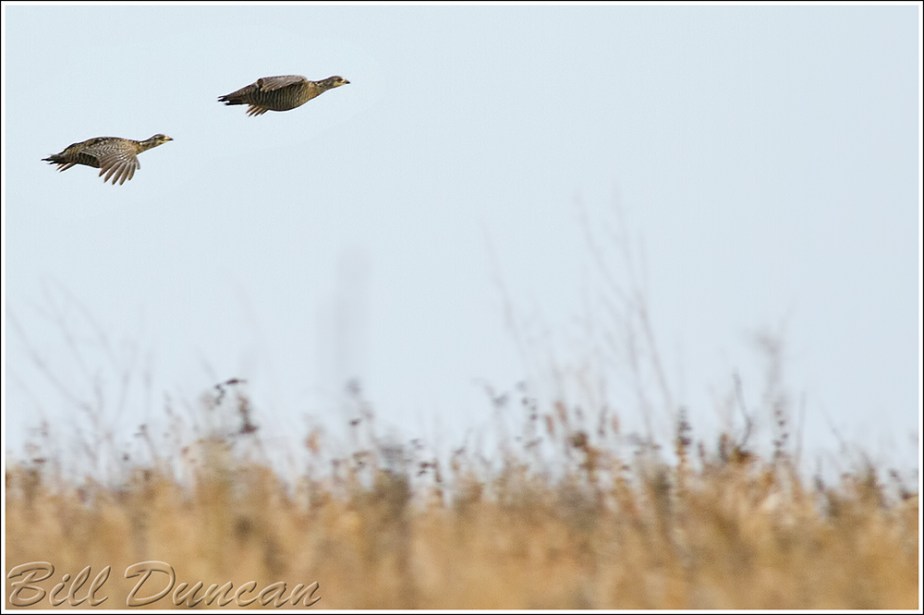
IMG_0944

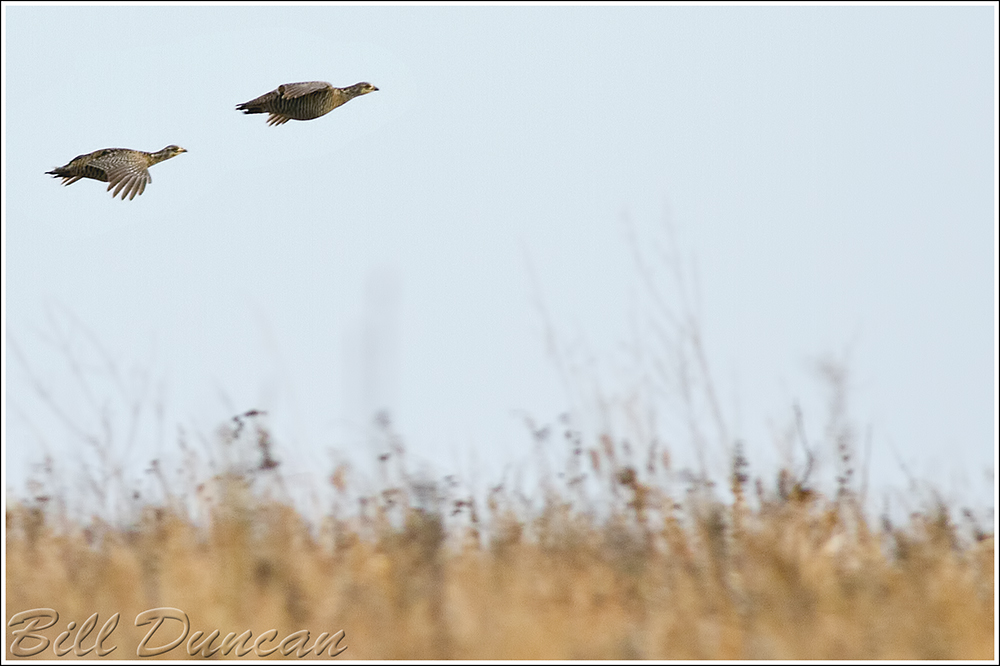
“Greater Prairie Chickens in Flight, February 2013”

Technical details: Canon EOS 7D camera, EF500mm f/4.5L USM lens, ISO 1000,  f/5, 1/1000 sec

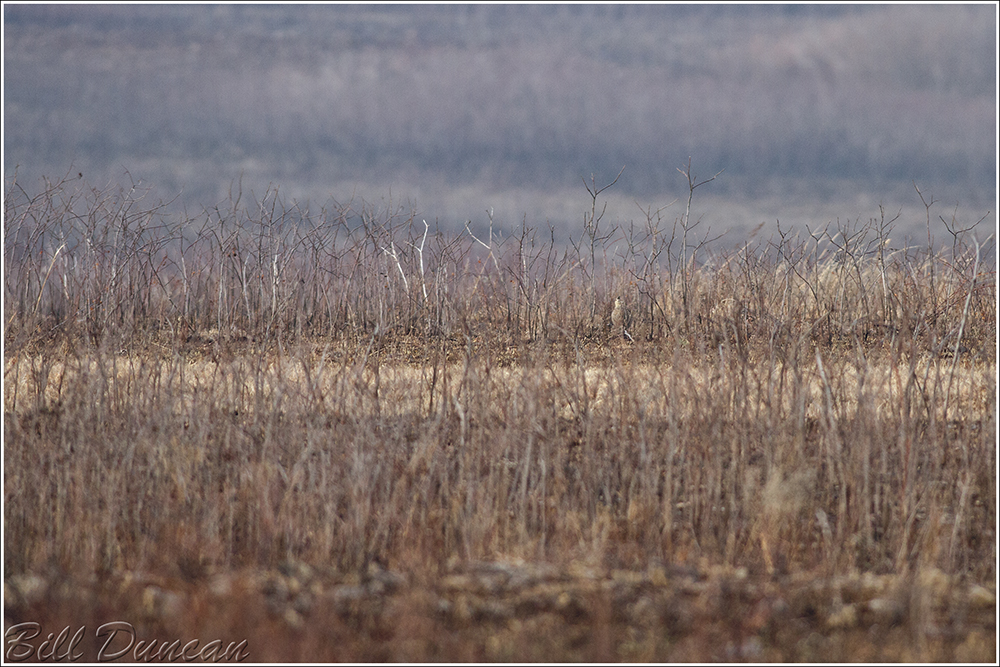
Yes!  Hiking through a rather nondescript section of the prairie, all of a sudden we flushed a couple of birds.  As I mentioned earlier, I did not really expect that we would be fortunate enough to spot them during winter, so I tried to turn them into anything else.  Quail, doves, anything but GPCH.  As Steve and I talked it through and looked at my first batch of crappy images I was able to shoot off, it seemed more and more unlikely they could be anything but GPCH.  As we closed within 100 yards or so we stopped to see if we could find them using the scope and my big camera lens.  I felt our chances would be very slim here as well.  What would the chances be of finding these birds that can camouflage so well in the prairie vegetation?  In a relatively short time I was shocked to hear Stephen proclaim, “I think I found one!”  This was a great job from someone not completely accustomed to using a scope for birding.  I was able to find the bird in my camera and squeezed a few shots and discovered the bird was watching us!  Can you find him in the photo below?
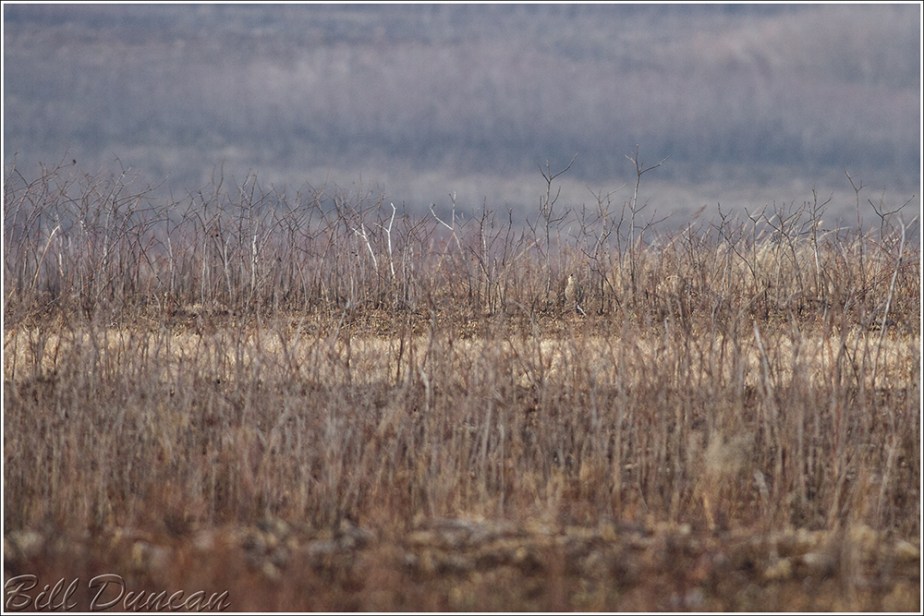
http://www.flickr.com/photos/ozark_bill/8511090731/in/photostream/lightbox/

“Where’s Waldo?”

Technical details: Canon EOS 7D camera, EF500mm f/4.5L USM lens, ISO 1000,  f/5, 1/640 sec

This cover’s some of the highlights and a few images made during our brief visit.  I will continue to post images from this trip on Flickr and I will look forward to sharing stories and more photographs from the trip Sarah and I made back to this region a couple of weeks later.  Much of the information I presented in this post and further reading can be found in these great publications:

  • “Public Prairies of Missouri 3rd Ed” 1999. Free Publication by the Missouri Department of Conservation.
  • “Prairie: A Natural History” 2004. Candace Savage. Greystone Books.
  • “Save the Last Dance: A Story of North American Grassland Grouse” 2012. Noppadol Paothong. Noppadol Paothong Photograpy LLC.
A Couple of Different Birds at Riverlands

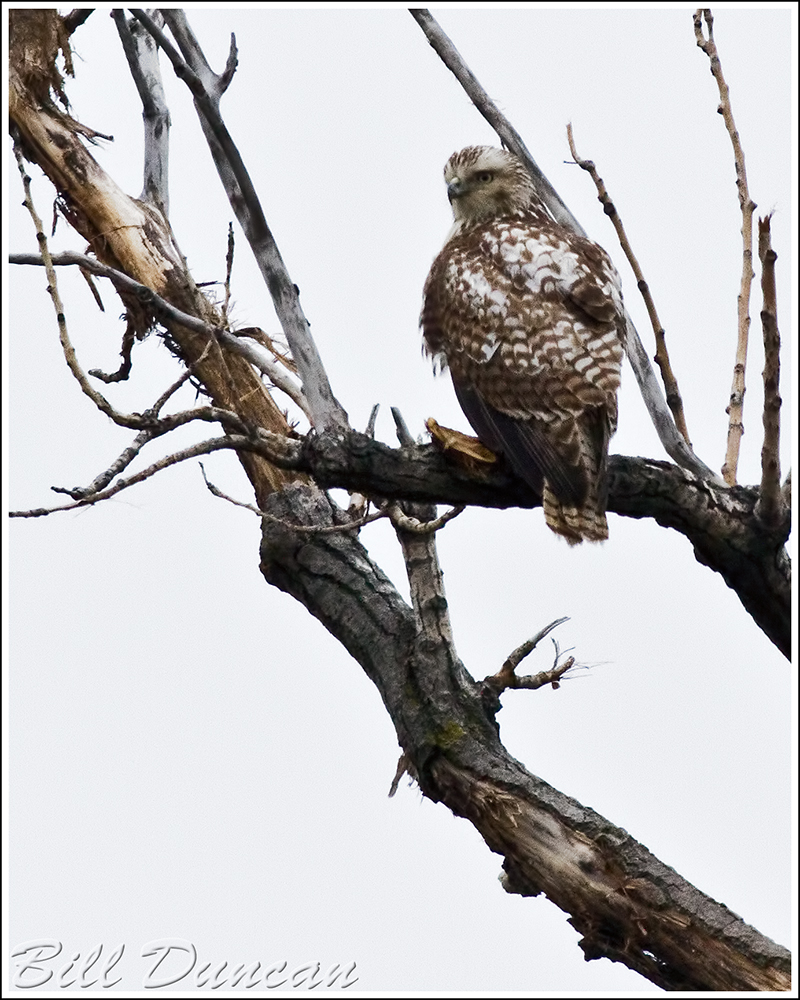
I spent the AM hours at Riverlands Migratory Bird Sanctuary and Columbia Bottom C.A. yesterday.  I mostly ran into lots of the usual: waterfowl, American Kestrels, Harriers, Eagles and an assortment of Sparrows.  Two birds at RMBS were a bit unusual.  The first was this juvenile, “Krider’s morph” light phase Red-Tailed Hawk.  I watched him at this perch for a while until one of the resident Eagles decided it was time for him to leave the tree.  I looked for him the rest of the morning, both at RMBS and CBCA, but never spotted him again.

IMG_0271

Technical details: Canon EOS 7D camera,  EF500mm f/4.5L USM lens, ISO 800,  f/6.3, 1/640 sec

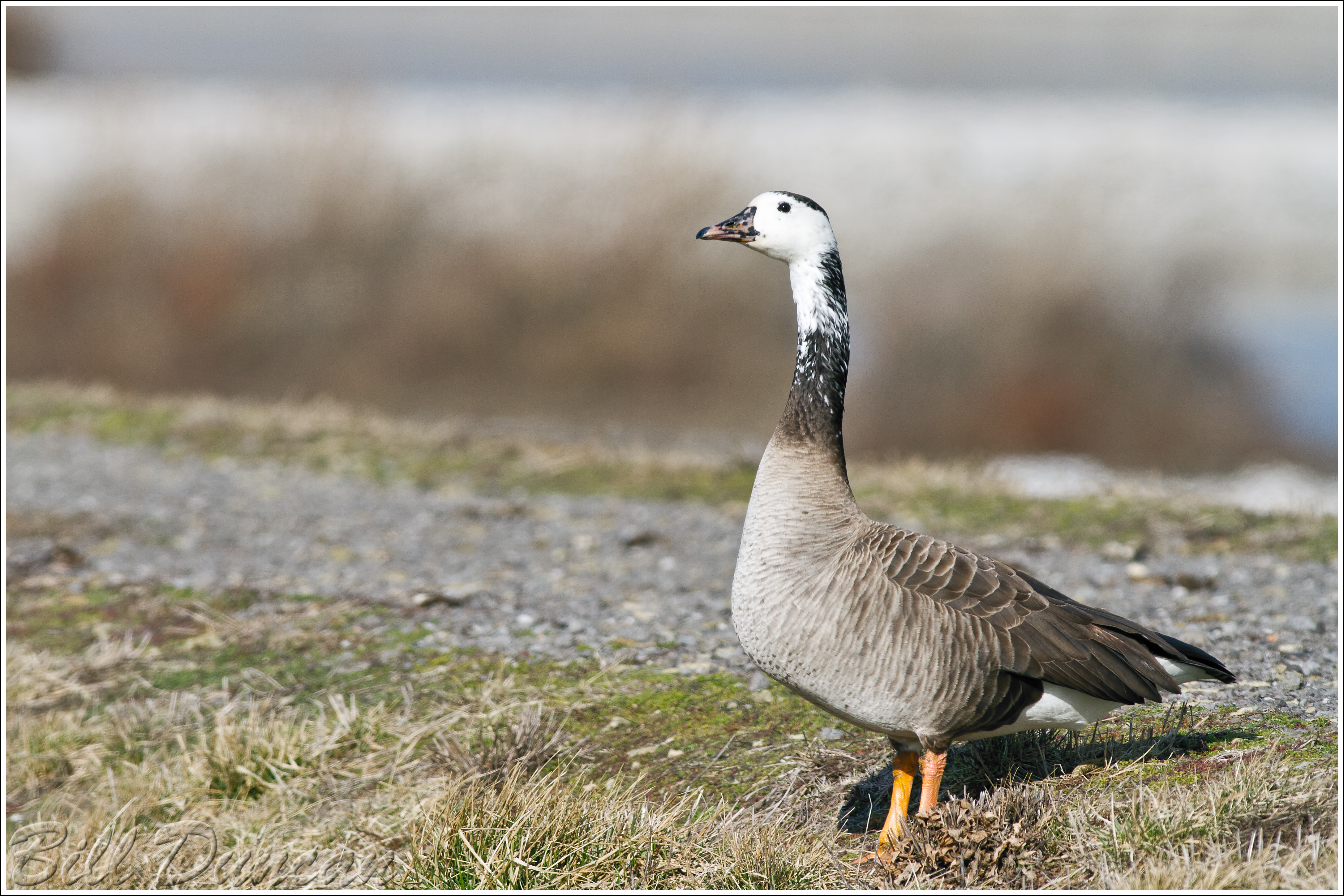
The other bird that drew my attention was this guy below.  I am making no sure statements as to what this one is.  It mostly reminds me of an aberrant Canada Goose, i.e. partial leucistic.  However, the orange legs remind me of a Greater White-fronted Goose.  Perhaps a mix of some kind?  Hopefully the experts can shed some light…

IMG_0381

Technical details: Canon EOS 7D camera,  EF500mm f/4.5L USM lens, ISO 400,  f/6.3, 1/2000 sec

A Warm Winter’s Day in the St. Francois

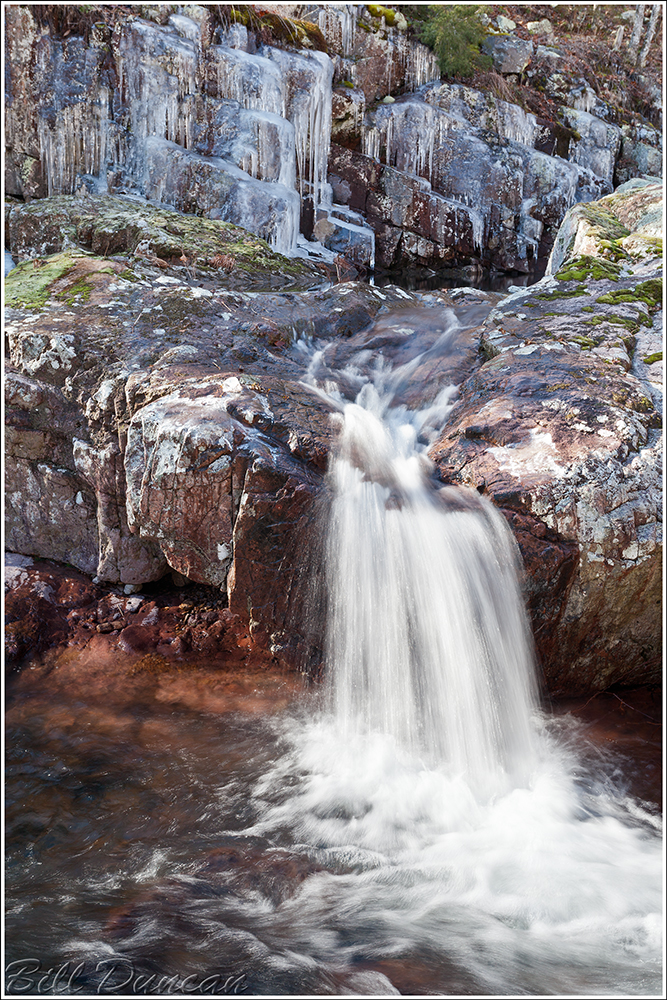
With forecasted highs near 60F, there was no question what I would be doing this past Saturday.  The only problem was where to take a hike!  Being mid-January and a warm, sunny day, I knew that Lower Rock Creek would not disappoint.  As expected, the Ozark Witch Hazel was in full bloom and beautifully fragrant.  The sky was completely clear and the lighting harsh for much photography of the many water features the area has to offer, but of course I had to try.  Ultimately I just tried to enjoy the hike and experience the wilderness that life continually rips from my fingertips.  There were a good number of ice formations still left on north-facing canyon walls and this particular patch was beginning to melt, releasing its maker into a mirror-like pool that ultimately fell down this drop and married with the rest of the stream.  I looked for ways to get closer to these formations but could not find a safe passage.

IMG_2548

Technical details: Canon EOS 5D Mark II camera, EF17-40mm f/4L USM @ 40mm, ISO 200,  f/11, manual blend of two exposures

On the way upstream, I stayed off the trail as much as possible; I preferred following the creek bed although wet and icy rocks often made this a challenge.  A couple of times near bends I was forced to go up and over a ridge because of lack of good foot or handholds above the creek.  After about three hours of rock hopping with my 30lb pack, fatigue started to creep in and I twisted my ankle bad enough to cause a minor sprain/strain.  This was very close to this wonderful swimming hole, so I pulled my boot and sock off and dunked my foot into this spring-fed water… for about 30 seconds.

 IMG_2551

 Technical details: Canon EOS 5D Mark II camera, EF17-40mm f/4L USM @ 25mm, ISO 100,  f/11, manual blend of two exposures

 On the way back downstream I followed the trail most of the way, shedding layers as the temperature rose over 5oF.  Along the route I was fortunate to spot a coupling couple of Eastern Garter Snakes.  These light-bodied snakes, much like grasshoppers and Morning Cloak Butterflies, will often wake up and see what’s happening on a warm winter day.  And usually, the males have something other than food in mind.  As can be seen in this image, the female was about two thirds larger than her mate.  Following a successful copulation, the female can store sperm until closer to the warmer months, and many snake species can and do copulate several times and will actively select sperm of her choosing.  I tried my best not to disturb this pair too much.  They were rather laid back and didn’t seem to be alarmed, even when I lowered the diffuser mere inches from them.  When I left the male was still busily making his intentions known, while she kept her eye and tongue focused in my direction.

IMG_2597

Technical details: Canon EOS 5D Mark II camera, EF100mm f/2.8L Macro IS USM, ISO 400,  f/11, 1/40 sec

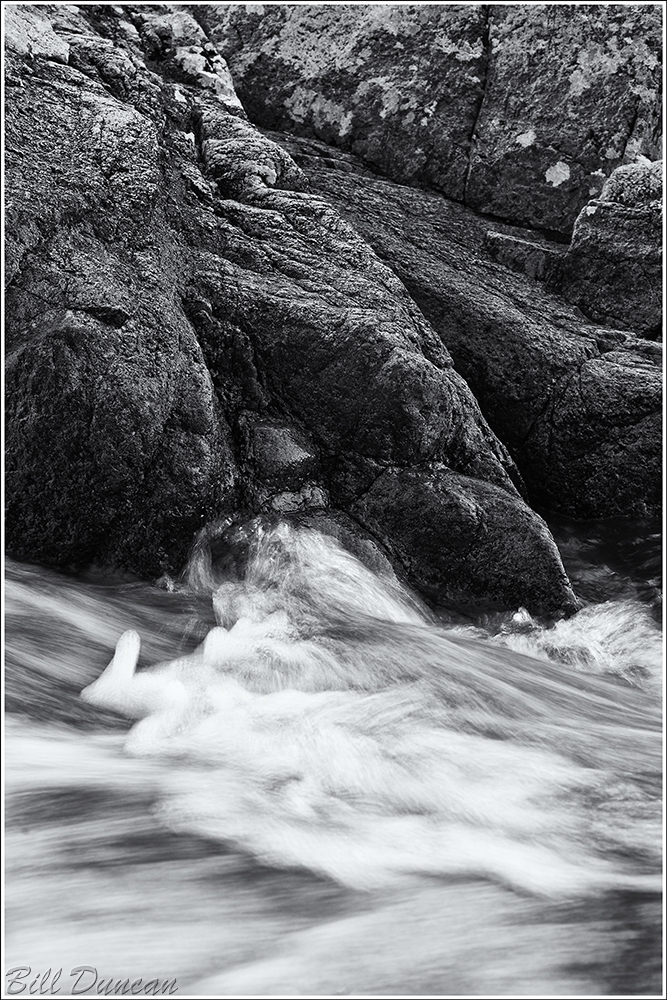
 After having some lunch at the car I tried my best at finding the John James Audubon Trail that I have been wanting to visit for a while.  After some fruitless searching I was unable to find a single trail-head, placard, sign or blaze marker that I was confident in.  Unless I hear otherwise I will consider this a defunct trail.  So I decided to visit the Castor River Shut-ins and spend the remainder of the daylight hopping around on even more rocks.  The lighting was still rather poor and I had little inspiration for finding a composition so I experimented a bit, focusing on the effect of minute changes in exposure time on capturing the movement of flowing waters.

IMG_2651

 Technical details: Canon EOS 5D Mark II camera, EF24-105mm f/4L IS USM @ 60mm, ISO 320,  f/7.1, 1/13 sec

IMG_2789

Technical details: Canon EOS 5D Mark II camera, EF24-105mm f/4L IS USM @ 80mm, ISO 400,  f/6.3, 1/40 sec

Less Than an Inch of Depth of Field!?!?!?

So I recently acquired a new bird/wildlife lens.  I came across an old Canon 500mm f 4.5, non-IS in unbelievable condition for its age and I had to make it mine.  This should become my main bird lens, but I have kept the 400mm 5.6 as a backup as well as for use in specific scenarios.  I have used the 400 for three or four years and I felt I was just beginning to become proficient with it, just getting to the point where it was comfortable, like an extension of my eye.  I understood almost everything about the lens and the laws of optics shooting at this focal length on a 1.6X crop body.

I realized that switching to the 500mm would bring about a lot of change from what I was used to.  I knew I would be outside my comfort zone for quite a while, perhaps I would not be able to tap into the full extent of what this new lens would bring for a year or more.  I am prepared for this and have made sure my patience account is well funded (especially now since my monetary accounts are not) .  So far, in taking the beast out for light duty, I have been relatively pleased by the results I have been able to make.  I still have much to learn, however.  What are some of the big differences between the 400 and the 500?  First and most notably is size and weight.  I went from the 400, which weighs about 2.5lbs to the 500 that tops in around 6.5lbs!  This is not a negligible difference.  The new lens is almost twice the length of the old as well.  Also, in my opinion, the laws of optics seem to have changed more than the increase of a mere 20% the corresponding focal length.

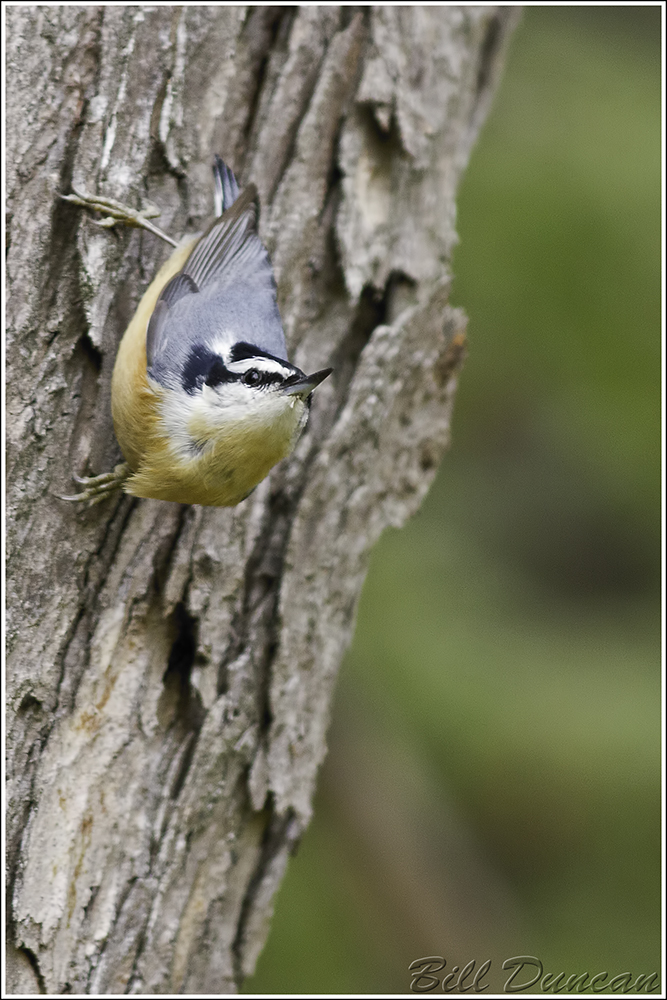
Take this image, for example.  One expected change with this lens I knew was coming would be for the demand of light.  On this day and setting the light was quite lacking.  So, I decided to open up the aperture to the full f/4.5.  I had already determined that this lens is not like the 400 f/5.6.  In the 400, there was no need to stop down to improve sharpness and image quality.  I could shoot that forever at f/5.6 and be satisfied I would be getting top IQ.  The 500mm is a bit of a different story.  So far, it looks like stepping down the aperture will definitely increase sharpness, maxing out around 6.3-7.1.  The photos taken below f/6.3 are definitely still usable, but it is not hard to see differences.  So, the main point I am attempting to make is that what I did not realize until I got this photo on the computer is that although the bird’s head is reasonably in focus, its feet are not!  I estimate that I was about 20″ from the bird.  Looking up the DoF on an app, I discovered that the area in focus at this distance while shooting at f/4.5 was less than one inch!  Using the 400 “wide open” at f/5.6 at that distance the range was about three inches, likely enough to get this whole subject in sharp focus.

It was never my intent to discuss gear in this blog, but I fealt this transition was something I’d like to record and share with other photographers that might be considering similar choices.  This is but one of several examples of differences between these two lenses that I will need to adapt to in order to get the maximum out of each lens.  Patience and practice will be needed in ample amounts, and I am definitely looking forward to the challenge.  Happy shooting, birding, or whatever is your passion.

IMG_9622

“Out of Focus Feet”

Technical details: Canon EOS 7D camera, EF500mm f/4.5L USM lens, ISO 800,  f/4.5, 1/250 sec