The Ozark Tree

While growing up in the inner St. Louis suburbs, I have relatively few memories of nature before entering my twenties.  One memory that particularly stands out is on a trip south seeing an Osage orange fruit for the first time.  Just what the heck was this strange fruit, so reminiscent of the cerebral cortex of the human brain?  Like so many ignorant of nature, I wondered what its purpose was and why it had to be so creepy.

Thirty years later I realized I still did not know much about this tree.  Sarah found this fruit on our trip through the Ozarks and I brought it back to make it the subject of this study.  The common name, “Osage orange” is rather self explanatory.  The name Osage comes from the Osage tribe that was historically found over much of Missouri and the fruit does resemble an orange, so commonly eaten.  I have since learned that the best adaptive story to explain such a large amount of flesh covering the hidden nut is that the primary disperser of these seeds were the Mastadons.  Following the disappearance of these large herbivores, humans became the primary dispersers of this species, planting these trees as windbreaks and fences.  The wood of these trees is some of the heaviest, densest and hardest in the Ozarks.  This fact plus the thorns on young branches made this the perfect species for such purposes.

The nature of this species wood also made them perfect for use in making bows by native Americans.  This fact prompted the French to name them “Bois d’Arc” or bowwood.  This name is the most favored in being responsible for the name “Ozarks” given to the hills and habitats of Missouri, Arkansas and surrounding states.  It is theorized that Bois d’Arc was bastardized to “Bodark”, and later to Ozarks by English settlers.  To my understanding, this cannot be proven, but is the best conjecture given by historians.  That is why I titled this post “The Ozark Tree”.

So, I brought this fruit home and took it out in the backyard and placed it among colorful white-oak leaves, a milkweed pod, Monarda seed heads, and a prairie dock leaf.  It is still siting in my backyard.  I want to see, if left alone to rot over winter, whether or not the seeds will germinate.

“Bois d’Arc″
Technical details: Canon EOS 5D Mark II camera, EF100mm f/2.8L Macro IS USM, ISO 160,  f/14, 1/6 sec

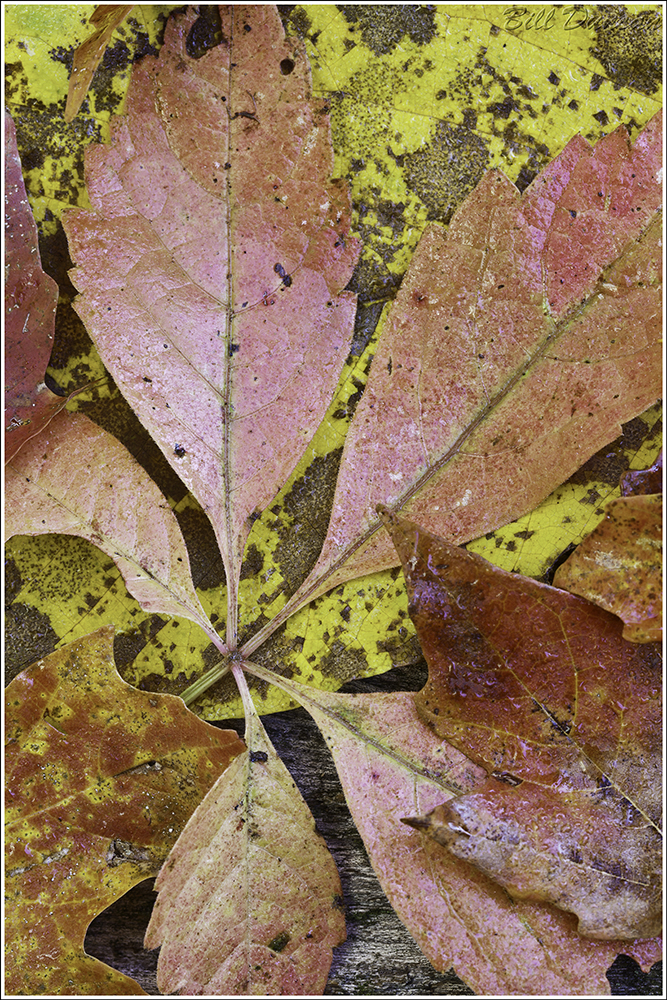
When the Maples Blaze

“I do not see what the Puritans did at this season, when the Maples blaze out in scarlet. They certainly could not have worshiped in groves then. Perhaps that is what they built meeting-houses and fenced them round with horse-sheds for.”

-Henry David Thoreau-

“When the Maples Blaze″
Technical details: Canon EOS 5D Mark II camera, EF100mm f/2.8L Macro IS USM, ISO 160,  f/16, 1.3 sec

Compromise

Along with the concept of the “Golden Rule” go ahead and put the law of compromise up on the list of common sense life lessons we all should have learned by the age of eight or so.  That being said, at my age I have come to realize how strongly this law affects any aspect of life I can think of.  Do nothing but eat Little Debbies and watch He-Man & the Masters of the Universe after school then don’t be surprised at the talentless overweight adult you have become.  Do nothing but work at studies, tirelessly trying to become the most productive individual on the planet, then chances are you will wind up with a joyless existence.  Don’t work, go hungry.  Do nothing but work and starve just the same.  I think you get my point.

Photography is the perfect example of this law.  The contemporary photographer has the exposure triad – equal parts shutter speed, aperture setting and ISO speed.  Increasing any one of these three for particular aesthetic effects (DOF, action freeze, etc…) will necessitate a change in one or both of the others.  We can rarely get everything we want from all three corners of the triad without a good deal of work, patience and serendipity.  Taking this even further, the nature photographer – as I describe myself, has what I call a “subject triad” that covers the landscape, the wildlife, and the macro.  Now, none of these are mutually exclusive, but rather like the exposure triad it can be seen as a continuous three-way interaction.

The larger point I’m attempting to make is, just like using the exposure triad in making a proper exposure under constantly changing lighting, a nature photographer should be open at all times to changing subjects.  This point was driven home recently when Sarah and I paid a visit to the Castor River Shut-ins within Amidon Conservation Area.  This is one of my favorite locations for landscape photography.  It can often be very challenging, however.  Compositions must be hunted down and the light needs to be near perfect to capture the rocks, water and vegetation just the way you like.  During this particular visit, even though there was some nice autumn color, the lighting was utter crap at the shut-ins.  As I hopped from rock to rock attempting not to drown myself or my over-priced gear trying to make something happen with what little I was presented with, I happened to take a look back at my wife, Sarah.  As usual, she had taken a short little stroll and was in the woods taking pictures!  I noticed she was taking back-lit foliage pics as well as macro shots.  I then cursed myself for putting the blinders on and looking only for that grand landscape composition and forgetting the other points within my self-described triad.  The maples and hickories were in glorious colors and I was able to take some macro shots that I am pretty pleased with.  This is why I try to carry as much gear with me as I comfortably can.  If I did not have my macro equipment, then I would have likely been out of luck.  The compromise?  Aching legs and shoulders for the next few days!

“But we gotta get happy when we wiggle in the middle” – John Hartford

“Creeper, Pawpaw & Maple″
Technical details: Canon EOS 5D Mark II camera, EF100mm f/2.8L Macro IS USM, ISO 160,  f/16, 1.6 sec

Defining Irony

Who or what is your favorite Halloween story or character from pop culture?  Many of us would say “The Exorcist” or give you the name, Freddy, Jason, Leatherface or Tammy Faye Bakker. Before you say another word, let me tell you what I did this Halloween evening.  I spent a little more than two hours in a dentist’s chair getting three fillings and a root canal.  “The horror!”  Actually, my dentist is great and much better than I deserve.  After spending the first 25 years of my life making candy, cookies and ice-cream the staple of my diet (no exaggeration, trust me) and exercising less than optimal dental care, I have been paying the price to the dentist for the past 12 years or so.  The thought of all those wonderful Halloweens coming back to haunt me in this way!  Ironic horror, or not ironic at all?

Take care of your teeth, kids.

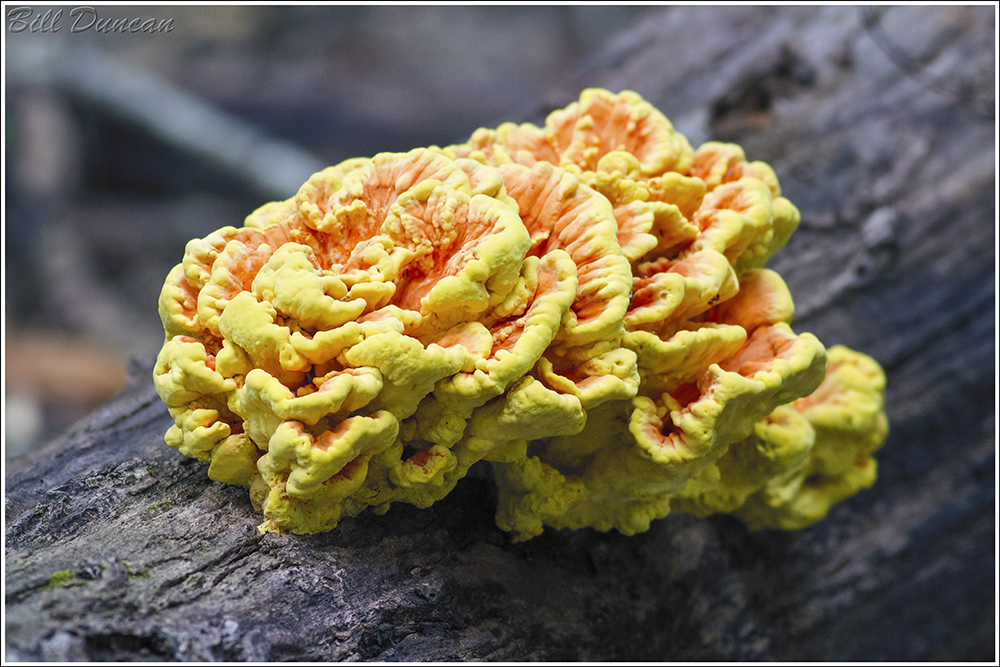
Today’s photo is not really representative of autumn, but it is an example of something I’d prefer to be munching on these days and about as close to a Halloween image as I could come up with.  This sulfur shelf polypore is more commonly known as chicken of the woods.  It is so named due to a texture that is similar to that of chicken meat.  The one sample of this I took for eating was quite tough; most often the outer edges of the youngest leaves are most fit for eating.  I do look forward to trying this again with a more sophisticated recipe.  Unfortunately I had my bird equipment on this outing and this was as best an image I could make of it.

What is my favorite horror movie moment?  This Bill Murray character.  “I’m sure I need a long, slow root canal”

I’m going to go cry now…

“Sulfur Polypore”

Technical details: Canon EOS 7D camera,  EF400mm f/5.6L USM lens, ISO 1000,  f/5.6, 1/400 sec

Location Spotlight: The Canyon-land of Ferns and Waters – Hickory Canyons Natural Area

Today’s post spotlights a few images I took recently at the least well-known, but perhaps my favorite, of the Ste. Genevieve trio gem locations found in south-eastern Missouri, Hickory Canyons Natural Area.  The other two nearby locations are Hawn State Park and Pickle Springs Natural Area.  Much of the exposed rock in this area is known as LaMotte sandstone and was deposited around 500 million years ago under the Paleozoic sea, which covered this region except the igneous knobs of what are now called the St. Francois Mountains.  Unlike the other sedimentary rocks – like dolomite and limestone that compose much of the Ozarks, sandstones are generally much more resistant to erosion.  This results in rock features that are often quite spectacular to the eye and the canyons, bluffs and other exposed sandstone bedrock have become favorites for hikers, rock climbers and other travelers to this region.

“Addressing the Optimates”

Technical details: Canon EOS 7D camera, EF70-200mm f/4L IS USM lens @ 89mm, ISO 320,  f/20,  0.4 sec

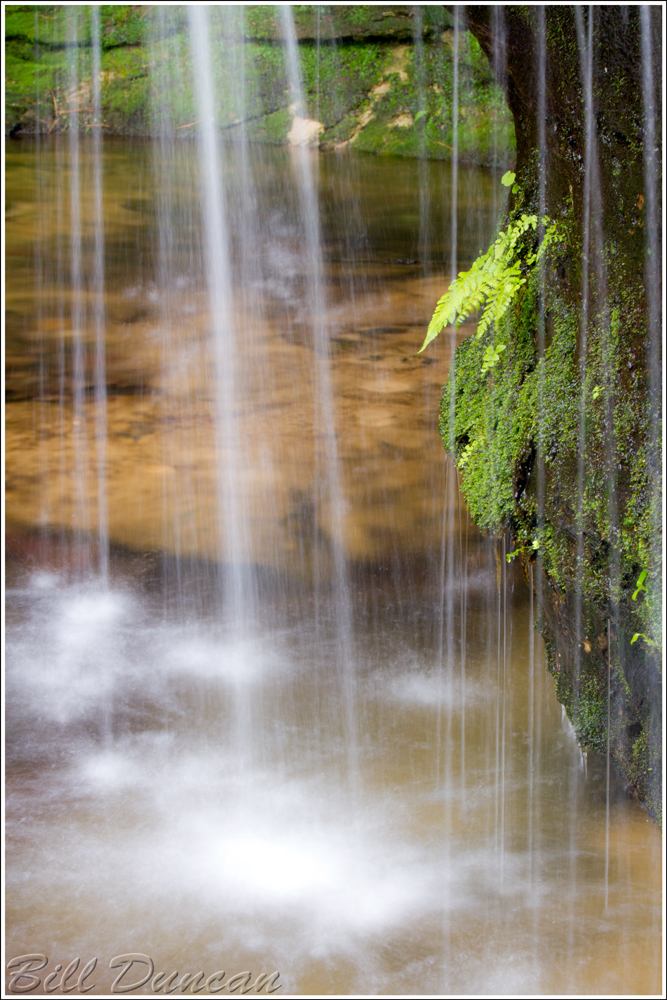
Two short hikes are available at Hickory Canyons N.A.  Both offer great views of the rock formations, including wet-weather waterfalls like the one shown below.

“The Bath House”

Technical details: Canon EOS 7D camera, EF70-200mm f/4L IS USM lens @ 70mm, ISO 320,  f/16,  1.3 sec

The overhangs and cracks created in these box canyons, gorges and cascades provide opportunities for ferns, mosses and lichens.  In fact, these three spots mentioned above in Ste Genevieve Co are the only place the fern enthusiast need travel to in Missouri.  The well-draining, sandy and acidic soils found here are perfect for species like wild-rose azalea, hay fern and rattlesnake orchid.  White oak, hickories, sugar maples, short-leaf pine and flowering dogwood are the primary tree species found at this location.  A few trips during spring time are definitely worth it to find some of these fantastic plants in bloom set against these dripping canyons and ephemeral cascades and waterfalls.  The wild-rose azaleas bloomed about six weeks early this spring and I missed them.  Oh well, something to look forward to next year.

“The Senate”

Technical details: Canon EOS 7D camera, EF24-105mm f/4L IS USM lens @ 28mm, ISO 160,  f/16,  2.5 sec

“Floralia”

Technical details: Canon EOS 7D camera, EF70-200mm f/4L IS USM lens @ 93mm, ISO 250,  f/16,  1 sec

Virere Candere

Technical details: Canon EOS 7D camera, EF24-105mm f/4L IS USM lens @ 24mm, ISO 160,  f/16,  1.6 sec

Arboris Relictus

Technical details: Canon EOS 7D camera, EF100mm f/2.8L Macro IS USM lens, ISO 160,  f/16,  0.5 sec

As the glaciers of the last major ice age retreated, species that required lower temps and had higher water requirements moved back north as well.  These canyons provide cooler and wetter environments for relict species like the one pictured above, the partridge berry.  This evergreen vine-like tiny shrub can be found throughout the canyon and hollow floors along with lichens and mosses.

I Got Your Oxalis Right Here!

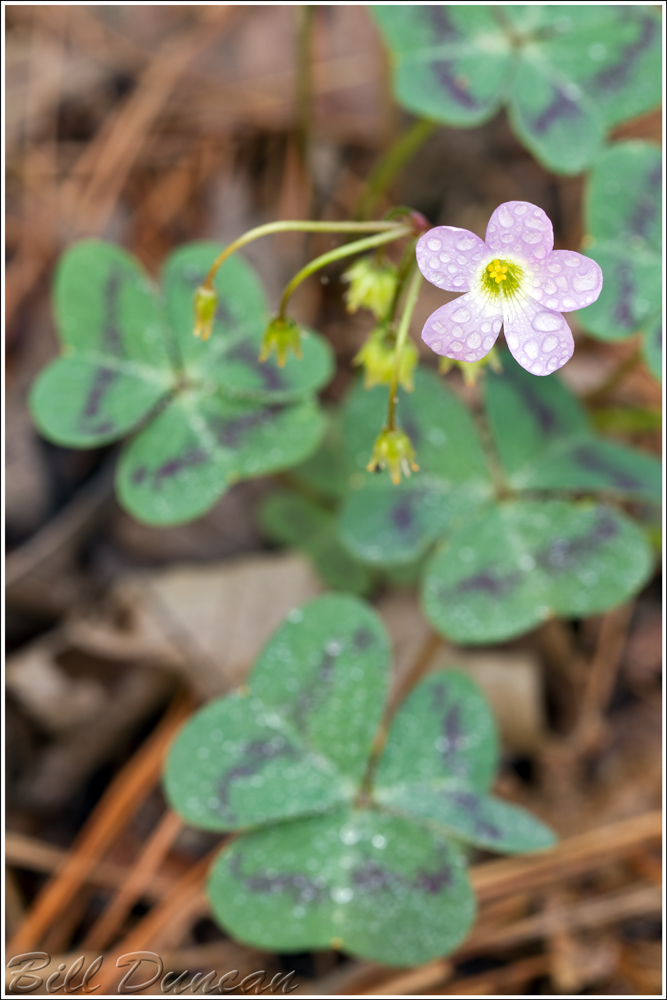
“Violet Wood Sorrel”

Technical details: Canon EOS 7D camera, EF100mm f/2.8L Macro IS USM lens. ISO 160,  f/10, 1/15 sec

Dedicated to my bros Brian K. and Jeff H.  They’ll know what I mean. ;=)

The name “sorrel” comes from the sour-like taste these plants give.  This taste comes from oxalic acid and these guys were the first source from which this compound was isolated.  I have recently read that much like most of the forbs in the Ozarks these guys were used by Native Americans and early European settlers as a food source to spice up salads as well as having intended medicinal values.  Don’t eat too much, however, as the concentrations of oxalate in these plants are even higher than in spinach and tea and apparently kidney stones could be a consequence.

Violet wood sorrel grows from tiny bulbs beginning in mid spring in the Ozarks and is usually found in acidic, rocky open woods, fallow fields, prairies and roadsides according to Steyermark.  These guys will bloom multiple times across the growing season, usually following a cool rainy spell.

I spent most of yesterday hiking Hawn State Park, where these guys were one of the most abundant wildflower in bloom.  I hiked all three loops, Whispering Pines North and South and the White Oak trail for the first time in one day.  Including the connector trail I believe this was a bit more than 15 miles.  With my 27 pound pack and lunch + water, let me tell you I felt it during the last five miles or so.  I didn’t take the camera out much, being mostly interested in the hike and not seeing too much that interested me composition-wise anyway.

I’m still stunned about the schedule spring has taken and I can’t stop talking about it.  I went to Hawn hoping to time the bloom of the wild azaleas, which usually do not start to bloom until the last week of April or the first week of May in the park.  Yesterday I found only two or three bushes that were still in bloom along sheltered north-facing hillsides.  The rest had bloomed and were nearly in full leaf!  Everywhere I look vegetation is 4-6 weeks ahead of typical schedule.  I was waiting to see if bird migration might be early as well.  We have seen some evidence of this.  There have been reports already of new early arrival state records of warblers and yesterday all the usual nesters seemed to be in the area and setting up territories.

This time of year at Hawn can be quite useful for the birder-by-ear.  Yesterday, several hard-to-discern trillers could be found and compared in the field at one time.  Within my hike I found the Pine and Worm-eating Warblers, the Chipping Sparrow the Dark-eyed Junco and Swamp Sparrow all singing their trill-like advertisements.  Every spring it seems like I have to start my ear from scratch, the Worm-eating Warbler being the most distinctive to me.  After a couple weeks I finally think I make some progress and then forget again soon after.  Usually I can go by location; the Junco leaves pretty soon and the other two sparrows are usually found in more open, grassy habitats, which leaves the two warblers to discern.  There, as its name suggests, the Pine is found in concentrations of the short-leaf pin in our region and the Worm-eating is more often found amongst deciduous tree tops.

Yesterday was a glorious day for hiking at Hawn S.P.  As usual, I was surprised but pleased that I did not see more folks on the trails.  If a day like that can’t tear you away from the couch I don’t know what can.


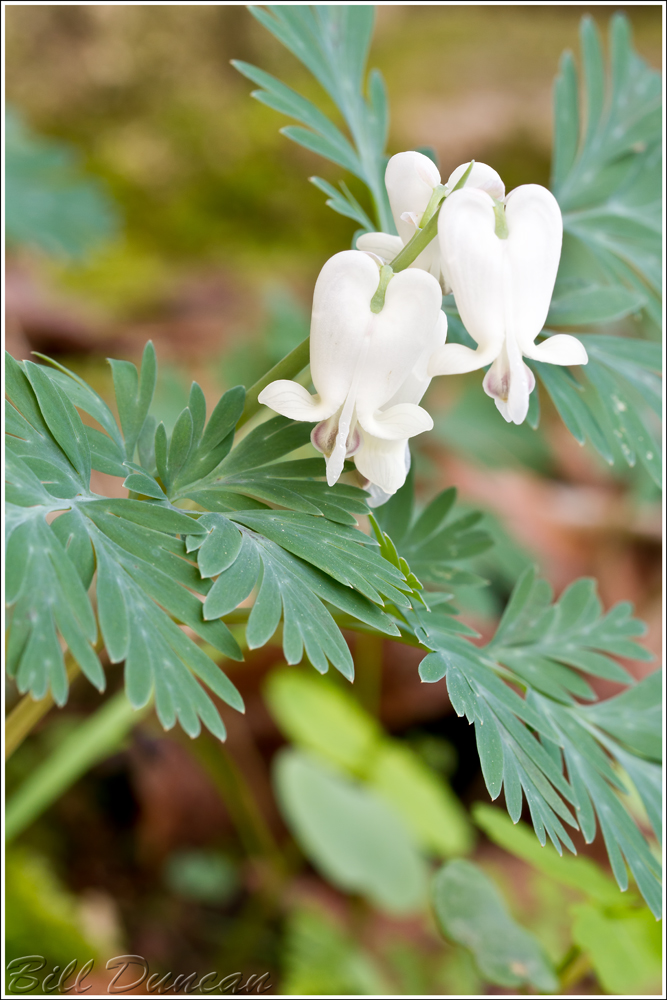
The Dutchman’s Lesser Known Brother

“Squirrel Corn”

Technical details: Canon EOS 7D camera, EF100mm f/2.8L Macro IS USM lens. ISO 160,  f/11, 1/8 sec

Leaving my Missouri Ozarks this weekend, I found myself visiting some of the places I’ve been wanting to visit in the equally desirable Shawnee National Forest region of Southern Illinois.  Towards the end of the day I wound up at Giant City State Park, known mostly for its rock outcropping features, but just as bountiful in spring-ephemeral wildflowers.

The plant featured above is called squirrel corn and is in the same genus as its more famous sibling, the Dutchman’s breeches.  Unlike Dutchman’s breeches, squirrel corn is pretty rare in the Missouri Ozarks, having been found in only a handful of counties.  Along a trail in this state park, the two were found in almost equal abundance.  It was very nice seeing the two flowering in synch within inches of one another. The density of wildflowers here was bewildering.  Colors littered the ground everywhere I looked and the possibilities for composition seemed endless.

With failing light and late afternoon winds, it was challenging for macro photography.  I had not yet photographed this species, nor had I even seen another species that was just beginning to bloom here – the white trillium.  So, I pulled out the macro gear and went to work with sounds of recently arrived songbirds advertising their newly acquired real estates and small streams funneling their light charge of the previous day’s rain down the sandstone steps.  This, unfortunately was broken too often from the idiots pounding large plastic containers against rocks for some reason.  State Parks.  I love them and hate them.

Flowers and Blood

“Bloodroot”

Technical details: Canon EOS 7D camera, EF100mm f/2.8L Macro IS USM lens. ISO 160,  f/16, 1/13 sec

I’ve been having a lot of fun with the spring ephemeral wildflowers this year.  It is hard to believe the numbers and diversity that are in peak bloom already this year.  I can’t imagine what the woods are going to look like by the end of April.  You might as well stock up on pyrethrin because by mid-summer the ticks are going to be owning us all.

This image was taken in the Labarque Creek watershed during a early spring hike.  Bloodroot are fascinating plants, getting their name from the reddish sap that is especially prominent in their tuber-like rhizome.  Several Native American tribes have been known to use this sap as a natural dye for artwork projects.

These plants will spread and grow easily clonally and vast colonies can be found that may have started from a single individual.  Another method of reproduction these plants use is myrmecochory, which means that their seeds are dispersed by ants.  The ants feed on a fruit-like structure that is attached to the seed.  The ants move the seeds to the relative safety of their colony and after the ants feed on the fruit they deposit the seed into their underground middens, or trash heaps.  Here the seeds can safely germinate and have access to some useful fertilizer in the process.

Bloodroot sends up a flowering stalk usually before the leaves begin to emerge and blooms usually open before the leaves have fully expanded.  The flowers last less than a full day, so it is recommended you get out on the trail before noon if you really want to seem them in their full glory.

It’s Spring Again. Everybody Know it’s Spring Again.

“Renewal”

Technical details: Canon EOS 7D camera, EF100mm f/2.8L Macro IS USM lens. ISO 250,  f/11, 1/13 sec

“To the girls and boys and people above, This is the time to fall in love”

Sorry, I always turn on the Biz Markie this time of year.  It wouldn’t be spring without him.

This image and post is dedicated to my stepfather, Wally, who bought me my first camera about 20 years ago.  Wally has a birthday this month.  Happy Birthday!  It was a Pentax K-1000, a manual-only film camera in which I learned the basics of exposure.  In my opinion, this body is one of the best values of this class and generation of camera available and still underrated.  It’s too bad they don’t make a digital version of this camera today.  Having a manual-only digital body would something else.  I use manual mode about 95% of the time anyway, so I guess it wouldn’t be a big difference.

I took this photo on a recent hike in the Missouri Ozarks.  This bush must have had two dozen of these emerging leaf buds, each with a drop or two from gutation.  This phenomenon is seen when plants are growing in high humidity or in very saturated soils, like many parts of our region have been experiencing lately.  Between the low light and the high macro magnification getting a sharp image of the foreground subject was tricky.  I pulled out the reflectors to bring a little more light to the situation, but this only helped a little.

Spring has Sprung. Winter MIA and Presumed Dead

I spent the majority of the day at Shaw Nature Reserve in Grey Summit, Missouri.  Mother Nature is busy transitioning to the next phase.  As the photo shows, I found harbinger of spring as well as spring beauty and a couple of very early blood roots in bloom.  It’s nice to get out looking for wildflowers this time of year because there are so few I can identify them all!  Over the next three months or so, Shaw NR will have an ever changing cycle of blooming spring-ephemerals, then the summer plants start!  The bird life I witnessed today also suggests that nature is moving on even though old man winter was playing dead beat dad this time around.  I had my first Pheobe and Field Sparrow of the year. I love listening to the Field Sparrows sing their bouncing ping-pong ball type of advertisement song across the open savannahs and woodlands.  It was also entertaining watching and listening to the Eastern Bluebirds who were busy building their nests in the boxes provided them across the reserve.  Yellow-rumped Warblers were seen in increasing number and the Woodpeckers could be seen and heard in every part of the preserve all day long.  The weather was fantastic today, although the sky was that boring, uninterrupted Robbin’s egg blue without a single cloud.  The morning was chilly though still, with no wind, which is so important for macro photography.  The best part of the day was finding the location of this year’s Red-shouldered Hawk nest.  This pair of Hawks or their descendants have nested in the same section of SNR for at least the past five years.  I’m glad I found the location this early.  It seems to be in a good location for making some good images.  It looked like there were already eggs in the nest and I can’t wait to get back and watch and take some photos.

Technical details: Canon EOS 7D camera, EF100mm f/2.8L Macro IS USM lens, ISO 160,  f/11, 1/6 sec