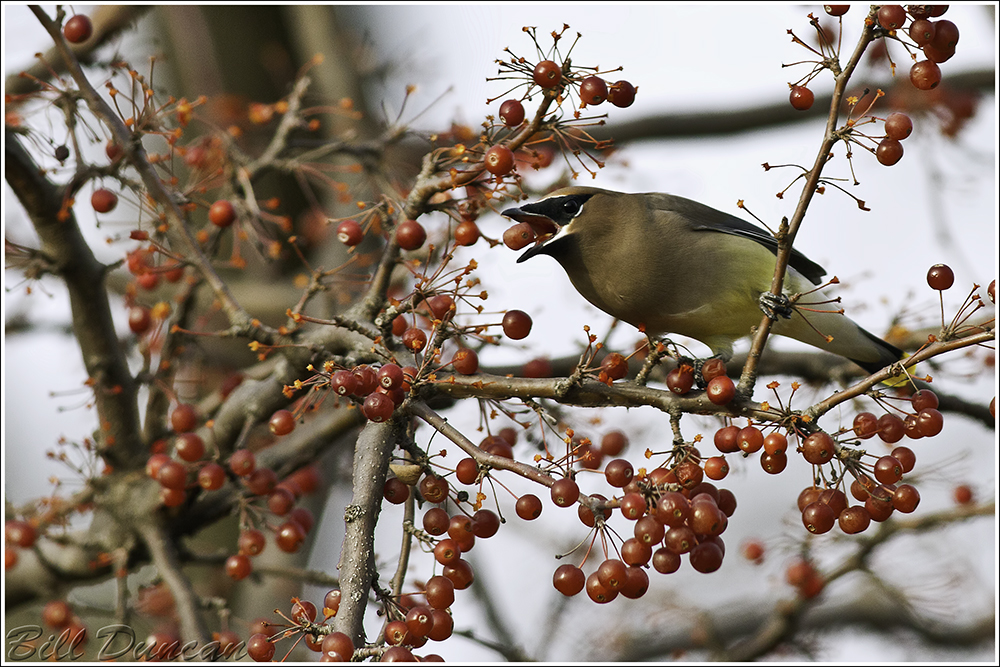
This post is likely only to interest photographers, particularly wildlife photographers, if even them. So, if you are not in this category go ahead and have a look at this mediocre photograph of an absolutely stunning bird – the Cedar Waxwing – having fun with its food (what I believe are the berries of the green hawthorn). Go ahead, I assure you. You will not care a bit about what I’m about to ramble on about.
I’m always confused when trolling around the nature photography forums, as I sometimes do, when I see a photographer presenting their work proudly claim that “this image has not been cropped in any way.” So what? I could close this by simply saying that a viewer of a photograph doesn’t give a damn what you did to make the final image. Nor should they! The end product-the photograph, should stand by itself and tell the story you are attempting to relate. End of story.
But, to take this a bit further. To try and understand why someone should take pride in such an “accomplishment”, I will try and dig through this a bit. What these folks are saying is that the bird or other creature is presented exactly as they were in the viewfinder of the camera at time of exposure. One reason they take pride in this is that they were able to accomplish the final composition “in camera” and did not “recompose” in post-processing. Okay, there may be something to be said for this, but I do not find it all that motivating. I think boasts like this, as well as the fact that some can do it, says a couple of potential things about the person making the image. One: they are likely able to afford long glass. In the majority of cases they need a very long focal length to accomplish a final non-cropped image. Or, two: they likely got too close to the animal being photographed. Don’t get me wrong. I think anyone who spends a considerable amount of time photographing wildlife – particularly birds, will get too close, or at least wonder if they are putting too much stress on their subject. I know I have. Having explored this a bit, I do not see a reason for the prideful boasts.
These same types will then exclaim that any photographer who must crop an image in post to make the final composition of a centralized subject (gasp!!) must then present it as a cropped image when exhibiting that photograph. Once again, the concept of the photograph as the ultimate piece of the process makes me beg the question, why? I think we are fortunate to live in this era of high-resolution. Those of us who can’t or won’t afford to spend for the super-tele, super-fast glass now have the opportunity to make a worthwhile image by cropping as much as 75% of the captured image! Of all the bird photos I have made, I estimate that I cropped 98% in post. I typically shoot the bird using the center positioned AF point to maximize proper exposure and get the subject as sharp as possible. I will then crop as the final action in my post work flow. Usually, this is the first time I think about composition. In the field tracking a wild bird you simply must grab the shot when the animal presents itself. You cannot ask if it would please sit on the horizontal branch in the open with the bright red berries while showing us a particular side. Well, I guess you can if you are one to use bait to draw in your subject, but that’s a subject of a different post…
Please forgive my boring rambling. And please, do let me know if you have a dissenting opinion. I would love to hear any other reasoning behind this line of thinking.
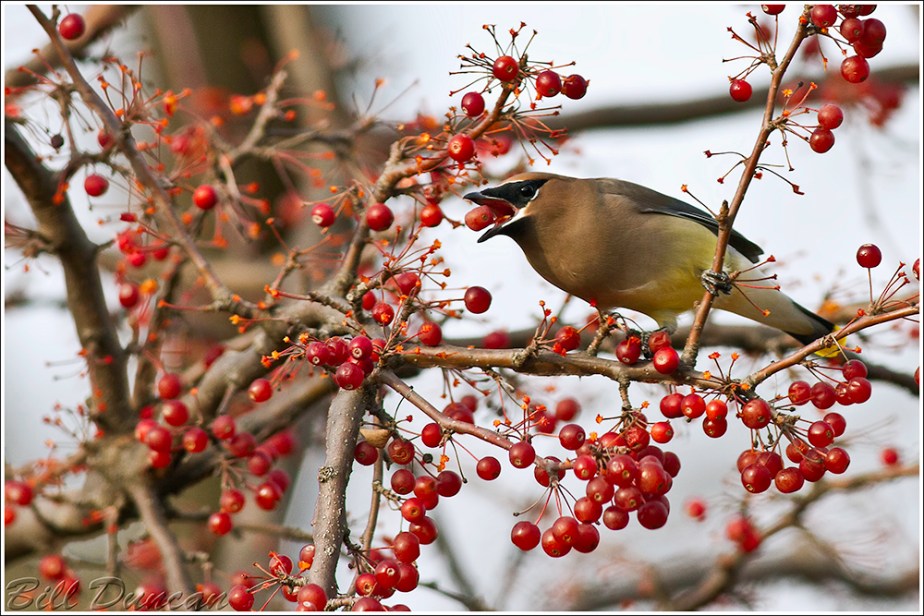
“You Are What You Eat”
Technical details: Canon EOS 7D camera, EF500mm f/4.5L USM lens, ISO 640, f/5.6, 1/1600 sec




 A Thousand Acres of Silphiums