Hey Kid, Boogie Too, Did Ya?

Do I have a man-crush on David Essex?  You’re damn right, and I’m not apologizing.  I know a lot of people have strong feelings about what they want done with their bodily remains following their last breath.  My personal philosophy was put very nicely by the comic, David Cross, “…I don’t care, because I can’t.”  If I have any loved ones when I die, I hope they do whatever they think is best and most convenient for them.  However, if they want to go through with a lot of trouble, instead of spending all that money on an over-priced box and funeral home and burial plot and deli sandwiches, here is something at least I would be entertained by.

I once read about a procedure that the hipsters in Europe are doing as an alternative to cremation.  Lyophilization.  This is just the fancy term for freeze-drying.  In this hypothetically more environmentally friendly procedure, the body is freeze dried then thrown into a hopper filled with heavy ball bearings.  Then the hopper is shaken by a giant paint shaker type apparatus until the remains are basically a fine powder.  So, everything but the water is gone and I helped by slowing my carbon’s escape into the environment!

Okay, so if 60% of a human body is water weight, what to do with the 60 lbs of powdered Bill?  That’s a great question.  Here is what I think would be nice (no, snorting or ingesting of said product will not be considered).  On a pleasant evening near sunset, hall my ass up to Elephant Rocks in as many Thomas Coffee cans as needed, gather whoever desires to be present and play David Essex’s “Rock On” on a boom box or giant speaker wall or whatever is handy.  Then you can spread Bill-dust across the landscape while Rosie Perez screams “Billy!” over and over, a la White Men Can’t Jump.  Like I said, I don’t really care what happens after I die, because I can’t.  But, if nobody has any better ideas, I’m thinking this would be a pretty cool way to be sent off.

Here is a photo…

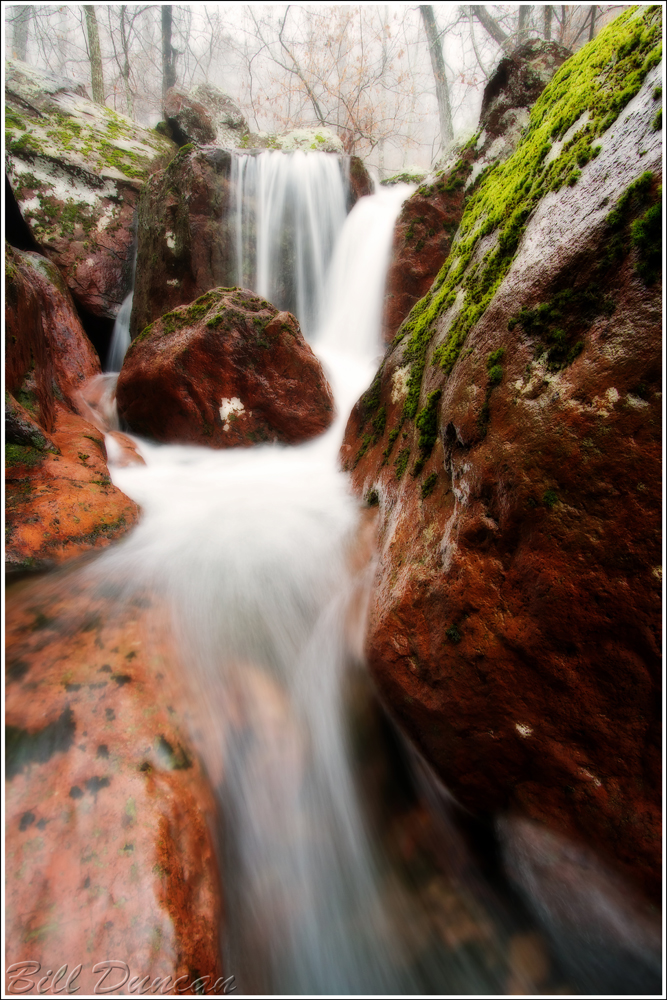
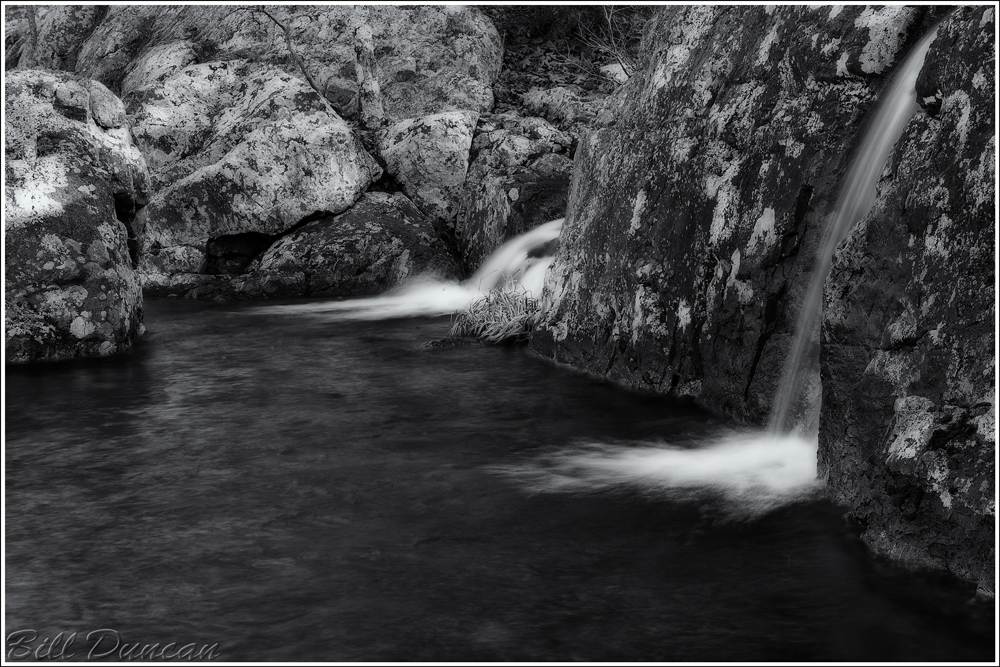
“Walled In”

Technical details: Canon EOS 5D Mark II camera, EF24-105mm f/4L IS USM lens @ 24mm, ISO 100,  f/14, manual blend of two exposures
 

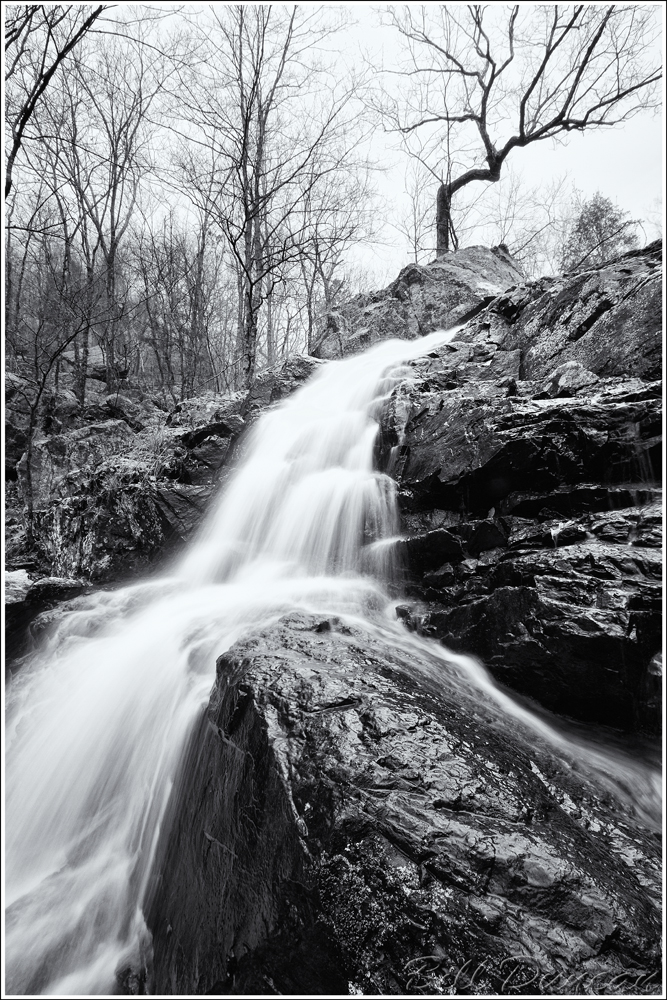
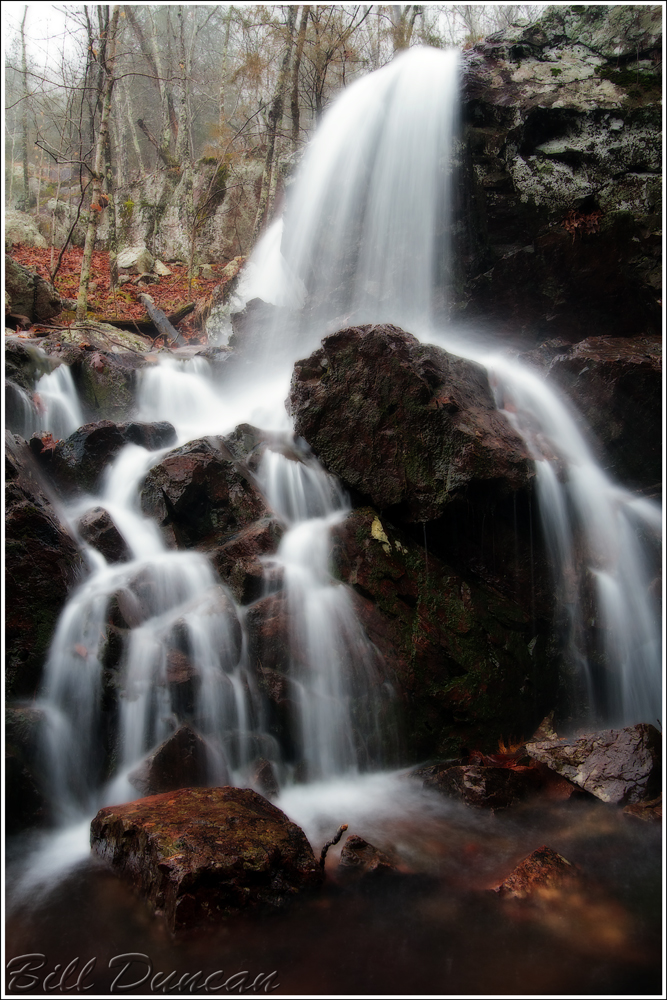
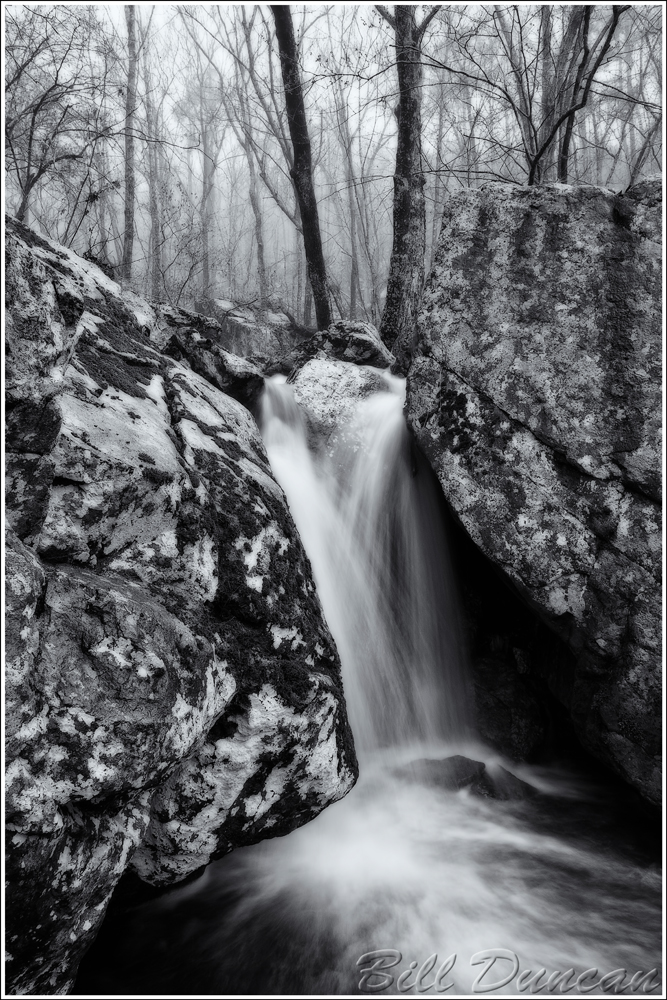
Location Spotlight: Black Mountain Cascades

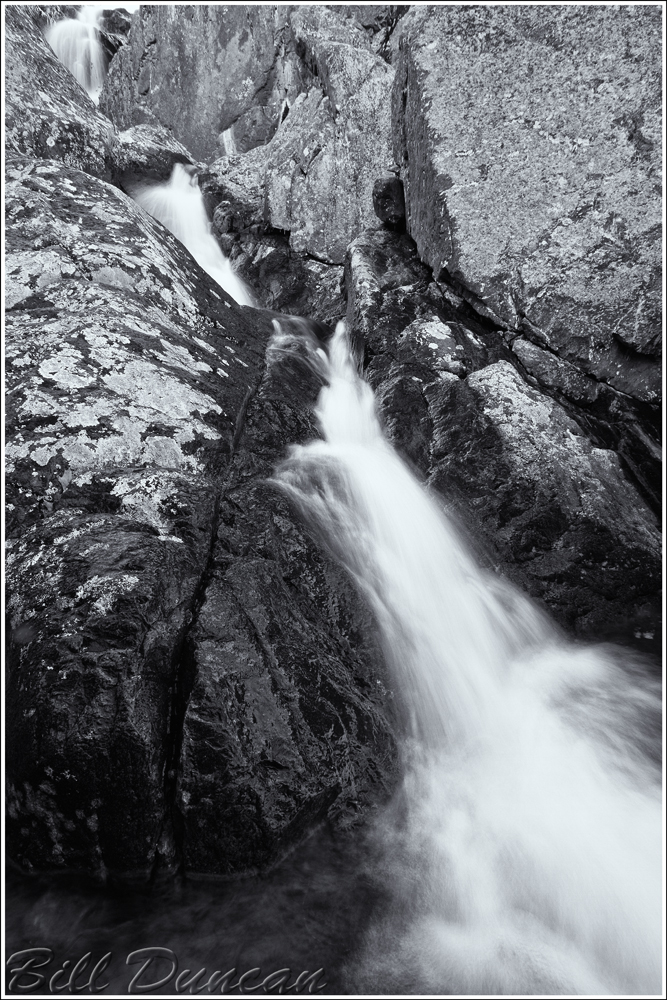
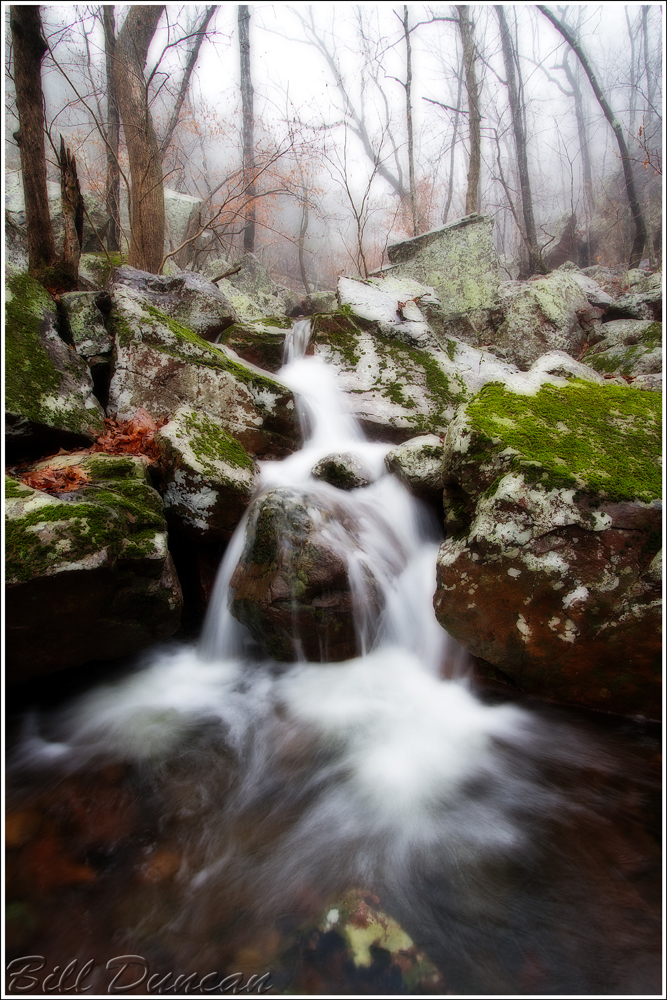
This post features one of my favorite places to visit and photograph in my beloved St. Francois Mountains. Black Mountain and these cascades that tumble down more than 400 vertical feet in a series of steps lie southwest of Fredericktown and can be found literally alongside Highway E.  The waters run under a drainage pipe in the road and travel another few yards before dumping into the St. Francois River. I was first turned on to this place by a fantastic landscape photographer of the Missouri Ozarks named Mark Karpinski.  I highly suggest looking him up and buying a bunch of his photographs for your walls.  His images are the best I’ve seen of this region.

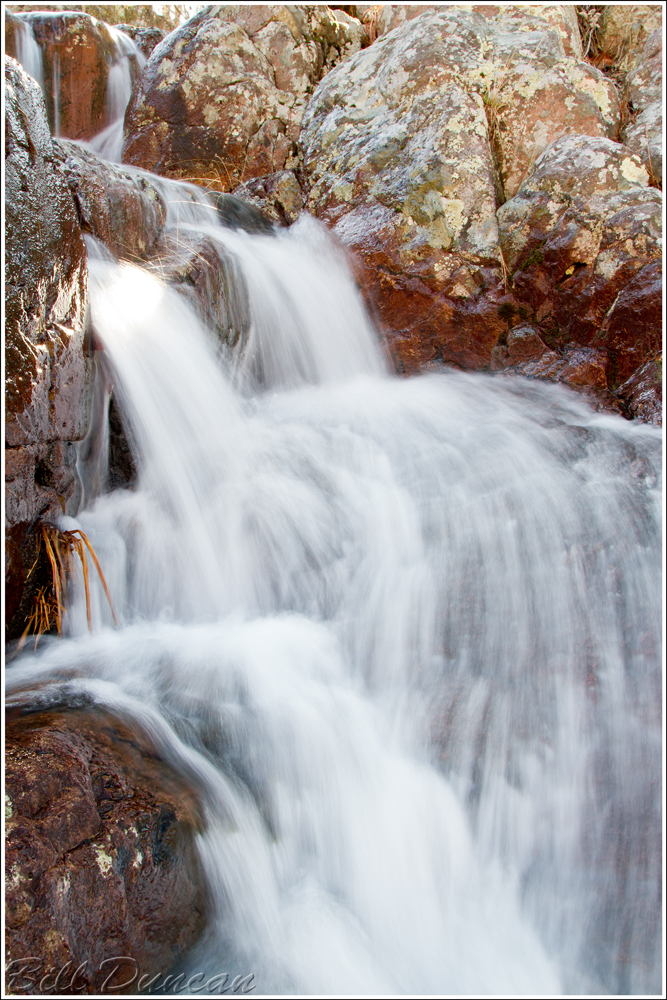
“Rivers or Veins”

Technical details: Canon EOS 7D camera,  EF-S10-22mm f/3.5-4.5 USM lens @ 12mm, ISO 200,  f/13, 0.5 sec

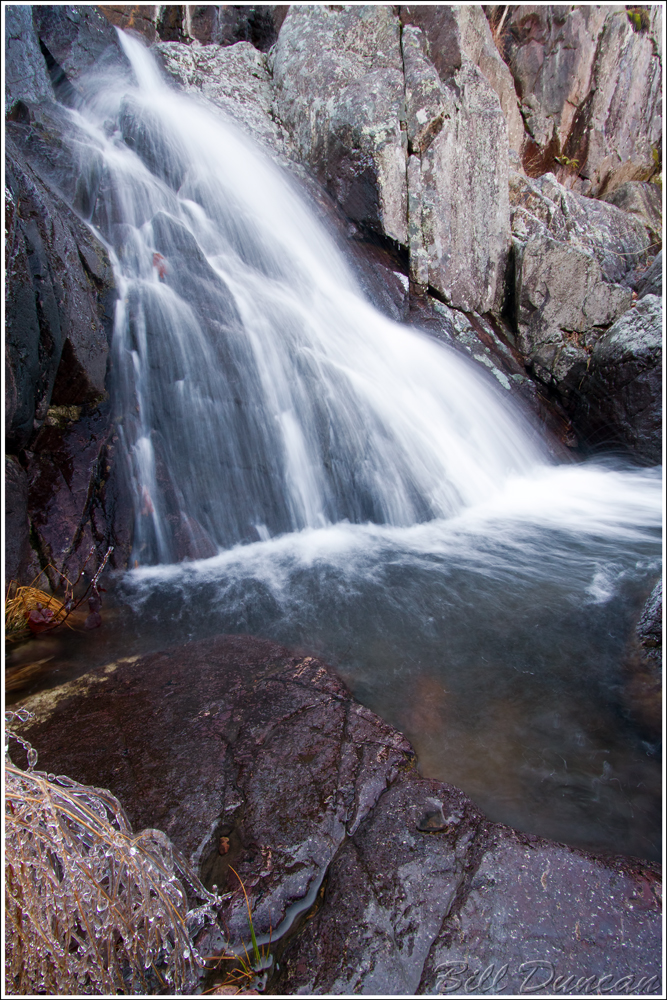
As I mentioned in previous posts, this “winter” brought out possibilities for photography that I would normally be taking advantage of in the warmer months.  These images were taken in early February following a couple of rainy days.  These cascades run out completely in dry times, so you must carefully plan a visit following rainy periods.

“Roll of Ancient Thunder”

Technical details: Canon EOS 7D camera,  EF-S10-22mm f/3.5-4.5 USM lens @ 10mm, ISO 160,  f/13, 0.4 sec

Before you make plans for a visit, listen to warning.  There are no trails here – it is just bush-whacking up the slopes.  Sometimes you will need to go up leaf-littered hills and sometimes you must climb hand and foot over rocks and the cascades.  There are all sorts of risks here.  The rocks are extremely slippery.  I highly suggest the use of felt-bottomed shoes or waders and take all precautions against water and your camera equipment.  You will get wet!  In the growing season I have been to few places with as much or worse concentrations of poison ivy.  If you visit in mid to late summer, cover yourself head to toe and then burn your clothes afterwards.  And ticks!  In early February I hadn’t given a thought to ticks.  This day I received a tick bite and found another three on my pants.  I learned my lesson to pay attention to the temperature and not the calendar.

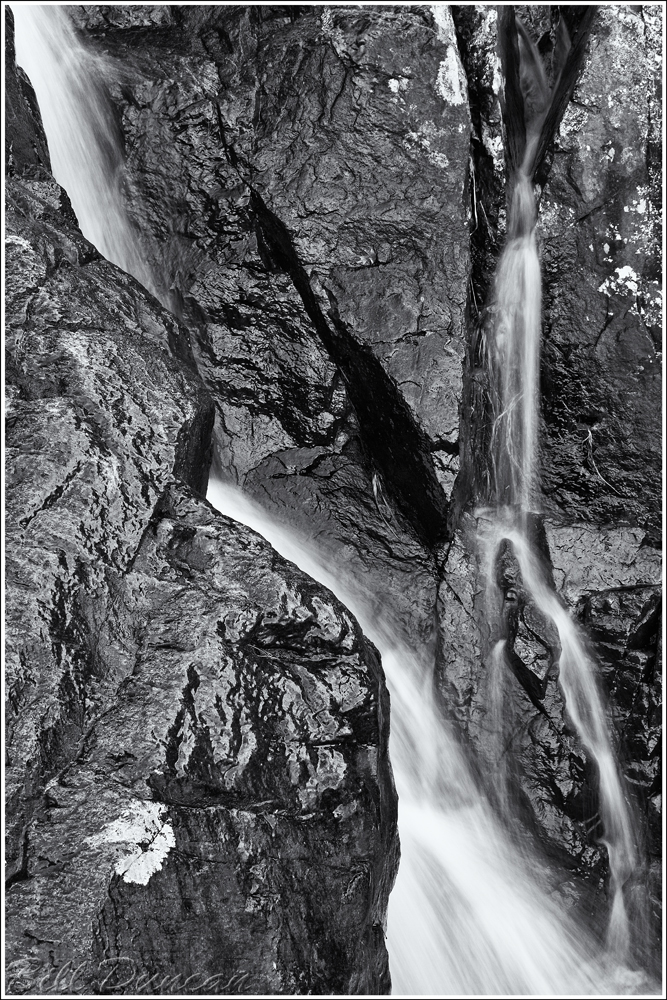
“Crash of Molars”

Technical details: Canon EOS 7D camera,  EF-S10-22mm f/3.5-4.5 USM lens @ 20mm, ISO 200,  f/11, 2 sec

I’ve been fortunate enough to have spent some great days on this mountain.  I have visited on 50% chance of rain days and was able to spend a few hours of cloudy, but relatively rain free weather – perfect for this type of photography.  If you are in shape and have the determination to make the hike to the top, the view of the St. Francis River valley below is sure worth it.  Pack a picnic basket!

“Firing Diamonds At Boots”

Technical details: Canon EOS 7D camera,  EF-S10-22mm f/3.5-4.5 USM lens @ 16mm, ISO 200,  f/13, 0.6 sec

The titles of the images in this post I stole from the lyrics of a song called “Buried in Teeth” by Mariee Sioux.  I can’s stop listening to this song or Mariee’s music in general lately.  I realize this may be considered IP infringement, but I have trouble with titles and I also wanted to  try and give her some props, so to speak.

“Swallowed Into the Gut of Centuries”

Technical details: Canon EOS 7D camera,  EF-S10-22mm f/3.5-4.5 USM lens @ 11mm, ISO 200,  f/16, 0.8 sec

Thanks for visiting the blog.  You can find more of my photos from this location here.  If you decide to make an excursion to this spot or anywhere else into the St. Francois Mountain region, please be careful, enjoy yourself, leave only footprints and take only photographs!

Seven Days of Mina Sauk Falls – Day Seven

“Taum Sauk Eternal”

Technical details: Canon EOS 7D camera,  EF24-105mm f/4L IS USM lens @ 40mm, ISO 200,  f/14, 0.6 sec

Hi everyone.  Here is the last in my planned succession of image postings of Mina Sauk Falls of the Missouri Ozarks.  This photograph may be my favorite of the day.  The textures of the rock and the patterns of the lichen suggested to me that this would make a nice black and white.  I added a light Orton effect to enhance these contrasts and bring out the highlights a bit more.  The pool of water might be my favorite aspect of the image.

I had another great Saturday exploring and photographing in the Ozarks.  We really had some magnificent lightning displays from thunderstorms that went through the region in the afternoon.  I hope none of you had any damage or other worries from these storms.  I started my day with an actual plan and had to make changes due to the weather.  I started my day in the Labarque Creek Watershed, thinking the storms we had on Thursday may have filled the drainage creeks and there would potentially be lots of falls, cascades and other water features to shoot.  I also realized that the spring ephemeral wild flowers would be really getting going.  Well, the water flow was next to nothing.  The rain from early in the week had either drained quickly or was not enough to get things flowing.  The spring ephemerals were exactly what I expected.  Spring beauty, rue anemone, Dutchman’s breeches, hounds tooth and blood root were all present in the thousands.  I wish I had actually spent more time shooting these, but I had other plans as well.

My plan after Labarque was to head to the nearby Shaw Nature Reserve to photograph the early happenings of the Red-shouldered Hawk nest located there.  I hauled all my photo equipment and my spotting scope and my chair and snacks, set up, had an opportunity to take a few shots when the rains came in.  So, I packed up and started back home.  I knew the weather would also interfere with my plan to photograph a local Great-horned Owl nest that I was planning on visiting in the late afternoon and evening.  I went back home, ate dinner and checked weather.com.  There looked to be a gap between 5:00PM and 7:00PM where the chance of rain was significantly lower.  I suspected that the 0.5-1″ or so of rain we received this afternoon may be enough to really get the ephemeral drainage creeks of Labarque flowing.  So, I packed up and headed back to Eureka, knowing it still might rain for another few hours and I may not even get out of the car.  When I arrived, it was barely sprinkling so I put my rain gear on and covered my camera pack with its rain cover and with my hiking pole and trusty Tilley to keep my head dry, I started on the trail – anxious about the weather and quickly cover the mile or so to the features I most hoped would be filled with water.  The situation was not perfect.  It rained about half the time I was on the hike.  I was able to pull the camera out and do some shooting, but the light was very low, even for shooting moving water!  In a couple of brief deluges I carried myself and my gear to a small cave to wait it out.  This was one of the most memorable hikes of my life.  The light, sky, fog water and life all around me seemed to be changing by the minute.  At least half a dozen frog species were singing and the Eastern Towhees were constantly telling me to “Drink your Tee!”.  I heard the ever-vocal Red-shouldered Hawks and the hoots of Barred and Great-horned Owls.

Finally, when the light was so low I couldn’t get anything shorter than a 30 second exposure, I headed back to the car.  Upon reaching the top of one of the steep ridges I saw a spectacular display of warm colors as the sun was able to break through a bit near the horizon and juxtapose itself with the cumulonimbus clouds and associated displays of lightning.

I apologize if this is boring any readers, but I am using this blog as a journal in as much as anything else.  I haven’t really looked at any of the photos I took today.  Hopefully the images will be close to what I hope they can be.  If not, I will always be looking forward to the next hike in the Missouri Ozarks.

Seven Days of Mina Sauk Falls – Day Six

“Warm Flow”

Technical details: Canon EOS 7D camera,  EF24-105mm f/4L IS USM lens @ 24mm, ISO 160,  f/11, 1/4 sec

Near the top of Taum Sauk these cascades were very appealing but somewhat difficult to shoot as the sun began to creep in.  Ice covering the rocks was still an issue and I carefully moved along a ledge to get close to this pretty little slide.  Being able to rest a bit in the sunshine and eat some cocoa-covered almonds and have some coffee while listening to the falls was great after spending the previous hour or two on the shadow side of the mountain in the cold and mist.

Seven Days of Mina Sauk Falls – Day Five

“Frigid Mina”

Technical details: Canon EOS 7D camera,  EF-S10-22mm f/3.5-4.5 USM lens @ 11mm, ISO 250,  f/14, 0.4 sec

Here we have one of the mid-tier drops of Mina Sauk.  This one falls about 20 feet and on this morning the temperature was just cold enough to freeze the mist of the falls on whatever it landed upon.  It was a real challenge keeping the front of the lens free of freezing drops.  The icy rock surfaces were also quite a challenge of foot near any of the falls.  I really grew to appreciate the different colors and tones in the rocks here during this trip.  With no greenery of warmer months or warm colors of autumn the purples, pinks and various other hues that these granites and their lichen passengers exhibit was something to focus on.

Seven Days of Mina Sauk Falls – Day Four

“Spanning Time”

Technical details: Canon EOS 7D camera,  EF24-105mm f/4L IS USM lens @ 24mm, ISO 200,  f/10, 1/4 sec

So how did Mina Sauk and her father mountain, Taum Sauk, get their names?  I am currently looking for an original and direct source for the telling of the legend of Mina Sauk.  Here are a few paragraphs collected from the web that were originally published by the Kansas City Star:

The Legend of Taum Sauk Mountain ~ A Native American “Romeo and Juliet” story as told to John Russell, from the Kansas City Star, by “Old Uncle Jim Connelly” back in 1953, the summer after the park became accessible by automobile to the public.  Uncle Jim, an ex-railroad worker, who for many years ran a service station and tourist court from his home near Ironton, knew a host of stories and Indian legends tied up with the mountain.

“Uncle Jim’s favorite story probably is one about Taum Sauk, the Piankashaw Indian chieftain after whom the mountain is named, and his daughter, Mina Sauk, for whom the beautiful waterfall on the northwestern slope of the mountain is named.

“Long before the white man came here,”  Uncle Jim relates, “this land of flowers, now called the Arcadia Valley, was the hunting grounds of the Piankashaw Indians.  The Piankashaws had a famous chieftain, Sauk-Ton-Qua.  Because the name was hard for the white man to pronounce, he was later call Taum Sauk.”

“Taum Sauk was wise and although the Piankashaws were not as large a tribe as the Cherokees or Osages, he was able to hold his territory against their invasions.  The Piankashaws lived in comparative peace in and around the Arcadia Valley, where they hunted and fished and raised a little corn in the summertime.  In the winter they would move to the limestone bluff shelters along the Mississippi river and stay there until warm weather.”

“Taum Sauk’s beautiful daughter, Mina Sauk, was greatly desired by all the young warriors in the tribe.  However, Mina Sauk met a young Osage warrior in the woods and lost her heart to him.”

“For a long time he wooed her secretly, but one day she was discovered in the arms of the young Osage.  The young warrior was captured and taken before the chieftain.  He was tried and condemned to death.”

“He was executed on the slopes of Taum Sauk Mountain, where a great porphyry outcrop form an escarpment overlooking Taum Sauk creek and facing Wildcat mountain. The young warrior was tossed from the parapet down a succession of benches on the mountainside, thrown from bench to bench with the spears of warriors.  He fell bleeding and dying in the valley below.”

“The grief-stricken maiden was restrained by the tribal women from interfering with the execution.  But at the fatal moment, she broke loose from her captors and threw herself to death on the same benches.”

“The old Indian legend says that this displeased the great spirit, and that the earth trembled and shook, and the mountain cracked.  Then a stream of water poured forth and flowed down the rock benches, washing away the blood.”

“The place is still known as the Mina Sauk falls and along the edges of the rivulet, even today, there grow little flowers with crimson blossoms which the Indians believed got their color from this ancient tragedy.”


-I really like this story and think it could be something special if it were fleshed out more fully.  I find it hard to believe that someone like Longfellow never picked this one up and turned it into a classic.  But, I guess this part of the country has never had too many literary classicists.  Maybe Woodrell can pick this up and give it a modern Ozark face.  Someone should suggest this to him.


Seven Days of Mina Sauk Falls – Day Three

Technical details: Canon EOS 7D camera,  EF24-105mm f/4L IS USM lens @ 40mm, ISO 200,  f/11, 1/4 sec

It wouldn’t be a trip to the St. Francois Mountains in January through March without finding some Ozark Witch Hazel in bloom.  These small shrubs love the sandy, acidic soils found along streams in this region.  The flowers of these guys really put out some fragrance!  If you find yourself in a large patch of these during a particularly warm day, the smells of vanilla and other sweet spices and floral notes can almost be overpowering.  In this image, I tried to feature a branch of one of these plants that carries both new blooms from this year along with spent fruit cases from last year – many of which that still hold seed.  I used a gold portable reflector to increase the warmth of the branch and its flowers.  This branch is featured nicely in front of a couple of picturesque falls that can be found high on the set of falls and cascades that make up Mina Sauk.

Seven Days of Mina Sauk Falls – Day Two

Technical details: Canon EOS 7D camera, EF-S10-22mm f/3.5-4.5 USM lens @ 10mm, ISO 160,  f/14, 0.6 sec

I estimate the vertical distance in this image in the neighborhood of 60-80 feet or more.  The ultra wide angle utilized in this image takes out a lot of that scale for the viewer.  I should have placed a kitten or something in the near foreground to capture that scale, I know.

The cascades and falls begin much higher up the mountain than this particular section.  Here is where the falls begin their more vertical descent.  This is a good example of the fractures (joints) that form in this super hard and dense rhyolite and granite.  The water slowly works its way in between the cracks and given enough time, water wins.

Location Spotlight: Elephant Rocks

Technical details: Canon EOS 7D camera, EF24-105mm f/4L IS USM lens @ 28mm, ISO 160,  f/14, 1.3 sec

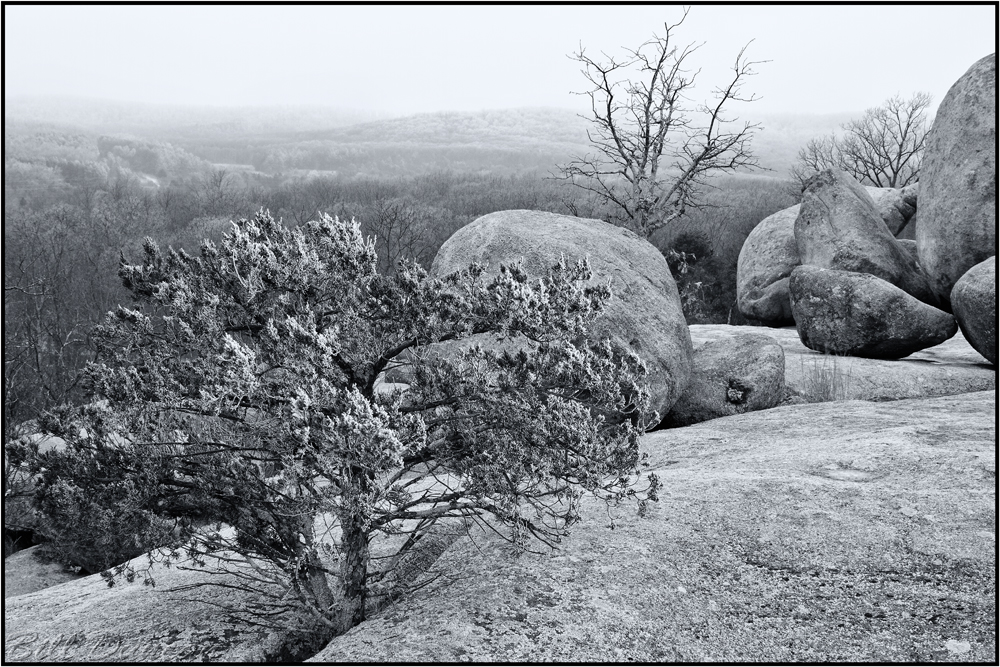
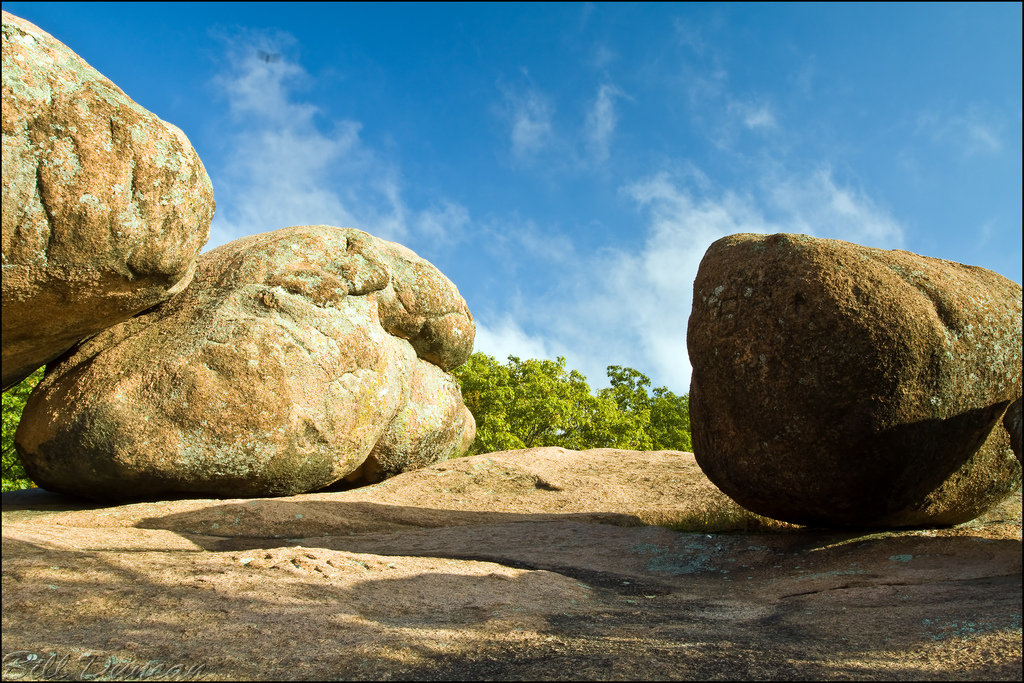
Today we’re traveling back south to my favorite region for landscape photography, the rugged and beautiful St. Francois Mountains.  This location, known as Elephant Rocks, is located in Iron County and lies about six miles north of Ironton and two miles west of Graniteville.  By the names of these towns can you figure out what the principle economic activities of this area were historically?  The primary features of this location, the elephants, are easy to see in the image below.

Technical details: Canon EOS 50D camera, EF17-40mm f/4L IS USM lens @ 17mm, ISO 100,  f/16, 1/6 sec

So what are these “elephants” and how did they get there?  Well first of all these rocks are composed of a pink-colored, Graniteville Granite, or more affectionately known as “Missouri Red Granite”.  Geologists discern between different types of granite based on mineral grain-size and color.  Missouri Red is actually one of the younger granites of the St. Francois Mountains, coming in at a mere 1.3 billion years.  Missouri Red, collected from quarries surrounding this feature was used as paving stones that covered most of St. Louis near the turn of the 20th century.  It was also used in parts of the Eades Bridge, the Jefferson National Expansion Memorial, the Missouri Governors Mansion in Jefferson City and in important buildings across more than a dozen cities in the United States.  It is still quarried today and used mostly for tombstones and counter-tops.

Technical details: Canon EOS 50D camera, EF-S10-22mm f/3.5-4.5 USM lens @ 10mm, ISO 100,  f/16, 1/6 sec

So, if you are reasonably educated in the discipline of geology and you were forced to guess how these boulders managed to be found here your first answer might be to suggest those great marble movers – the glaciers must have moved them here from up near Canada, right?  Sorry, the southern limit of intrusion of those sheets of ice was about where the Missouri River now flows about 150 miles or so to the north.  Hints upon the excepted mechanism of formation can be seen in the image above.

These boulders were formed by a process known as “spheroidal weathering”.  Before you reach for that tube of Preparation H, let me try to explain.  Sometime in the Pre-Cambrian molten rock was forced into the earth’s crust.  As the rock slowly cooled it formed long, nearly vertical joints, or fractures.  As time passed these rocks were covered with younger, sedimentary rocks.  When the Ozark Plateau was forced upward the resulting streams cut their way through this younger rock and eroded much of it away.  Erosional ground waters acted on the corners and edges of these granite joints quicker than on the surfaces and gradually increased these joints.  When the rocks were later exposed to the surface, erosion and weathering acted much quicker in forming the clean and rounded features of the boulders.  Plant life (tree and grass roots, lichen, etc…) also helped to chip away at the surfaces of these future boulders.  Eventually a tor – an exposed mass of bedrock, was left with these elephantine boulders now widely separated.

Technical details: Canon EOS 50D camera, EF-S10-22mm f/3.5-4.5 USM lens @ 10mm, ISO 100,  f/14, Photomatix-HDR blend of 9-images

Above you can see one of the more famous pachyderms who make this site their home, “Dumbo”.  This guy measures at about 27 feet tall, and with the incredible density of this granite (~160 lb per cubic ft) weighs close to 680 tons.

Technical details: Canon EOS 50D camera, EF17-40mm f/4L USM lens @ 19mm, ISO 100,  f/16, 1/6 sec

Not even the people of the “it will never run out” period of western U.S. expansion would destroy something as unique as Elephant Rocks.  Although there has been mining of granite, iron, lead and other minerals throughout this area, Elephant Rocks still looks pretty much as it did 200 years ago.  When a quarry worker reached “master stonecutter” status they would carve their names here upon the boulders and bedrock.  This gives the place an interesting human historical aspect.  Today, this location is protected as a Missouri State Natural Area and a State Park.  There is a very well done ~mile paved “braille trail” that circles through many of the features of the park.  The trail’s meandering allows the blind to feel some of the geologic features and braille signs are posted to explain what the person is experiencing.  I find this to be a fantastic development.  In my opinion our country does nowhere nearly enough to help the blind and these people are often forced into greater dependence and exclusion because our government refuses to take the smallest of steps.  Ever notice how the US paper currency is all the same size?

Technical details: Canon EOS 50D camera, EF-S10-22mm f/3.5-4.5 USM lens @ 12mm, ISO 100,  f/16, 1/10 sec

The tinajita, or panhole like those pictured above are more evidence of the weathering this exposed porphyry is being subjected to.  The process of seasonal freezing and thawing as water seeps ever deeper into minute cracks forms these shallow depressions that fill with water in wetter times allowing for animals like insects and frogs to have places to breed.

Technical details: Canon EOS 7D camera, EF-S10-22mm f/3.5-4.5 USM lens @ 15mm, ISO 100,  f/16, manual-HDR blend of 2-images

Elephant Rocks.  It comes as no surprise to those who live in the region – everything in the mid-western United States, but particularly the Ozarks is often overlooked in favor of the grand natural spectacles of the Rockies, the Appalachians, the South-West’s deserts and canyons, etc…  Well, Elephant Rocks is one location that should be on the bucket lists of any tourist, any rock-star landscape photographer or nature enthusiast.  It is a location deserving of being voiced-over by a James Earl Jones, Alec Baldwin or Brangelina in the nature documentary of the week.  I hesitate to scream too loudly, however. I have loved the times I’ve been able to spend hours here without seeing another bipedal ape and hope for many more

I’ve called this the place of unlimited compositions.  I have been fortunate enough to make a few images I really like and I look forward to many more visits over many more years to come to see what other compositions the place is hiding.

You can view more of the photographs I’ve taken at Elephant Rocks.      

Ice Is Nice (When You Can FIND It)

Technical details: Canon EOS 7D camera, EF24-105mm f/4L IS USM lens @ 60mm, ISO 100,  f/13, 1/20 sec

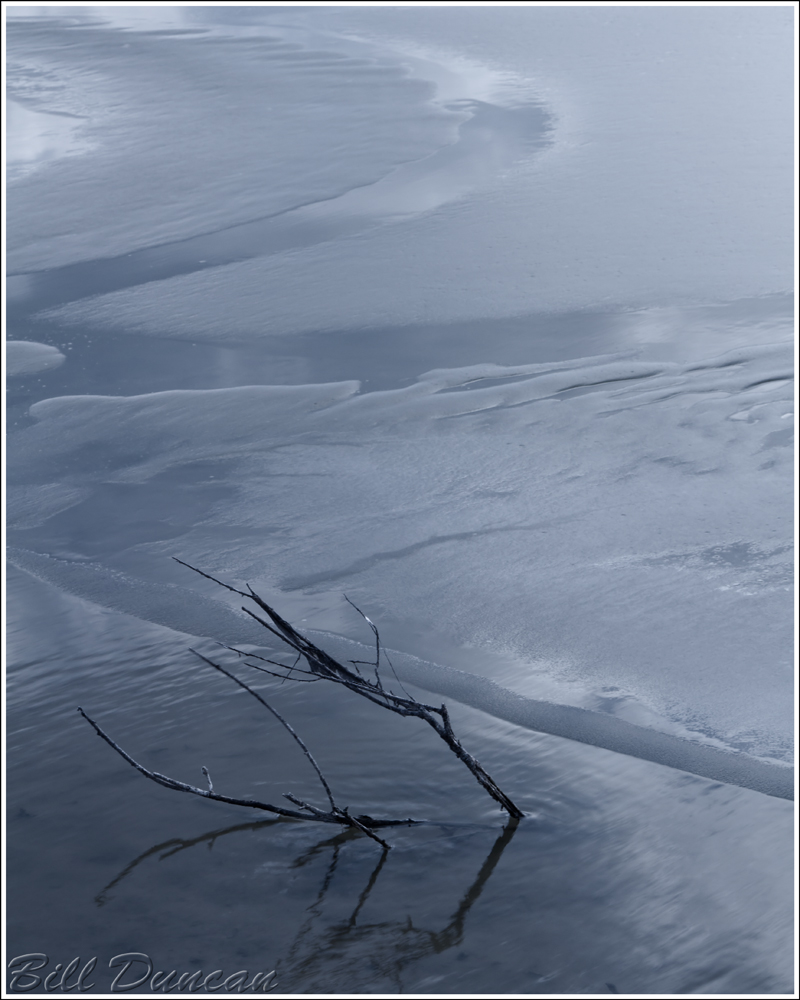
Photographing ice is a nice challenge for the nature photographer.  Negotiating the landscape itself when covered in snow and ice is the first obstacle and finding safe passage in both transporting yourself to the scene and then within the scene is obviously critical.  Nailing the exposure in camera is crucial in making an ice image that works compared to one that falls short – ice and snow have their obvious challenges as being bright subjects that can confuse the camera in automatic exposure modes.  Composition is a challenge, as many ice shots are all about pattern and flow through the rectangle and may not be focused on an apparent subject.  Finally, color and white balance of the image needs to be carefully scrutinized.  There are lots of options here.  Will you leave the scene cold?  This is a popular choice for winter images, or is there reason to warm it up?  Will it be in color or will you convert to B&W?  If you do go monochrome, color toning leaves you with more potential options.

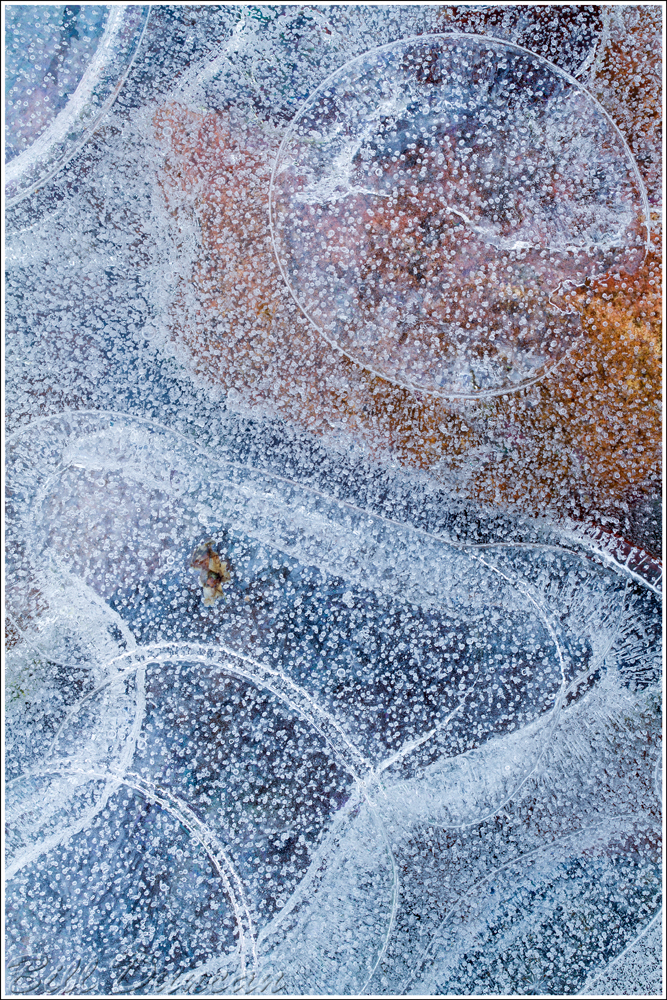
Technical details: Canon EOS 7D camera, EF100mm f/2.8L Macro IS USM lens, ISO 320,  f/14, 1/6 sec

I naturally tend to process the winter images I’ve been able to produce toward the cool end, either through white balance decisions or in monochrome toning.  The image presented above is a more neutral or even warm image.  These leaves, which had fallen weeks earlier in mid-autumn were approximately two feet under the surface of this stream which runs through Hawn State Park in the beautiful St. Francois Mountains.  A layer of ice about one inch thick provided the first layer of texture and the warm mosaic the fallen leaves of the stream bottom provided another.

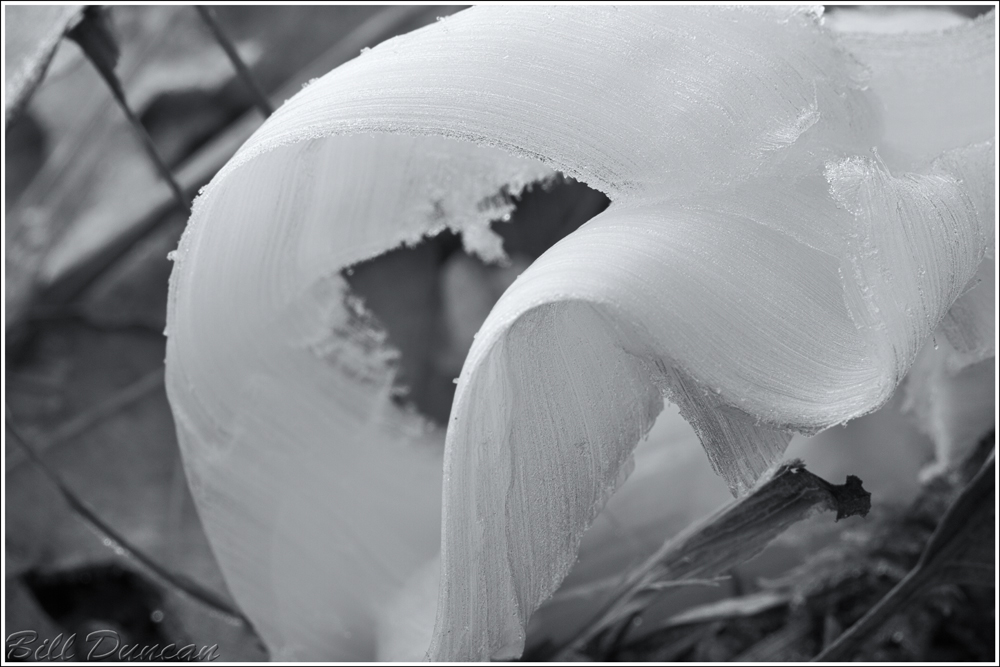
Technical details: Canon EOS 7D camera, EF100mm f/2.8L Macro IS USM lens, ISO 100,  f/18, 1.6 sec

The crystalofolia.  Ive blogged about these once before.  This particular beauty was quite intricate.  I tried to convey a sense of three-dimensionality and capture the detail one can only really see through the magnification of a lens.

Technical details: Canon EOS 7D camera, EF100mm f/2.8L Macro IS USM lens, ISO 100,  f/11, 1 sec

You don’t have to read the title of this post to know that winter is MIA this year across much of North America.  This past spring I purchased my all wheel drive-all the time Subaru Forester, replacing a good vehicle but one of the worst winter vehicles to drive you can imagine.  For years, I had to either stay home or borrow the wife’s front-wheel drive vehicle if I wanted to make an outing into the snow and ice.  My anticipation for this winter season has been growing ever since.  Nothing was going to stop me now from the winter image making opportunities I dreamed about finding in some of my favorite places in the Ozarks and northern Missouri.  Never did I imagine the Mother Nature would play a cruel prank and give me what is to date the mildest winter that I can recall.   I have been able to make a few winter photographs this year, including the ones in this post.  But come on, I bought a pair of ice cleats for my hiking boots!  If February continues the way it started here in Missouri, I’ll be the first to sign the “Let’s eat Punxsutawney Phil in a stew of his own juices” petition.

Happy Groundhog Day.