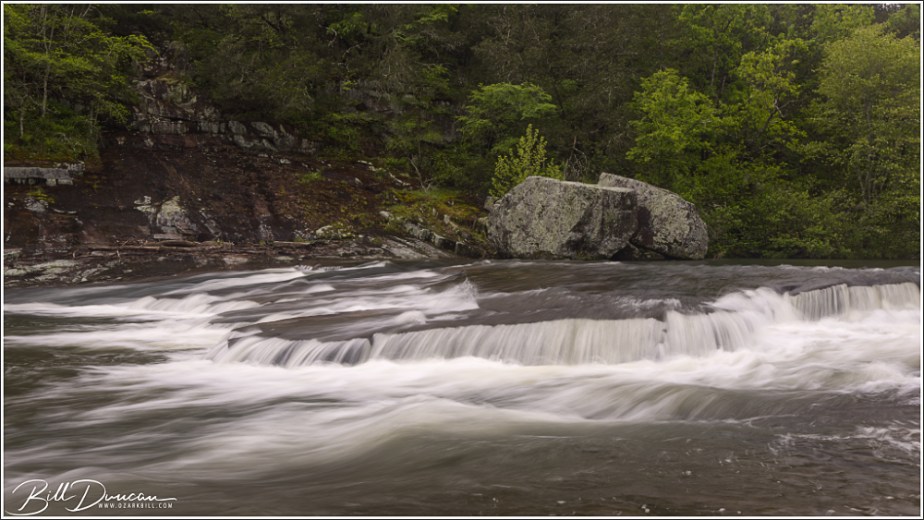
Three Lesser Known Shut-ins of the St. Francois River Watershed

Anyone with a bit of knowledge about the St. Francois River of southeastern Missouri has probably heard of or has even visited the well-known stretch of the Tiemann Shut-ins that create the great series of class 1-3 rapids that experienced kayakers long to ride. The stretch of this river between Millstream Gardens and Silver Mines Recreational Area is one of the most scenic and biodiverse areas of the Show-Me State.

This spring I was turned on to three new-to-me shut-ins in the St. Francois watershed that I should have visited long ago. At first, it was surprising to me that these three geological features are not more well known. However, once I found out a little of the difficulty of getting to these locations, I am now not surprised at all.
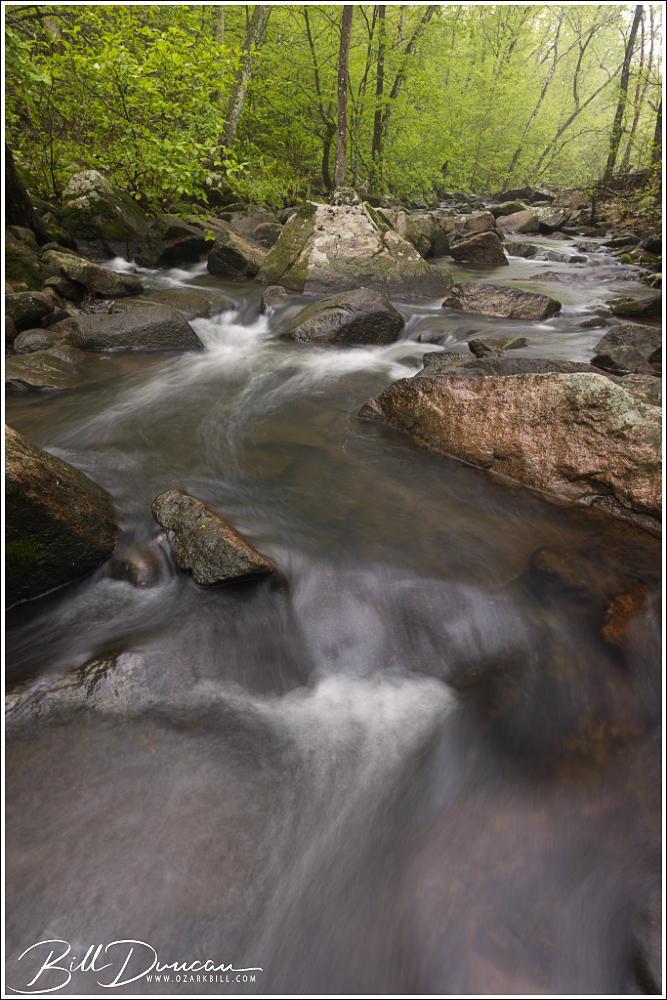
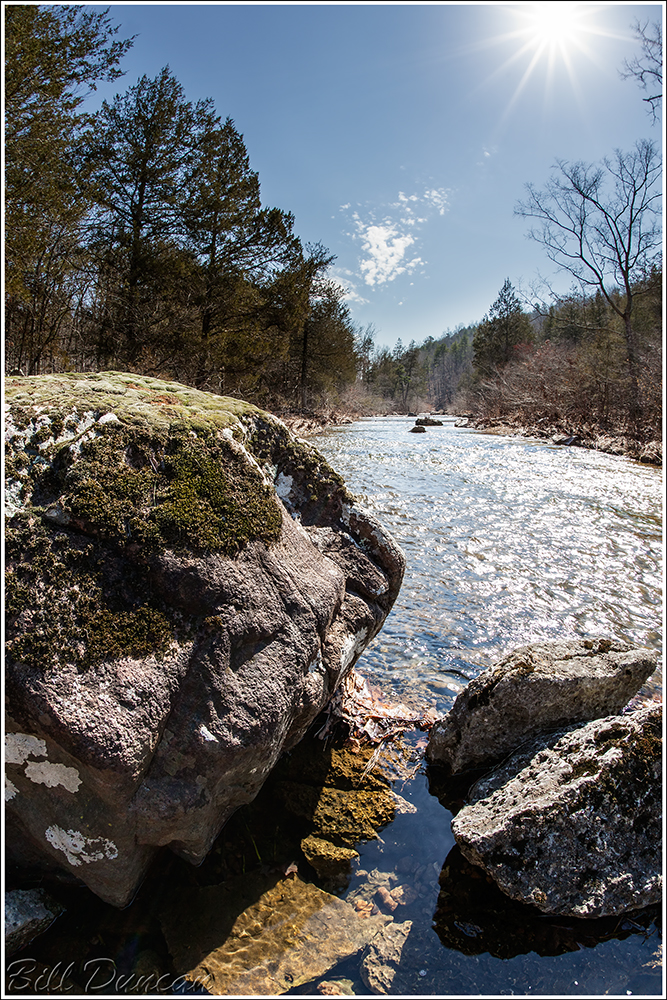
Looking up Turkey Creek

The St. Francois Watershed
The geological history of the St. Francois River watershed is a tale written in stone, shaped over millions of years by dynamic processes. At its core lies the ancient Ozark Plateau, characterized by its resilient dolomite and limestone bedrock, remnants of a bygone era when shallow seas covered the region. Erosion and uplift sculpted the landscape, carving out rugged hills, steep bluffs, and winding valleys that define the watershed’s topography today.

Upper Stouts Creek Shut-ins

Within the embrace of the St. Francois River watershed thrives a rich tapestry of ecological diversity, harboring a multitude of habitats that support an abundance of plant and animal life. The forested slopes of the Ozarks provide refuge for a myriad of tree species, from towering oaks and hickories to delicate dogwoods and redbuds. Beneath the canopy, a lush understory of ferns, wildflowers, and mosses carpet the forest floor, while clear, spring-fed streams meander through the landscape, sustaining populations of freshwater mussels, fish, and amphibians.
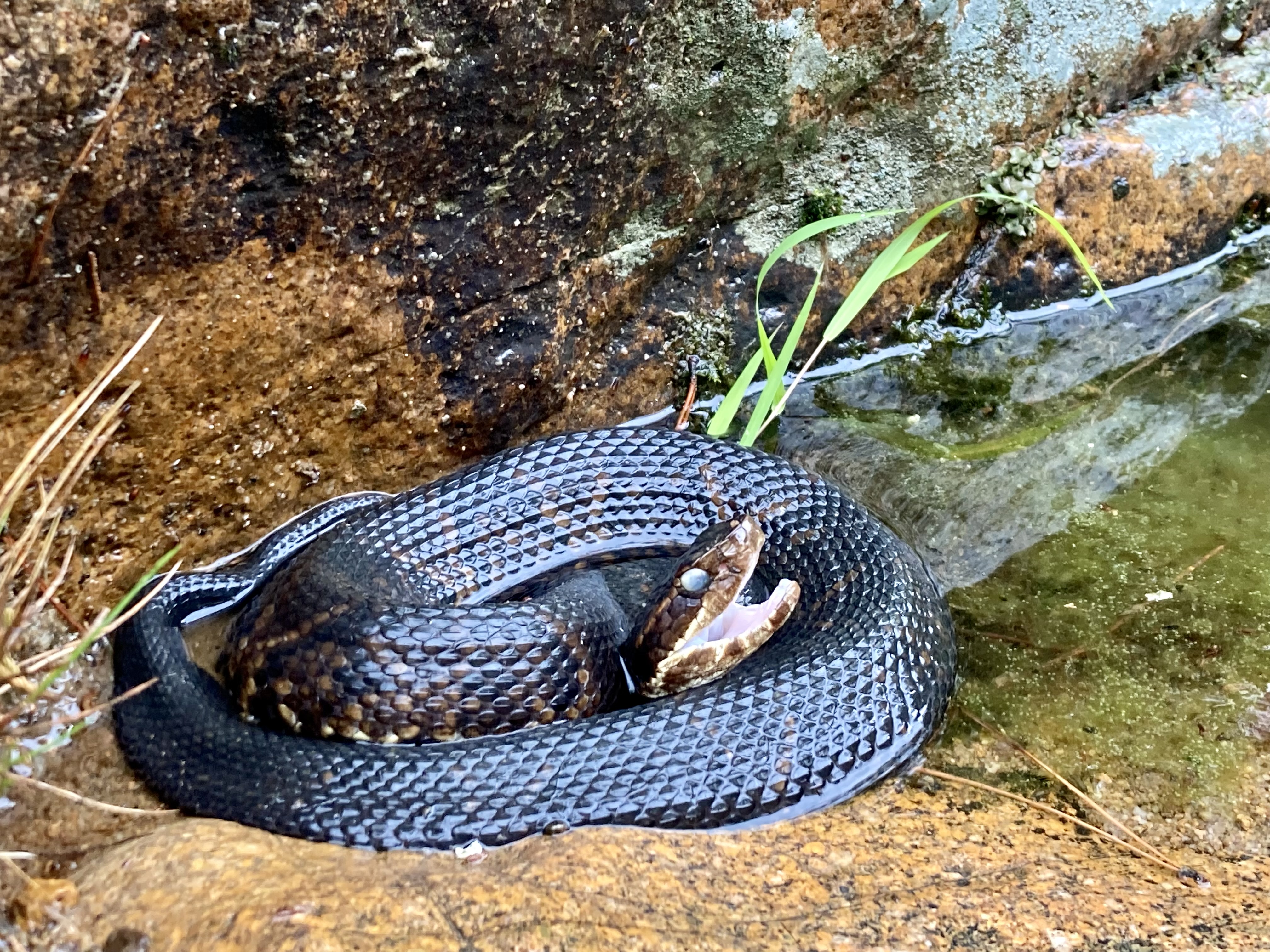
The traveler to the shut-ins of the St. Francois River watershed should always be on the lookout for cottonmouths.

The river itself serves as a lifeline for countless species, offering vital habitat and nourishment along its meandering course. From the elusive Ozark hellbender to the Bald Eagle, the St. Francois River watershed supports a diverse array of wildlife, including many species of conservation concern. Endemic flora and fauna, such as the Ozark chinquapin and the Hine’s emerald dragonfly, find sanctuary within the watershed, highlighting its importance as a stronghold for biodiversity.

About Missouri’s Shut-ins
Shut-ins are a testament to the enduring forces of nature. Formed over many thousands of years, these unique rock formations are the result of a complex interplay between water erosion and geological upheaval. The shut-ins, characterized by narrow channels and cascading waterfalls, are formed when swiftly flowing streams encounter resistant igneous bedrock, creating natural barriers that redirect the flow and sculpting the surrounding landscape into breathtaking formations.
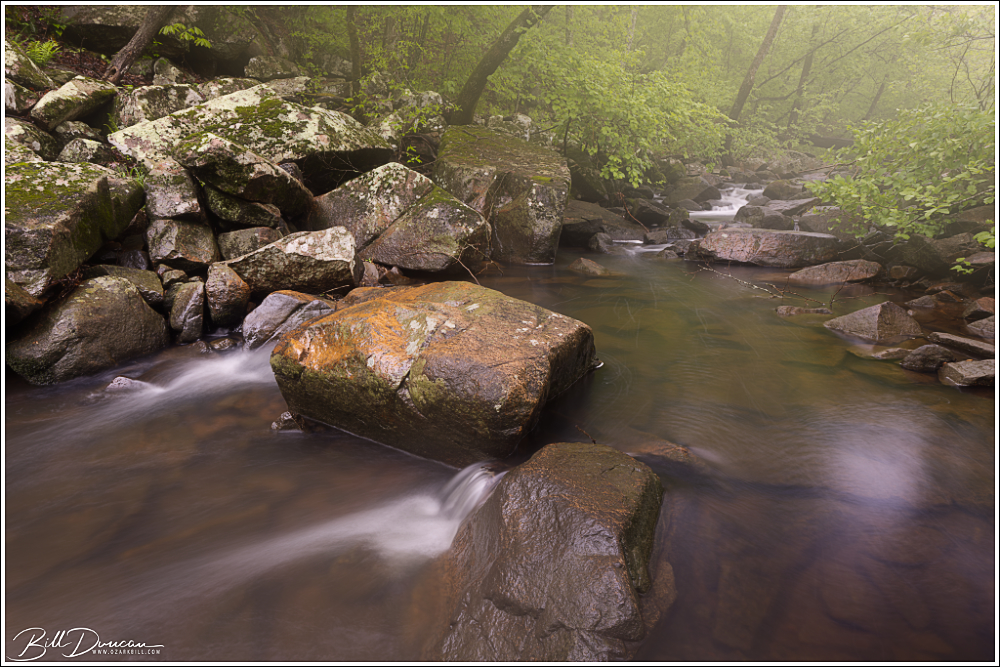
Humidity in these creek beds is usually very high, creating fog and haze. Turkey Creek Shut-ins.

Beyond their stunning beauty, shut-ins are also home to a diverse array of flora and fauna. The cool, clear waters of the shut-ins provide a habitat for various aquatic species, including aquatic invertebrates, freshwater mussels and fish. Along the rocky banks, towering hardwood forests thrive, offering refuge to an abundance of wildlife, from songbirds to white-tailed deer. The unique microclimate created by the shut-ins supports a rich tapestry of plant life, including rare species adapted to the harsh conditions of the rocky terrain.

Upper Stouts Creek Shut-ins
One of the main feeding branches of the St. Francois River, Stouts Creek contains a number of picturesque shut-ins. Casey and I had noted this particular one driving by for years but had never made the stop. We had to trespass a little to get our shots, but the folks who own this property are, theoretically at least, supposed to be inclined to forgive those who trespass. We spent just a few minutes here and were in and out without incident.
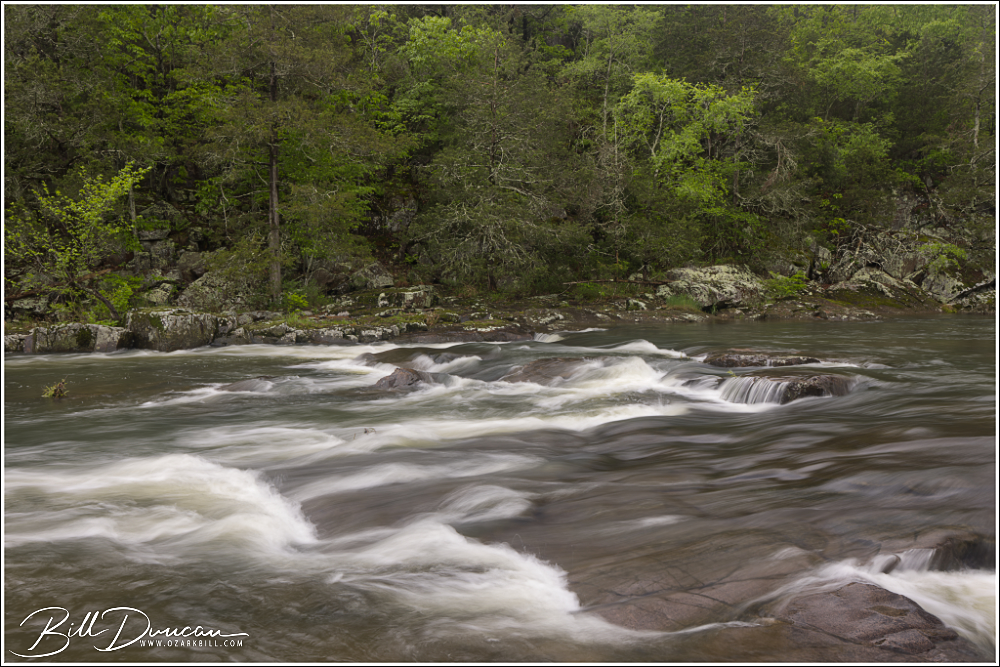
Upper Stouts Creek Shut-ins

Turkey Creek Shut-ins
Flowing from the north, Turkey Creek empties its contents into the east side of the St. Francois River, just upriver from the historic Silvermines Dam. Getting to the Turkey Creek Shut-ins requires either a treacherous hike along the creek from the confluence, or a slightly less arduous bushwhack up and over a highland to the sight of the more picturesque parts of the shut-ins. Taking the easier way means missing portions of the shut-ins but will also result in fewer potential run-ins with cottonmouth snakes and ankle-snapping rocks.

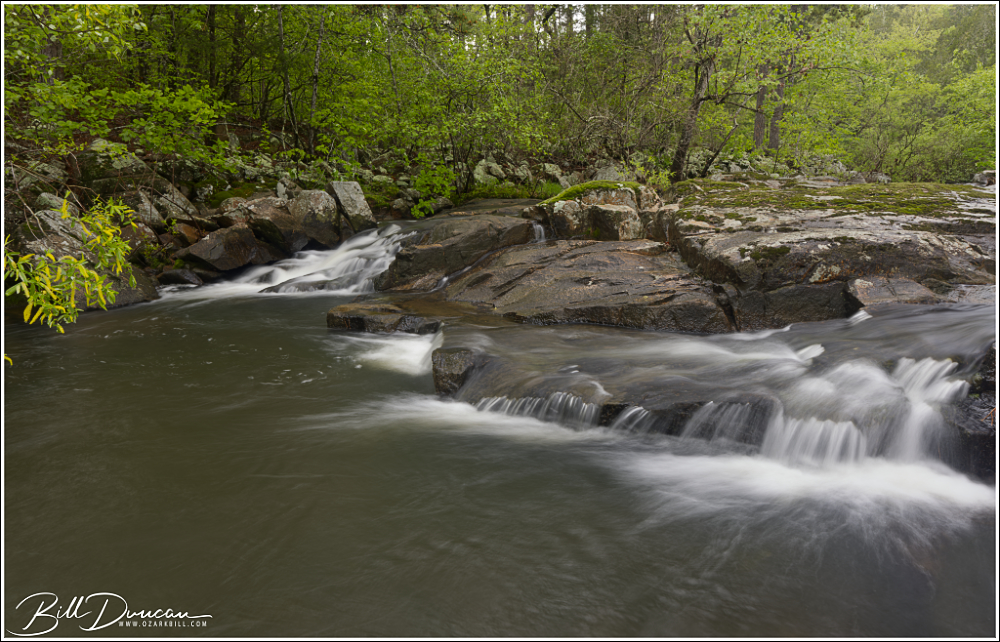
Turkey Creek Shut-ins
Swimming holes abound in shut-ins like these at Turkey Creek.
Turkey Creek Shut-ins

Mud Creek Shut-ins
Mud Creek Shut-ins are definitely one of the most memorable shut-ins that I have had the pleasure to visit – not only because of their classic St. Francois Mountain beauty, but due to my story in reaching them. As is the case with Turkey Creek Shut-ins, these shut-ins can be reached by paddling the St. Francois River. However, I doubt my kayak skills would service safe passage across the class-3 rapids of this stretch of the river, especially while carrying expensive camera gear.

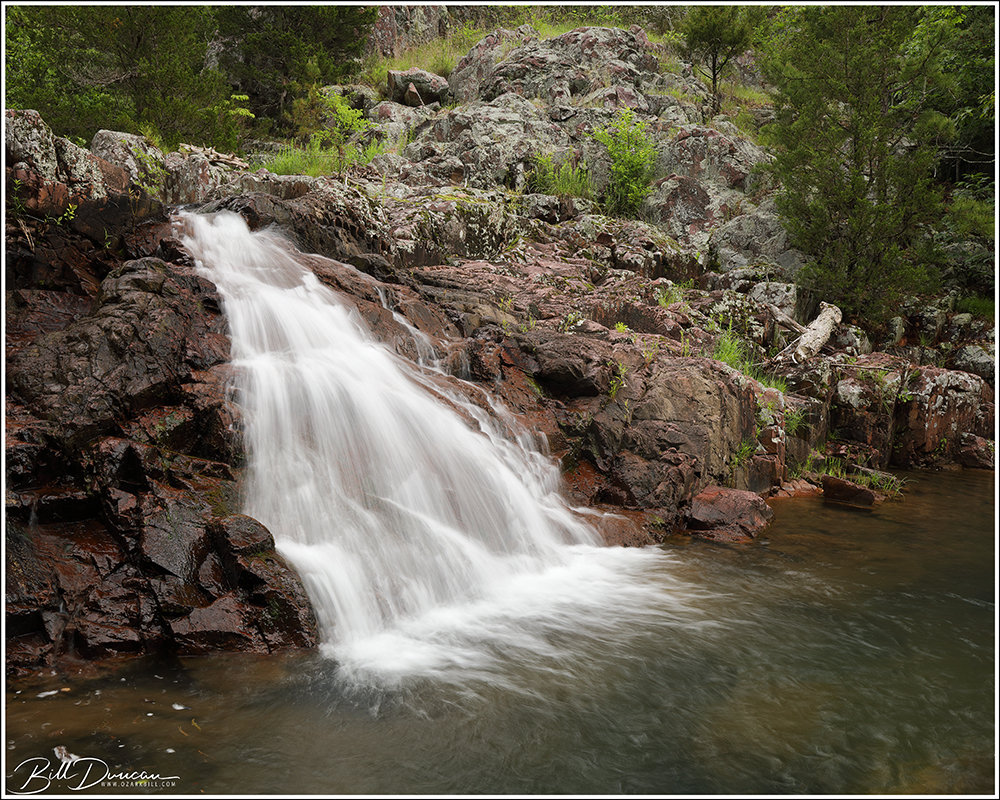
Moving upstream along Mud Creek from its confluence with the St. Francois, one first gets to view this very nice waterfall.

The next best option? Footing it across. I began this trek from the parking lot of the Silvermines Recreational Area. In times of high water, the low footbridge across the St. Francois River can be underwater, so I recommend parking on the north side of the river and paying the ridiculous $5.00 to park your car for a few hours.
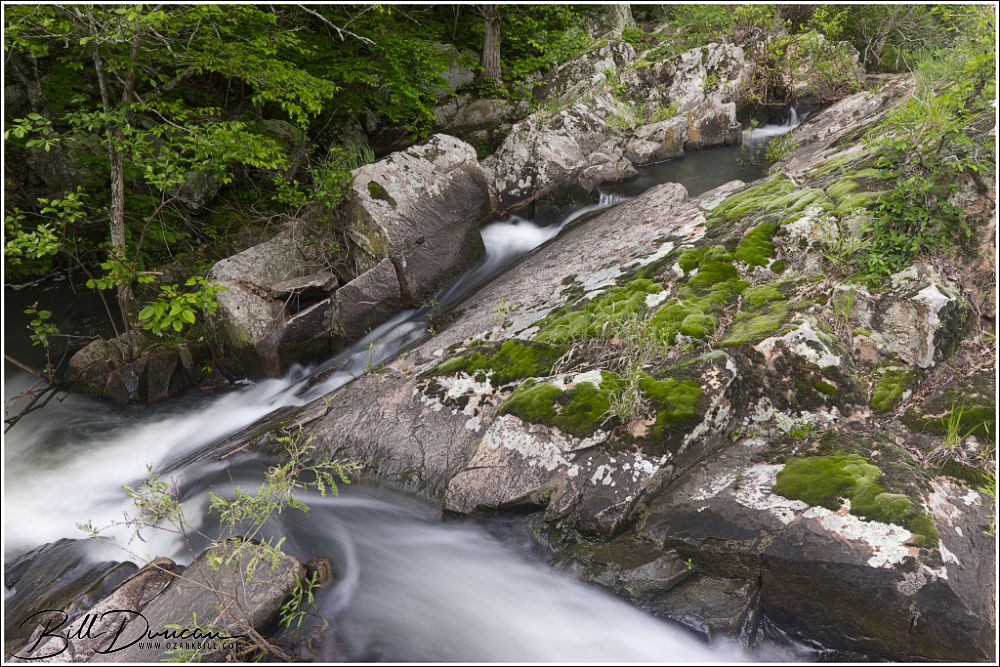
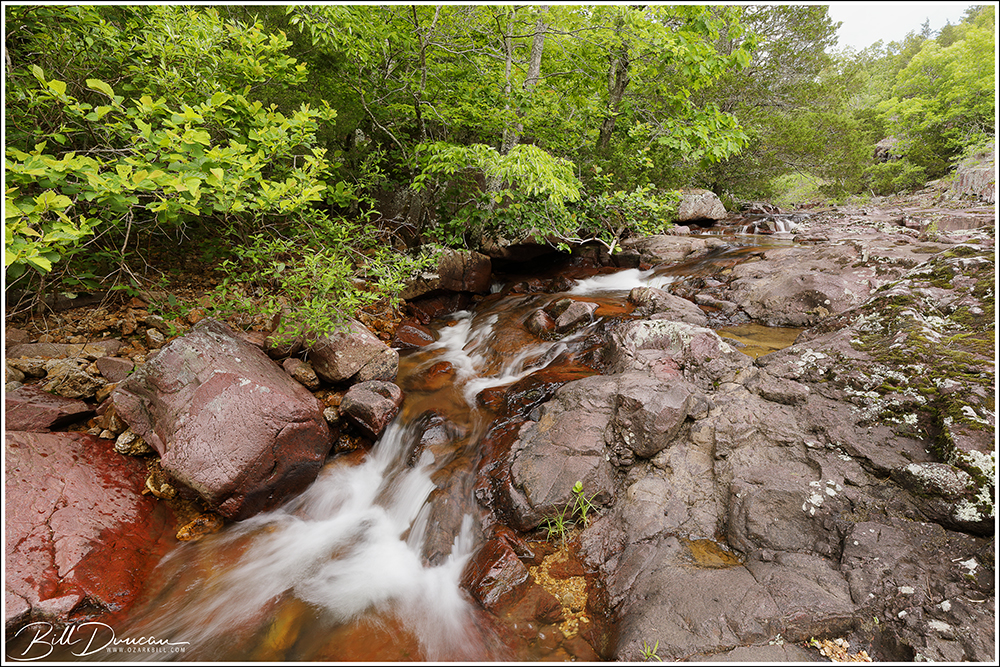
The water finds multiple pathways against the rock as the creek races down the ravine.

From the parking area, I took the “trail” that runs upstream along the north side of the river until I got to the namesake mines. From here, it was steep climbing until I eventually ran into an old two-track that allowed for some switch-backing until I eventually rose from the river’s ravine into a more upland forest. Although the topology here was more manageable, fallen trees were everywhere, presumably from strong storms of recent years. The bushwhacking got frustrating, especially with the need to eat a spider or two every five to ten steps! Using my GPS, I kept the river to my right side and generally headed to the northeast to where Mud Creek meets the St. Francois. I should have headed much further to the north, but I kept finding myself heading back into the boulder-strewn ravine of the river. Eventually, I learned my lesson and rose to the highest elevation possible and made a direct line to where the GPS told me the confluence would be. Finally arriving, I realized I was then facing the hurdle of heading back down the ravine to the confluence. I could hear rushing water from the east and the north, shut-ins along the river and creek, respectively. I chose my point to descend into the ravine, not knowing if this would take me to sheer cliffs that would force me back up to try again. I eventually stumbled into the relatively small river bank that was thick with twenty foot tall alder and witch-hazel thickets.

Mud Creek Shut-ins

Clearing these thickets, with water halfway up my wellies (I got my first pair of Gumleaf boots recently, so I can no longer call these muck boots), I was finally able to see the confluence. Navigating around huge boulders, I began clambering up Mud Creek and almost immediately came upon the nicest waterfall of these shut-ins. About this time, the sky began to darken. Most of my trek to this point was in mostly sunny skies, making me wonder if the overcast skies forecasted for this afternoon where ever going to happen. Now I was hearing thunder and watching dark skies closing in quickly from the west.

Porphyry and swirls

I realized I probably had limited rain-free time with the shut-ins so I got to work, moving myself and my gear from one point of interest to the next upstream. This type of landscape photography is not for the faint of heart! Due to the sharp sides of the ravine, I was forced to cross the creek several times, negotiating deep pools, fast-moving water and slippery rocks. On several occasions, I used my tripod as an extra set of legs, helping me stabilize myself while crossing the creek.

Mudd Creek Shut-ins

Getting about a half mile upstream from the confluence, the shut-ins widened, opening up to large sections of exposed granite. It was around here that I decided the storm was not going to pass me by, but come right down on me. The thunder was getting closer and more frequent. I put my camera bodies and lenses into individual Ziplock bags and put the rain cover over my bag just when the sky opened up with torrential rains. It was then that I realized I was on the wrong side of the creek to get back to where I needed to be. I also sensed the waters in Mud Creek were starting to rise. The opposite side of the creek this far upstream looked like near-vertical cliffs, but I knew I probably did not have time to head back downstream to a point where I made the crossing earlier. I found the closet point to make a relatively safe crossing and found myself with just a few feet between the steep rise of the ravine and the creek that seemed to be increasing inch by inch. I found some handholds and started climbing. Spiders be damned!
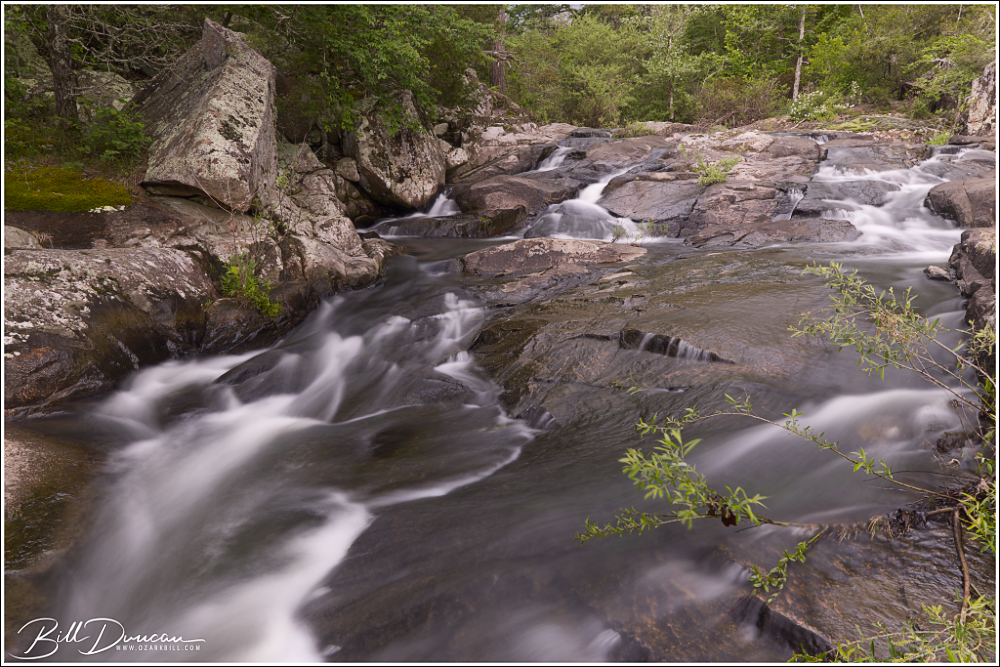
St. Francois Mountain Beauty!

I climbed as carefully as possible, making progress while the rain came down in sheets and lighting danced across the sky directly above me. In five to ten minutes I made it up the approximately 400 feet of increased elevation and reached the top of the ravine. Not liking the idea of clambering down the opposite side of the ravine to get back to the mines, I decided a better route back would be to stay in the uplands and head north to Highway D to get back to my car. That was another two-mile bushwhack, back through the fallen trees, my wellies filling up with rain water, and limited visibility. I eventually made it to the road, finding my way safely back to my car. Not wanting to ruin my seat with my soaking wet cloths and not having a dry change of cloths, I striped to my boxer-briefs, put a towel down on my seat and drove the two-hours home. Thankfully I did nothing to raise the attention of any authorities on the way. 😉

I’d Like to thank Casey Galvin, Kathy Bildner and midwesthiker.com for the information that helped me reach these fantastic locations!
Meeting new shut-ins in the St. Francois Mountains

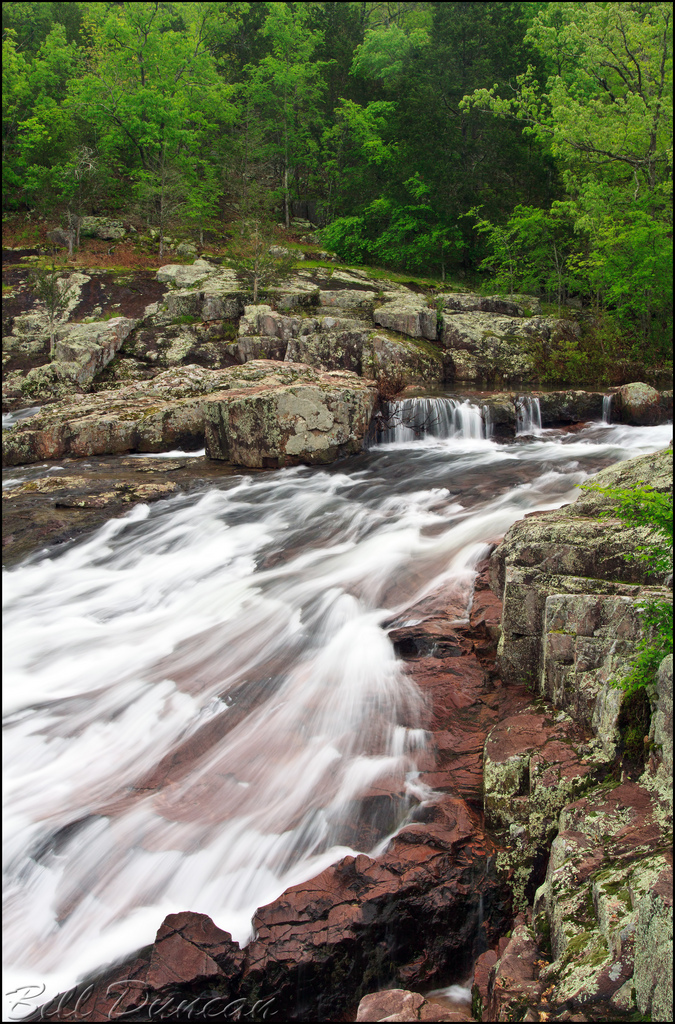
A sharp drop of approximately 8 feet (to pool’s surface) ends one of the nicest series of shut-ins – located on private land in Madison and Iron Counties (location 1).

This year I was fortunate to be introduced to two new-for-me shut-ins in the southern region of the St. Francois Mountains. Both of these locations are currently on private land and with assistance from a couple of friends, it was quite a thrill to be able to visit and photograph these stunning geologic features.

We would of have liked to have more flowing water on our couple of visits to these shut-ins (loc. 1), however, these creeks are both partially spring-fed so there is always at least some flow.

What surprised me most about both of these locations was that they were not covered in Beveridge’s “Geologic Wonders and Curiosities of Missouri”. I am not sure if this was because he did not know of them or because he chose not to feature them for some reason. I sure hope it was the later.

This phot was taken at the same location as the previous image, but in the autumn.

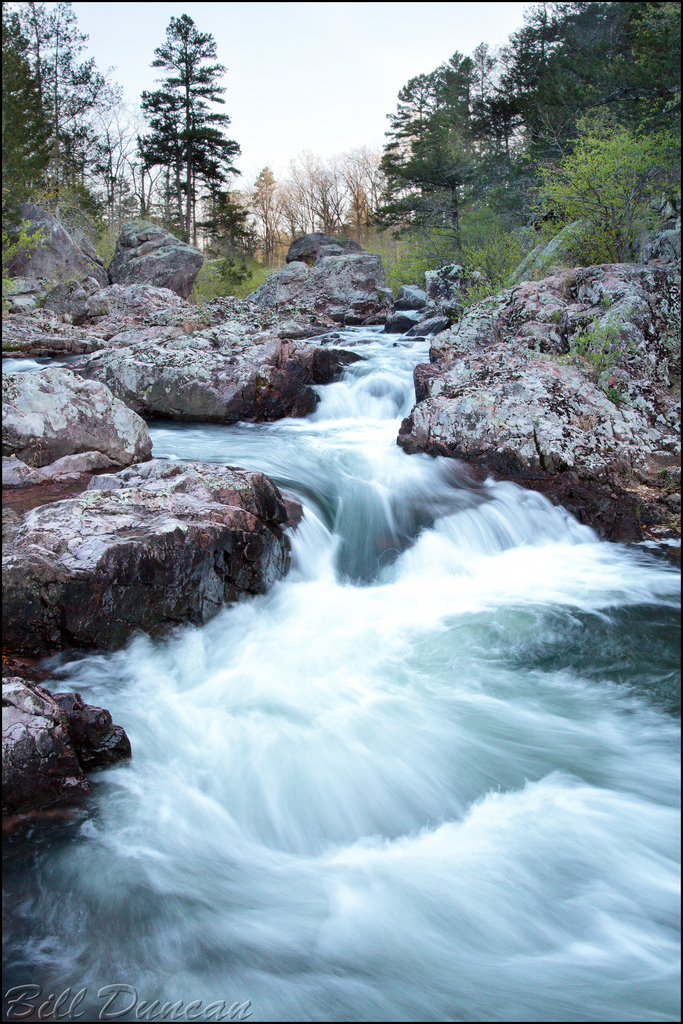
Definitely wild country. We pushed through witch hazel and other streamside brush, taking deliberate steps over slick-as-ice rocks to find the next small section of cascades.

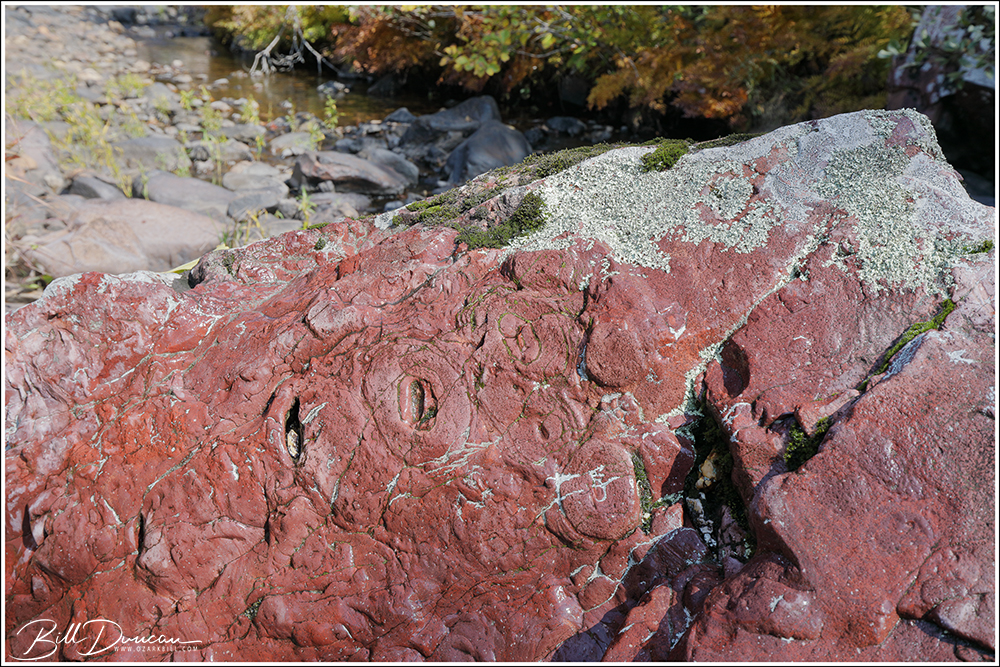
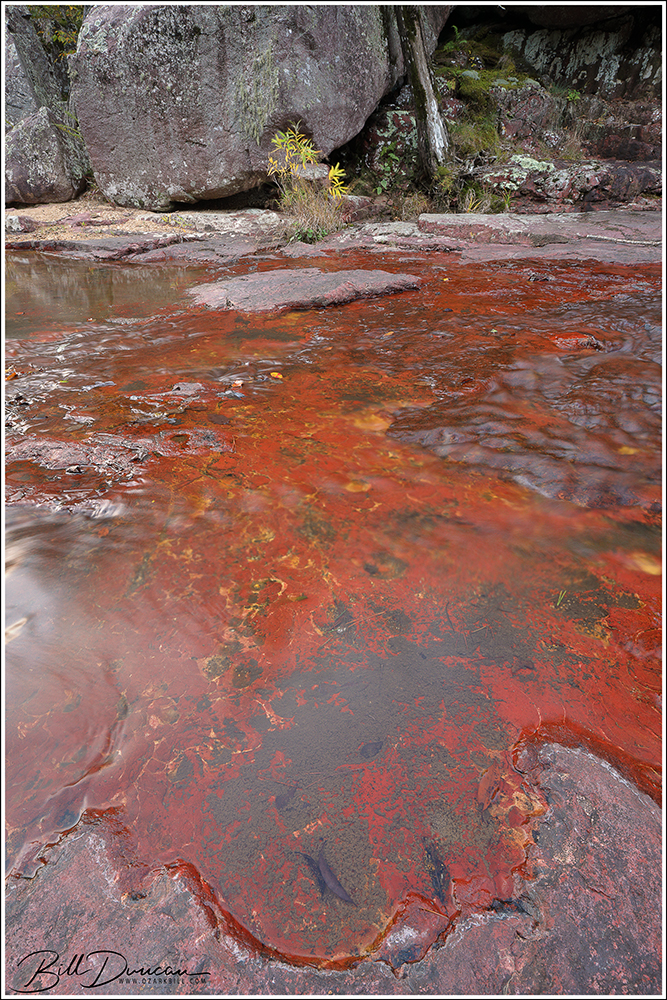
The tile-red rhyolite porphyry that makes up the majority of this streambed matches well against the warm tones of autumn foliage.

My recent delves into geology and astronomy have really been eye-opening, tying together everything else I know of natural history into place. There is so much more for me to learn, with Geology I know almost nothing, but it has been such an aid for me in remembering that most of what everyone worries over is so insignificant compared to the real that is right under our noses.

Lava-gas bubbles (lithophysae), thought to be formed by expanding gases prior to solidification into rock, can be seen on this rhyolite protrusion.

Talk about your tile-red rhyolite porphyry!

Don’t confuse this with lava flows from Kīlauea. This is ancient igneous rock that solidified approximately 1.5 billion years ago.

This creek bed at location 2 is located in Iron County. Here, the rock would be considered more of a purple porphyry and is nicely capped by royal fern (Osmunda regalis).

Found near the creek at location 2 was this splendid Lobelia cardinalis (cardinal flower) growing against a bed of Conoclinium coelestinum (blue mistflower). A nice October find.

This is all I have to share from these two locations for now. I am looking forward to visiting again with hopefully more water flow and at different season. Thanks for visiting.

-OZB


A Hike Down Rocky Creek

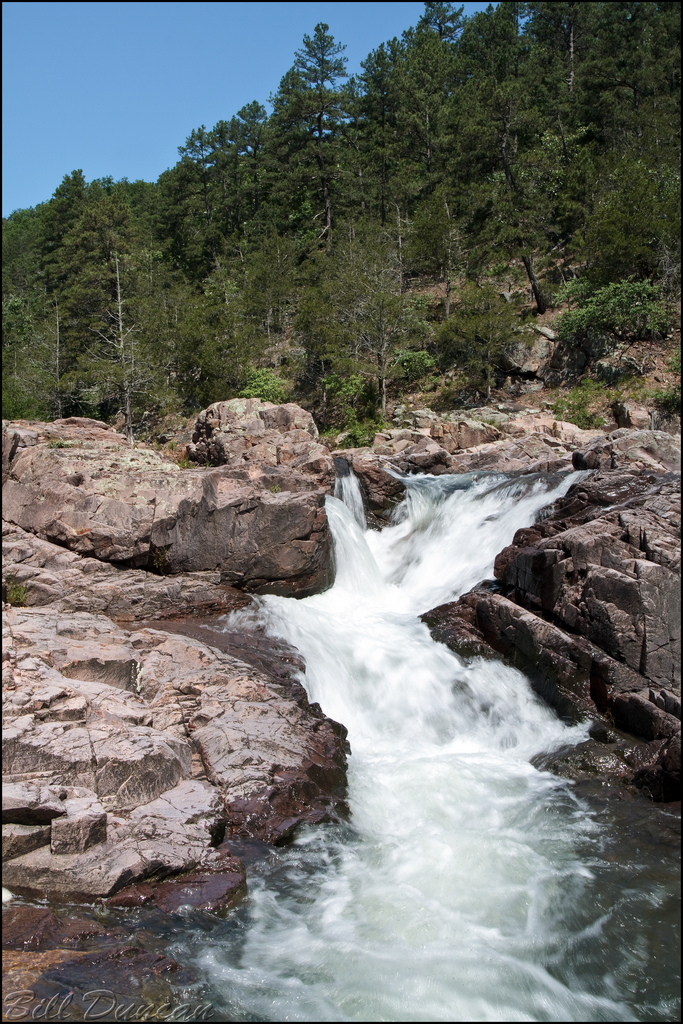
I have been wanting to make the hike down Rocky Creek to its confluence with the Current since I read about the idea in Louis C. White’s Ozark Hideways.  This past Saturday, Steve and I were both aching to get on the trails, to be with nature on a beautiful late winter’s day.  This hike was high on the ever-growing list of potential day-hikes, so we decided that this was the day for this one.  As was the plan, we started at the Rocky Falls N.A. parking lot.  We found that the water level in Rocky Creek was a bit higher than we expected.  While this is fantastic if your goal is to get some nice flowing water shots, it can make for some wetter than desired hiking and stream crossing.  Although this stream is not officially in the St. Francois Mountains, the exposed red rhyolite reminds me of the scenery there to the north-east.  We would see three of the best shut-in areas to be found in the Missouri Ozarks, with Rocky Creek Falls being first.  This image was taken on a previous visit.

Rocky Falls

“Rocky Creek Falls″

Technical details: Canon EOS 50D camera, EF17-40mm f/4L USM @ 23mm, ISO 100,  f/16, 1/4 sec

The first half mile or so of the hike is spent walking alongside the creek, past an impressive beaver-pond until this little side-spur hooks into the Ozark Trail.  A right turn leads to Stegall Mountain, one of the “higher” peaks in Missouri and Peck Ranch C.A.  We turned left to keep along with Rocky Creek and head ultimately to the Current River.  The OZT comes and goes from within sight of the stream.  When possible, Steve and I strayed from the trail and kept close to the stream.  About a half mile from the Hwy NN crossing, we came across the next series of major shut-ins, those at the base of Buzzard Mountain.  The photo below was made on a previous visit.

Buzzard Mountain Shut-ins

“Buzzard Mountain Shut-Ins″

Technical details: Canon EOS 50D camera, EF17-40mm f/4L USM @ 22mm, ISO 250,  f/14, 1/20 sec

Continuing past these beautiful formations of rock vs. water we followed the stream.  It was difficult to make progress, as around every bend there were shelves of exposed, upraised porphyry.  These ~ 3.5 billion year old “benches” were perfect traps for lounging and loafing, snacking and passing the time philosophizing, all the while listening to the ever present sounds of the crystal-clear water fighting its endless battle downstream.  This image was made in between our breaks.

IMG_3052

“Another World″

Technical details: Canon EOS 5D Mark II camera, Sigma 15mm f/2.8 EX DG, ISO 100,  f/14, manual blend of two exposures

A mile or two past Buzzard Mountain we came across the third and last of the major shut-ins along Rocky Creek.  These shut-ins are at the base of Mill Mountain, and the Klepzig Mill can still be found here.  Somehow, after several visits I have still not photographed the mill structure.  Oh well, another excuse to return.  Below is a photo of the shut-ins made on a prior visit to the area.


“Mill Mountain Shut-Ins″

Technical details: Canon EOS 50D camera, EF17-40mm f/4L USM @ 24mm, ISO 250,  f/16, 1/25 sec

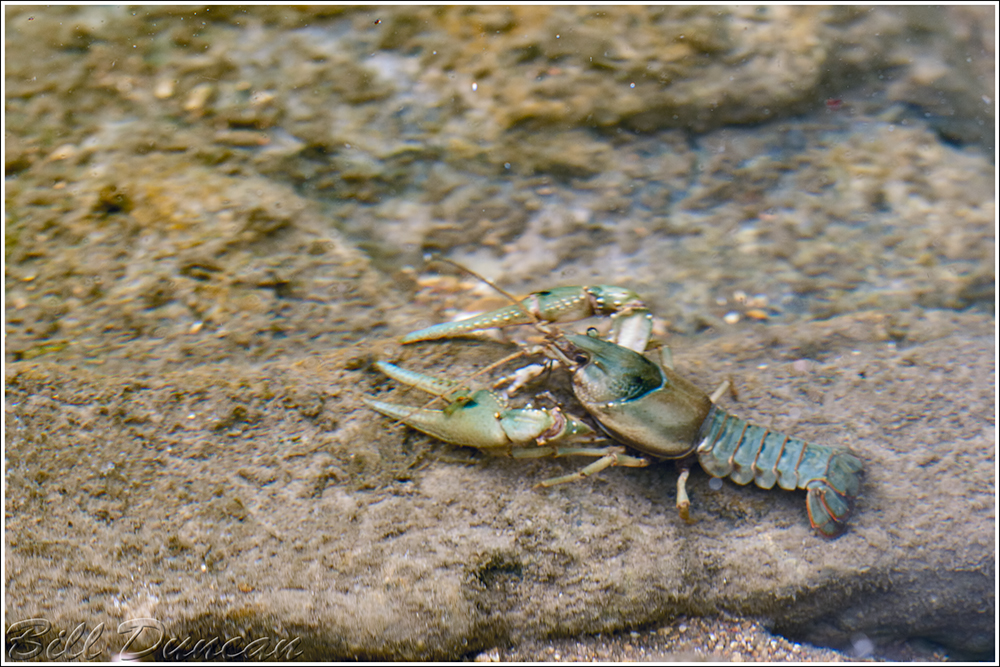
About here we left the OZT to continue east with the stream towards its rendezvous with the Current.  The vast majority of the course of the stream has a very shallow base; in most places it can be forded without wetting your knees.  Once in awhile, pools deep enough to swim in would come about.  These pools held some decent sized fish and looked quite inviting for a swim.  Near one of these we stopped for a bite, including some tuna sandwiches that Steve brought along.  At one point Steve missed his mouth and a chunk of tuna  landed in the water along a shallow shelf.  We watched to see if a fish would come along for a free bite.  No fish found this piece, but in a few minutes this guy, smelling the oils leaching from the fish presumably, came out of the depths to scavenge our waste.

IMG_3115

“Spothanded Crayfish″

Technical details: Canon EOS 5D Mark II camera, EF100mm f/2.8L Macro IS USM, ISO 400,  f/4, 1/60 sec

Did you know…? The Missouri Ozarks are home to 25 species of Crayfish, seven of which are found nowhere else.  The ancient geology of the Ozark region has created spatially isolated streams, supporting varied aquatic habitats based on bedrock and erosional composition.  This has enabled high speciation rates of crayfish and other aquatic and riparian animals.

The Spothanded Crayfish is known to have specific color and other morphological differences between populations in Missouri.  In the western populations, such as this one found in the Current River watershed, the species is greenish in color and contains the dark spots  on the base of the pincers, while populations in the eastern drainages of the Meramec and Black Rivers usually do not show the spots and have red or orange tinted pincers.

Read more about the Spothanded Crayfish or any other of Missouri’s Crayfish by checking out this wonderful guide: The Crayfishes of Missouri, by William Pflieger.

Another two or three miles of stream-side bushwhacking, trail and forest road hiking and we found ourselves at the confluence, the now flat and tranquil Rocky Creek dumping its waters into the Current River.  The hike back was quicker and partially under the cover of darkness.  A highlight of our return was very close looks of an American Woodcock that we heard wobbling  among the dry leaves near the trail.  A favorite of mine.

We finished the day by grabbing a couple of pies at Saso’s in nearby Ellington.  The pies were fine, but no homemade baklava was on hand… 😦

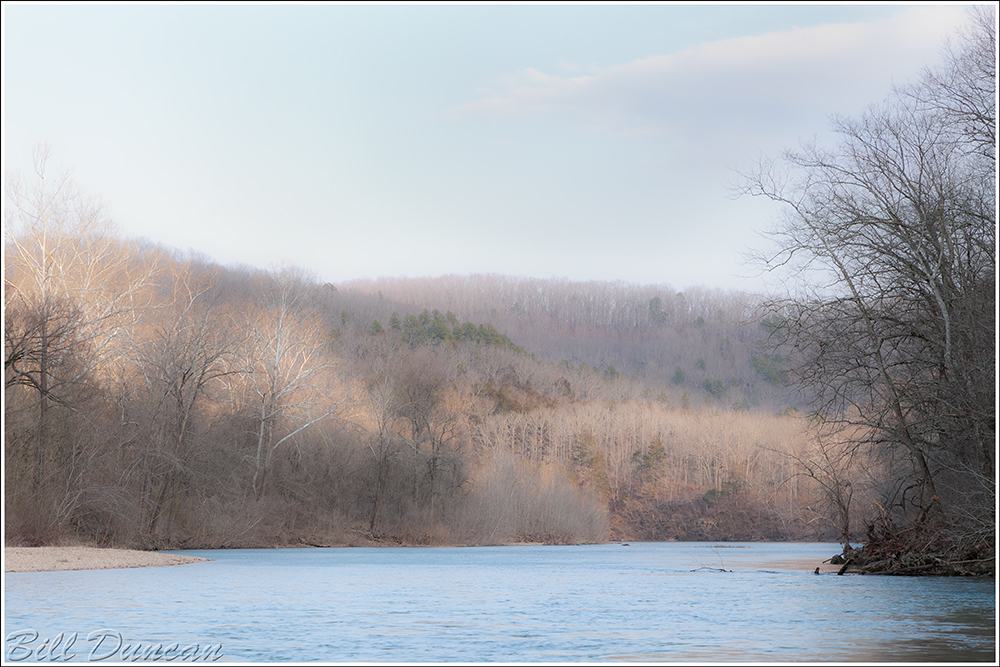
I’ll end with the late-afternoon view we had from the point of the confluence.  Rocky Creek is moving in from the right.  The sun was pushing its last of the day onto the hills and was partially obscured by rapidly-moving clouds.  This resulted in the dynamic light across the landscape on the opposite bank of the Current.  I decided to go with a bit of a pictorialist treatment, but I am not completely convinced it was the best direction to go.  I used the clarity slider in ACR RAW to give the image a softer, less defined appearance, hopefully bringing attention to the changing tones as well as to the calmness of the water, which is juxtaposed by the images made upstream that were placed earlier in this post.

Well, I hope this wasn’t boring, and perhaps makes you wish to witness some of these locations for yourself.  Until next time, make like a camper and go take a hike.

IMG_3139


“A Place in My Heart″

Technical details: Canon EOS 5D Mark II camera, EF24-105mm f/4L IS USM @ 96mm, ISO 125,  f/10, 1/13 sec

Thorny Creek Shut-in

Technical details: Canon EOS 7D camera, EF24-105mm f/4L IS USM lens @ 32mm, ISO 250,  f/14, 0.5 sec. Orton effect applied in PS Elements 9.

One of my several lifelong photo projects is to find and photograph every interesting shut-in I can within the Missouri Ozarks.  What is a “shut-in” you may ask?  A shut-in is a section of a river that is forced to move through resistant, igneous rock, such as the rhylolite pictured above.  Because the igneous rock is much tougher to erode, the water is often forced through narrow passages resulting in picturesque cascades, drops, chutes, steps, shelves, potholes, waterfalls and other sensory pleasing features.  Beveridge listed near 90 Shut-ins in Missour and most of these are located within the sturdy St. Francois Mountains.  Shut-in was originally an Appalachian term that was brought by the first white settlers in the Ozark region. It is now a term that is almost entirely used by Ozark residents.

This particular shut-in, on a small tributary of the Current River called Thorny Creek is located not to far from where the creek meets the Current.  It is also quite close to the three spectacular shut-ins of Rocky Creek and the rugged shut-ins type cascades of Prairie Hollow Gorge.  This location would actually have been easier reached by boat from the Current River.  Not knowing all that much about boating and not having access to one if I did, I hiked about two hours one way to make my way here.  I was quite pleased with myself upon reaching my goal as some amount of bushwhacking was required and I was not completely sure of where the location was.  Using maps and GPS was crucial.

Finding and spending time at a shut-in is always a grand idea.  Often these location not only provide candy for the eyes and ears, but are great spots for having a swim, fishing, taking a nap as well as doing some nature watching.  Most of the Missouri shut-ins are found within high-quality forest habitat and it is usually easy to find an interesting plant in bloom or a bird stopping at the fresh flowing water for a drink.  If I’m going to find many of the other shut-ins I will definitely need to build my skills in reading maps as well as talking with land-owners when these locations might be found on private property.