"What a thousand acres of Silphiums looked like when they tickled the bellies of the buffalo is a question never again to be answered, and perhaps not even asked." -Aldo Leopold
Ants and most flies that are abundant around my milkweed are nectar robbers – providing no pollination services for the plant. I do see flies from time to time that might carry a pollinia, and sometimes a lightweight like the housefly pictured above will get a leg or two stuck and be unable to free itself. That’s what these ants are waiting for. Here we see the ants beginning to dissect their prey while it struggles to free itself.
Time Flies Like an Arrow… Hover Flies Like a Flower
Anyone who has spent any amount of time studying flowers in the backyard garden has at some point noticed Syrphid flies. Known as hover flies, flower flies, bee flies and other names, this group is most well known for mimicking bees and wasps (Batesian mimicry). This small guy was captured feeding on my Ohio Spiderwort this spring.
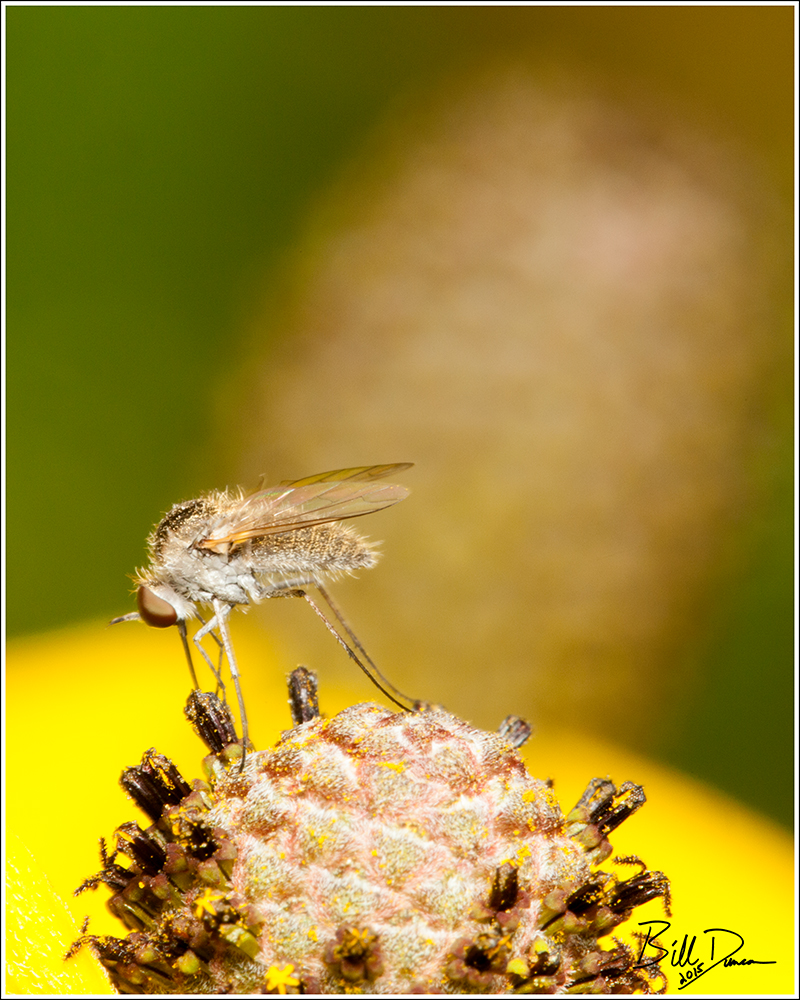
Bee Fly
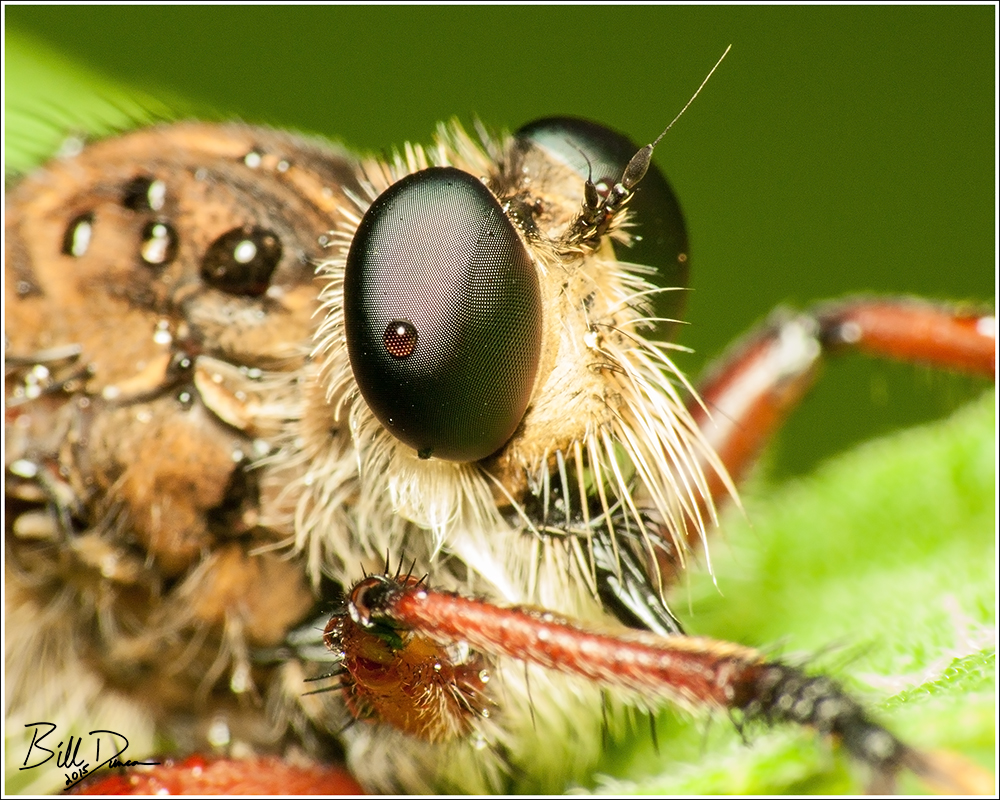
This is quite the important group of insects. The Syrphids are major pollinators for numerous flowering plants, potentially as important as native bees in this service. Larvae in this group may feed on rotting vegetation and many species will feed on aphids and other plant pests. The rather large bee fly pictured above was found feeding on a Common Milkweed in the backyard.
Syrphid Sensuality
Eating and making baby Syrphids… If it isn’t already on a T-shirt, it should be. I often find these guys doing the Diptera 12-step in my backyard. If we did that, we’d be thrown in jail!
The Snowberry Clearwing is a member of the Sphinx Moths (AKA Hawk Moths). Its name comes from the fact that one of this species important larval foods is the Snowberry plant. Sphinx moths are important pollinators and are often mistakenly identified as Hummingbirds or Bumble Bees due to their size and their habits of visiting flowers. Most Sphinx Moths are active nocturnally or at dawn and dusk, but the Snowberry Clearwing is diurnal. One Missouri favorite, the Missouri Evening Primrose of glade habitats, shares an obligate pollination mutualism with a species of Hawk Moth, meaning that no other animal can provide pollination services for this plant. This is a photography project someday in the future!
Not a Humingbird…
The caterpillars of these moths are known as “hornworms”, and they are just as fascinating as the adults. Included in this group is the Tobacco Hornworm, which is a notorious pest on tomato plants. A useful natural controller of hornworms are the parasitoid braconid wasps that lay their eggs on the developing moth and whose larvae then eat the caterpillar from the inside out.
A Sphinx Moth
Next time you are in the garden, take a closer look at that bumblebee or hummingbird. It might not be what you assume it to be!
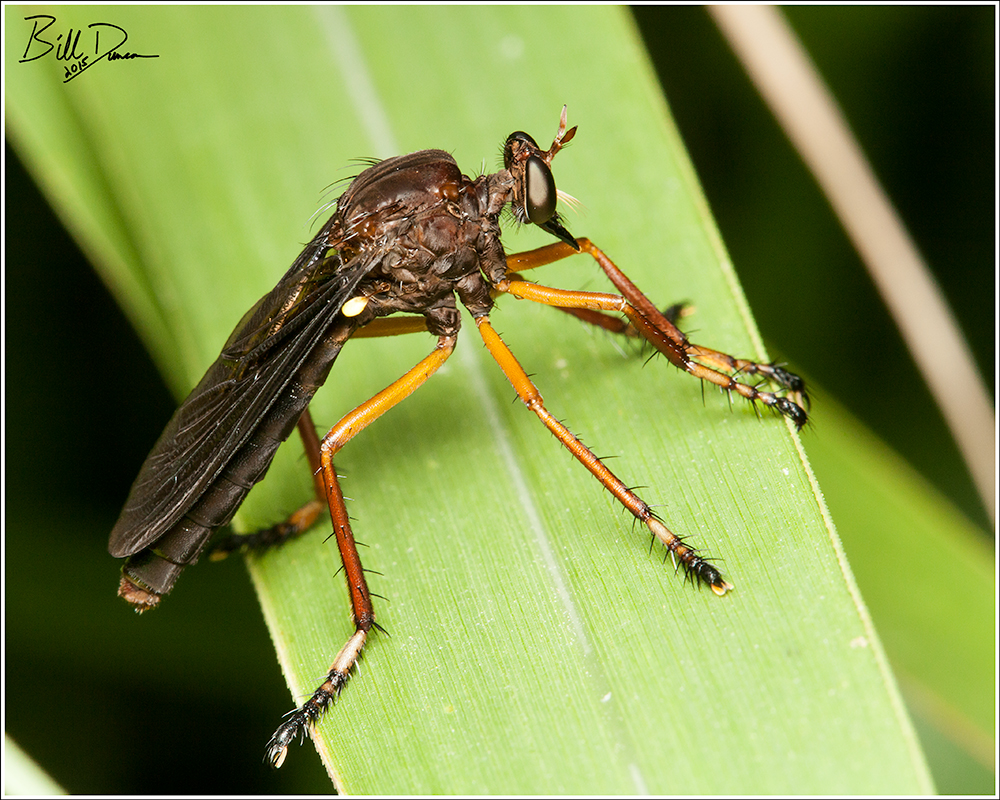
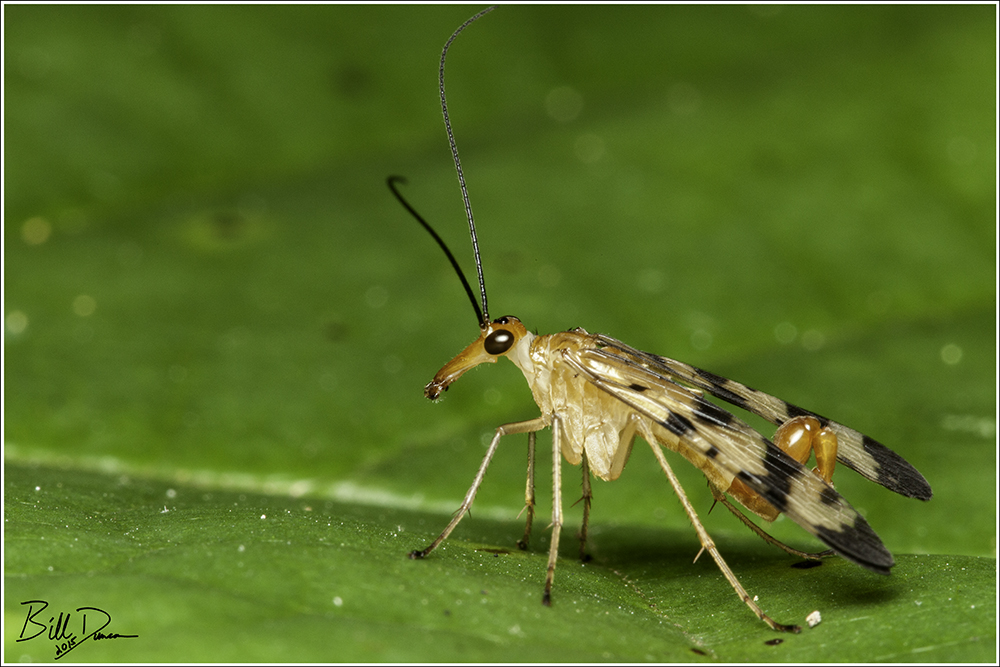
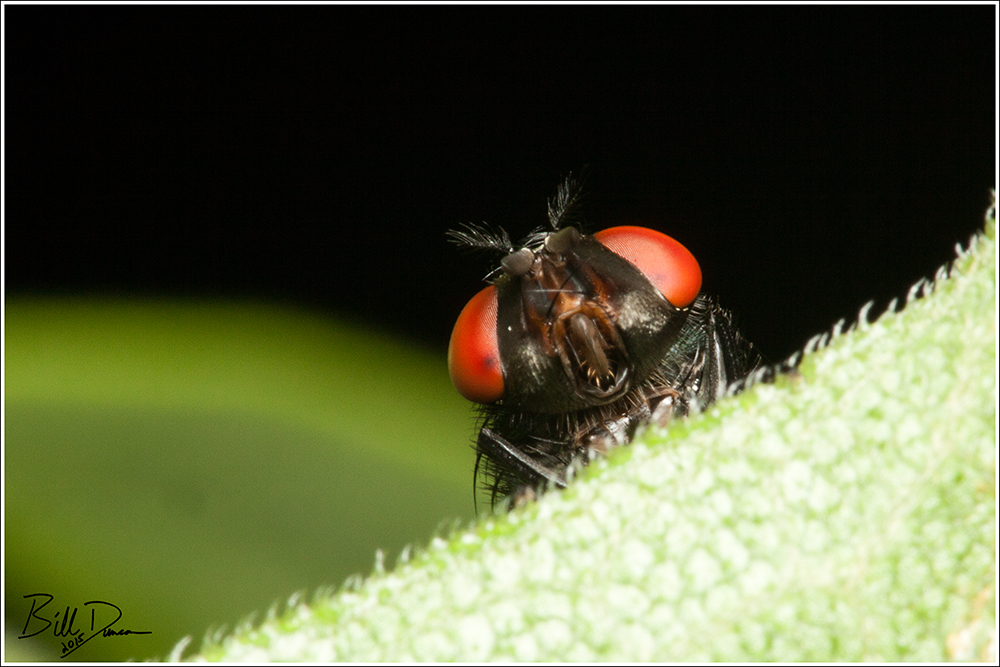
The beetles (order Coleoptera) are famous for being the most diverse group of animals on the planet. The flies, however, are not too far behind and many people are surprised to hear how many forms and places flies can be found. I have been able to find and photograph a few of these forms in my own backyard and will share them here. I photographed this carrion fly (Calliphoridae) hanging out on my rosinweed.
I imagine the conversation may have went something like this…
Aphid (with a cockney accent, of course): “Oh, hello, who are you then?”
Damsel: “Name’s Damsel…” “Oh, that’s a lovely name. My name is Aphid.” “No, I think I’ll call you ‘Sugar Bag.’ “ “Sugar Bag? Now that doesn’t sound Aghhh!…”
😉
Sugar Bag
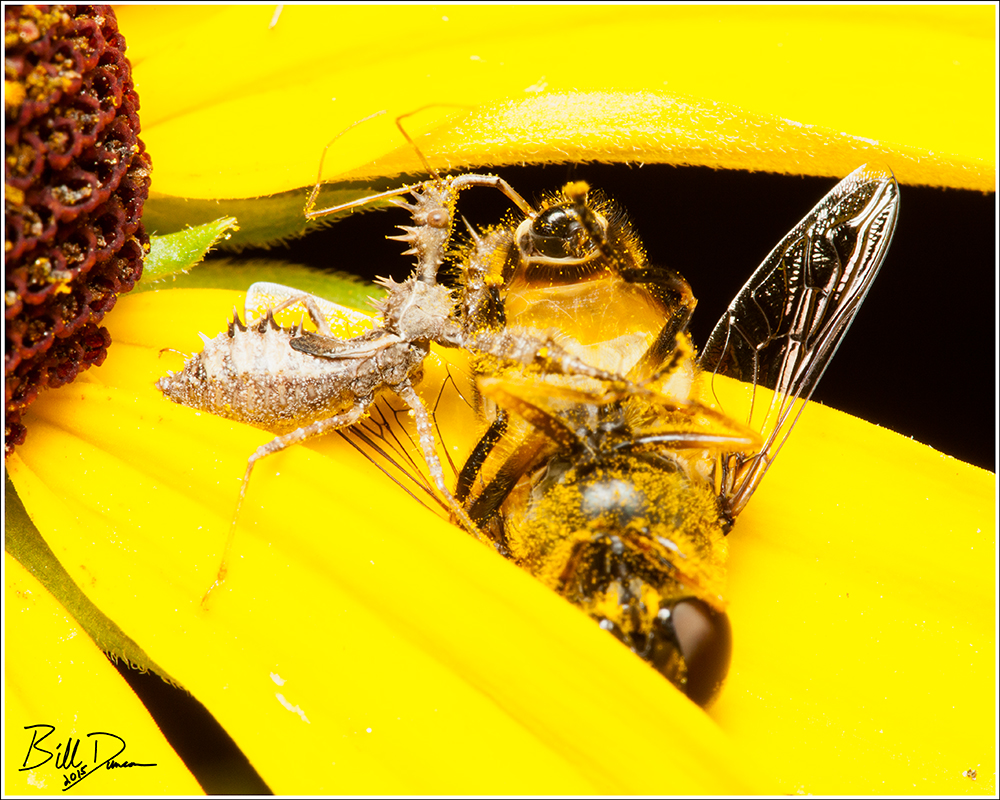
I caught a glimpse of this guy early one morning patrolling around the surfaces of my rosinweed and decided to watch. I didn’t wait long to observe the hunt. This bug is definitely in the family Nabidae, and I am going to call this one the common damsel bug, Nabis americoferus, due to it matching a few photos and the fact that this is considered to be the one of the most common hemipterans in the United States.
Nabis
I have read that these guys overwinter as adults and have a wide selection in the prey they choose. It seems that if it is smaller than they are, or close in size at least, they will poke it and suck out their hemolymph. Like I said, “damsel” in name only…
Here are a couple of pics of a Hooded Warbler that visited a favorite birding spot of mine a couple of weeks ago. Quite low light on a cloudy early morning, so I apologize for the grain and poor detail.
Before we get to a few birds from this spring… Why do people like Adobe Lightroom so much? I know it definitely helps in cataloging my images and I am better off than what I was before, but the hassle and bugs I have to deal with… Just yesterday, we lost power during the storms and then next time I was able to load up LR, all my settings went back to default! I guess I should be thankful that all of my images appear to be in the right spot. Computers…
Hermit Thrush
Such a silent bird. Whenever I am lucky enough to cross its path, it is almost always found by eyesight. This guy patiently hung out with me for a bit.
Hermit Thrush
Mallard Drake
Pretty much a staple in the pond at my working location. Sometimes I don’t seem to bother them, while others I cause them to flush.
Mallard Drake in Repose
Brown Creeper
I have seen these guys all over the place this spring. Always one of my favorites, it has been a real treat to seem them so regularly the past two weeks.
From one of my favorite birds to one of my favorite plants, the shrub known as Ozark Witch Hazel (Hamamelis vernalis).
Ozark Witch Hazel
I have featured and discussed this plant a number of times on this blog and on Flickr over the years, but there were (and still are) a number of things I did not know and hoped to discover about this fascinating shrub of the Ozark Highlands. As the species name vernalis suggests, these shrubs flower from January through late March, while their sister species, the more easterly Common Witch Hazel (H. virginiana) blooms in the fall. There may be some overlap in flowering and hybridization might actually occur in certain circumstances, but I was unable to find anything that suggests how frequently this might take place.
Here is an image I made this year. Notice the snow and ice in the background.
The Winter Blooms
One of the things I wanted to get to the bottom of, either through direct observation or finding in literature is what are the specifics of pollination for a shrub that blooms in the winter months? Nearly all of the scholarly articles I could find dealt mostly or exclusively with H. virginiana, but I believe that we can assume that most of these results can be used to describe OWH as well. There are several things to consider. The first and perhaps most logical consideration is that the plant may predominantly self pollinate or rely on wind-pollination. A couple of papers suggest that although self-pollination does occur, self-fertilization does not, making the species self-incompatible, so we can eliminate that option. The potential for being primarily gravity or wind-pollinated does not make sense when considering that the plants put some considerable resources into making colorful flowers with a noticeable and pleasant odor. The flowers of OWH have all the classic signs entomophily – brightly colored, nectar producing, fragrant, large, sticky pollen, with male and female structures found in close proximity to one another.
The long strap-like petals of these flowers (see photo below) will unfurl on warmer days and odors increase, thus suggesting the strong likelihood of attracting diurnal pollinators.
OWH – Yellow Flowered
Assuming there must be an active pollinator that moves the sticky pollen from plant to plant, what are the potential options for such an insect species in the Ozark Highlands? An interesting article written by Bernd Heinrich of popular science writing fame gave one possibility, at least for the more eastern H. virginiana. In this paper he recorded that winter-active moths he was researching used that shrub’s flowers as a food source. This has been picked up by a number of writers on the internet who have jumped to the conclusion that these moths must be the primary pollinators of the North American Witch Hazels. However, as these primarily warm-colored (preferred by bees) flowers often roll their petals closed and cease odor production at night, the case for nocturnal moths as pollinators should be considered fortuitous at best, and not a reliable vector for pollination by this plant.
Witch Hazel Flower Anatomy
I wanted to visit a good stand of blooming OWH on a warm, sunny day in early February or March and see if I could identify and hopefully photograph a pollinator. No such luck. We were able to see a few small midge-like flies and a few native bees surrounding the plants, but photographing one while visiting a flower was to be impossible. Next time I will bring my handy corn syrup in order to coax pollinators to stay a while longer. To get an answer, it was off to the literature. In a study focused on Common Witch Hazel, insects of six orders were identified as visiting flowers. Of these, flies (order Diptera) were most prevalent and comprised 73% of floral visitors and 52% of the identified species, followed next by Hymenoptera (bees, wasps and ants).
Why flower during colder months? Advantages and disadvantages can be identified with a little thought. What are the advantages of an entomophilous plant that opens its doors for business in the colder months? Not many plants will be flowering in such cold conditions, therefore, on warmer days that allow for flying insects to move about and earn a living, there will be little competition and most pollen collected and moved from flower to flower will be of a compatible, intraspecific origin. In contrast, insects moving about in mid June might be carrying loads of pollen from a number of species, and if these other species provide a higher quantity or superior quality of nectar and pollen, you might find yourself unable to be cross-pollinated.
This strategy is not as clear-cut of an advantage as it may sound, however. It has been found that the North American Witch Hazel have a pretty poor flower to fruit ratio – with a less than 1% fruit set on average (the average fruit set in angiosperms is close to 25%). This makes sense. If you bloom in the winter then there will be generally fewer pollinators, and in particularly long and harsh winters fruit set can and has been documented to fall to zero in Common Witch Hazel. One thing the Hamamelis do to assure that a minimum number of successful seed are produced is by increasing the number of flowers. It has been studied and determined that these plants produce more flowers than similarly sized shrubs. So, although the success rate of each flower is generally poor, when factoring in the number of flowers produced per plant along with the fact that these plants are usually found in dense stands, the total number of seed produced per season is enough to keep the population sustained.
Another of the fascinating natural history notes of the North American Witch Hazels are their means of seed dispersal. These plants exhibit what is termed “explosive dehiscence”, similar to another Ozark native – the Jewelweed. The drying fruit capsules split suddenly, ejecting the seed(s) contained within up to three meters. In the following photo you can see an empty fruit case some time after it has expelled its seeds. An observer will notice another interesting characteristic in the photo. These plants hold onto their spent fruits long into the next season, in this case the plant is in full bloom with its next flowers while still holding onto last years spent fruits.
Explosive Remains
For now, that is about all I have to say and share about the Hamamelis of the Ozark Highlands. If you find yourself in a sandy stream-bed within the St Francois Mountains during the first quarter of the calendar year, be sure to keep your senses open and prepared for an unexpected blast of spring.
Ozark Witch Hazel in Bloom
Please note – other than a few easy observations and a little bit of thought, I produced no original work in the written portion of this post. If I was worth my carbon, I would have cited the source of each work I used within the text, but this is my blog, so I don’t have to. Instead, here is a list of works I consulted in writing this.
Anderson, G.J., & Hill, J.D. (2002). Many to flower, few to fruit: The reproductive biology of Hamamelis virginiana (Hamamelidaceae). American Journal of Botany, 89(1): 67-78.
Bradford, J.L., & Marsh, D.L. (1977). Comparative studies of the Witch Hazels Hamamelis virginiana and H. vernalis. Arkansas Academy of Science Proceedings, 31: 29-31.
De Steven, D. (1982). Seed production and seed mortality in a temperate forest shrub (Witch-Hazel, Hamamelis virginiana). Journal of Ecology, 70: 437-443.
Gapinski, A. (2014). Hamamelidaceae, Part 1: Exploring the witch-hazels of the Arnold Arboretum. Arnoldia, 72(2): 2-17.
Yatskievych, G. (2013). SteyerMark’s Flora of Missouri Volume 3 – Revised Edition.