Flowers and Blood

“Bloodroot”

Technical details: Canon EOS 7D camera, EF100mm f/2.8L Macro IS USM lens. ISO 160,  f/16, 1/13 sec

I’ve been having a lot of fun with the spring ephemeral wildflowers this year.  It is hard to believe the numbers and diversity that are in peak bloom already this year.  I can’t imagine what the woods are going to look like by the end of April.  You might as well stock up on pyrethrin because by mid-summer the ticks are going to be owning us all.

This image was taken in the Labarque Creek watershed during a early spring hike.  Bloodroot are fascinating plants, getting their name from the reddish sap that is especially prominent in their tuber-like rhizome.  Several Native American tribes have been known to use this sap as a natural dye for artwork projects.

These plants will spread and grow easily clonally and vast colonies can be found that may have started from a single individual.  Another method of reproduction these plants use is myrmecochory, which means that their seeds are dispersed by ants.  The ants feed on a fruit-like structure that is attached to the seed.  The ants move the seeds to the relative safety of their colony and after the ants feed on the fruit they deposit the seed into their underground middens, or trash heaps.  Here the seeds can safely germinate and have access to some useful fertilizer in the process.

Bloodroot sends up a flowering stalk usually before the leaves begin to emerge and blooms usually open before the leaves have fully expanded.  The flowers last less than a full day, so it is recommended you get out on the trail before noon if you really want to seem them in their full glory.

It’s Spring Again. Everybody Know it’s Spring Again.

“Renewal”

Technical details: Canon EOS 7D camera, EF100mm f/2.8L Macro IS USM lens. ISO 250,  f/11, 1/13 sec

“To the girls and boys and people above, This is the time to fall in love”

Sorry, I always turn on the Biz Markie this time of year.  It wouldn’t be spring without him.

This image and post is dedicated to my stepfather, Wally, who bought me my first camera about 20 years ago.  Wally has a birthday this month.  Happy Birthday!  It was a Pentax K-1000, a manual-only film camera in which I learned the basics of exposure.  In my opinion, this body is one of the best values of this class and generation of camera available and still underrated.  It’s too bad they don’t make a digital version of this camera today.  Having a manual-only digital body would something else.  I use manual mode about 95% of the time anyway, so I guess it wouldn’t be a big difference.

I took this photo on a recent hike in the Missouri Ozarks.  This bush must have had two dozen of these emerging leaf buds, each with a drop or two from gutation.  This phenomenon is seen when plants are growing in high humidity or in very saturated soils, like many parts of our region have been experiencing lately.  Between the low light and the high macro magnification getting a sharp image of the foreground subject was tricky.  I pulled out the reflectors to bring a little more light to the situation, but this only helped a little.

More Snipe than You Could Fit in Your Bag

“Scolopacid Dawn”

Technical details: Canon EOS 7D camera,  EF400mm f/5.6L USM lens, ISO 640,  f/5.6, 1/400 sec

I arrived at CBCA well before dawn.  I knew from a visit a week earlier that a large amount of waterfowl, specifically Pintail, were using the habitat here and my hope was to catch some early morning photos of these birds flying by.  In one of the large pools alongside the road I saw nearly 50 of these bizarre birds with a bill almost as long as their bodies.  They were not very flighty at all, allowing me in my “mobile blind” to easily get within distance for some decent shots.

Members of the Scolopacidae family of shorebirds include the traditional Sandpipers, the beautiful Phalaropes, the Curlews, the Dowitchers, and several others – including the bird pictured above, the Common Snipe.  The Scolopacids are well known for their complex and diverse mating behaviors.  Not as complex or developed as the Passerine songbirds, this group also uses extensive advertisement vocalizations, most likely evolved to be well understood on their vast tundra breeding grounds.

Similar to its cousin, the Woodcock, the Common Snipe uses a “winnowing display” to attract mates.  These birds will fly high into the air and plummet towards the ground while fanning their tail feathers, which make a distinctive winnowing noise as the air rushed rapidly over them.

Looking closely at the length of a shorebird species’ bill gives a great clue to what the bird feeds on and how much water they typically forage in.  With the great diversity in the morphology of these birds, the specific depth of water and vegetation these species are accustomed to and food sources they utilize, it is no wonder that habitat management programs can be quite complex.  What works great for waterfowl or a particular species of shorebird may not be useable at all for another species.  CBCA has come a long way in providing the diversity of habitat and the managers seem to be doing a great job in their management practices, especially considering the unpredictable weather patterns we have had in this region the past several years.

Seven Days of Mina Sauk Falls – Day Seven

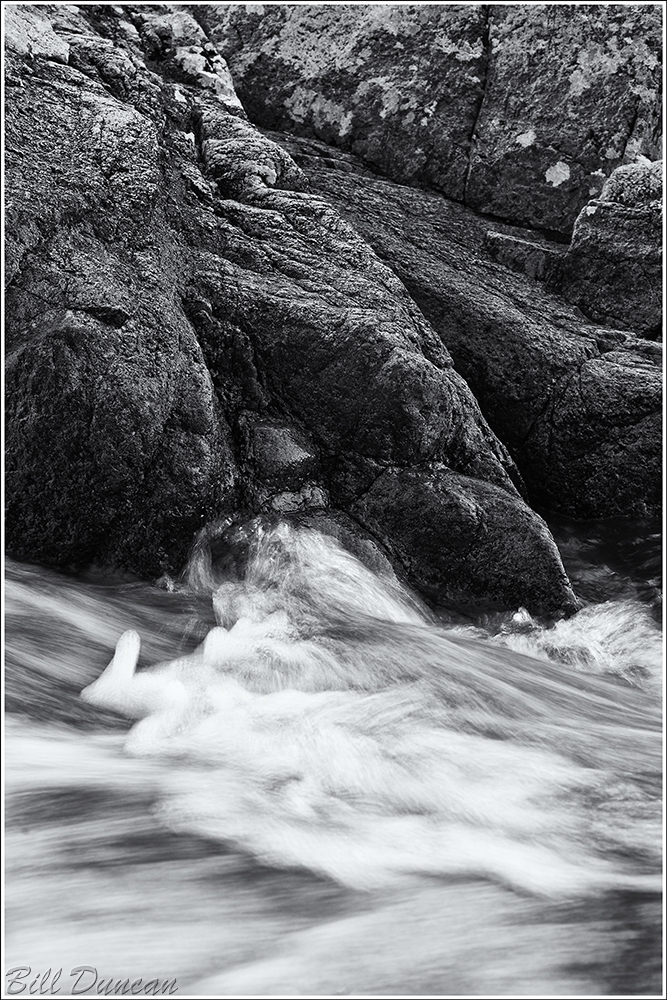
“Taum Sauk Eternal”

Technical details: Canon EOS 7D camera,  EF24-105mm f/4L IS USM lens @ 40mm, ISO 200,  f/14, 0.6 sec

Hi everyone.  Here is the last in my planned succession of image postings of Mina Sauk Falls of the Missouri Ozarks.  This photograph may be my favorite of the day.  The textures of the rock and the patterns of the lichen suggested to me that this would make a nice black and white.  I added a light Orton effect to enhance these contrasts and bring out the highlights a bit more.  The pool of water might be my favorite aspect of the image.

I had another great Saturday exploring and photographing in the Ozarks.  We really had some magnificent lightning displays from thunderstorms that went through the region in the afternoon.  I hope none of you had any damage or other worries from these storms.  I started my day with an actual plan and had to make changes due to the weather.  I started my day in the Labarque Creek Watershed, thinking the storms we had on Thursday may have filled the drainage creeks and there would potentially be lots of falls, cascades and other water features to shoot.  I also realized that the spring ephemeral wild flowers would be really getting going.  Well, the water flow was next to nothing.  The rain from early in the week had either drained quickly or was not enough to get things flowing.  The spring ephemerals were exactly what I expected.  Spring beauty, rue anemone, Dutchman’s breeches, hounds tooth and blood root were all present in the thousands.  I wish I had actually spent more time shooting these, but I had other plans as well.

My plan after Labarque was to head to the nearby Shaw Nature Reserve to photograph the early happenings of the Red-shouldered Hawk nest located there.  I hauled all my photo equipment and my spotting scope and my chair and snacks, set up, had an opportunity to take a few shots when the rains came in.  So, I packed up and started back home.  I knew the weather would also interfere with my plan to photograph a local Great-horned Owl nest that I was planning on visiting in the late afternoon and evening.  I went back home, ate dinner and checked weather.com.  There looked to be a gap between 5:00PM and 7:00PM where the chance of rain was significantly lower.  I suspected that the 0.5-1″ or so of rain we received this afternoon may be enough to really get the ephemeral drainage creeks of Labarque flowing.  So, I packed up and headed back to Eureka, knowing it still might rain for another few hours and I may not even get out of the car.  When I arrived, it was barely sprinkling so I put my rain gear on and covered my camera pack with its rain cover and with my hiking pole and trusty Tilley to keep my head dry, I started on the trail – anxious about the weather and quickly cover the mile or so to the features I most hoped would be filled with water.  The situation was not perfect.  It rained about half the time I was on the hike.  I was able to pull the camera out and do some shooting, but the light was very low, even for shooting moving water!  In a couple of brief deluges I carried myself and my gear to a small cave to wait it out.  This was one of the most memorable hikes of my life.  The light, sky, fog water and life all around me seemed to be changing by the minute.  At least half a dozen frog species were singing and the Eastern Towhees were constantly telling me to “Drink your Tee!”.  I heard the ever-vocal Red-shouldered Hawks and the hoots of Barred and Great-horned Owls.

Finally, when the light was so low I couldn’t get anything shorter than a 30 second exposure, I headed back to the car.  Upon reaching the top of one of the steep ridges I saw a spectacular display of warm colors as the sun was able to break through a bit near the horizon and juxtapose itself with the cumulonimbus clouds and associated displays of lightning.

I apologize if this is boring any readers, but I am using this blog as a journal in as much as anything else.  I haven’t really looked at any of the photos I took today.  Hopefully the images will be close to what I hope they can be.  If not, I will always be looking forward to the next hike in the Missouri Ozarks.

Seven Days of Mina Sauk Falls – Day Six

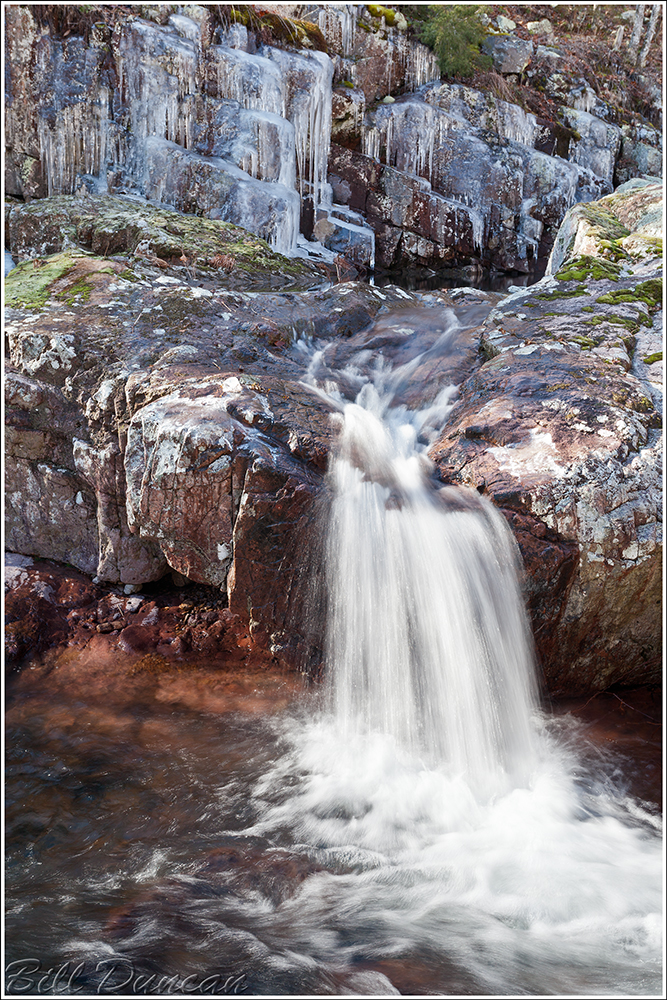
“Warm Flow”

Technical details: Canon EOS 7D camera,  EF24-105mm f/4L IS USM lens @ 24mm, ISO 160,  f/11, 1/4 sec

Near the top of Taum Sauk these cascades were very appealing but somewhat difficult to shoot as the sun began to creep in.  Ice covering the rocks was still an issue and I carefully moved along a ledge to get close to this pretty little slide.  Being able to rest a bit in the sunshine and eat some cocoa-covered almonds and have some coffee while listening to the falls was great after spending the previous hour or two on the shadow side of the mountain in the cold and mist.

Seven Days of Mina Sauk Falls – Day Five

“Frigid Mina”

Technical details: Canon EOS 7D camera,  EF-S10-22mm f/3.5-4.5 USM lens @ 11mm, ISO 250,  f/14, 0.4 sec

Here we have one of the mid-tier drops of Mina Sauk.  This one falls about 20 feet and on this morning the temperature was just cold enough to freeze the mist of the falls on whatever it landed upon.  It was a real challenge keeping the front of the lens free of freezing drops.  The icy rock surfaces were also quite a challenge of foot near any of the falls.  I really grew to appreciate the different colors and tones in the rocks here during this trip.  With no greenery of warmer months or warm colors of autumn the purples, pinks and various other hues that these granites and their lichen passengers exhibit was something to focus on.

Seven Days of Mina Sauk Falls – Day Four

“Spanning Time”

Technical details: Canon EOS 7D camera,  EF24-105mm f/4L IS USM lens @ 24mm, ISO 200,  f/10, 1/4 sec

So how did Mina Sauk and her father mountain, Taum Sauk, get their names?  I am currently looking for an original and direct source for the telling of the legend of Mina Sauk.  Here are a few paragraphs collected from the web that were originally published by the Kansas City Star:

The Legend of Taum Sauk Mountain ~ A Native American “Romeo and Juliet” story as told to John Russell, from the Kansas City Star, by “Old Uncle Jim Connelly” back in 1953, the summer after the park became accessible by automobile to the public.  Uncle Jim, an ex-railroad worker, who for many years ran a service station and tourist court from his home near Ironton, knew a host of stories and Indian legends tied up with the mountain.

“Uncle Jim’s favorite story probably is one about Taum Sauk, the Piankashaw Indian chieftain after whom the mountain is named, and his daughter, Mina Sauk, for whom the beautiful waterfall on the northwestern slope of the mountain is named.

“Long before the white man came here,”  Uncle Jim relates, “this land of flowers, now called the Arcadia Valley, was the hunting grounds of the Piankashaw Indians.  The Piankashaws had a famous chieftain, Sauk-Ton-Qua.  Because the name was hard for the white man to pronounce, he was later call Taum Sauk.”

“Taum Sauk was wise and although the Piankashaws were not as large a tribe as the Cherokees or Osages, he was able to hold his territory against their invasions.  The Piankashaws lived in comparative peace in and around the Arcadia Valley, where they hunted and fished and raised a little corn in the summertime.  In the winter they would move to the limestone bluff shelters along the Mississippi river and stay there until warm weather.”

“Taum Sauk’s beautiful daughter, Mina Sauk, was greatly desired by all the young warriors in the tribe.  However, Mina Sauk met a young Osage warrior in the woods and lost her heart to him.”

“For a long time he wooed her secretly, but one day she was discovered in the arms of the young Osage.  The young warrior was captured and taken before the chieftain.  He was tried and condemned to death.”

“He was executed on the slopes of Taum Sauk Mountain, where a great porphyry outcrop form an escarpment overlooking Taum Sauk creek and facing Wildcat mountain. The young warrior was tossed from the parapet down a succession of benches on the mountainside, thrown from bench to bench with the spears of warriors.  He fell bleeding and dying in the valley below.”

“The grief-stricken maiden was restrained by the tribal women from interfering with the execution.  But at the fatal moment, she broke loose from her captors and threw herself to death on the same benches.”

“The old Indian legend says that this displeased the great spirit, and that the earth trembled and shook, and the mountain cracked.  Then a stream of water poured forth and flowed down the rock benches, washing away the blood.”

“The place is still known as the Mina Sauk falls and along the edges of the rivulet, even today, there grow little flowers with crimson blossoms which the Indians believed got their color from this ancient tragedy.”


-I really like this story and think it could be something special if it were fleshed out more fully.  I find it hard to believe that someone like Longfellow never picked this one up and turned it into a classic.  But, I guess this part of the country has never had too many literary classicists.  Maybe Woodrell can pick this up and give it a modern Ozark face.  Someone should suggest this to him.


Seven Days of Mina Sauk Falls – Day Three

Technical details: Canon EOS 7D camera,  EF24-105mm f/4L IS USM lens @ 40mm, ISO 200,  f/11, 1/4 sec

It wouldn’t be a trip to the St. Francois Mountains in January through March without finding some Ozark Witch Hazel in bloom.  These small shrubs love the sandy, acidic soils found along streams in this region.  The flowers of these guys really put out some fragrance!  If you find yourself in a large patch of these during a particularly warm day, the smells of vanilla and other sweet spices and floral notes can almost be overpowering.  In this image, I tried to feature a branch of one of these plants that carries both new blooms from this year along with spent fruit cases from last year – many of which that still hold seed.  I used a gold portable reflector to increase the warmth of the branch and its flowers.  This branch is featured nicely in front of a couple of picturesque falls that can be found high on the set of falls and cascades that make up Mina Sauk.

Thorny Creek Shut-in

Technical details: Canon EOS 7D camera, EF24-105mm f/4L IS USM lens @ 32mm, ISO 250,  f/14, 0.5 sec. Orton effect applied in PS Elements 9.

One of my several lifelong photo projects is to find and photograph every interesting shut-in I can within the Missouri Ozarks.  What is a “shut-in” you may ask?  A shut-in is a section of a river that is forced to move through resistant, igneous rock, such as the rhylolite pictured above.  Because the igneous rock is much tougher to erode, the water is often forced through narrow passages resulting in picturesque cascades, drops, chutes, steps, shelves, potholes, waterfalls and other sensory pleasing features.  Beveridge listed near 90 Shut-ins in Missour and most of these are located within the sturdy St. Francois Mountains.  Shut-in was originally an Appalachian term that was brought by the first white settlers in the Ozark region. It is now a term that is almost entirely used by Ozark residents.

This particular shut-in, on a small tributary of the Current River called Thorny Creek is located not to far from where the creek meets the Current.  It is also quite close to the three spectacular shut-ins of Rocky Creek and the rugged shut-ins type cascades of Prairie Hollow Gorge.  This location would actually have been easier reached by boat from the Current River.  Not knowing all that much about boating and not having access to one if I did, I hiked about two hours one way to make my way here.  I was quite pleased with myself upon reaching my goal as some amount of bushwhacking was required and I was not completely sure of where the location was.  Using maps and GPS was crucial.

Finding and spending time at a shut-in is always a grand idea.  Often these location not only provide candy for the eyes and ears, but are great spots for having a swim, fishing, taking a nap as well as doing some nature watching.  Most of the Missouri shut-ins are found within high-quality forest habitat and it is usually easy to find an interesting plant in bloom or a bird stopping at the fresh flowing water for a drink.  If I’m going to find many of the other shut-ins I will definitely need to build my skills in reading maps as well as talking with land-owners when these locations might be found on private property.

Location Spotlight: Elephant Rocks

Technical details: Canon EOS 7D camera, EF24-105mm f/4L IS USM lens @ 28mm, ISO 160,  f/14, 1.3 sec

Today we’re traveling back south to my favorite region for landscape photography, the rugged and beautiful St. Francois Mountains.  This location, known as Elephant Rocks, is located in Iron County and lies about six miles north of Ironton and two miles west of Graniteville.  By the names of these towns can you figure out what the principle economic activities of this area were historically?  The primary features of this location, the elephants, are easy to see in the image below.

Technical details: Canon EOS 50D camera, EF17-40mm f/4L IS USM lens @ 17mm, ISO 100,  f/16, 1/6 sec

So what are these “elephants” and how did they get there?  Well first of all these rocks are composed of a pink-colored, Graniteville Granite, or more affectionately known as “Missouri Red Granite”.  Geologists discern between different types of granite based on mineral grain-size and color.  Missouri Red is actually one of the younger granites of the St. Francois Mountains, coming in at a mere 1.3 billion years.  Missouri Red, collected from quarries surrounding this feature was used as paving stones that covered most of St. Louis near the turn of the 20th century.  It was also used in parts of the Eades Bridge, the Jefferson National Expansion Memorial, the Missouri Governors Mansion in Jefferson City and in important buildings across more than a dozen cities in the United States.  It is still quarried today and used mostly for tombstones and counter-tops.

Technical details: Canon EOS 50D camera, EF-S10-22mm f/3.5-4.5 USM lens @ 10mm, ISO 100,  f/16, 1/6 sec

So, if you are reasonably educated in the discipline of geology and you were forced to guess how these boulders managed to be found here your first answer might be to suggest those great marble movers – the glaciers must have moved them here from up near Canada, right?  Sorry, the southern limit of intrusion of those sheets of ice was about where the Missouri River now flows about 150 miles or so to the north.  Hints upon the excepted mechanism of formation can be seen in the image above.

These boulders were formed by a process known as “spheroidal weathering”.  Before you reach for that tube of Preparation H, let me try to explain.  Sometime in the Pre-Cambrian molten rock was forced into the earth’s crust.  As the rock slowly cooled it formed long, nearly vertical joints, or fractures.  As time passed these rocks were covered with younger, sedimentary rocks.  When the Ozark Plateau was forced upward the resulting streams cut their way through this younger rock and eroded much of it away.  Erosional ground waters acted on the corners and edges of these granite joints quicker than on the surfaces and gradually increased these joints.  When the rocks were later exposed to the surface, erosion and weathering acted much quicker in forming the clean and rounded features of the boulders.  Plant life (tree and grass roots, lichen, etc…) also helped to chip away at the surfaces of these future boulders.  Eventually a tor – an exposed mass of bedrock, was left with these elephantine boulders now widely separated.

Technical details: Canon EOS 50D camera, EF-S10-22mm f/3.5-4.5 USM lens @ 10mm, ISO 100,  f/14, Photomatix-HDR blend of 9-images

Above you can see one of the more famous pachyderms who make this site their home, “Dumbo”.  This guy measures at about 27 feet tall, and with the incredible density of this granite (~160 lb per cubic ft) weighs close to 680 tons.

Technical details: Canon EOS 50D camera, EF17-40mm f/4L USM lens @ 19mm, ISO 100,  f/16, 1/6 sec

Not even the people of the “it will never run out” period of western U.S. expansion would destroy something as unique as Elephant Rocks.  Although there has been mining of granite, iron, lead and other minerals throughout this area, Elephant Rocks still looks pretty much as it did 200 years ago.  When a quarry worker reached “master stonecutter” status they would carve their names here upon the boulders and bedrock.  This gives the place an interesting human historical aspect.  Today, this location is protected as a Missouri State Natural Area and a State Park.  There is a very well done ~mile paved “braille trail” that circles through many of the features of the park.  The trail’s meandering allows the blind to feel some of the geologic features and braille signs are posted to explain what the person is experiencing.  I find this to be a fantastic development.  In my opinion our country does nowhere nearly enough to help the blind and these people are often forced into greater dependence and exclusion because our government refuses to take the smallest of steps.  Ever notice how the US paper currency is all the same size?

Technical details: Canon EOS 50D camera, EF-S10-22mm f/3.5-4.5 USM lens @ 12mm, ISO 100,  f/16, 1/10 sec

The tinajita, or panhole like those pictured above are more evidence of the weathering this exposed porphyry is being subjected to.  The process of seasonal freezing and thawing as water seeps ever deeper into minute cracks forms these shallow depressions that fill with water in wetter times allowing for animals like insects and frogs to have places to breed.

Technical details: Canon EOS 7D camera, EF-S10-22mm f/3.5-4.5 USM lens @ 15mm, ISO 100,  f/16, manual-HDR blend of 2-images

Elephant Rocks.  It comes as no surprise to those who live in the region – everything in the mid-western United States, but particularly the Ozarks is often overlooked in favor of the grand natural spectacles of the Rockies, the Appalachians, the South-West’s deserts and canyons, etc…  Well, Elephant Rocks is one location that should be on the bucket lists of any tourist, any rock-star landscape photographer or nature enthusiast.  It is a location deserving of being voiced-over by a James Earl Jones, Alec Baldwin or Brangelina in the nature documentary of the week.  I hesitate to scream too loudly, however. I have loved the times I’ve been able to spend hours here without seeing another bipedal ape and hope for many more

I’ve called this the place of unlimited compositions.  I have been fortunate enough to make a few images I really like and I look forward to many more visits over many more years to come to see what other compositions the place is hiding.

You can view more of the photographs I’ve taken at Elephant Rocks.