"What a thousand acres of Silphiums looked like when they tickled the bellies of the buffalo is a question never again to be answered, and perhaps not even asked." -Aldo Leopold
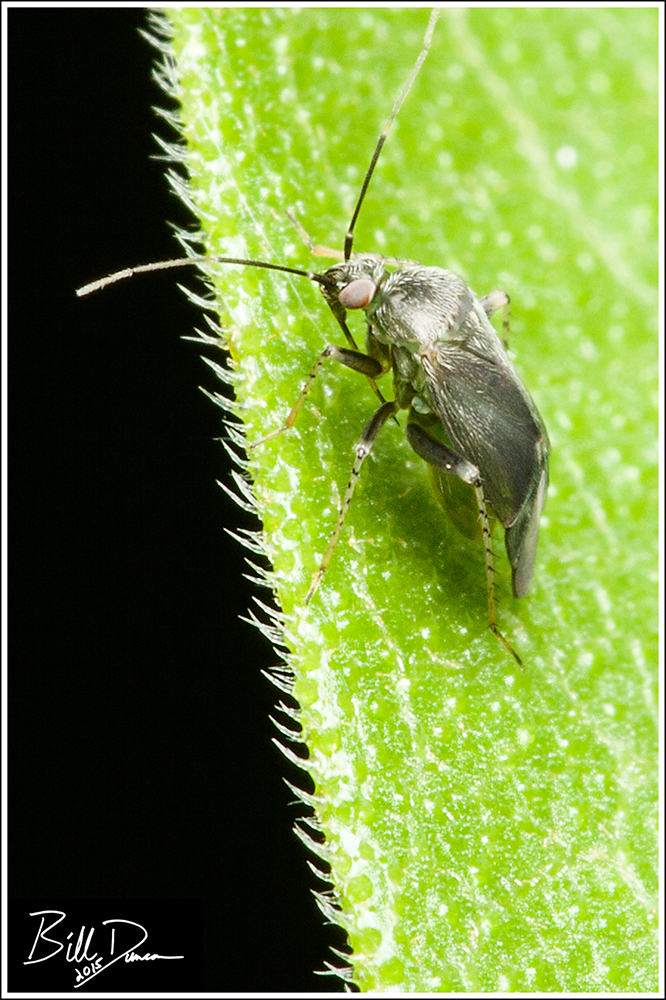
Today’s “From the Garden” spotlight is on another insidious predator, the Minute Pirate Bugs, or Flower Bugs. These true bugs, classified within the Family Anthocoridae, specialize in piercing and sucking the contents of any soft-bodied insects that are roughly their own size or smaller. These prey insects, such as thrips, aphids, caterpillars and their eggs, are important insect pests. I believe the insect pictured in this post falls within the genus Orius.
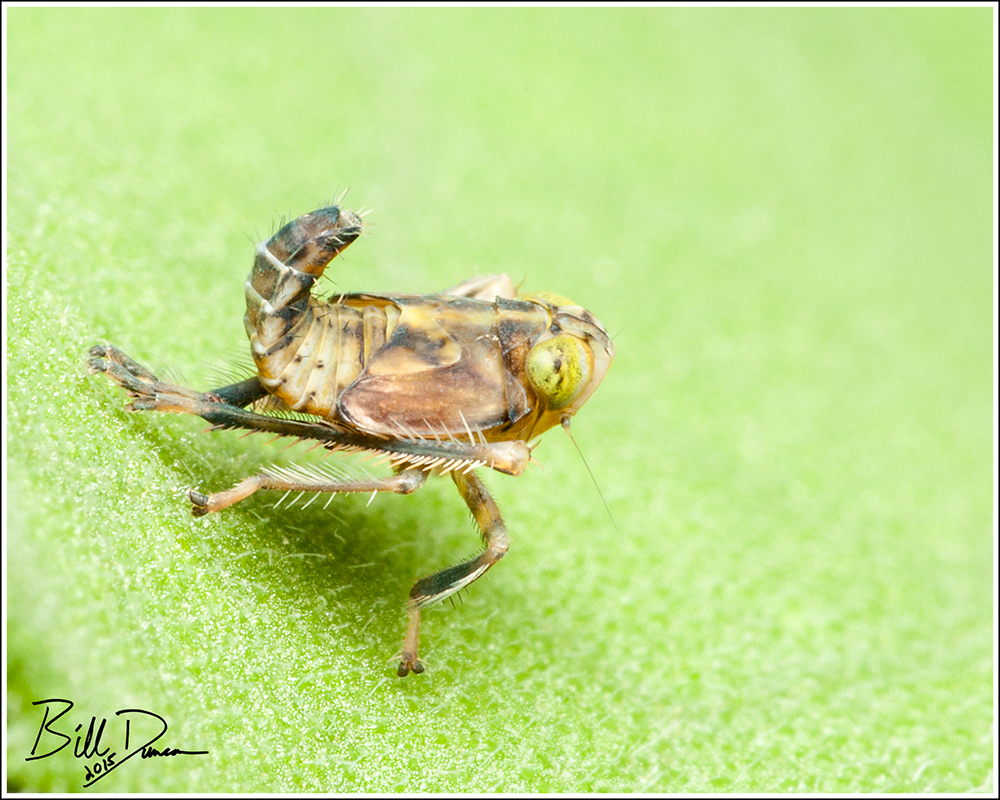
Planthoppers and Leafhoppers are groups of insects collectively found within the insect Order Hemiptera. Both groups have piercing and sucking mouth parts and feed primarily on plant saps and tissues. These groups are highly diverse. I have been able to capture a few of these fascinating creatures with the camera in the backyard, but these are generally the more common species. The insect pictured above is known as a Spittlebug – named for the behavior of encasing themselves as nymphs in a spittle-like mucous for protection.
The Stormtrooper
I’ve said before that there is no such thing as an original idea in fantasy or sci fi. I’ve found that almost every creature or effect you can find to celebrate in these films or books has been taken (consciously or not) from nature, most often from invertebrates or the deep sea.
Planthopper Nymph
This ultra-tiny guy posted above is a planthopper nymph. Often members of this group will have long, colorful waxy lengths of fibers extruding from their tail ends that are used for multiple purposes, including predator avoidance.
Candy Stripers
Many folks who have spent any time in the backyard have surely seen the Candy-striped Leafhoppers, one of the most abundant species in this group. Gorgeously colored and quick to disappear, the two pictured above are busy making more.
I look forward to sharing more photos of members of these groups in the near future.
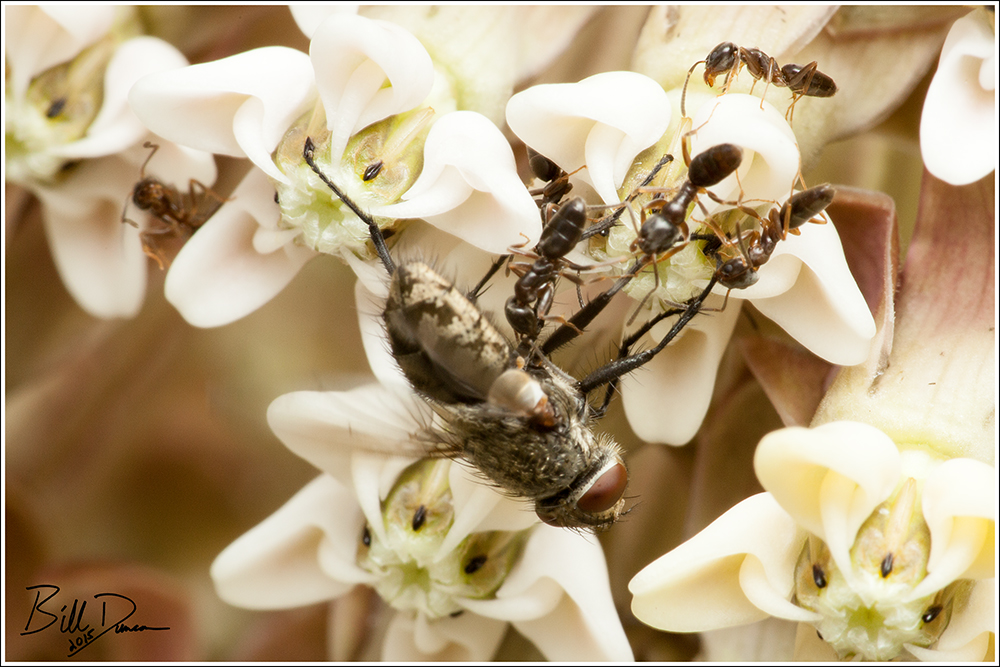
Ants and most flies that are abundant around my milkweed are nectar robbers – providing no pollination services for the plant. I do see flies from time to time that might carry a pollinia, and sometimes a lightweight like the housefly pictured above will get a leg or two stuck and be unable to free itself. That’s what these ants are waiting for. Here we see the ants beginning to dissect their prey while it struggles to free itself.
The beetles (order Coleoptera) are famous for being the most diverse group of animals on the planet. The flies, however, are not too far behind and many people are surprised to hear how many forms and places flies can be found. I have been able to find and photograph a few of these forms in my own backyard and will share them here. I photographed this carrion fly (Calliphoridae) hanging out on my rosinweed.
I imagine the conversation may have went something like this…
Aphid (with a cockney accent, of course): “Oh, hello, who are you then?”
Damsel: “Name’s Damsel…” “Oh, that’s a lovely name. My name is Aphid.” “No, I think I’ll call you ‘Sugar Bag.’ “ “Sugar Bag? Now that doesn’t sound Aghhh!…”
😉
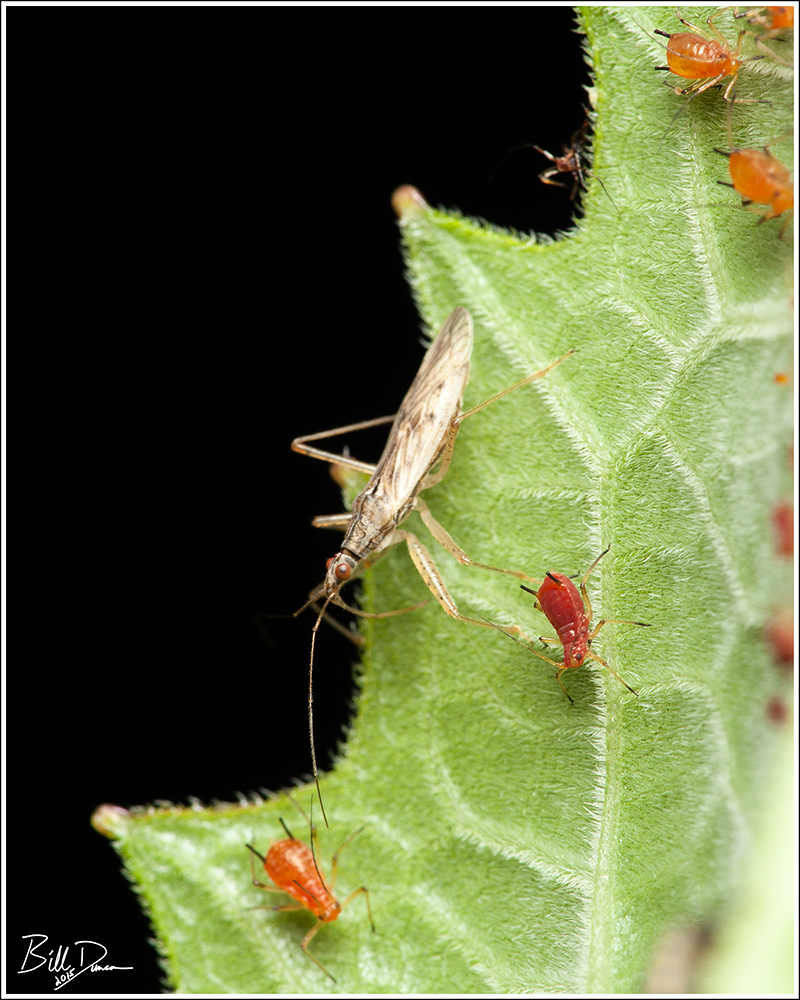
Sugar Bag
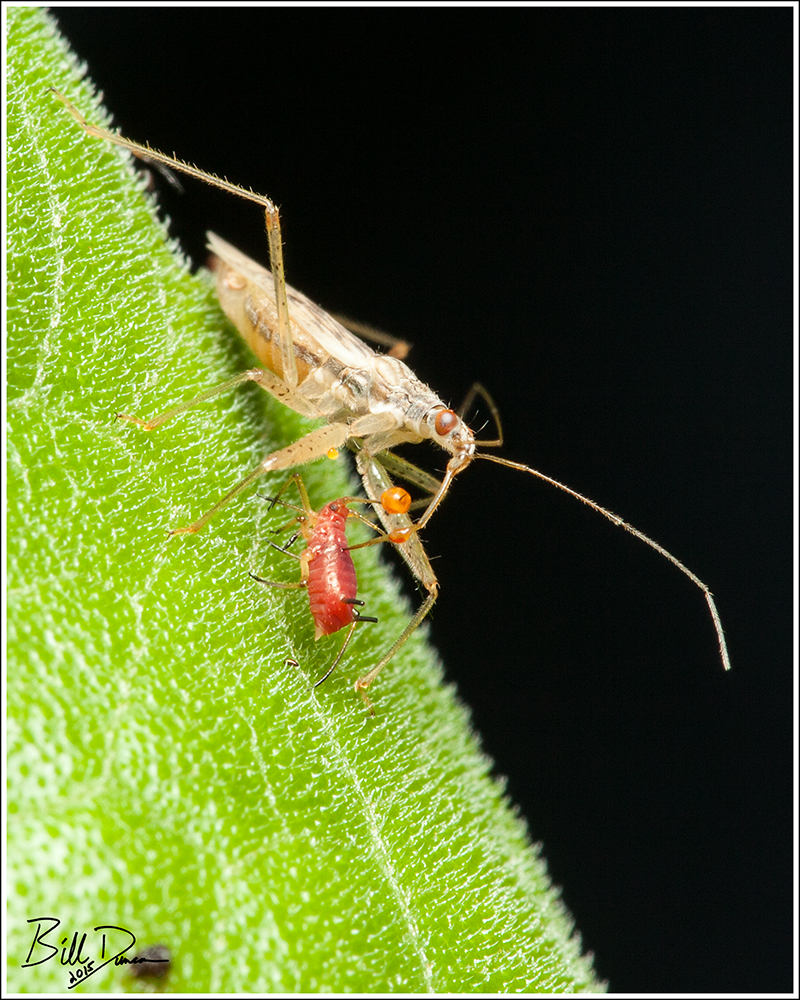
I caught a glimpse of this guy early one morning patrolling around the surfaces of my rosinweed and decided to watch. I didn’t wait long to observe the hunt. This bug is definitely in the family Nabidae, and I am going to call this one the common damsel bug, Nabis americoferus, due to it matching a few photos and the fact that this is considered to be the one of the most common hemipterans in the United States.
Nabis
I have read that these guys overwinter as adults and have a wide selection in the prey they choose. It seems that if it is smaller than they are, or close in size at least, they will poke it and suck out their hemolymph. Like I said, “damsel” in name only…
I had been watching this exquisitely camouflaged spider on this Common Milkweed (Asclepias syriaca) all week. This evening I noticed it had grabbed itself some tucker and grabbed the camera. In these two photos (not the same bee) check out the pollinium (pollen sacs) that are attached to the honeybee’s legs. This is quite the interesting pollination system that milkweed use. As an insect is having a meal on the nectar the flowers provide, the pollinium attaches itself to the leg of the visitor and is removed from the donor flower. Upon removal, the pollen sack is turned perpendicular to the receptor sight, known as the “stigmatic slit” – thus avoiding self-pollination. A few minutes or so later, as the insect is visiting other flowers, the translator arms begin to dry and that flat sack of pollen now orients itself to be able to fit in this slit – thus pollinating another flower. Often, these pollinium can attach to themselves, forming long, branched chains, which may increase the chances for successful pollination.
Obviously the honeybee is not the natural pollinator of milkweed, but this exotic insect is now the primary pollinator of A. syriaca and several other milkweed species. Scientists are unsure which native species were primarily responsible for this service prior to the introduction of the honeybee, or why they are not found in more abundance currently. With the current plight of both the honeybee and the monarch butterfly, it would be a wise thing to plant as many milkweed as we can in neighborhoods and in reconstructions of prairie habitats. So far my milkweed are looking good and I hope to collect plenty of seed this year (aphids really limited flower and seed production the last two years). So, if you are interested in planting some milkweed, let me know.
From one of my favorite birds to one of my favorite plants, the shrub known as Ozark Witch Hazel (Hamamelis vernalis).
Ozark Witch Hazel
I have featured and discussed this plant a number of times on this blog and on Flickr over the years, but there were (and still are) a number of things I did not know and hoped to discover about this fascinating shrub of the Ozark Highlands. As the species name vernalis suggests, these shrubs flower from January through late March, while their sister species, the more easterly Common Witch Hazel (H. virginiana) blooms in the fall. There may be some overlap in flowering and hybridization might actually occur in certain circumstances, but I was unable to find anything that suggests how frequently this might take place.
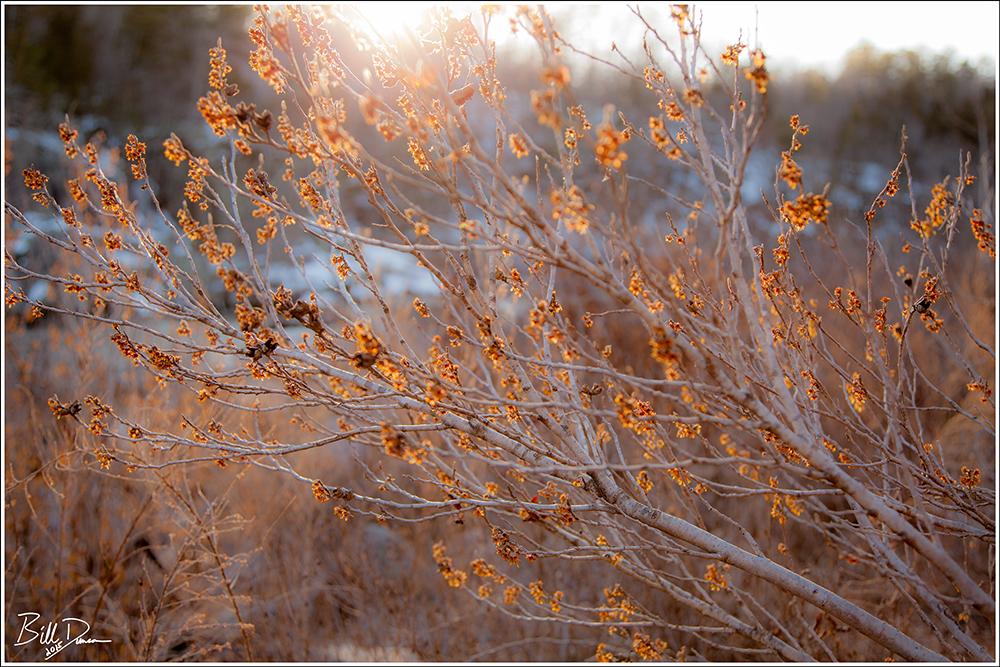
Here is an image I made this year. Notice the snow and ice in the background.
The Winter Blooms
One of the things I wanted to get to the bottom of, either through direct observation or finding in literature is what are the specifics of pollination for a shrub that blooms in the winter months? Nearly all of the scholarly articles I could find dealt mostly or exclusively with H. virginiana, but I believe that we can assume that most of these results can be used to describe OWH as well. There are several things to consider. The first and perhaps most logical consideration is that the plant may predominantly self pollinate or rely on wind-pollination. A couple of papers suggest that although self-pollination does occur, self-fertilization does not, making the species self-incompatible, so we can eliminate that option. The potential for being primarily gravity or wind-pollinated does not make sense when considering that the plants put some considerable resources into making colorful flowers with a noticeable and pleasant odor. The flowers of OWH have all the classic signs entomophily – brightly colored, nectar producing, fragrant, large, sticky pollen, with male and female structures found in close proximity to one another.
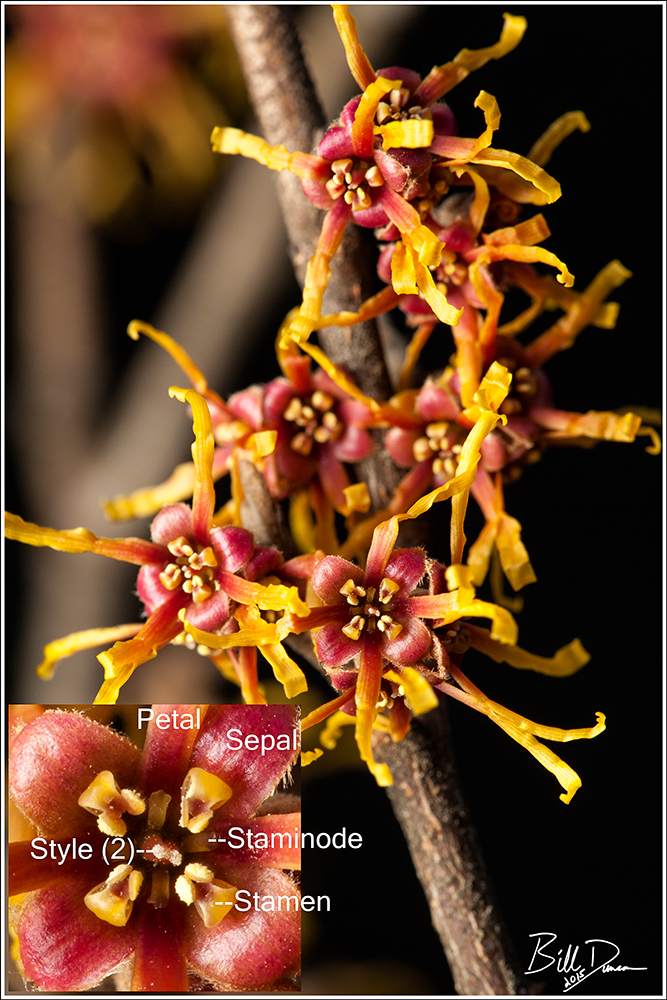
The long strap-like petals of these flowers (see photo below) will unfurl on warmer days and odors increase, thus suggesting the strong likelihood of attracting diurnal pollinators.
OWH – Yellow Flowered
Assuming there must be an active pollinator that moves the sticky pollen from plant to plant, what are the potential options for such an insect species in the Ozark Highlands? An interesting article written by Bernd Heinrich of popular science writing fame gave one possibility, at least for the more eastern H. virginiana. In this paper he recorded that winter-active moths he was researching used that shrub’s flowers as a food source. This has been picked up by a number of writers on the internet who have jumped to the conclusion that these moths must be the primary pollinators of the North American Witch Hazels. However, as these primarily warm-colored (preferred by bees) flowers often roll their petals closed and cease odor production at night, the case for nocturnal moths as pollinators should be considered fortuitous at best, and not a reliable vector for pollination by this plant.
Witch Hazel Flower Anatomy
I wanted to visit a good stand of blooming OWH on a warm, sunny day in early February or March and see if I could identify and hopefully photograph a pollinator. No such luck. We were able to see a few small midge-like flies and a few native bees surrounding the plants, but photographing one while visiting a flower was to be impossible. Next time I will bring my handy corn syrup in order to coax pollinators to stay a while longer. To get an answer, it was off to the literature. In a study focused on Common Witch Hazel, insects of six orders were identified as visiting flowers. Of these, flies (order Diptera) were most prevalent and comprised 73% of floral visitors and 52% of the identified species, followed next by Hymenoptera (bees, wasps and ants).
Why flower during colder months? Advantages and disadvantages can be identified with a little thought. What are the advantages of an entomophilous plant that opens its doors for business in the colder months? Not many plants will be flowering in such cold conditions, therefore, on warmer days that allow for flying insects to move about and earn a living, there will be little competition and most pollen collected and moved from flower to flower will be of a compatible, intraspecific origin. In contrast, insects moving about in mid June might be carrying loads of pollen from a number of species, and if these other species provide a higher quantity or superior quality of nectar and pollen, you might find yourself unable to be cross-pollinated.
This strategy is not as clear-cut of an advantage as it may sound, however. It has been found that the North American Witch Hazel have a pretty poor flower to fruit ratio – with a less than 1% fruit set on average (the average fruit set in angiosperms is close to 25%). This makes sense. If you bloom in the winter then there will be generally fewer pollinators, and in particularly long and harsh winters fruit set can and has been documented to fall to zero in Common Witch Hazel. One thing the Hamamelis do to assure that a minimum number of successful seed are produced is by increasing the number of flowers. It has been studied and determined that these plants produce more flowers than similarly sized shrubs. So, although the success rate of each flower is generally poor, when factoring in the number of flowers produced per plant along with the fact that these plants are usually found in dense stands, the total number of seed produced per season is enough to keep the population sustained.
Another of the fascinating natural history notes of the North American Witch Hazels are their means of seed dispersal. These plants exhibit what is termed “explosive dehiscence”, similar to another Ozark native – the Jewelweed. The drying fruit capsules split suddenly, ejecting the seed(s) contained within up to three meters. In the following photo you can see an empty fruit case some time after it has expelled its seeds. An observer will notice another interesting characteristic in the photo. These plants hold onto their spent fruits long into the next season, in this case the plant is in full bloom with its next flowers while still holding onto last years spent fruits.
Explosive Remains
For now, that is about all I have to say and share about the Hamamelis of the Ozark Highlands. If you find yourself in a sandy stream-bed within the St Francois Mountains during the first quarter of the calendar year, be sure to keep your senses open and prepared for an unexpected blast of spring.
Ozark Witch Hazel in Bloom
Please note – other than a few easy observations and a little bit of thought, I produced no original work in the written portion of this post. If I was worth my carbon, I would have cited the source of each work I used within the text, but this is my blog, so I don’t have to. Instead, here is a list of works I consulted in writing this.
Anderson, G.J., & Hill, J.D. (2002). Many to flower, few to fruit: The reproductive biology of Hamamelis virginiana (Hamamelidaceae). American Journal of Botany, 89(1): 67-78.
Bradford, J.L., & Marsh, D.L. (1977). Comparative studies of the Witch Hazels Hamamelis virginiana and H. vernalis. Arkansas Academy of Science Proceedings, 31: 29-31.
De Steven, D. (1982). Seed production and seed mortality in a temperate forest shrub (Witch-Hazel, Hamamelis virginiana). Journal of Ecology, 70: 437-443.
Gapinski, A. (2014). Hamamelidaceae, Part 1: Exploring the witch-hazels of the Arnold Arboretum. Arnoldia, 72(2): 2-17.
Yatskievych, G. (2013). SteyerMark’s Flora of Missouri Volume 3 – Revised Edition.
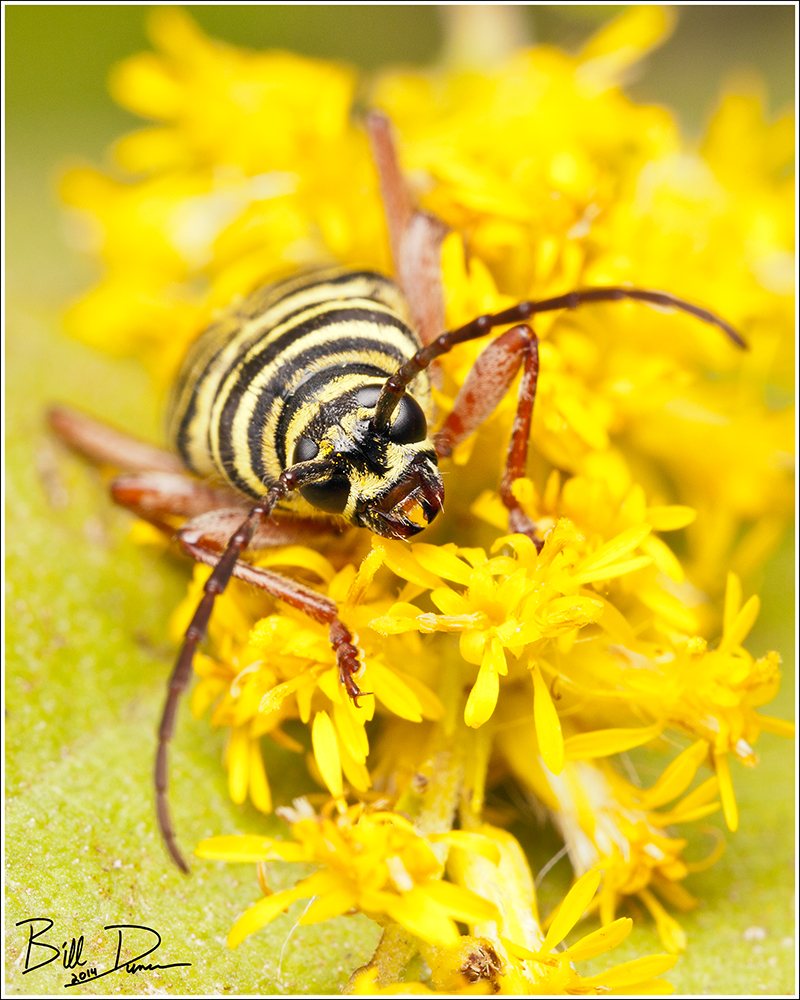
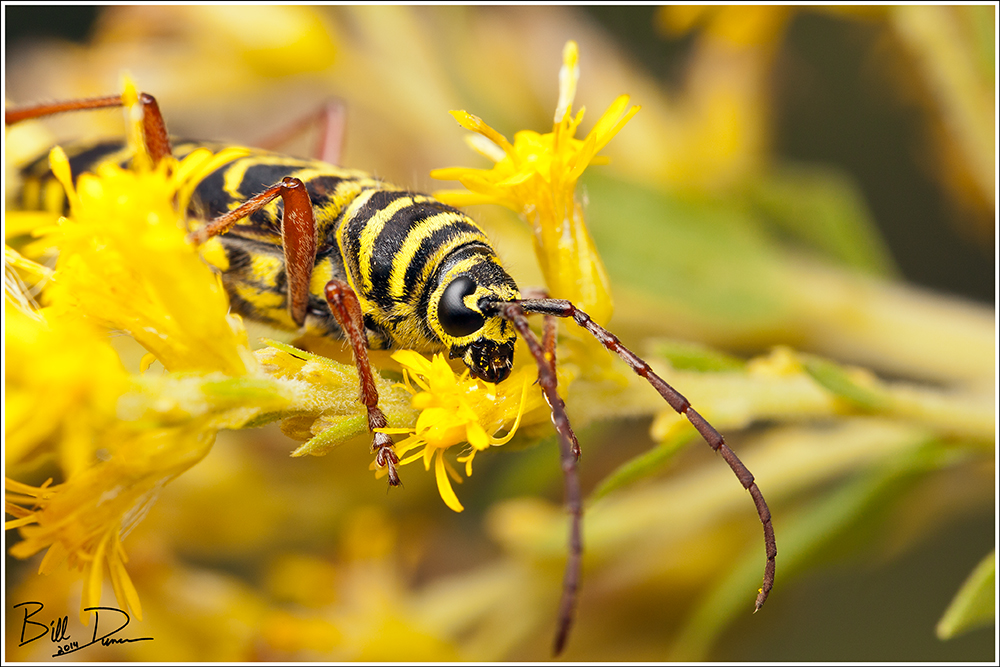
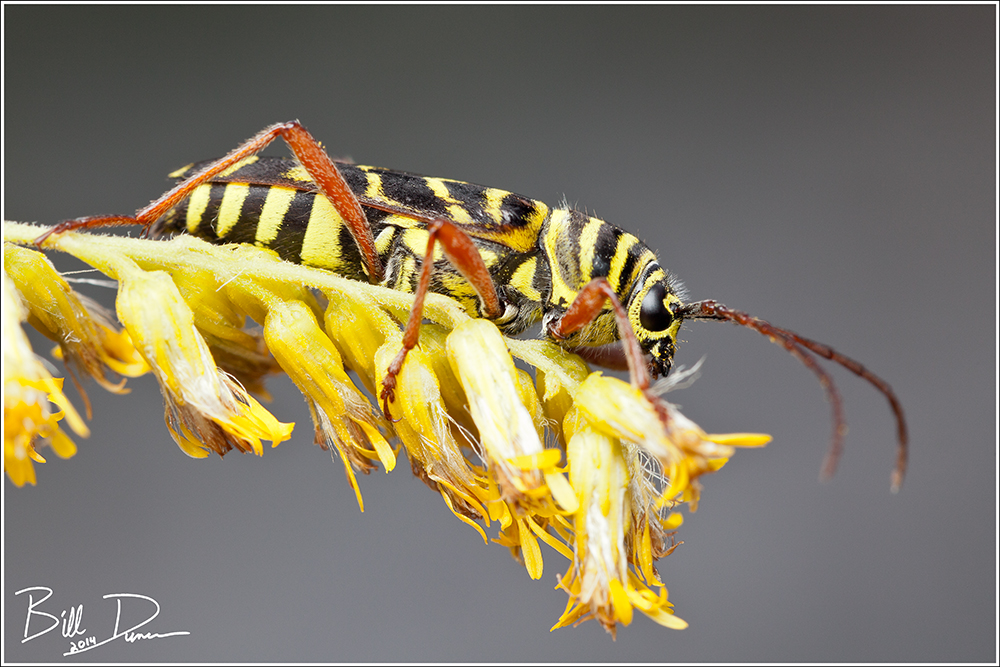
This Locust Borer (Family Cerambycidae) was photographed this fall feeding on Tall Goldenrod (Solidago altissima) that grow in my wildflower patches in our yard.
Locust Borer
The Locust Borer’s preferred larval host plant, the black locust tree, is now widespread across North America and Europe, but was originally found in the Appalachian and Ozark regions.
Locust Borer
It is unclear whether the color and pattern of this long-horned beetle serves to mimic the aposematic coloration of the well-known yellow jacket wasps (Batesian mimicry), or for crypsis – allowing for camouflage in the goldenrod, where they are often found.
This past June, Steve and I took a walk through one of the highest quality woodlands our Ozark hills have to offer. The short hike from the head of the spring to the Powder Mill trail-head and back offered an amazing diversity of life. Here are just a few of the things we were able to find and capture on camera.
Nothing can be mentioned about this location without first discussion of the spring itself. The Osage Indians referred to it as “Spring of the Summer Sky”, a most apt description for a spring who’s appearance defines the color blue. And in summer, when the flow is not overly encumbered by the suspension of dissolved limestone from heavy rains, the crystal-clear waters afford a look to the bottom of the spring, some 250 feet below the pool’s surface.
“Blue Spring Run”
The small nooks and crevices carved over the ages into the limestone and dolomite that overlook the spring pool make the perfect shelter for the Eastern Phoebe to make their nests. Most folks have likely seen the nests of this species under overhangs on human-made structures. It has only been within the last year that I have been fortunate enough to observe these nests in their more natural of settings. A perfectly placed snag within the spring’s pool makes for a fine resting place for a young Phoebe that is taking a break from the carrying on that was taking place near these nests. It was also a great place and time for us to take a break and take in everything this spot has to offer.
“Eastern Phoebe on a Snag“
Back on the trail a few minutes later Steve and I were pleased to find this guy. A first for the both of us, this Dung Beetle was moving this “resource” with full conviction. We couldn’t figure out where she was moving it, but she was sure not going to let us get in her way. When gently stopped she would climb to the top of her ball and let it be known that it was claimed.
“King of the Hill“
Here’s a little “motion pan” to give an idea of the speed at which she could move her grocery towards its future larder.
“The Cache”
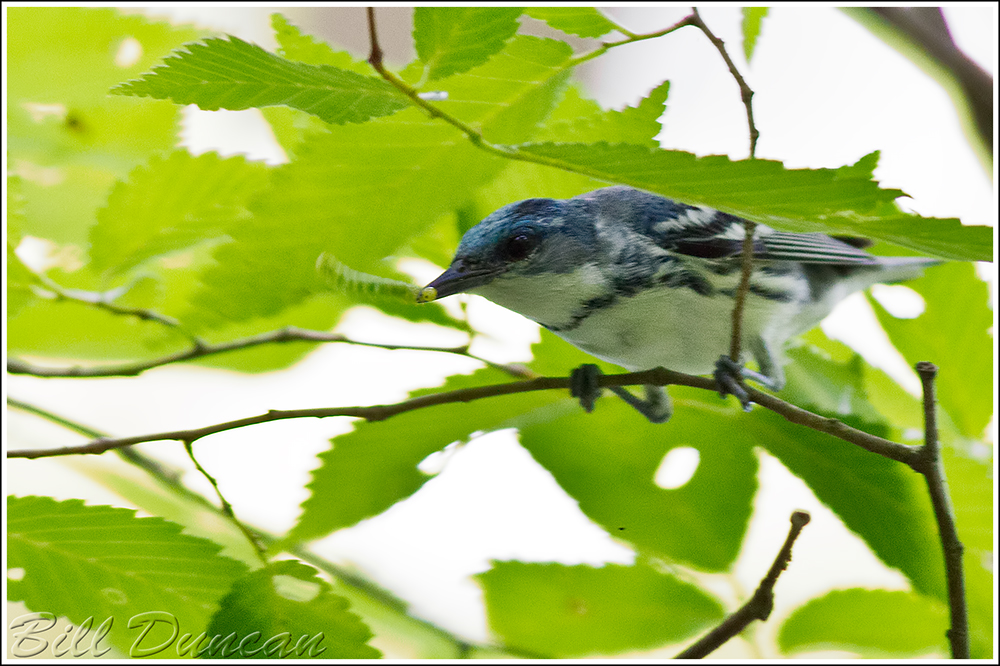
Our primary goals for this early summer day where to see if we couldn’t find and photograph any or all of three of the more rare warblers that are known to nest in this area. These would be the Swainson’s, Cerulean and Hooded Warbler. Although we did get a few confirmed vocalizations from a Swainson’s, we could not get our eyes on the sneaky guy through all the vegetation. A few quick and loud playbacks did, however, coax 4-5 male Cerulean Warblers to descend from the forest canopy in order to meet the new male who had apparently set up shop amidst their territory cluster.
“Singing Cerulean”
This was a sweeter treat for us than spending time with Willy Wonka (Wilder not Depp) and Heather Graham in a chocolate factory. They seemed totally curious and intrigued as they moved among lower branches, foraging and singing as they went. Did you know this species has suffered more than 70% population decline since the 1960’s? Approximately 500,000 birds are the current population estimates and habitat destruction and fragmentation continue to threaten this species. Check out The Nature Conservancy for more information on this great bird, and consider checking out Cerulean Blues.
“Cerulean with Insect“
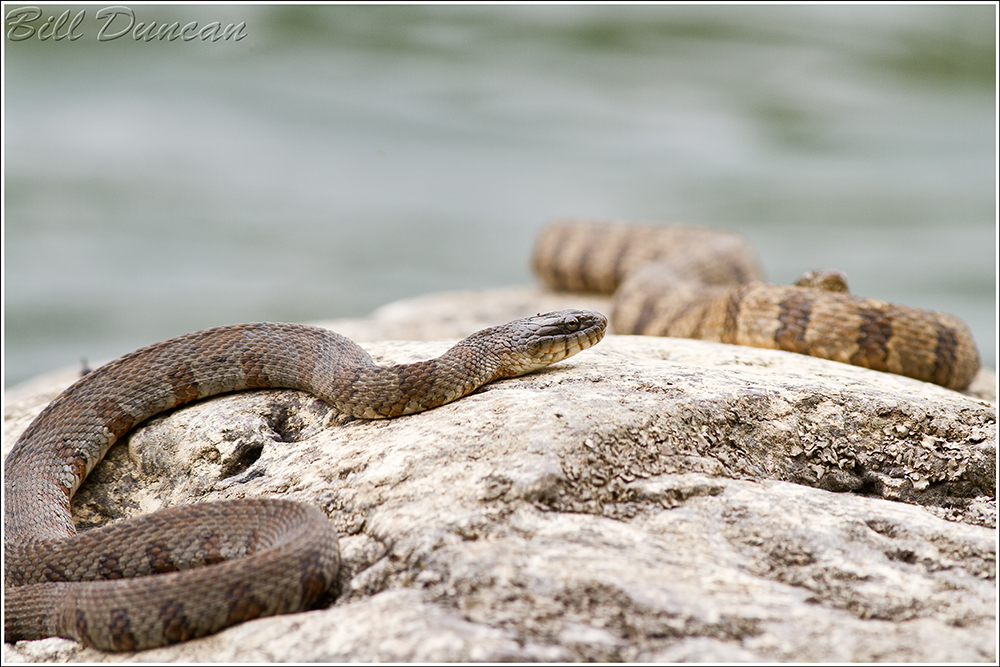
Finally, I present a pair of gorgeous Northern Water Snakes that were basking on some exposed rock not to far from shore along the Current River.















 A Thousand Acres of Silphiums