"What a thousand acres of Silphiums looked like when they tickled the bellies of the buffalo is a question never again to be answered, and perhaps not even asked." -Aldo Leopold
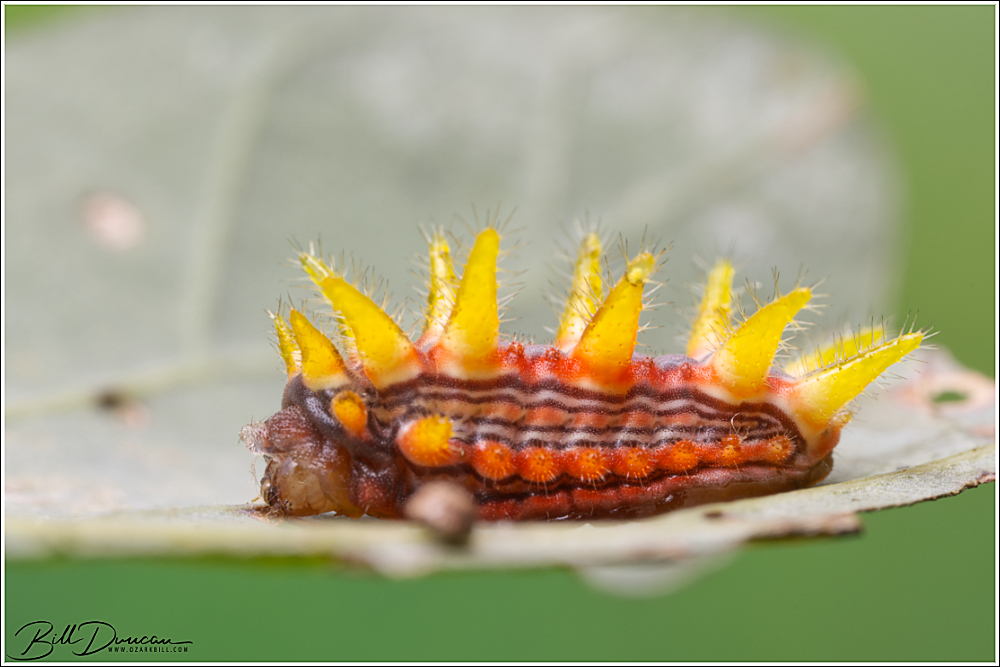
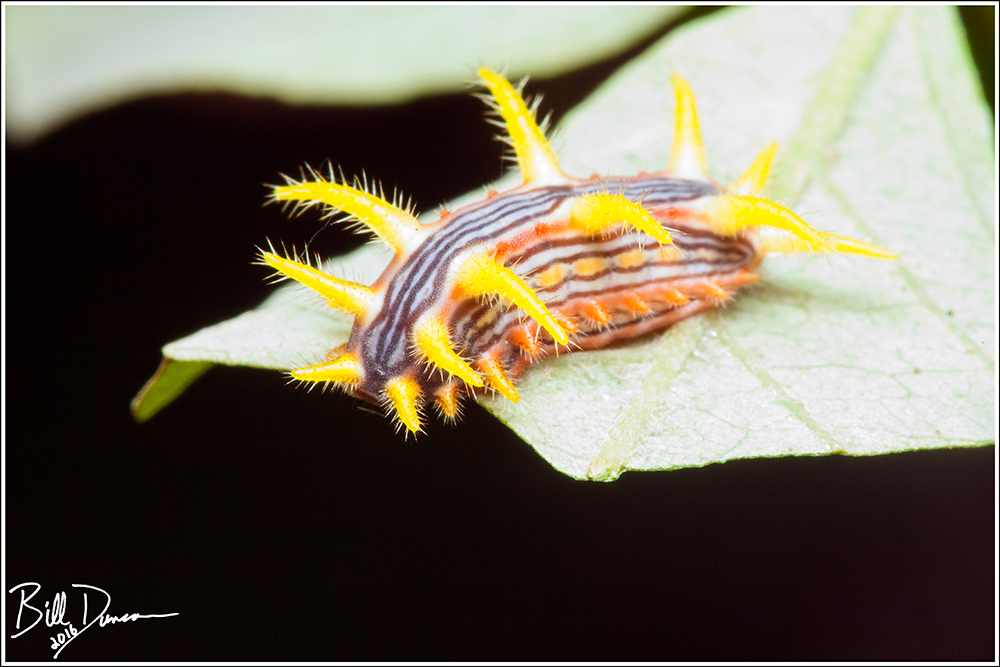
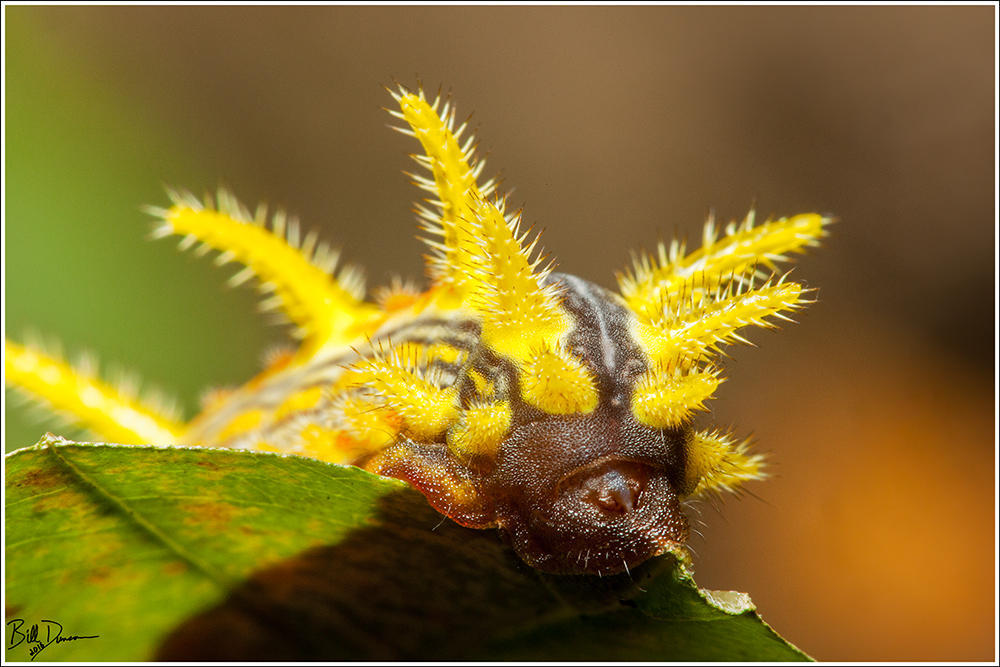
Stinging Rose Caterpillar Moth Parasa indetermina fam. Limacodidae Host plant: Nearly any native woody plant in the area Dates found: 17, Aug, 2024; 14, Sep, 2024 Locations Found: Kaintuck Hollow, Phelps County, MO; Schoolcraft Prairie, Washington County, MO Notes: Stings from this species are relatively minor, reminiscent of that received from wood nettle.
I got back into serious hunting of caterpillars beginning in late August of this year. On some trips, I hunted with a nice group of friends and on several others I went on solo outings. All in all, it was a lot of work and, at times, I wondered if the payoff was worth the time and effort. However, like I’ve said before, anytime spent in quality spots in the outdoors is time well spent. In this first post, I am sharing, as no surprise to those who know me well enough, images of larvae from my favorite family of Leps – the Limacodidae, otherwise known as the “slug moth” caterpillars.
Red-crossed Button Slug Moth (Tortricidia pallida) Limacodidae, Hodges#4653 By far the most abundant slug we found this season was the red-crossed button. I did not collect good enough records to put a specific number of the individuals found, but it would be close to 25.
Nason’s Slug Moth (Natada nasoni) Limacodidae, Hodges#4679 This is another one that is usually found in goodly numbers during the hunting season. We found a few, but not nearly as abundant as in most years.
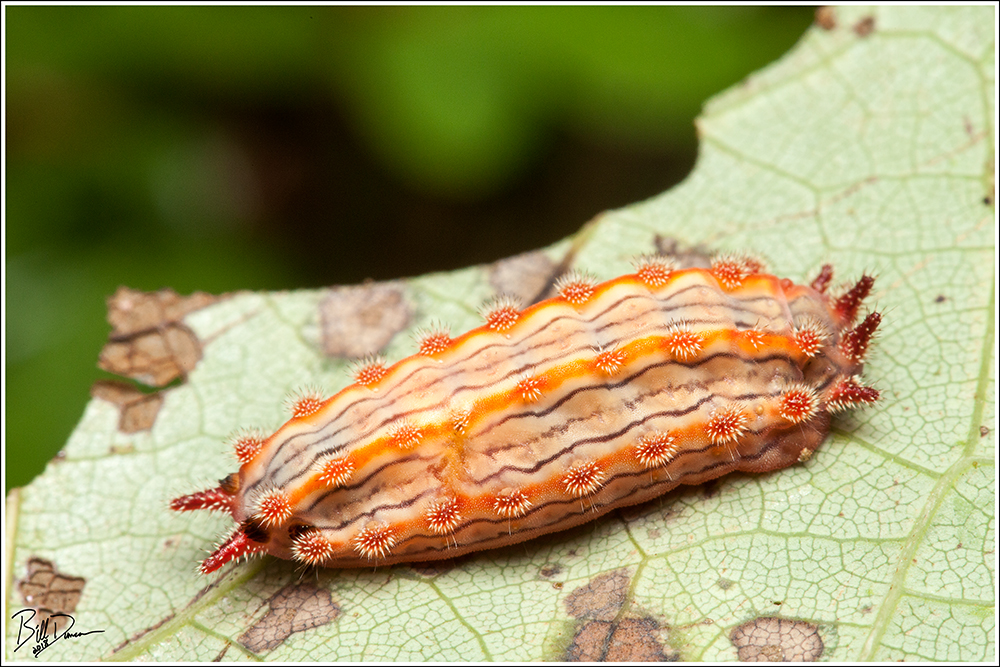
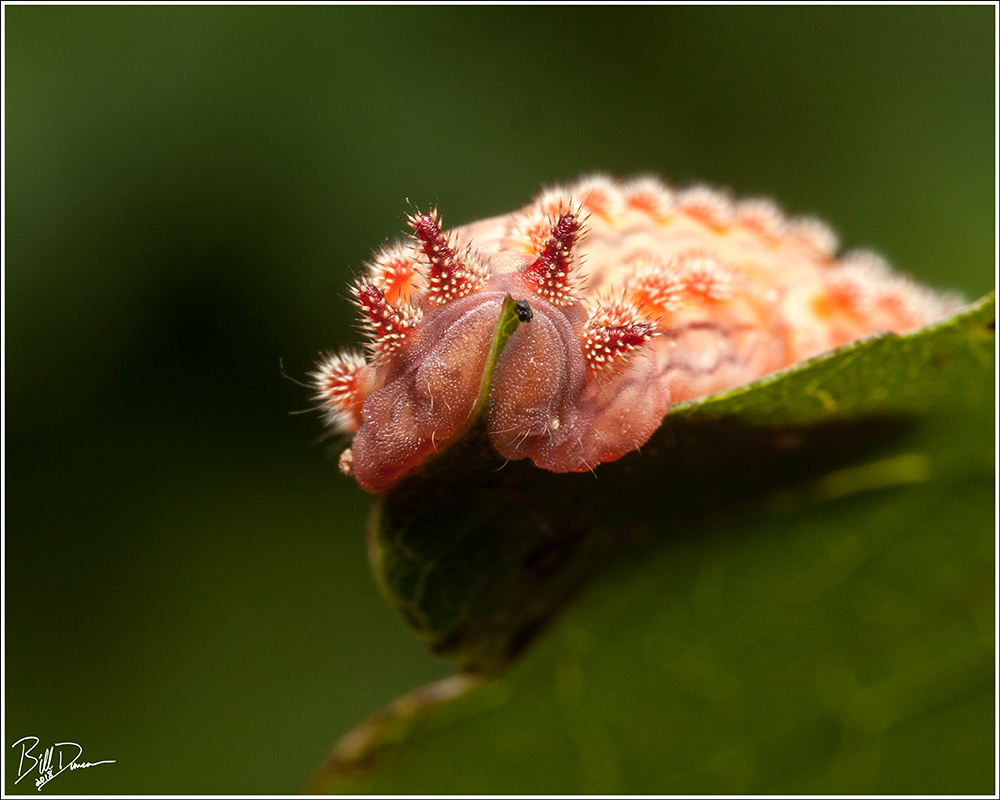
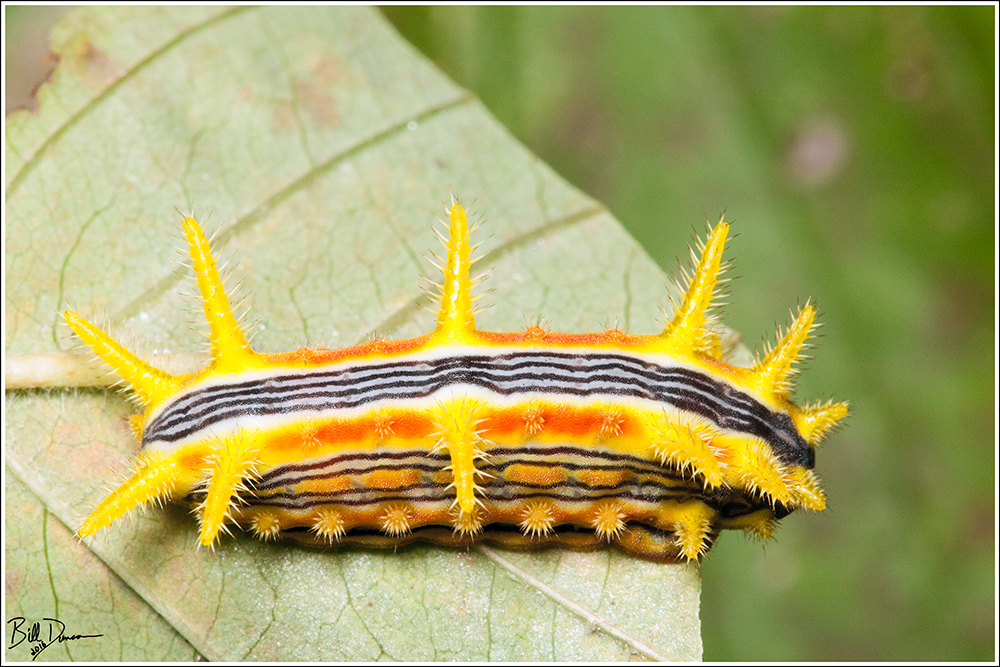
Stinging Rose Caterpillar Moth (Parasa indetermina) Limacodidae, Hodges#4699 Always a pleasure to find, the stinging rose caterpillars will vary considerably in the amounts of the yellow, white, black and red colors.
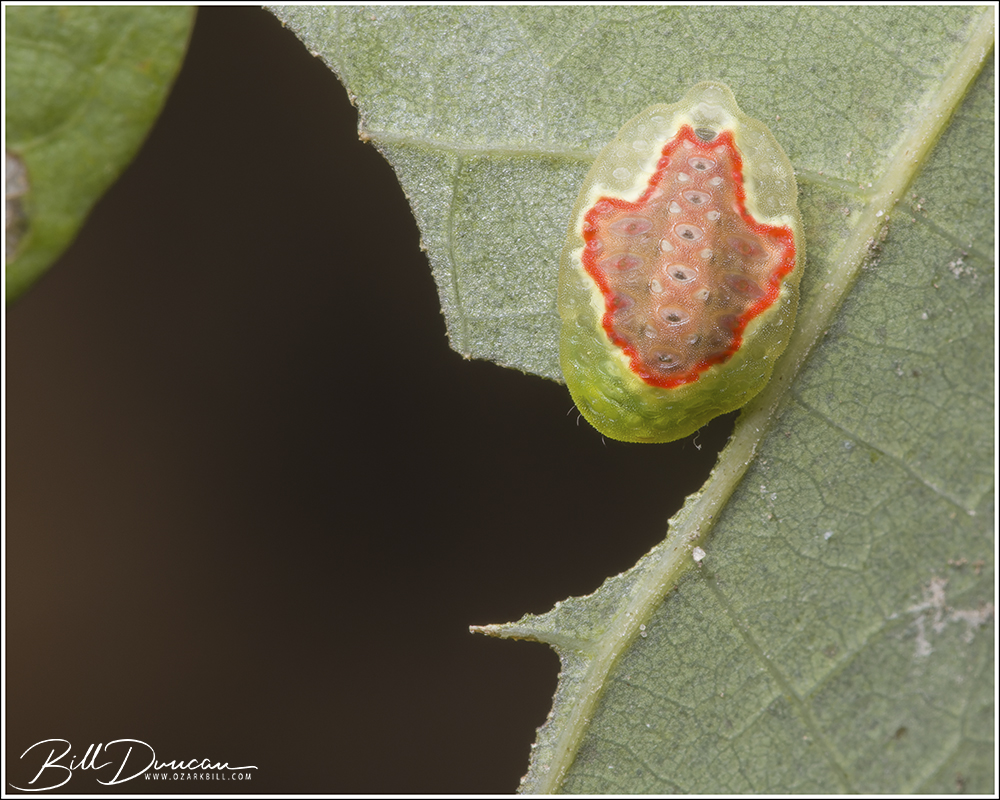
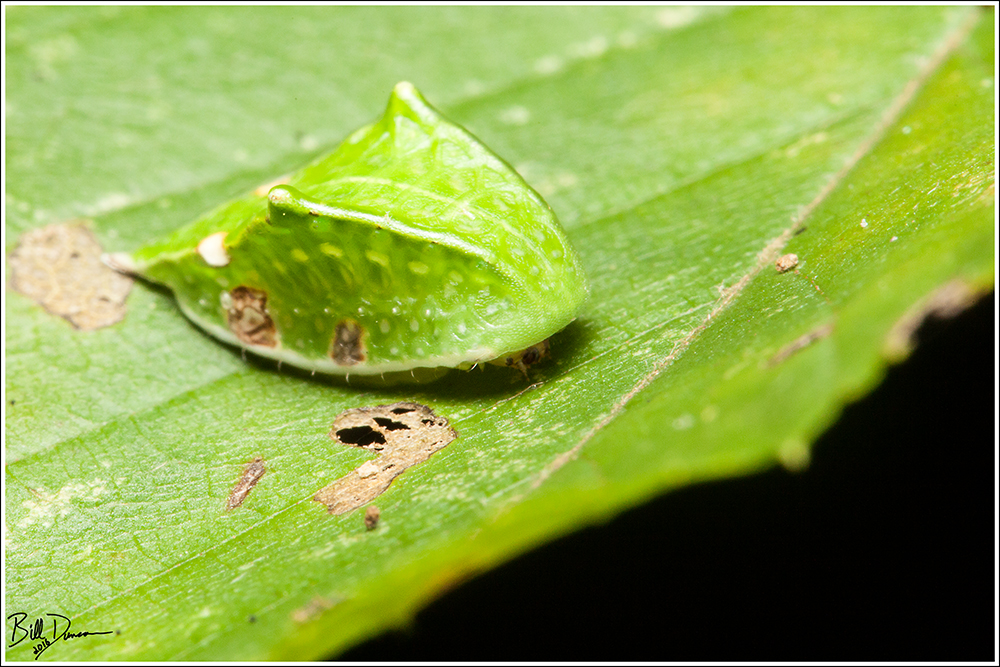
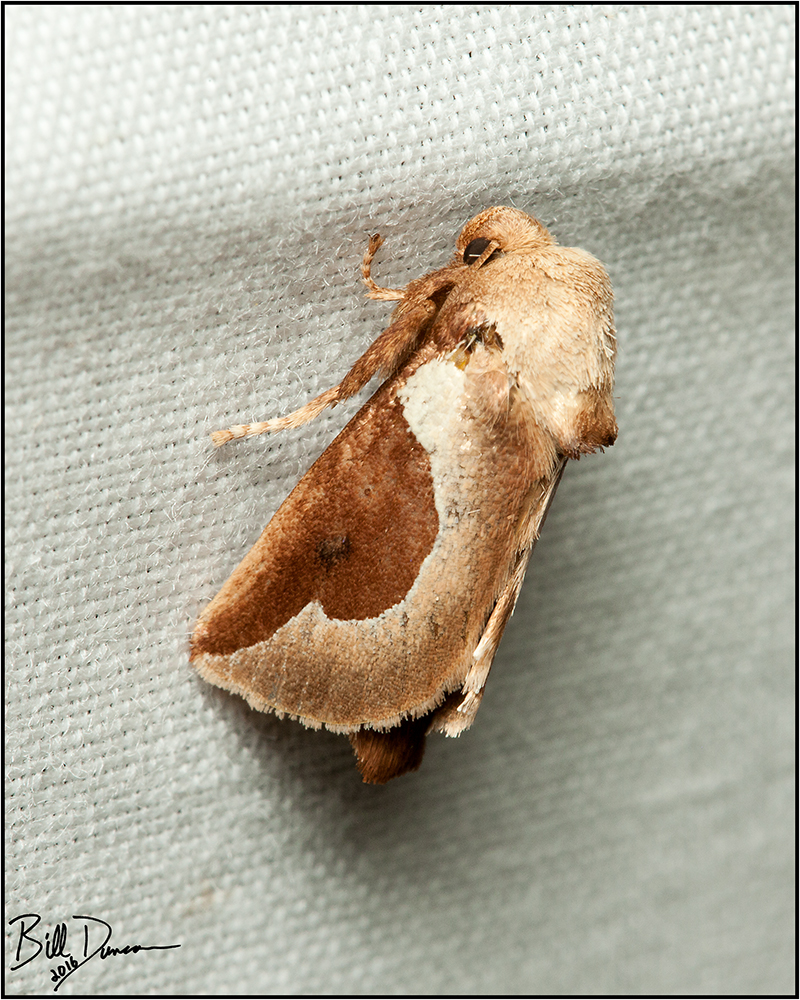
Skiff Moth (Prolimacodes badia) Limacodidae, Hodges#4671 Another slug that can be quite variable in colors and patterns, the skiff moths can often be found on the tops of leaves. This is opposed to most of the cats in this family being located on the undersides of leaves. As you can see in the one pictured here, these guys are patterned to appear as easily-overlooked spots of necrosis on late-season green leaves.
Inverted Y Slug Moth (Apoda y-inversum) Limacodidae, Hodges#4667 Overall, I was a little disappointed in the numbers and diversity of slugs we found this season, however this species and the following one are not always encountered every season. I believe this is only the third cat of this species I have been able to find.
Beutenmueller’s Slug Moth (Isochaetes beutenmuelleri) Limacodidae, Hodges#4675 Until this year, I have only been able to see one caterpillar of the Beutenmueller’s slug, better known as the “spun-glass” slug. This year I found three! I’ll never get tired of seeing these.
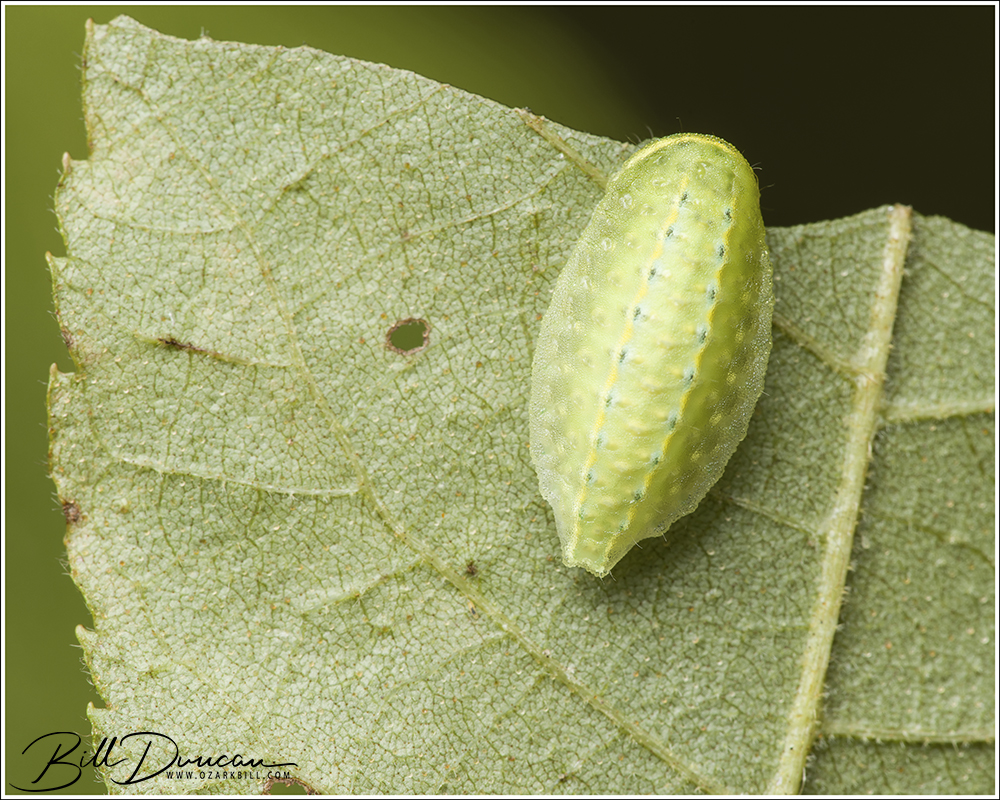
Unknown Limacodid This mid-instar cat could potentially be one of several species. I think there is a chance it could be the – jeweled tailed slug moth (Packardia geminata), but it is most likely a yellow-shouldered slug (Lithacodes fasciola). I wish I would have thought to bring it home to rear. In the know and have a better idea on the identity of this one? Please let me know in the comments below.
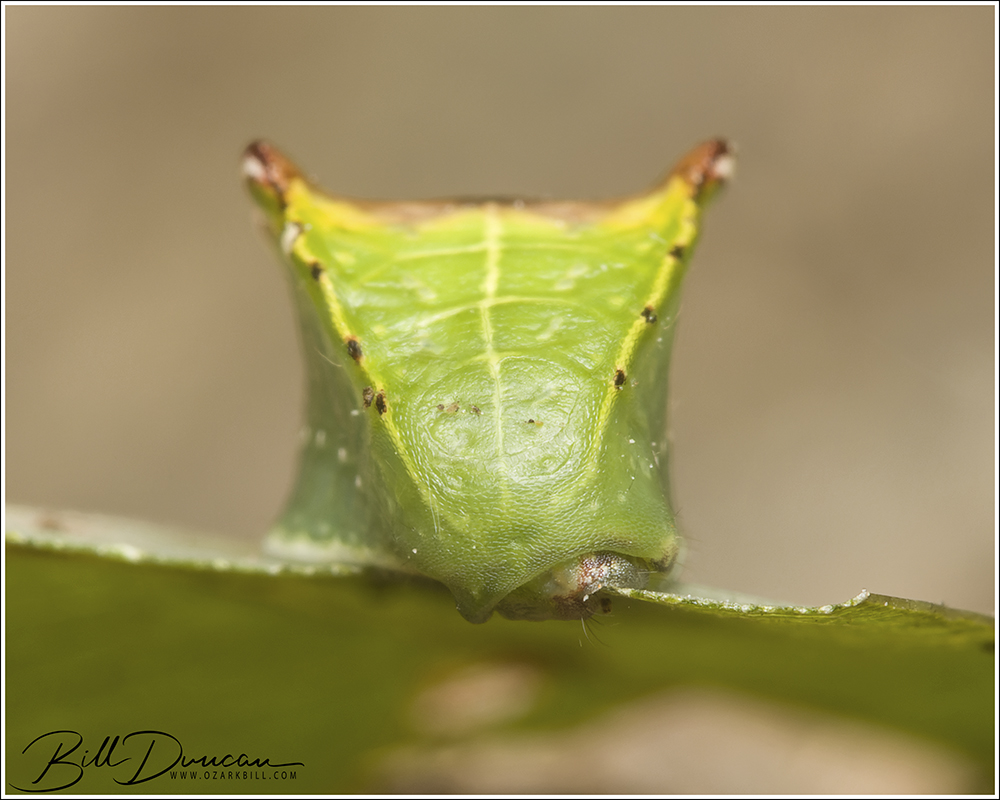
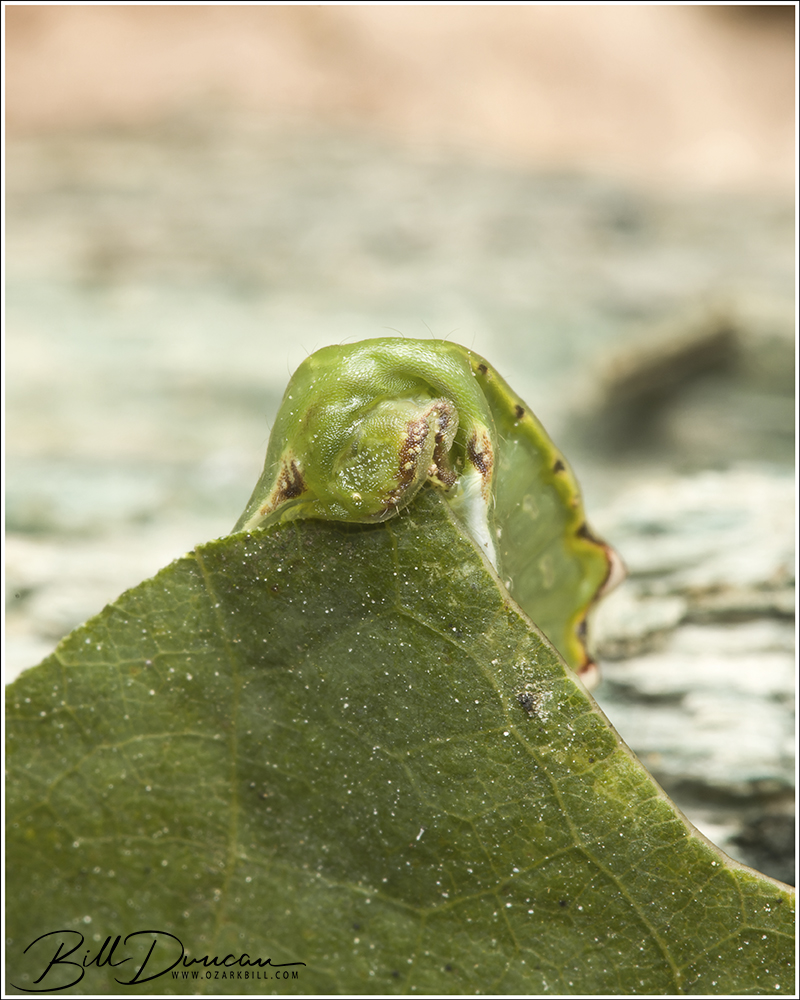
Shagreened Slug Moth (Apoda biguttata) Limacodidae, Hodges#4669 In the picture below of this shagreened slug, you can see a couple of the traits that are distinctive to the Limacodidae. First, it is quite common that the slug cats will eat the leaves in a more horizontal direction, squaring off the leaves, so-to-speak. Most other caterpillars will eat circular notches in the leaves as they feed. Second, although difficult to see in this picture, is the distinctive frass the caterpillar is dropping. Limacodid frass is distinctly shaped, with one section being notched to “fit” along side the ones before and after. Interestingly, monarch (Danaus plexippus) and likely other groups also share this trait.
Hag Moth (Phobetron pithecium) Limacodidae, Hodges#4677 Either we were out too early, in general, or the hag moth cats, AKA “monkey slugs,” were later than usual. I found quite a few mid-instar monkey slugs this season but not a single late-instar. I was too lazy, or perhaps disappointed, to pull out the big rig to photograph any of these, so here is a cellphone shot. The reason I wanted to share this is to show the interesting feeding behavior of cats at this stage of their development.
Notice the wavy, white to lime-green patches on the top of this leaf? This is indicative of how this younger monkey slug is feeding. Instead of free-feeding and consuming the entire leaf, this guy is feeding like a skeletonizer or a leaf-miner, in that it is scraping the top layer of the leaf. In this photo, you can see fresh scraping areas and ones that are much older, suggesting that this cat has been living on this leaf for some time. I suppose it likely that early to mid instars of all species in this family feed in this way, but I am not usually out hunting in early to mid summer to have observed this before.
A mid-instar hag moth caterpillar, feeding by scraping off the top layer of the leaf surface. BTW, the caterpillar is in the upper left section of this photo. 😉
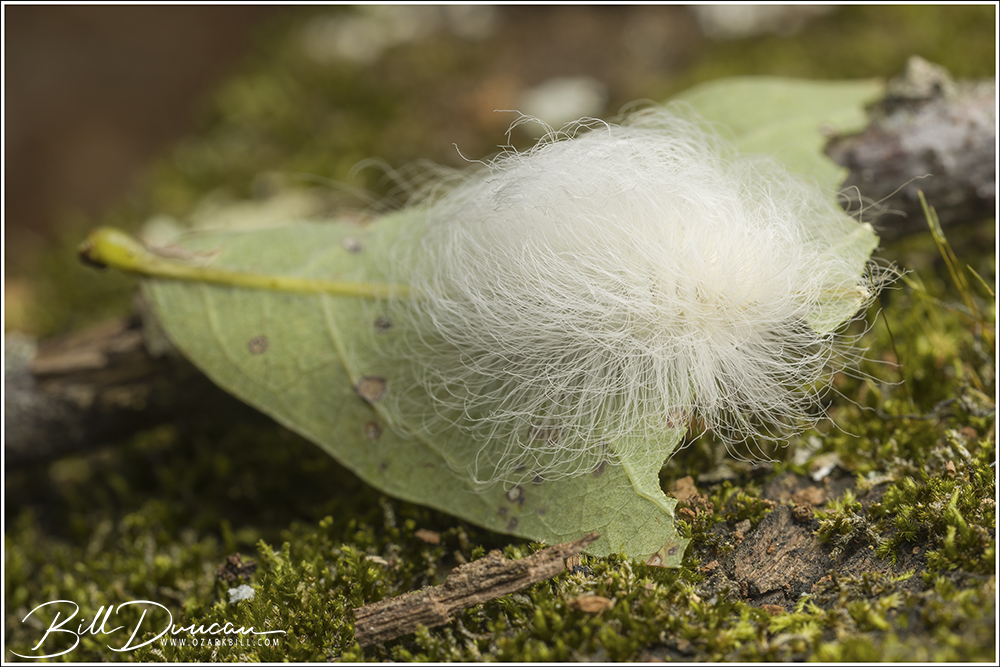
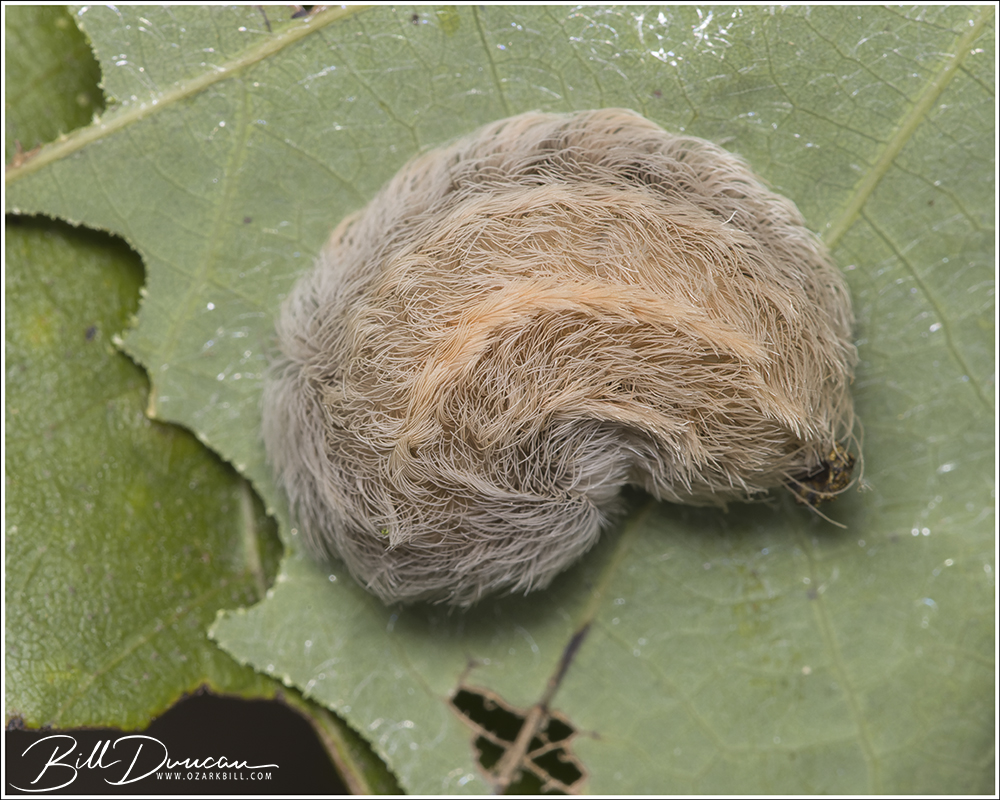
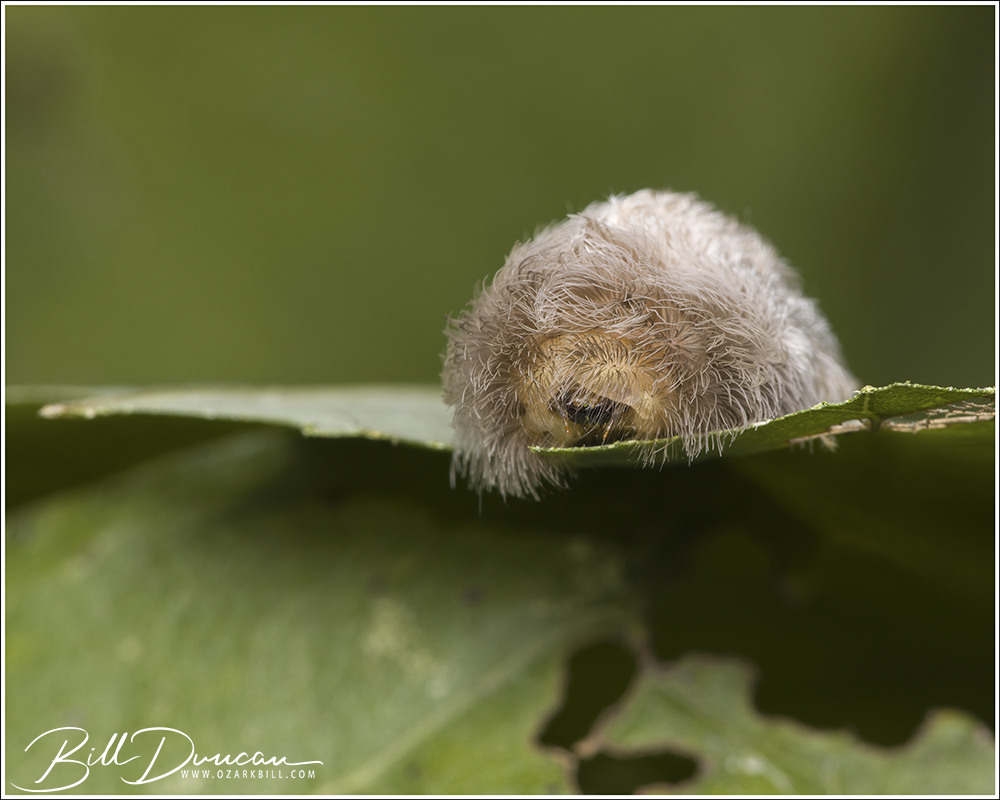
Black-waved Flannel Moth (Megalopyge crispata) Megalopygidae, Hodges#4644 Technically, not a Limacodidae family member, the black-waved flannel moth is in the closely related family, Megalopygidae, within the same super family (Zygaenoidea), which include not only the slugs and flannel moths, but leaf skeletonizer moths as well. We regularly find this species on our late-season outings. This year I was able to find and photograph two different stages. The earlier instars are fluffy white in appearance, while the final instars are colored in warmer browns.
Remember, these guys are not for petting. Descriptions vary, but the hairs on these have been described as highly irritating to downright dangerous, potentially requiring a hospital visit.
A mid-instar of the black-waved flannel moth (Megalopyge crispata) in its fluffy white coat.
Late instars of this species are draped in reds and browns. Some have suggested they can look like the top of a recent “president’s” head.
I believe these are all of the photos I have to share of the Limacodidae from this past season. Thanks for visiting and please let me know if you find any errors in my identifications by making comments below.
The WGNSS Nature Photography Group met on September 1, 2018 at Don Robinson State Park in Jefferson County, MO, with the goal of finding slug moth caterpillars and whatever other macro subjects of interest we could find. Overall, I think we had good fortune on this hot and muggy, late-summer day, finding quite a few interesting caterpillars. The slug moth caterpillars were a little scarce, but we did find a little something extra special – the pin-striped vermilion slug moth (Monoleuca semifascia) (Hodges # 4691). In four summers of looking for slug cats, this is the first one I have seen. It is a southern species and I assumed it would need to be found in the south-western part of our state where the open barren woodlands and savanna type environments this species prefers are more common.
Slug cats can be found on virtually any species of woody plant in the state. Although oaks and hickories seem to be the preferred host plants, this animal was found on an eastern redbud (Cercis canadensis).
The highly variable colors and patterns of the skiff moth are hypothesized to mimic senescent/necrotic lesions on leaf surfaces. They often have paired white spots that are thought to mimic the eggs of the tachinid fly, a parasite that enters the caterpillar after hatching. These “egg mimics” are hypothesized to work by dissuading flies that may attempt to avoid depositing eggs on victims that were previously parasitized.
Stinging Rose Caterpillar -Limacodidae – Parasa intermedia (4699). Cuivre River State Park, Lincoln Co, MO.
Arguably the most stunning of Missouri’s slug moth caterpillars, the Stinging Rose Caterpillar can most often be found on oak and hickory saplings. However, a number of other woody species (including those in the rose family) will also be used as host plants.
Stinging Rose Caterpillar -Limacodidae – Parasa intermedia (4699). Horseshoe Bend Natural Area – Washington SP, Texas Co, MO.
This is one of the species I voluntarily allowed to sting me – it wasn’t that bad, perhaps a mild ‘stinging-nettle’ type of experience that was gone in 30 minutes or so.
Stinging Rose Caterpillar -Limacodidae – Parasa intermedia (4699). Horseshoe Bend Natural Area – Washington SP, Texas Co, MO.
The image below shows a little of the variety of color and patterns that can be found in this species, this one showing more of a yellow/orange background. Some animals can be found that are completely yellow.
Stinging Rose Caterpillar -Limacodidae – Parasa intermedia (4699). Horseshoe Bend Natural Area – Washington SP, Texas Co, MO.














 A Thousand Acres of Silphiums