Hug A Turkey Day

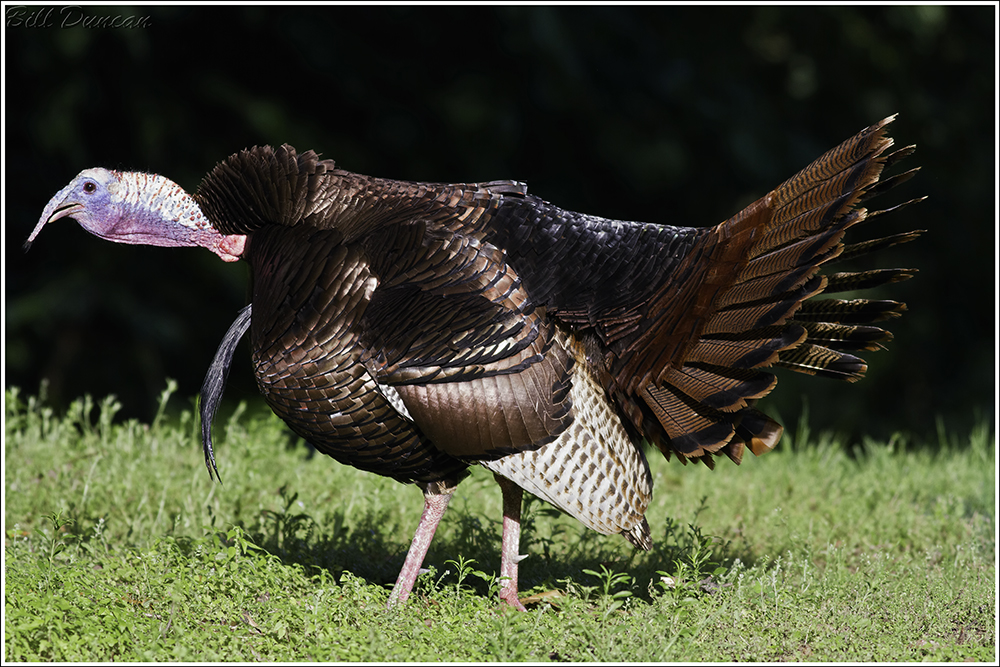
So, the president pardoned two turkeys today, named “Gobble” and “Gobble” apparently.  Who writes this stuff?  The country slaughters near 60 million birds and sparing these two is supposed to make it all okay?  Don’t get me wrong, next to chicken and salmon, turkey flesh is one of my favorite animal protein sources.  What I am suggesting is that the Wednesday before Thanksgiving should be designated as another national holiday in which everyone who plans on eating turkey on that special Thursday must find and hug one first.  Think about it.  The amount of calories spent in this endeavor should just about equal that which will be ingested by the glutton.  I’m not sure which of my favorite ideas for a new national holiday will catch on first, this one or my idea for a national “punch a weatherman in the face” day.  Happy Thanksgiving.

Anyway, did you know…?

-During the 1930’s the Wild Turkey population was estimated to be less than 30,000 birds.  Through hunting regulations and habitat management there are now between 5-10 million birds in this country.

“Wild Turkey!”

Technical details: Canon EOS 7D camera,  EF400mm f/5.6L USM lens, ISO 400,  f/5.6, 1/800 sec

Mondays Are For The Birds – Golden Crowned Kinglet

“”In short, they who have not attended particularly to this subject are but little aware to what an extent quadrupeds and birds are employed, especially in the fall, in collecting, and so disseminating and planting, the seeds of trees.”

-Henry David Thoreau-

“Golden-crowned Kinglet”

Technical details: Canon EOS 7D camera,  EF400mm f/5.6L USM lens, ISO 640,  f/5.6, 1/250 sec

Mondays Are For The Birds – Scarlet Tanager

I have a challenge for myself that I have not yet built up the courage to try.  I want to one day go into a wooded lot and only feed on insects or other invertebrates I find in the trees, shrubs and forest floor.  Have you ever watched an insect-eating song bird closely as the scavenge about for bugs?  It is truly amazing how often they are able to find and capture prey items.  Often they seem to pick them out nowhere, gulp them down and continue on the hunt.  The photo below pictures a southern-bound, female Scarlet Tanager as it eats a larvae of some kind that it just pulled from inside a small branch.

“Autumn Scarlet Tanager”

Technical details: Canon EOS 7D camera,  EF400mm f/5.6L USM lens, ISO 800,  f/5.6, 1/320 sec

Mondays Are For The Birds – Red-Eyed Vireo

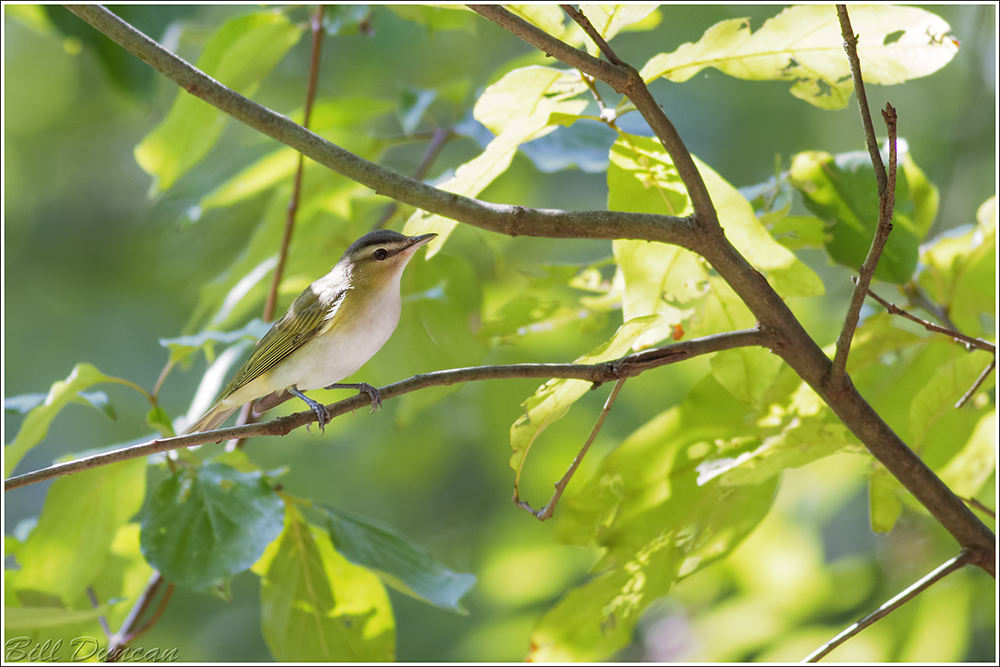
Hello again.  Today I am starting a new blog series that I am calling “Mondays Are For The Birds” and today’s first spotlight bird is this Red-eyed Vireo.  For anyone fool-hardy enough to do some summer hiking in the deciduous woodlands and forests of the Missouri Ozarks, the Red-eyed Vireo shouldn’t be new to you.  When almost all other songbirds have given up claims to their nesting grounds and quit vocalizing for the season, the REVI is just warming up.  In the middle of a sweltering summer’s day one will still hear the questions this guy’s song seems to ask. “Who are you, who am I, Here I am, Look at me, In this tree!”

This photo was taken recently during the fall migration.  This species along with other vireos and warblers will eat primarily caterpillars and other arthropods during spring migration and throughout the summer breeding season, but in fall will switch to a diet primarily consisting of berries, such as those found on the wild grape.

Thanks for visiting today.  I hope you like the photo and I hope you had the best possible Monday.

“Red-Eyed Vireo”

Technical details: Canon EOS 7D camera,  EF400mm f/5.6L USM lens, ISO 800,  f/5.6, 1/250 sec

King’s Realm

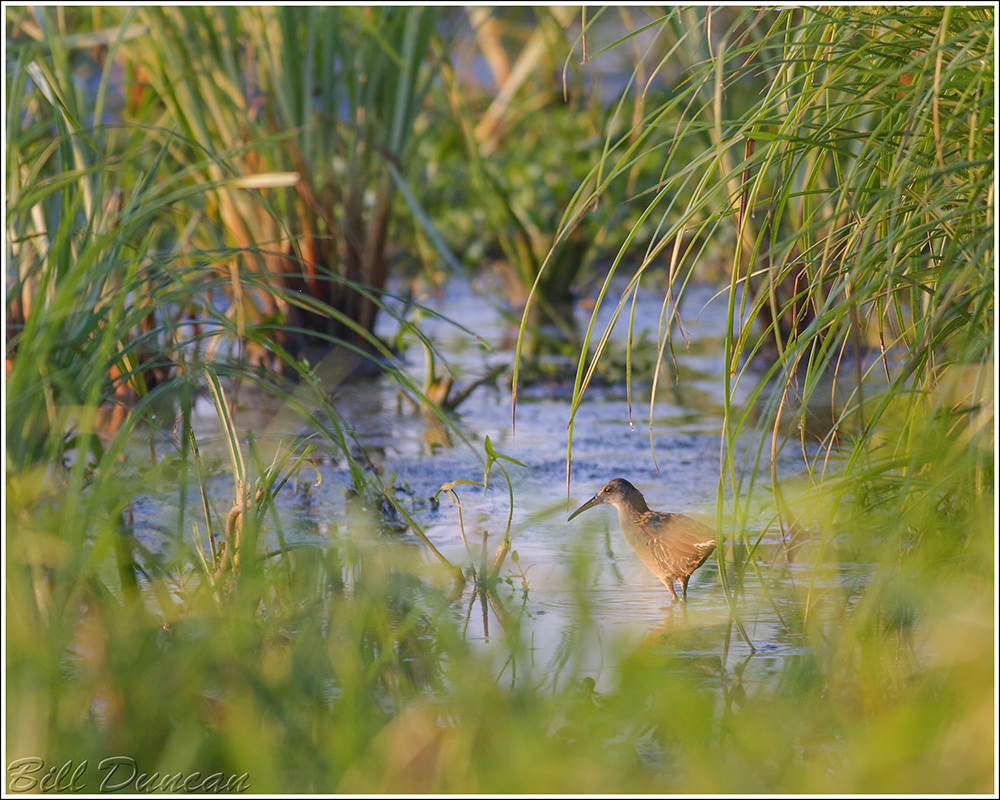
In the field, the brief views I was fortunate enough to get suggested to me this was a Virginia Rail.  The Virginia is only about half the size of the King and this obvious difference should usually make the identification quite easy.  Unfortunately my brief, distant and mostly obscured view of this bird did not allow me to get a good estimate on the bird’s size.  Once back home with the photo and field guides open I began to doubt my original ID call.  I listed as many reasons to feel KIRA as VIRA.  I quickly realized I needed help and rushed the photo and my thoughts to the three wise men of the birding community I knew would love the challenge.  The single photo was less than the smoking gun I was hoping it was.  All three agreed it was most-likely a King Rail, but there is still room for doubt.  Although a photo of a Virginia Rail would have added a new species to my bird-photo-life-list it always makes me happy to find and watch a bird of conservation concern, as is the King.

You can see in this “bird in habitat” photo just the sort of habitat that rails and other waders need.  Rails love to be in water about up to their knees with plenty of vegetation to use for cover.  Most shorebirds like the mud, while larger waterfowl, obviously like a little more water.  Heron Pond at RMBS is being managed to provide the habitat these groups of birds need.  Check out a few images of young KIRA I took a while ago.

“King Rail”

Technical details: Canon EOS 7D camera,  EF400mm f/5.6L USM lens, ISO 640,  f/5.6, 1/400 sec

As Noisy as a Mouse

More often heard than seen, this quite secretive wren rarely is found more than a few feet off the ground.  Like a mouse, these guys spend a great deal of time low in the tall grasses and sedge of wet meadows/prairies.  In July and August taking a walk in this type of habitat within their range will certainly guarantee you will hear their consistent staccato vocalizations as they work to define their small territories and keep rival males at bay.  Trying to lay the glass on these birds is much more difficult.  These guys rarely will respond to pishing, and if driven out of their particular patch of grass they will simply skirt above the grasses for a second or two before dropping back into the bush, yielding partial, unsatisfying glimpses at best.  To get this shot, I admit, I used a vocalization playback.  I played just a few bars and waited.  This guy was not happy with that!  He raced out of his hiding whole and began singing forcefully in attempt to send the potential usurper out of his territory.  I was happy with the few quick bursts of the shutter I was able to get and that was that.  He may have been a bit stressed, but I bet the burst of testosterone he received from successfully defending his kingdom more than made up for it.

“Sedge Wren”

Technical details: Canon EOS 7D camera,  EF400mm f/5.6L USM lens, ISO 400,  f/5.6, 1/1250 sec

Kid ‘n Play

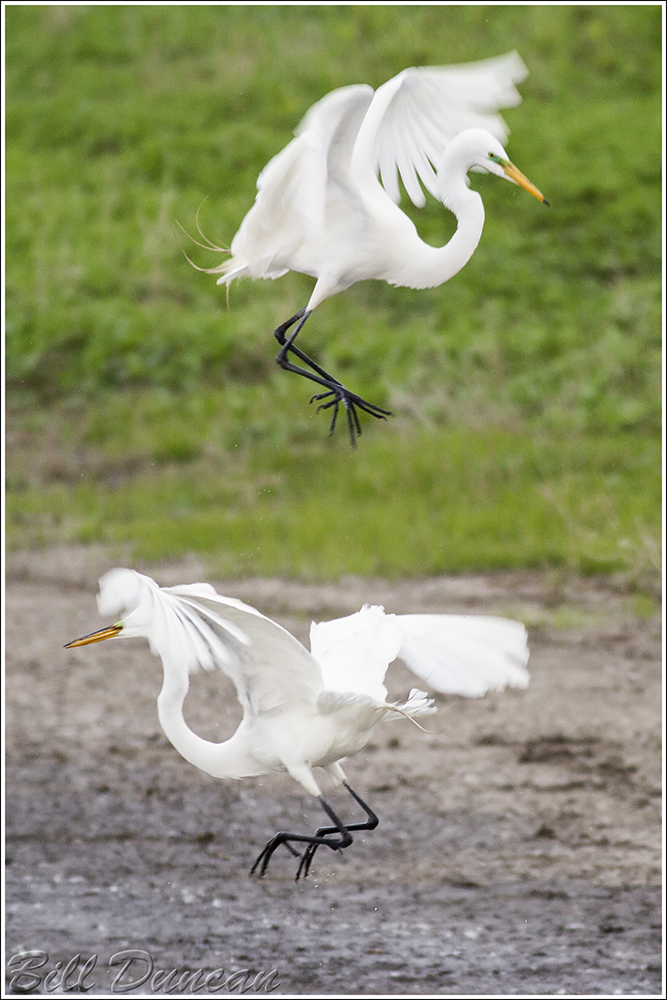
This image is from a series I took early this summer at Colombia Bottom Conservation Area.  These two dancing birds were among a large group of Great Egrets competing for standing room only space in a shrinking pool that was loaded with fish.  These moves reminded me of the dancing and rhyming styles of that old hip hop dynamic duo of my youth, Kid ‘n Play.  If I ever get around to processing all the keepers from this series, you will definitely not want to miss the shot I took of the bird I was able to get to wear a “Kid wig”.  😉

Ain’t Gonna Hurt Nobody… We Just Dancin’ Ya’ll!

“Kid ‘n Play”

Technical details: Canon EOS 7D camera,  EF400mm f/5.6L USM lens, ISO 640,  f/5.6, 1/400 sec

The Sandhill Crane

This stained adult Sandhill Crane is currently visiting some soy fields near St. Louis.

“Our ability to perceive quality in nature begins, as in art, with the pretty.  It expands through successive stages of the beautiful to values as yet uncaptured by language.  The quality of cranes lies, I think, in this higher gamut, as yet beyond the reach of words.”

-Aldo Leopold

“A Sand County Almanac And Sketches Here and There”

“Stained Adult Sandhill Crane”

Technical details: Canon EOS 7D camera,  EF400mm f/5.6L USM lens, ISO 400,  f/5.6, 1/500 sec

Summer at the Confluence

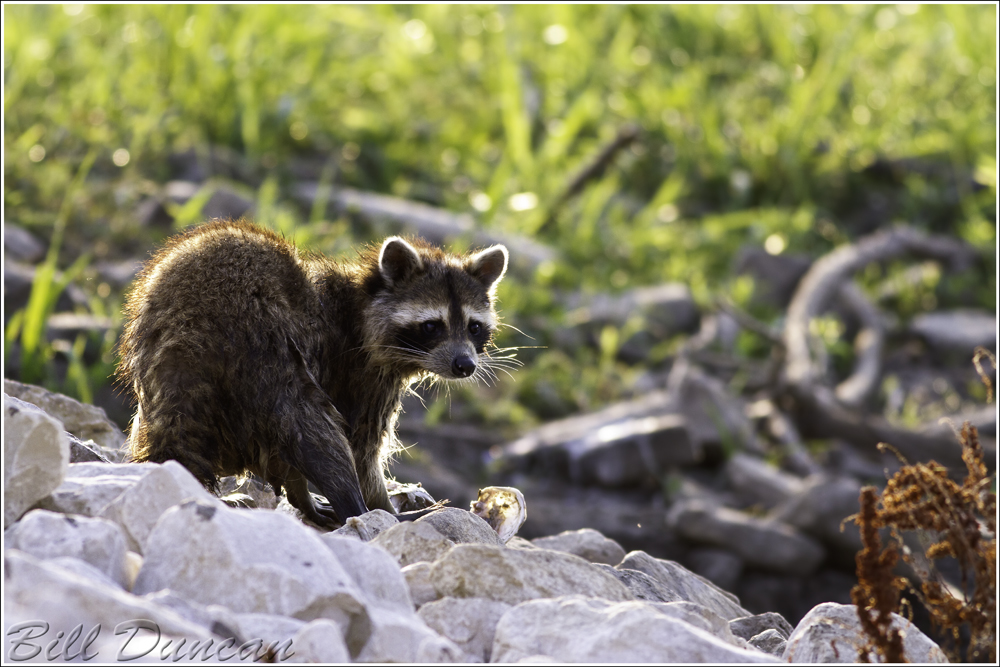
This weekend I spent both mornings at Riverlands Migratory Bird Sanctuary, arriving near dawn and walking around the trails for a few hours before the extreme heat of the day took over.  Sarah got up early and came with me this morning. Saturday morning I was fortunate to spot this guy feasting on carcases of fish that succumbed to the poorly oxygenated waters of the shrinking, heated pools of the wetlands.  This was my first opportunity at shooting a raccoon.  Even at such an early morning hour, the back-light serves to give a sense of the heat and humidity that were already noticeable.

Technical details: Canon EOS 7D camera,  EF400mm f/5.6L USM lens, ISO 640,  f/5.6, 1/400 sec

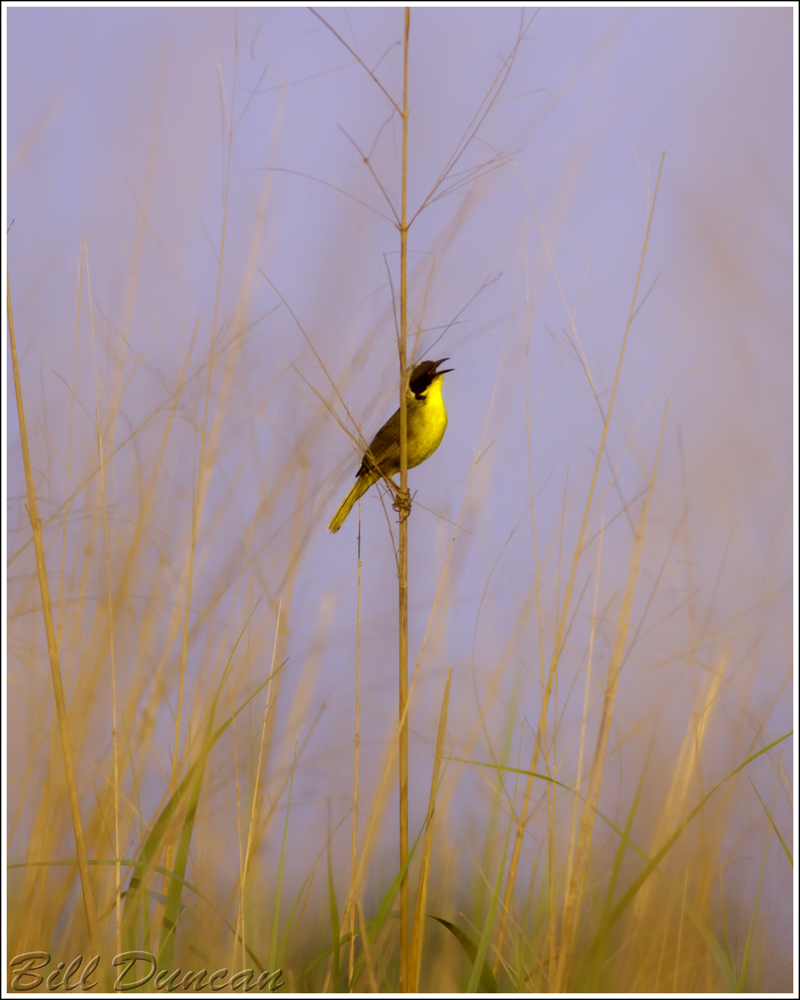
One of the photographic challenges of this location is trying to get shots of the song birds that live among the tall grasses.  They usually stay pretty far from the trails and are usually hidden low in the vegetation.  This Common Yellowthroat Warbler was close enough and partially obscured by the grasses.

Technical details: Canon EOS 7D camera,  EF400mm f/5.6L USM lens, ISO 640,  f/5.6, 1/1250 sec

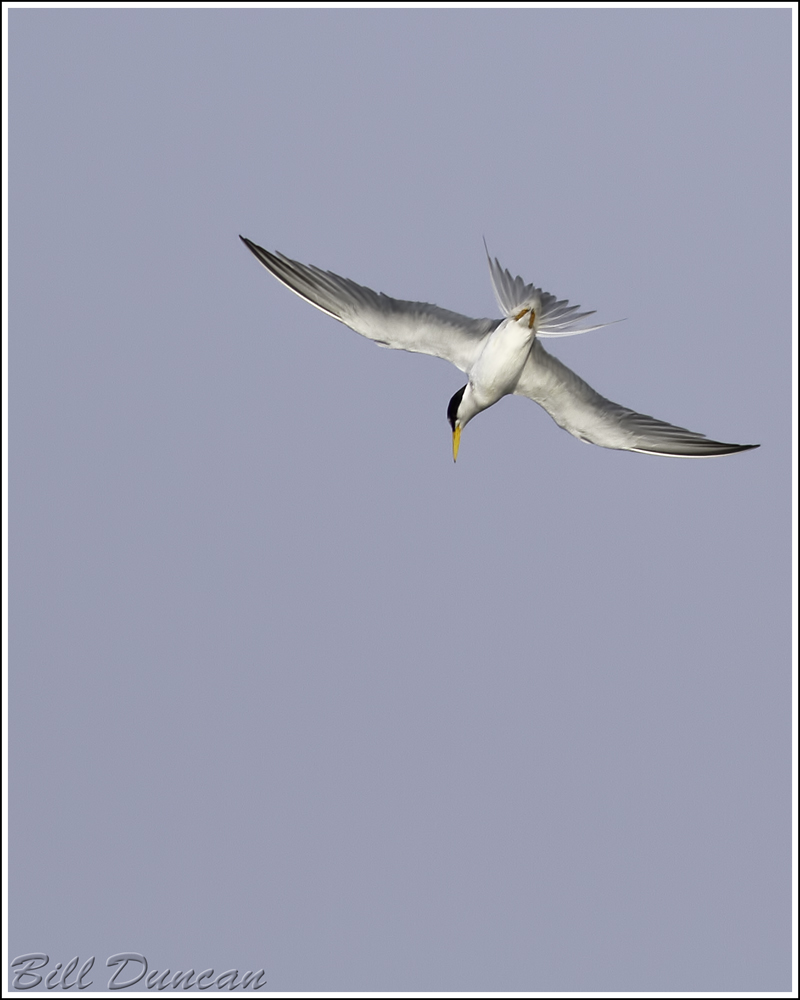
One of the pleasure one can get from a summertime visit to RMBS is watching the Least Tern.  I love watching these guys fish.  This one is beginning the plunge into the water off of Ellis Island to grab a little fish.

Technical details: Canon EOS 7D camera,  EF400mm f/5.6L USM lens, ISO 250,  f/5.6, 1/1600 sec

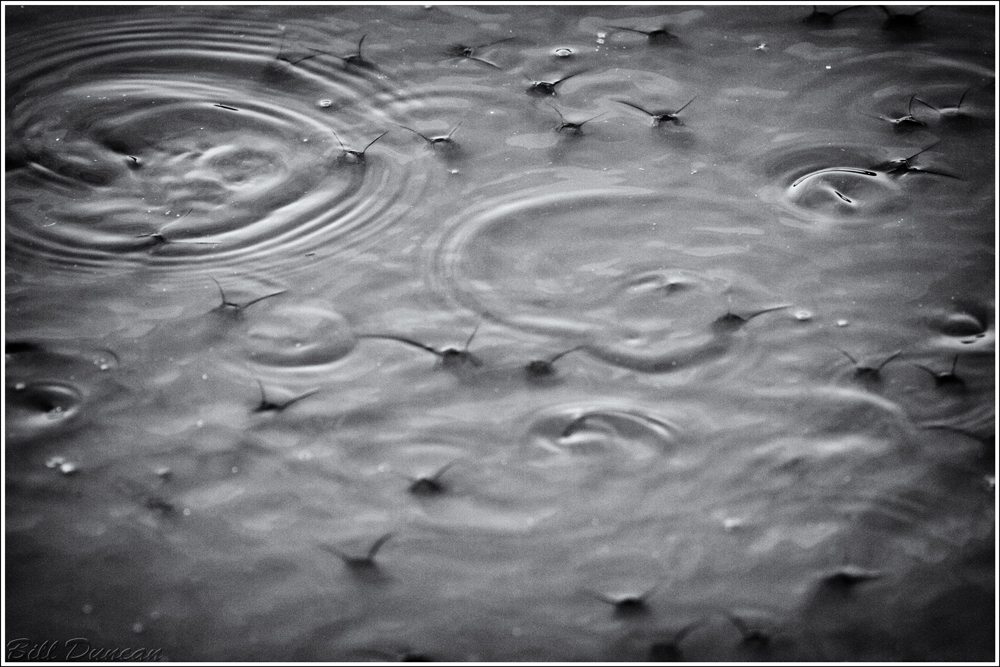
Kudos to Sarah, who took a closer look at these guys.  What looked like a bunch of tadpoles gulping at the surface of one of these rapidly vanishing pools was actually a nice-sized school of small catfish.  If rains do not come soon, these guys have no chance.

Technical details: Canon EOS 7D camera,  EF400mm f/5.6L USM lens, ISO 800,  f/5.6, 1/400 sec

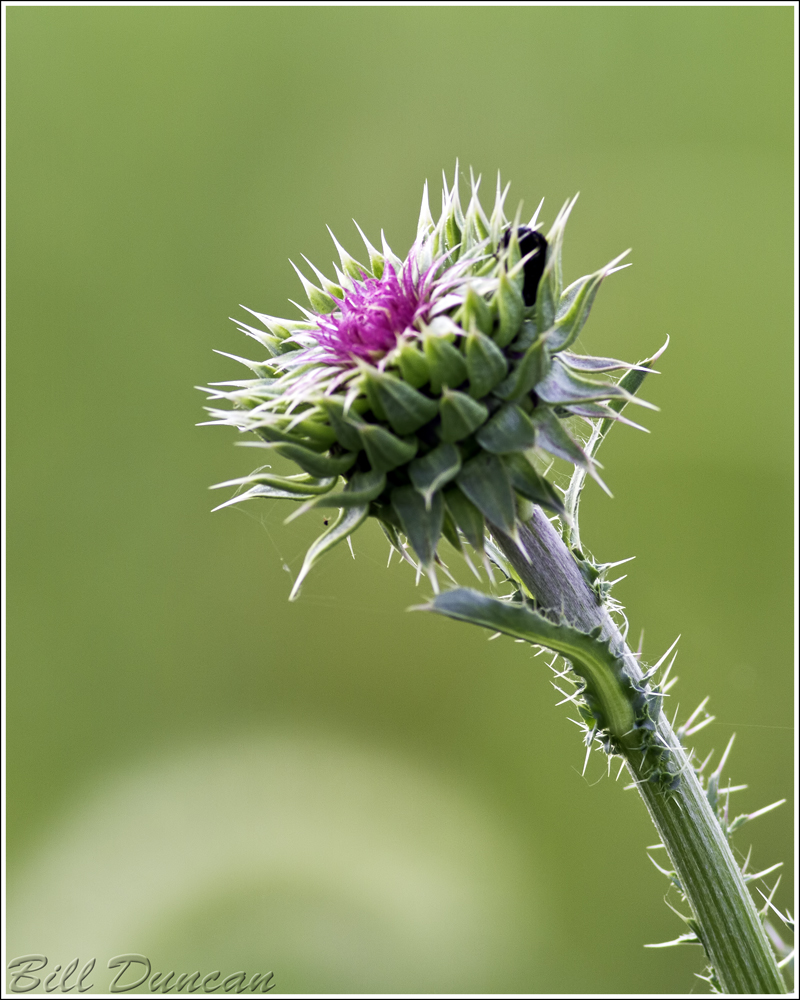
Sarah also spotted this thistle in early bloom and asked that I take its picture.  I haven’t done a lot of macro style shooting with the 400mm, but I know that using the super tele’s to do this can work magic.  The focus isn’t perfect, but I was actually fighting the minimum focus distance.  I need to try this with dragonflies and other large insects.

Technical details: Canon EOS 7D camera,  EF400mm f/5.6L USM lens, ISO 800,  f/5.6, 1/400 sec

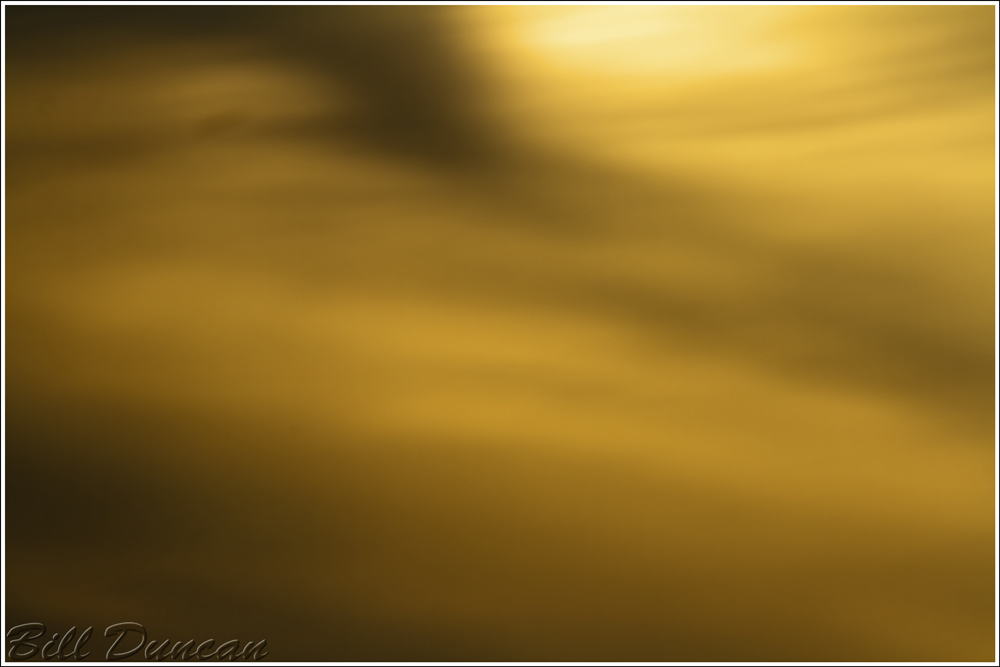
This morning there was actually a bit of cloud cover over the sun.  I decided to try a little panning blur and thought this was an apt image to go along with the record breaking heat we’ve been experiencing.  Stay cool everyone.  I am sure looking forward to all the time I’ll have to spend in the greenhouse this week.  ;=)

Technical details: Canon EOS 7D camera,  EF400mm f/5.6L USM lens, ISO 100,  f/14, 1/125 sec

Location Spotlight: Squaw Creek National Wildlife Refuge

“Traditional Boundaries”

Technical details: Canon EOS 7D camera,  EF400mm f/5.6L USM lens, ISO 400,  f/10, 1/1250 sec

I’m finally taking a few of the images I made during my first visit to Squaw Creek National Wildlife Refuge last autumn and putting them into a blog post.  Living within miles of the Mississippi River Flyway – an ancestral route many migratory birds follow in their north-south seasonal movements – I have all sorts of options in visiting well-managed wetland areas to watch and photograph waterfowl.  Of all these locations none has the opportunities for getting great looks at numbers and diversity of bird species that can be found at Squaw Creek NWR, located near Mound City in north-western Missouri, not too far from the Nebraska Border.
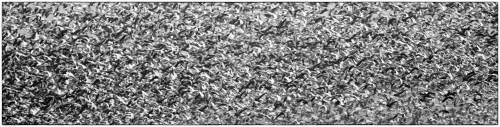
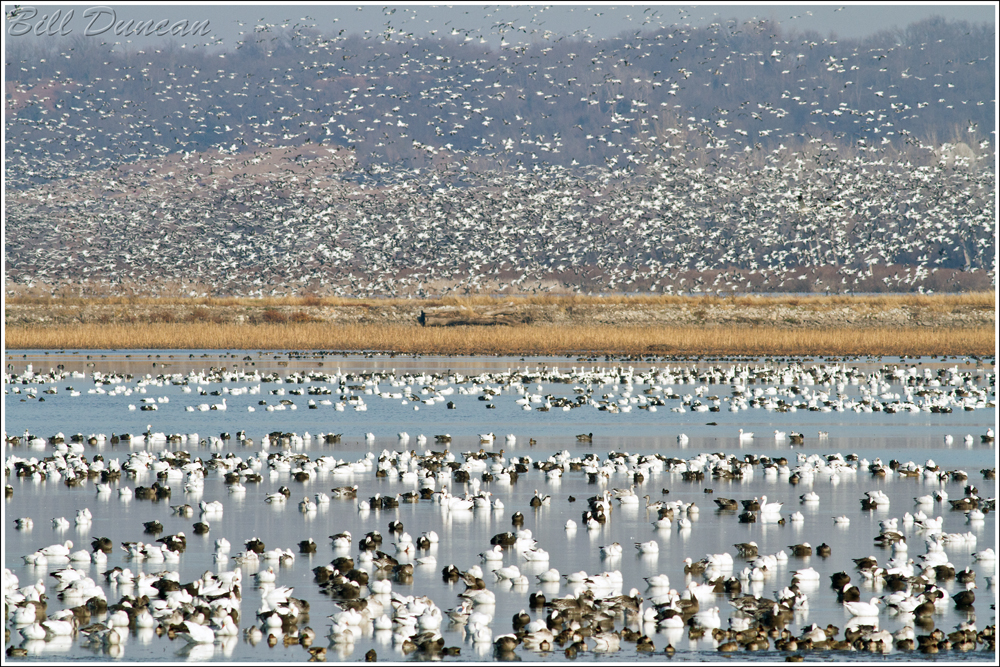
“Cacophonic”

Technical details: Canon EOS 7D camera,  EF400mm f/5.6L USM lens, ISO 1600,  f/5.6, 1/125 sec

The big stars at Squaw Creek around Thanksgiving and surrounding weeks are the Snow Geese.  For years I had read about and seen images of the more than one million birds that pass through this location every fall.  At peak times more than 500,000 birds can be counted on the reserve at one time.  I had images in mind that I hoped to make if I could find the birds present in these kinds of numbers.  I really had little clue of where and when I needed to be set up and if I had the ammunition (lenses) to make the images I had in mind.  I feel the photos I was able to get are of mixed success due to several reasons.  I was quite lucky in the numbers of birds that showed up.  A week before my visit the counts were only a little more than 10,000.  The day I arrived the latest weekly count suggested there were more than 250,000 on the reserve.  This is shy of the 500-600K that can be found during peek times, but for my first visit, it was quite a treat!  Of the 1.5 days I had to spend here, one full day was very cloudy and dark, making bird photography particularly troublesome.  Around noon on my last day the sky cleared and I was able to get some nice light.  Hopefully I can spend a few days more during my next visit.
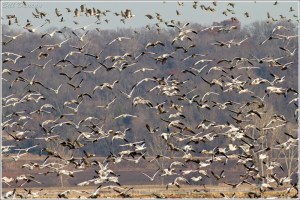
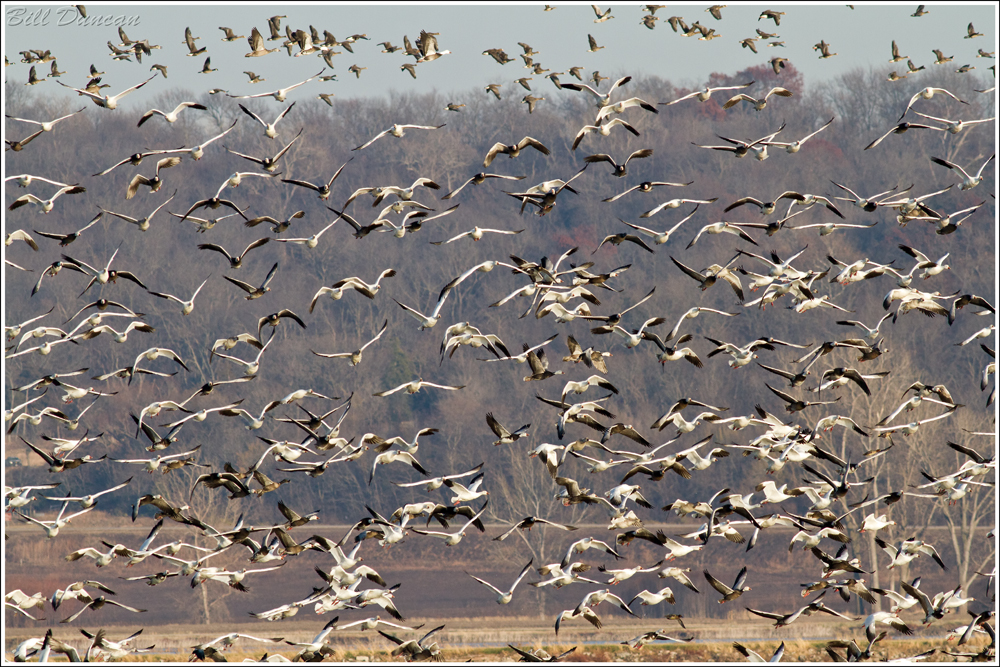
“Let My Army Be The Rocks And The Trees And The Birds In The Sky”

Technical details: Canon EOS 7D camera,  EF400mm f/5.6L USM lens, ISO 400,  f/8,  1/1250 sec

Snow Geese are not the only waterfowl that can be found in good numbers here.  In almost every one of these types of images Greater White-fronted Geese, Green-winged Teal, Northern Pintail, Mallards and more can be found as well.
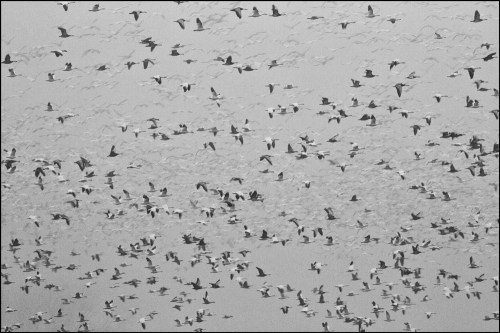
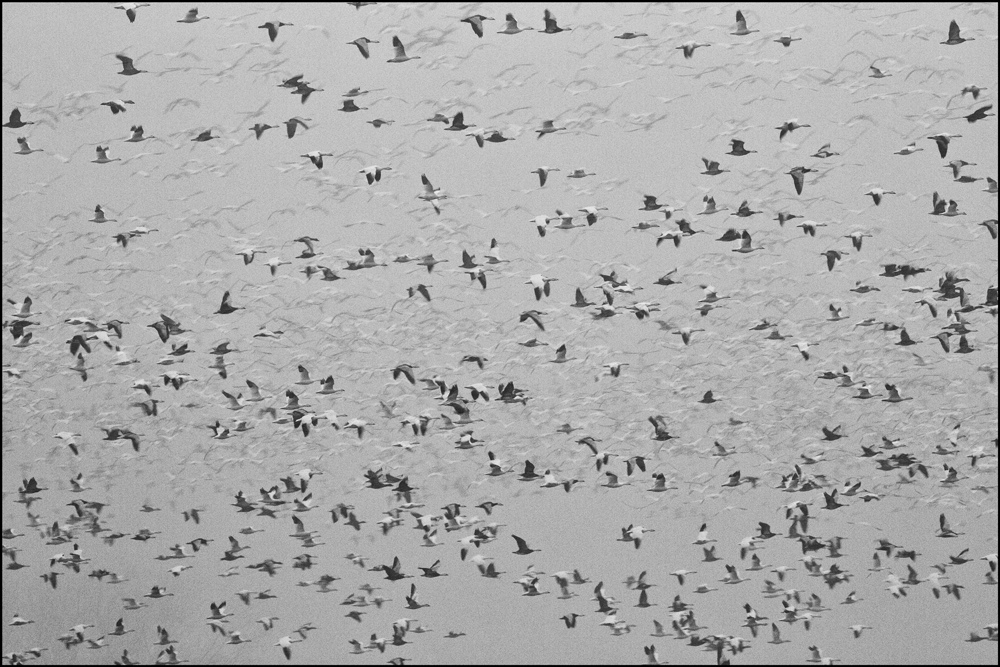
“The Snow & the Mist”

Technical details: Canon EOS 7D camera,  EF400mm f/5.6L USM lens, ISO 1600,  f/8,  1/100 sec

Squaw Creek NWR and its 7500 acres was established in 1935 just in time.  Close to 98% of the original marshes and related wetlands that border the Missouri River in the state of Missouri have been destroyed or permanently altered – mostly for use as farmland.  Thankfully sportsmen realized the importance for providing habitat for migrating and over-wintering waterfowl and a series of these man-made marshes were built near Kansas City, Columbia and St. Louis.  This image is actually a composite of two separate photographs – the foreground and the background, both taken in extremely cloudy and grey conditions.  I was surprised by how well this blending worked and I feel it represents what it was like on this first day, the geese constantly taking off in large groups and others taking their place in the marshes.

“Squaw Creek Eagle”

Technical details: Canon EOS 7D camera,  EF400mm f/5.6L USM lens, ISO 800,  f/5.6,  1/400 sec

Waterfowl are not the only birds or wildlife that utilize the reserve.  Although you can see more Bald Eagles in spots along the Mississippi River, I have never been able to get as close to these birds perched as I did during this visit.  This is true with the wildlife in general.  The auto-route roads were set perfectly in the reserve, in my opinion.  Getting close enough to the wildlife can be troublesome from the roads at other places I visit, but here the roads are much better situated near the pools and the wildlife never seem to be overly stressed.  During the time of my visit with cloudy weather and poor light, I was able to get closer to several duck species than I have ever been able to before.

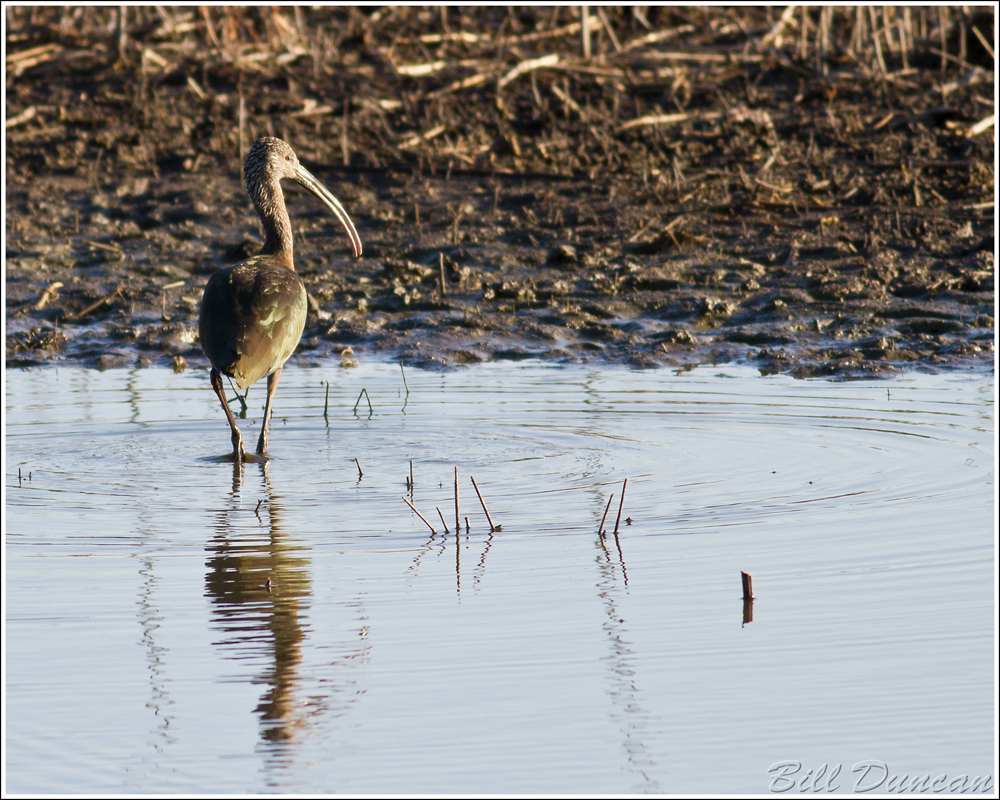
“White Ibis”

Technical details: Canon EOS 7D camera,  EF400mm f/5.6L USM lens, ISO 400,  f/5.6,  1/640 sec

This White Ibis was actually a very late bird for this part of Missouri and it made a bit of noise in the MO birding community.  This was also one of my best looks at this species.  I had found it the day before and took some rather poor photos.  I was happy to see it still in the same pool the next day when light was better.

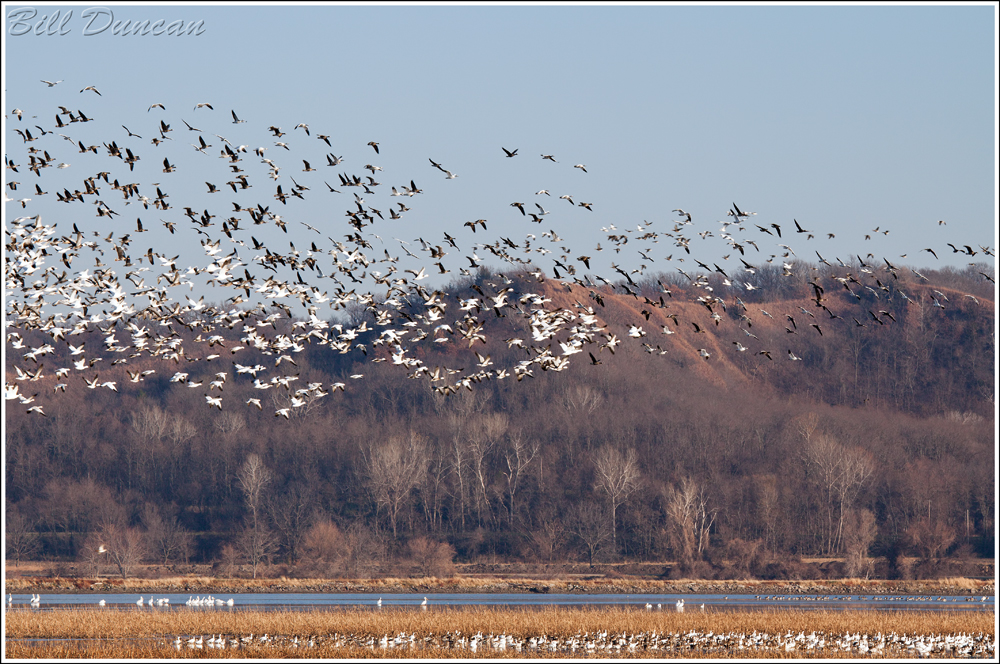
“Snow Geese on Loess”

Technical details: Canon EOS 50D camera, EF70-200mm f/4L IS USM lens @ 150mm, ISO 100,  f/10,  1/200 sec

This image is probably my favorite from this trip.  To me, it really captures the essence of the place and I believe this is what this area looked like when Lewis and Clark first laid eyes to this part of the country.  The bluffs in the background are known as loess hills and are formed by the actions of glaciers.  Along with draining the natural wetland habitats along the Big Muddy, European settlers also got busy destroying many of the impressive loess hills, using the fertile soil for numerous development and farming projects.  Many of these features are still being harvested and destroyed to this day.

There are several more nationally well-known reserves like this throughout the country that scores of photographers, nature lovers, biologists and sportsmen flock to every year.  I can’t imagine a spot being more suited for these activities than Squaw Creek NWR.  I hope to make an annual pilgrimage to this location on Thanksgiving week.

If you make the visit and are looking for a nice place to eat, I highly recommend “Klub”.  This is a great place to enjoy a late dinner after spending the day at the reserve, which is only about ten minutes away.  They have a great menu using a lot of fresh, local ingredients.  I ate here twice during my visit and I was quite surprised to find such a quality establishment in such a little town like Mound City.

Thanks for paying a visit.  You can find more photographs taken from this location by visiting my Squaw Creek Flickr Set