I had been wishing to visit Dunn Ranch Prairie in Harrison County, Missouri for a few years. Part of the Grand River Grasslands, Dunn Ranch, along with Prairie State Park to the south is one of the two largest contiguous prairie habitats in Missouri. Fortunately, Dunn is home to about 1000 acres of original, unplowed prairie alongside parcels that are in various stages of prairie reclamation via reconstruction activities by The Nature Conservancy staff. With help from contacts at TNC (Hi and thanks Amy, Hillary and Randy!) and a recently found twin brother, Steve, who is as willing, able and interested in getting elbows deep in whatever Nature and the outdoors puts in our path, I had that opportunity as part of a five day excursion to the western half of the State. We made stops to visit other prairie and marsh remnants nearby, but Dunn Ranch and adjacent Pawnee Prairie were our base. I hope to provide tidbits of information about these endangered habitats and discuss some of the trials that TNC faces in these reclamation efforts and provide hopefully interesting accounts of Steve’s and my excursion in future posts where I plan to discuss birds/wildlife and landscape photography. This first post is dedicated to astrophotography.
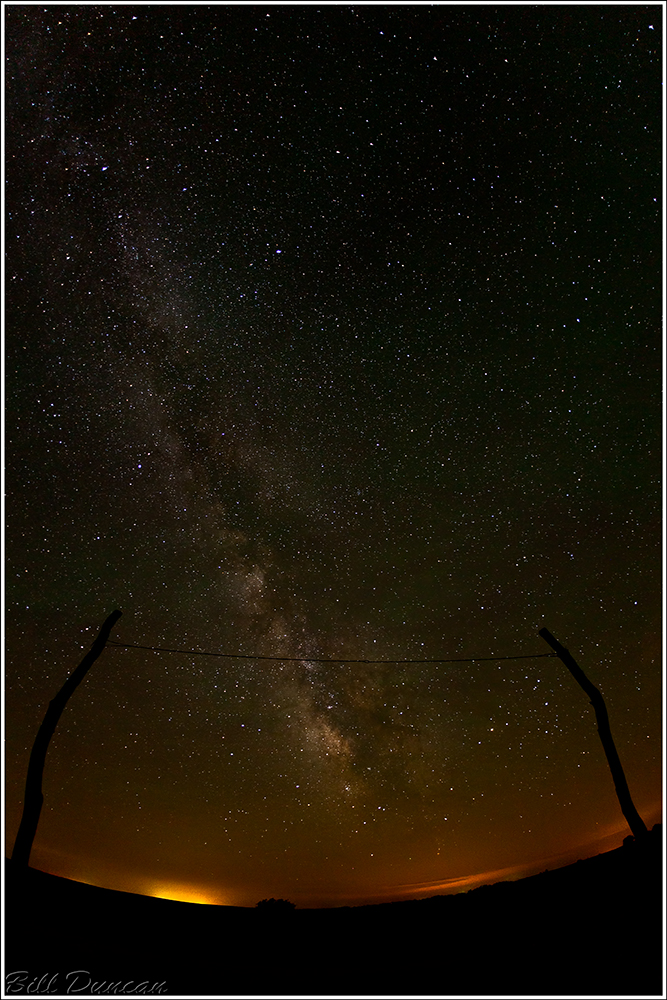
Astrophotography has been of interest to me for some time now. Being born and raised in urban environments, I can count on one hand how many times I’ve been able to witness a dark, clear sky – relatively free from light pollution. Making images of this type of sky was one of the major goals for this trip. Even without the aid of telescopes and tracking mounts, astrophotography with the dSLR can be a fulfilling challenge. I scoured the web for months prior to the trip, trying to find techniques and tips for success. With so much to consider, I knew this was going to be a mostly trial and error experience.
The internet is full of great “how-to” articles on how to go about making nice astrophotographs, so I will not go into too much detail. We were fortunate in a number of ways concerning the environmental conditions for this endeavor. First, obviously, one needs clear skies. The first couple of days (and nights) were a bit overcast, but on the night all these images were taken, we had a mostly clear sky. Second, for taking photos of stars, it is optimal to have little or no moon. On this particular night, the moon was just a couple days past “new”. But, that did not matter because the moon was almost in perfect sync with the rising and setting of the sun. On this night, the fingernail moon was below the horizon by 10:00. So, we had two important factors in our favor. Other issues to consider are light pollution from ground sources. We thought we were on the winning side here, being so far removed from any city of significant size. What we came to discover is how much the camera’s sensor will pick up artificial light sources. Even well past midnight, all the images I made show glow from the horizon, illumination that was not noticeable by the human eye.
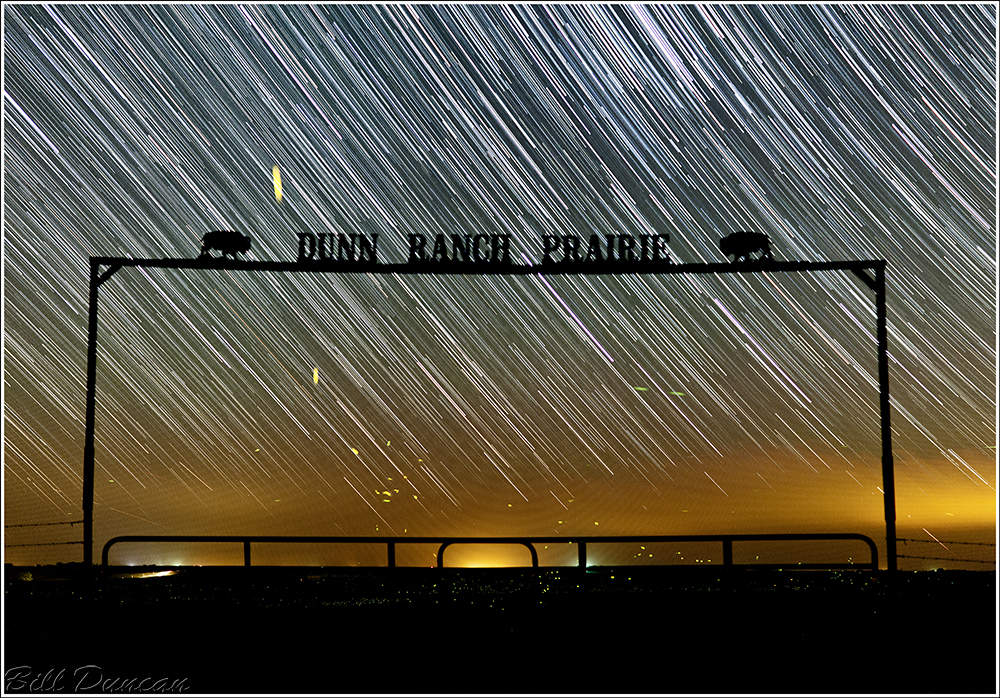
One other potential headache for consideration is aircraft and satellites moving through your frame. Depending on the specific technique you use to create a star-trail image like the one above, you will either have one long exposure of up to an hour or longer, or a series of shorter images taken in continuous fashion and combined later in the computer. Either way, in most areas of our country you will pick up the light signatures of these aircraft in your images. I was quite surprised by the numbers of these trails that were picked up on the camera’s sensor. In making the two composite-made star-trail images in this post I spent several hours painstakingly removing these by hand from hundreds of individual images used to generate these composites. The yellowish green lights are trails from lighting bugs that collected over these images. I decided to leave these alone.
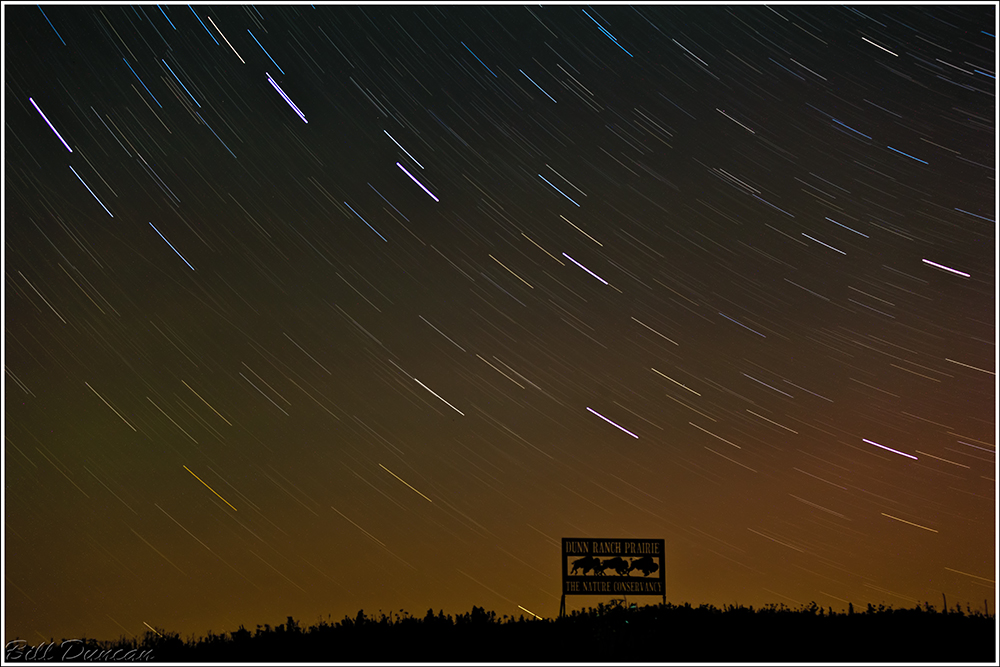
Although it may be pretty, a photograph of the stars alone with normal focal lengths usually holds little lasting interest. I knew that to make something interesting and to relate it to place, I needed to find something unique and attractive to position in the foreground. This would make a complete image.
The couple of days or so before this evening, I was checking out the landscape around Dunn, looking for these potential foregrounds and asking Steve to help me remember their locations and the general directions in which they faced. These cut-steel/iron signs were quite popular with the different ranches in the area and I assume someone makes them locally. I fell in love with this one on a prairie hillside at Dunn and knew I had to try this. Unfortunately, this was getting quite late into the morning and I did not have the energy left to give it my all. I used a longer focal length because of the distance of the sign from the road. This gives a somewhat pleasant side effect of allowing for star trails to record in less time than it takes for a wide angle composition. This image is one exposure of about 11 minutes. If I had known the potential here, I would have given it more thought and probably put together a longer composite series to lessen the horrible noise and IQ observed in the RAW image. Oh well, maybe next time. Oh yeah, in this photo, the light pollution from the horizon works pretty well in back-lighting the sign and making some nice silhouettes of the prairie forbs. We tried a bit of light painting, but it came nowhere close to this.
P.S. Can you name the constellation caught in this image above?
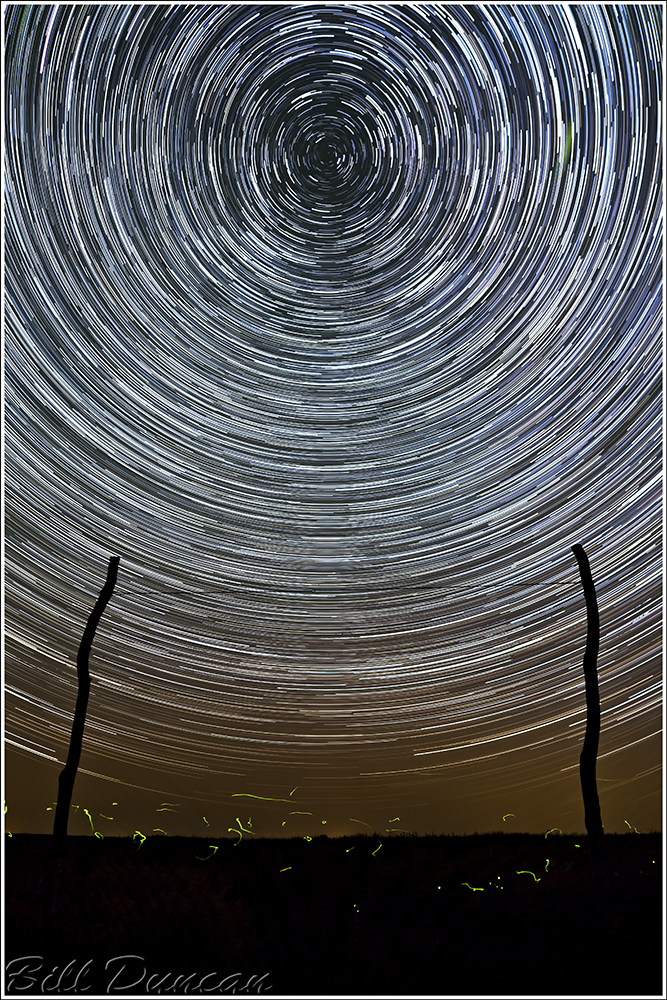
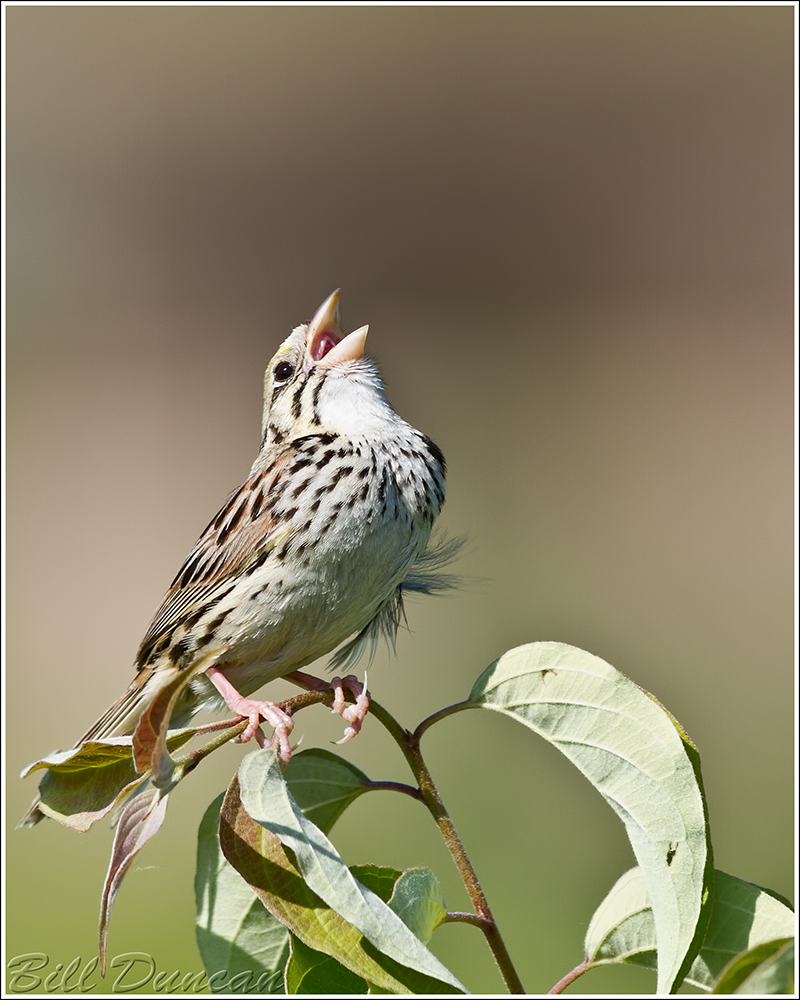
The image above I believe is my favorite of my astrophotography attempts. I wish I could say I did my homework and knew exactly where the north star was and positioned it oh so perfectly between the gate posts. Steve and I could not say for certain (Do you know how many stars there are up there!?). All I did was try my best to center the gates in the middle of the frame as best we could in this dark night. I wish I could say I knew exactly how long (how many exposures) I wanted/needed to get the rotating perspective seen here. All I did was decide that I would try and fill an entire eight gig memory card. This equated to about 350 13-second exposures for a total “exposure time” of about 75 minutes. I did not even know how I was going to stack these together in the computer. I knew there were a few specialty software as well as a manual option in PS. I tried three different freeware apps and discovered the last one I tried, “Startrails” gave me the best results. Anyway, this image will always remind me of sitting in the road with the camera doing its work, enjoying a couple of good beers with Steve and listening to wildlife: coyotes howling on three sides of us in the distance, Henslows Sparrows singing like it was the middle of the day and a presumable deer that walked just off the road past us less than 10 feet away. I have no idea if the deer could see us or knew that we were there.
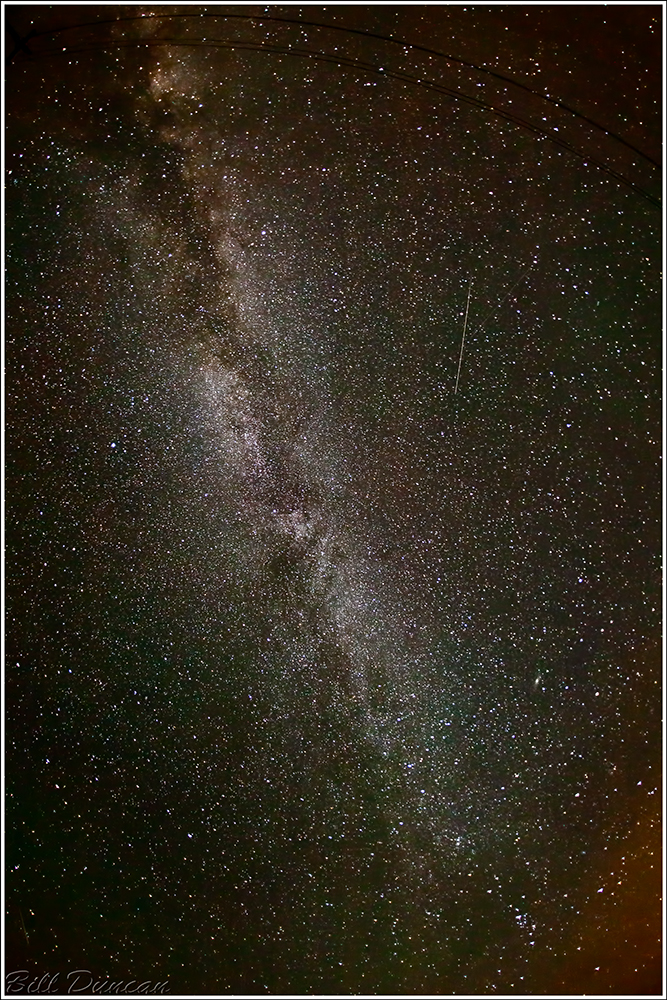
I say with all sincerity that I would trade the benefits of living in a large metropolitan area just to have the privilege of viewing night skies like this on a regular basis. How did we agree to give this up? I guess this issue ranks up there with the question of my foreskin. Nobody ever asked me and I’ll likely never have the opportunity to get it back. ;=)
Anyway, this was one hell of an experience and I can’t wait to give it another try.