"What a thousand acres of Silphiums looked like when they tickled the bellies of the buffalo is a question never again to be answered, and perhaps not even asked." -Aldo Leopold
Piping Plover – Captive bird held at the Lincoln Park Zoo
A few of us headed up to Montrose Harbor on the north side of Chicago yesterday in search of a rare and late shorebird visitor. There has been a Piping Plover that has intermittently been using the beaches here since October. We visited following approximately four straight days that the bird was sighted and the weather forecast was great for this time of year. Unfortunately, the bird was a no-show for us on this day. Since the Lincoln Park Zoo was almost directly across the street, we checked to see if they had a Piping Plover in their collection. This is the female bird in winter plumage pictured above.
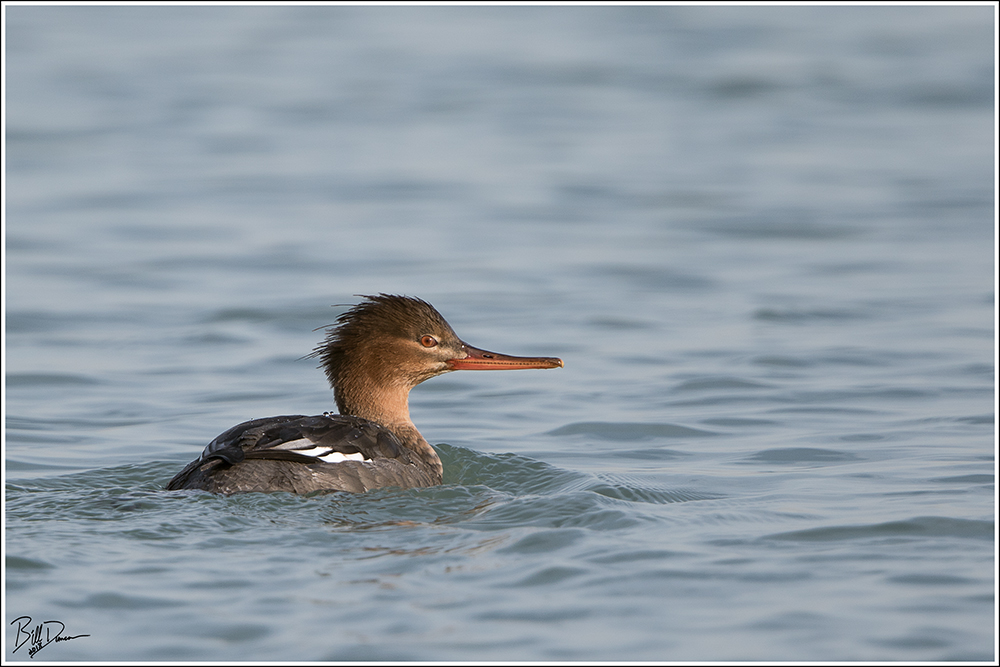
The harbor held a decent number of waterfowl that we were able to get close enough for some shots. See below.
Seven of us made the long drive to our destination on the morning of the 23rd . The week of
Thanksgiving can be an excellent choice for visiting Loess Bluff NWR, but always depends on the
weather. We were a bit concerned with the early cold snap our region experienced this autumn.
However, in the week or so preceding the trip, the weather warmed so we were not hampered by ice
that can completely cover the shallow waters of the wetlands. Having open water affords very close
views of our photographic subjects and the primary reason we drove such a distance – the blizzard.
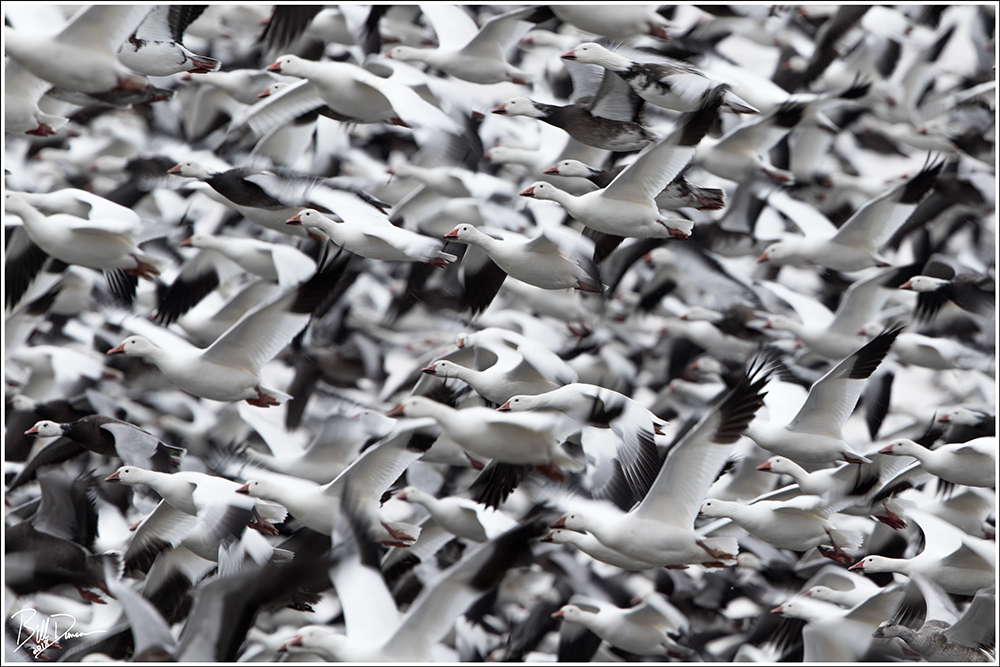
The blizzard
Typically, one million to two million Snow Geese will make this location a stop over during spring
and autumn migration and numbers of over 500,000 birds on a single count are not uncommon.
During our visit, the official counts were slightly over 100,000 birds, but the feeling with the group
was that this was grossly underestimated.
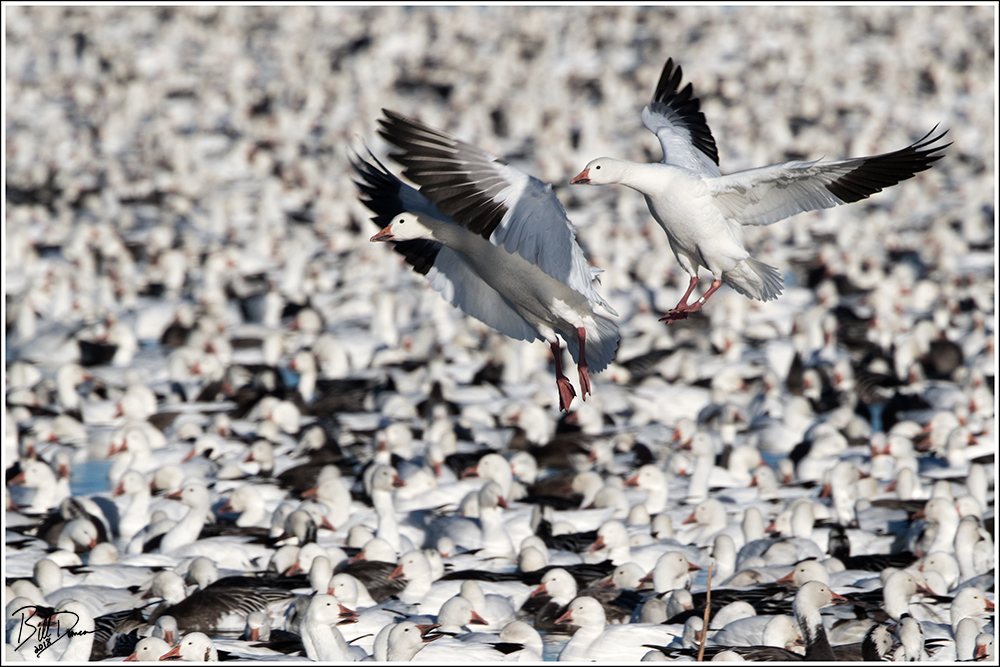
Rising snow
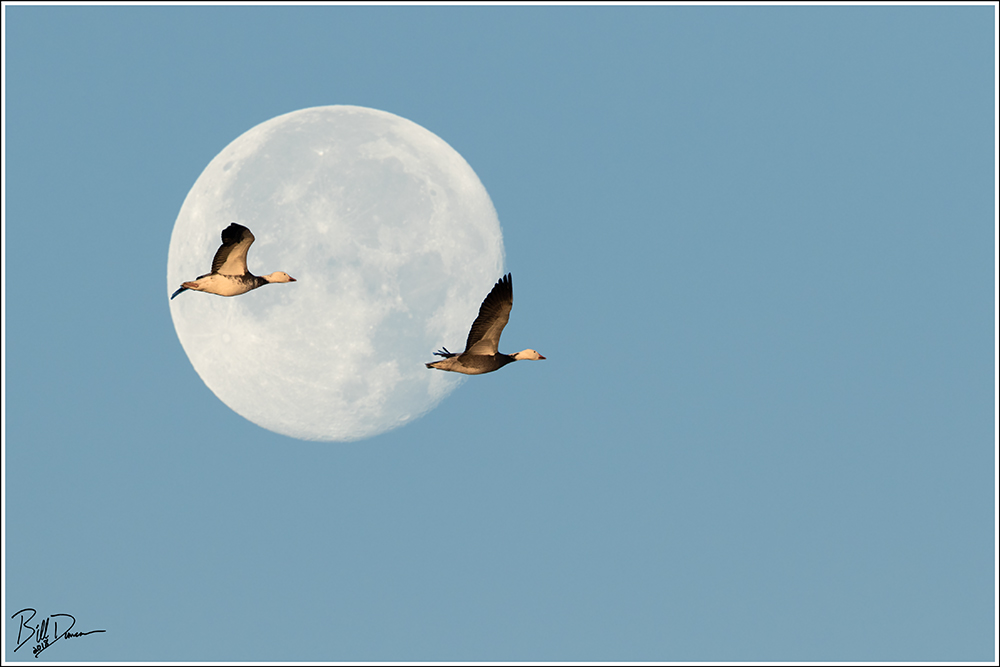
If conditions allow, getting the moon behind the Snow Geese can make a nice composition.
Rising snow against setting moon
Lunar Liberty
On our first day of the trip we were faced with mostly cloudy weather. As I told the group, this provides an opportunity to more easily try panning motion shots like the one pictured below. This is not my most successful attempt at such an image, but I wanted to share it here to demonstrate the multitude of opportunities for a diversity of photos to be made.
Panning with the action
Snow Geese are not the only subjects that make this trip worthwhile. The refuge also provides
important habitat for birds such as Bald Eagles, sparrows, a variety of ducks and wading birds, as
well as mammals like white-tailed deer and muskrats. On our initial entry to the park, Dave and Bill
found a Merlin on a relatively good perch above the road. We spent some time photographing the
bird, but regretted that the rest off our party were on the other side of the refuge and would not
likely be able to get the looks we did. Fortunately, a Merlin – likely the same bird, was spotted on
our second day and was viewable by all.
Merlin
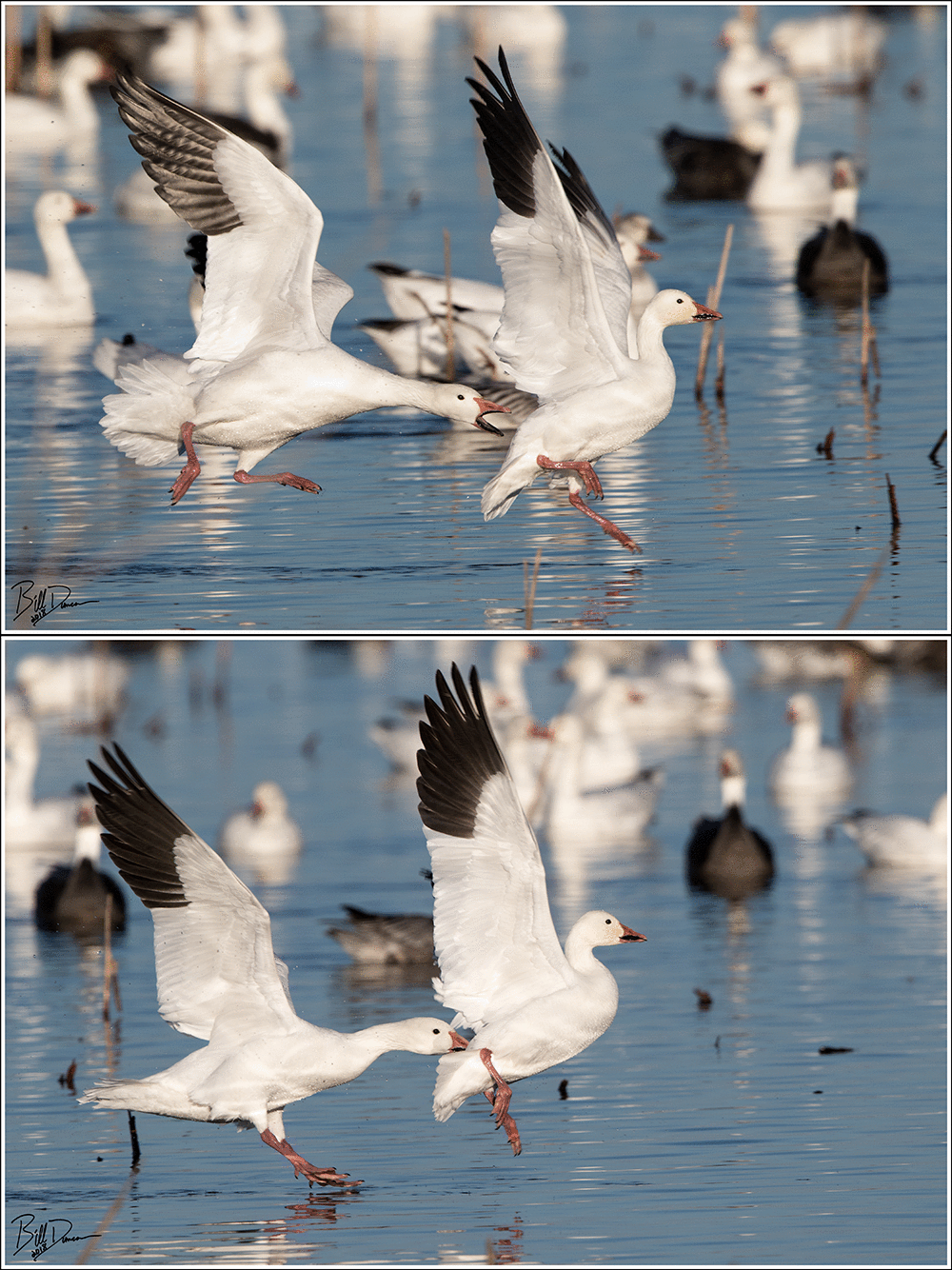
With subjects in the hundreds of thousands to the millions, making a purposeful image can be challenging. It is quite natural to want to shoot at everything that moves, but try and focus. Finding smaller action scenes is one way the photographer can focus on the individuals and their stories that make up the grander scheme.
Goosing a goose
Although we experienced skies with periods of heavy overcast, we were presented with fantastic
sunsets on both days. Being able to make the birds part of the story made these images all the more special.
Sun setting on snowy waters
A beautiful end
The WGNSS Photo Group is committed to an overnight trip to this and similar locations within the Midwest on Thanksgiving week. If you’d like to join us next year, please let me know!
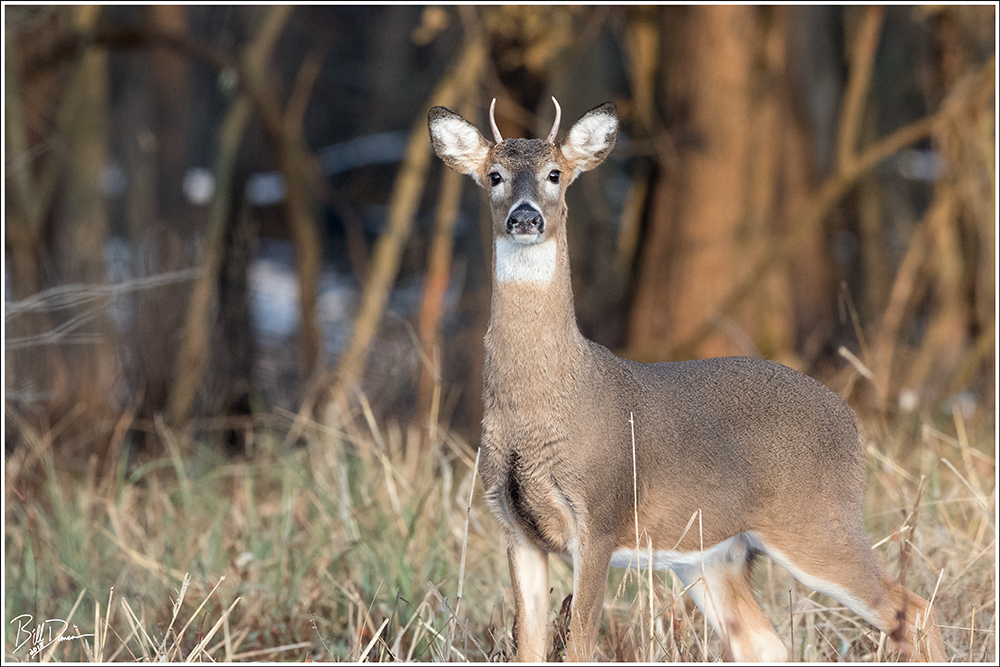
Until this autumn, I never considered targeting our abundant white-tailed deer as a photo subject. When my friend, Miguel, brought up the idea along with a place with a lot of potential, I asked him to lead the way. We set up in a copse of trees located near the center of a scrub field in an area that does not allow hunting and Miguel’s predictions of worry-free males still on the hunt came to fruition.
Buck and Foxtail
Although I cam ill-prepared, leaving my tripod and any other means of support at home, the light was just sweet enough to allow for proper hand-holding the big 500mm. Once I took off the unnecessary teleconverter, it worked even better.
Spike
We counted at least two larger bucks that patrolled the area, but found this young spike buck as well. He was not quite as confident as the other two.
Doe
Females walked the area as well, but were more skittish. The bucks were more curious when they first heard the sounds of our shutters slapping and picked up our sent in the light morning breeze. The does, however, tended to trot away at first sign that something different lurked in our copse.
White-tailed Deer
This spot turned out to be quite nice. With the rising sun to our backs, the trees at the far edge of the field provides for a nice backdrop for that warm light to hit against. These guys have probably, or will soon be dropping these nice racks. With any luck we can try more of this next year.
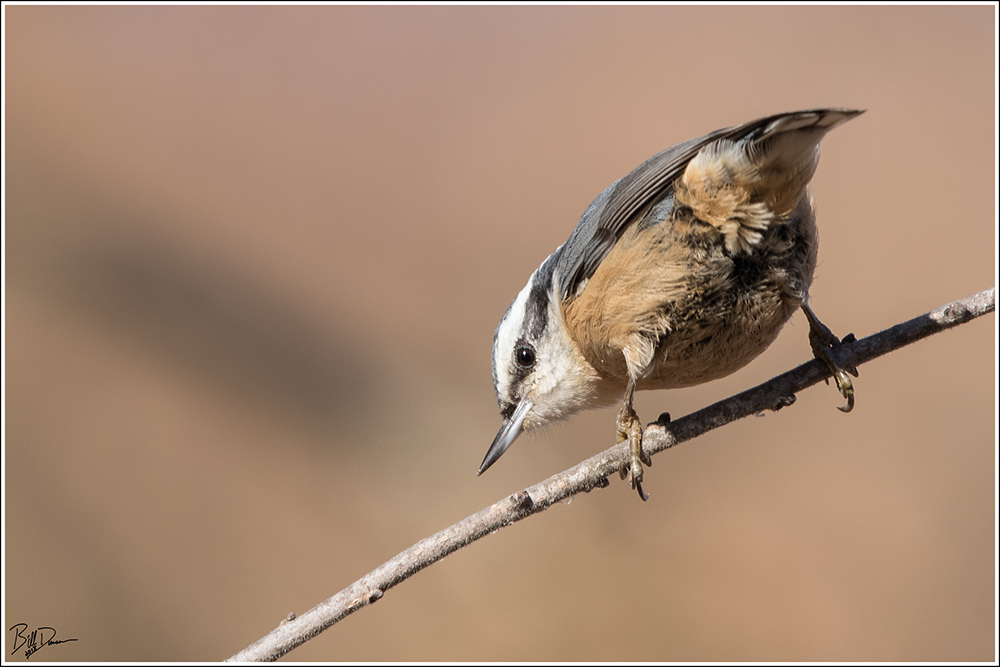
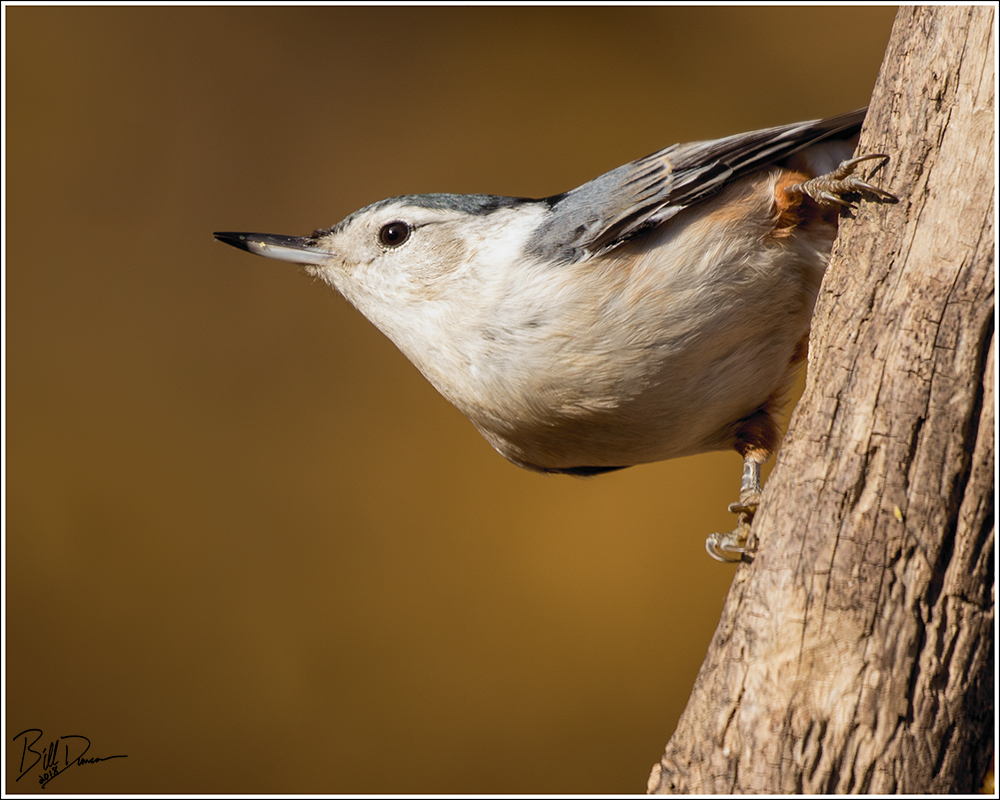
I’m so glad I spent some time at home this afternoon. This gave me the opportunity to find the first Red-breasted Nuthatch that I have found visiting our backyard feeders. I so wanted to some how tell this little one that I would have seed available all winter long as it consistently went back and forth from the big oak to the feeder, each time carrying a sunflower seed to hide in the bark. I am pretty certain that this bird visited the feeder more than 50 times in the couple hours I watched.
I have been given a lot inspiration lately by a number of Facebook friends to photograph the great birds that visit our feeders, or to put it another way, make these models work for their supper. On a recent birding trip, Sarah and I collected some great drift wood that I turned into horizontal and vertical branches in the backyard, not too far from the feeders and our sun-porch.
Dark-eyed Junco
I drilled a few extra holes towards the rear of some of these to act as unseen cavities to place my homemade bark butter. It only took the Juncos a couple of hours to find their favorite food. These guys go crazy trying to figure out how to get to this stuff. I made sure to place a few feeding spots near horizontal perches that they could access without too much difficulty as they cannot grasp vertical perches very well. These guys are so tame that they were my primary subjects, other species being a little more timid to visit the close perches and seed deposits that I sat close to.
Dark-eyed Junco
For a first attempt, I’m pretty pleased. These were shot hand-held in mixed lighting with my 100-400 mm lens and I shot through the not-so clean windows of the sun-porch. I tried sitting behind the open windows, but this must have made me much more conspicuous. I sat for an hour or more with few birds coming in to feed. Within seconds of me closing the windows, the Juncos came to the feeding stations.
Downy Woodpecker
I’m a little concerned that my resident Downy Woodpeckers might have a little too much of the rich food I am providing. They now have access to the peanut and tree nuts in the no-mess mix I provide, beef tallow suet blocks, and now the bark butter. But, I suppose it would take a lot for a wild bird to over indulge.
Anyone who feeds their wild birds and has an interest and access to photography should give this a try. I’m looking forward to more cold mornings spent outside trying my hand at this.
I was busy for several weeks this summer observing and photographing a Ruby-throated Hummingbird and her nest. I collected a lot of behavioral data and took way too many photos and video. Here is part one of what will likely be a three to four part video that summarizes the experience.
Ever since I heard that a number of newly identified populations had been discovered in Missouri, I have been wanting to find the Hine’s Emerald Dragonfly (Somatochlora hineana). I’ve gone a time or two on my own in previous years, but without specific knowledge on the where’s and when’s to find the flying adults. On June 16th, 2018, the Webster Groves Nature Study Society’s (WGNSS) Nature Photography Group headed to what might be the largest population of this species in the state. Thanks to WGNSS member and photographer, Casey Galvin, we were allowed access to a privately held farm in Dent County, MO that holds this population.
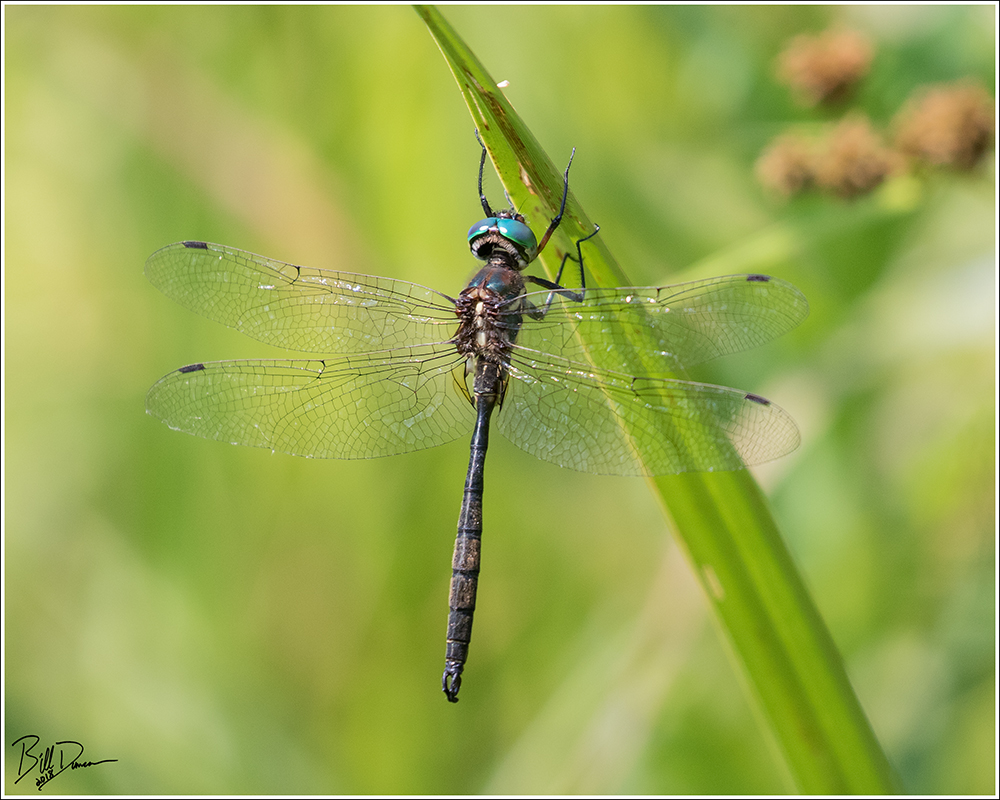
So, what is a Hine’s Emerald Dragonfly and what distinguishes them from the other 24 or so species in the Stomatochlora genus, or the “striped emeralds”? The above photo shows these distinguishing characteristics. Beyond the obvious emerald green eyes that all of the striped emeralds possess is the pair of yellow thoracic stripes on the sides of this species. Another and more diagnostic is the particulars of the genitalia. Using a good field guide will easily allow you to come to a species.
Hine’s Emerald Dragonfly – Finally at rest
Currently on the endangered species list, S. hineana was thought extinct as late as the mid 1900’s. Current populations of this species are now known from the states of Illinois, Wisconsin, Michigan and Missouri. Current population estimates indicate that there are approximately 30,000 individuals in the world. About 20,000 of these are believed to be in the species stronghold of Door County, WI. Like many of the striped emeralds, S. hineana has specific habitat requirements. The preferred habitat for this species is fens and sedge meadows overlying dolomite bedrock. Habitat loss, pesticide use and changes in ground water are identified risk factors affecting the Hine’s Emerald.
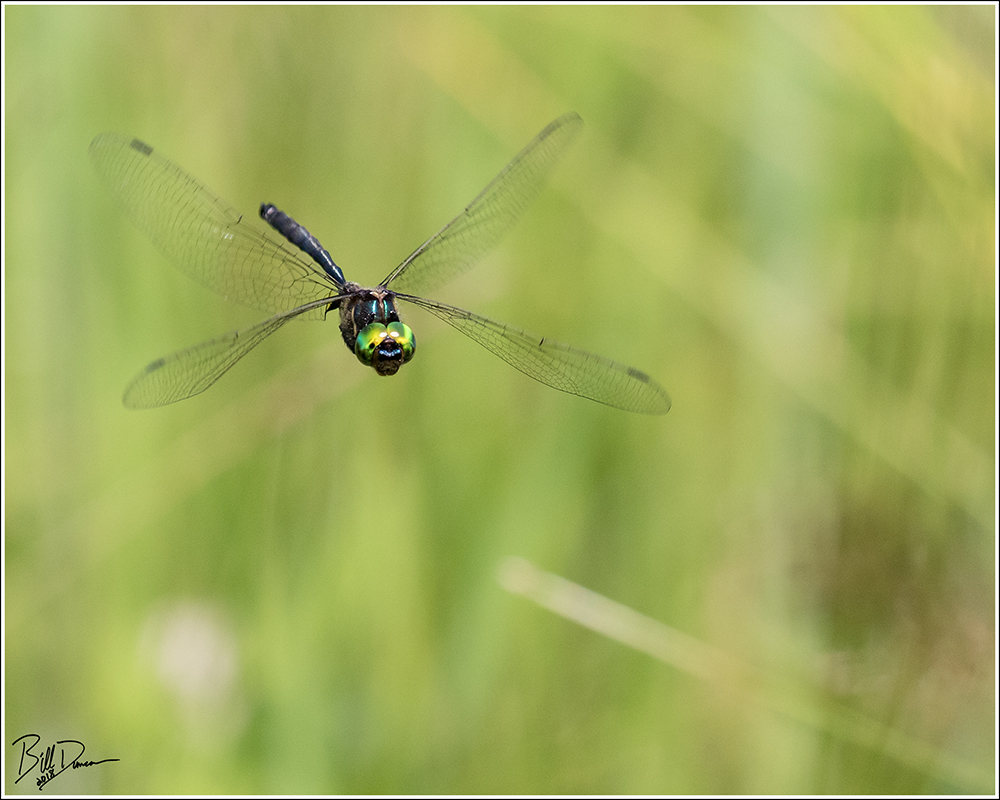
Hine’s Emerald Dragonfly – A photographer’s potential nightmare
Like many dragonflies, S. hineana is a sun-lover, active in the early parts of a June morning before things get too hot and he finds a hidden perch. Until then the males are airborne, patrolling their territory in the hopes of finding a female or a male to chase away. The photographer need be patient and wait for the opportunity when the insect stops to hover in the same general place. This is the split-second opportunity that you wait for. The problem is that autofocus is of little to no help. I primarily used manual focus on the in-flight shots.
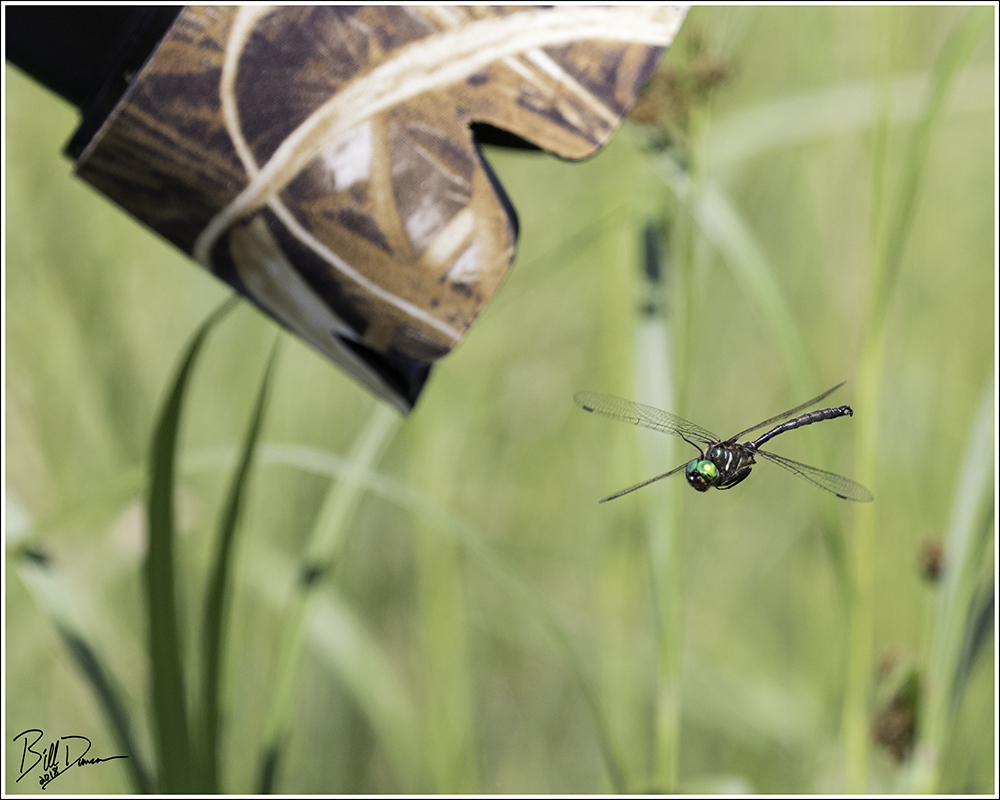
Hine’s Emerald Dragonfly – A worthy pursuit
There were plenty of opportunities for the patient photographer and observer. Often, an individual would fly so close to the lens we were sure it would use it as a perch. At these distances any movement by the dragonfly would throw it completely out of focus, so the photographer is looking for the sweet spot – close enough to be large in the frame, but far enough to enable tracking.
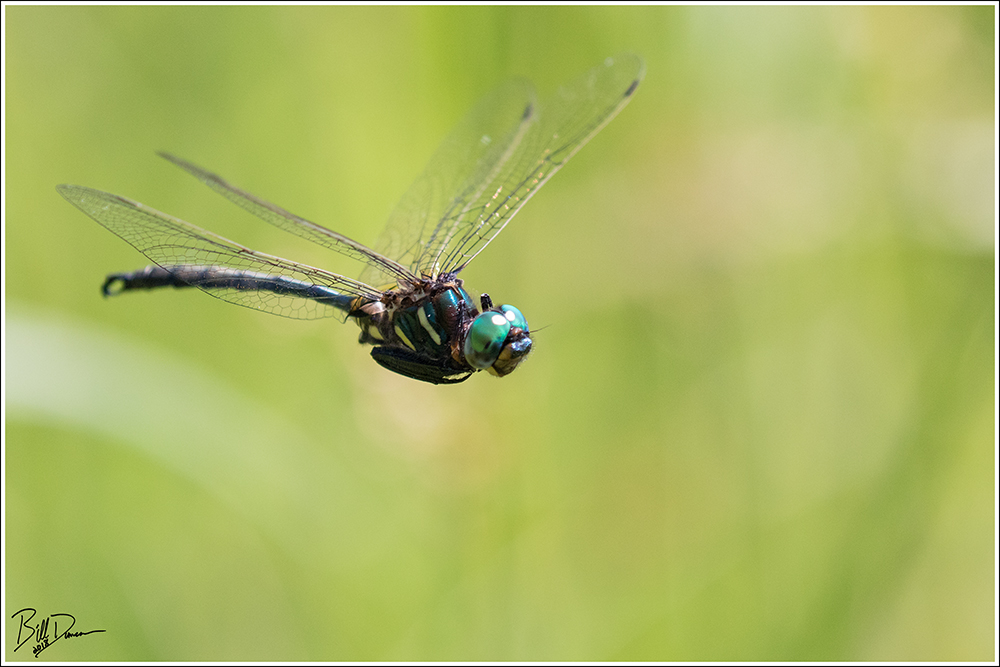
Hine’s Emerald Dragonfly – A rare gem
It was such a thrill to finally be able to meet these guys. With this location and up to 20 others, it is nice to know that Missouri is home to such a rare gem. Hopefully it will remain so.














 A Thousand Acres of Silphiums