"What a thousand acres of Silphiums looked like when they tickled the bellies of the buffalo is a question never again to be answered, and perhaps not even asked." -Aldo Leopold
While driving around BK Leach Conservation Area this spring, we came across a Turkey Vulture feeding on a raccoon carcass. Did you know that the Turkey Vulture has the most advanced olfactory system of any known bird? They can pick up the smell of a rotting animal from more than a mile away. As shown below, we noticed the bird would attempt to cover up its meal when it spotted other vultures soaring nearby.
It’s all mine!
Turkey Vultures can often be seen with their wings widely spread in what is referred to as an “horaltic pose”. The benefits of doing this are not entirely known but have been hypothesized to be an aid in warming the birds and helping to dry feathers. The bird posing in the shot below was taken one morning while I was hiking at Shaw Nature Reserve.
Horaltic Poser
Finally, I thought I would share some video footage that this patient bird let us take whilst it was digging into some coon.
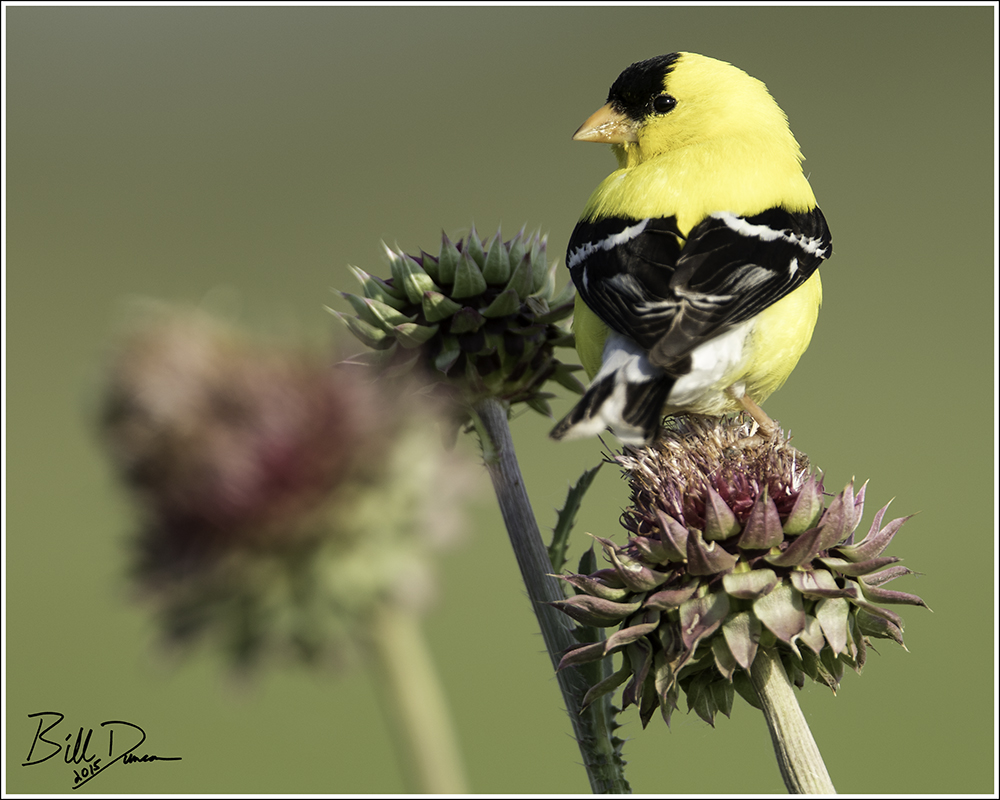
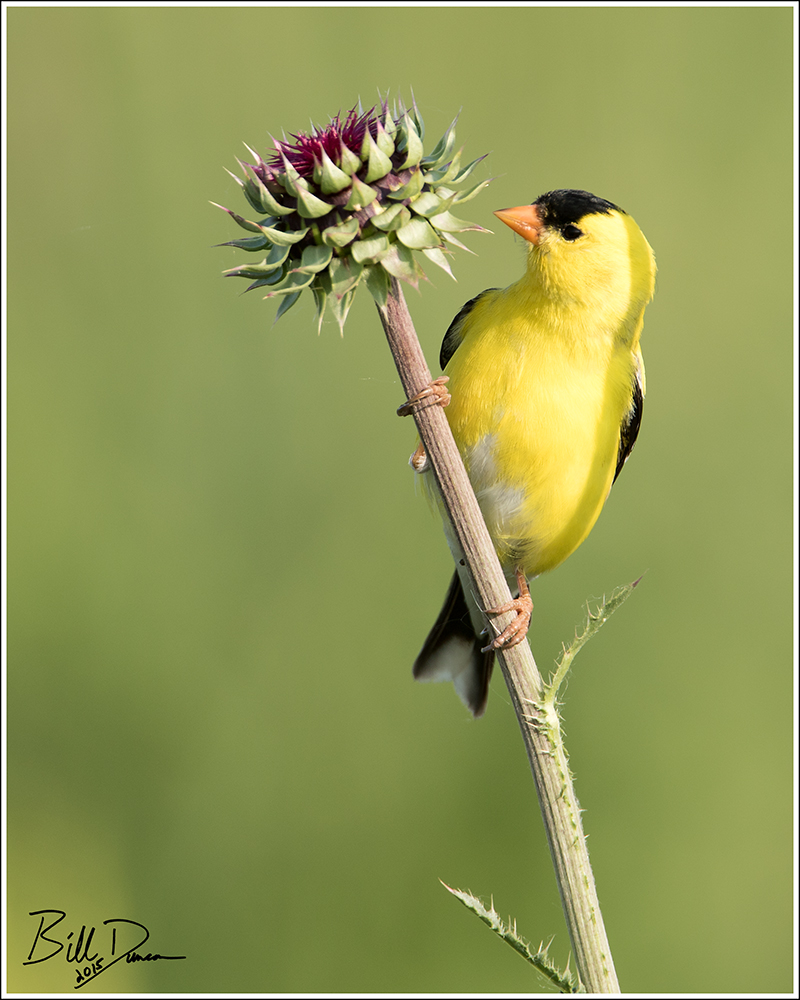
The Goldfinch have really taken a liking to the Silphium in my garden this year. Every time I’m out there I observe at least a couple picking the seeds. The two images of this post show them with their more famous plant source, the thistle, taken this summer at RMBS.
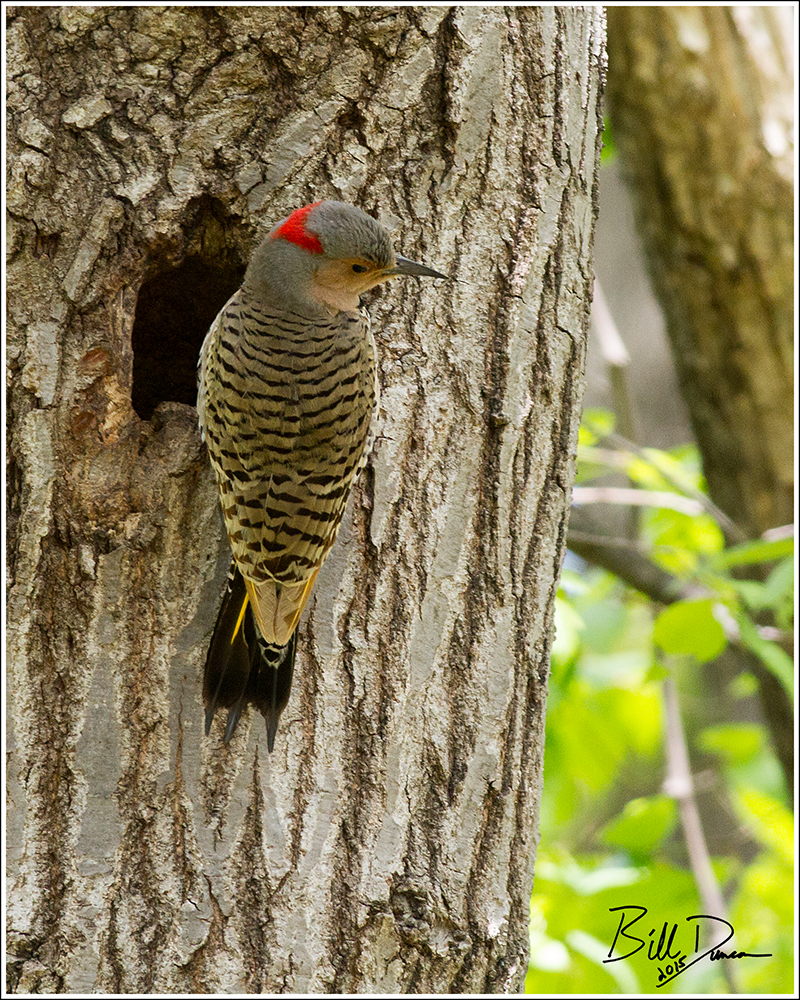
Earlier this spring I watched with anticipation as a pair of Flickers inspected a potential nest cavity in a wood lot where I work. I watched over several mornings as they came and went and made a ruckus. Here, the male admires the view from the front door.
Northern Flicker – Female
The female is pictured above, inspecting the potential nest sight.
No Thanks!
But alas, for whatever reason, the pair decided this wasn’t the spot for them this year. Ah well.
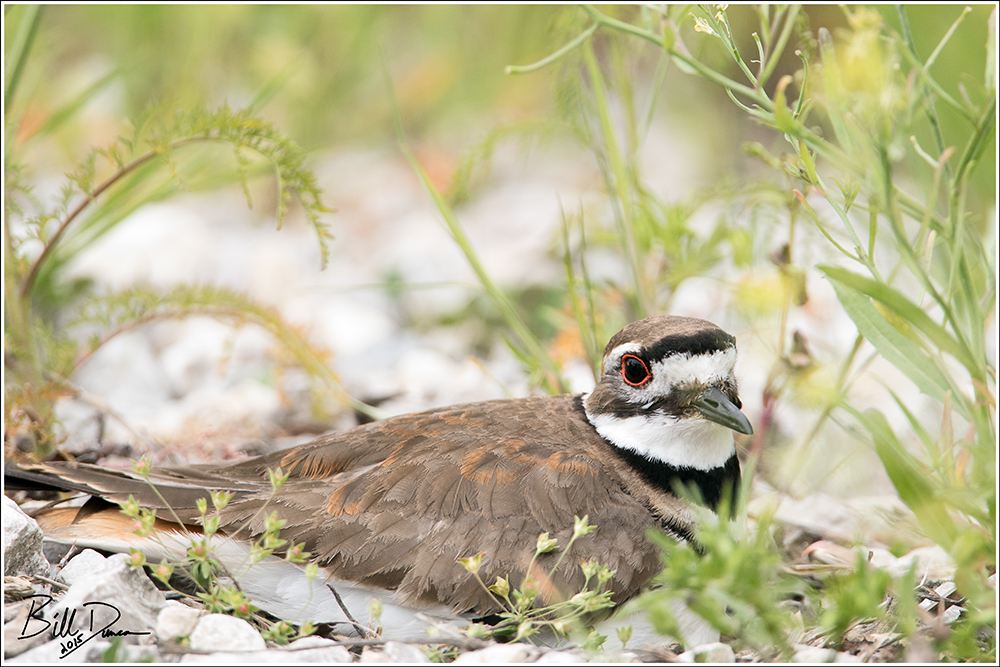
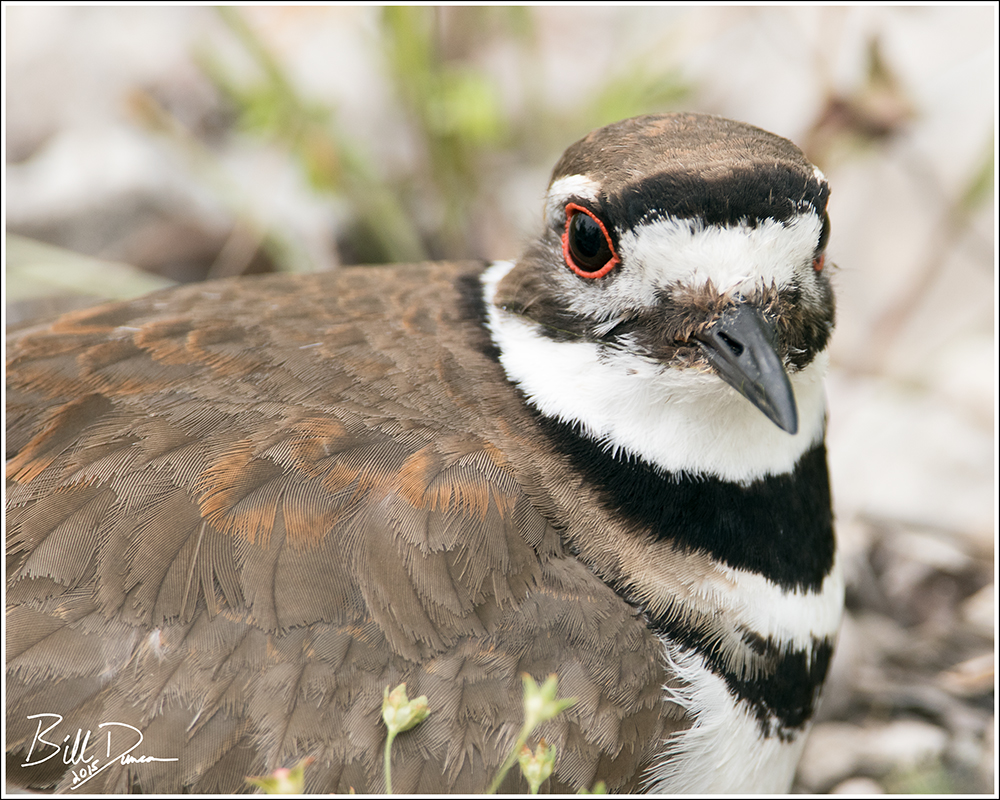
Sarah and I found this girl on her eggs this spring at Clarence Cannon NWR. According to Harrison (Peterson Field Guides – Eastern Birds’ Nests), the male of the species will “make various scrapes in the ground” and one is chosen by the female to deposit and incubate her eggs. As most of us familiar with the bird know, the Killdeer will usually nest far from water and often within human disturbed habitat. This girl’s nest was along the side of a gravel road within the refuge.
Warning: although I find the material in this post quite interesting and I am pleased with the observations made and detective work accomplished, there is not, unfortunately, a happy ending.
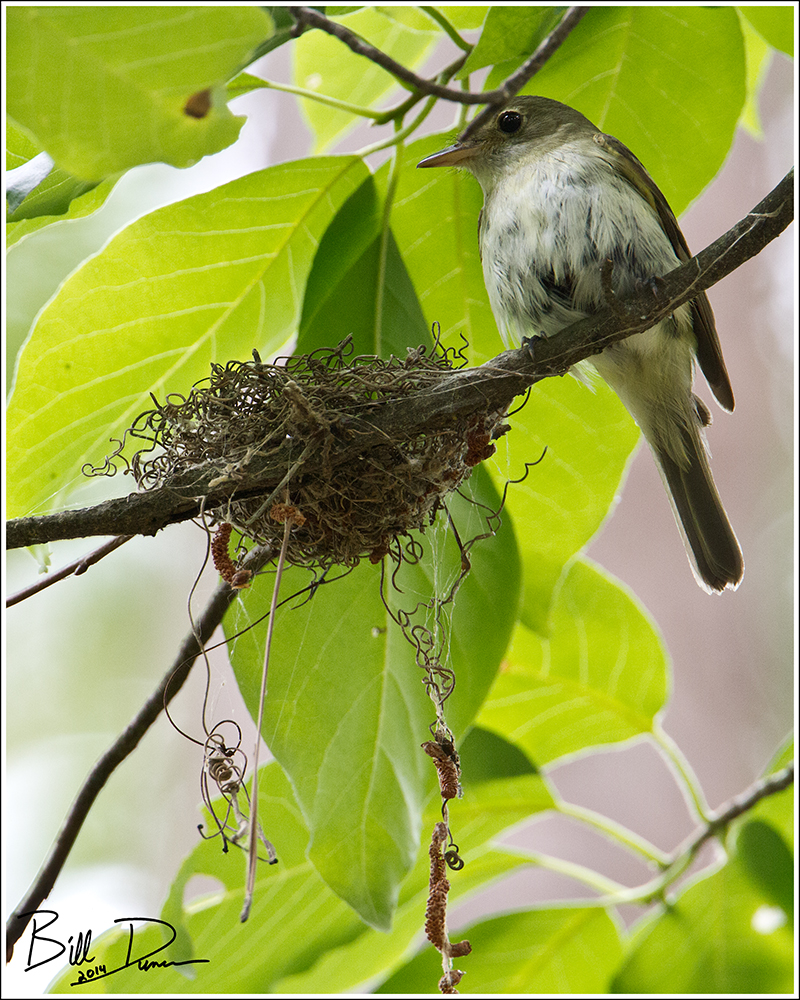
Having the fortune of living within minutes of a few Ste. Genevieve County gems, this summer Steve was fortunate to find something we had been on the lookout for while on a stroll at Hawn S.P. He sent word that he had found an active nest of a pair of Acadian Flycatchers. Not only that, but it was in a fairly nice position for photography and the pair did not seem too concerned if the viewer stayed low and silent. Needless to say, I was excited. We visited days later to find mom on the eggs – yet to hatch.
Acadian Flycatcher – On Nest
The female would leave the nest for less than three to four minutes at a time to feed herself. The male was primarily concerned with scouting and announcing his territory, vocalizing continuously as he traveled its circumference.
Acadian Flycatchers – Mom Taking a Break
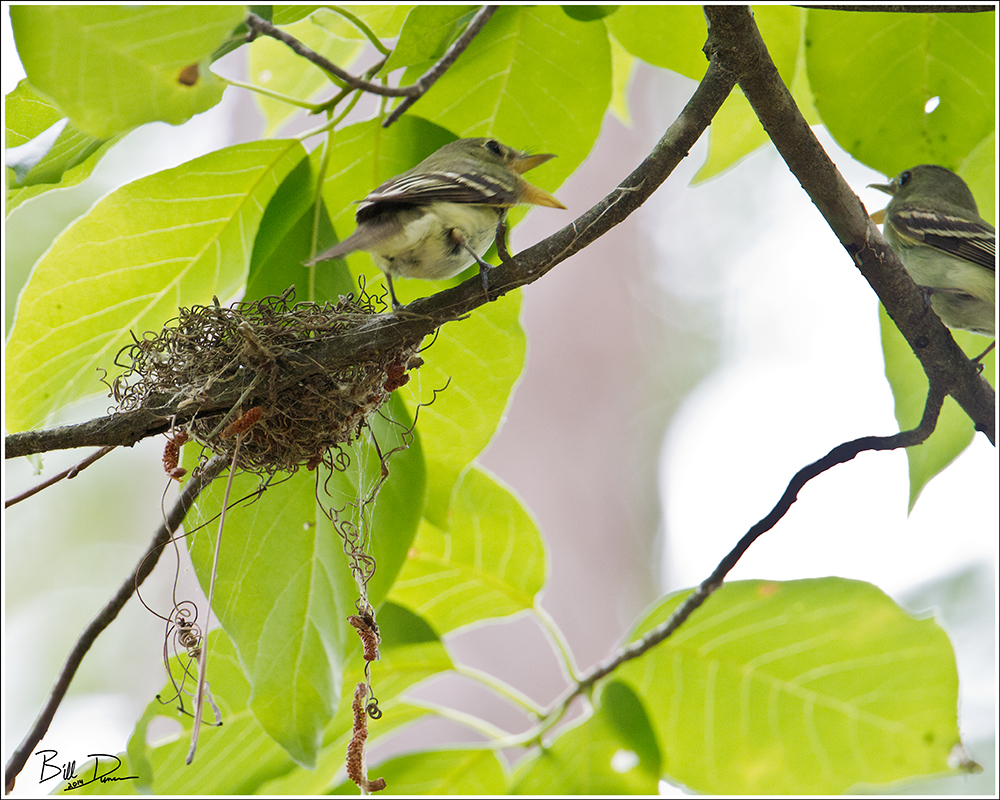
Once in a while both parents would be at the nest at the same time. Gee, I wonder why dad doesn’t come around more often… 😉 We were surprised by the relatively large size of the bird’s beaks and the small size of the nest!
Acadian Flycatchers – Giving the Business
To give some idea of the habitat these guys were using… These are definitely forest dwelling birds. This section of Hawn was close to a 50:50 mix of Short-leaf Pine and deciduous trees. The nest itself was located in a Black Gum that was approximately 30-40′ tall.
Acadian Flycatchers – Habitat Shot
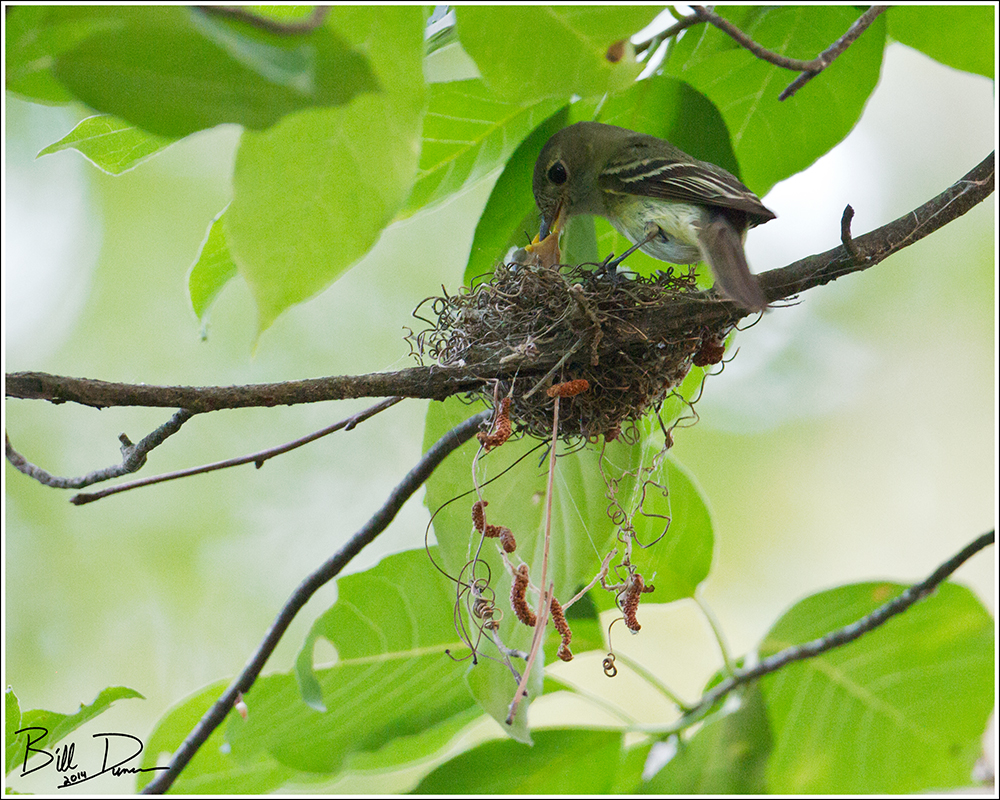
A follow up visit a week later found that two visible chicks were in that tiny nest! In the photo below, one of the parents had just brought a spider back to feed to one of the altricial young.
Acadian Flycatchers – Feeding Time
The next photo documents the large, developing eyes of these sightless young. Also take note of the characteristic nests of these birds. The tendrils on these nests are strung up with spider webs and can be up to a meter long. According to the literature, this nest is near the maximum height range from the ground (~25′) that this species will build. As great as this was, I would love to find a nest built lower.
Acadian Flycatchers – Unmistakable
The following Saturday we visited during prime lighting hours for where the nest was located. With the relatively quick fledging time of these songbirds, we gave it about a 50% chance that the chicks would still be in the nest. We got to our viewing spot – a dry creek bed that gave us partial cover, and waited. Other than an occasional song from dad at a distance, we had no sign whatsoever of anything going on at the nest. After sitting silent and ready for about 40 minutes, we had concluded that the nest was no longer in use. The chicks might have fledged?
We decided we could safely walk directly under the nest without interfering with anything. When we arrived we were disappointed to find that both chicks were lying directly underneath the nest, dead. For a while we contemplated what could have happened. Could a storm or wind gust have knocked them from the perch? As we lamented the demise of these fresh beings, Steve saw something near the crotch where the nest branch met the trunk. Here is what we observed and answered our questions.
Black Rat Snake – Eater of Chicks
See that bulge in this young Rat Snake? We hypothesized that this was a third chick that this guy had preyed upon. We suppose that during the process of ingesting this chick, the other two were either pushed or decided they were better off jumping from the nest, then wait for the fate of the unfortunate sibling. We were fortunate to arrive at the nest in time to spot this snake before it had moved on. We bothered it long enough to take some images, then let him hide in peace to digest his meal.
Being almost solely interested in “herps” (reptiles and amphibians) for a couple decades of my life, a place in southern Illinois known as LaRue Road, or more legendarily – “Snake Road”, has long been on my list of favorites to visit. Years ago, before becoming interested in the reptiles with wings and feathers, I barely took notice that this location was swarming with all sorts of life. Upon becoming a more rounded nature enthusiast, I have since discovered this simple road is located within a special zone of multiple habitats. Whether it be herps, birds, plants, insects, etc., this is a special area of biodiversity that is celebrated by those lovers of life who are fortunate enough to have found it.
So enough with the flowery description. What makes this area so special? LaRue Rd. is located on the western edge of the Shawnee National Forest; this particular portion of the forest is called the LaRue Pine Hills. Where the flood plains of the Mississippi and Big Muddy Rivers meet these hills, bluffs of up to 200 feet have formed. At the base of these bluffs, the rivers have helped form some very special swamp and marshy habitats. Between the mixed hardwood-pine forests and the wetlands lies – Snake Road. Okay, so what of that? Well, this explains the moniker. Twice a year, snakes move en mass – from the hills to the swamps in spring, and vice versa in autumn to find a high, dry and safe place to overwinter. To do so, they must cross a gravel road.
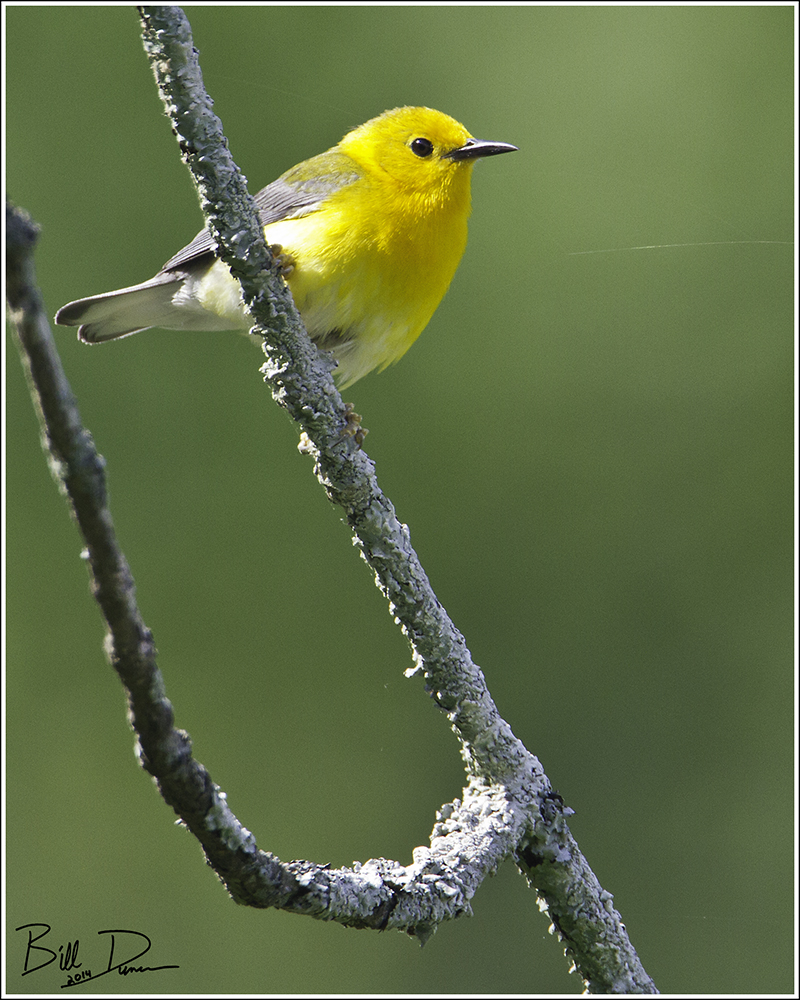
Anyway, snakes were not even the quarry in mind when Steve and I decided to take the journey. Being so late in the season and relatively late in the day, I didn’t give credit to any dreams of finding a legless squamate. Our goal was to find and grab an exceptional photograph of a Prothonotary Warbler. I’m not sure of the latter, but we were sure able to find them!
Prothonotary Warbler
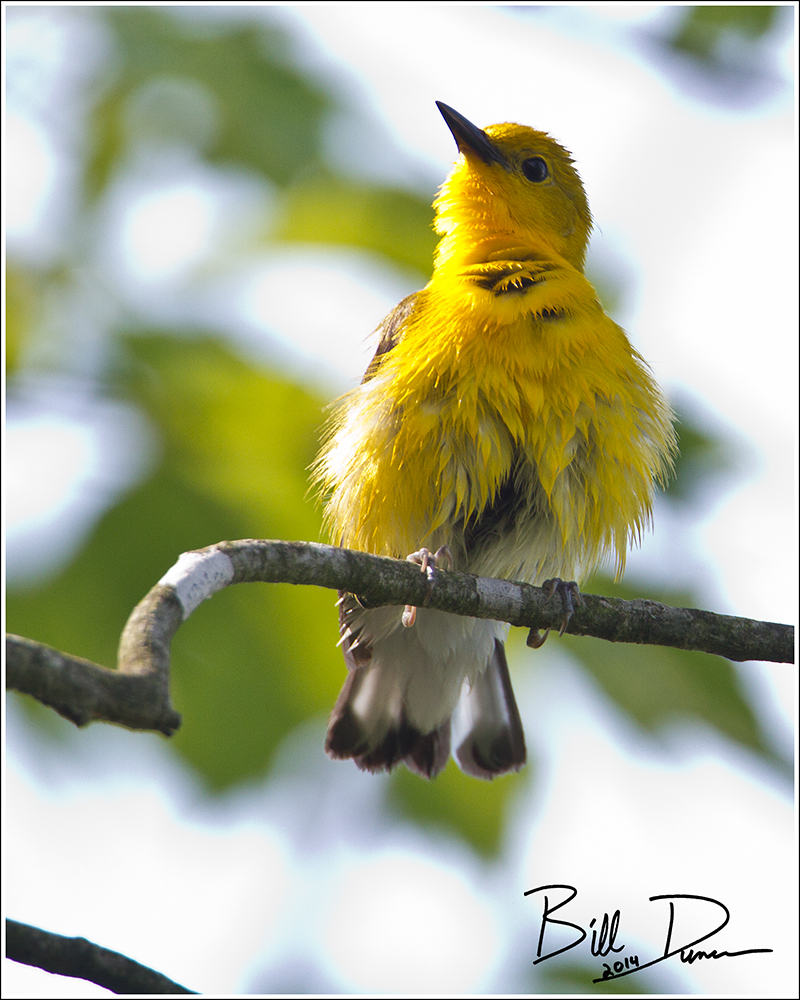
A slightly shallower depression in the road often afforded mostly unbroken looks into the marsh, and opportunities to find these ancient clerics soaking up the sunlight that gives them their spectacular color. Once finding a male, a little bit of playback brought out more and more, coming to get a look at the particularly pathetic naked apes. This guy did a bit of preening following a bath.
Prothonotary Warbler
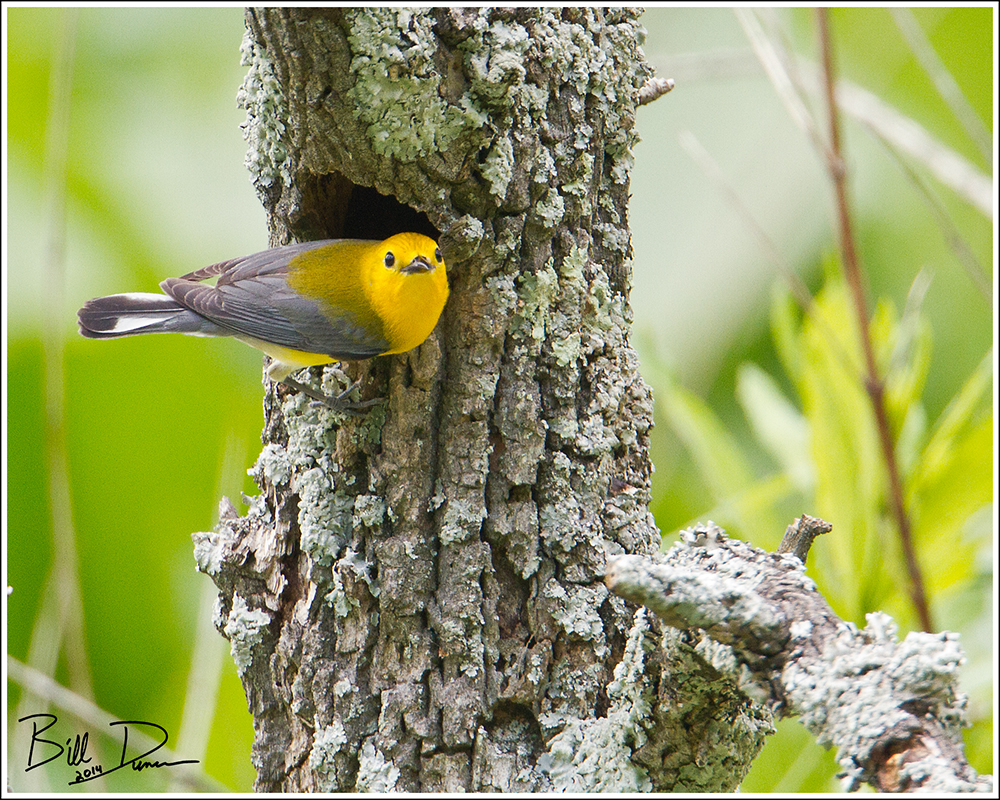
Getting great looks at several of these spectacular animals was more than we could ask. Walking a bit farther we were fortunate to find an active nest!
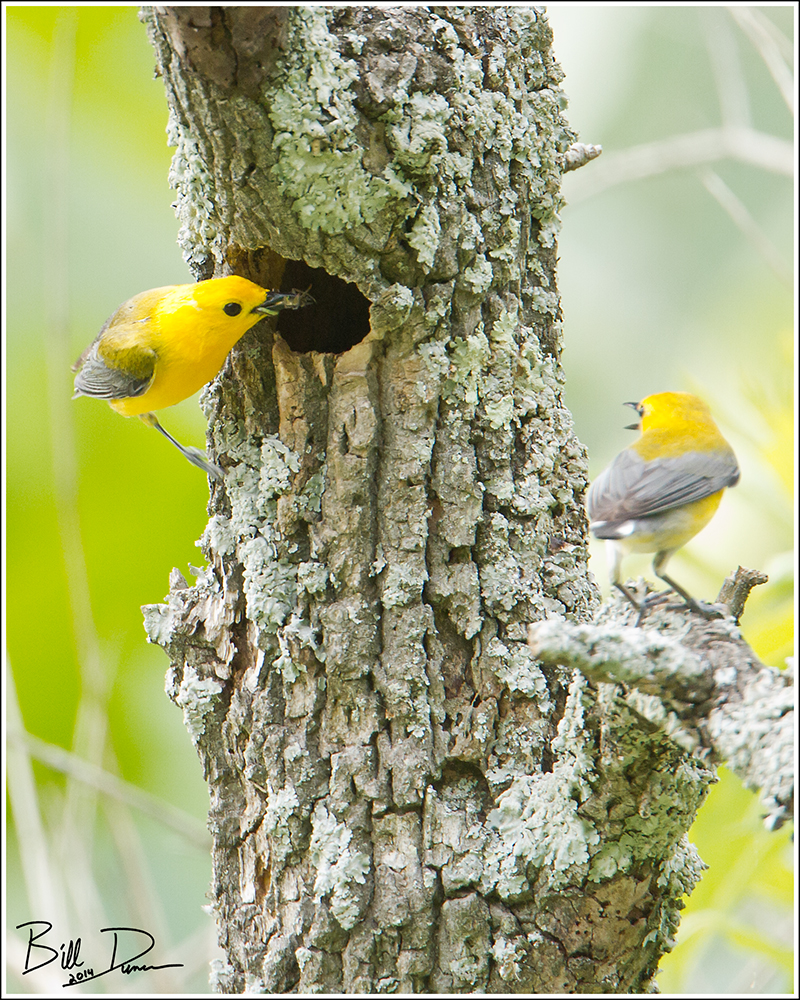
Prothonotary Warbler at Nest
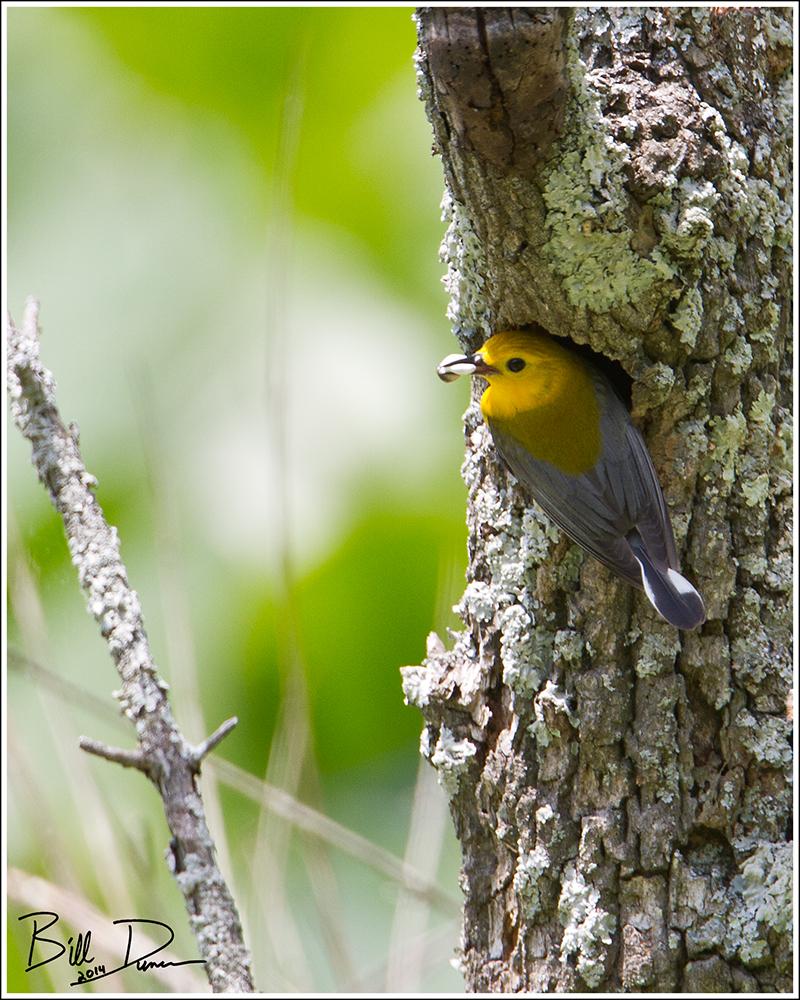
Prothonotary Warblers nest in shallow cavities in trees, often old Downy Woodpecker nest holes. Below, one of the parents can be seen removing a fecal sac from the nest.
Prothonotary Warbler Removing Fecal Sac
The next photo shows what I am assuming to be mom instructing dad to find an even bigger insect next time. 😉
Parents
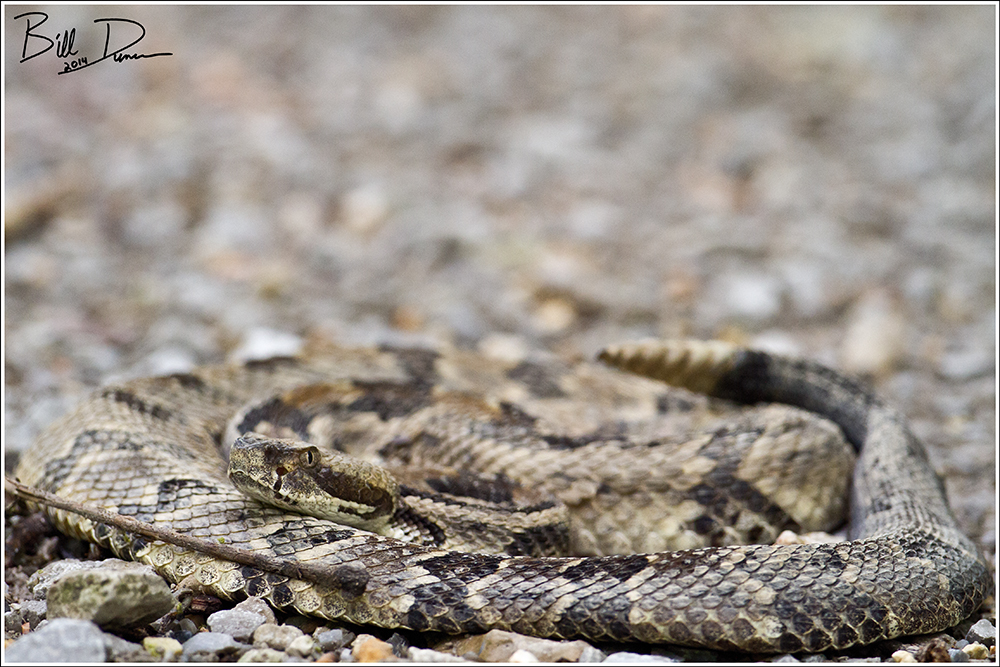
Remember when I said we were not expecting to find much of anything besides the birds on our trip down “Snake Road”? There, in the middle of the road, we discovered the guy you see in the next image, and I discovered I made another huge mistake. On more than two occasions now I have been in a circumstance of not being able to make a photograph, or the photograph I had envisioned, because I did not bring the necessary equipment. On this day, my only equipment was a 500mm lens on a 1.6 crop body and my iPhone. After contemplating throwing myself on the viper to end my pathetic existence once and for all, I decided to give a shot at shooting a snake with an equivalent focal length of 800mm! On a partly cloudy day with lots of tree cover, I knew that lighting the subject would be difficult. Of course, I had no artificial light source either. Shooting wide open, depth of field was nearly nonexistent. This was the result of my first attempt.
Timber Rattlesnake
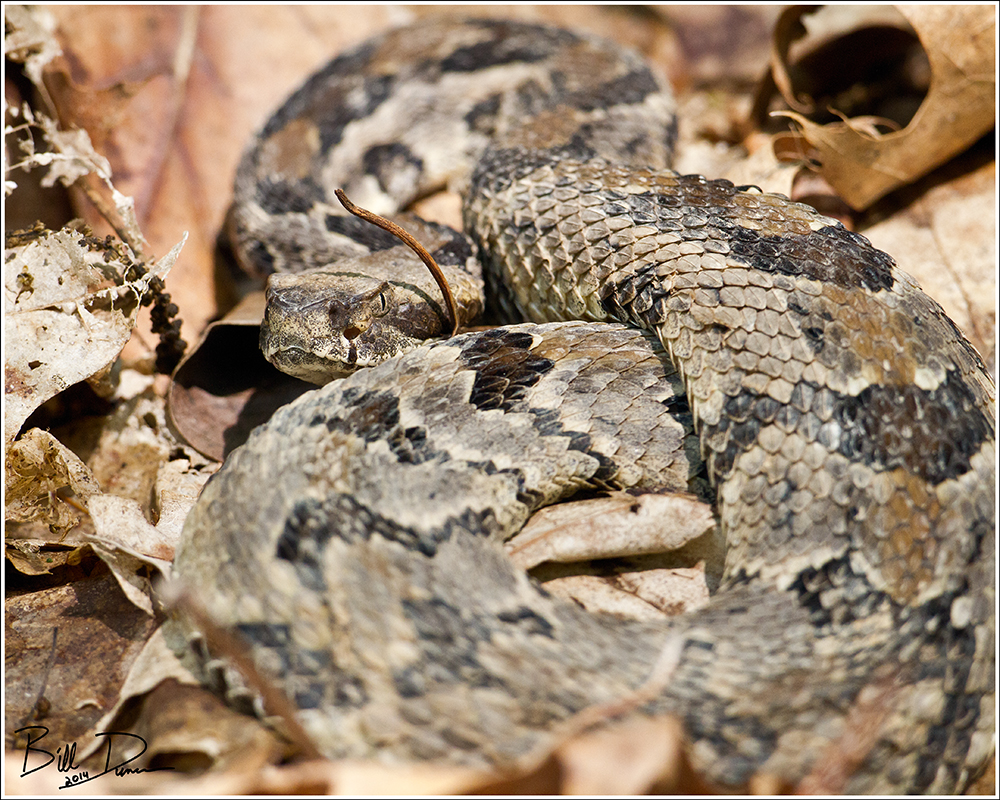
So, not a complete disaster, but something like a 70-200mm would have been more desirable. We then decided to get him in a little more natural setting with hopefully a bit more light. We gently moved the snake just off the road and I remembered a trick I could use to get a little closer than the lens’ close focusing distance of 15 ft. I put an extension tube between the lens and the body. Although I still had pathetically little DoF (as long as I get the eye in focus, right?), I was able to get somewhere in the range of 10-12 feet from the subject, allowing it to look a little more prominent in the composition. I must apologize for the oh-so-distracting leaf petiole in this image. I asked Steve to please remove it gently with his fingers, but he replied with some of his medical jargon, going on about rhabdomyolysis, hypotension, necrosis; whatever, it sounded like cop-out to me.
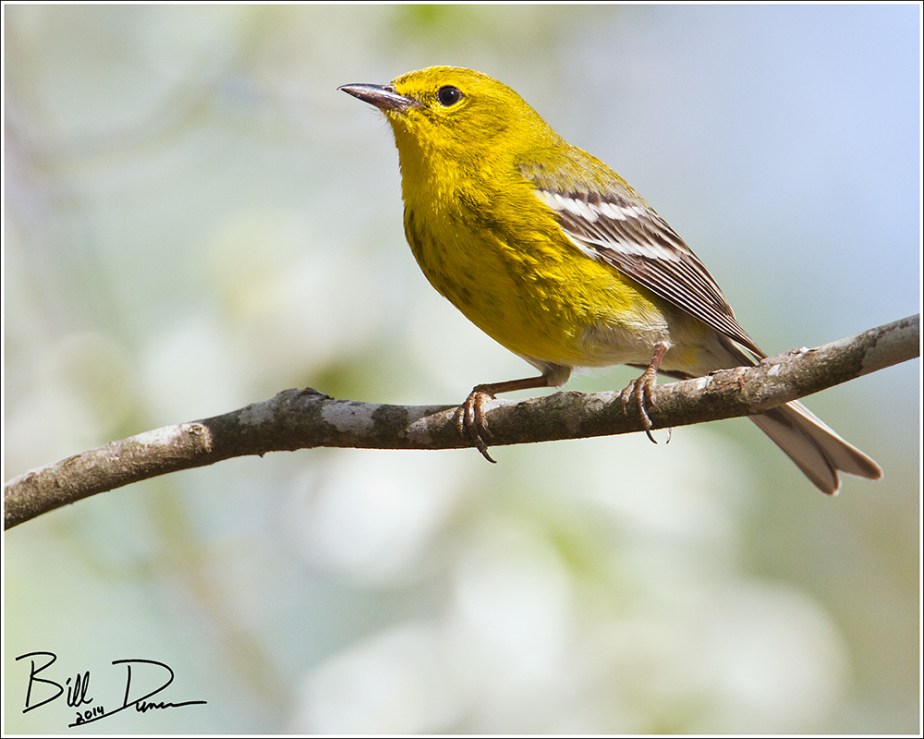
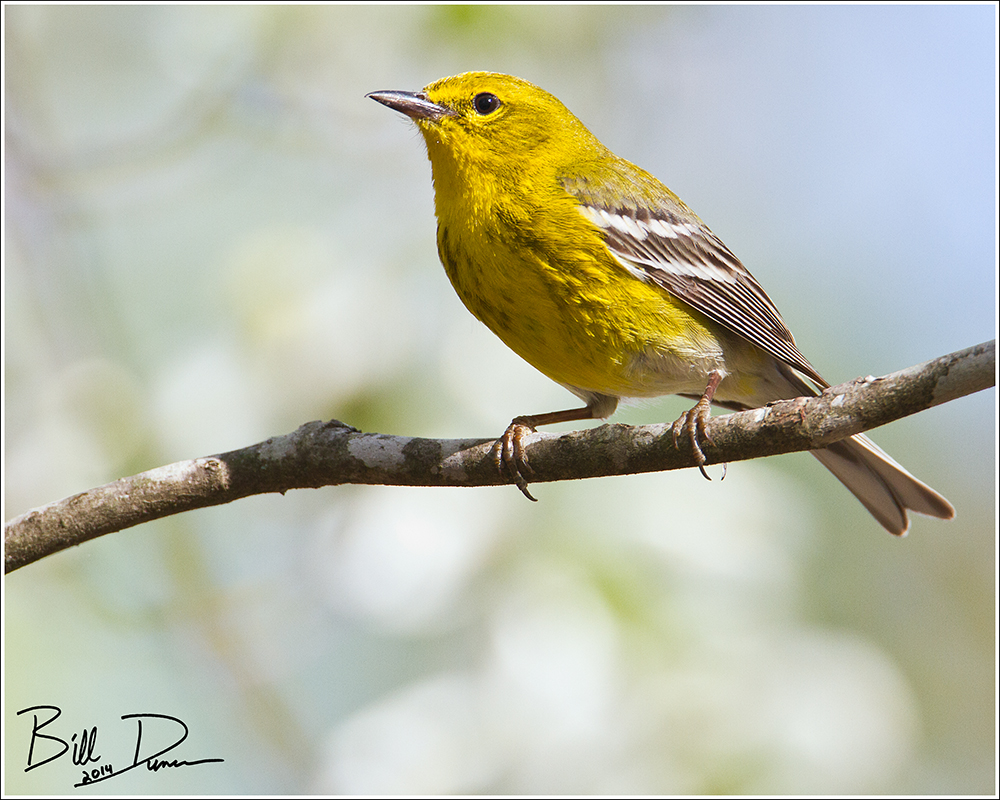
Perhaps the most appropriately named warbler, this special bird is said to nest almost exclusively in pine trees and is one of the earliest nesting warblers within it’s range. These special birds were a thrill for us to find and watch. Closeup images of the male bird were taken at Big Spring State Park, while the nest was located in a Short-leaf Pine located on a parking lot within Shaw Nature Reserve.
Male Pine Warbler, Big Spring State Park, April 2014
The chicks were adorable and near-helpless, only able to open their gigantic craws at anticipation of a juicy insect meal.
Pine Warbler Chicks, Shaw Nature Reserve, May 2014
During the time Steve and I strained our necks watching the child care from ~50 ft below, we were able to observe that when dad visited the nest he always approached from the side of the nest facing us as seen in the image below. Mom always visited on the opposite side, affording us poor looks. It was interesting to observe that both parents approached the nest in a slow and indirect manner, usually starting low in the nest tree or an adjacent neighbor. They would then hop from branch to branch, often in a spiral up the tree to reach the nest. I do not remember watching either parent make a direct flight to the nest.
Pine Warbler Father with Chicks, Shaw Nature Reserve, May 2014
I’ll leave you with the Pine Warbler advertisement song and with hopes of seeing them as soon as possible in the next spring.
Male Pine Warbler, Big Spring State Park, April 2014
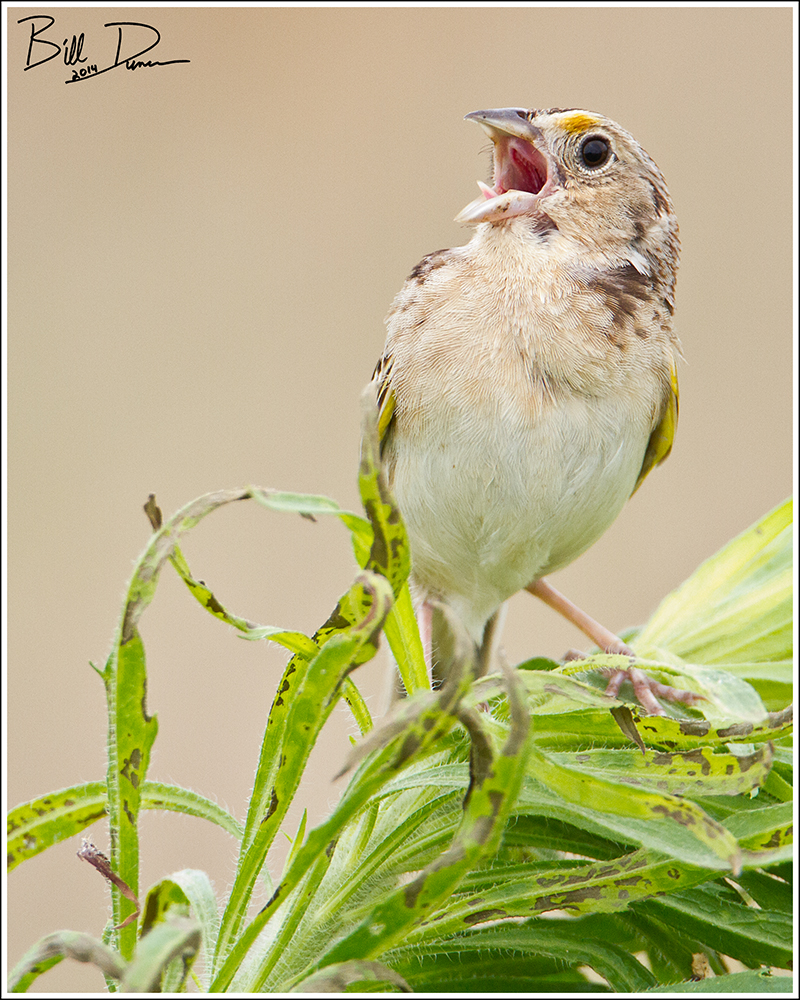
Sarah helped me nab this shot of a singing Grasshopper Sparrow recently at Confluence State Park. It was interesting to me that out of such a large area of potential habitat, the only two birds we had singing this day were right on top of each other.
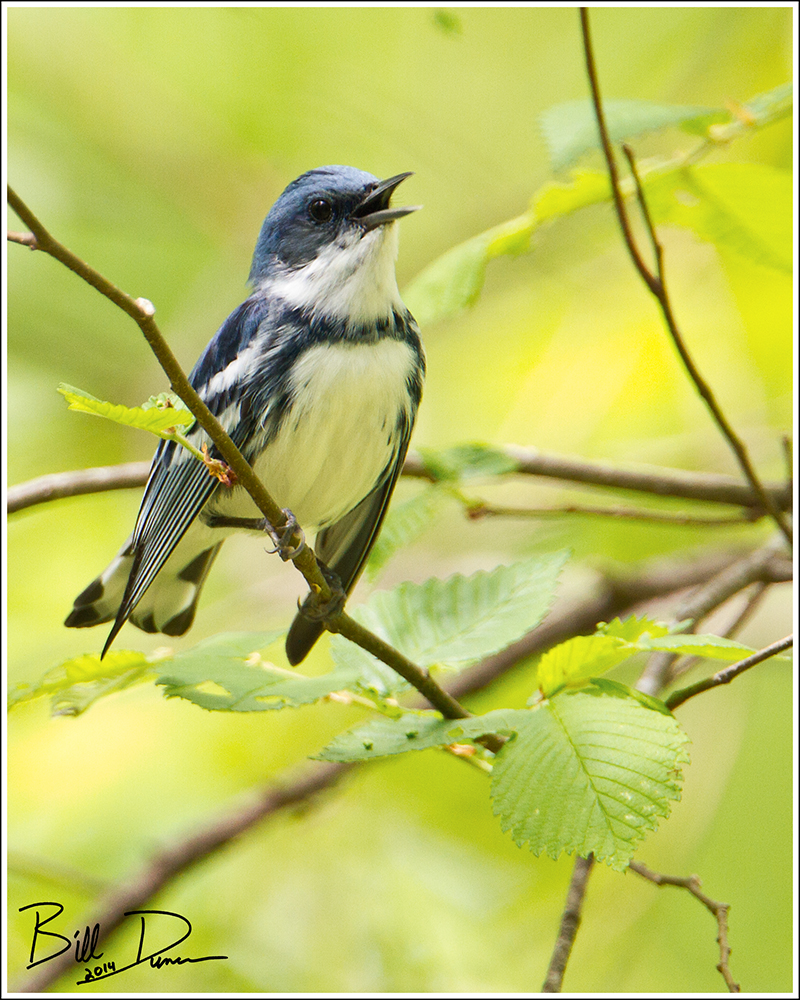
The Cerulean Warbler population has declined more than 80% since breeding bird surveys began in 1966? Habitat destruction, in the form of mountaintop removal and stream filling in the Appalachians, and forest destruction for agriculture in the Mississippi Alluvial Valley, along with wintering grounds destruction for coffee and cocoa production in South America are responsible. Habitat preservation via cessation of deforestation in both nesting grounds and wintering forests are crucial if we are to continue hearing the Cerulean song.










 A Thousand Acres of Silphiums