Arctic Oscillations and the Winter that Never Was

Technical details: Canon EOS 7D camera, EF100mm f/2.8L Macro IS USM lens, ISO 320,  f/14, 1/13 sec

According to weather scientists, yeah those experts so closely related to our news meteorologists, the jet stream and the current “positive oscillation” is to blame for much of the continental United States lack of anything resembling winter this year.  The problem is that the jet-stream is in a negative phase, or dropping southerly in places like Alaska, much of Europe and Russia.  While where we reside, here in the Ozarks for example, the jet-stream is far to the north, allowing warmer air fronts to reside across the country.  Those places I just mentioned are getting lots of winter with lots of that white stuff we saw on holiday cards and gift wrap about a month ago, while we are in a sort of limbo between autumn and spring.

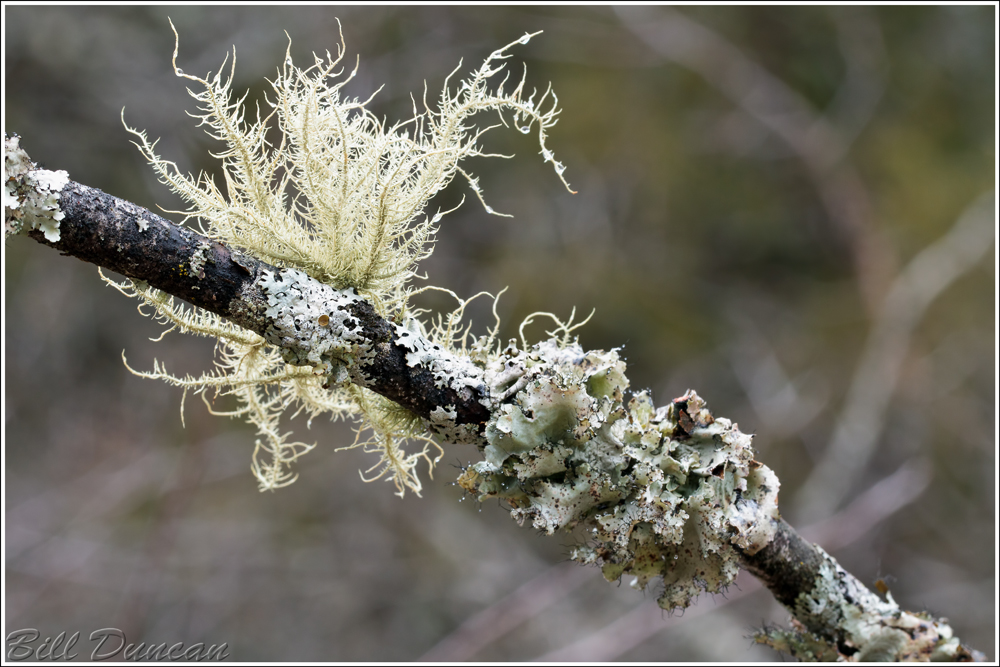
The reason I bring this up is that, as I mentioned in a previous post, there is a lack of typical winter photography opportunities this year.  The past few outings I have been making my subjects more typical of what I would normally shoot during the warmer months.  During a nice, leisurely and of course, warm hike yesterday looking for one of the harder to find shut-ins along a creek in the Courtois Hills I found a patch of short trees that were loaded with lichen.  In these mild and wet times that we’ve been having (normally seen in spring and fall), the lichen appear to be thriving.

Lichen, a fusion of two normally separate living taxa – a fungus and an algae – are a treasure of diversity, harbingers of the state of the environment in which they are found, beautiful and are still not well appreciated or celebrated by the common public.  Experts in lichen taxonomy use many characteristics in concluding the correct identification of these fascinating life forms.  The largest primary groupings to consider in determining what lichen you are dealing with is to determine is whether the lichen is foliose – flat and leaf life-like with lobed margins, fruticose – branched and stem-like in appearance, or crustose – crusty, splotchy, almost stain-like.  Following this generalization, the expert then goes into more specific characteristics in determining the identification.  Is the lichen corticolous (lives in trees), or is it saxicolous (lives on rocks)?  The expert in lichen taxonomy will consider the upper and lower surfaces of the lichen body, the cilia and isidia (hair-like projections), the strong-hold structures that hold the lichen to its substrate, the apothecia and perithica (fruiting bodies), and similarly to the fungi, the actual chemistry of the lichen itself will hold clues to identification.

So what are the two lichens captured in the image above?  These are my best guesses and I am far from an expert in lichen identification.  The left-most lichen is the fruticose, bloody beard lichen – Usnea mutabulis.  The other, ruffled lichen I cannot ID for sure.  I should have collected some notes of it in the field.  But, I have narrowed it down to either the salted ruffle lichen – Parmotrema crinitum or the cracked ruffle lichen – Rimelia reticulata.  If you are someone who knows their lichen and can tell me what I have just through the information in this photograph, please let me know.

The Ozarks of southern Missouri are rich in lichen diversity and the Ozarks are home to several endangered lichen forms.  If you tire of botanizing, birding, mushroom hunting or whatever else brings you out in the field, consider having a go at the lichens.  They are a fascinating subject.

P.S.  One of the last things I expected to happen in early February occurred to me yesterday.  Leaving my first stopping point I found two ticks on my pants.  I wasn’t too concerned.  I sprayed the remainder of a can of deet spray on my pants and continued my Saturday adventures.  Mistakenly I didn’t give myself a full check upon returning and did not find the tick that was feeding on me until this morning, at least 12 hours after the tick had probably attached itself.  Now I get the fun of wondering if I’ll come down with some tick-borne illness over the next month.  I believe this is still a relatively rare thing in Missouri, but still.
 

Ice Is Nice (When You Can FIND It)

Technical details: Canon EOS 7D camera, EF24-105mm f/4L IS USM lens @ 60mm, ISO 100,  f/13, 1/20 sec

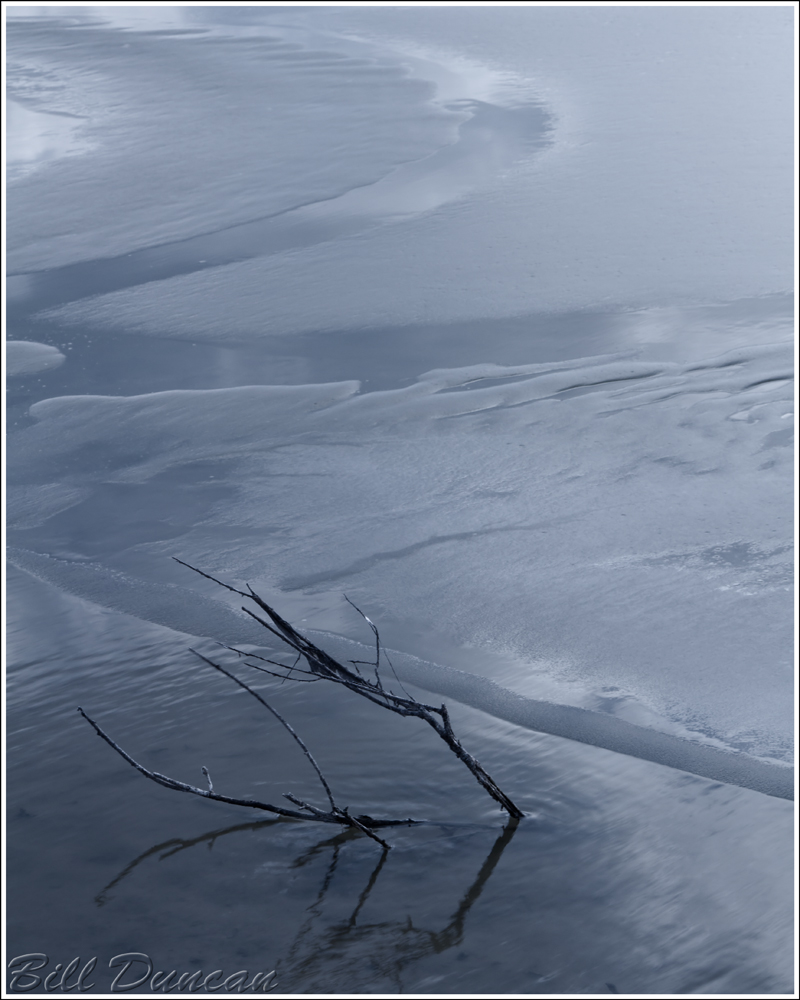
Photographing ice is a nice challenge for the nature photographer.  Negotiating the landscape itself when covered in snow and ice is the first obstacle and finding safe passage in both transporting yourself to the scene and then within the scene is obviously critical.  Nailing the exposure in camera is crucial in making an ice image that works compared to one that falls short – ice and snow have their obvious challenges as being bright subjects that can confuse the camera in automatic exposure modes.  Composition is a challenge, as many ice shots are all about pattern and flow through the rectangle and may not be focused on an apparent subject.  Finally, color and white balance of the image needs to be carefully scrutinized.  There are lots of options here.  Will you leave the scene cold?  This is a popular choice for winter images, or is there reason to warm it up?  Will it be in color or will you convert to B&W?  If you do go monochrome, color toning leaves you with more potential options.

Technical details: Canon EOS 7D camera, EF100mm f/2.8L Macro IS USM lens, ISO 320,  f/14, 1/6 sec

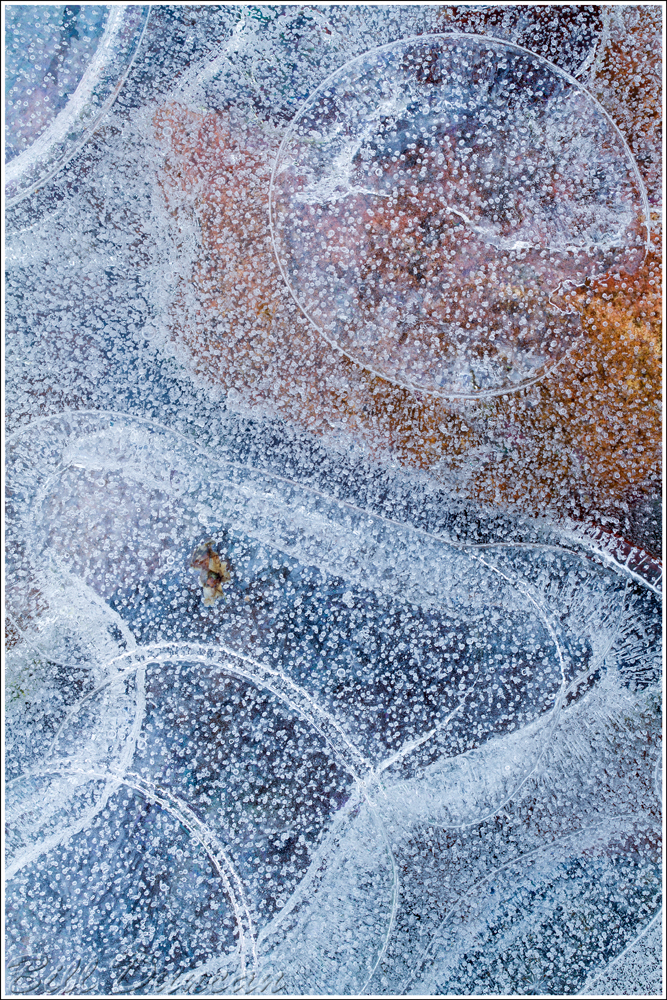
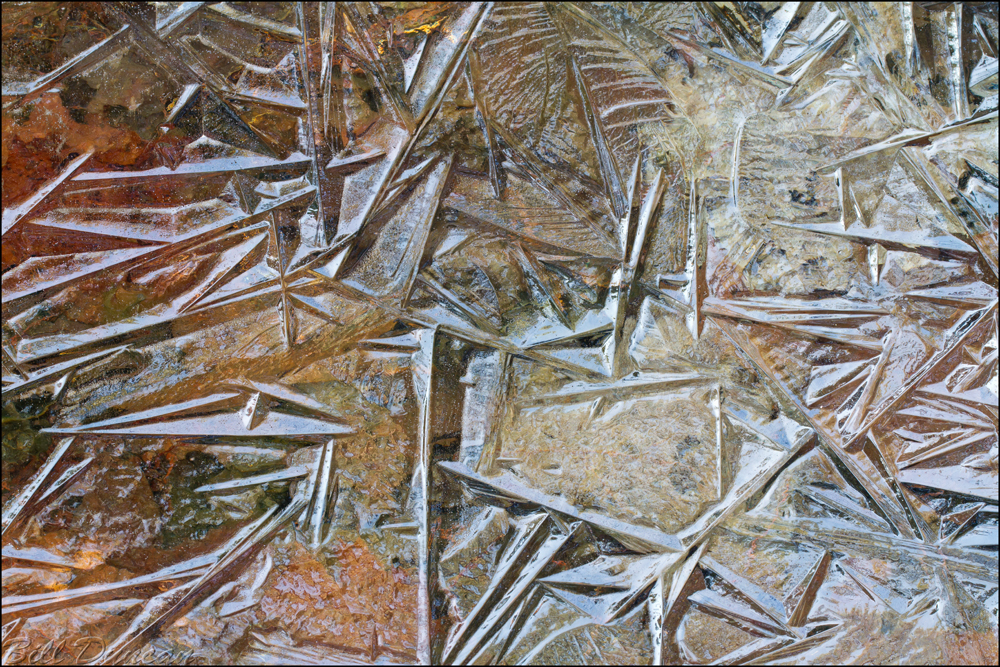
I naturally tend to process the winter images I’ve been able to produce toward the cool end, either through white balance decisions or in monochrome toning.  The image presented above is a more neutral or even warm image.  These leaves, which had fallen weeks earlier in mid-autumn were approximately two feet under the surface of this stream which runs through Hawn State Park in the beautiful St. Francois Mountains.  A layer of ice about one inch thick provided the first layer of texture and the warm mosaic the fallen leaves of the stream bottom provided another.

Technical details: Canon EOS 7D camera, EF100mm f/2.8L Macro IS USM lens, ISO 100,  f/18, 1.6 sec

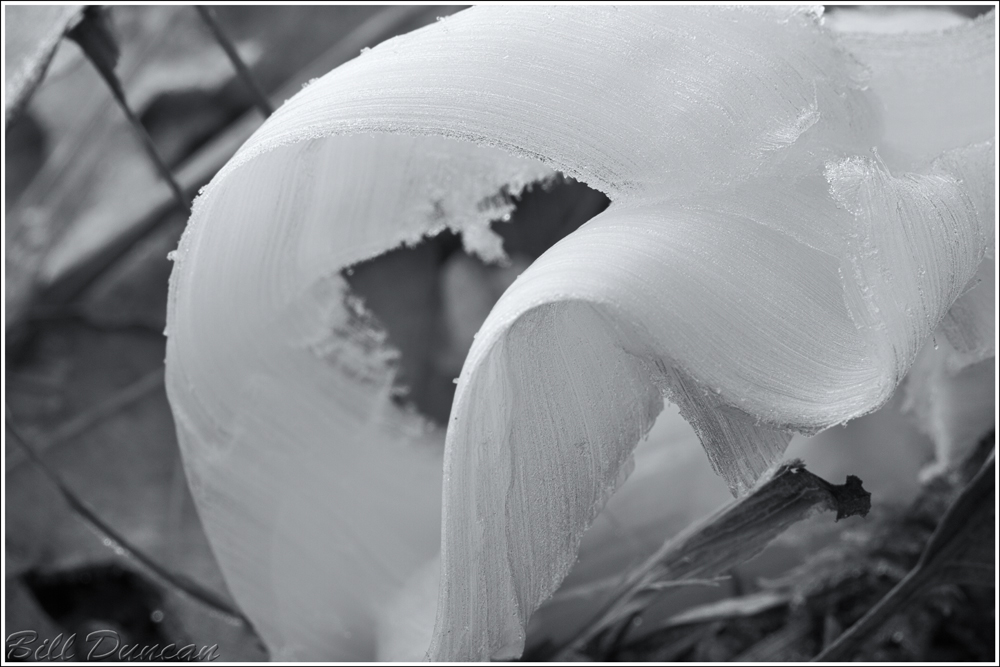
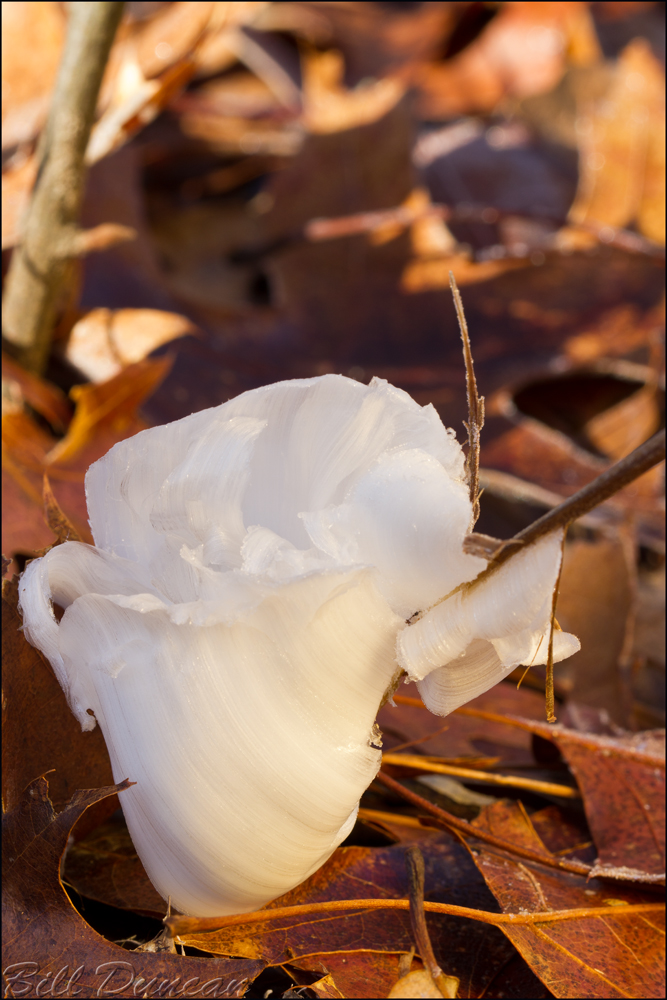
The crystalofolia.  Ive blogged about these once before.  This particular beauty was quite intricate.  I tried to convey a sense of three-dimensionality and capture the detail one can only really see through the magnification of a lens.

Technical details: Canon EOS 7D camera, EF100mm f/2.8L Macro IS USM lens, ISO 100,  f/11, 1 sec

You don’t have to read the title of this post to know that winter is MIA this year across much of North America.  This past spring I purchased my all wheel drive-all the time Subaru Forester, replacing a good vehicle but one of the worst winter vehicles to drive you can imagine.  For years, I had to either stay home or borrow the wife’s front-wheel drive vehicle if I wanted to make an outing into the snow and ice.  My anticipation for this winter season has been growing ever since.  Nothing was going to stop me now from the winter image making opportunities I dreamed about finding in some of my favorite places in the Ozarks and northern Missouri.  Never did I imagine the Mother Nature would play a cruel prank and give me what is to date the mildest winter that I can recall.   I have been able to make a few winter photographs this year, including the ones in this post.  But come on, I bought a pair of ice cleats for my hiking boots!  If February continues the way it started here in Missouri, I’ll be the first to sign the “Let’s eat Punxsutawney Phil in a stew of his own juices” petition.

Happy Groundhog Day.

Sophia M. Sachs Butterfly House

“So, where are we going?  To see Sophey having sex?” my wife questioned me when I woke her early on one of our shared days off during the past holiday break.

No, I replied.  “We are getting up early to get some breakfast and then on to the Sophia M. Sachs Butterfly House.  We have to get there by 9:00 to beat the crowds of older and younger people that will surely be troublesome as well as everyone with a camera phone who is trying to take a masterpiece of a butterfly.  We have to get there early so that the butterflies are not fully warmed by the slow winter sun and become too active to shoot easily.”

Technical details: Canon EOS 7D camera, EF100mm f/2.8L Macro IS USM lens, ISO 160,  f/14, 1/30 sec

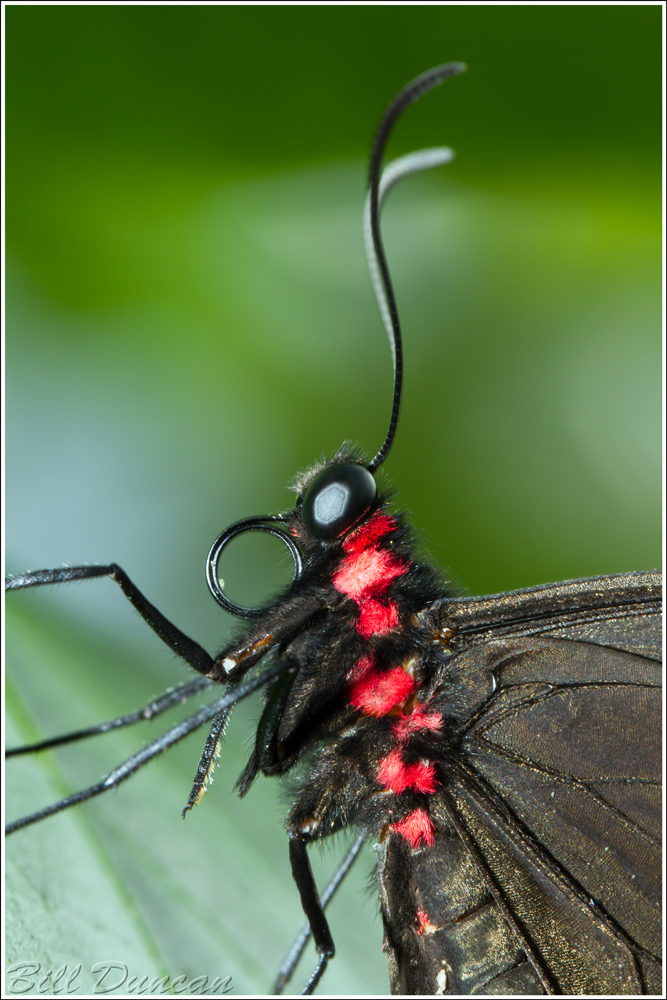
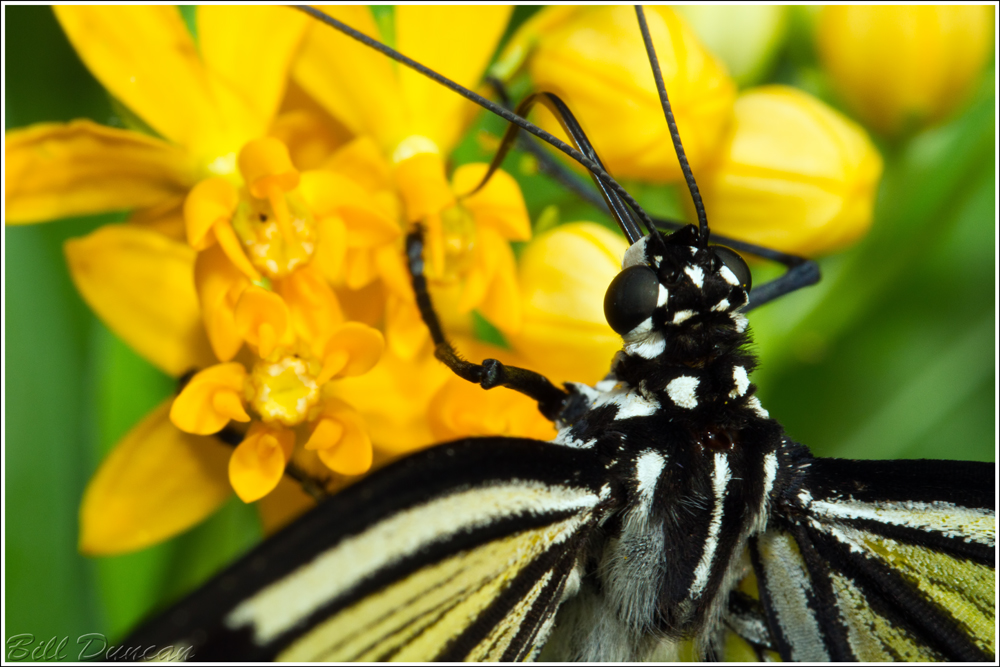
These subjects at this location are definitely a challenge.  What makes it even worse is that on a colder winter day you cannot expect to go directly in to the high temperature and high humidity environment and start shooting.  You will find that your cold equipment has condensation all over it.  Sure, you could try wiping the glass surface of your lens over and over until the condensation is all but gone, but you shouldn’t.  Think about it.  If the moisture is building on the outside of your camera and lens, then any moisture that is suspended in the air inside your equipment will also condense – condense all over the intricate electronic circuits that make up your expensive camera and lens package that you saved for so long to purchase.

Technical details: Canon EOS 7D camera, EF100mm f/2.8L Macro IS USM lens, ISO 200,  f/14, 1/30 sec

So what to do now?  Well, if your equipment is much colder or warmer moving from one environment to another you only have a couple of options.  You could do nothing and wait for all signs of condensation to dissipate before powering your equipment, thereby being relatively certain there is no condensation on those electrical connections that you do not want to short.  Or, you can seal your equipment in a zip-lock bag.  Leave your equipment in the bag and allow it to reach the temperature of the new environment.  The air in the bag will not be nearly as humid as the air in the greenhouse, or whatever warmer environment you have moved to.  Once the equipment has reached the same temperature, take it out of the bag and you will not see the condensation.  This second option would be the most desirable, if you remember to pack appropriate-sized zip-lock bags.

Technical details: Canon EOS 7D camera, EF100mm f/2.8L Macro IS USM lens, ISO 320,  f/16, 1/40 sec

There are many techniques and equipment combinations one can use for macro photography and I have used several different combinations and techniques.  For insects, distance is obviously important and focal length and focusing distance should be a primary consideration when making your decisions about what equipment to purchase.

Technical details: Canon EOS 7D camera, EF100mm f/2.8L Macro IS USM lens, ISO 200,  f/11, 1/40 sec

I would love to see the Butterfly House have one or two “photographers hours” a week.  I picture a day where they open the house early for an hour or so for only photographers.  There would be no school groups, no kids trying to rip the animals wings off.  This could be a great opportunity for us to get some great practice in for the summer insect season.

Technical details: Canon EOS 7D camera, EF100mm f/2.8L Macro IS USM lens, ISO 320,  f/16, 1/60 sec

Devil’s Walking Stick

Rising from the alluvial plain that the Mississippi River carved in eastern Missouri and Arkansas is the geological feature known as Crowley’s Ridge.  This ridge, composed of sedimentary soil known as loess, is populated with flora and fauna that are more-closely related to ecosystems of the Appalachians then they are to the closer, mountainous regions of the Ozarks to the North and West.  One of the uniquely eastern species that is commonly found along Crowley’s Ridge is the devil’s walking stick, Aralia spinosa.  This image was taken at Morris State Park in South-eastern Missouri.

Technical details: Canon EOS 50D camera, EF100mm f/2.8L Macro IS USM lens, ISO 160,  f/11, 1/4 sec

Crystallofolia & Armadillos: Hawn State Park Presents its Inspiration at Every Season

I spent a fantastic Saturday hiking and making images in the Missouri Ozarks yesterday.  Any day, even a bad day, in nature beats about anything else I can think of doing.  Some days I barely take the camera out of the bag, instead concentrating on hiking, birding, botanizing, etc…  Other days, like yesterday, it took me close to six hours to hike the North loop of the Whispering Pine Trail of Hawn SP because I stopped so often to set up the camera or observe some wildlife.

Technical details: Canon EOS 7D camera, EF100mm f/2.8L Macro IS USM lens, ISO 100,  f/14, 1/13 sec

My primary photographic subject turned out to be these exquisite crystallofolia, or “frost flowers”.  I have wanted to get some pictures of these things for a while now but they can be quite difficult to find, needing specific requirements to form.  I could spend a few paragraphs attempting to explain this mysterious and ephemeral natural wonder.  Instead, I will lead you to the well-written document by Missouri’s own Ted MacRae.

Technical details: Canon EOS 7D camera, EF100mm f/2.8L Macro IS USM lens, ISO 100,  f/18, 1/6 sec

As the title of this post suggests, Hawn SP is a destination of mine at least once a season.  I have rarely visited this spot in Ste Genevieve County and gone home without seeing something new, something extraordinary or at least come away renewed.  There are no shortages of photographic potentials and it is one of the closest spots to St. Louis where I really feel I have gotten away from it all.  Even on the busiest days it is rare to come across other people on the trail.

Technical details: Canon EOS 7D camera, EF100mm f/2.8L Macro IS USM lens, ISO 100,  f/18, 1/3 sec

Getting near the trailhead on the way back I heard some rustling in the leaves.  I followed the sound to what at first looked like a large opossum.  I was pleasantly surprised to find it was an armadillo!  This was the first live armadillo I’ve seen and photographed.  When I came across this guy my camera was of course attached to my tripod and strapped to my pack.  I had Canon’s new 100mm f2.8 macro L lens attached at the time.  I did not think I had much time before this guy slipped up and over the ridge she was heading up where I would lose her to the poor light on the north-facing side.  Therefore, I did not try and swap lenses to something a little more useful for this type of encounter such as the 70-200mm or 400mm.  Of course when focus is sharp, this lens has no equivalent in sharpness and image quality; however, autofocusing this lens under this situation was challenging to say the least.  I’ve read reviews saying this lens was a slow dog for autofocus, but that’s not what we buy macro lenses for, is it?  Anyway, besides a larger portion of focus failures than I’m accustomed to, I guess I managed to grab a few images that I am relatively happy with.

Technical details: Canon EOS 7D camera, EF100mm f/2.8L Macro IS USM lens, ISO 320,  f/4, 1/250 sec

Like many small mammals in the Missouri Ozarks, Armadillos have poor eyesight and must rely on their hearing and smell.  The section of the trail where this took place had a fair number of Oaks and of course at this time of year the forest floor was covered with a noisy blanket of dry fallen leaves.  I made enough of a racket running up the hillside that she was definitely aware someone was following her.  She often stopped and listened and as the previous image shows, she would raise up on her hind legs to get a good whiff of the potential predator on her tail.  Thankfully, I’ve been told I smell almost exactly like an armadillo, so she probably was not too alarmed by my presence.

Technical details: Canon EOS 7D camera, EF100mm f/2.8L Macro IS USM lens, ISO 320,  f/4, 1/800 sec

As usual, I reluctantly left Hawn in the early afternoon and proceeded to my evening destination – Hughes Mountain Natural Area, which is another place that never disappoints (although I still haven’t had too many interesting skies like I hope for).  I knew there would be a full-moon rising shortly after sunset and had a few poorly conceived ideas about what I wanted to do.  I took some images of the sunset and watched as the brightest, reddest and coldest moon I have ever seen rise almost directly opposite the sky from the sun.  In the end, it got too cold too quickly.  I played around with the moon in some images but I doubt I got anything I’ll be happy with.  I believe this image is showing the four hills that make up Buford Mountain and Bald Knob to the South-west of Hughes Mountain.  I’m still not close to have the sunrise/sunset images I’m looking for from Hughes Mountain.  One of these days everything will line up and I will hopefully get closer to what I am after.

Technical details: Canon EOS 7D camera, EF24-105mm f/4L IS USM lens @ 65mm, ISO 160,  f/11, 3.2 sec

Overall, another fantastic day.  I’ll be trying to rest my legs today.