Location Spotlight: Piney Creek Nature Preserve – Part Two

Technical details: Canon EOS 7D camera, EF-S10-22mm f/3.5-4.5 USM lens @ 12mm, ISO 100,  f/16, 0.6 sec

Ten days following my first visit and hike into Piney Creek Nature Preserve I arose early and left the house during one of the two appreciable snowfalls we’ve had this winter in our region so far (I was very sick on the second snowfall and could not enjoy it).  Prior to the temperature drop we had inches of rain during the previous day and I realized that places such as this should have a significant amount of water flowing through their streams and intermittent waterfalls.  Following a careful drive through the snow, I arrived two hours later almost the exact second the snowfall stopped.  This makes photographing a little easier without worrying about the equipment getting wet, but it would have been nice to hike in the falling white stuff for a while.
Technical details: Canon EOS 7D camera, EF24-105mm f/4L IS USM lens @ 24mm, ISO 200,  f/13, 0.8 sec

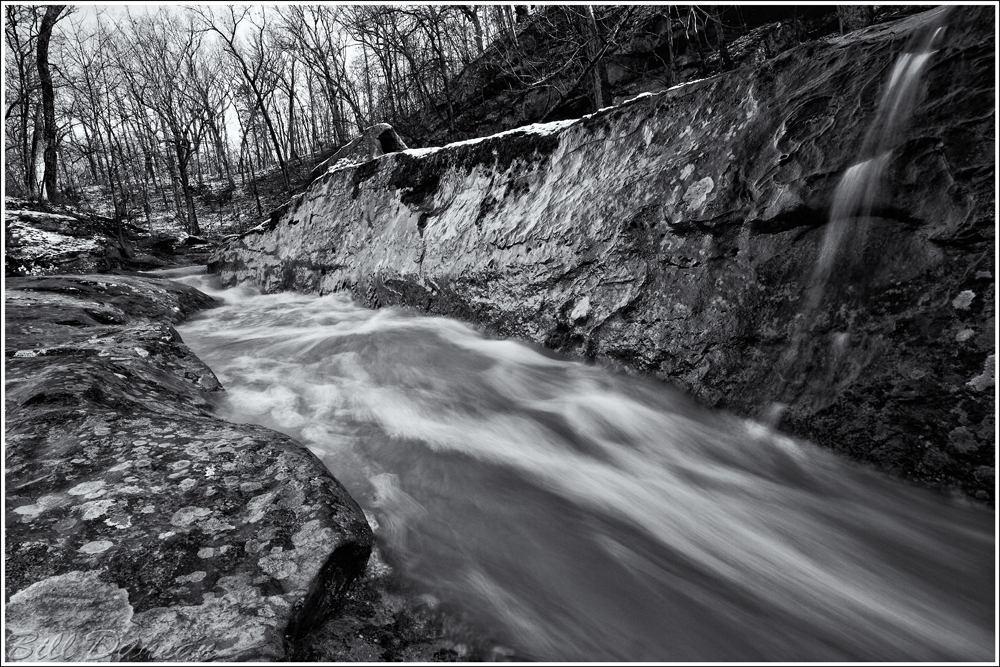
The image above was the first waterfall I heard.  To get here required a short bushwhack off trail and down into the ravine.  A hiking pole and crampon/spikes on your boots are definitely helpful in doing this.  The rock in this area was extremely slick, with ice on top of algae/slime.  I was very cautious moving on the rocks to set up this shot, realizing that the rock sloped toward the stream and loosing my footing would prove disastrous. Because of the higher water and treacherous footing the available compositions were somewhat limited.  Considering how poorly I function with too many options, this was not exactly a bad thing!
Technical details: Canon EOS 7D camera, EF-S10-22mm f/3.5-4.5 USM lens @ 21mm, ISO 100,  f/16, 0.3 sec

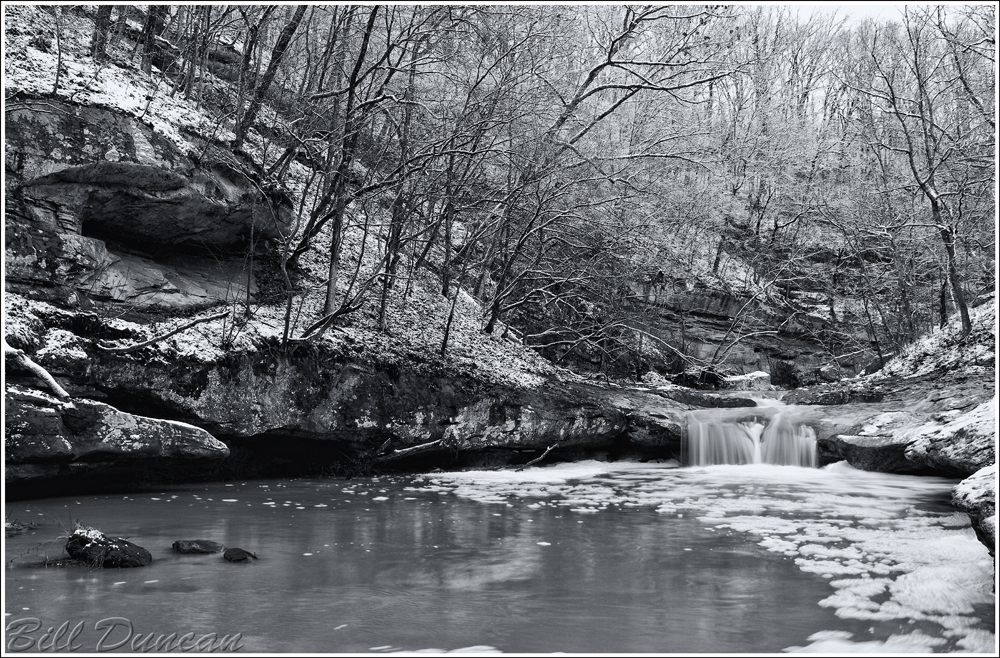
This cascade pictured above is a section of a longer series of twists and drops found closer to the back side of the hiking loop.  The water here skips shallowly over rock shelves and narrow chutes and takes occasional breaks in what appear to be quite deep pools.  When I made it to this section of the reserve the cloud cover was almost completely gone and blue skies were above.  The sun that would completely melt this fresh snow by the time I drove home this day was just beginning to peak over the bluff.  I realized that I would soon be faced with high-contrast shadows and harsh glare off the landscape scenery and I needed to grab every capture I could in the limited time available.  Sometimes it is also best to work with a deadline.  😉
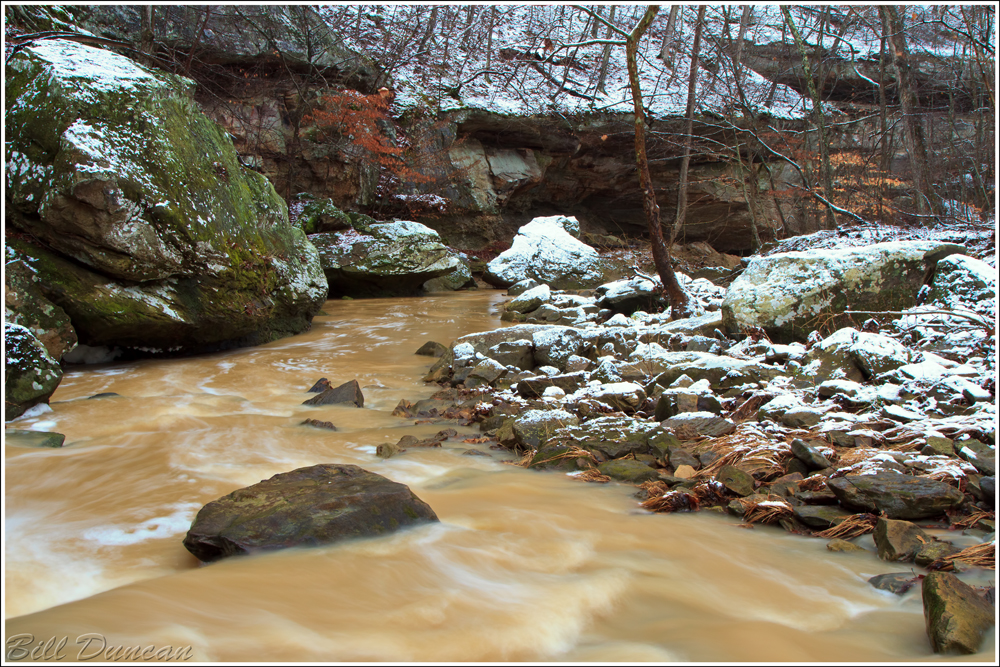
Technical details: Canon EOS 7D camera, EF24-105mm f/4L IS USM lens @ 24mm, ISO 200,  f/14, 1 sec

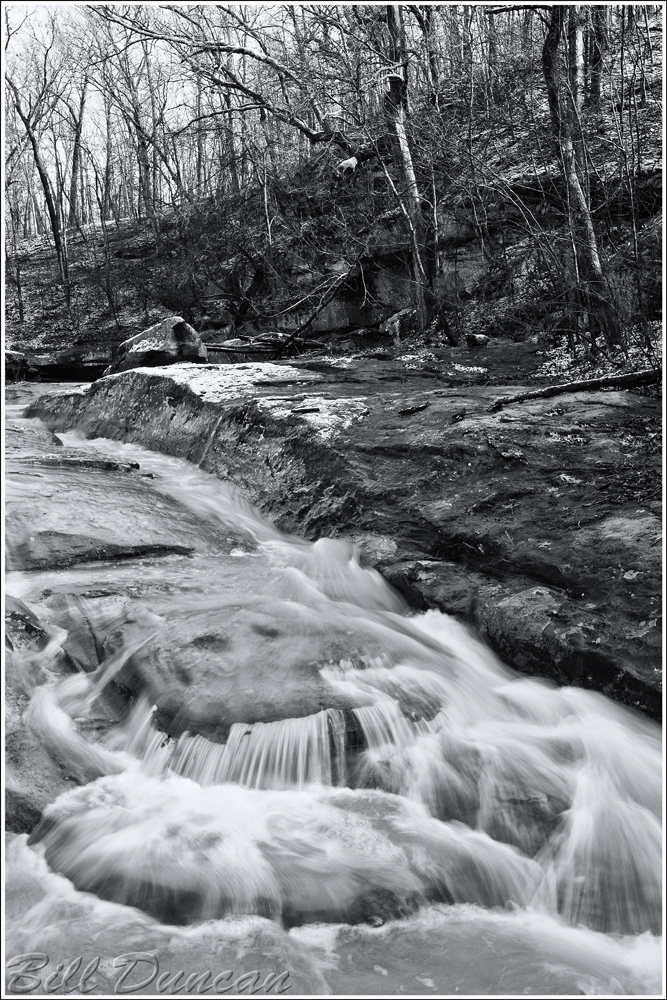
You can see that the previous one to two day rain brought a lot of soil into the stream.  Because of this, I felt most of the images would be presented best in monochrome.  I did want to present what one of these scenes looks like in color, however.  This one had some greens and reds to provide a little contrast between the browns of the water and rocks and white snow.
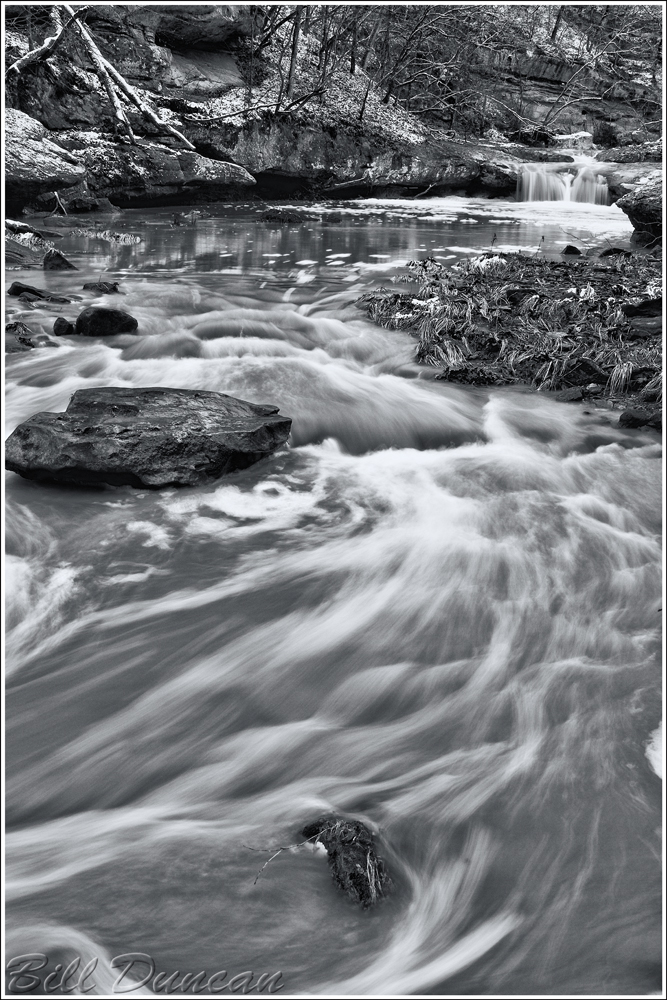
Technical details: Canon EOS 7D camera, EF24-105mm f/4L IS USM lens @ 24mm, ISO 160,  f/16, 0.8 sec

This place has a lot more to offer than what I present here.  There were at least two other significant waterfalls that I could see or hear, but the terrain with the snow and ice on precipitous ravine sides caused me to think wisely against trying to get within good photography distance.  Definitely something to try during better weather this spring.  I’ll be looking forward to my next visit to Piney Creek Nature Reserve.  Maybe I’ll even plan on paying a visit to the Popeye museum along the way in the town of Chester.
Location Spotlight: Rock Between Two Soft Places

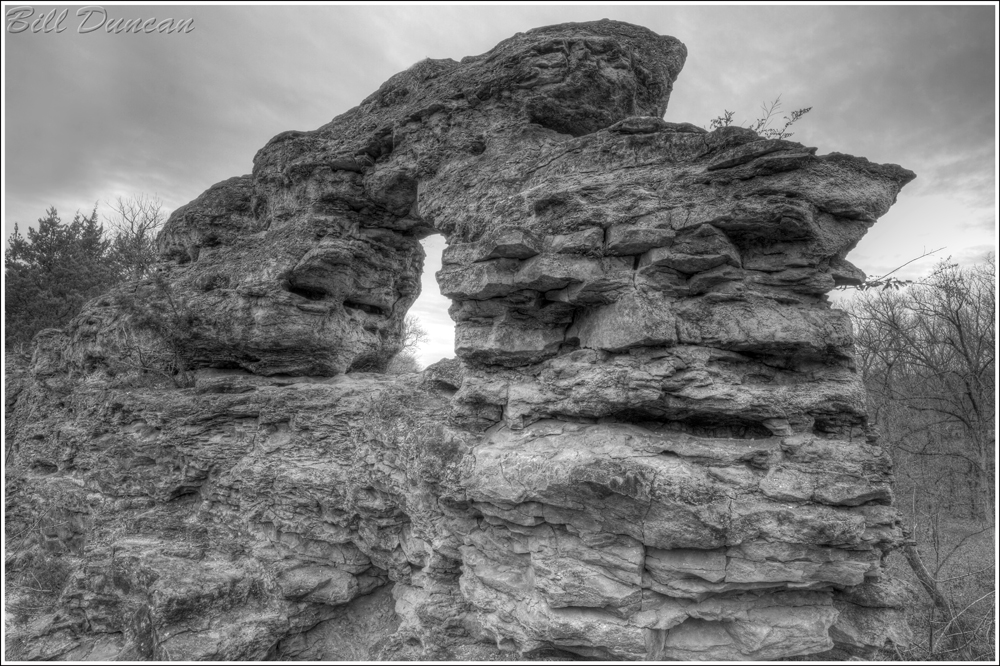
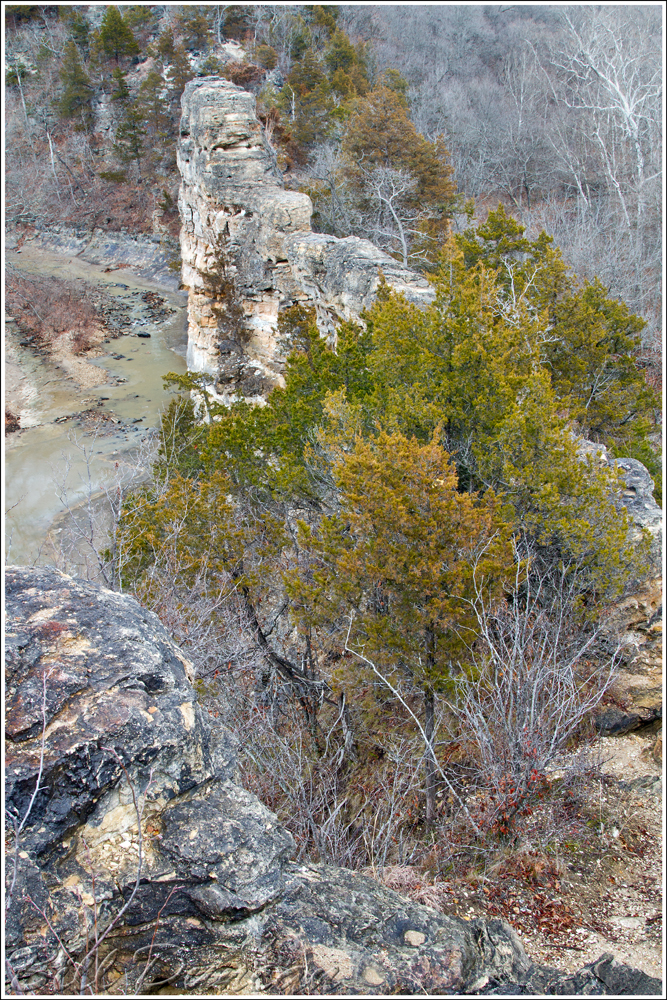
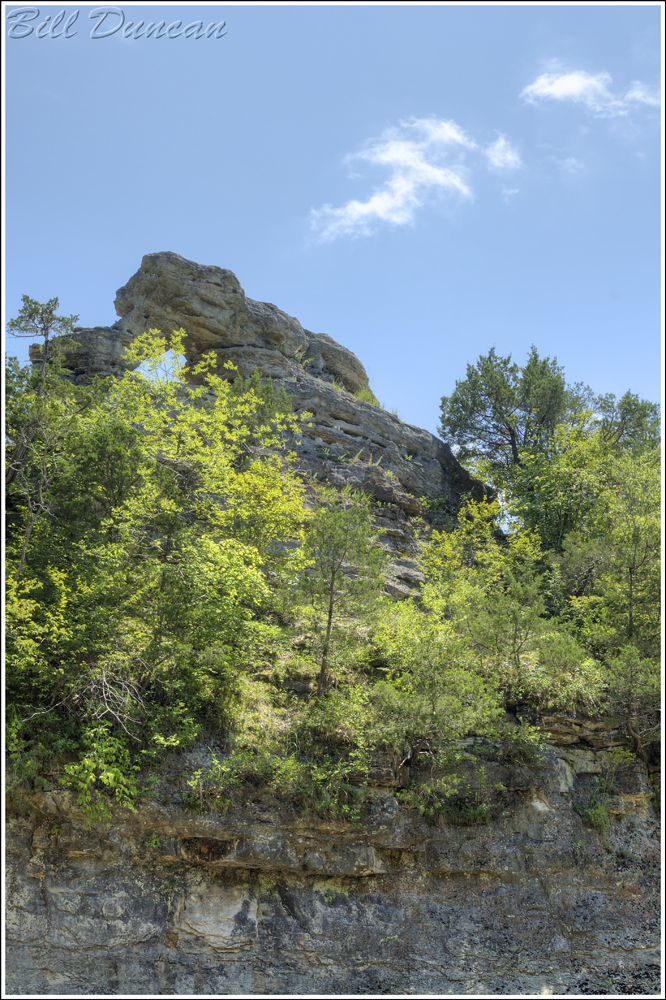
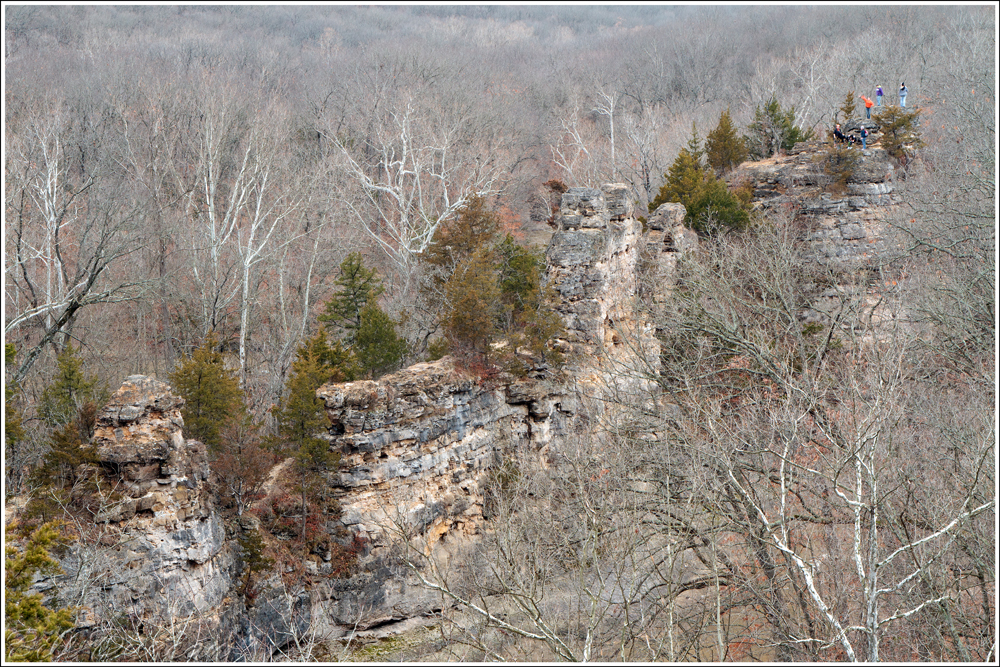
The Pinnacles, also known as “Boone County Pinnacles Youth Park” is a Missouri State Designated Natural Area located approximately 12 miles north of Columbia.  The geologic structures know as The Pinnacles formed between two parallel Ozark streams, Silver Fork and Rocky Fork.  These streams running closer and closer to one another have formed this erosional structure (senile ridge) that is approximately 75′ high and 1000′ in length.

Technical details: Canon EOS 7D camera, EF24-105mm f/4L IS USM lens @ 60mm, ISO 160,  f/13, 1/4 sec

The Pinnacles are composed primarily of Burlington Limestone, with a small amount of sandstone to act as a “cement” in some places.  This fact was the inspiration of the title of this post.  These two streams are quite quickly, in a geological perspective, eroding this separation between them.  Limestones are very easily eroded by forces of weather and flowing water.  On this visit I easily found fossil crinoids in the rock, a feature Burlington limestone is known for.

Technical details: Canon EOS 7D camera, EF24-105mm f/4L IS USM lens @ 24mm, ISO 160,  f/18, 1/4 sec

The most recent time I visited here the weather was quite poor.  During one of the sporadic sleet and freezing rain showers I took shelter under one of the windows, or natural arches, that erosion has carved in the rock.  While I was waiting out the weather I was able to take a close look at the composing rock.  The amount of cracks and other signs of erosion was eye-opening.  While I was sitting there, bits and pieces of rock were literally falling off the overhanging arch and landing around me.  It takes little imagination to realize the effects that changing mid-western seasons along with ebbing flows of the streams are having on this feature.  Geologists reckon this rock feature has only a couple thousand years left, so if you plan on visiting, do it soon!

Technical details: Canon EOS 7D camera, EFS10-22mm f/3.5-4.5L IS USM lens @ 13mm, ISO 160,  f/16, HDR blend of two images

If you do plan on visiting and bushwhacking your way across the stream and up onto the rocks, take care!  There are numerous spots that one wrong step could potentially be your last.  On top of the risks of being swept away by high water in crossing the stream and falling from the top of one these spires, there is the usual risk associated with the Northern Missouri Ozarks – private property.  Apparently one side of this site is bounded by a stretch of property owned by a particularly cranky old man.  I was warned by a regular visitor to stay clear of that side of the park as he will not hesitate to accost hikers that stray too far.  Unfortunately one of the two shallow spots I have found to cross the stream is located in what seems to be his property.

Technical details: Canon EOS 7D camera, EF24-105mm f/4L IS USM lens @ 28mm, ISO 160,  f/16, 1/2 sec

The eastern red cedar, which is really a juniper, loves limestone.  This species is a long-lived pioneer invader that will be one of the first trees to grow in a disturbed area or any area that other species find undesirable.  Because it will grow in crevices along bluffs and shallow, rocky soils that often lack resources needed to grow quick and large, small trees can often be over 600 years old.  In fact, the oldest documented individual of this species was recorded in Missouri and was found to be 795 years old!  This species is currently taking over much of Missouri’s knob-top glades found throughout the Ozarks.  Cedar is not tolerant of fire and the suppression of natural and man-made fires on modern private land as well as public lands such as the Mark Twain National Forest is allowing cedars to take hold in these habitats where they were historically controlled.  But, this is a subject for another post.

Technical details: Canon EOS 50D camera, EF17-40mm f/4L IS USM lens @ 28mm, ISO 100,  f/16, HDR blend of four images

Just a stone’s throw south of The Pinnacles is a “shelving rock” style of shut-in (not pictured).  This feature was formed by erosional forces of Silver Fork as the creek runs dead-on into limestone bedrock and is forced to make a sharp left turn.  This shelter is 40′ deep, 10′ high and 125′ long.  Although it looks like the shelter is often flooded during high waters, I am sure this was used by pre-Colombian man.

The Pinnacles is another destination for the landscape photographer in the Missouri Ozarks that offers a diversity of photo ops depending on time of day, weather and the season.  It is also a high quality biological habitat even though it is so close to a a major metropolitan area.  With luck and continued proper management this location will continue to be a place visitors can come to appreciate the geologic and natural features that the Missouri Ozarks offers and once offered in much greater abundance.

Much of the information used in this post was found in “Geologic Wonders and Curiosities of Missouri” by Thomas R. Beveredge.  This is a highly prized book in my collection.  I only wish someone would update and revise with GPS coordinates!


Ozark Dynamism

Elephant Rocks is one of my favorite locations in the Missouri Ozarks to visit and make photographs.  I don’t think it’s a big surprise that this would be true for many nature lovers/photographers.  I love the fact that one can make good photographs here any season of the year and almost any time of day.  If you face the right direction you can find good light on a good composition on almost every visit, not just in the narrow window of the “golden hour”.  However, if you can get there with perfect light and an interesting sky the outcome can be better than good.  My favorite time to visit is early in the day.  This is not only for the better light, but for the fact that I have had the place entirely to myself for a couple or more hours on several occasions.

I was fortunate to find an interesting sky on this visit.  I found that converting this one to B&W really played the dynamic sky against the interesting texture of the boulders below.  Inscribed on one of the rocks you can see the name of one of the many quarry workers who harvested the granite species of rocks from the surrounding area.

Technical details: Canon EOS 50D camera, EF-S10-22mm f/3.5-4.5 USM lens @ 10mm, ISO 100,  f/16, 1/15 sec

Finding A Sunset

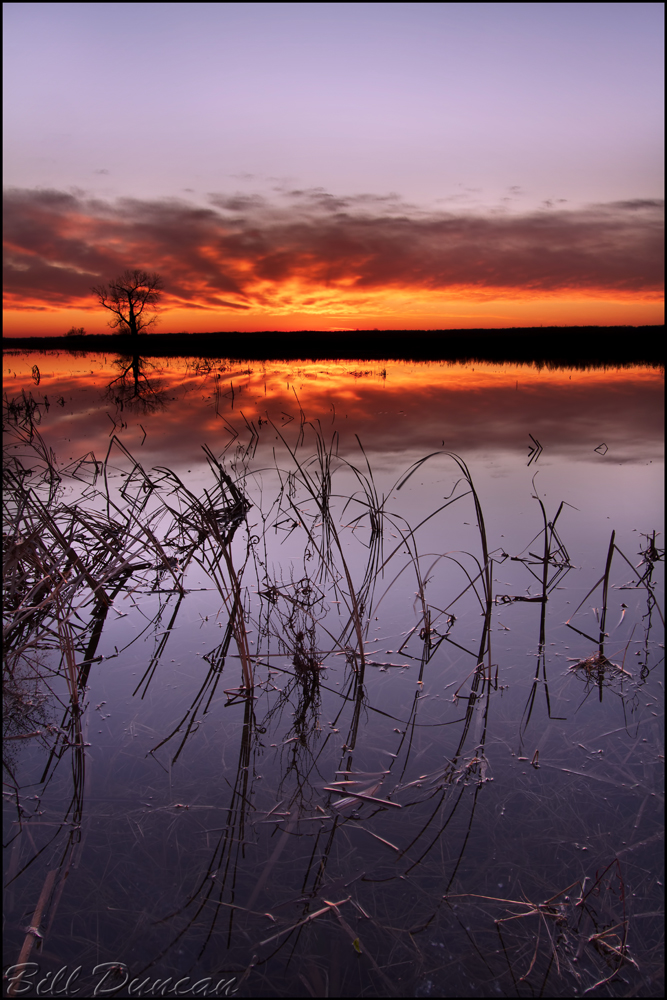
Columbia Bottom Conservation area, where this image was taken, and Riverlands Migratory Bird Sanctuary across the river are famous for the birds and other wildlife they support.  I have enjoyed birding these places, located at the confluence of North America’s two greatest rivers- the Missouri and the Mississippi, for more than five years now.  But, there is another reason I love being able to visit these locations.  These are two of the closest places near St. Louis to see open skies, open skies without hills, trees, building or too many power lines and utility poles.  I love shooting sunsets here because of the amount of sky that can be captured.  True, I did not cover much sky in this image.  This was due to the limited clouds in tonight’s sky.  If there were more clouds throughout the sky I would have loved to have let the sky cover two thirds or more of the frame.


It always saddens me when I’m driving to or from work and see one of the many spectacular sunsets or sunrises from the car and know I can’t be out in nature trying to experience that moment and capture it in a lasting image.


Technical details: Canon EOS 7D camera, EF-S10-22mm f/3.5-4.5 USM lens @ 16mm, ISO 100,  f/16, manual-HDR (7-images)

Crystallofolia & Armadillos: Hawn State Park Presents its Inspiration at Every Season

I spent a fantastic Saturday hiking and making images in the Missouri Ozarks yesterday.  Any day, even a bad day, in nature beats about anything else I can think of doing.  Some days I barely take the camera out of the bag, instead concentrating on hiking, birding, botanizing, etc…  Other days, like yesterday, it took me close to six hours to hike the North loop of the Whispering Pine Trail of Hawn SP because I stopped so often to set up the camera or observe some wildlife.

Technical details: Canon EOS 7D camera, EF100mm f/2.8L Macro IS USM lens, ISO 100,  f/14, 1/13 sec

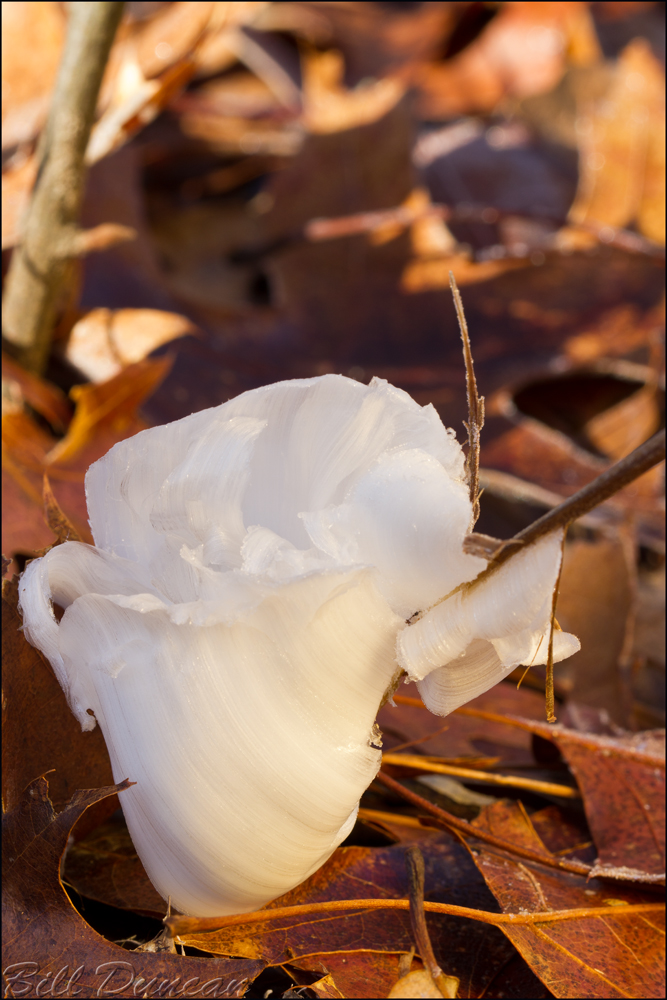
My primary photographic subject turned out to be these exquisite crystallofolia, or “frost flowers”.  I have wanted to get some pictures of these things for a while now but they can be quite difficult to find, needing specific requirements to form.  I could spend a few paragraphs attempting to explain this mysterious and ephemeral natural wonder.  Instead, I will lead you to the well-written document by Missouri’s own Ted MacRae.

Technical details: Canon EOS 7D camera, EF100mm f/2.8L Macro IS USM lens, ISO 100,  f/18, 1/6 sec

As the title of this post suggests, Hawn SP is a destination of mine at least once a season.  I have rarely visited this spot in Ste Genevieve County and gone home without seeing something new, something extraordinary or at least come away renewed.  There are no shortages of photographic potentials and it is one of the closest spots to St. Louis where I really feel I have gotten away from it all.  Even on the busiest days it is rare to come across other people on the trail.

Technical details: Canon EOS 7D camera, EF100mm f/2.8L Macro IS USM lens, ISO 100,  f/18, 1/3 sec

Getting near the trailhead on the way back I heard some rustling in the leaves.  I followed the sound to what at first looked like a large opossum.  I was pleasantly surprised to find it was an armadillo!  This was the first live armadillo I’ve seen and photographed.  When I came across this guy my camera was of course attached to my tripod and strapped to my pack.  I had Canon’s new 100mm f2.8 macro L lens attached at the time.  I did not think I had much time before this guy slipped up and over the ridge she was heading up where I would lose her to the poor light on the north-facing side.  Therefore, I did not try and swap lenses to something a little more useful for this type of encounter such as the 70-200mm or 400mm.  Of course when focus is sharp, this lens has no equivalent in sharpness and image quality; however, autofocusing this lens under this situation was challenging to say the least.  I’ve read reviews saying this lens was a slow dog for autofocus, but that’s not what we buy macro lenses for, is it?  Anyway, besides a larger portion of focus failures than I’m accustomed to, I guess I managed to grab a few images that I am relatively happy with.

Technical details: Canon EOS 7D camera, EF100mm f/2.8L Macro IS USM lens, ISO 320,  f/4, 1/250 sec

Like many small mammals in the Missouri Ozarks, Armadillos have poor eyesight and must rely on their hearing and smell.  The section of the trail where this took place had a fair number of Oaks and of course at this time of year the forest floor was covered with a noisy blanket of dry fallen leaves.  I made enough of a racket running up the hillside that she was definitely aware someone was following her.  She often stopped and listened and as the previous image shows, she would raise up on her hind legs to get a good whiff of the potential predator on her tail.  Thankfully, I’ve been told I smell almost exactly like an armadillo, so she probably was not too alarmed by my presence.

Technical details: Canon EOS 7D camera, EF100mm f/2.8L Macro IS USM lens, ISO 320,  f/4, 1/800 sec

As usual, I reluctantly left Hawn in the early afternoon and proceeded to my evening destination – Hughes Mountain Natural Area, which is another place that never disappoints (although I still haven’t had too many interesting skies like I hope for).  I knew there would be a full-moon rising shortly after sunset and had a few poorly conceived ideas about what I wanted to do.  I took some images of the sunset and watched as the brightest, reddest and coldest moon I have ever seen rise almost directly opposite the sky from the sun.  In the end, it got too cold too quickly.  I played around with the moon in some images but I doubt I got anything I’ll be happy with.  I believe this image is showing the four hills that make up Buford Mountain and Bald Knob to the South-west of Hughes Mountain.  I’m still not close to have the sunrise/sunset images I’m looking for from Hughes Mountain.  One of these days everything will line up and I will hopefully get closer to what I am after.

Technical details: Canon EOS 7D camera, EF24-105mm f/4L IS USM lens @ 65mm, ISO 160,  f/11, 3.2 sec

Overall, another fantastic day.  I’ll be trying to rest my legs today.