"What a thousand acres of Silphiums looked like when they tickled the bellies of the buffalo is a question never again to be answered, and perhaps not even asked." -Aldo Leopold
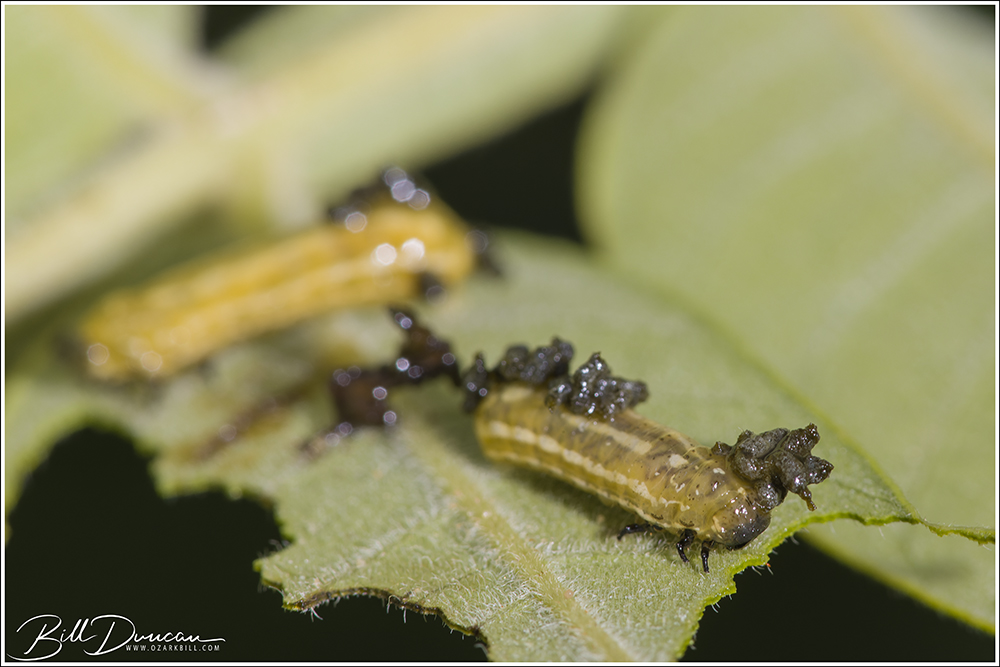
Today’s post features lovely little Chrysomelid beetle larvae. These were found at Taberville Conservation Area in St. Clair County, MO in June of this year. Blepharida rhois – the sumac flea beetle, create “shields” by retaining their feces as a means of protection from would-be predators. It has been discovered that chemicals from their sumac (Rhuss spp.) host plants, along with partial metabolites from the digestive process, act as swell deterrents in avoiding ant predators. When fed a diet of lettuce, the shields’ protective abilities were lost.*
*Vencl, F., Morton, T. The shield defense of the sumac flea beetle, Blepharida rhois (Chrysomelidae: Alticinae). Chemoecology8, 25–32 (1998). https://doi.org/10.1007/PL00001800
Belepharida rhois – the sumac flea beetle with protective shields composed of their own frass
…comes the newest in reality based, sustainable living instructional programming: Corruption Construction!
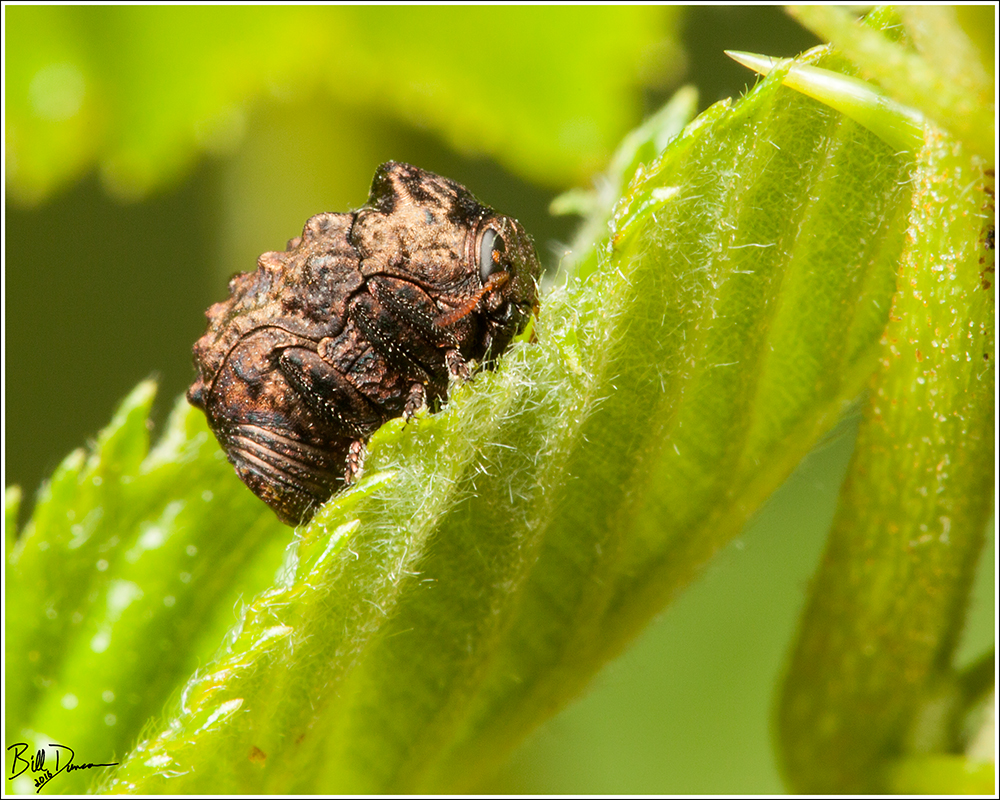
In a previous post I wrote a bit about the Warty Leaf Beetle (Neochlamisus gibbosus), a member of the Cryptocephalinae subfamily. Fascinating due to the fact that the adult form seems to be a perfect mimic of caterpillar frass, this species is much more interesting than I had imagined.
This species is highly, if not solely, associated with blackberry as a host plant. While watching these guys and looking for other insects on these plants I kept noticing gall-like structures, usually on the undersides of the leaves.
Paying closer attention, I noticed that these structures were not galls, nor were they attached directly to the plant tissue – they moved. On closer inspection, I could sometimes see the legs of the creature that resided within the house.
I had to crack one open to see if I could get an idea of what sort of organism built and resided within. As you can see in the photograph below, the animal appeared to be a beetle larvae.
Warty Leaf Beetle – Chrysomelidae – Neochlamisus gibbosus. Larvae exposed from within its scatological residence. Photographed at Shaw Nature Reserve, MO.
It took me a while to put it together, but eventually I confirmed that the larvae belonged to the same species as the adult beetles that I observed all over the blackberries. My next question was, on what materials did the larvae use to build its shelter? Usually, an insect will use detritus or perhaps fresh plant tissue that it processes to make a protective enclosure like this. These guys do it a bit differently.
It starts with mom. As she oviposits, she encases each egg with a layer of her own feces and some rectal secretions. As the larvae hatches and grows, it continues to expand its home by building with its own feces to accommodate its increasing bulk. Here is a photo of an adult and larvae close together.
While investigating a patch of Maypop (Passiflora incarnata) I could not find my goal of the Passion Flower Flea Beetle, but I was still happy to find a number of Shiny Flea Beetles – Chrysomelidae – Asphaera lustrans.
The Redbud Bruchid (Gibbobruchis mimus), as its name suggests, is one of those perfect examples of insect-plant specialization. The larvae of this species will only grow on the seeds of Redbud trees and perhaps on those of a relative or two.
Redbud Bruchid
Being extremely small (2.5 – 3 mm), these cute guys are quite the challenge to photograph. Adults feed on plant tissues (flower petals, pollen, nectar, etc…) and I typically have seen them feeding on my Echinacea flowers.
Redbud Bruchid
The guy above can be seen creating or adding to a hole in a flower petal. I much prefer them to the exotic invasive Japanese Beetles that tend to leave nothing behind.
Redbud Bruchid
The Bruchids are a subfamily or “tribe” found within the quite large family – the Chrysomelidae, known as “Leaf Beetles”.
Redbud Bruchid
If you know the size of an individual blossom of the Common Milkweed (Asclepias syriaca), the image above will give you a good idea on just how small these little guys are.





 A Thousand Acres of Silphiums