"What a thousand acres of Silphiums looked like when they tickled the bellies of the buffalo is a question never again to be answered, and perhaps not even asked." -Aldo Leopold
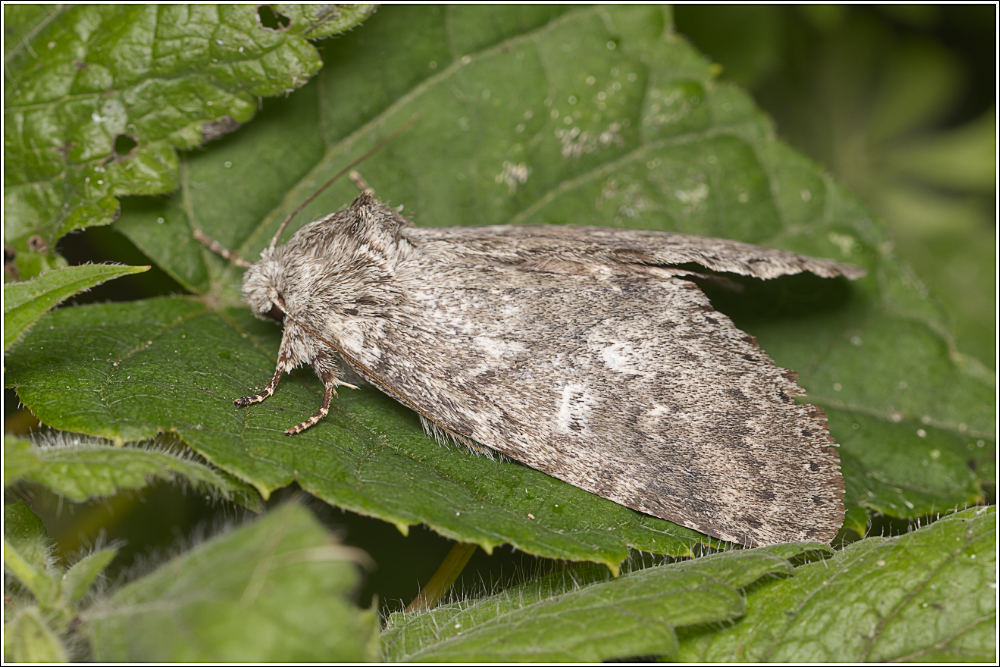
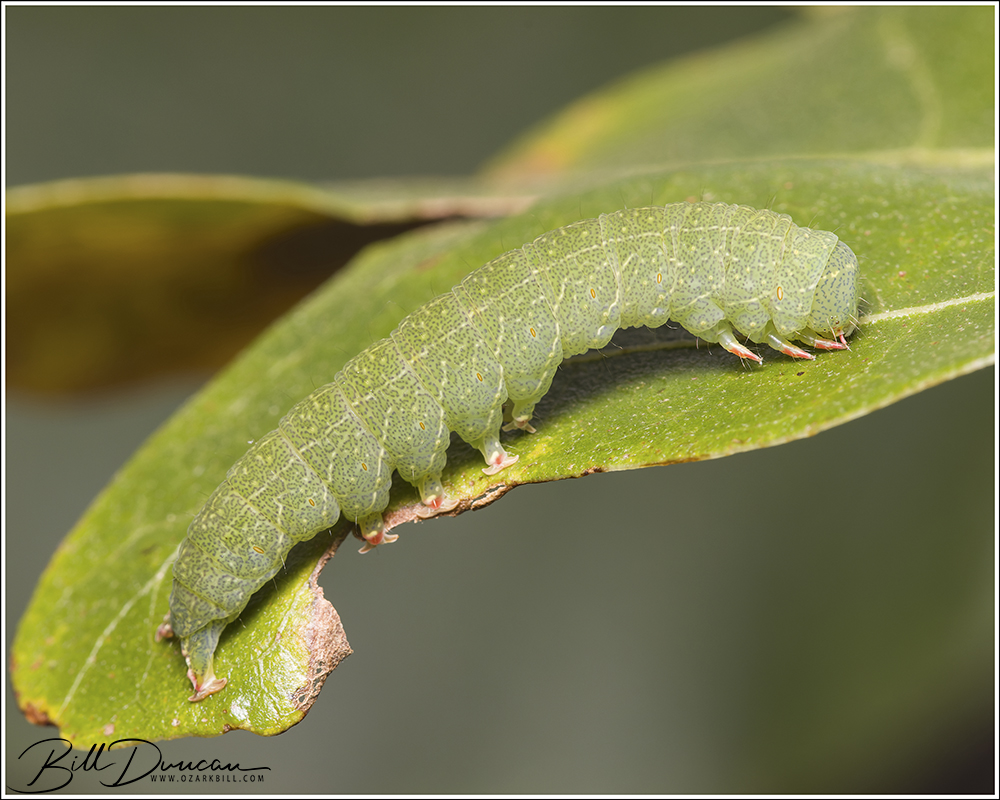
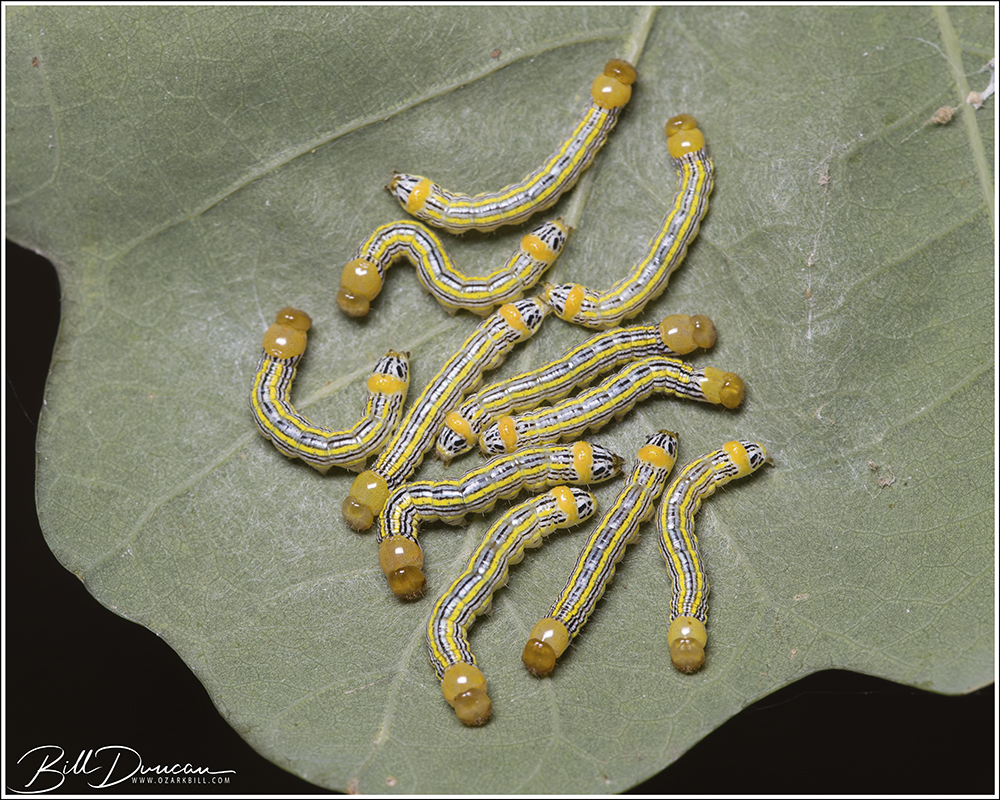
Red-fringed Emerald Nemoria bistriaria fam. Geometridae Host plant: Found on white oak (Quercus alba) Date found: 7, Sep, 2024 Locations Found: Kaintuck Hollow, Phelps County, MO Notes: Although some reports suggest other host plants are used, it is likely that this species specializes on white oak.
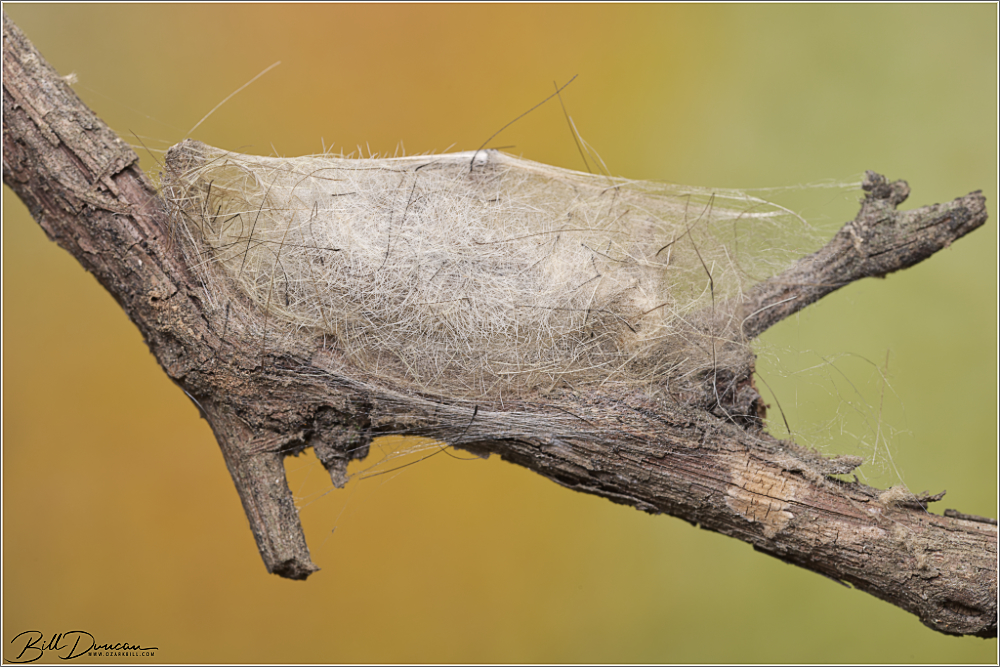
This post is related to the rearing work I shared previously of the Orgyia leucostigma (white-marked tussock moth). During a caterpillar hunting outing with Sarah, I found what was obviously a cocoon of a tussock moth. I can’t say for certain it belonged to O. leucostigma, but it is likely. So, I photographed it in the field and brought it home, keeping it separate from the O. leucostigma cocoons that I was rearing that were collected from my yard. As time went on and the other cocoons I was rearing began producing moths, I figured something was going to be different with the one pictured below.
A tussock moth (Orgyia sp.) cocoon collected on 21, Sep, 2024 at Onondaga Cave State Park. Note the long setae from the tussock moth caterpillar that are incorporated into their cocoons
Checking the container on 6-October, I found this beautiful Orgichneumon calcatorius, an Ichneumonid wasp with a Holarctic range that is a parasitoid of moths in the Orgyia and Dasychira genera. After taking a few photos, I let it go in the backyard. After emerging, females of the species mate and then overwinter as adults utilizing crevices in tree bark. In the spring and summer of the following year, they look for new caterpillars to insert their eggs.
A newly emerged Orgichneumon calcatorius with the pupa and cocoon that hosted it in the background.
A closeup look of the brilliantly patterned Orgichneumon calcatorius
Virginia Creeper Sphinx Moth Darapsa myron fam. Sphingidae Host plant: Found on wild grape (Vitis sp.) Date found: 13, Sep, 2024 Locations Found: River’s Edge Park, St. Louis County, MO Notes: Other common name is hog sphinx.
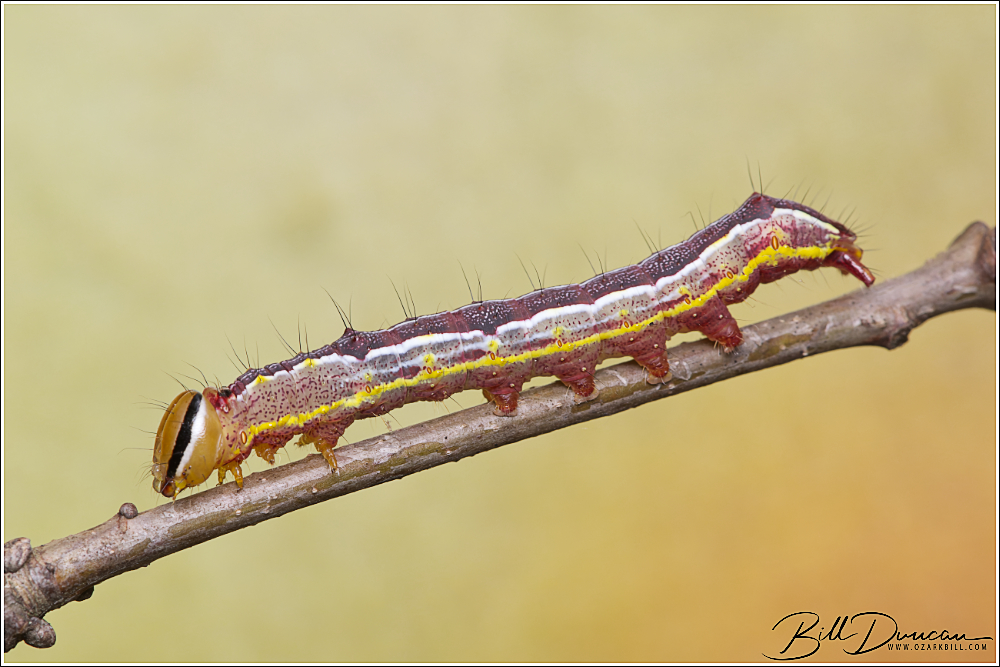
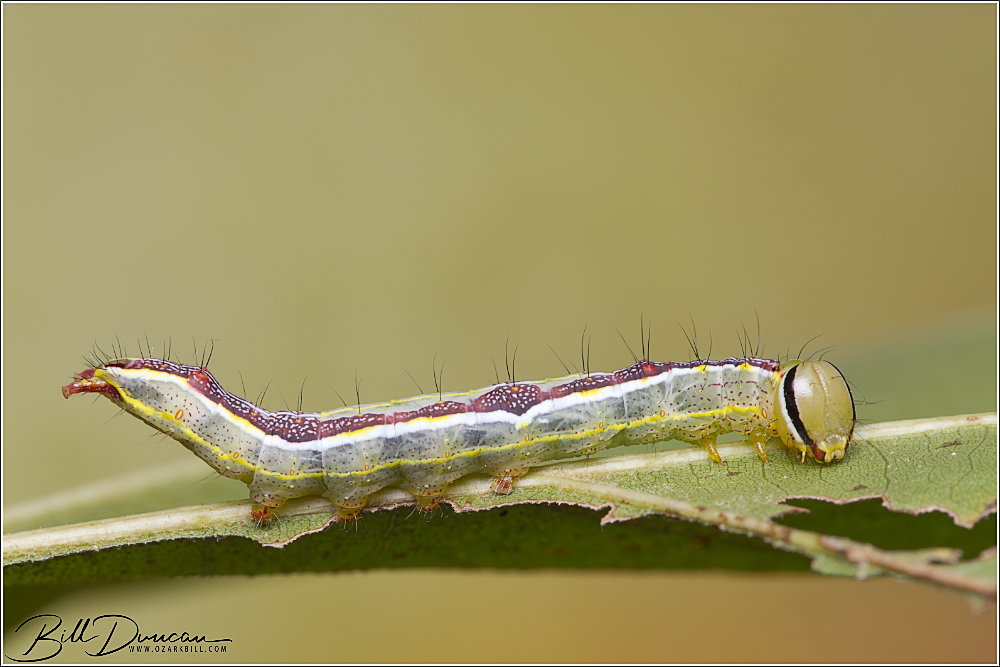
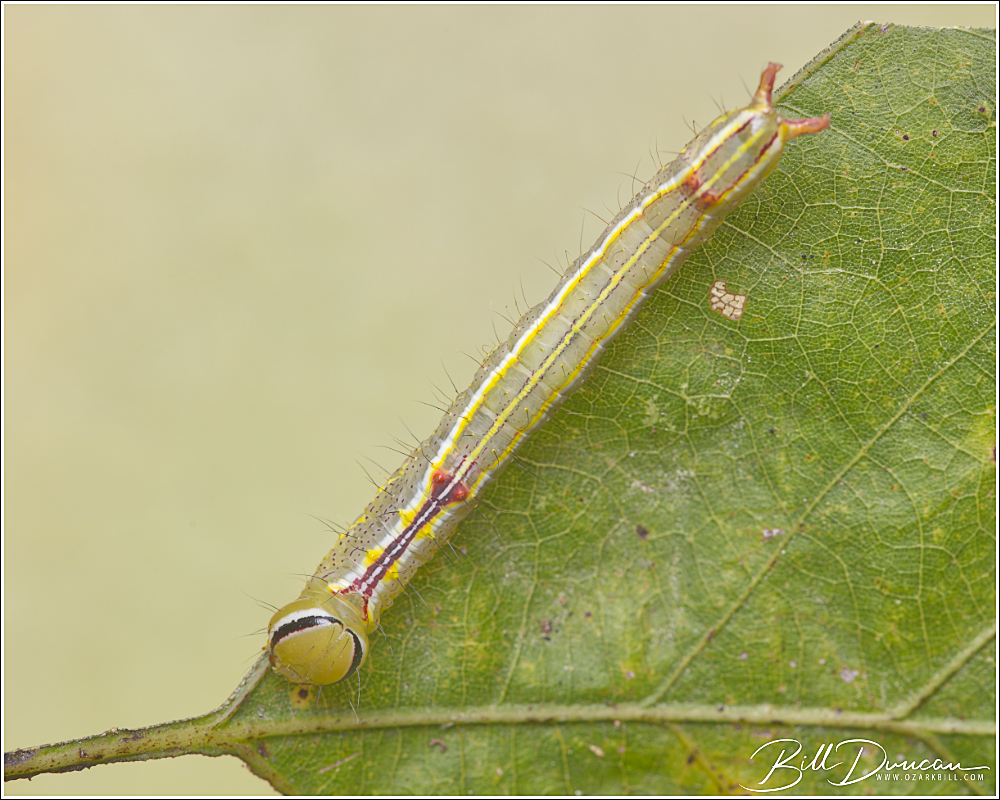
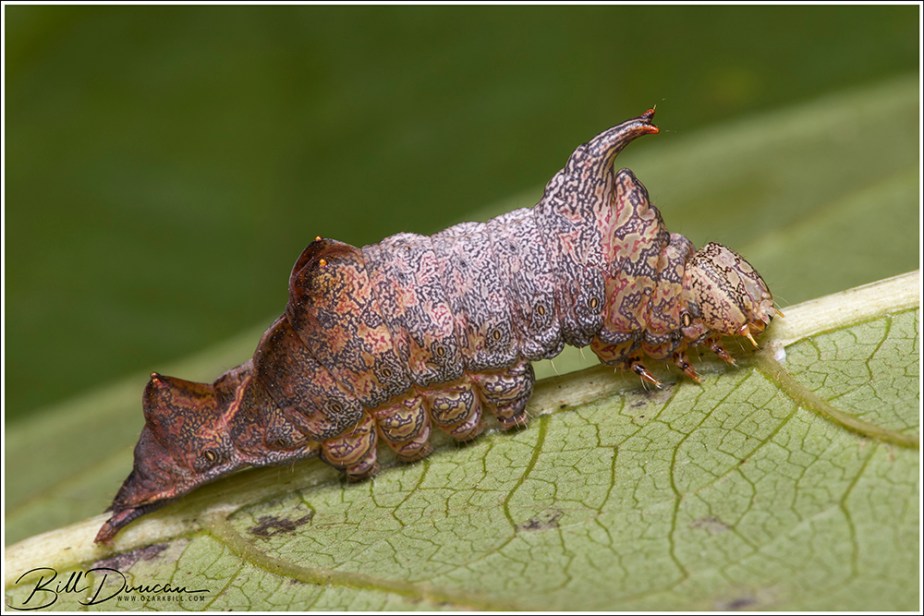
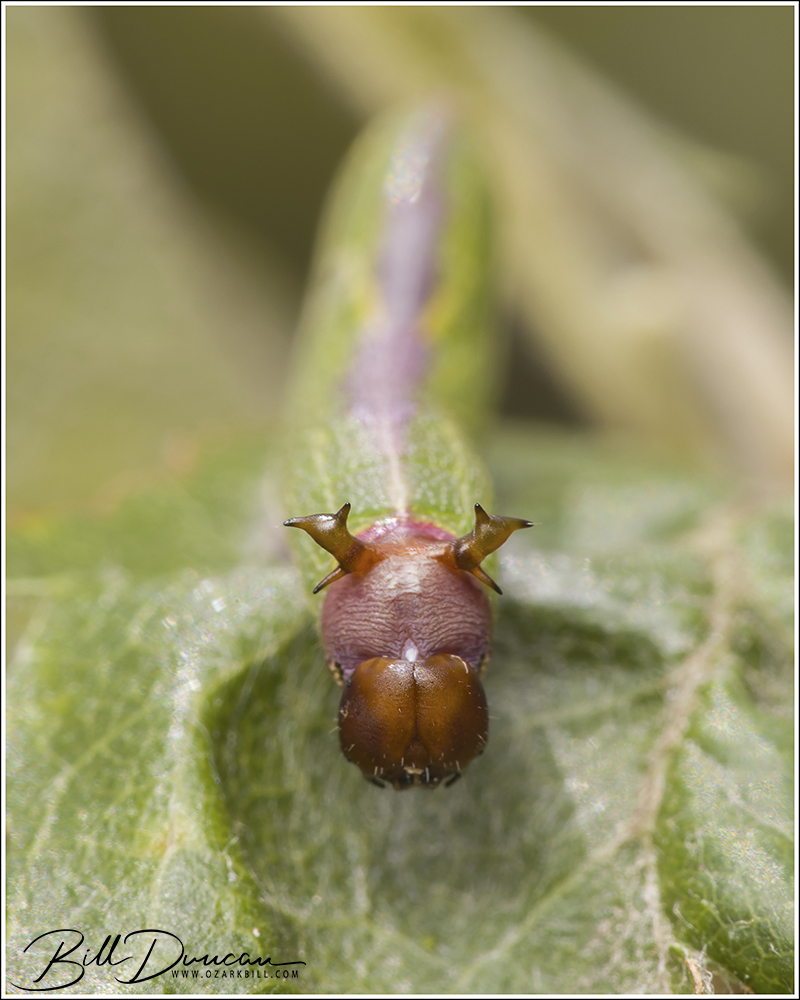
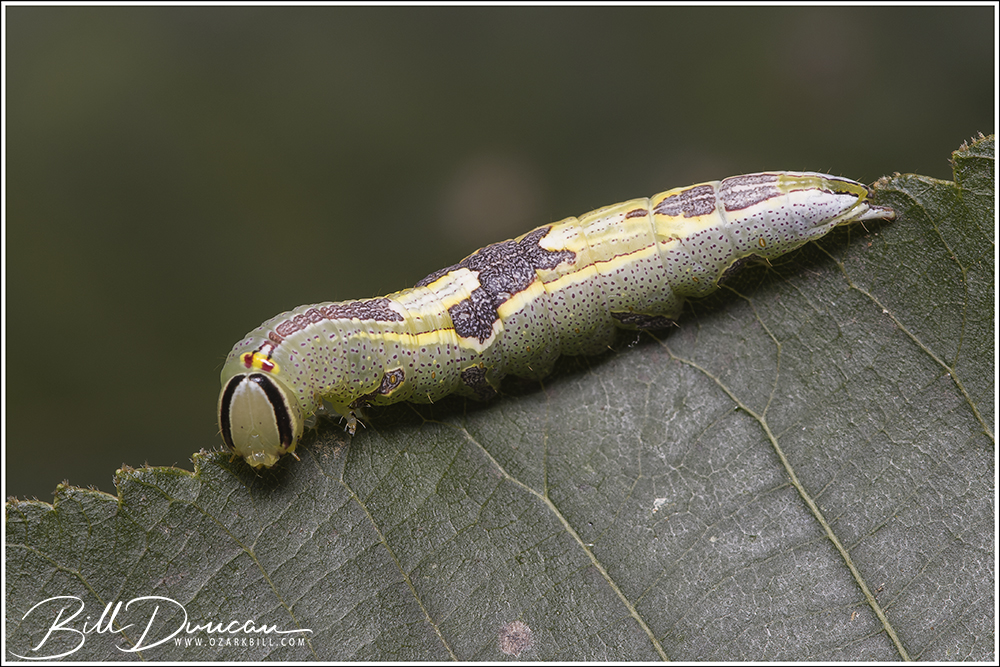
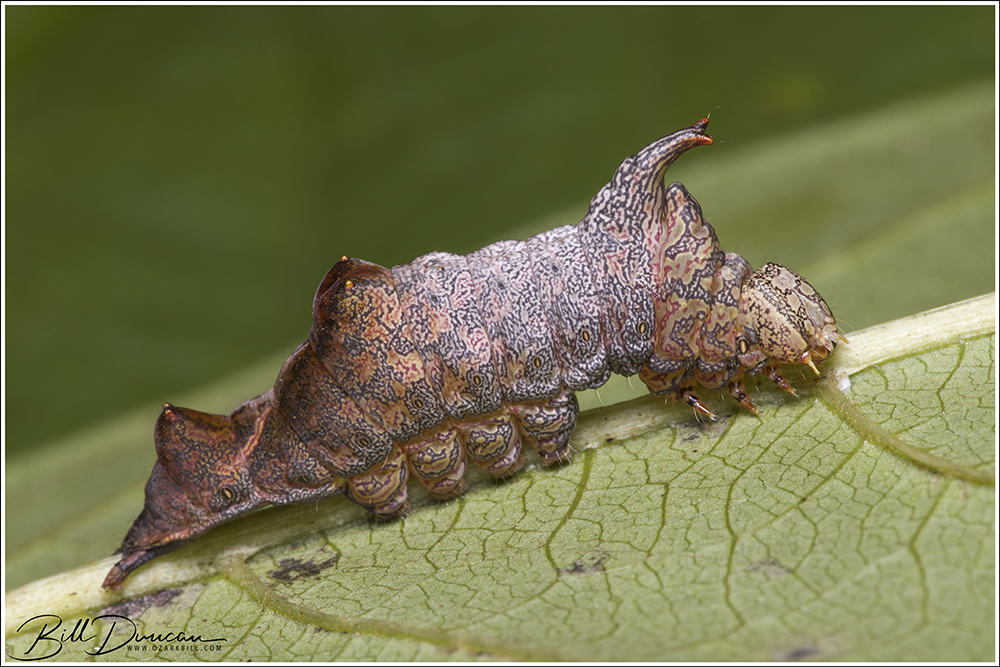
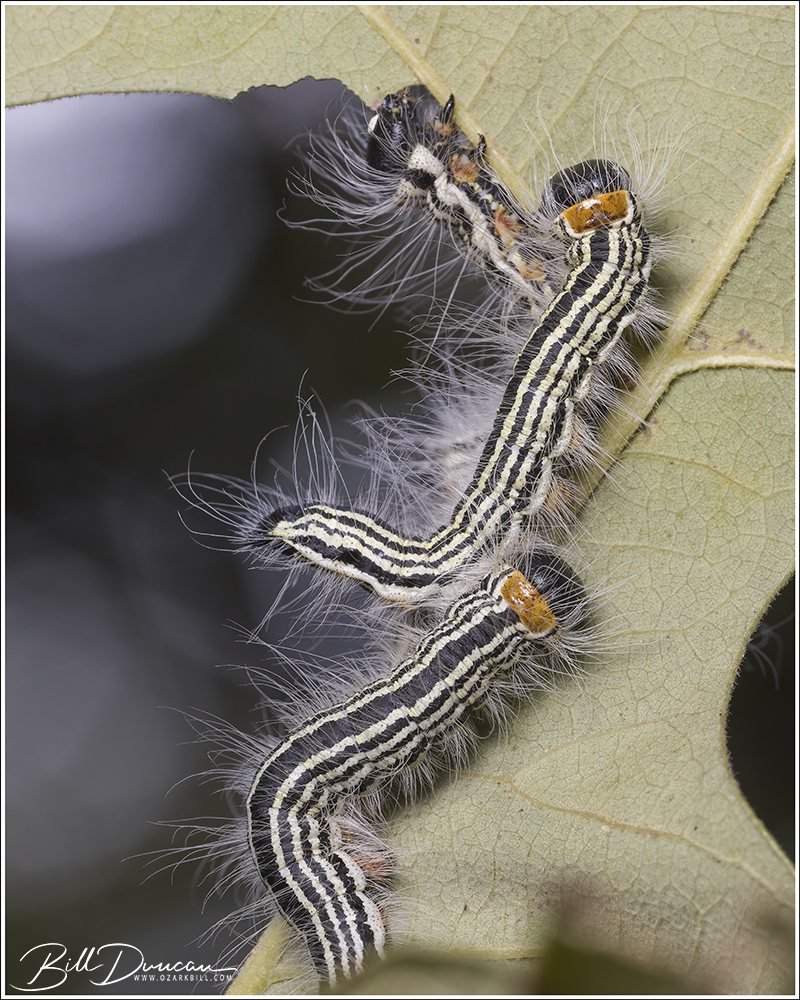
Variable Oakleaf Caterpillar Lochmaeus manteo and L. bilineata fam. Notodontidae Host plant: Found on oaks (Quercus sp.) Date found: Multiple dates in August – September, 2024 Locations Found: Hawn State Park, Ste. Genevieve County, MO; Onondaga Cave State Park, Crawford County, MO Notes: Highly variable and larvae are apparently impossible to distinguish between the two species.
First, a glimpse of the variable patterns and colors of these cats.
The adult photographed at Schoolcraft Prairie in Washington County, MO in mid-August, 2024.
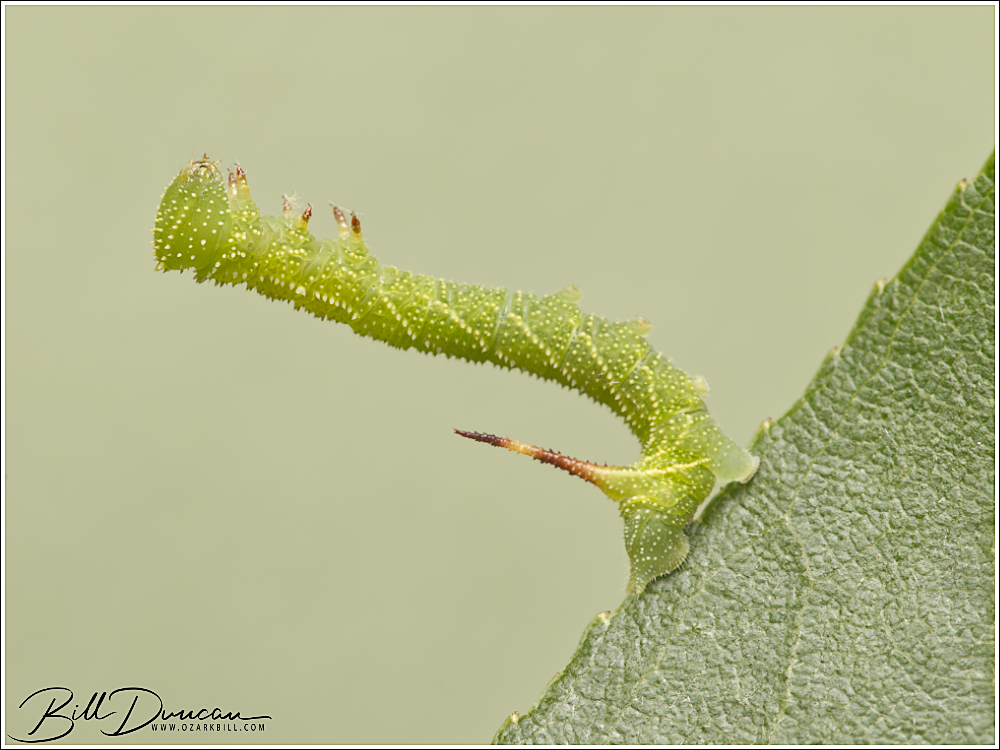
For tonight’s caterpillar, I am featuring the Sphingidae family member, Amorpha juglandis – the walnut sphinx moth. This is the only species in the monotypic genus, Amorpha, a name that is shared with a plant genus that holds our leadplant (Amorpha canescens) and false indigo bush (A. fruticosa). This name comes from the Greek – amorphos- meaning formless or mishappen. This describes the lack of wing and keel petals of the corolla of these beans. For the moth, I am not completely certain, but it may have to do with the unique shape and placement of the rear wings when this moth is at rest. This species is very easily identified in both larval and adult forms.
First up are a couple of early instar brood mates that I found on the same walnut tree in mid-July at Kaintuck Hollow in Phelps County, MO.
Next up is an older cat found at Schoolcraft Prairie in Washington County, MO in mid-August. Caterpillars of this species at this stage are infamous for its defensive displays when harassed, including emitting a high-pitched squeak, thrashing and biting. Unfortunately, this one was pretty chill, so I could not show this off to the folks I was with.
Amorpha juglandis – the walnut sphinx moth
Finally, on the same night we photographed the caterpillar pictured immediately above, an adult male moth was attracted to our blacklight setup. This was my first looks at the adult form of this species.
For the past month or so I’ve been hitting the trails hard, trying my best to find caterpillars in the early to mid season. As expected, this has been tougher than the late season for me. My success rate in finding interesting and new species has been lower than I would like, but good thing the one strength I feel I truly possess in this life is pertinacity.
Usually by the late season cat hunts, hackberry trees (Celtis sp.) have all but dropped their leaves or look as though they should. Once I started beating branches of hackberries this summer, I found that the two species of Asterocampa (Nymphalidae) found in Missouri were quite easily found. Not only are the hackberry butterfly adults beautiful, but I find the caterpillars to be extremely cute as I hope you can agree with the photos below of the hackberry emperor (Asterocampa celtis).
Today I’m finishing up with the remaining cats of late summer and autumn hunting trips of 2023 from an assortment of families.
Walnut Sphinx Moth (Amorpha juglandis) Sphingidae, Hodges#7287 These are among my favorites. Not only are they quite handsome when viewed up close, but they are one of the few caterpillars with a voice! Be prepared if you handle or otherwise disturb them; they will let out a surprising squeak when they feel threatened.
Walnut Sphinx Moth (Amorpha juglandis)
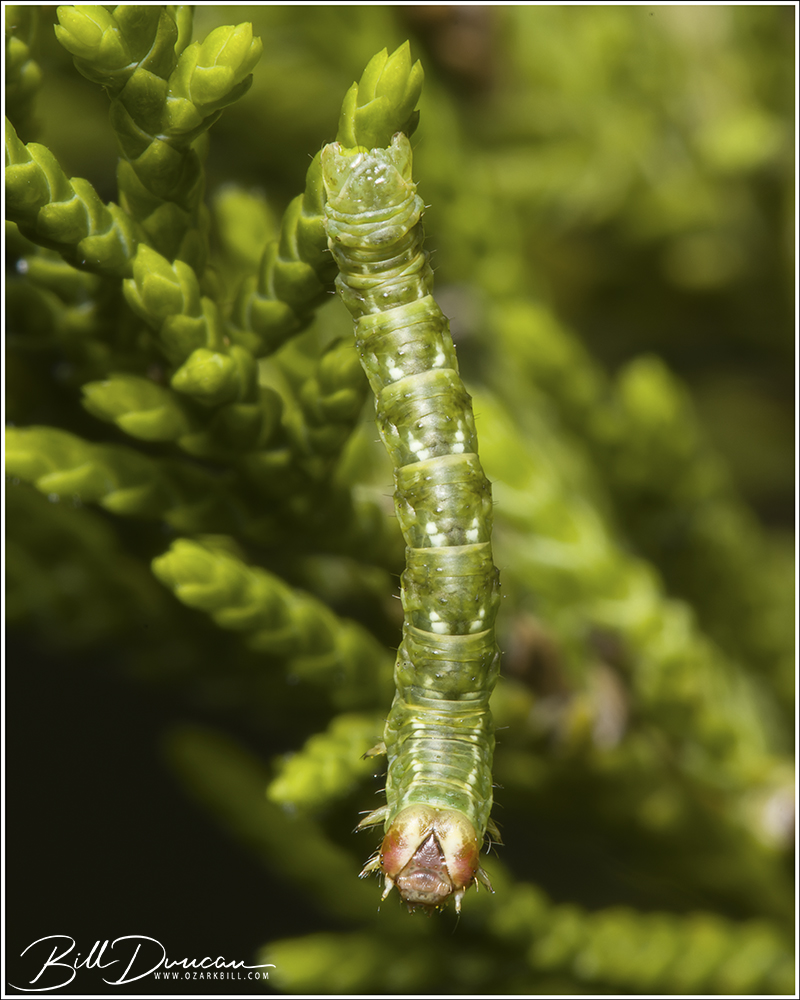
Curve-lined Angle (Diagrammia continuata) Geometridae, Hodges#6362 Casey and I observed that the juniper hairstreaks (Callophrys gryneus) had a bumper year this year while hiking in glades early in the season. We thought this might be the year to finally find the fantastic larvae of this species. We spent several hours beat-sheeting the red cedars in these areas in late summer and early fall. No luck in finding that species, but we did find another inconspicuous cat that uses this plant as its host. You can probably see that, like the hairstreak, the caterpillars of this moth species would be next to impossible to find without the use of a beat-sheet.
Curve-lined Angle (Diagrammia continuata)
Undescribed Flower Moth (Schinia nr-jaguarina) Noctuidae, Hodges#11132.01 I shared photos of this yet to be described species before. These are photos of the cats we found at a new location, Horn’s Prairie Grove LWR, in central Illinois.
Red-lined Panopoda(Panopoda rufimargo)Erebidae, Hodges#8587 An interesting cat we found while beet-sheeting a hickory thicket on a friend’s property in St. Francois County.
Red-lined Panopoda (Panopoda rufimargo)
Pipevine Swallowtail (Battus philenor) Papilionoidea Conspicuous and distasteful due to the absorbed secondary chemicals of their pipevine host, it seems like we always find these guys in low-light situations, making the use of supplemental light a necessity.
Pipevine Swallowtail (Battus philenor)
Giant Swallowtail (Papilio cresphontes)Papilionoidea My favorite swallowtail species. It was a real treat finding this final instar cat back in September.
Today I am featuring the more interesting larvae we found of the Notodontidae Family, commonly known as the prominent moths. This is a widely distributed and diverse family with close to 4,000 species described worldwide. Hosts for this family are mostly woody plants and we often find these feeding on oaks and hickories.
Variable Oakleaf Caterpillar (Lochmaeus manteo) Notodontidae, Hodges#7998 Finding a lot more than I decided to photograph, this aptly-named species feeds primarily on oaks (Quercus sp.) and is highly variable in coloration and pattern. This is a species you may get tired of finding when focusing on oaks during your searches.
Mottled Prominent (Macrurocampa marthesia) Notodontidae, Hodges#7975 We found a few of these guys this year and I find these to be very handsome little cats.
Heterocampa pulverea, Notodontidae, Hodges#7990.1 Until recently, this was a pretty large genus, containing close to 50 species. A couple of years ago, armed with molecular data, this genus was split and now contains 18 species. This one was found on a WGNSS group outing at Pickle Spring Conservation Area in early September.
Orange-banded Prominent (Litodonta hydromeli) Notodontidae, Hodges#7968 We found this guy on another WGNSS outing while looking for the bumelia borer beetle (Plinthocoelium suaveolens). We did not find our target that day but I was thrilled to find this cat that previously I did not know existed. This is another specialist that only feeds on the gum bumelia (Sideroxylon lanuginosum).
Saddled Prominent (Cecrita guttivitta) Notodontidae, Hodges#7994 This is a very common species that feeds on oaks and until recently belonged in the genus Heterocampa.
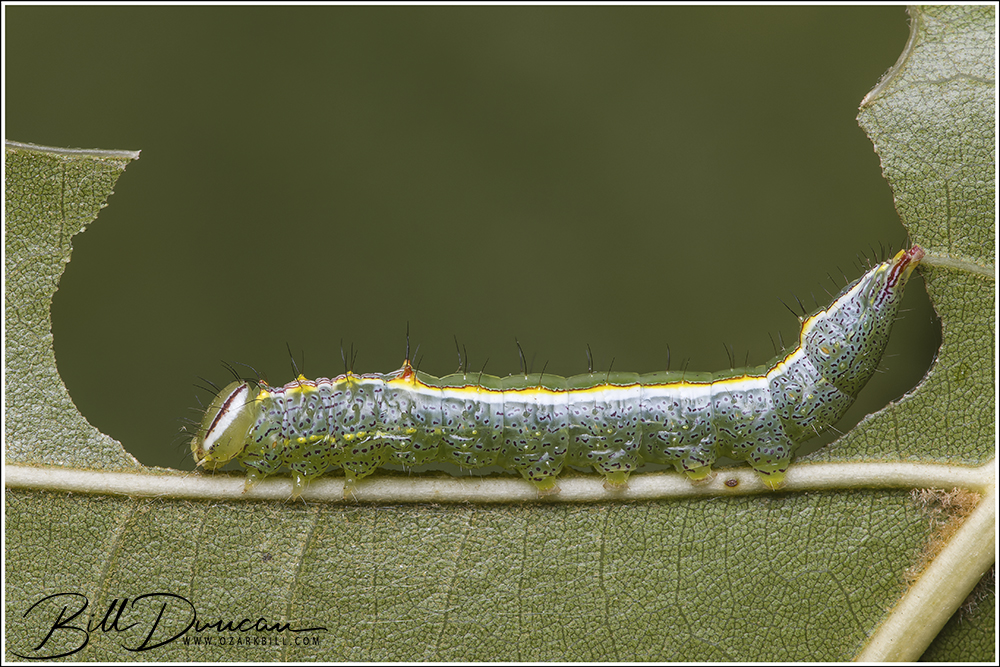
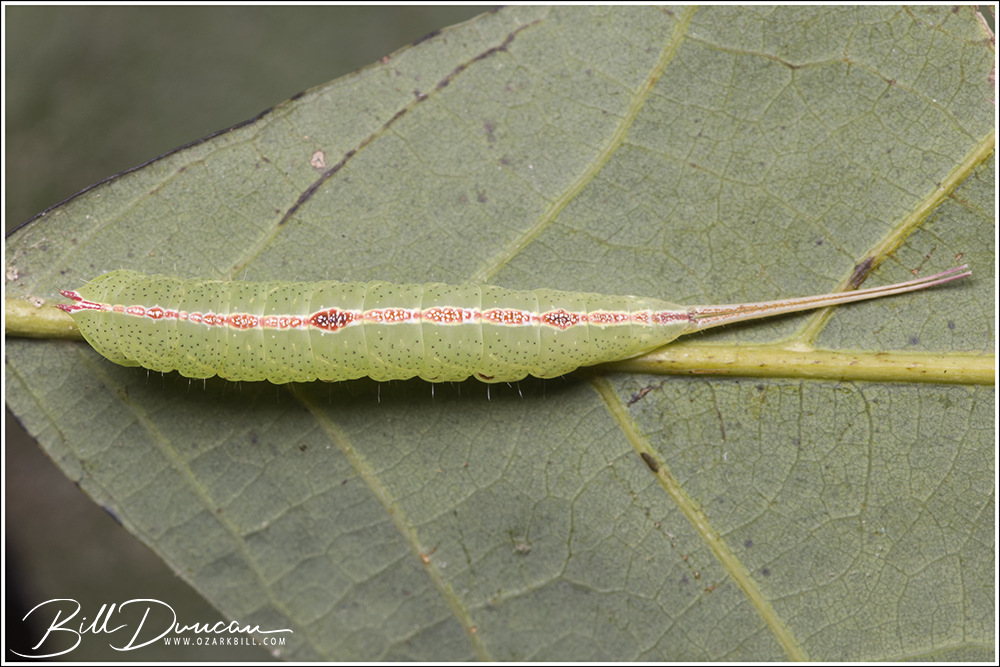
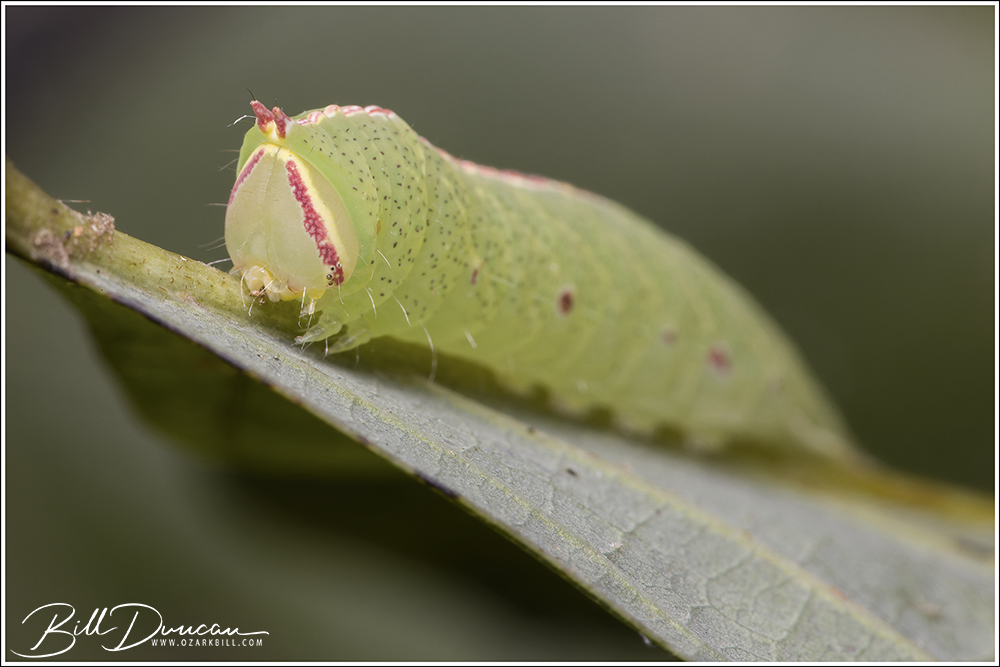
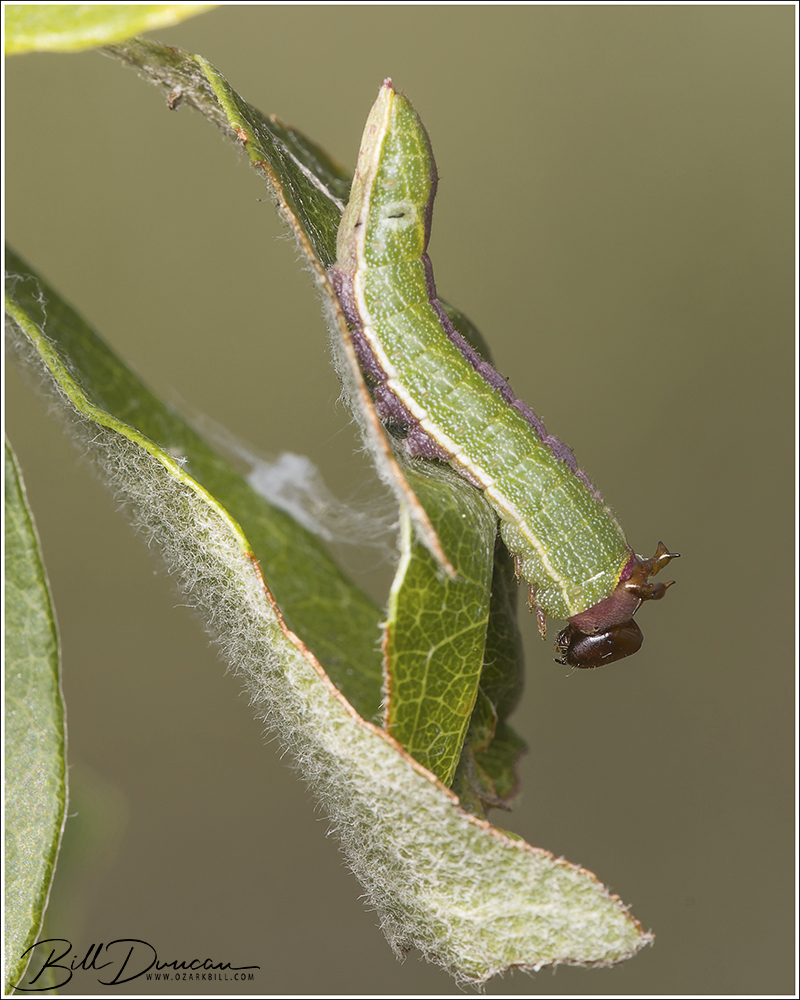
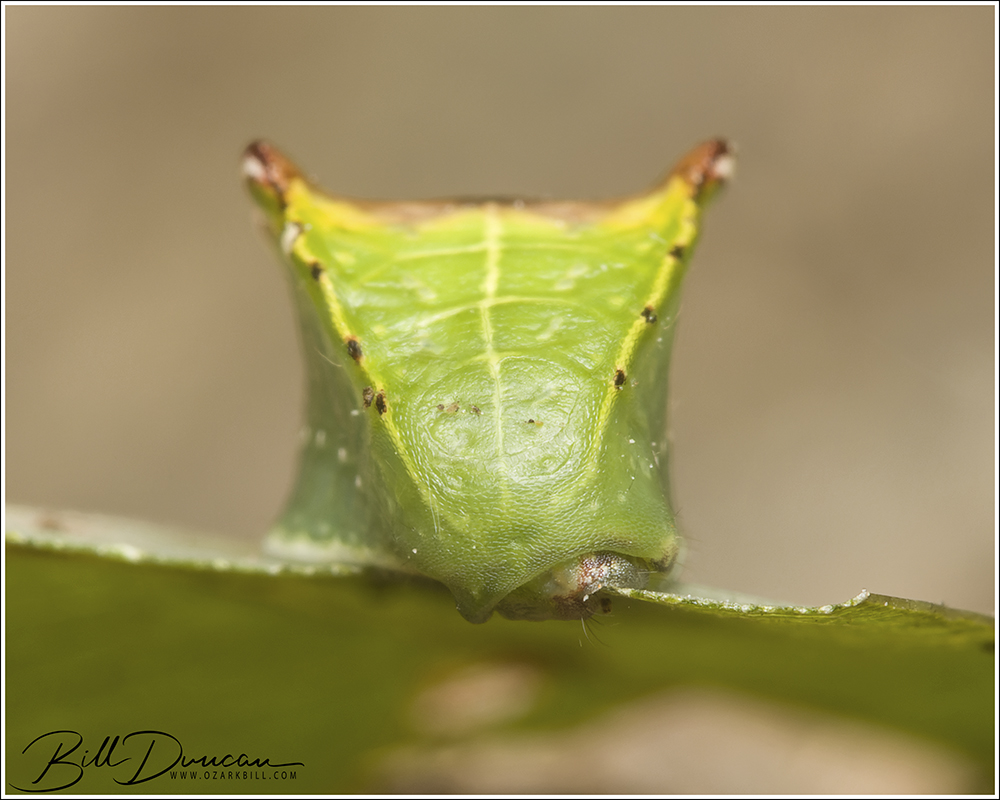
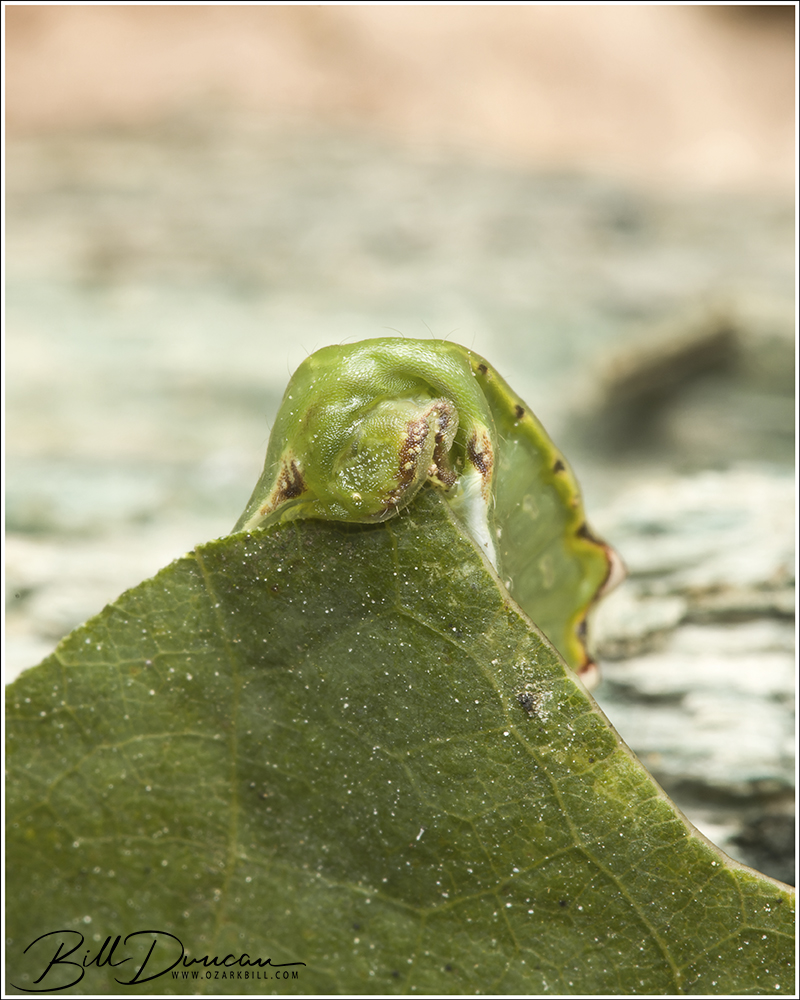
White-streaked Prominent (Ianassa lignicolor) Notodontidae, Hodges#8017 Also known as the lace-capped caterpillar, this is one of many caterpillars in this family that hide in plain sight. You will almost always find these sitting on the section of leaf they have previously eaten, using their coloration and patterns to look like a diseased or senescent portion of the leaf. These can be quite tricky to find until you get the right search engine installed in your brain.
Red-washed Prominent (Oedemasia_semirufescens) Notodontidae, Hodges#8012 Although considered fairly common, this was the first year I was finally able to find one of these outstanding cats. This species is quite polyphagous, feeding on almost any native woody plants. One of the two we found this year was feeding on pawpaw (Asimina triloba).
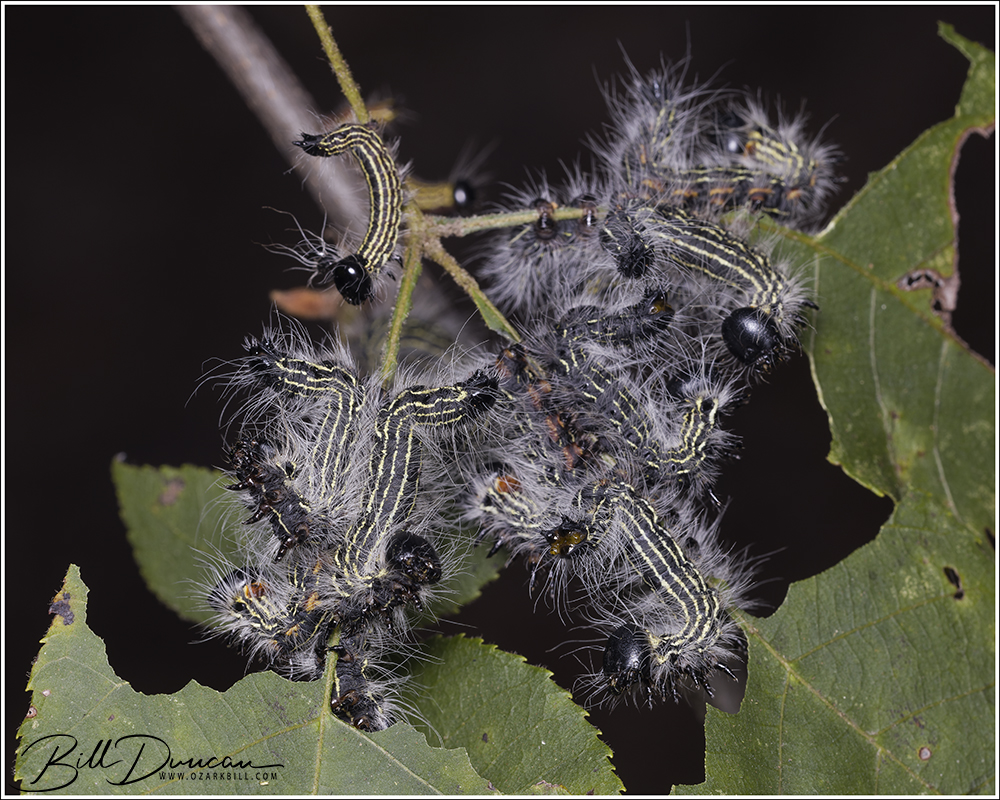
Datana Caterpillars (Datana sp.) Notodontidae Most notodontids are solitary. But certain groups, like these Datana are gregarious and can be found in large groups even in later instars.
Contracted Datana Caterpillars (Datana contracta)
A group of datana caterpillars (Datana sp.)
Symmerista Prominents (Symmerista sp.) Notodontidae Another gregarious taxa, the Symmerista are notoriously difficult to identify to species in both larval and adult phases.
Symmerista sp. caterpillars
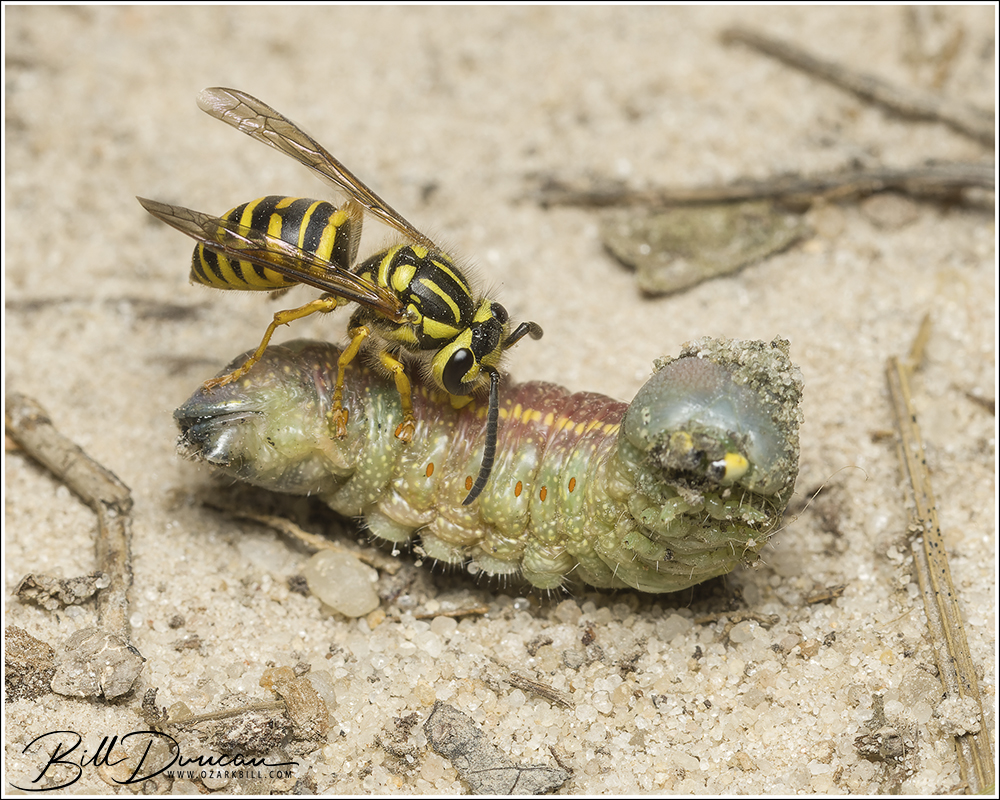
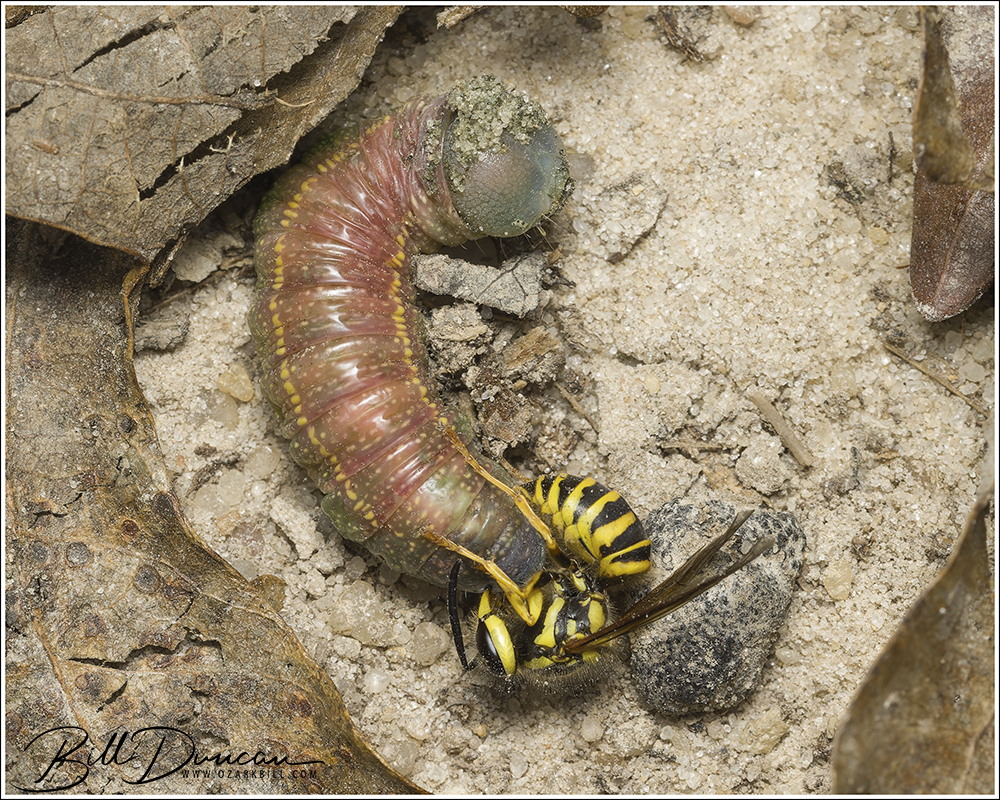
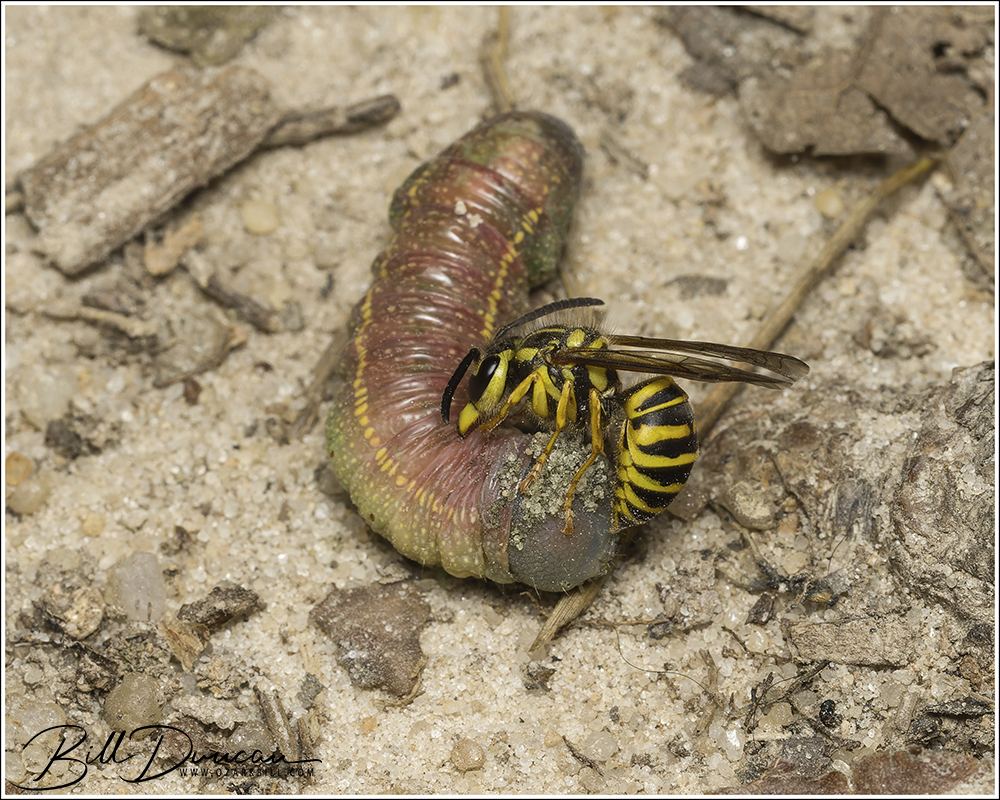
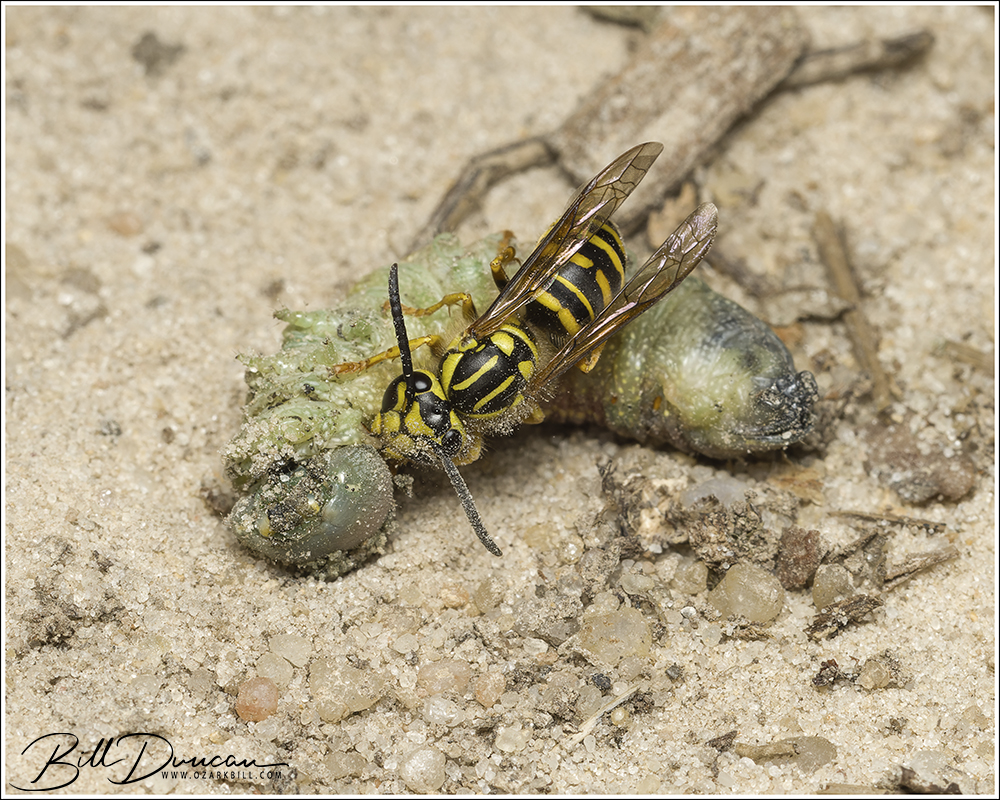
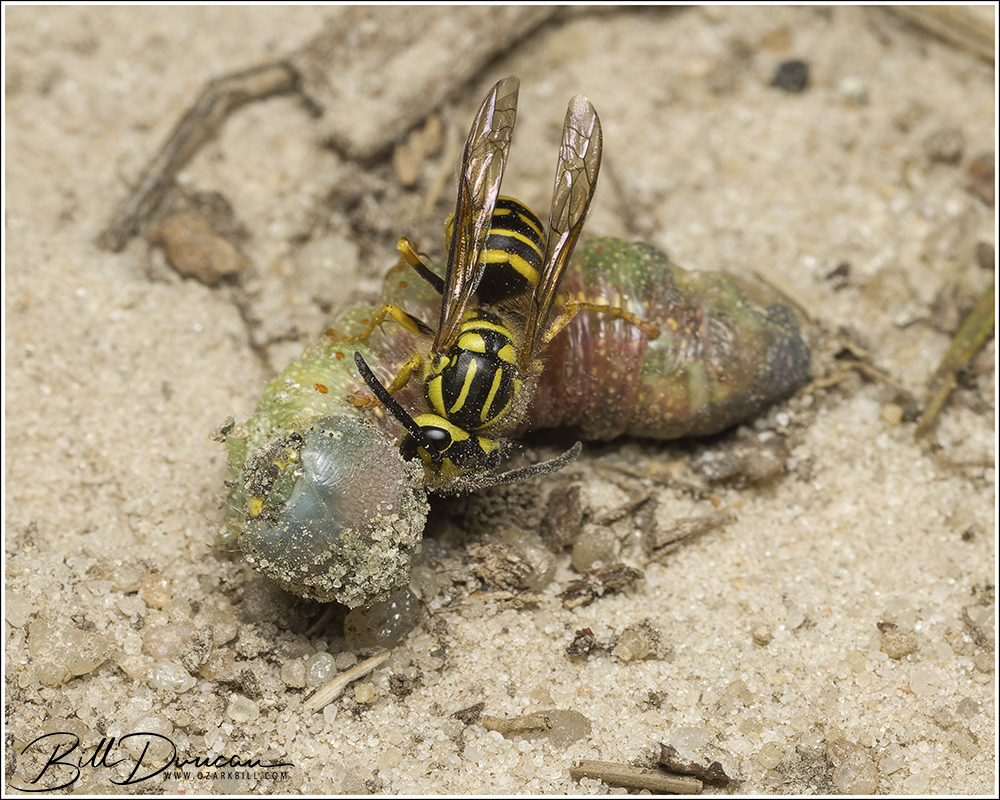
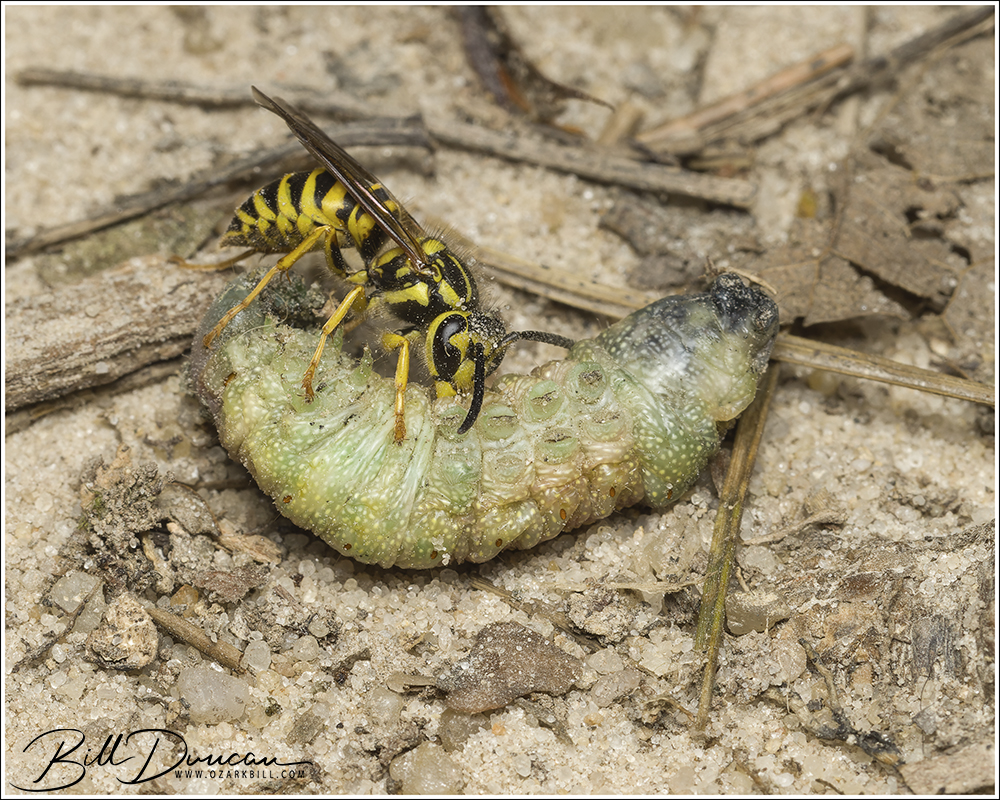
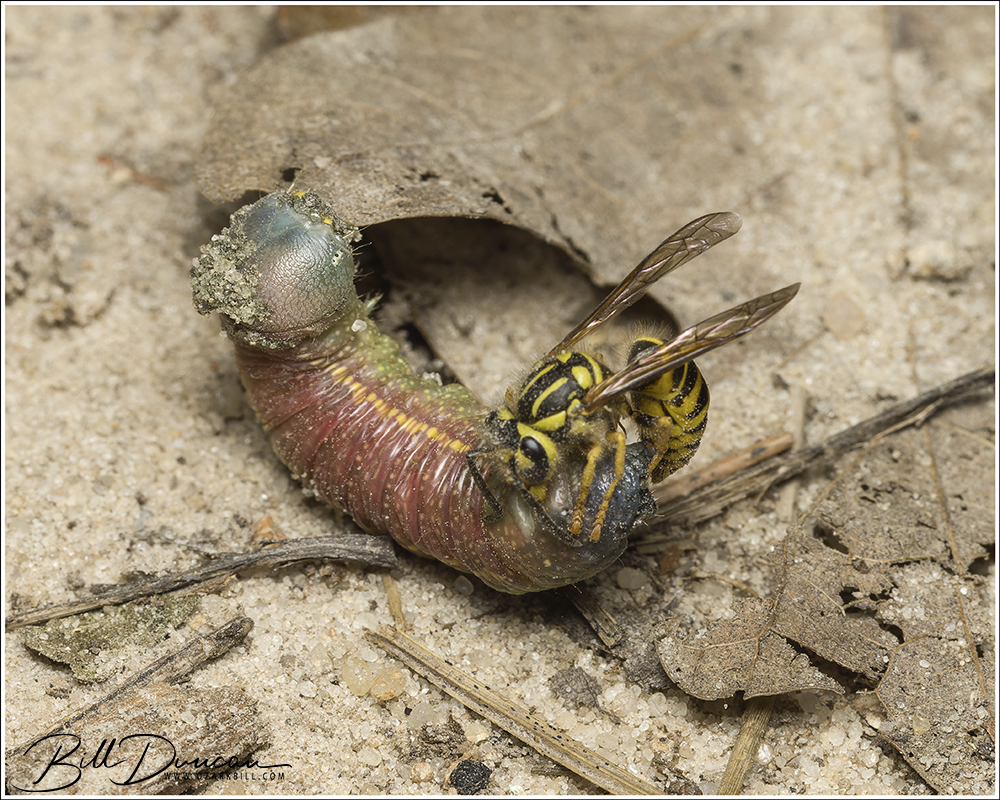
White-dotted Prominent (Nadata gibbosa) Notodontidae, Hodges#7915 Perhaps the most common caterpillar we find on our hunting trips, the white-dotted prominent can be found in large numbers on oaks. We find these so often that I rarely even tell the others in the group when I find them. But here we find a common species in a not so common situation. We came across this one on its way to find its pupation spot that would likely be in the ground or leaf litter. You can tell this was the case by the reddish or maroon coloration. Many caterpillars will change to this type of coloration immediately before they begin the pre-pupal stage. Unfortunately for the caterpillar, some southern yellowjackets (Vespula squamosa) found it as well. We watched the drama unfold as the wasps continued to sting and bite at the poor creature that will not likely make it to adulthood.
I got back into serious hunting of caterpillars beginning in late August of this year. On some trips, I hunted with a nice group of friends and on several others I went on solo outings. All in all, it was a lot of work and, at times, I wondered if the payoff was worth the time and effort. However, like I’ve said before, anytime spent in quality spots in the outdoors is time well spent. In this first post, I am sharing, as no surprise to those who know me well enough, images of larvae from my favorite family of Leps – the Limacodidae, otherwise known as the “slug moth” caterpillars.
Red-crossed Button Slug Moth (Tortricidia pallida) Limacodidae, Hodges#4653 By far the most abundant slug we found this season was the red-crossed button. I did not collect good enough records to put a specific number of the individuals found, but it would be close to 25.
Nason’s Slug Moth (Natada nasoni) Limacodidae, Hodges#4679 This is another one that is usually found in goodly numbers during the hunting season. We found a few, but not nearly as abundant as in most years.
Stinging Rose Caterpillar Moth (Parasa indetermina) Limacodidae, Hodges#4699 Always a pleasure to find, the stinging rose caterpillars will vary considerably in the amounts of the yellow, white, black and red colors.
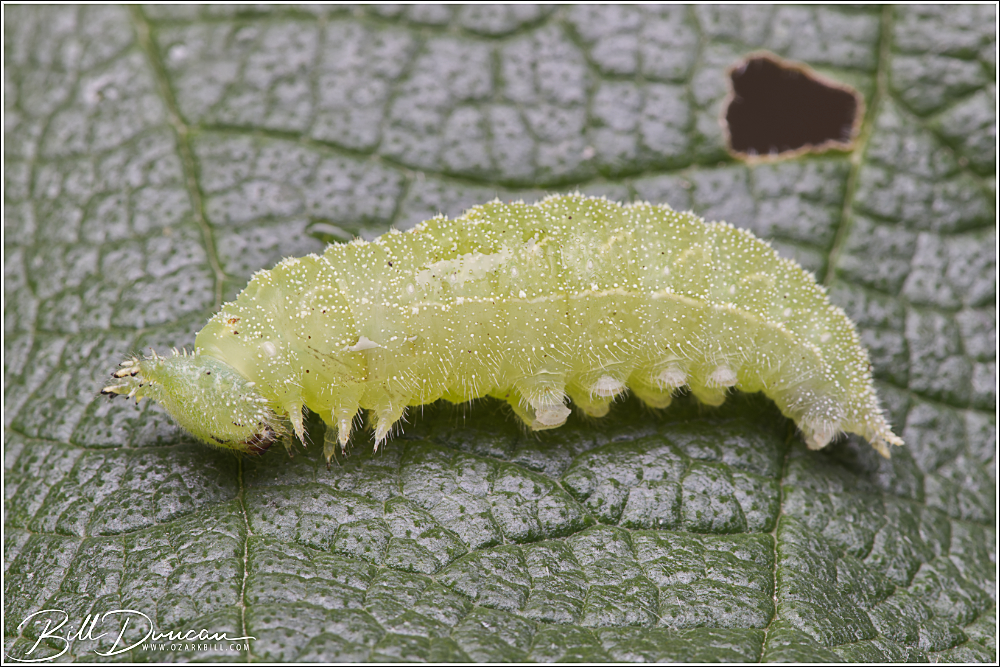
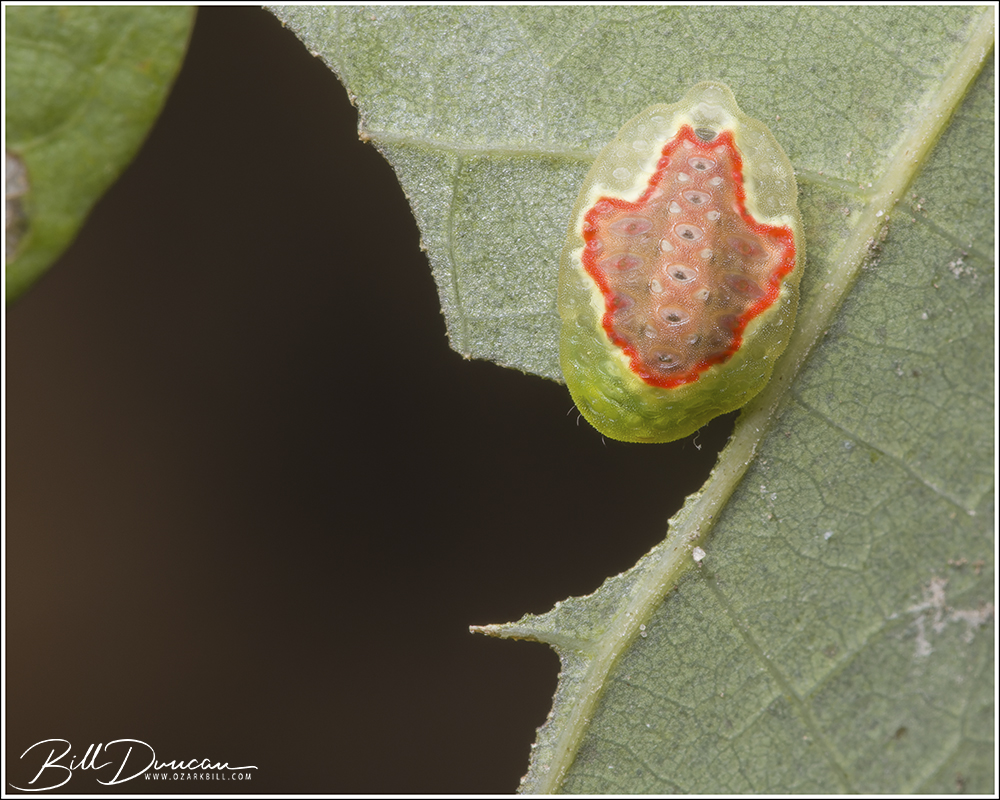
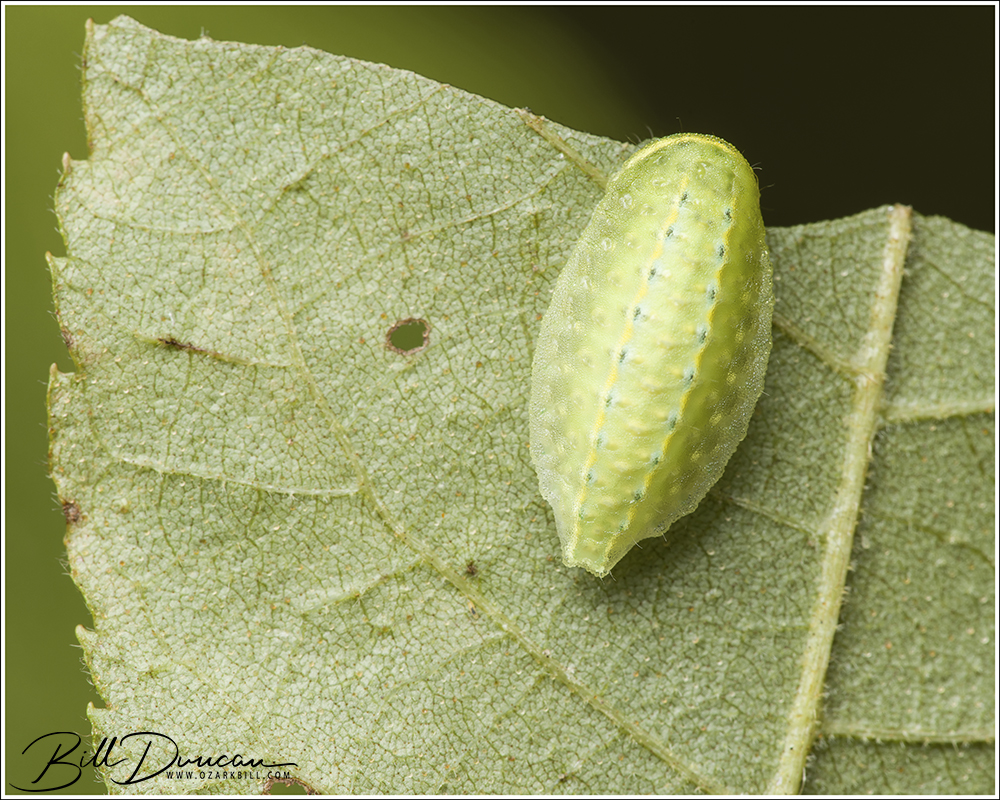
Skiff Moth (Prolimacodes badia) Limacodidae, Hodges#4671 Another slug that can be quite variable in colors and patterns, the skiff moths can often be found on the tops of leaves. This is opposed to most of the cats in this family being located on the undersides of leaves. As you can see in the one pictured here, these guys are patterned to appear as easily-overlooked spots of necrosis on late-season green leaves.
Inverted Y Slug Moth (Apoda y-inversum) Limacodidae, Hodges#4667 Overall, I was a little disappointed in the numbers and diversity of slugs we found this season, however this species and the following one are not always encountered every season. I believe this is only the third cat of this species I have been able to find.
Beutenmueller’s Slug Moth (Isochaetes beutenmuelleri) Limacodidae, Hodges#4675 Until this year, I have only been able to see one caterpillar of the Beutenmueller’s slug, better known as the “spun-glass” slug. This year I found three! I’ll never get tired of seeing these.
Unknown Limacodid This mid-instar cat could potentially be one of several species. I think there is a chance it could be the – jeweled tailed slug moth (Packardia geminata), but it is most likely a yellow-shouldered slug (Lithacodes fasciola). I wish I would have thought to bring it home to rear. In the know and have a better idea on the identity of this one? Please let me know in the comments below.
Shagreened Slug Moth (Apoda biguttata) Limacodidae, Hodges#4669 In the picture below of this shagreened slug, you can see a couple of the traits that are distinctive to the Limacodidae. First, it is quite common that the slug cats will eat the leaves in a more horizontal direction, squaring off the leaves, so-to-speak. Most other caterpillars will eat circular notches in the leaves as they feed. Second, although difficult to see in this picture, is the distinctive frass the caterpillar is dropping. Limacodid frass is distinctly shaped, with one section being notched to “fit” along side the ones before and after. Interestingly, monarch (Danaus plexippus) and likely other groups also share this trait.
Hag Moth (Phobetron pithecium) Limacodidae, Hodges#4677 Either we were out too early, in general, or the hag moth cats, AKA “monkey slugs,” were later than usual. I found quite a few mid-instar monkey slugs this season but not a single late-instar. I was too lazy, or perhaps disappointed, to pull out the big rig to photograph any of these, so here is a cellphone shot. The reason I wanted to share this is to show the interesting feeding behavior of cats at this stage of their development.
Notice the wavy, white to lime-green patches on the top of this leaf? This is indicative of how this younger monkey slug is feeding. Instead of free-feeding and consuming the entire leaf, this guy is feeding like a skeletonizer or a leaf-miner, in that it is scraping the top layer of the leaf. In this photo, you can see fresh scraping areas and ones that are much older, suggesting that this cat has been living on this leaf for some time. I suppose it likely that early to mid instars of all species in this family feed in this way, but I am not usually out hunting in early to mid summer to have observed this before.
A mid-instar hag moth caterpillar, feeding by scraping off the top layer of the leaf surface. BTW, the caterpillar is in the upper left section of this photo. 😉
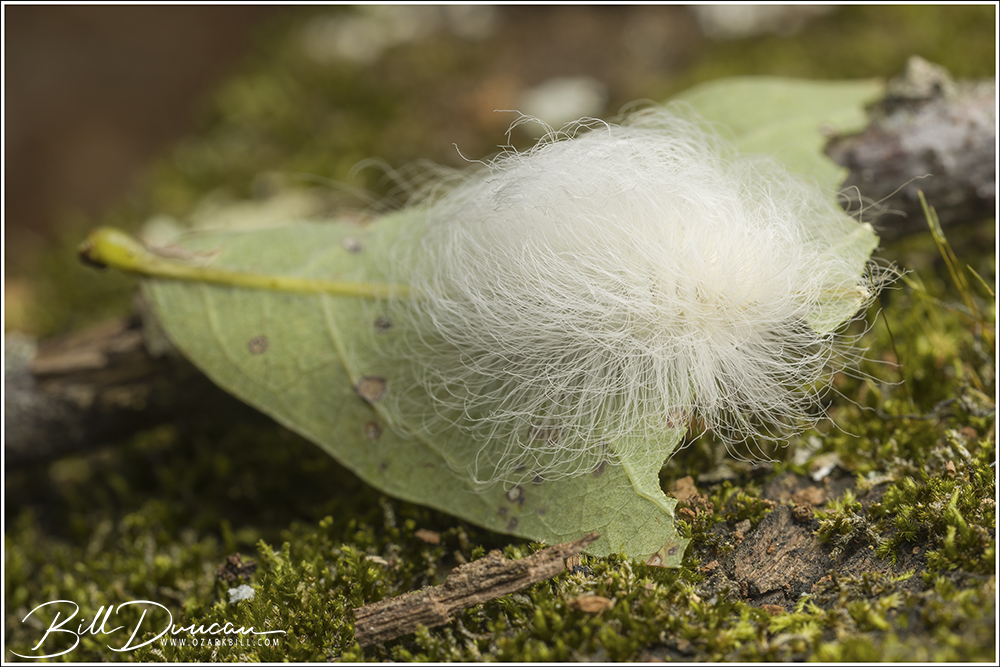
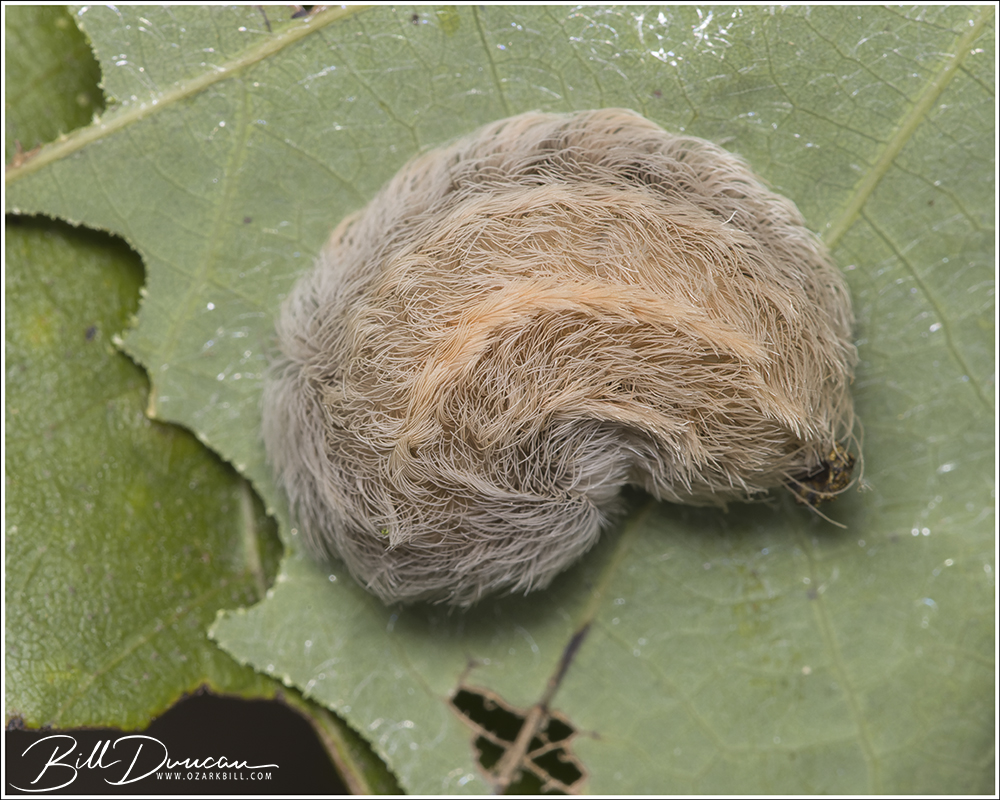
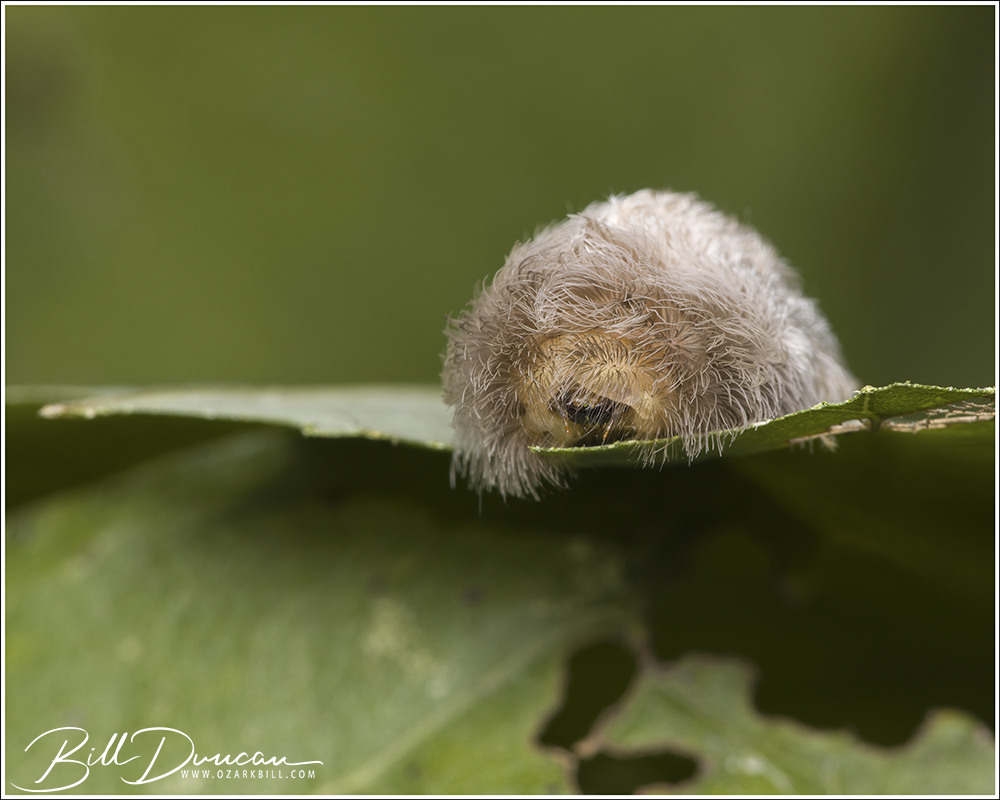
Black-waved Flannel Moth (Megalopyge crispata) Megalopygidae, Hodges#4644 Technically, not a Limacodidae family member, the black-waved flannel moth is in the closely related family, Megalopygidae, within the same super family (Zygaenoidea), which include not only the slugs and flannel moths, but leaf skeletonizer moths as well. We regularly find this species on our late-season outings. This year I was able to find and photograph two different stages. The earlier instars are fluffy white in appearance, while the final instars are colored in warmer browns.
Remember, these guys are not for petting. Descriptions vary, but the hairs on these have been described as highly irritating to downright dangerous, potentially requiring a hospital visit.
A mid-instar of the black-waved flannel moth (Megalopyge crispata) in its fluffy white coat.
Late instars of this species are draped in reds and browns. Some have suggested they can look like the top of a recent “president’s” head.
I believe these are all of the photos I have to share of the Limacodidae from this past season. Thanks for visiting and please let me know if you find any errors in my identifications by making comments below.
Sarah and I traditionally conduct a caterpillar hunt on the weekend of her birthday in mid-September and 2022 was no different. This year we headed to Meramec State Park. I had recently heard of a short trail that covered the lush river bottom and contained hundreds of pawpaw trees. My hope was to find caterpillars of zebra longwing butterflies – a cat that has been elusive despite my many attempts at finding a late instar to photograph. We wound up short of this goal again, but we did find quite a few interesting species. I know Sarah will want me to mention that she did indeed win the day by finding more cats than I did. 🙂
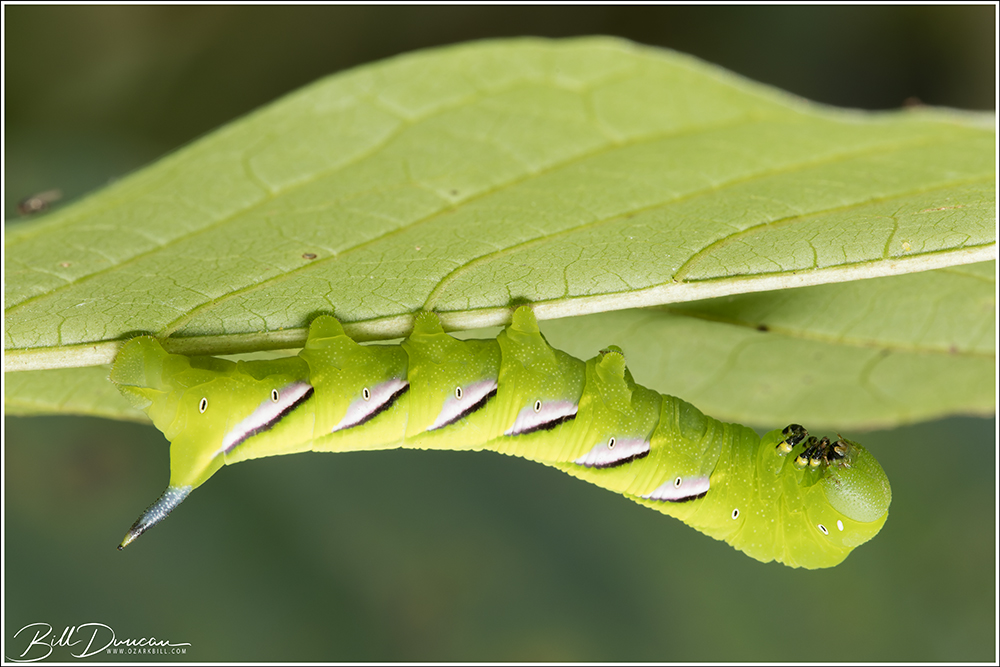
Ceratomia undulosa (waved sphinx) in the family Sphingidae. This impressive cat was found feeding on an ash (Fraxinus sp.).
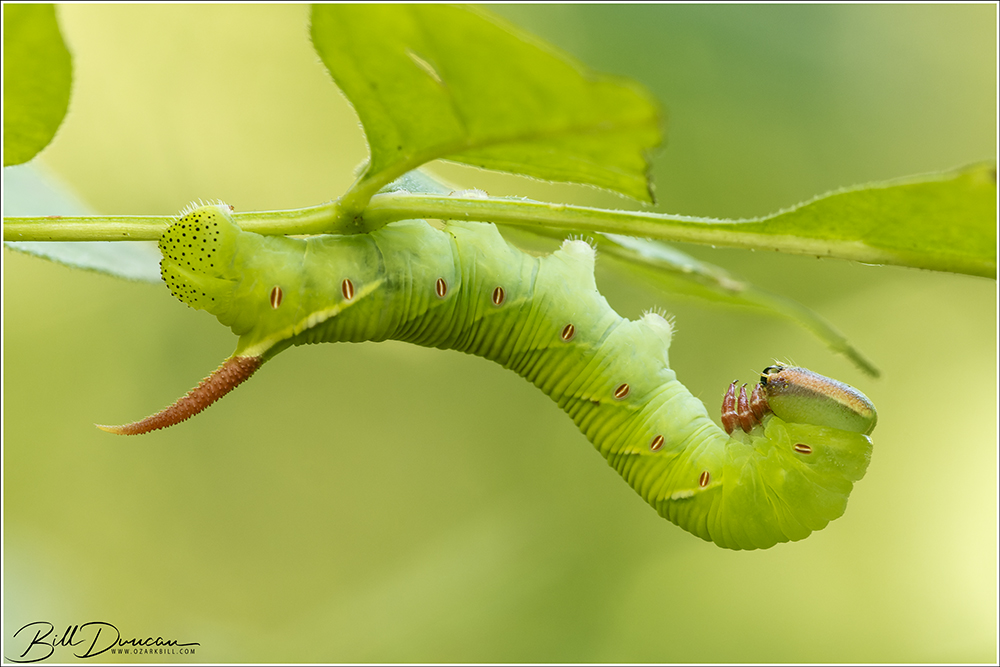
Although we strike out on the zebra longwings, searching through pawpaws still yield results with other specialist feeders, such as this lovely Dolba hyloeus (pawpaw sphinx).
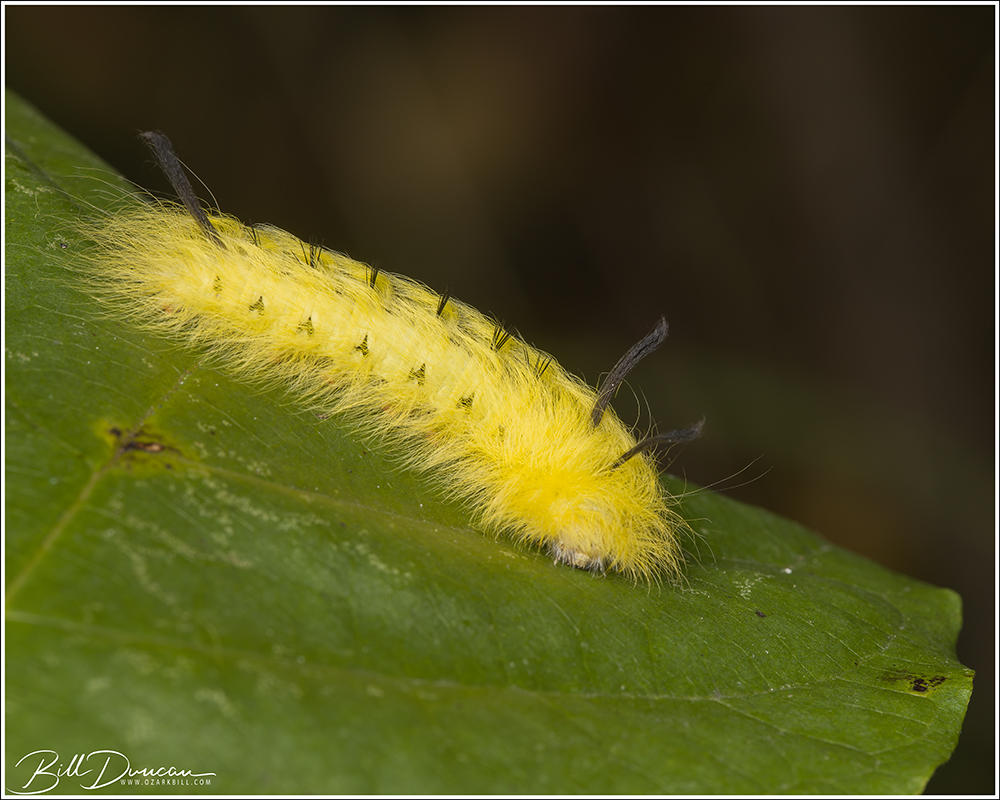
Perhaps because they are so conspicuous, we often have luck finding the cats of the beautiful Apatelodes torrefacta (spotted apatelodes moth) in the Apatelodidae family. These come in two flavors – vanilla white and the more pleasing lemon chiffon pictured here.
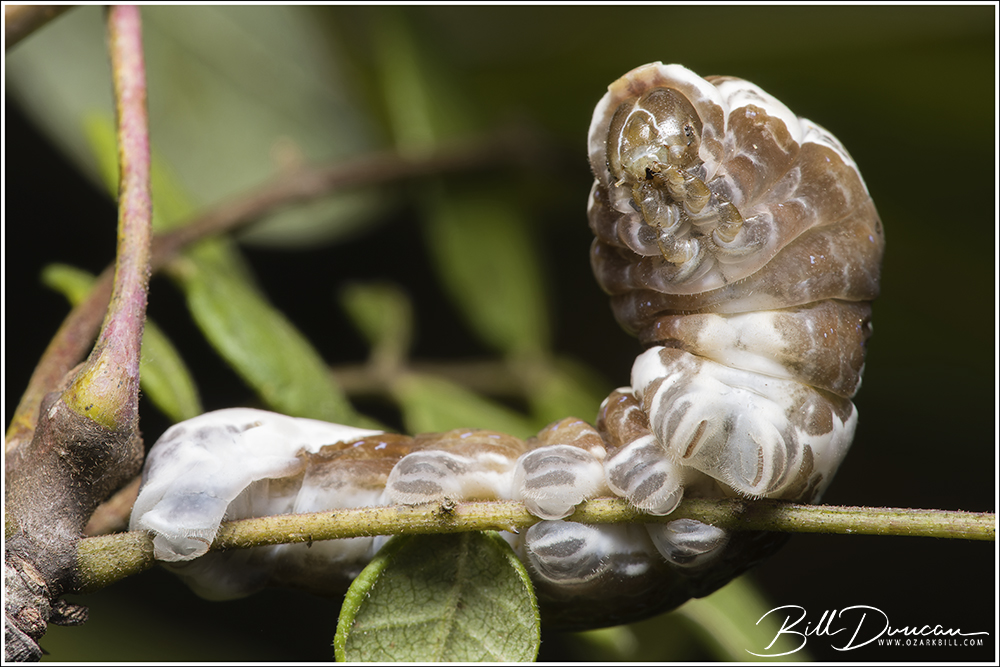
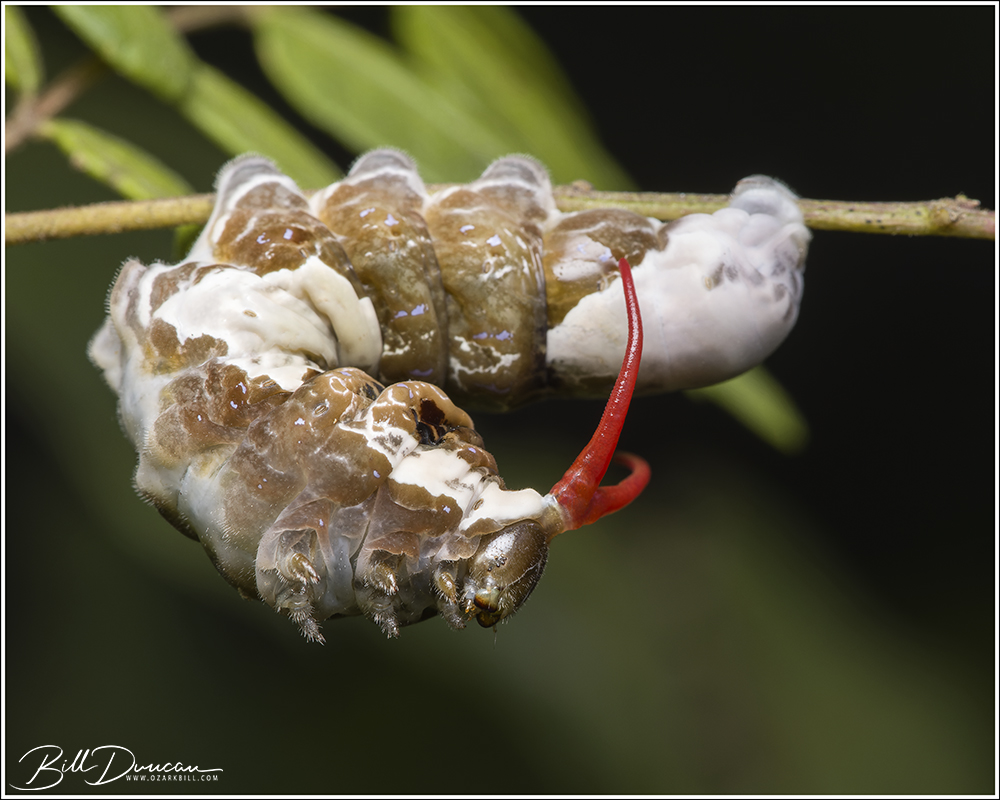
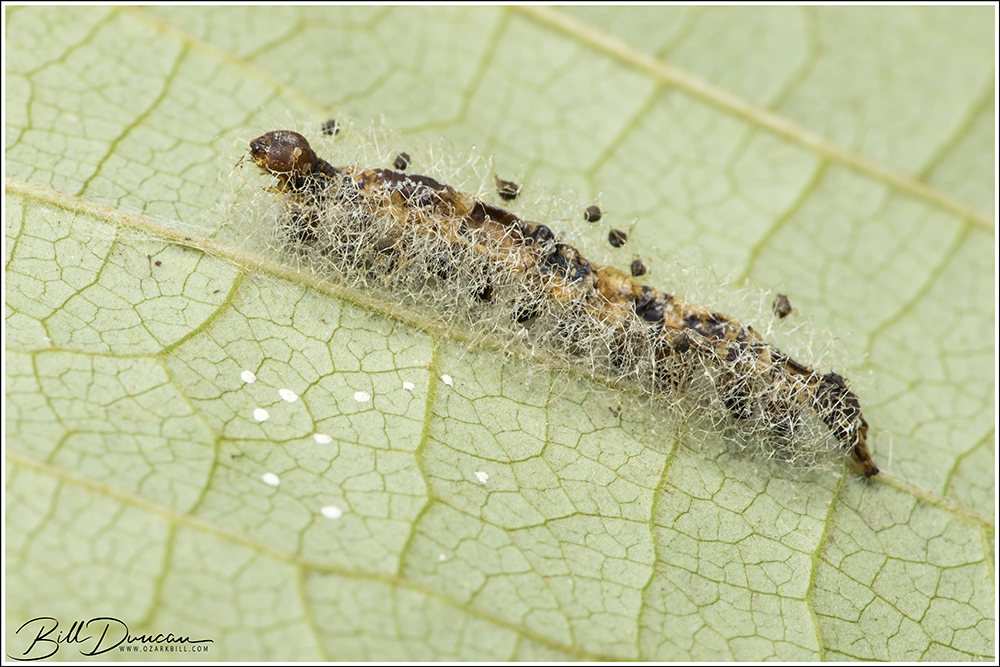
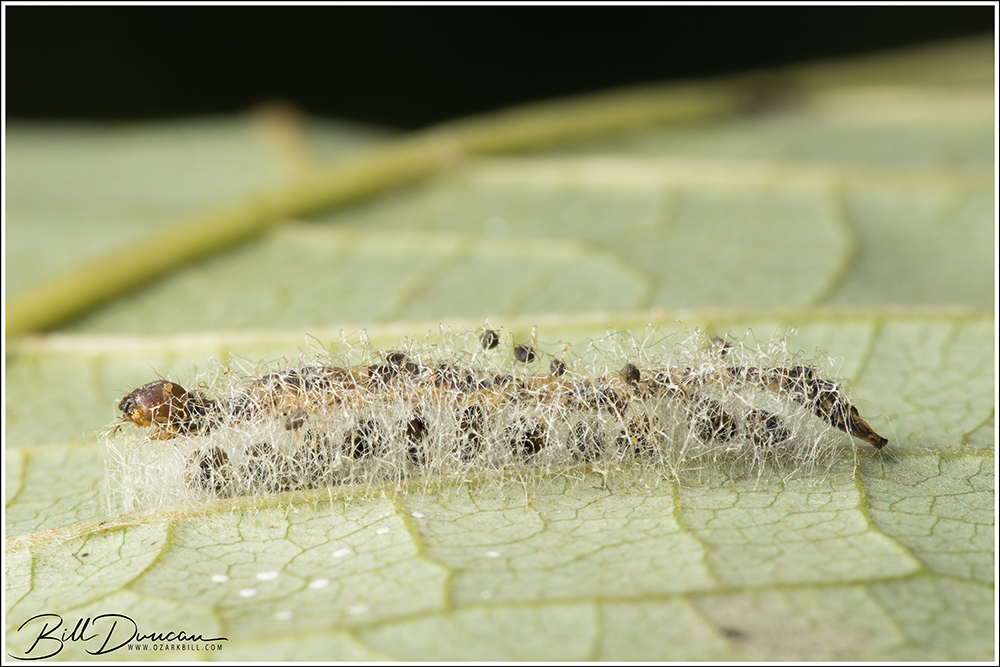
Perhaps my favorite find of the day was this husk of an unknown caterpillar species having been preyed upon by larvae of an Eulophid wasp, likely an Euplectrus species. These wasps are ectoparasitoids that ride on the backs of their caterpillar hosts. When reaching their final stages in development, they spin webs and pupate within, using the remains of the caterpillar and their webs as cover.
Getting the lighting just right on these was challenging. Here, I tried my best to position the flash to illuminate the number of pupae residing beneath the remains of this poor deceased caterpillar.
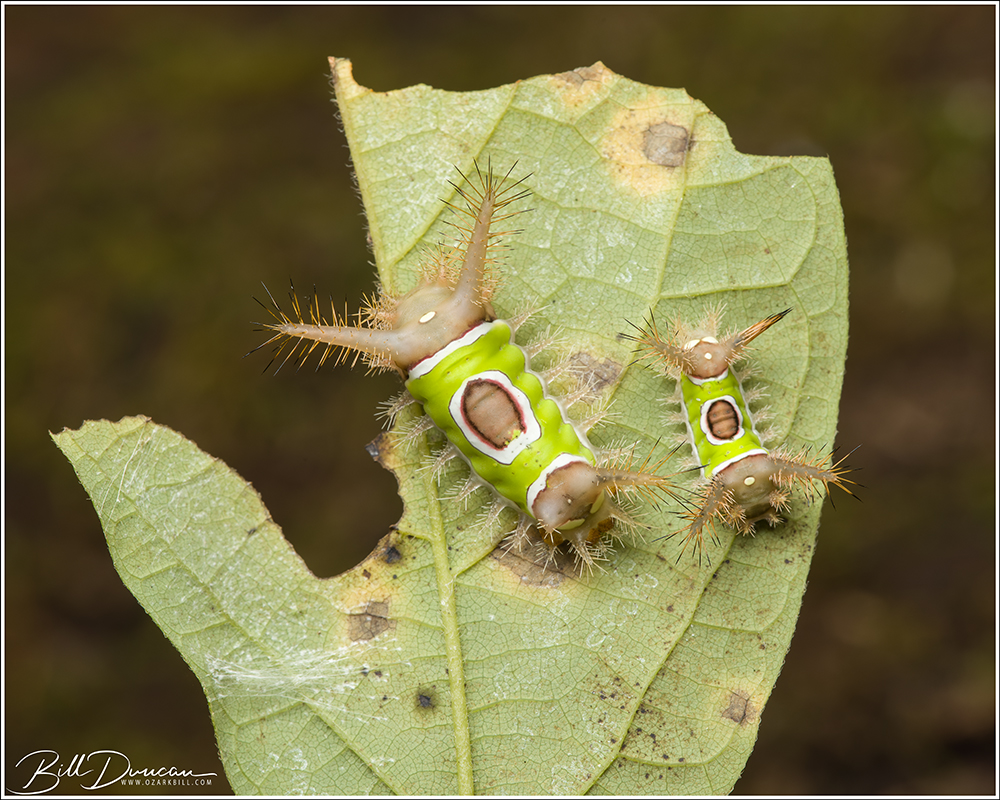
Of course we are always on the lookout for larval members of the Limacodidae, or “slug moth” caterpillars. We found lots of saddlebacks (Acharia stimulea), including the two seen here. I’ve come to see how widely generalist this species is, having found them not only on numerous woody plant species, but in completely different environments, from dry upland woods to corn fields to humid bottomland forests like the one we were in on this day.
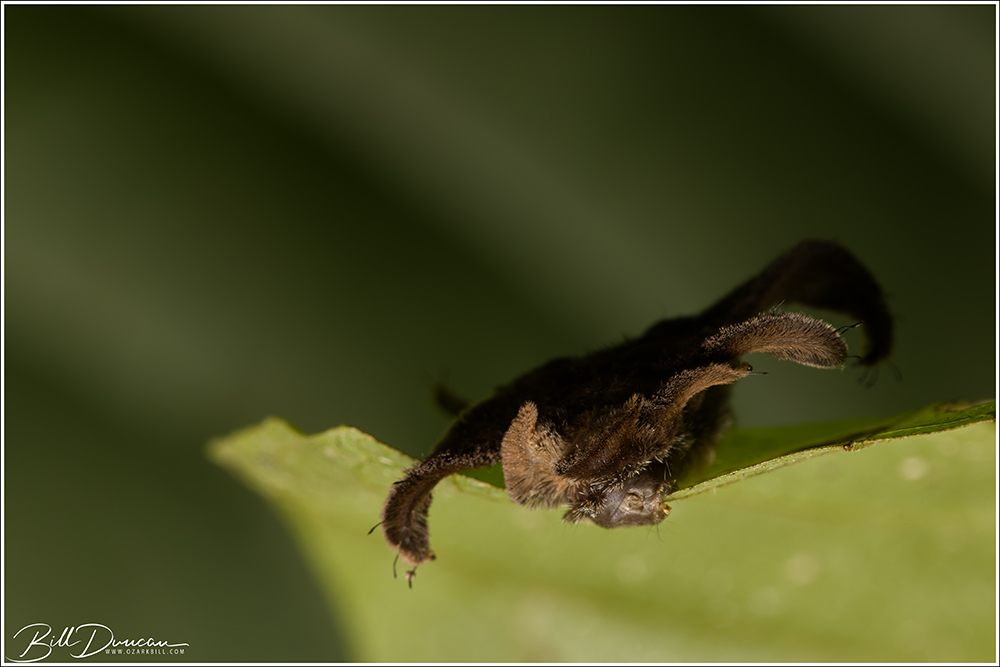
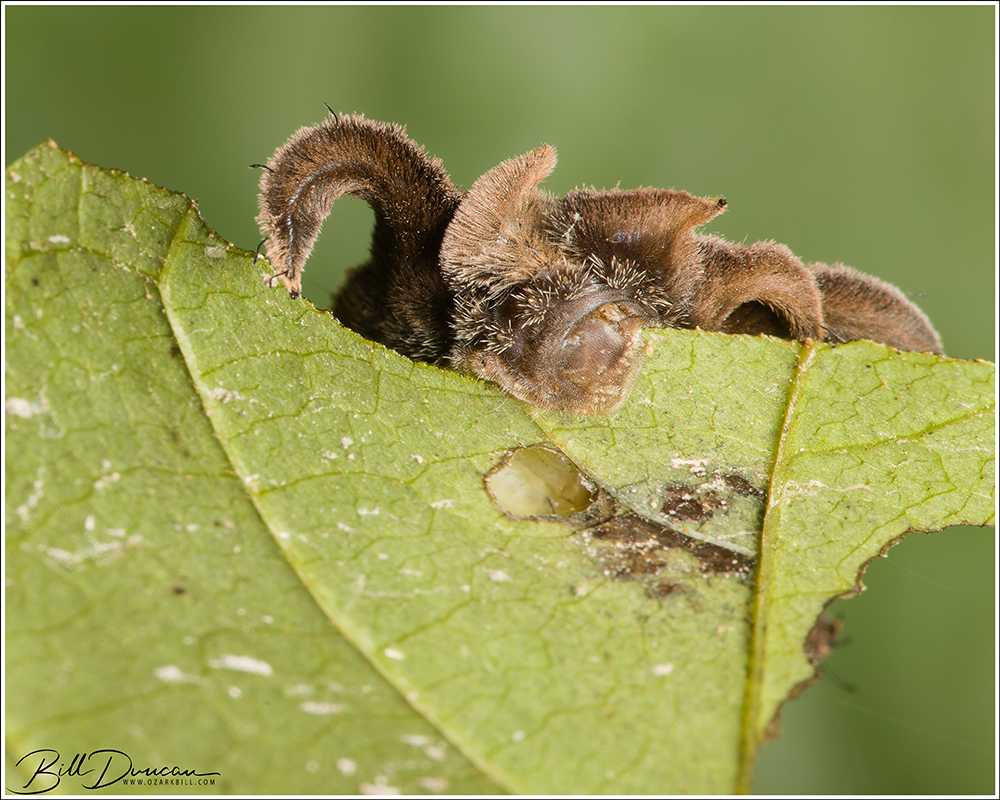
The monkey slug (Phobetron pithecium), purposed to be a mimic of tarantula exuvia, never ceases to fascinate me. Like the saddlebacks pictured above, the monkey slug also contains spines that deliver a toxic punch upon contact.
Here you can see the monkey slug’s appendages rising above the leaf it is feeding upon. The problem with being a generalist caterpillar is that these species need to be able to deal with a variety different toxins that reside in the mature leaves of their many host species. This is believed to be the reason it takes the larvae of the Limacodids so much longer to develop compared to similarly-sized caterpillars of other taxa. This comparatively longer development time may also be the selective force that helped drive the development of the stinging spines that are used to defend against parasitoids and other predators.




























 A Thousand Acres of Silphiums