This post is an article that was originally published in the Webster Groves Nature Study Society’s journal, Nature Notes (November, 2019, Vol. 91, No. 9).
I have previously shared a fair amount of material regarding the Ruby-throated Hummingbird nest. You can find more photos and video at the following locations: RTHU Part One, RTHU Part Two, RTHU Part Three.

During the summer of 2018, I had the opportunity of a lifetime to watch a mother Ruby-throated Hummingbird (RTHU) incubate and raise a pair of offspring. To make these observations, I simply needed to step onto my back deck and pull up a chair. Mom had built a nest approximately 30 feet away and eight feet off the ground. From the deck, I had an almost eye-to-eye vantage into the nest.
Knowing my interests in Nature and photography, my kind next-door neighbors turned me on to the nest on July 13th. The white oak branch that the nest had been built upon was on their property in St. Louis County. Along with taking nearly 50,000 photographs of the nest and growing birds, I also collected rudimentary data focused on the nesting habits of mom. This should not be considered exactly ‘scientific’, but I do find it interesting enough to share.
I began collecting the following data on July 17th: time mom spent on or off the nest in one-minute increments, weather data (temperature, wind speeds. and sky cover), number of times she visited the artificial feeder in my yard that was approximately 20’ from the nest location, chick feeding, and other bits of behavior (e.g. encounters with other RTHU in the area, behavior of mom in severe weather, etc.).
Incubation behavior
From my angle of viewing, I could not see directly inside the nest. However, going by the behavior of mom, I believe the two eggs (most typical clutch size for RTHU) hatched during the night of July 25/26, so the data I am sharing for the incubation period covers the final nine days (7/17–7/25) of incubation. Incubation typically takes ~12–14 days (Robinson et al. 1996), so I assume the eggs were in the nest prior to the initiation of my data collection and it is likely eggs were laid on or near July 13th.
I collected incubation behavior data for a total of 753 minutes, averaging 83.7 minutes per day (59–130 minutes), the majority of which was in the first 1-3 hours of daylight each day. I observed mom on the nest 69% of the time (520 min.). This closely matches the ~75–85% of the time on nest reported of RTHU incubation activity (rubythroat.org, journynorth.org). Mom spent 31% of the time (233 min.) away from the nest and these trips off the nest (n = 56) averaged 4 minutes, 5 seconds (1–18 min.). During her time off the nest, I recorded her visiting the artificial feeder in my yard 26 times for an average visitation of a little more than 2x per hour of observation. Unfortunately, I wasn’t diligent at watching the feeder and likely missed a few visits.
Regarding the time it takes for incubation and fledging to occur in the RTHU, I felt that it seemed a bit long on both compared to birds of similar size. With some investigation, and not surprising, there is a strong correlation between egg volume and incubation timing (Worth, 1940). Someone who pays little to no attention to birds would easily realize how much greater volume a Mourning Dove egg (0.34 cu. in) has than a RTHU (0.03 cu. in.) egg. However, it would probably surprise them, and potentially you, dear reader, to know that eggs of both species hatch in approximately the same number of days (Worth, 1940). Therefore, there is indeed a delay in the amount of time expected for a complete nesting cycle in the RTHU when compared with other similarly-sized species. The primary reasons for this may be obvious. Mourning Doves provide bi-parental care, meaning males help with both incubation and feeding of young. For the RTHU, mom is on her own; the father typically provides nothing but genetic material. Consequently, female RTHU are compelled to take more frequent trips from the nest to feed and leave the eggs or chicks relatively exposed to the environment (cooling). The second primary reason for this delayed development is the size of the RTHU eggs. Objects with larger volumes can retain heat longer. Considering the ~30% of the time mom spends doing things other than incubating and the small volume of these eggs, this longer than expected nesting cycle for the RTHU is not surprising. This naturally poses questions regarding selection pressures for and against species where males provide little to no care in their offspring. This has not much to do with my personal observations, but I thought an interesting aside.
Chick rearing behavior
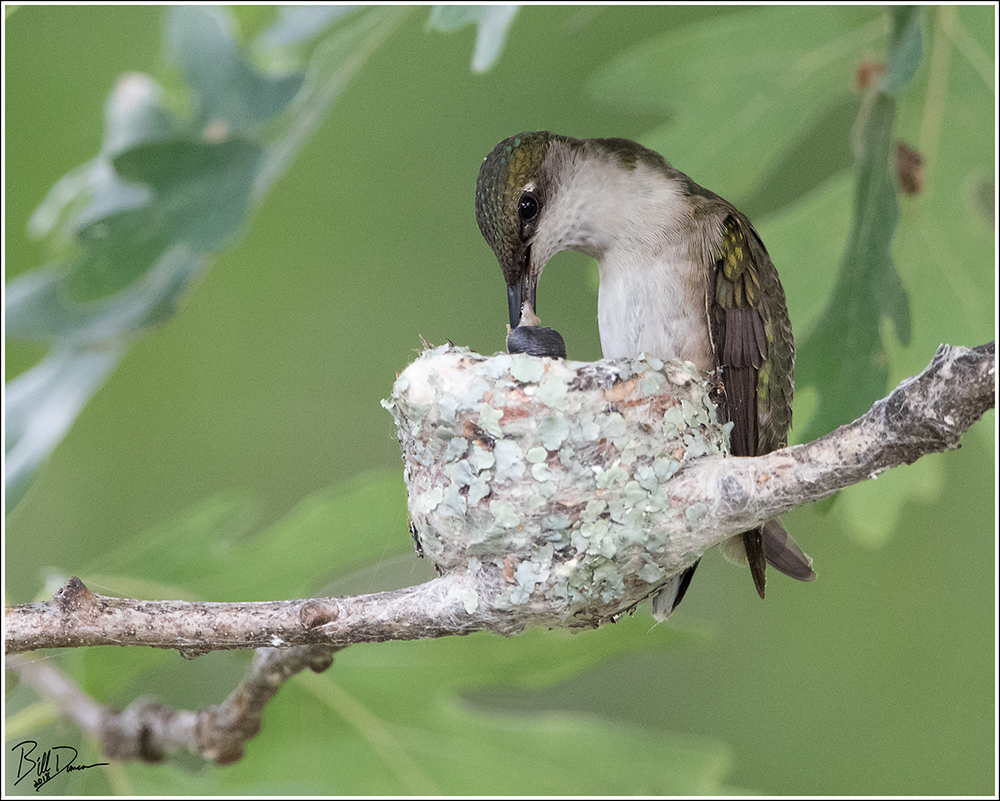
Chick rearing prior to fledging took place between July 26th and August 16th for a total of 21 days from hatching to both chicks fledging. This falls within the range of time reported to fledging (18-22 days) by Robinson et al. (1996). During the 3,846 minutes I observed the nest during this period, mom fed her chicks 124 times for an average of a little less than two times per hour. With my closeness to the nest and using sufficient optics, it was sometimes easy to see that mom was feeding a mixture of nectar (presumably a mixture of natural and artificial) and small arthropods that she collected in the bug-rich environment of our neighborhood.

Mom brooded the two chicks following hatching, staying on the nest for similar periods of time presumably to provide heat and avoid exposure to the altricial young. Mom spent significant portions of time on the nest between July 26th and August 3rd. During these eight days, I observed the nest for 1,052 minutes and recorded mom on the nest 52% of this time (543 min.). I presume, but did not document, that mom stayed on the nest most or all the nighttime hours during this period as well as during incubation.

On August 4th, her behavior changed dramatically. From this date until fledging, mom only spent a total of three minutes on the nest. It is likely that after eight days out of the egg, a physiological switch was turned on, and/or, sufficient feather development enabled the chicks to maintain their own body temperature. From this date until fledging, mom spent most of her time foraging and often was seen perched within eyeshot of the nest. She only physically visited the nest to feed or provide shelter from rain and winds.
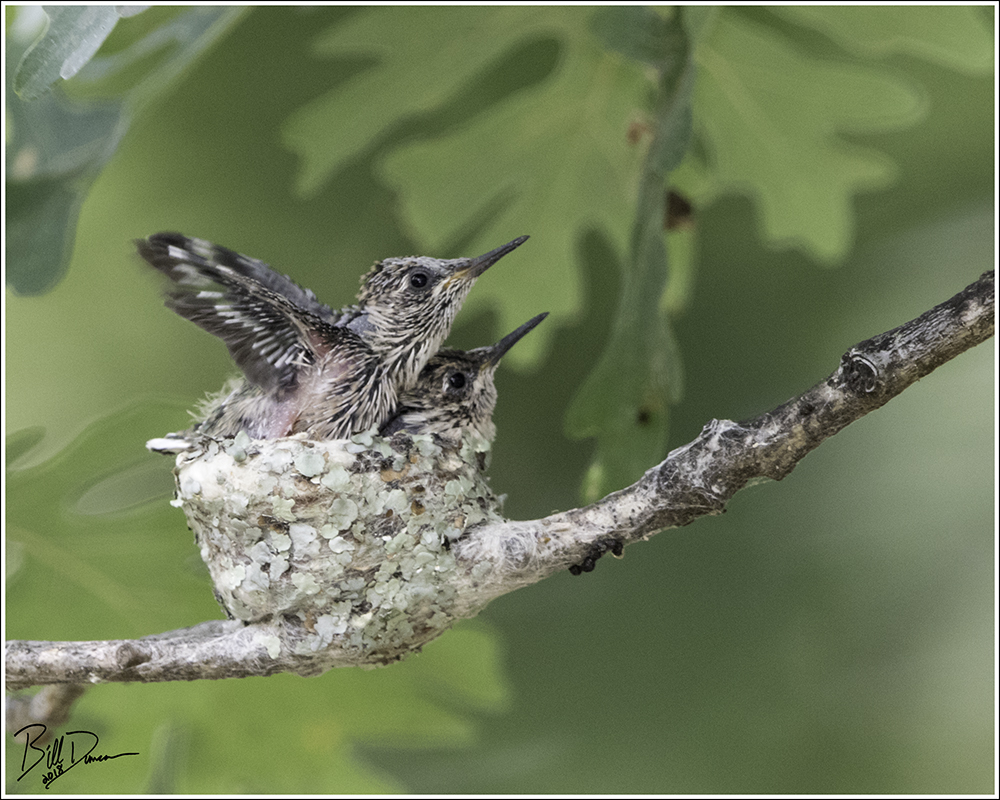
Documenting these observations gave me something to do while waiting to get my action shots of this wonderful story. I hope these words and the documenting photos adequately describe this experience and hope that you might be fortunate enough to experience a similar story.

REFERENCES
https://journeynorth.org/tm/humm/NestingPhenology.html
Robinson, T.R., R.R. Sargent, and M.B. Sargent. 1996. Ruby-throated Hummingbird, Archilochus colubris. In The Birds of North America, no. 204. Edited by A. Poole and F. Gill. The Academy of Natural Sciences, Philadelphia, and The American Ornithologists’ Union, Washington, D.C.
http://www.rubythroat.org/RTHUReproductionMain.html
Worth, C.B. 1940. Egg Volumes and Incubation Periods. The Auk 57:44–60.