"What a thousand acres of Silphiums looked like when they tickled the bellies of the buffalo is a question never again to be answered, and perhaps not even asked." -Aldo Leopold
A fresh Cypripedium parviflorum photographed in late May in St. Francois County, Missouri.
May was definitely a lady’s slippers month. My friends and I found four species within a week (three in MO, 1 in AR). Of the three species found in Missouri, two are species of conservation concern within the state – Cypripedium candidum, small white lady-slipper (S1) and C. reginae, showy lady-slipper (S2S3). I’ve shared photos of C. reginae on this blog before and a C. candidum post will be coming shortly.
I’ve posted photos of C. parviflorum (yellow lady’s slipper) here before as well but these accompanying photos were taken at a new location for me in St. Francois County. Some taxonomists, books and keys have this species split into two varieties – C.parviflorum var. pubescens, or the “greater” yellow lady’s slipper and C.parviflorum var. makasin, the “small” yellow lady’s slipper. Some authors have even split these two into specific status while even others have argued there is no basis in splitting these into varieties. From my limited experiences with these in Missouri and the taxonomic descriptions I have read, I have not seen ample evidence to suggest these should be split into varietal forms. There seems to be a lot of variation in the characteristics that are supposed to describe these two varieties and until someone shows me better proof that these should be treated as two separate forms, all I can say is that, “I’m from Missouri” and I will not be including these as two in my “master list” of the Missouri orchids.
If you are knowledgeable in this area and wish to argue, by all means, please let me know.
I shared images of this orchid last year. However, with an opportunity to visit one of its special homes this past weekend with a couple of friends, I couldn’t pass up the chance to see them again. I’ll be sharing photos of new orchids soon.
Spiranthes ovalis var. erostellata (oval ladies ‘-tresses)
Spiranthesovalis var. erostellata can be very difficult to find. Usually growing in groups of ones and twos, it is a small plant that prefers shadier locations that get dappled sunlight. I want to thank John Oliver for all his assistance getting me on this and a number of other Spiranthes species this year.
This species of ladies’-tresses is known for its graceful and diminutive flowers. Casey and I found only a couple of plants, each with flowers rather less developed than hoped for. I’m not sure if we were a day or two early, or if this might be all to expect from this population. We found these plants alongside trails at Babler State Park in mid-September.
Spiranthes ovalis var. erostellata (oval ladies ‘-tresses) The flowering stem can be seen here at the same time as its basal leaf.
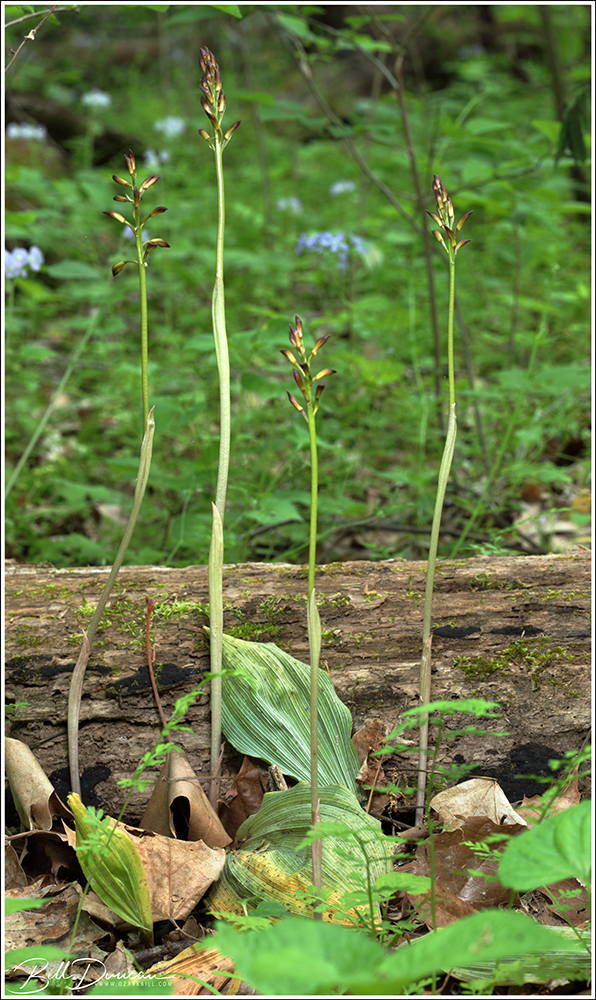
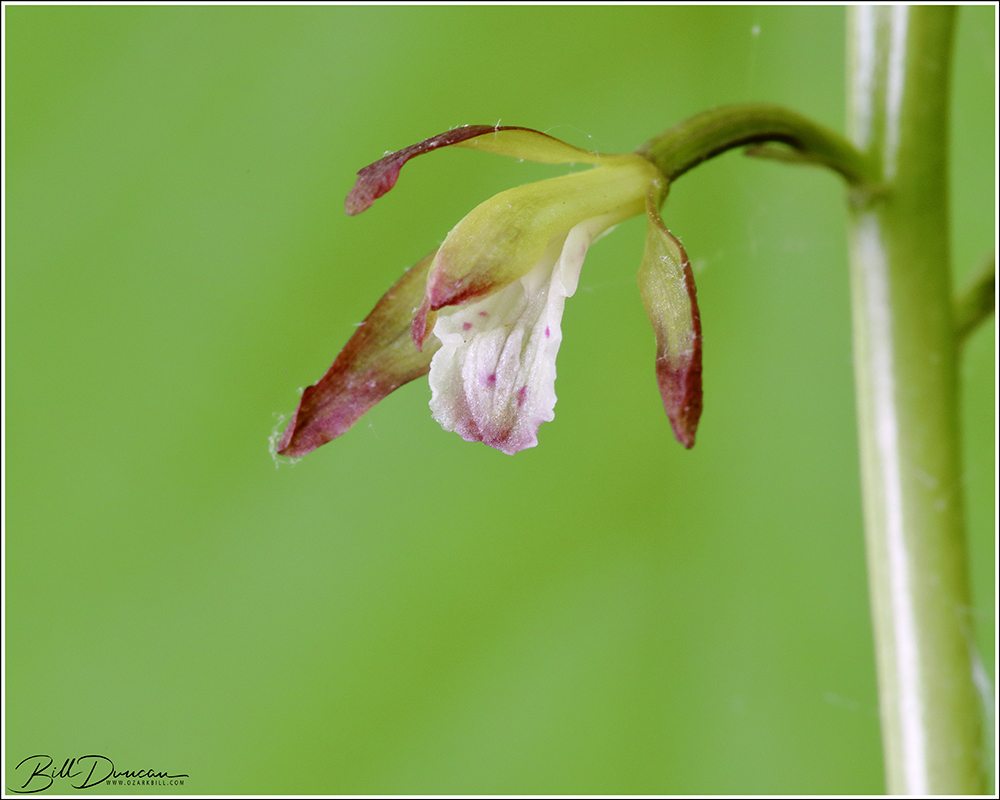
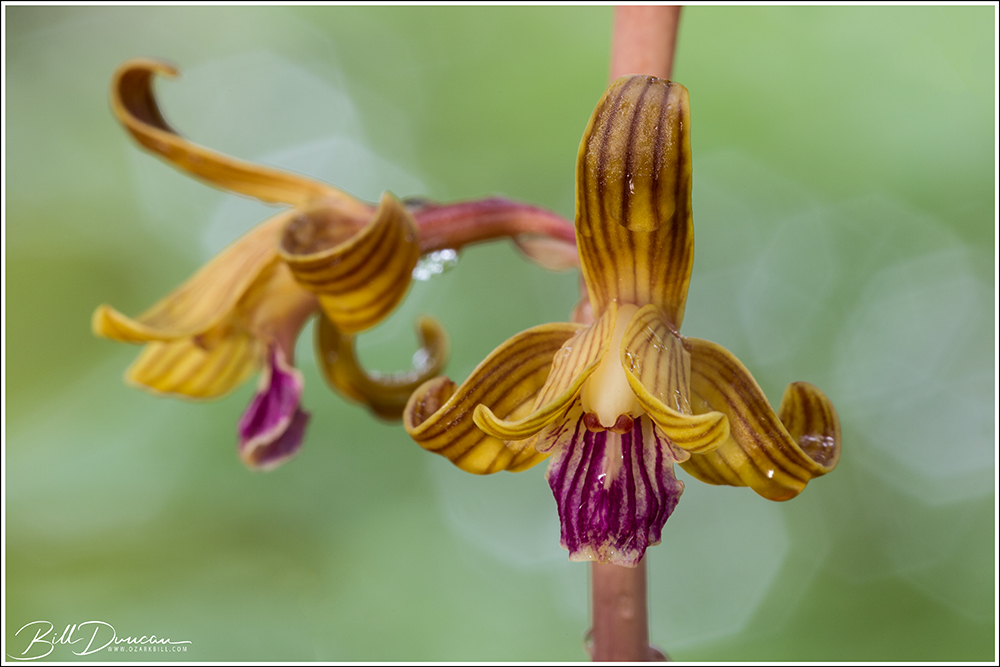
A rare open flower of Corallorhiza odontorhiza (autumn coralroot). Most plants of this species produce cleistogamous flowers that do not open, thus facilitating self-pollination.
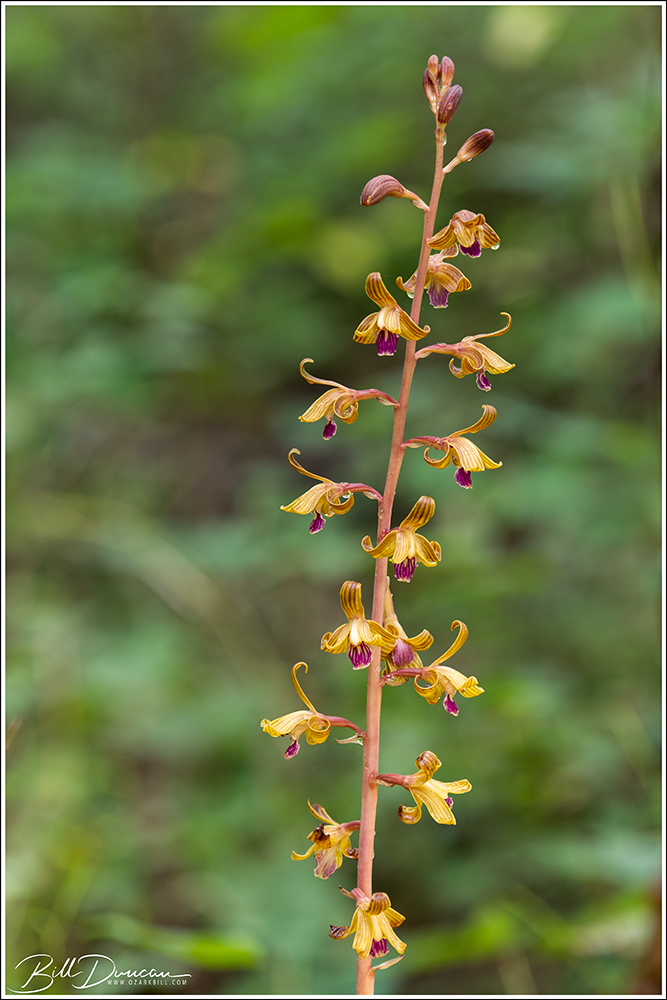
Casey and I found three separate populations of Corallorhiza odontorhiza in early to mid September this year, each population consisting of just a few bunches of plants. Most plants of this species found in Missouri are cleistogamous, containing flowers that never open and thus forcing the plant to self-pollinate. This might account for the rather dull colors and patterns on flowers of this species when compared to its vernal-blooming relative, C. wisteriana. Of the three locations, we found only one bunch of plants, located in St. Louis County, that contained open (chasmogamous) flowers and these were slightly more showy than I expected them to be.
Chasmogamous flowers of Corallorhiza odontorhiza with obvious swollen ovaries.
Like C. wisteriana, this species is myco-heterotrophic, parasitizing mycorrhizal fungi to obtain carbon and other necessary nutrients. Consequently, this species never produces leaves. Both Corallorhiza species are found scattered throughout Missouri and can be found in a variety of habitats, but seem to prefer open woodlands on xeric to mesic soils.
Corallorhiza odontorhiza. These are cleistogamous flowering stems that Casey and I monitored from just after emergence. The flowers never opened and ovaries began to swell prior to the flowering stems reaching their full height.
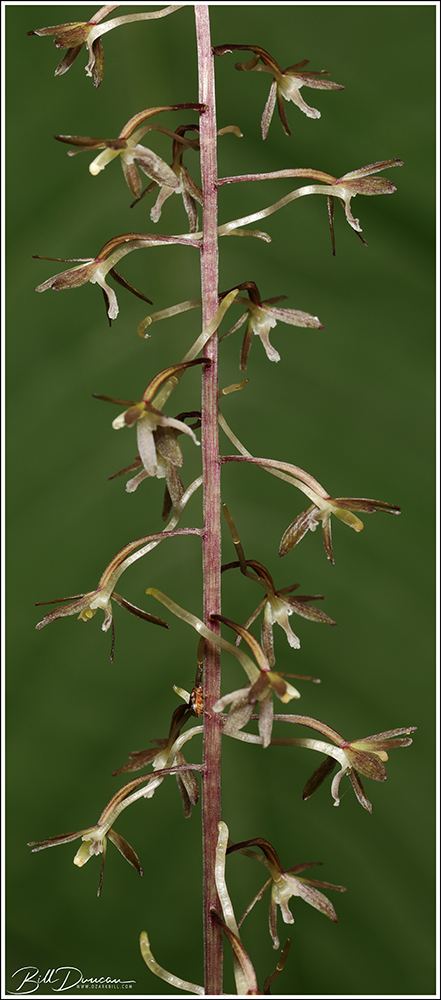
Tipularia discolor, the cranefly orchid so-called due to the appearance of the flowers to a hovering group of crane flies.
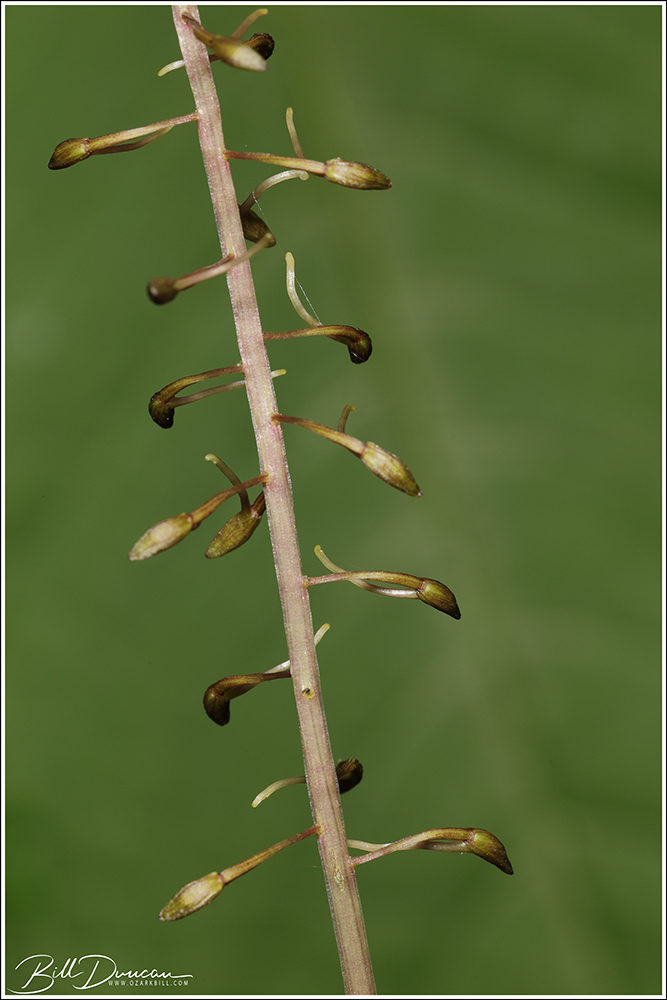
Tipulariadiscolor, or the ‘cranefly orchid,’ was first collected in Missouri in 1988 and new discoveries across the Midwest in recent decades suggest it is actively expanding its range. Similar to the puttyroot orchid (Aplectrum hyemale), this orchid blooms in the summer without the presence of any leaves. Leaves emerge in autumn and are usually completely withered by May. Both the common and genus names come from the apparent resemblance of the open flowers to that of crane flies in the genus Tipula. Moths in the family Noctuidae are the primary pollinators and use their proboscises to collect nectar from the long nectar spurs of the flowers.
This is the only species in the genus to be found in the Americas. Casey and I found these plants in Stoddard County on August 1st of this year.
Tipularia discolor blooms in tight bud. The nectar spurs are easy to discern at this stage of development.
Platanthera clavellata (club-spur orchid), Stoddard County, MO.
The habitat this featured orchid was found was quite interesting – a wet, fen-like area with many pea-gravel rivulets to walk down. All this was set under a thick overstory that allowed little light on the cloudy day Casey and I visited. Often forced to hunch as we searched for other plants, lighting for photography was challenging, but we got what we came for.
As you can see below, this is a dainty and sweet orchid that has a large primary leaf and a secondary, bract-like leaf.
Platanthera clavellata (club-spur orchid), Stoddard County, MO.
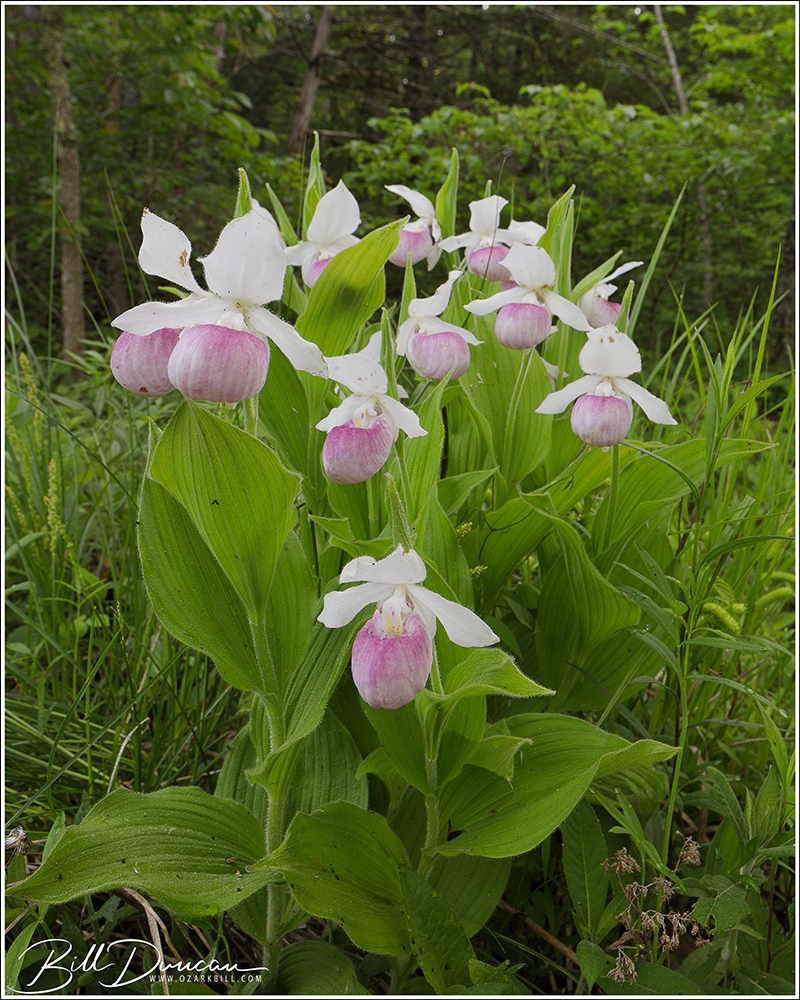
I was thrilled to be able to photograph this stunner of an orchid this past spring. Thanks to Casey Galvin who turned me on to this tiny population in Shannon County, MO.
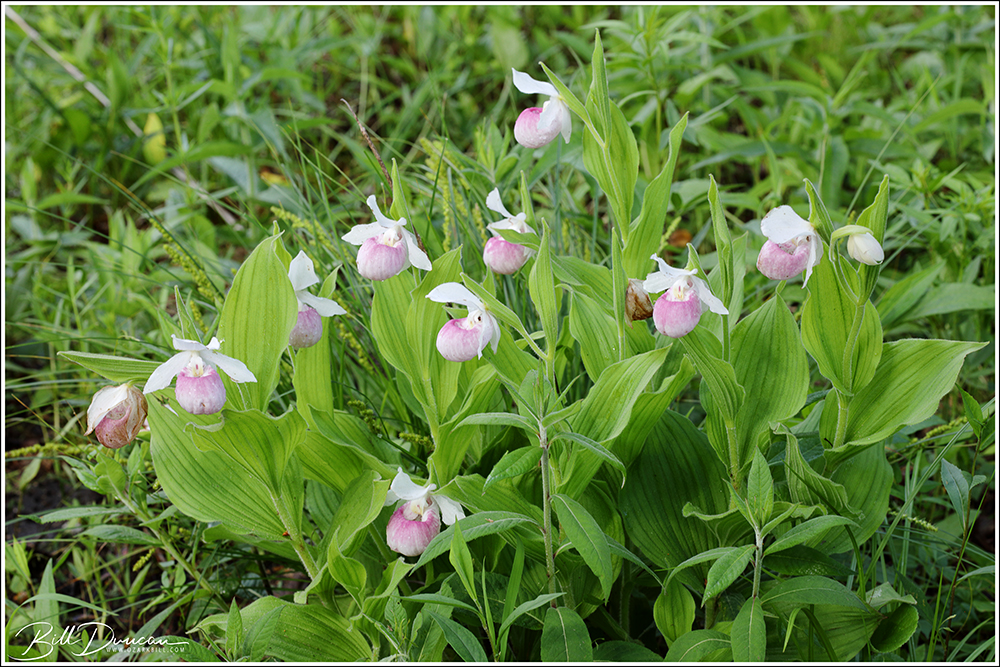
A small cluster of Cypripedium reginae in bloom.
The Showy Lady’s Slipper is currently ranked as S2/S3 in Missouri, meaning this species is imperiled/vulnerable. We carefully tread around these guys and hide their specific locations as this is a species that may still be poached for horticulture purposes.
Aplectrum hymale is a relatively common orchid in Missouri, preferring rich mesic forests, particularly along stream and river banks. It is known by two common names that are both widely used. “Adam and Eve Orchid” is used due to the presence of twin underground corms. The leaf of the current year is connected to the youngest corm (Eve), and is an offshoot of the previous corm (Adam).
Aplectrum hymale (Adam & Eve orchid)
The other common name, “puttyroot orchid”, is given to this species due to the putty-like consistency of the corms that were sometimes eaten, most likely for medicinal purposes.
Aplectrum hymale in early stages of flower development.
A. hymale is unusual in that it exhibits an alternate vegetative cycle. Leaves of this plant (one leaf per plant) develop in the autumn and overwinter. The leaves begin to senesce in the spring and have almost completely withered by the time the plants are in full bloom, or shortly after. In the preceding photo you can see the leaves at the time of flower shoot formation.
Aplectrum hymale with senescing leaves and flowers just shy of blooming
These plants typically bloom in early to mid-May in Missouri. By the time June rolls around the leaves will most likely be completely deteriorated and the only sign of the plant over the summer is the flowering stem (raceme) and developing fruit capsules.
This post is a modified article that was originally published in the Webster Groves Nature Study Society’s journal, Nature Notes (January, 2020, Vol. 92, No. 1).
Finding the orchid, Triphora trianthophora (three-bird orchid, nodding pogonia), during open bloom can be somewhat of a chore, particularly among us weekend warriors. Casey Galvin and I were both intrigued about the possibility of getting photographs of this diminutive and gorgeous orchid since learning of their discovery at Babler State Park by the WGNSS Botany Group led by Nels Holmberg, John Oliver and others in 2018. The following descriptions and photographs are anecdotal and were not collected using rigorous scientific methodology.
Phenology
There are several reasons it is challenging to find this extremely ephemeral plant in bloom. First, being partially saprophytic, the plants exhibit periodic dormancy and may not send up above-ground shoots every year, persisting instead as subterranean tubers for extended periods (Homoya, 1992). Even when they do produce stems and leaves, there is no guarantee the plants will flower in a given year. Additionally, when they do flower, any one bloom is open for only a few hours during a single day.
Exhibiting a phenomenon known as thermoperiodicity, a group or population of these plants are synchronized to open mature buds on the same day. This first wave of synchronous blooming is reportedly induced by a drop in minimum daily temperature of at least three degrees over two or more consecutive days. Following another 48-hour period, all mature buds within the population will then open on the same day (Luer 1975). Being skeptically minded, this was something I wanted to observe for myself.
Beginning in late July, Casey and I began monitoring the easier to get to population at Babler State Park. The first wave of synchronous flowering occurred on August 3rd. We unfortunately missed this but know the exact date because of visits on days immediately before and after this date. Looking into historical temperatures collected from the closest publicly-available weather station (Babler Park Estates – KMOBALLW37) revealed the initial blooming date fit the required temperature pattern perfectly (see attached figure). I continued monitoring and collecting flowering data and observed two more large flushes of synchronized blooms along with three days interspersed where only 3–10 stems/plants opened flowers. For subsequent synchronized days, I did not observe a coinciding drop in temperature as described above. I assume that the trigger for the initial bloom works to synchronize the population and subsequent larger bloom days are consequently synchronized due to all plants ‘running ahead’ at the same rate. However, there could potentially be some other unknown environmental triggers that are playing a hand here.
The first synchronous bloom occurred on August 3rd, approximately 48 hours following a four-day drop of approximately seven degrees in minimum daily temperature. Data collected from https://www.wunderground.com/ accessed on 12/06/2019. No longer “nodding”. Triphora trianthophora flowers open towards the sky en masse on just the right day. Photo by Bill Duncan.Arrive a day too late and this will be what you find. Photo by Casey Galvin.Much like the flowers, these developing pendulous seed capsules will become erect at maturity. Photo by Bill Duncan.
Pollination
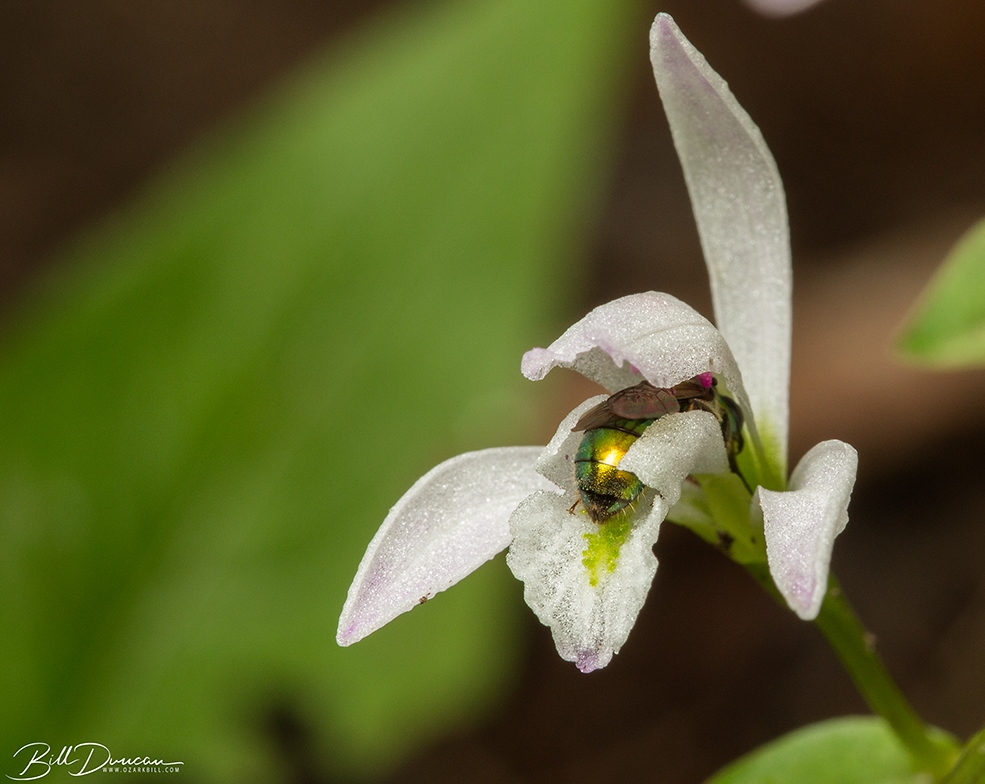
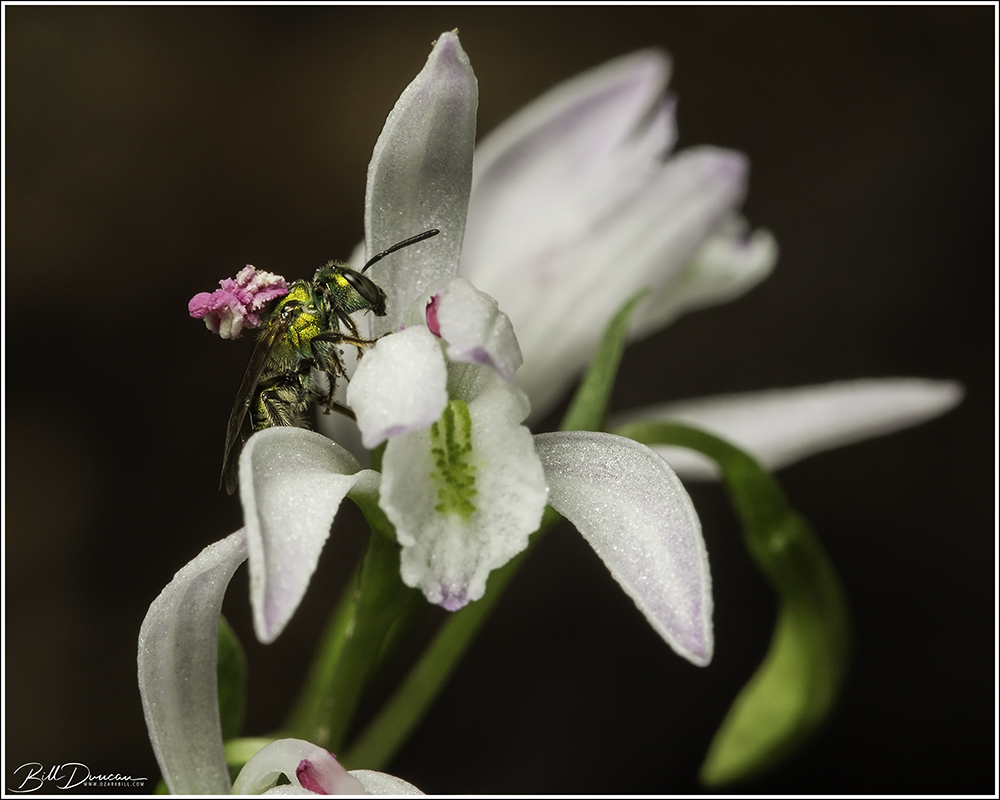
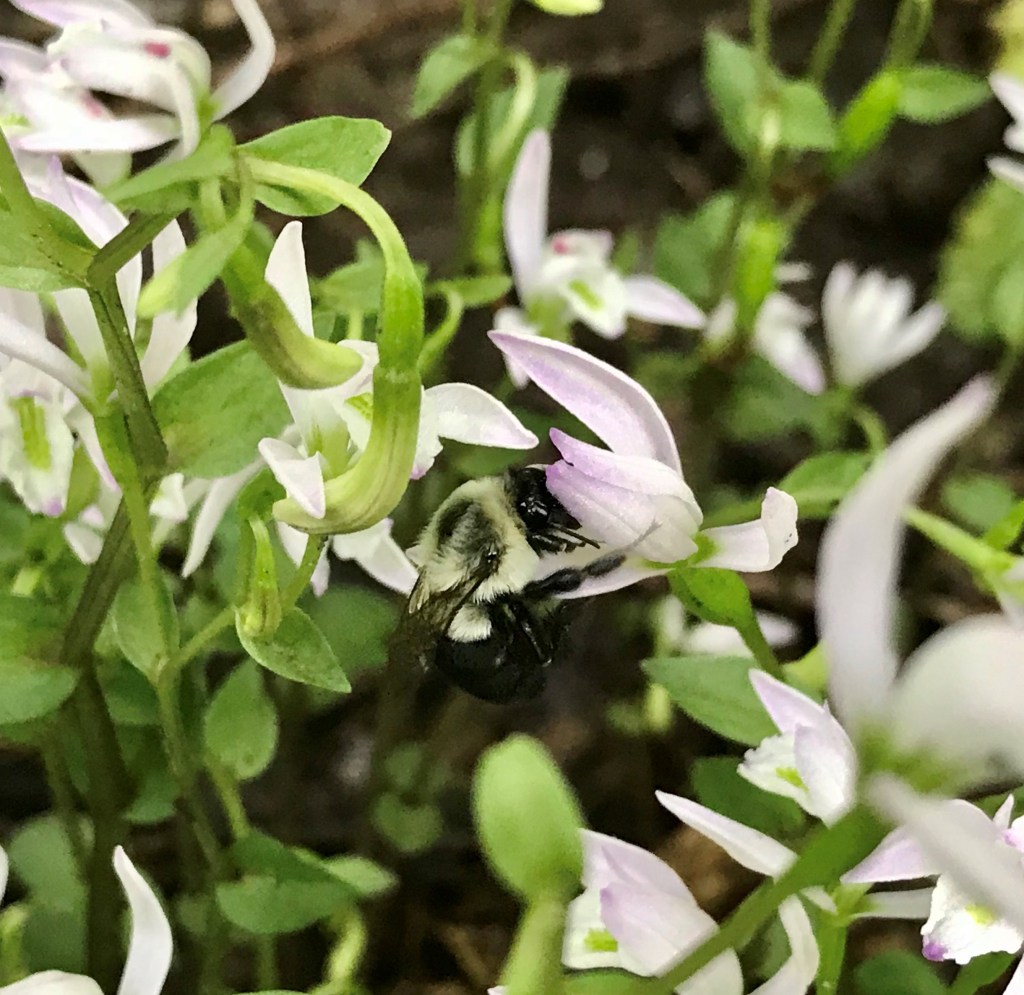
Halictid bees have been reported to be the primary pollinator for this species (Luer 1975). I had this in mind as I observed and began taking photographs while visiting on a large bloom day but doubted I would be fortunate enough to observe or photograph a potential pollinator visit. However, patience allowed me to do just that. I first observed visits by small flies and Bombus impatiens. Although Williams (1994) reported that Bombus have acted as pollinators of this species, I did not observe any of these visitors with attached pollinia during the 10-15 flowers I watched them visit. Eventually, I observed three different Halictid bees as they visited multiple flowers and observed these were heavily attached with pollinia. As described by Williams (1994), seed capsule production (successful pollination) is a relatively rare event in this species. Nevertheless, this was a treat to observe and photograph.
Nectar thieving flies and developing buds can be seen along with an open flower. Photo by Casey Galvin.Like a hand to a glove… This halictid bee (Augochlora pura) does not yet realize the burden it will be asked to take in exchange for sweet nectar. Photo by Bill Duncan.Removing itself along with attached pollinium requires some gymnastic effort. Photo by Bill Duncan.Removing itself along with attached pollinium requires some gymnastic effort. Photo by Bill Duncan.If you had to make this bee anymore attractive? Augochlora pura with attached colorful Triphora trianthophora pollinium. Photo by Bill Duncan.Bees in the genus Bombus have been described as active pollinators of Triphora trianthophora. I watched several B. impatiens each visit multiple flowers and observed no attached pollinia. Photo by Bill Duncan.
REFERENCES
Homoya, M.A. Orchids of Indiana. Indiana University Press, Indianapolis, Indiana, USA.
Luer, C.A. 1975. The Native Orchids of the United States and Canada. New York Botanical Garden, Bronx, New York, USA.
Williams, S.A. 1994. Observations on reproduction in Triphora trianthophora. Rhodora 96:30-43.
This single stalk that bloomed in early August was found by the WGNSS Botany Group in Jefferson County, MO. Many thanks to John Oliver, Scott George and others who helped get me on this plant during the bloom.













 A Thousand Acres of Silphiums