Comet background
Hopefully you were aware that the astronomy gods gifted us with another incredible wonder in 2024–a bright comet that was naked-eye visible for several weeks. To date, this has been the brightest comet of the century.
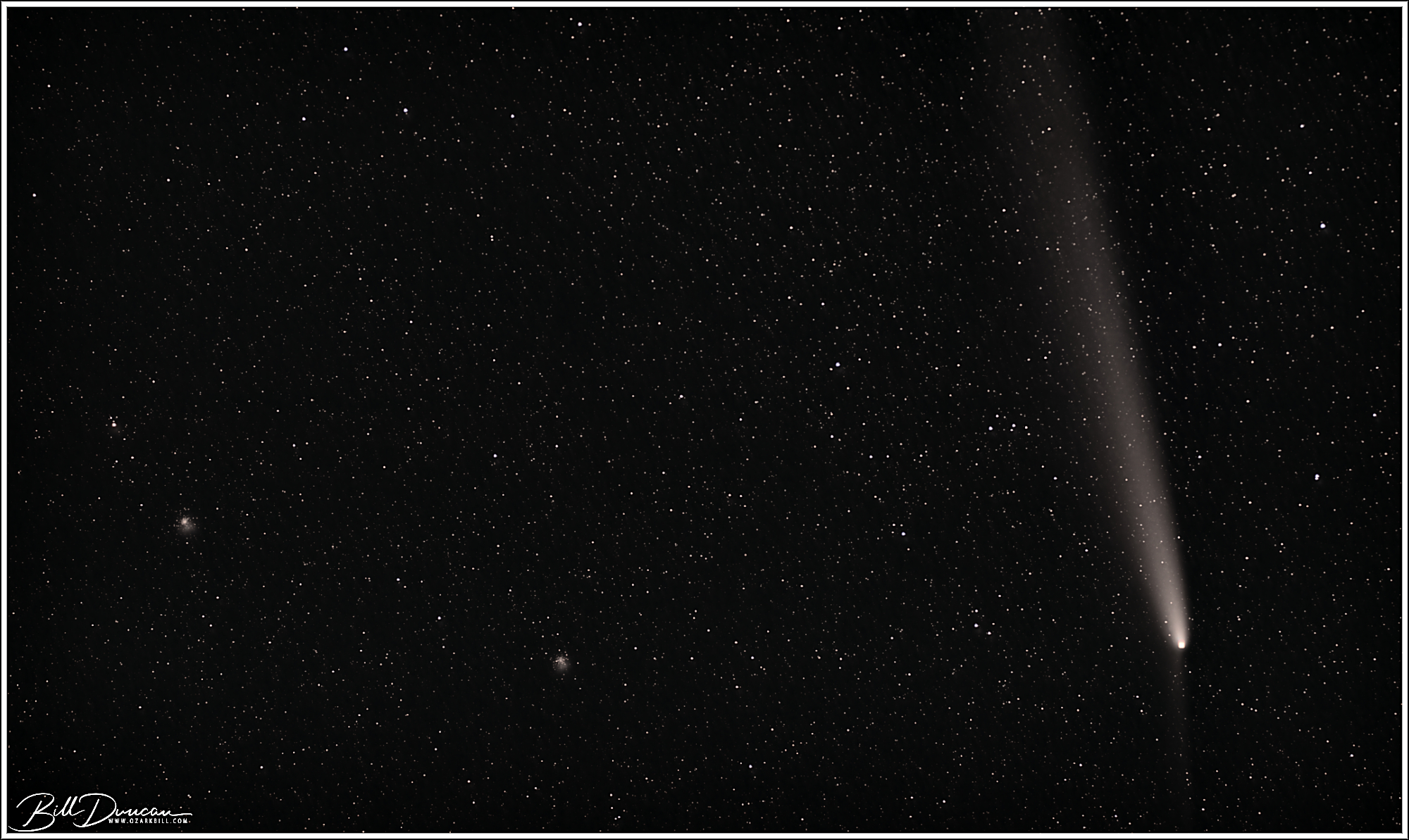
The long-period comet, named C/2023 A3 (Tsuchinshan-ATLAS) (from hereon referred to as Comet A3), last visited this close to earth around 80,000 years ago, during a period of heavy glaciation in North America and when Homo sapiens were first beginning their epic migration from Africa. First discovered in January 2023, Comet A3 made its closest approach to earth on October 12th, 2024, at a distance of 0.275 AU, or 41.1 million km, where it reached a magnitude of -4.9. During the month of October, astronomy enthusiasts and astrophotographers found themselves at their favorite dark sky sites to observe the comet. Above the western horizon, it was naked-eye visible for short periods of time after sunset. Following its closest orbital intersection with earth, it then began to grow fainter as it climbed the sky night after night.
Perihelion, the point in which the comet was closest to the sun, occurred on September 27th, 2024 at a distance of 0.391 AU. Current projections are that, due to Comet A3’s hyperbolic trajectory, it will likely be ejected from the solar system after this pass.
Being an amateur astrophotographer and a comet enthusiast, I made a few attempts at photographing Comet A3 during its relatively close pass to earth. We were fortunate in having mostly clear skies during this period of time but unfortunate in that this period coincided with the a full moon, providing plenty of unwelcome light that hindered clear observation and photography of the comet.
Photography details
Dates and location
Comet A3 was photographed on 15-October (composition 1) and 20-October (composition 2). Data for both images were collected at Danville Conservation Area in Montgomery County, MO.
Equipment
For these images I used a Canon 7D mkii camera connected to the specific lenses described below. In order to compensate for the earth’s rotation and keep stars as pinpoint as possible, I used a Fornax LighTrack II tracking mount set on a William Optics Vixen Wedge Mount. A QHYCCD Polemaster was used to assist with obtaining polar alignment. This equipment sat on a Gitzo carbon fiber tripod. I also utilized a shutter release cable, a laser pointer to help find Polaris and sky targets, a lens warmer to prevent dew and frost on lens, and a dummy battery connected to an external power source to power the camera. A lithium battery generator was used to provide power to the camera, dew heater and the laptop computer.
Composition 1 was taken with an Askar ACL200 200mm f/4 lens (260mm focal length equivalent). Composition 2 was taken with a Canon 90mm f/2.8 macro tilt-shift lens (144mm focal length equivalent).
Imaging Details
Composition 1:
Sub-exposures taken (ISO 640, f/4, 25 second exposure): 73
Sub-exposures after cull due to tracker error, wind, bumps, clouds, etc.: 73
Used best 90% of remaining sub-exposures based on scores from stacking software in stack for a total of 66 subs (27 min. 30 sec.) used for integration
Calibration frames: none
Composition 2:
Sub-exposures taken (ISO 1600, f/2.8, 30 second exposure): 80
Sub-exposures after cull due to tracker error, wind, bumps, clouds, etc.: 79
Used best 90% of remaining sub-exposures based on scores from stacking software in stack for a total of 72 subs (36 min.) used for integration
Calibration frames: none
Processing
RAW files stacked in Deep Sky Stacker using comet stacking mode, GraXpert for gradient removal, Affinity Photo 2 for stretching and other cosmetic adjustments.

 A Thousand Acres of Silphiums
You hit this one out of the park, Bill.
Bill, I like the write and how these images turned out. Fantastic work.