Allegheny Spurge (Pachysandra procumbens)

Pachysandra procumbens (Family Buxaceae), commonly known as Allegheny spurge or mountain pachysandra, is a species of flowering plant native to the southeastern United States. Many thanks to Pete, who turned us on to this small group of plants that was found in Forest Park in St. Louis City. Not native to this region, this was obviously planted there at some point.

A newly emerging inflorescence of Pachysandra procumbens.

Pachysandra procumbens has a delicate and unique appearance. Its leaves are larger and serrated, with a distinct purple-bronze coloration in the spring that matures to a glossy green throughout the growing season.
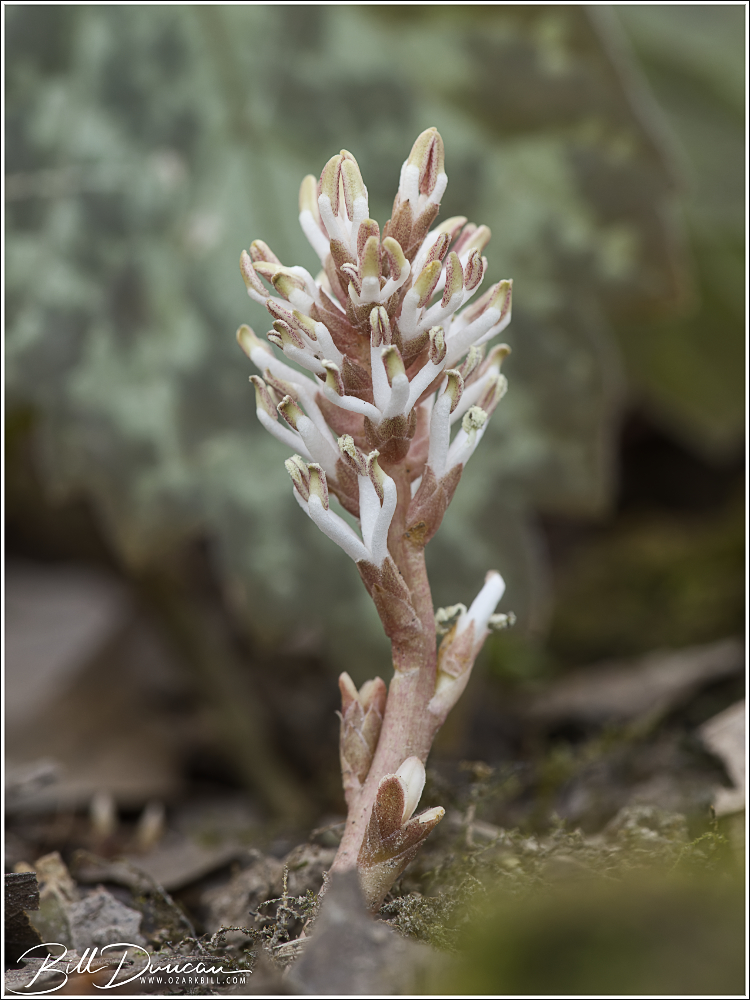
A prime inflorescence of Pachysandra procumbens against a backdrop of its leaves.

In the spring, Pachysandra procumbens produces small, white, bottlebrush-like flowers that are highly attractive to pollinators such as bees and butterflies. These flowers give way to small, berry-like fruits that add further interest. This plant prefers moist, well-drained soil and is partial to full shade. The inflorescence are small, but definitely worth a close look.

From the Garden – Manfreda virginica (False Aloe)

During the first couple of seasons in our front-yard wildflower garden, the deer took a liking to this Manfreda virginica (F. Asparagaceae). This prompted me to start spraying its foliage with deer deterrent last year. This had the desired effect and I was happy to see and photograph the blooms of this plant, which are primarily pollinated by large moths such as the sphinx moths. The blooms will also be visited by Ruby-throated Hummingbirds.

Inflorescence of Manfreda virginica.

This species is typically found in dry, rocky and alkali soils, so I was not sure how it would like the clay pan in our yard. I’m happy to say that it is putting on new leaves this spring. I’ve lost a few plants in the garden during the past winter and I’m glad to see this one coming back.

Closeup of individual bloom of Manfreda virginica.

More Wild Turkey

I’ve had a little more luck recently with the Wild Turkeys in the neighborhood woods patch. During my last couple of session, the hens in this group have roosted immediately above the patch of ground I cleared of bush honeysuckle. Previously, they roosted in trees a quarter mile up the hollow. This is problematic because I haven’t been able to set up quietly enough not to flush them. I was able to call in a few of the Toms, although this is hit or miss. They love hanging out and strutting in the backyards of the streets that border the hollow. We call back and forth and they are obviously trying to get me to come to them. Finally, on this occasion, they couldn’t stand it so came in to find the hen (me) that was sounding so pretty. They did not come all the way into my prime shooting lane, but I made the best I could of it.

A couple of Toms looking for love.

I have read and am beginning to learn how keen their sense really are. I need to be careful with calling as they come in. When they enter the area, they tend to ignore the decoys altogether and instead look directly in my direction. They know precisely where the calls emanate. Turkey hunters will often call at the location they wish the birds to appear and when they hear the Toms coming, they move into their shooting position. This is kind of hard to do when using a bag blind and where the birds can see a long distance. The small geography I am working in has some limitations.

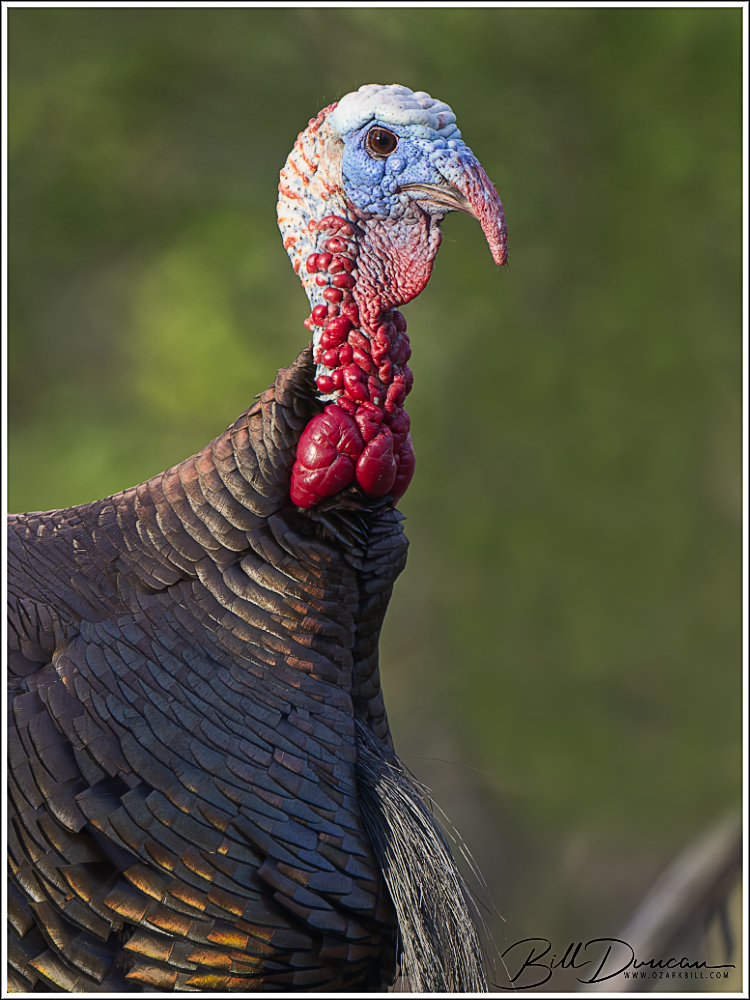
With the county’s colors boldly displayed, I think the Wild Turkey would have been a great national bird.
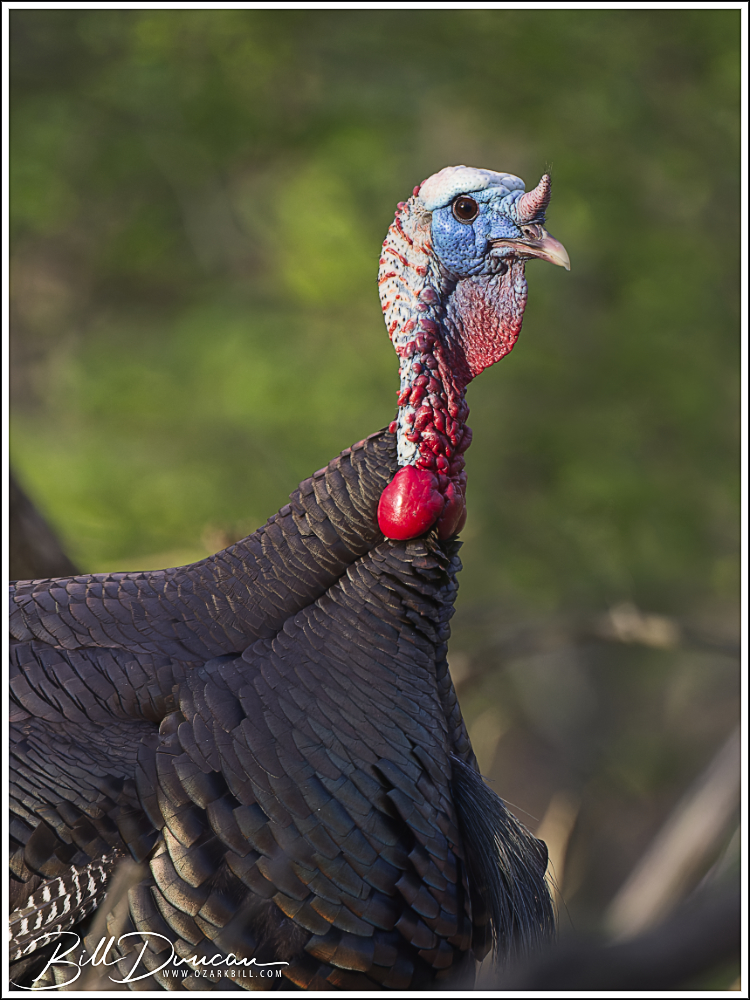
The snood (the dangling appendage that is overhanging this bird’s beak) is quite interesting. Until watching these guys recently, I was not aware of what control they had over it. When excited and wanting to display, they fill it with blood and it can turn a bright red.
When the birds are more alert and not displaying, the snood is kept erect like a horn as seen here. The transition takes only seconds.