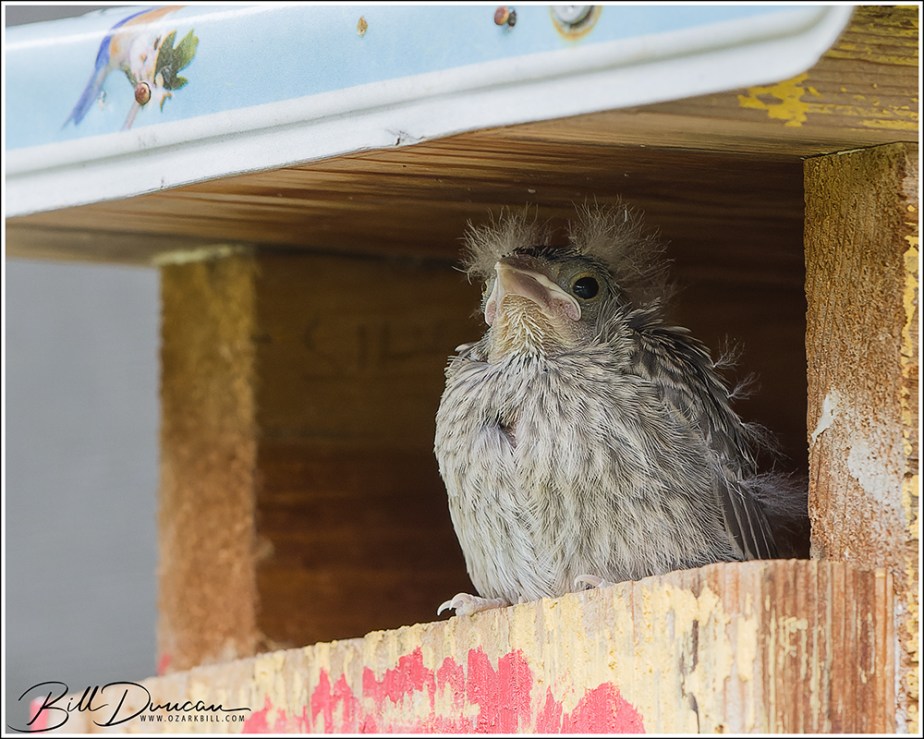
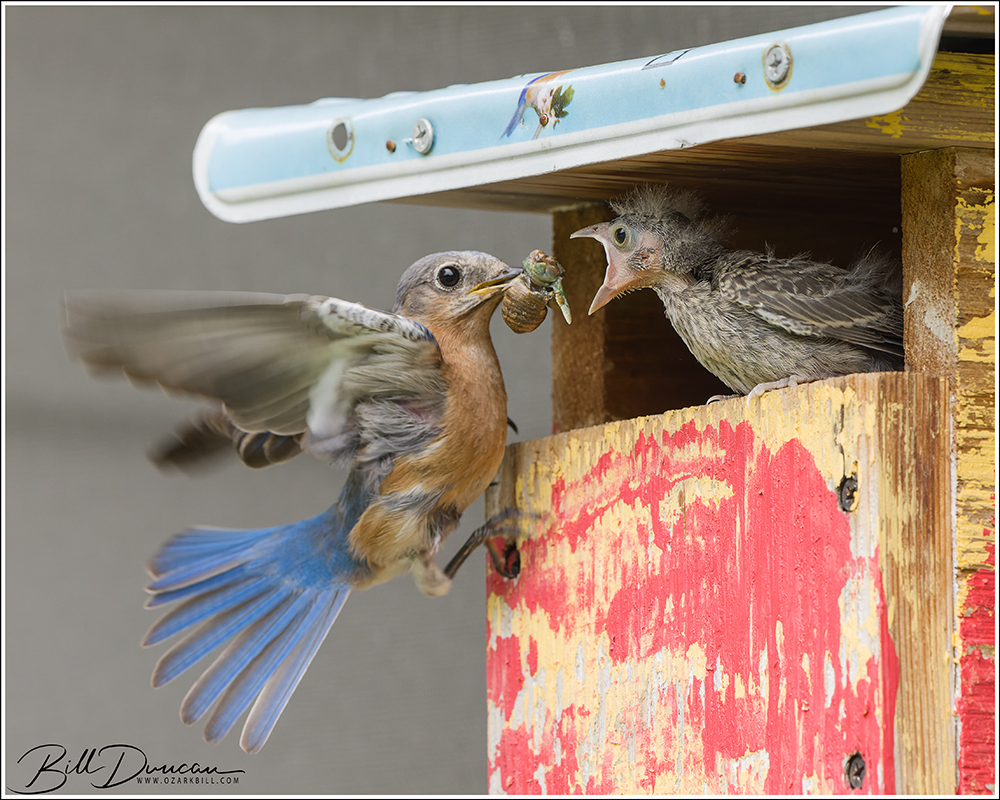
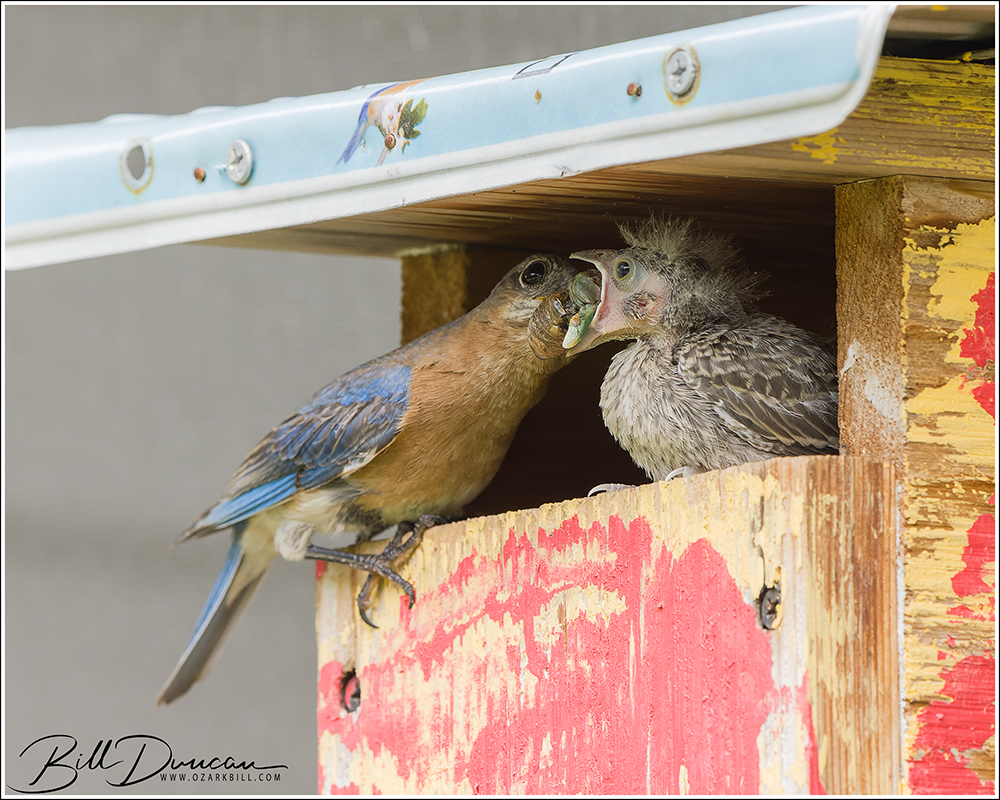
The Bluebirds had another great year. I was much to busy to do the typical monitoring I normally like to do, but they did have three clutches this year with a total of 12 fledged birds (3, 5 and 4 eggs in 1st, 2nd and 3rd nests). Immediately after putting up the nest box in early March, a pair took control and made their first nest. After completing this, I cleaned the box and began a daily routine of removing nesting material from the non stop Eurasian Tree Sparrows. I removed nests 1-2 times per day, often removing up to eight inches of nest and sometimes with an egg or two. They were relentless. This went on for at least six weeks. I was wondering why the Bluebirds didn’t come in and take over so I could have a break when I finally decided to have a look in the Wren box, which they did use in a previous year. Yep, inside I found five young chicks (nest 2). I took advantage of this and was able to take a few photographs that I am sharing here. They then went back to the Bluebird box for their third nest. These chicks fledged a couple weeks ago.
I knew the ETS would be back to this box in a heartbeat like they do every late summer and fall, so I removed the Bluebird box for the season. I think three clutches for the season is great, although it wouldn’t have surprised me to see that the Bluebird pair might try for a forth. But, I think it might be better not to push the female too far and let her build some fat for the winter.


 A Thousand Acres of Silphiums
That nestling really looks a lot like a young BHCO…. My Bluebirds fledged five in the first clutch and five in the second. They had laid four eggs in the third round, but the Eurasian Tree Sparrows cracked the shells and dragged the eggs out of the box. Argh!!!!
Thanks Diane. Yes, I agree – I was also thinking this was likely a BHCO chick, but the two species look so similar at this stage – I even saw hints of blue in its feathers. So I hoped. But, another point here – it was far more advanced than the other four chicks who were still mostly naked at the same date. This probably confirms that this is a BHCO.
An observation here – I had to chase away a neighbor’s cat several times a few days after these shots were taken. Shortly after, this chick disappeared. I thought it likely that it had fledged, but I never saw it again – never begging from the parents. I think it likely that the cat got it. The Bluebirds had no problems fledging the other four chicks that were presumably their own. This is why I think it a good idea to provide mealworms. I think it unlikely that the parents could nearly fully raise a cowbird as well as four of their own chicks without the additional provisions, at least in the suburbs.
Sorry to hear that about your nest. And yet, so many of our friends and colleagues still hold to the idea that this isn’t an invasive species…